

- BEE Star Label Certification rates electrical appliances from 1 to 5 stars based on energy efficiency, under the Energy Conservation Act, 2001.
- It is mandatory for products such as air conditioners, refrigerators, ceiling fans, LED lamps, televisions, geysers, deep freezers and distribution transformers.
- Registration fees generally range from ₹5,000 to ₹2,00,000 depending on product category, applicant type and company turnover; validity typically runs 1 to 3 years.
- This guide covers eligibility, documents, the step-by-step application process, fees, renewal timelines and the January 2026 mandatory list expansion.
Introduction
BEE Star Label Certification is issued by India's Bureau of Energy Efficiency (BEE), under the Ministry of Power, to rate the energy efficiency of appliances on a 1-to-5-star scale. Manufacturers and importers must get their product tested at a NABL-accredited or BEE-approved lab, register the brand and each model on the official BEE portal, and pay the applicable fee before affixing the star label.
As of January 1, 2026, the mandatory list has expanded to cover refrigerators, televisions, LPG stoves, chillers, cooling towers, deep freezers, distribution transformers and grid-connected solar inverters, in addition to previously mandated products like ACs, fans and LED lamps.
What Is BEE Star Label Certification?
BEE Star Label Certification is an official energy-efficiency rating issued by the Bureau of Energy Efficiency (BEE), a statutory body functioning under India's Ministry of Power, established under the Energy Conservation Act, 2001. The certification rates household and industrial appliances on a scale of 1 to 5 stars, where 5 stars indicates the highest energy efficiency and the lowest running cost over the product's lifetime.
You have likely seen the label already — a small yellow-and-red sticker with a row of stars on air conditioners, refrigerators, ceiling fans and washing machines sold in Indian stores. That sticker is the outcome of a structured testing, registration and compliance process run through BEE's Standards & Labelling (S&L) Programme, launched in 2006 to help buyers compare energy consumption before they purchase.
The programme runs on two tracks: mandatory labelling, where the star label is a legal requirement to sell the product in India, and voluntary labelling, where manufacturers opt in to build consumer trust and market differentiation.
Why BEE Star Label Certification Matters
Energy efficiency certification isn't just a compliance formality — it shapes buying decisions, brand trust and, at a national level, electricity demand. Here's why it matters to different stakeholders:
- For consumers: the star rating makes it possible to compare running costs across brands in seconds, without needing technical knowledge of watts or kilowatt-hours.
- For manufacturers and importers: a higher star rating is now a genuine sales driver, not just a regulatory checkbox — retailers increasingly give shelf priority to 4- and 5-star products.
- For the environment and the grid: BEE-rated appliances collectively reduce national electricity demand, which supports India's broader energy conservation and emission-reduction goals.
- For institutional and government buyers: many public procurement tenders and green-building certifications now reference minimum BEE star ratings as an eligibility condition.
Legal Framework Governing BEE Certification
BEE Star Label Certification operates under the Energy Conservation Act, 2001, which empowers the Bureau of Energy Efficiency to notify Minimum Energy Performance Standards (MEPS) for specified appliances and to make star labelling compulsory for them. Once a product category is notified as mandatory, manufacturing, importing or selling that product in India without a valid, correctly affixed BEE label is a legal violation — not merely a missed marketing opportunity.
Applications, test report uploads, model registration and renewals are all processed online through BEE's dedicated portals — beestarlabel.com and labeling.beeindia.gov.in — which BEE updates periodically as product schedules and standards are revised.
Mandatory vs Voluntary Star Labelling: Which Products Need What
Not every appliance needs the same treatment. BEE classifies product categories as either mandatory (legally compulsory) or voluntary (optional but market-favoured). The table below summarises the current position.
| Category | Examples | Status |
| Cooling & climate | Room air conditioners (fixed & variable speed), ceiling fans, chillers, cooling towers | Mandatory |
| Refrigeration | Frost-free refrigerators, direct-cool refrigerators, deep freezers | Mandatory (expanded Jan 2026) |
| Lighting | Tubular fluorescent lamps, self-ballasted LED lamps | Mandatory |
| Water heating | Stationary storage-type electric water heaters (geysers) | Mandatory |
| Home appliances | Washing machines, televisions (colour TV & UHD TV) | Mandatory (TVs expanded Jan 2026) |
| Kitchen appliances | LPG gas stoves | Mandatory (added Jan 2026) |
| Power & energy infrastructure | Distribution transformers, grid-connected solar inverters | Mandatory (added Jan 2026) |
| Others | Microwave ovens, air compressors, solar water heaters, pedestal/table/wall fans | Voluntary / category-specific |
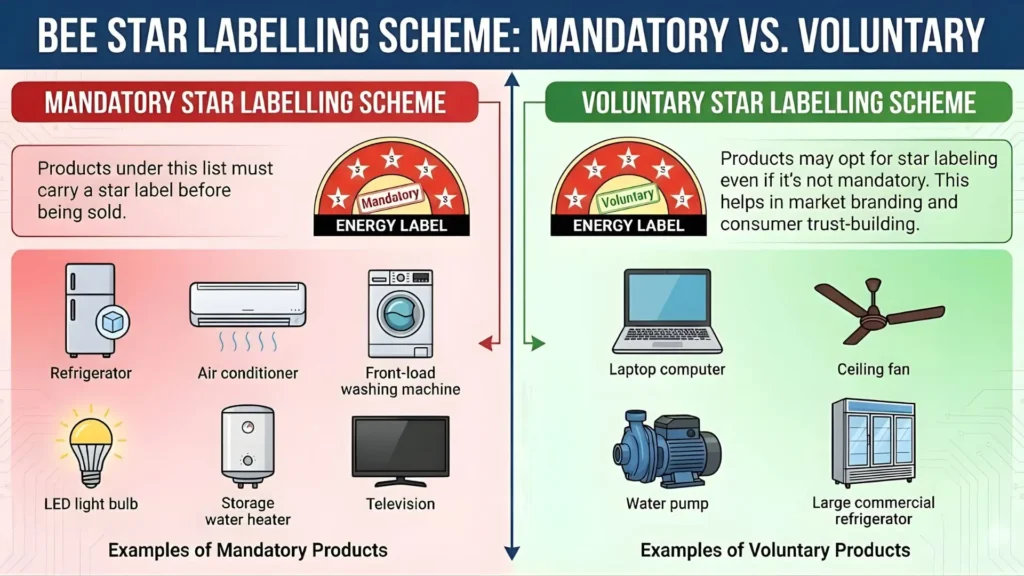
Because the mandatory list is reviewed periodically, always confirm your exact product's current status and applicable Indian Standard (IS) on the official BEE portal before starting testing — using an outdated schedule is one of the most common causes of application rejection.
BEE Star Label Certification: What's New in 2026
BEE has made several notable changes that certification applicants and existing holders need to know about this year:
- Mandatory list expanded from January 1, 2026: Star labelling is now compulsory for refrigerators, televisions, LPG gas stoves, cooling towers, chillers, deep freezers, distribution transformers and grid-connected solar inverters — categories that were previously voluntary or unregulated.
- Revised star rating tables (2026–2028 cycle): BEE has issued updated star rating tables for products including frost-free and direct-cool refrigerators, ceiling fans and electric water heaters, with the new tables valid from January 1, 2026 to December 31, 2028. Models registered under the older 2023–2025 tables need re-registration under the revised norms.
- Tighter MEPS for room air conditioners: BEE has progressively raised the minimum energy performance benchmark for room ACs, meaning older test data may no longer qualify for the same star rating.
- Supply-chain transparency push: Emerging compliance guidance asks registered manufacturers to maintain and be ready to share a verified list of authorised dealers and retailers, aimed at curbing counterfeit or misused BEE labels.
- Category-specific validity extensions: BEE has issued advisories extending validity for specific product groups, such as pedestal/table/wall fans, solar water heaters, microwave ovens and air compressors — always check the latest advisory for your category rather than assuming a blanket rule.
The practical takeaway: if your product falls into a newly mandatory category, or if your existing registration was issued under an older star rating table, you should audit your portfolio now rather than waiting for a renewal deadline to force the issue.
Who Needs BEE Star Label Certification?
BEE certification applies to three broad categories of applicants:
- Domestic manufacturers — any company manufacturing a notified appliance within India must register the brand and every individual model before it can be sold.
- Importers — any business importing a mandatory-category appliance into India must hold a valid BEE registration in its own name before the goods clear customs; the manufacturer's home-country certification does not substitute for this.
- Traders and assemblers — entities that assemble, re-brand or trade notified appliances under their own brand name are also required to register, even if they don't manufacture the core components themselves.
There is no minimum turnover or company-size threshold for eligibility — a startup, an MSME and a large enterprise all follow the same core process, though the applicable fee slab may differ by enterprise classification.
Key Benefits of BEE Star Label Certification
| Benefit | What it means for you |
| Legal market access | For mandatory categories, it is the only way to legally manufacture, import or sell the product in India. |
| Consumer trust | A visible star rating reassures buyers about running costs and product quality before purchase. |
| Competitive shelf positioning | Retailers and e-commerce platforms often prioritise higher-starred products in listings and displays. |
| Tender and procurement eligibility | Many government and institutional tenders require a minimum BEE star rating as a qualifying condition. |
| Brand credibility | Association with a recognised government-backed rating strengthens brand positioning against uncertified competitors. |
| Long-term cost signal | Encourages product design improvements that reduce energy consumption, benefiting both consumers and manufacturers over time. |
Documents Required for BEE Star Label Certification
While exact requirements vary slightly by product category and applicant type, a typical BEE application requires:
- Company incorporation certificate / business registration proof
- GST registration certificate
- Trademark registration certificate or brand ownership proof (if applicable)
- Authorization letter (for importers, a signed letter from the foreign manufacturer)
- Test report from a NABL-accredited or BEE-approved laboratory, issued as per the current Indian Standard (IS) for that product
- Product technical specification sheet and photographs
- Sample of the proposed BEE label design as per the current template
- Declaration of conformity / self-declaration undertaking
- Quality management system certificates, where applicable (e.g., ISO 9001)
- Payment receipt for the applicable registration fee
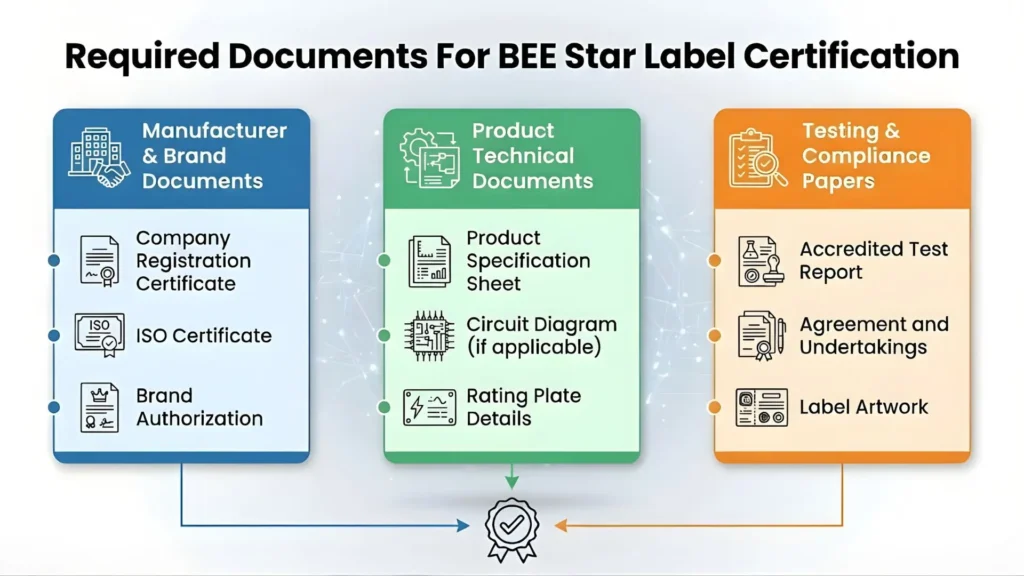
Keep a close eye on document validity — test reports are typically only accepted if issued within a defined recency window (commonly around 90 days for certain categories), and using an Indian Standard version that has since been superseded by a BEE Schedule update is one of the most frequent reasons applications are sent back for correction.
Step-by-Step BEE Star Label Certification Process
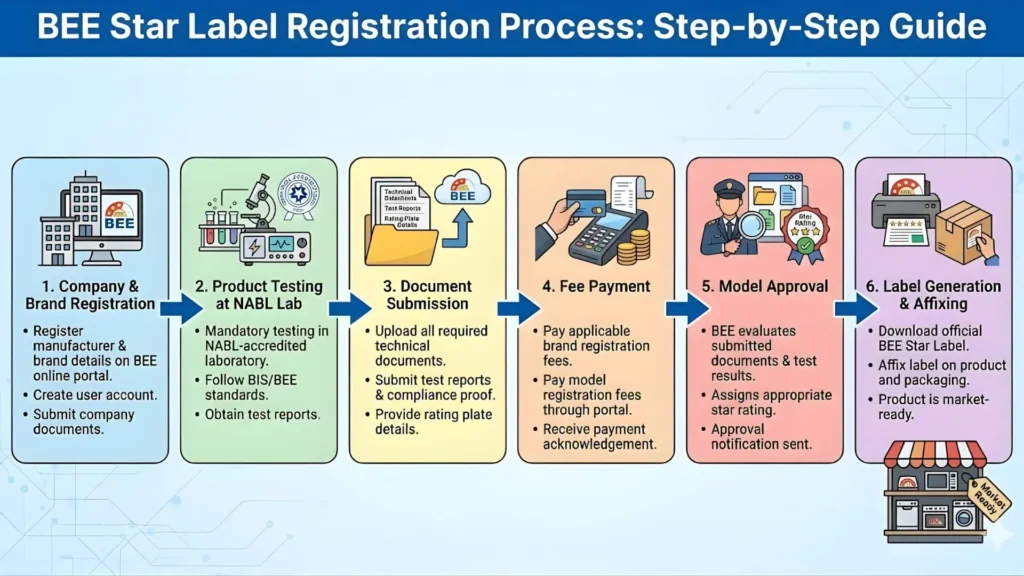
The entire BEE Star Label Certification process is conducted online through the official BEE portal. Here is the process broken down into clear stages:
- Confirm your product category and check whether it falls under Mandatory or Voluntary Standards & Labelling (S&L).
- Download the current Product Schedule and Standards document for that category to identify the Minimum Energy Performance Standards (MEPS) and the exact Indian Standard (IS) version you must test against.
- Get the product tested at a NABL-accredited laboratory (or a lab specifically listed as BEE-approved for that category), ensuring the test covers every parameter required by the relevant IS Standard.
- Register your brand/company on the BEE portal with company documents and, where applicable, pay the initial security deposit or brand registration fee.
- Submit the model registration application: upload the test report, declaration of conformity, product details and the proposed label design in the specified format.
- Pay the model registration fee online via net banking, NEFT/RTGS or demand draft, and retain the payment receipt as proof for your records.
- Submit hard copies of the application and payment receipt where required, signed by your authorised signatory.
- BEE's technical team scrutinises the application; if there are deficiencies, you will receive a deficiency notice and must respond promptly to avoid delays or lapse of the application.
- On successful verification (and, for some categories, a physical inspection), BEE issues the Registration Certificate with a unique registration number and the validity period.
- Print the BEE-specified label — including your registration number, star rating and energy consumption figures — on every unit before it enters the market.
Typical processing time: most applicants complete the full cycle — testing, documentation and portal approval — in roughly 5 to 10 weeks, though this varies with lab turnaround and how quickly deficiencies (if any) are resolved. Importers should build in extra lead time, since goods cannot clear Indian customs without a valid BEE registration number already affixed to the label.
BEE Star Label Certification Fees
BEE registration fees are not a single flat number — they depend on the product category, applicant type (manufacturer vs. importer), and in some cases the company's enterprise classification or turnover. As a general guide:
| Fee Component | Approximate Range |
| Brand / company registration (security deposit) | Varies by enterprise category and product group |
| Model registration fee (per model, per category) | Commonly cited example: around ₹2,000 for certain categories |
| Overall registration cost across categories | Roughly ₹5,000 to ₹2,00,000 depending on product and company size |
| Laboratory testing charges | Paid directly to the NABL-accredited lab; varies widely by product type |
| Renewal fee | Generally lower than fresh registration, but re-testing costs may apply if standards were revised |
Because fee structures are revised from time to time, always verify the current fee schedule on the official BEE portal or with your certification consultant before budgeting — treat the figures above as indicative planning ranges, not final quotes.
Validity Period and Renewal Timeline
BEE registration validity is not uniform across categories — depending on the product and the current labelling cycle, certificates are commonly valid for anywhere between 1 and 3 years. For several major categories under the 2026 revision cycle, BEE has set validity from January 1, 2026 to December 31, 2028. The exact validity date is always printed on your Registration Certificate — that date, not a general rule of thumb, is the one to track.
Renewal Timeline Checklist
Start the renewal process 60–90 days before your certificate's expiry date to avoid a compliance gap.
- Confirm whether the star rating table for your category has been revised since your last registration — if so, re-testing under the new IS version and MEPS is required.
- Re-verify that your testing lab's NABL accreditation is still current for your product category.
- Update your production and sales data as requested during renewal.
- Submit the renewal application, pay the applicable fee, and track the application reference number until the new certificate is issued.
Selling a product after its BEE registration has lapsed is treated the same as selling it with no registration at all — there is no informal grace period once the printed validity date passes.
BEE Certification vs BIS Certification: What's the Difference?
These two certifications are often confused because both appear on the same appliances, but they test for completely different things.
| Parameter | BEE Certification | BIS Certification |
| Focus | Energy efficiency (star rating) | Product safety and quality (ISI mark) |
| Governing law | Energy Conservation Act, 2001 | BIS Act, 2016 |
| Issued by | Bureau of Energy Efficiency | Bureau of Indian Standards |
| Applies to | Notified energy-consuming appliances | Wide range of industrial and consumer products |
| Can overlap? | Yes — e.g., air conditioners often need both | Yes — same overlap applies |
Common Mistakes to Avoid
- Testing against an outdated Indian Standard (IS) version after BEE has already revised the Schedule for that category.
- Assuming a foreign energy-efficiency certificate is valid for Indian sale — BEE registration must be obtained separately, in the Indian entity's name.
- Missing the renewal window and continuing to sell stock with an expired registration number.
- Using a testing lab that is NABL-accredited generally but not specifically approved for the relevant product category.
- Printing label artwork that doesn't match the current BEE template, registration number format, or star rating disclosure requirements.
Consequences of Non-Compliance
Manufacturing, importing or selling a mandatory-category appliance without a valid BEE Star Label is a legal violation under the Energy Conservation Act, 2001 — not a minor paperwork gap. Consequences can include product seizure at customs (for importers), forced recall from retail shelves, financial penalties, and reputational damage that is often harder to recover from than the certification cost itself.
Because enforcement checks increasingly cross-reference the registration number printed on the label against the BEE database, mismatched or expired registrations are straightforward for authorities to catch.
Get Expert Help: Silvereye Certifications
Navigating product schedules, IS standard versions, lab selection and portal documentation on your own can be time-consuming — and a single wrong IS version or missed deadline can set your launch back by weeks. Silvereye Certifications, a Noida-based regulatory compliance consultancy, works with manufacturers, importers and brands across India to secure BEE Star Label Certification alongside related approvals such as BIS (ISI/CRS/FMCS), WPC-ETA, FSSAI, MSME and ISO certifications.
Their team supports the full journey — confirming your product's mandatory/voluntary status, coordinating with NABL-accredited labs, preparing and filing your BEE portal application, and managing renewals so your registration never lapses. If you'd rather focus on building your product than chasing paperwork, working with an experienced consultant like Silvereye Certifications can help you avoid the common documentation errors that cause delays, and keep your certification timeline predictable.
Conclusion
BEE Star Label Certification has moved well beyond a regulatory formality — in 2026, with the mandatory list expanded to cover refrigerators, televisions, LPG stoves, chillers and more, it directly determines whether a growing range of products can legally enter the Indian market at all.
For manufacturers and importers, the path is manageable once broken into its component steps: confirm your category's current status, test at the right accredited lab against the current IS Standard, register accurately on the BEE portal, pay the correct fee, and track your validity date closely enough that renewal never becomes an emergency.
Approached this way, BEE certification stops being a compliance headache and starts working as what it was designed to be — a trust signal that helps your product stand out to genuinely energy-conscious Indian consumers.
Frequently Asked Questions
What is BEE Star Label Certification?
It is an energy-efficiency rating issued by India's Bureau of Energy Efficiency, under the Energy Conservation Act, 2001, that rates appliances from 1 to 5 stars based on how efficiently they use electricity.
Is BEE Star Label Certification mandatory for all appliances?
No. It is mandatory only for notified product categories such as ACs, refrigerators, ceiling fans, LED lamps, televisions, geysers, deep freezers and distribution transformers. For other categories, it remains voluntary, though increasingly expected by retailers and buyers.
Who is required to apply for BEE certification?
Domestic manufacturers, importers and traders/assemblers of notified energy-consuming appliances must all register — importers cannot rely on a manufacturer's overseas certification instead.
What documents are needed for BEE Star Label Certification?
Typically company and GST registration proof, a NABL-accredited lab test report, product specifications, proposed label design, a declaration of conformity, and the registration fee payment receipt, among category-specific documents.
How long does the BEE certification process take?
Most applications are completed in roughly 5 to 10 weeks, depending on lab testing turnaround, documentation readiness, and how quickly any deficiency notices are resolved.
What is the fee for BEE Star Label Certification?
Fees vary by product category and company size, generally ranging from around ₹5,000 to ₹2,00,000, plus separate laboratory testing charges paid directly to the lab.
How long is a BEE registration valid?
Validity commonly ranges from 1 to 3 years depending on the product category and the current labelling cycle; for several categories under the 2026 revision, validity runs from January 1, 2026 to December 31, 2028. The exact date is printed on your certificate.
When should I start the BEE Star Label renewal process?
Begin the renewal process 60 to 90 days before your certificate's expiry date to avoid any compliance gap or forced market withdrawal.
What happens if I sell a product with an expired BEE registration?
It is treated the same as selling the product with no BEE registration at all — a legal violation that can lead to penalties, recalls or market bans.
What is new in BEE certification for 2026?
From January 1, 2026, the mandatory list expanded to include refrigerators, televisions, LPG gas stoves, cooling towers, chillers, deep freezers, distribution transformers and grid-connected solar inverters, along with revised star rating tables valid through December 2028 for several existing categories.
Is BEE certification the same as BIS certification?
No. BEE certification measures energy efficiency (the star rating), while BIS certification (ISI mark) verifies general product safety and quality. Some products, like air conditioners, require both.
Can a small business or startup apply for BEE certification?
Yes. There is no minimum company size or turnover requirement for eligibility, though the applicable fee slab may vary by enterprise classification.