- Two-stage process — Company Registration first, then Model Registration on the beestarlabel.com portal once lab testing is complete.
- Mandatory for notified products — appliances like ACs, refrigerators, ceiling fans, LED lamps, and distribution transformers cannot legally be sold in India without a BEE star label.
- 3-year validity — BEE registration certificates generally run for three years and must be renewed with fresh test reports before expiry.
- Importers register independently — a foreign manufacturer cannot apply to BEE directly; the Indian importer of record must hold the registration.
Introduction
BEE Star Rating Process registration is a two-stage process run by India's Bureau of Energy Efficiency. First, the manufacturer, importer, or brand owner completes Company Registration on the portal by submitting incorporation, PAN, GST, and authorization documents with the applicable fee.
Second, after the product is tested at a NABL-accredited lab, the applicant files Model Registration with the test report and label design. On approval, BEE issues a star label certificate valid for three years. Around 30 product categories, including ACs, refrigerators, fans, and LED lamps, require this mandatorily before sale in India.
What Is BEE Star Rating Registration?
The Bureau of Energy Efficiency (BEE) is a statutory body under India's Ministry of Power, set up under the Energy Conservation Act, 2001, to promote efficient use of energy across households, industry, and commercial establishments. Its Standards & Labelling (S&L) Program, running since 2006, is the mechanism through which everyday appliances get the familiar yellow-and-green star label — the same sticker you see on an air conditioner, refrigerator, or ceiling fan box at the store.
BEE Star Rating registration is the formal process a company follows to get that label legally applied to its product. It has two linked stages:
- Company Registration — The applicant registers as an entity on the BEE portal and is verified before it can register any product.
- Model Registration — Each individual product model is registered separately, backed by a lab test report that determines how many stars (1 to 5) it earns.
A higher star rating signals lower energy consumption for the same output — a 5-star appliance typically uses meaningfully less electricity than a 1-star appliance doing the same job, which is why the rating matters to both regulators and buyers.
Who Needs BEE Registration — Manufacturers, Importers & Traders
BEE registration is not limited to domestic factories. The obligation applies to anyone who places a covered product on the Indian market, which in practice covers three categories of applicants.
Domestic Manufacturers
Any company manufacturing a notified product in India — whether a large OEM or an MSME unit — must register the company and every model it intends to sell before dispatch to the market.
Importers
If you import a covered appliance into India, you — the Indian importer of record — are the one who must hold BEE registration, not the overseas factory. Foreign manufacturers cannot register with BEE directly; the compliance and legal responsibility for the product's energy performance in India sits with the importer. This is a common point of confusion for businesses sourcing ACs, fans, or LED products from abroad, so importers should build BEE registration into their sourcing timeline, not treat it as a last-mile formality before customs clearance.
Traders, Dealers & Brand Owners
A trader who sells a covered product under its own brand, or a company that gets a product manufactured on its behalf (OEM/private label arrangements), is also required to register, since the registration is tied to the brand and model being sold, not only to whoever physically assembled it.
Mandatory vs Voluntary BEE Star Labelling — Full Product Coverage
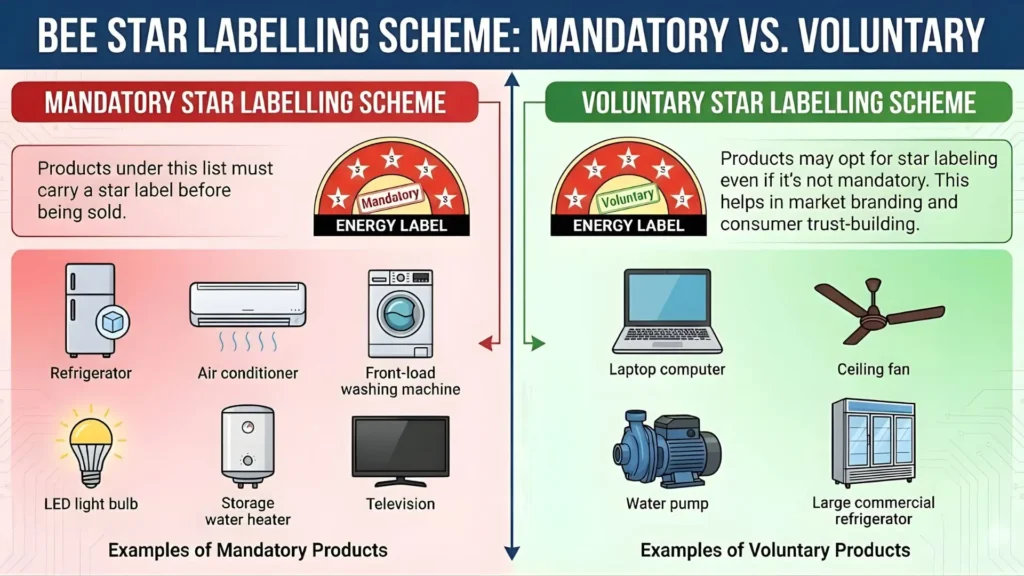
Not every appliance needs a star label by law. BEE classifies products into two tracks:
- Mandatory products — cannot be manufactured, imported, sold, or offered for sale in India without a valid BEE star label. Selling an unregistered mandatory product is a compliance violation and can hold up customs clearance or retail listing.
- Voluntary products — can be sold without a label, but the manufacturer may register to display a star rating as a market differentiator and build consumer trust.
BEE periodically moves products from voluntary to mandatory status through government Quality Control Orders (QCOs), so this list is reviewed and expanded over time. Always confirm current status for your exact product on the official portal before assuming a category is voluntary.
Commonly Notified Mandatory Product Categories
| Product Category | Typical Applicant | Governing Standard (indicative) |
| Room Air Conditioners (RAC) | Manufacturer / Importer | ISEER-based rating, IS 1391 |
| Frost-Free & Direct-Cool Refrigerators | Manufacturer / Importer | IS 15750 series |
| Ceiling Fans | Manufacturer / Importer | IS 374 |
| Pedestal, Table & Wall Fans | Manufacturer / Importer | IS 555 / applicable schedule |
| LED Lamps & LED Luminaires | Manufacturer / Importer | Luminous efficacy schedule |
| Colour Televisions | Manufacturer / Importer | Power consumption schedule |
| Distribution Transformers | Manufacturer / Importer | IS 1180, IS 2026 series |
| Induction Motors | Manufacturer | IS 12615 |
| Domestic Washing Machines | Manufacturer / Importer | Applicable BEE schedule |
| Domestic Gas Stoves | Manufacturer | IS 4246 |
| Water Heaters (Storage type) | Manufacturer / Importer | IS 2082 |
| Solid State Inverters / UPS | Manufacturer / Importer | Applicable BEE schedule |
| Office Automation Products (printers, copiers, monitors) | Manufacturer / Importer | Applicable BEE schedule |
| Diesel Generator Sets | Manufacturer | Applicable BEE schedule |
| Microwave Ovens | Manufacturer / Importer | Applicable BEE schedule |
| Air Compressors | Manufacturer / Importer | Applicable BEE schedule |
| Deep Freezers | Manufacturer / Importer | Applicable BEE schedule |
| Ballasts (for lighting) | Manufacturer | Applicable BEE schedule |
| Pumps (agricultural/domestic) | Manufacturer | Applicable BEE schedule |
Notable Voluntary Categories (label optional, but market-preferred)
- Evaporative (desert) air coolers
- Solar water heaters
- Solar inverters/PV-related equipment
- Tyres
If your product isn't listed above, don't assume it is exempt — check the Products section of beestarlabel.com, since new QCOs regularly add categories (distribution transformers and several white-goods categories, for instance, moved through revised mandatory schedules in recent cycles).
Eligibility Criteria for BEE Star Rating Process
Eligibility is largely about who you are and what you're selling, rather than company size — both large enterprises and MSMEs can register, though the fee slab differs.
- Legal entity in India — the applicant must be a registered company, LLP, partnership, or proprietorship with a valid Certificate of Incorporation or equivalent registration.
- Product falls under a notified schedule — mandatory registration applies only to products BEE has formally listed; voluntary registration is open to any eligible category.
- Import authorization — importers need a valid Import Export Code (IEC) issued by DGFT in addition to standard company documents.
- Test-ready product — the exact model/variant to be registered must be available in production-representative form for lab testing before model registration can proceed.
- Trademark ownership or authorization — if the product is sold under a brand the applicant doesn't legally own, a notarized authorization/licensing letter from the trademark holder is required.
Documents Required for BEE Star Rating Process
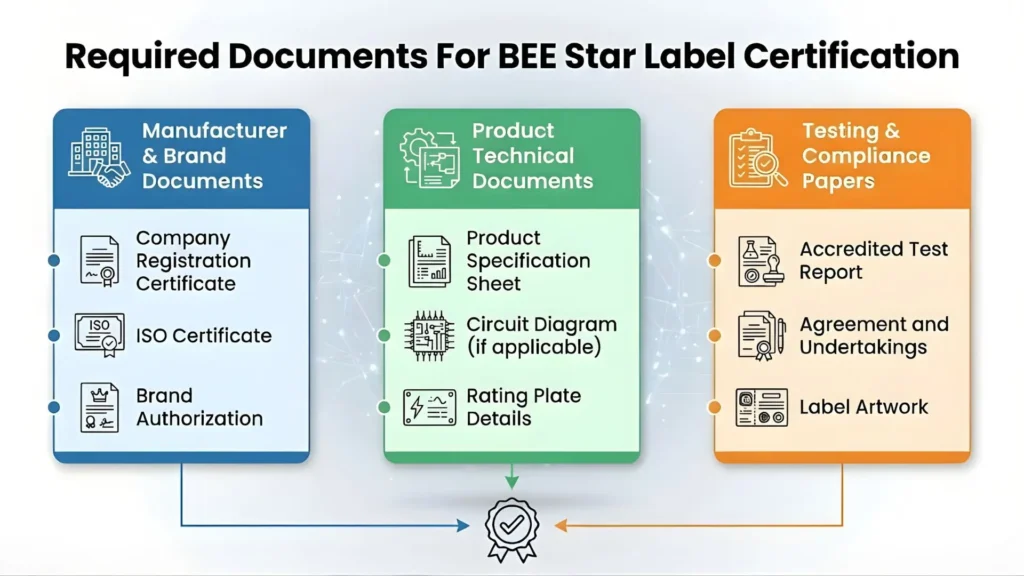
Documentation is checked twice — once during Company Registration, and again (with product-specific paperwork) during Model Registration. Keep both sets ready before you start the online application to avoid processing delays.
Stage 1 — Company Registration Documents
| Document | Purpose |
| Certificate of Incorporation / Partnership Deed / Registration Certificate | Confirms legal existence of the applicant entity |
| PAN Card of the company | Tax identity verification |
| GST Registration Certificate | Confirms tax-compliant business status |
| Trademark Registration Certificate (or authorization letter if brand isn't owned by applicant) | Links the product brand to the applicant |
| ISO 9001 Quality Management Certificate | Demonstrates manufacturing/quality-control credibility |
| Board Resolution / Authorization Letter | Names the authorized signatory for the BEE application |
| Import Export Code (IEC) | Mandatory for importers only |
| Registered office / factory address proof | Confirms operational address on record |
Stage 2 — Model Registration Documents
| Document | Purpose |
| Test report from a NABL-accredited or ILAC MRA-recognized lab | Establishes the star rating; typically must not be older than 90 days at filing |
| Product technical specification sheet | Matches the tested unit to the exact model being registered |
| Sample of the proposed energy label / artwork | Confirms label format meets BEE's display rules |
| Product photographs (all sides, including nameplate) | Verifies model identity against the test sample |
| Company registration approval / login credentials | Confirms the applicant is already registered before filing a model |
BEE Star Rating Registration Process: Step-by-Step
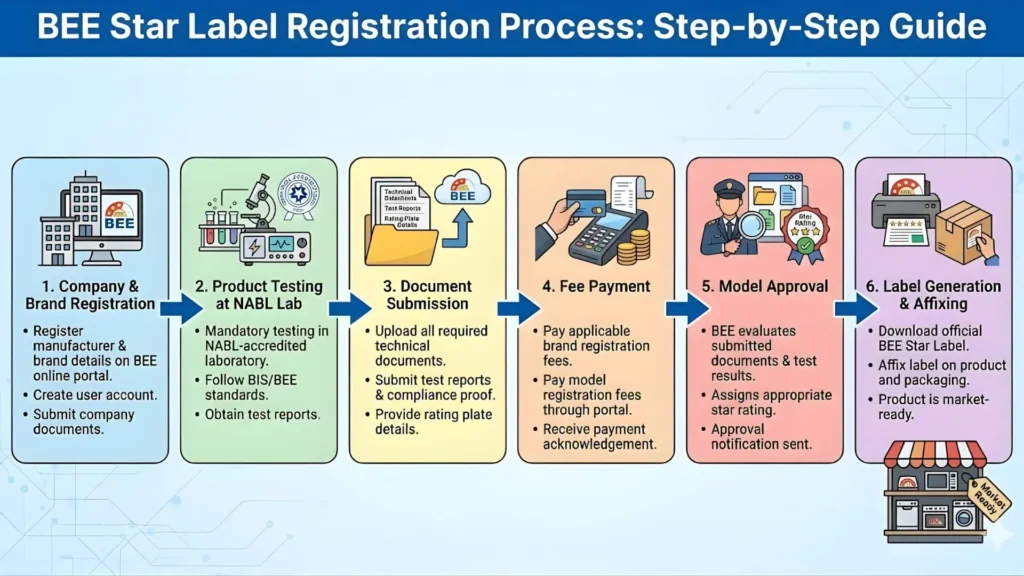
The full process runs online through the official BEE portal followed by submission of hard-copy originals to the Bureau's office. Here is the sequence in practice, for both company registration and model registration.
Stage 1: Company Registration
- Create a portal account — Visit beestarlabel.com and start a fresh Manufacturer/Importer registration, selecting your applicant type.
- Enter company details — Provide legal name, entity type, registered address, and contact details of the authorized signatory.
- Upload documents — Attach Certificate of Incorporation, PAN, GST certificate, trademark proof, ISO 9001 certificate, and the authorization letter.
- Pay the company registration fee — The fee is charged online based on business scale (see Fees section below).
- Submit hard-copy originals — Send the physical documents along with the payment receipt to the BEE office, as the online upload alone does not complete verification.
- Receive login credentials — Once BEE scrutinizes the submission and approves it, you get portal login credentials to proceed to model-level filings.
Stage 2: Product Testing
- Identify the applicable schedule — Check the Products section on the portal to confirm whether your model falls under Mandatory or Voluntary S&L, and download the relevant Product Schedule and Standards document, which sets the Minimum Energy Performance Standards (MEPS) your product must meet.
- Send samples for testing — Submit the exact production model to a NABL-accredited (or ILAC MRA-recognized) laboratory for energy-performance testing against the applicable Indian Standard.
- Collect the test report — The lab issues a report confirming energy consumption/efficiency data, which determines the star band the model qualifies for.
Stage 3: Model Registration
- Log in with your approved company credentials and open the Model Registration application.
- Enter model-specific details — technical specifications, variant name, and manufacturing/import details.
- Upload the test report, product photographs, and the proposed label artwork in BEE's specified format.
- Pay the model registration fee for that product.
- Submit hard-copy originals of the application and payment receipt to the BEE office for final scrutiny.
- Receive the star label certificate — once approved, BEE issues the registration certificate confirming the star rating, which the applicant must then reproduce correctly on the product and its packaging.
| Good to know One company login can register multiple models, but each model/variant needs its own separate registration and its own star rating — you cannot bundle several product variants under a single filing, even if they share a brand. |
BEE Registration Fees
Fees are charged at both stages and vary by applicant scale and product count. Treat the figures below as indicative — always confirm the live fee schedule on the BEE portal before payment, since circulars are revised periodically.
| Fee Component | Applicable To | Indicative Amount |
| Company Registration Fee | Large-scale industries | ₹1,00,000 |
| Company Registration Fee | MSME-registered units | ₹25,000 |
| Model Registration Fee | Per model, per applicant | ₹2,000 |
| Renewal Application Fee | Per registration, on renewal | ₹500 (indicative; varies by category) |
| Lab Testing Charges | Paid directly to the NABL-accredited lab | Varies by product and test standard |
Beyond the direct BEE fees, budget separately for laboratory testing costs (paid to the lab, not BEE) and, if you use a certification consultant, their professional service fee.
Timeline: How Long Does BEE Registration Take?
There's no single fixed number, because lab testing turnaround is the biggest variable — but as a working estimate:
- Company Registration approval: typically a few weeks, depending on how quickly documents clear scrutiny.
- Lab testing: roughly 3 to 6 weeks, depending on the product category and lab queue.
- Model Registration approval after test report: a further few weeks for document review and certificate issuance.
- End-to-end estimate: most applicants should plan for roughly 6 to 16 weeks from starting company registration to receiving a model's star label certificate — faster for straightforward categories like fans, slower for complex products like ACs or transformers.
Build this timeline into your product launch or import schedule; starting BEE registration only after goods arrive at port is one of the most common causes of customs and retail-listing delays.
Validity & Renewal of BEE Star Rating Certificates
A BEE registration certificate is generally valid for three years from the date of issuance. However, the star rating itself is tied to the label schedule in force for that product category — BEE revises MEPS thresholds periodically (commonly every two years for categories like air conditioners), and when a new schedule takes effect, a model that held 5 stars under the older schedule may only qualify for 3 or 4 stars under the revised criteria, even without any change to the product. This distinction matters: your registration may still be valid, but the star count you're allowed to display can change mid-cycle.
Renewal Process
- Track expiry — BEE typically sends a renewal notice to the registered email around six months before expiry; respond within the window specified (commonly within three months of the notice).
- Check for schedule changes — confirm whether a new MEPS revision applies to your product before renewing.
- Re-test if required — get an updated test report from an NABL-accredited lab if the applicable standard has changed or the previous report has aged out.
- Submit the renewal application — file through the BEE portal with updated documents and the current test report.
- Pay the renewal fee and retain the receipt — keep this for any follow-up correspondence with BEE.
Letting a registration lapse without renewal effectively pulls your right to sell that model as a labelled product in India, so building a renewal reminder at least six months ahead of expiry is worth doing as standard practice.
Benefits of BEE Star Rating Registration
- Legal market access — mandatory products simply cannot be sold, imported, or listed on major e-commerce and retail channels in India without it.
- Consumer trust — the star label is widely recognized by Indian buyers as a mark of energy efficiency and product quality, which supports purchase decisions.
- Competitive differentiation — even for voluntary categories, a star rating helps a product stand out against unlabelled competitors.
- Tender and institutional eligibility — government departments, utilities, and large procurement tenders increasingly specify a minimum star rating as a bidding precondition.
- Long-term cost signaling — higher-rated products can justify a premium price point by demonstrating lower running costs to end users.
Common Compliance Mistakes to Avoid
- Assuming a category is voluntary without checking — QCOs regularly move products into the mandatory list; verify status per product, per year.
- Starting registration after goods reach customs — importers who leave BEE filing until arrival risk demurrage and clearance delays.
- Using an outdated or non-accredited lab report — only NABL-accredited or ILAC MRA-recognized labs are accepted, and reports typically can't be older than 90 days at filing.
- Registering under the wrong entity — the importer of record, not the overseas factory, must hold the Indian registration.
- Missing the renewal window — a lapsed certificate stops legal sale of that model until renewed.
- Ignoring retailer/distributor data obligations — recent compliance updates require registered permittees to maintain and upload verified retailer/distributor details, not just the product certificate.
Conclusion
BEE Star Rating registration is a structured, two-stage compliance requirement — not a one-time formality — for anyone manufacturing or importing a notified appliance into India. Getting company registration, product testing, and model registration sequenced correctly, and tracking the three-year renewal cycle, keeps a product legally sellable and helps it hold onto the star rating that consumers and institutional buyers increasingly look for. Because product schedules and fee circulars change periodically, treat the official BEE portal as the final word on documentation, fees, and mandatory status for your specific product before filing.
Frequently Asked Questions
What is BEE Star Rating registration?
It's the process through which the Bureau of Energy Efficiency certifies an appliance's energy performance and authorizes the manufacturer or importer to display a 1-to-5 star label on it, run through company registration followed by model registration on the portal
Is BEE registration mandatory for all products?
No. It's mandatory only for products BEE has formally notified under its Standards & Labelling Program — around 30 categories today, including ACs, refrigerators, fans, and LED lamps. Other categories remain voluntary until notified.
Who needs to register — the manufacturer or the importer?
Whoever places the product on the Indian market. Domestic manufacturers register their own output; for imported goods, the Indian importer of record must register, since foreign manufacturers cannot apply to BEE directly.
Can a foreign manufacturer register directly with BEE?
No. BEE registration for imported products must be held by an Indian entity — the importer — who also carries legal responsibility for the product's compliance in India.
What's the difference between company registration and model registration?
Company registration verifies the applicant entity once; model registration is filed separately for each specific product model, backed by that model's lab test report, and determines its individual star rating.
How long does the full BEE registration process take?
Typically 6 to 16 weeks end to end, with lab testing (roughly 3–6 weeks) usually the largest variable, depending on the product category and lab availability.
What is the validity period of a BEE certificate?
Generally three years from the date of issuance, though the star rating itself can change sooner if BEE revises the MEPS schedule for that product category during that period.
How do I renew my BEE registration?
Track your expiry date, confirm whether a new label schedule applies, get an updated test report if needed, and file the renewal application with fresh documents and the prescribed fee before the certificate lapses.
What documents are required for BEE registration?
Company-level documents include incorporation certificate, PAN, GST certificate, trademark proof, ISO 9001 certificate, and an authorization letter; model-level documents include the lab test report, technical specifications, label artwork, and product photographs.
How much does BEE registration cost?
Indicative fees run around ₹1,00,000 for large-scale industries and ₹25,000 for MSMEs at company registration, plus roughly ₹2,000 per model at model registration — with lab testing charged separately by the laboratory. Confirm current fees on the official portal.
What happens if I sell a mandatory product without BEE labelling?
It's a compliance violation that can block customs clearance, prevent retail and e-commerce listing, and expose the seller to regulatory action, since mandatory products legally cannot be marketed in India without a valid star label.
Can one company register multiple product models?
Yes. A single company registration can be used to file model registrations for multiple products, but each model or variant still needs its own separate model registration and earns its own star rating.