- CDSCO Registration For Hair styling products — gels, waxes, sprays, mousses, serums, pomades, and clays — are regulated as cosmetics under the Drugs and Cosmetics Act, 1940 and require a CDSCO license before they can be manufactured, imported, or sold commercially in India.
- Domestic manufacturers apply via Form COS-5 and receive their license in Form COS-8 from the State Licensing Authority; importers apply via Form COS-1 and receive approval in Form COS-2 from CDSCO.
- Every hair styling product sold in India — whether a professional salon brand or a mass-market D2C gel — must carry a compliant label under Schedule XI of the Cosmetics Rules, 2020 including INCI ingredient list and batch number.
- Licenses are valid for 5 years; operating on an expired license or selling without one attracts criminal penalties under Section 18 of the Drugs and Cosmetics Act, 1940.
Regulatory Framework for Hair Styling Products in India
Hair styling products occupy a firmly established place in India's cosmetics regulatory landscape. The Indian hair care and styling market — valued at over USD 4 billion and growing — attracts domestic manufacturers, multinational FMCG brands, professional salon product companies, and D2C startups alike. All of them must comply with the same regulatory framework before a single jar of hair wax or can of hair spray reaches the Indian consumer.
The Drugs and Cosmetics Act, 1940 defines a cosmetic as any article intended for use on the human body for cleansing, beautifying, promoting attractiveness, or altering appearance — other than soap. Hair styling products squarely fit this definition: they are applied to hair to alter its appearance (hold, volume, shine, texture, shape) and to promote attractiveness. The Cosmetics Rules, 2020, which replaced the older Schedule S provisions, modernized the licensing, GMP, labelling, and safety assessment framework for all cosmetics including hair styling products.
If a hair styling product makes a therapeutic or medicinal claim — for example, 'treats scalp infection', 'cures dandruff at a medicinal level', or 'prevents alopecia' — it may be classified as a drug rather than a cosmetic. Pure styling claims ('strong hold', 'frizz control', 'adds volume', 'gives shine') are cosmetic claims and fall under CDSCO cosmetic licensing. Products with anti-dandruff claims using active pharmaceutical ingredients (zinc pyrithione at therapeutic doses, for example) may require additional regulatory scrutiny.
Governing Legal Framework
| Legal Instrument | Relevance to Hair Styling Product Manufacturers and Importers |
| Drugs and Cosmetics Act, 1940 | Primary legislation under which all hair styling cosmetics are regulated; defines offences and penalties for unlicensed manufacture and sale |
| Cosmetics Rules, 2020 | Prescribes licensing forms (COS-1 through COS-9), fees, GMP standards, labelling norms, and safety assessment requirements for all cosmetics including hair styling products |
| Schedule M-II | Good Manufacturing Practice (GMP) standards for cosmetic manufacturers — mandatory for all COS-8 license holders manufacturing hair styling products |
| Schedule VII | Safety Assessment Report (SAR) requirements — mandatory for cosmetic import license applications (COS-1) including hair styling product imports |
| Schedule VIII | Stability testing requirements for cosmetics — mandatory for COS-1 import applications; strongly recommended for domestic manufacturers |
| Schedule XI | Labelling requirements for all cosmetics in India — INCI ingredient list, batch number, expiry, MRP, manufacturer/importer details, and any required warnings (e.g., flammability for aerosol hair sprays) |
| Schedule II | Permitted colorants — relevant for tinted hair styling products such as colour-depositing styling creams or tinted hair gels |
| CDSCO (Central) | Grants COS-2 import licenses for hair styling products imported from abroad |
| State Licensing Authority (SLA) | Grants COS-8 manufacturing licenses and COS-9 loan licenses to domestic hair styling cosmetic manufacturers |
Do Hair Styling Products Need CDSCO Registration in India?
Yes. Hair styling products — including hair gels, waxes, sprays, mousses, serums, pomades, setting lotions, dry shampoos, and hair clays — are classified as cosmetics under the Drugs and Cosmetics Act, 1940 and the Cosmetics Rules, 2020. Every such product must have a valid CDSCO cosmetic license before it can be manufactured or imported for sale in India.
Domestic manufacturers need a COS-8 license from the State Licensing Authority (SLA). Importers need a COS-2 import license from CDSCO. No exemption exists for 'styling only' or 'salon use only' products — all hair styling cosmetics require licensing.
Complete Product Table: Hair Styling Products Requiring CDSCO Registration
The following is a comprehensive category-wise table of hair styling products that require CDSCO registration in India, covering both conventional and natural/herbal variants. This table is designed to help manufacturers, importers, and brand owners quickly identify the applicable license path for each product type.
| Product Category | Specific Product Examples | License (Manufacturing) | License (Import) | Key Regulatory Note |
| Hair Gel — Standard | Wet-look hair gel, strong hold gel, mega hold gel, light hold defining gel, curl defining gel | COS-5 → COS-8 | COS-1 → COS-2 | Carbomer-based gels: carbomer (polyacrylic acid) is a common gelling agent — verify it is in the permitted ingredient list; alcohol content must be stated |
| Hair Gel — Natural / Herbal | Aloe vera hair gel, flaxseed hair gel, marshmallow root gel, chia seed styling gel, amla gel | COS-5 → COS-8 | COS-1 → COS-2 | Natural gel polymers (aloe, seed mucilage): same cosmetic licensing applies; preservative efficacy testing (PET) mandatory for water-based natural gels |
| Hair Gel — Professional Salon | Extra strong hold salon gel, sculpting gel, thermal protection gel, professional curl gel | COS-5 → COS-8 | COS-1 → COS-2 | Professional salon products sold in India require same license as consumer products — 'professional use only' does not exempt from CDSCO licensing |
| Colour-Depositing Hair Gel | Blue tinted styling gel, pink shimmer gel, glitter gel, colour + hold gel | COS-5 → COS-8 | COS-1 → COS-2 | Colorants must comply with Schedule II permitted colorant list; glitter: biodegradable cosmetic-grade glitter permitted, non-biodegradable plastic glitter has EU restrictions — check Indian labelling requirements |
| Hair Wax — Standard | Matte finish hair wax, glossy hair wax, strong hold wax, medium hold styling wax, fibre wax | COS-5 → COS-8 | COS-1 → COS-2 | Petroleum-derived waxes (paraffin, microcrystalline) and beeswax are common bases — all must appear on INCI label; paraffin wax purity specification should be documented |
| Hair Wax — Natural / Organic | Beeswax styling balm, candelilla wax pomade, carnauba wax styling cream, natural hair wax with shea butter and argan oil | COS-5 → COS-8 | COS-1 → COS-2 | Candelilla and carnauba waxes are vegan alternatives to beeswax; natural wax products are cosmetics — same CDSCO licensing framework applies |
| Hair Clay | Matte clay, kaolin hair clay, bentonite clay styler, volcanic ash clay, white clay defining paste | COS-5 → COS-8 | COS-1 → COS-2 | Clay mineral ingredients: specify clay mineral grade and source in formulation; heavy metal testing recommended for mineral clays to confirm lead and arsenic within permitted limits |
| Hair Mud / Paste | Texturising paste, moulding paste, hair mud, beach wave paste, surf paste | COS-5 → COS-8 | COS-1 → COS-2 | Same classification as wax — cosmetic styling product; if salt-based ('sea salt spray / paste'), sodium chloride concentration must be appropriate for scalp safety |
| Hair Spray — Aerosol (Propellant-Based) | Extra hold aerosol hair spray, flexible hold hair spray, volumising hair spray, humidity-resistant hair spray, finishing spray | COS-5 → COS-8 | COS-1 → COS-2 | Aerosol hair sprays are flammable — label must carry flammability warning under Schedule XI; propellants (isobutane, propane, dimethyl ether) must be food/cosmetic grade; aerosol cans require additional compliance under Gas Cylinders Rules for filling (PESO) |
| Hair Spray — Pump / Non-Aerosol | Pump-action hair spray, non-aerosol flexible hold spray, humidity shield pump spray, shine spray | COS-5 → COS-8 | COS-1 → COS-2 | Non-aerosol sprays avoid PESO cylinder compliance but still require full CDSCO cosmetic license; ethanol content should be listed in INCI |
| Dry Shampoo Spray | Aerosol dry shampoo, volumising dry shampoo, natural starch dry shampoo spray, tinted dry shampoo (brunette / blonde) | COS-5 → COS-8 | COS-1 → COS-2 | Dry shampoo is classified as a hair care cosmetic; aerosol form: same flammability and PESO filling compliance as hair spray; absorbent starch ingredients (rice starch, tapioca starch): cosmetic grade required |
| Heat Protectant Spray | Thermal protection spray (flat iron, blow dryer protection), heat shield serum spray, blow-dry spray | COS-5 → COS-8 | COS-1 → COS-2 | Heat protectant claims are cosmetic claims ('protects hair from heat damage during styling') — no drug claims permitted; silicone polymers commonly used as heat protectants must be listed by INCI name |
| Natural / Botanical Hair Spray | Aloe vera finishing spray, rice water spray, herbal setting spray, essential oil hair mist | COS-5 → COS-8 | COS-1 → COS-2 | Water-based natural sprays: preservative efficacy testing critical given high water activity; essential oil allergens must be declared on label per Schedule XI |
| Hair Mousse — Standard | Volumising mousse, curl-enhancing mousse, strong hold mousse, root-lifting mousse, straightening mousse | COS-5 → COS-8 | COS-1 → COS-2 | Mousse is typically an aerosol product — same flammability labelling and PESO aerosol filling compliance as aerosol hair spray applies |
| Hair Mousse — Natural | Aloe vera mousse, flaxseed mousse, botanical curl mousse, sulphate-free foam mousse | COS-5 → COS-8 | COS-1 → COS-2 | Natural mousses with reduced synthetic polymer content: verify adequate hold performance through consumer testing; PET mandatory for water-based natural formulations |
| Hair Serum — Styling | Smoothing serum, anti-frizz serum, shine serum, split-end treatment serum (cosmetic claim), thermal protection serum, curl definition serum | COS-5 → COS-8 | COS-1 → COS-2 | Silicone serums (dimethicone, cyclopentasiloxane): these volatile silicones have EU regulatory scrutiny — if exporting to EU, check restrictions; in India, CDSCO follows Cosmetics Rules 2020 permitted list |
| Hair Serum — Natural / Herbal | Argan oil serum, coconut oil shine serum, marula oil serum, bakuchiol hair serum, Moroccan oil styling serum | COS-5 → COS-8 | COS-1 → COS-2 | Plant oil-based serums: same cosmetic license; shelf life may be shorter than synthetic serums — stability data important for COS-1 applications |
| Hair Elixir / Hair Oil (Styling) | Multi-benefit styling oil, glossing oil, taming oil, smoothing elixir | COS-5 → COS-8 | COS-1 → COS-2 | Styling oil is a cosmetic; distinguish from medicinal hair oils with scalp treatment claims which may require different classification review |
| Hair Pomade — Water-Based | Water-based pomade, light hold pomade, medium hold slick pomade, matte finish pomade | COS-5 → COS-8 | COS-1 → COS-2 | Water-based pomades: PET critical; polyquaternium polymers commonly used — list by INCI; avoid any medicinal hair health claims |
| Hair Pomade — Oil-Based | Traditional oil-based pomade, petroleum jelly pomade, lanolin pomade, grease pomade | COS-5 → COS-8 | COS-1 → COS-2 | Petroleum-derived ingredients: cosmetic-grade petrolatum specification required; lanolin: potential allergen — declare on label if sensitisation risk |
| Hair Cream — Styling | Leave-in styling cream, defining cream, curl cream, anti-frizz cream, hair butter (styling) | COS-5 → COS-8 | COS-1 → COS-2 | Leave-in products: ensure ingredient safety for prolonged scalp contact; UV filter claims require SPF efficacy data if protective claim is made |
| Texturising Cream / Salt Cream | Sea salt texturising cream, wave-defining cream, beach texture cream, matte texturising balm | COS-5 → COS-8 | COS-1 → COS-2 | Salt-based texturising products: sodium chloride concentration must be appropriate for scalp safety; test for scalp irritation if leave-in |
| Hair Setting Lotion | Traditional setting lotion, roller set lotion, curl set spray, pin curl lotion | COS-5 → COS-8 | COS-1 → COS-2 | PVP (polyvinylpyrrolidone) is a common film-forming polymer in setting lotions — permitted in cosmetics; resin-based setting products: ensure resins are cosmetic-grade |
| Hair Finishing Products | Gloss spray, shine drops, hair glaze, anti-humidity sealer, edge control | COS-5 → COS-8 | COS-1 → COS-2 | Edge control products: commonly used on edges/hairline; leave-in formulations require careful assessment of ingredients safe for prolonged skin contact on hairline |
| Keratin / Smoothing Treatment | Keratin hair treatment (cosmetic), Brazilian blowout, formaldehyde-free smoothing treatment, protein smoothing cream | COS-5 → COS-8 | COS-1 → COS-2 | Formaldehyde in keratin treatments: formaldehyde and formaldehyde-releasing preservatives have concentration limits under Cosmetics Rules 2020; products exceeding limits are non-compliant; 'formaldehyde-free' claim requires lab substantiation |
| Hair Relaxer / Straightener (Chemical) | Lye relaxer (sodium hydroxide), no-lye relaxer (calcium hydroxide / guanidine), ammonium thioglycolate straightener | COS-5 → COS-8 | COS-1 → COS-2 | Chemical relaxers: strong alkali products — require professional use warning; sodium hydroxide concentration limits apply; pH-related scalp safety must be assessed in SAR for import applications |
| Permanent Wave (Perm) Solution | Alkaline perm solution, acid perm (glyceryl monothioglycolate), cold wave solution, digital perm lotion | COS-5 → COS-8 | COS-1 → COS-2 | Thioglycolate-based perms: ammonium thioglycolate has concentration limits in Cosmetics Rules; pH and concentration data required; professional use restriction recommended on label |
Who Needs CDSCO Registration for Hair Styling Products?
Any person or entity that manufactures, imports, sells, distributes, or markets hair styling products in India needs to be part of a licensed supply chain. Here is a clear breakdown of who needs which license:
| Entity Type | License Required | Issuing Authority |
| Indian manufacturer of hair gels, waxes, sprays, or any styling product | COS-8 Manufacturing License | State Licensing Authority (SLA) |
| D2C brand outsourcing production to a contract manufacturer | COS-9 Loan License | State Licensing Authority (SLA) |
| Indian importer / authorised agent of a foreign hair styling brand | COS-2 Import License | CDSCO (Central) |
| Foreign hair styling brand entering India via an Indian distributor | COS-2 Import License (held by Indian entity) | CDSCO (Central) |
| E-commerce seller importing and selling hair styling products | COS-2 Import License | CDSCO (Central) |
| Professional salon product distributor importing from abroad | COS-2 Import License | CDSCO (Central) |
| OEM / contract manufacturer making private-label hair styling products | COS-8 Manufacturing License (own) + knowledge of client's COS-9 | State Licensing Authority (SLA) |
| Retailer / offline distributor sourcing from a licensed manufacturer | No separate license — covered by manufacturer's COS-8 / importer's COS-2 | N/A |
Cosmetic Import License for Hair Styling Products (COS-1 and COS-2)
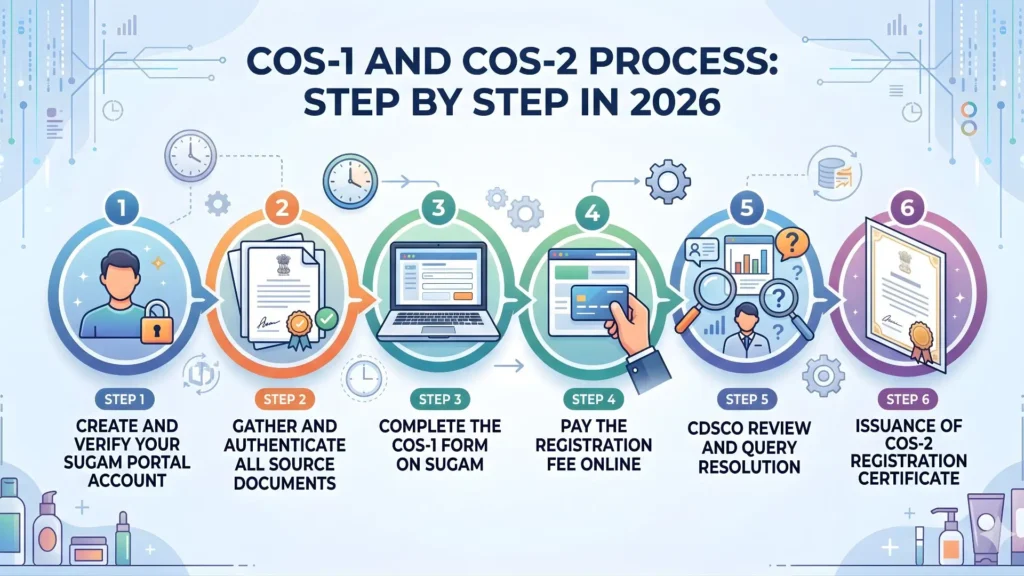
Any person who imports hair styling products — hair gels, waxes, sprays, serums, mousses, pomades, or any other styling cosmetic — into India for commercial sale must obtain a Cosmetic Import License from CDSCO. The application is submitted in Form COS-1, and upon approval, CDSCO issues the license in Form COS-2. All applications are filed and tracked through the SUGAM portal.
Eligibility for COS-1 / COS-2 (Hair Styling Products)
- Any Indian legal entity with a valid Import Export Code (IEC) issued by DGFT
- Indian authorized agent or distributor of a foreign hair styling cosmetics brand
- E-commerce importers and direct-to-consumer brands sourcing hair styling products from abroad
- Salon professional product distributors bringing in foreign professional hair styling ranges
- Companies expanding existing import license to include new hair styling product SKUs from the same or different foreign manufacturer
Form COS-1: Application for Hair Styling Product Import License
Form COS-1 is the prescribed CDSCO application for cosmetic import licenses. For hair styling products, the following fields and documents within COS-1 require careful attention:
| COS-1 Section | Specific Considerations for Hair Styling Products |
| Product Description | Clearly describe the product type — 'hair gel', 'aerosol hair spray', 'hair wax', 'hair serum' etc. — and its styling function; product category must be consistent throughout all documents |
| Complete Formulation (INCI) | Every ingredient must be listed with its INCI name and percentage by weight; for aerosol products, include propellant type and concentration; polymers (PVP, PVA, polyquaterniums) must be listed by INCI designation |
| Safety Assessment Report (SAR) | SAR must specifically address film-forming polymer safety, solvent/alcohol content, inhalation risk for spray products, scalp contact safety for leave-in products, and any restricted ingredient compliance |
| Stability Data | Particularly important for water-based gels and mousses prone to microbial growth; packaging compatibility data relevant for aerosol products |
| Labelling Review | Draft label must include flammability warning for aerosol sprays; 'Keep away from eyes' for styling products with high alcohol or hold polymer content; INCI ingredient list is mandatory |
| Aerosol-Specific Documentation | For aerosol hair sprays and mousses: propellant specification, fill weight, actuator specification, and pressure test data may be requested by CDSCO during scrutiny |
| Formaldehyde Content (Keratin Treatments) | For keratin / smoothing treatments: formaldehyde or formaldehyde-releasing ingredient concentrations must be within permitted limits; lab test certificate confirming formaldehyde content is strongly recommended |
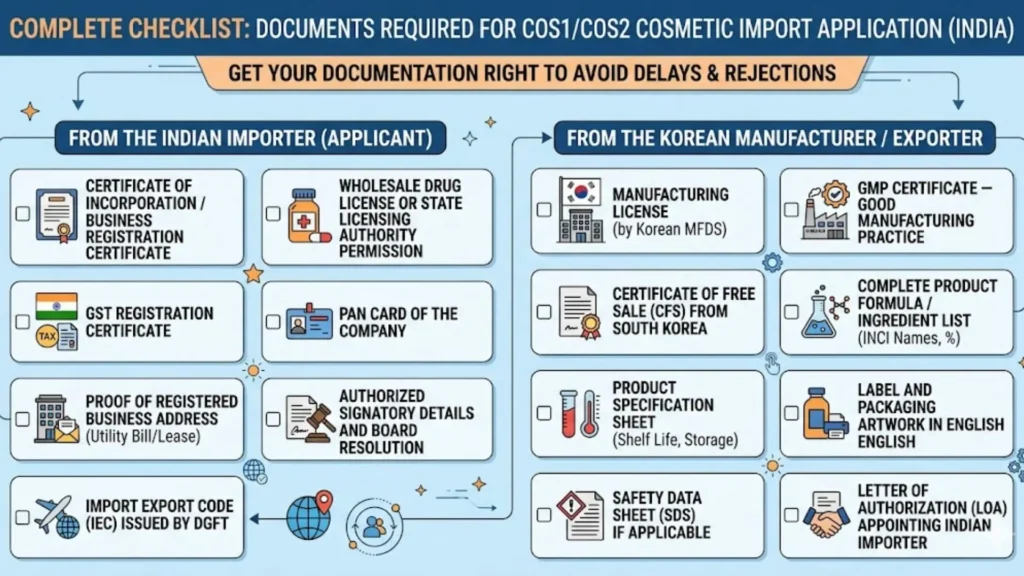
Documents Required for COS-1 (Hair Styling Products)
- Duly filled Form COS-1 with complete product and applicant details
- Certificate of Free Sale (CFS) from the country of origin — apostilled or notarized by the competent authority of the exporting country
- Good Manufacturing Practice (GMP) / ISO 22716 certificate of the foreign manufacturing facility
- Complete product formulation with INCI names and percentage composition — for aerosol products, include propellant specification
- Safety Assessment Report (SAR) as per Schedule VII of Cosmetics Rules, 2020 — addressing inhalation risk for spray products, polymer safety, alcohol content, and scalp/skin contact safety
- Stability data (minimum 6 months accelerated or 12 months real-time) as per Schedule VIII — packaging compatibility data for aerosol products
- Draft label for Indian market — compliant with Schedule XI of Cosmetics Rules, 2020 including INCI list, flammability warnings (for aerosols), batch number, expiry date, MRP, importer details
- Power of Attorney or Authorization Letter from foreign manufacturer to the Indian applicant
- Import Export Code (IEC) certificate of the Indian applicant
- Product information file (PIF) or technical dossier for each hair styling product
- For keratin / smoothing treatments: formaldehyde content lab test certificate from an accredited laboratory
- For chemical relaxers / perm solutions: pH and concentration data, professional use justification
- Fee payment proof — challan or online payment reference from SUGAM portal
Form COS-2: Grant of Hair Styling Product Import License
Once CDSCO reviews the COS-1 application and is satisfied with product safety and regulatory compliance, it issues the Import License in Form COS-2. COS-2 specifies the licensed product name, brand, manufacturer, pack sizes, and validity period. The Indian applicant (importer/authorized agent) bears full regulatory responsibility for the product's compliance throughout the license period. Any formulation change, brand name change, or new pack size addition requires a COS-2 amendment from CDSCO.
Import License Fees (COS-1 / COS-2)
| Fee Head | Amount (INR) |
| Application fee per product (COS-1) | Rs. 500 per product |
| License grant fee (COS-2) | Rs. 1,000 per product |
| Renewal fee (per product) | Rs. 1,000 per product |
| Amendment fee | Rs. 500 per amendment |
| Late renewal penalty | As applicable under Schedule II of Cosmetics Rules, 2020 |
Note: Always verify current fees on CDSCO's official website (cdsco.gov.in) or SUGAM portal before filing. Government fee schedules are subject to periodic revision.
Cosmetic Manufacturing License for Hair Styling Products (COS-5 and COS-8)
Any person who manufactures hair styling products in India for commercial sale must obtain a Cosmetic Manufacturing License from the State Licensing Authority (SLA) — typically the State Drug Controller — of the state where the manufacturing facility is located. The application is submitted in Form COS-5, and the license is granted in Form COS-8.
Eligibility for COS-5 / COS-8 (Hair Styling Product Manufacturing)
| Criterion | Requirement for Hair Styling Product Manufacturers |
| Premises | Dedicated manufacturing facility meeting Schedule M-II GMP requirements; for aerosol hair spray manufacturers, a separate pressurized filling area meeting PESO and fire safety requirements is mandatory |
| Technical Staff | Qualified person with minimum degree or diploma in pharmacy, chemistry, or relevant science; for aerosol manufacturing, knowledge of pressure vessel safety is required |
| Equipment | Appropriate mixing, homogenising, filling, and sealing equipment for the product forms — high-shear mixer for gels, Z-blade mixer for waxes and clays, aerosol filling line for spray products (with explosion-proof fittings for flammable propellants) |
| Quality Control | In-house or approved third-party QC lab capable of testing viscosity (for gels and waxes), pH, preservative efficacy, microbial limits, hold strength assessment, and stability |
| Aerosol Compliance (if applicable) | Aerosol hair spray manufacturers: PESO licence for aerosol cylinder filling required in addition to SLA cosmetic manufacturing license; aerosol filling area must meet fire safety and explosion-proof electrical standards |
| Raw Material Standards | Polymer-grade raw materials (carbomer, PVP, polyquaterniums) must meet cosmetic-grade purity specifications; solvent-grade ethanol must be from a licensed source |
| Water System | Purified water or deionised water system for water-based hair gels, mousses, and sprays — critical for microbial quality |
| Storage | Dedicated, safe storage for flammable raw materials (ethanol, aerosol propellants) — separate from general cosmetic raw material storage with explosion-proof fittings and fire suppression |
| Legal Entity | Any legal entity registered in India — proprietorship, partnership, LLP, or company |
Form COS-5: Application for Hair Styling Product Manufacturing License
Form COS-5 is the application to the SLA for a cosmetic manufacturing license. For hair styling product manufacturers, the following sections need particular care:
| COS-5 Section | Special Considerations for Hair Styling Manufacturers |
| Product List | List all hair styling products by type — gels, waxes, clays, sprays (specify aerosol or pump), mousses, serums, pomades, creams, setting lotions — with the product form (liquid, semi-solid, solid, aerosol) |
| Premises Layout | Layout must clearly show: raw material storage (including flammable solvent storage area), manufacturing hall, aerosol filling area (if applicable), QC lab, and finished goods storage |
| Equipment | Include aerosol filling line specification if applicable; all mixing and filling equipment should be listed with capacities |
| Flammable Material Handling | If manufacturing aerosol or alcohol-based sprays: describe fire safety arrangements, explosion-proof electrical fittings, solvent storage conditions, and SOP for handling flammable raw materials |
| Technical Staff | Provide technical person's qualification — highlight any specific experience in aerosol manufacturing, hair styling formulation, or cosmetic chemistry |
| QC Arrangements | Describe viscosity testing (Brookfield viscometer), pH meter, spray pattern testing (for sprays), hold strength assessment methods, and microbial testing arrangements |

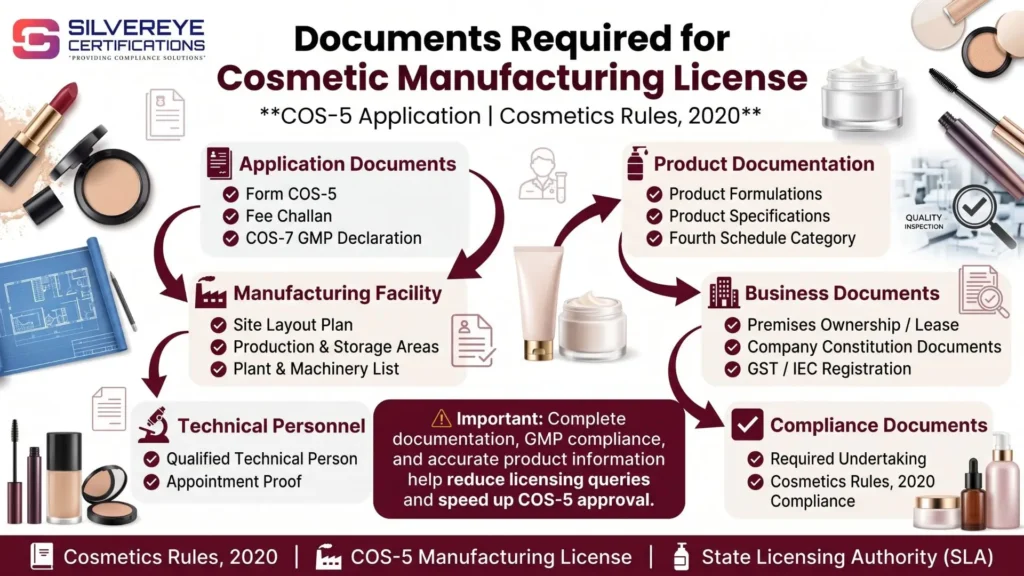
Documents Required for COS-5 (Hair Styling Manufacturing)
- Duly filled Form COS-5
- Site plan / layout plan of manufacturing premises — clearly showing all functional areas including any aerosol filling or flammable material handling areas
- Proof of premises ownership or registered lease deed
- List of all manufacturing equipment with specifications and capacities
- List of QC equipment with calibration certificates
- Qualification certificates and appointment letters of technical staff
- Water analysis report — purified water quality certificate
- Fire NOC (No Objection Certificate) from the fire department — particularly important for aerosol and alcohol-based spray manufacturers
- PESO license or approval for aerosol cylinder filling (if manufacturing aerosol hair sprays or mousses)
- Explosion-proof electrical compliance certificate for flammable material handling areas (if applicable)
- Environmental clearance or NOC from State Pollution Control Board (if applicable)
- Product list with formulation overview for each hair styling product category
- SOPs for manufacturing, filling, QC, and flammable raw material handling
- GST registration certificate and PAN
- Constitution of firm — MOA/AOA, partnership deed, or proprietorship declaration
- Challan / fee payment receipt
COS-5 / COS-8 Inspection Process
After COS-5 submission, the SLA schedules a physical inspection. For hair styling product facilities, inspectors pay particular attention to:
- Aerosol filling safety arrangements if aerosol products are in scope
- Flammable solvent storage conditions and fire safety compliance
- Separation of product types to prevent cross-contamination — wax filling areas separate from liquid gel/serum lines
- Microbial contamination controls for water-based products (gels, mousses, sprays)
- Viscosity and hold-strength QC testing capability
- Submit Form COS-5 with documents and fee to SLA / State Drug Controller
- Receive acknowledgment; SLA scrutinizes documents
- SLA inspector visits manufacturing premises for physical inspection
- Deficiency notice (if any) — rectify within 30 days
- Re-inspection if required by SLA
- SLA grants COS-8 Manufacturing License — display prominently at premises
Manufacturing License Fees (COS-5 / COS-8)
| Fee Head | Amount (INR) |
| Application fee (COS-5) | Rs. 3,000 (general); varies by state and product category |
| License fee (COS-8) | Rs. 5,000 – Rs. 10,000 (state-specific) |
| Inspection fee | As per state schedule |
| Renewal fee | Typically 50–100% of original license fee (state-specific) |
| Amendment fee | Rs. 1,000 – Rs. 3,000 per amendment (state-specific) |
Manufacturing license fees vary by state. Confirm the current fee schedule with your SLA before submitting COS-5.
Aerosol Hair Sprays and Mousses — Special Compliance Requirements
Aerosol hair sprays and mousses represent a product sub-category with additional compliance requirements beyond standard cosmetic licensing. Because aerosols contain pressurized flammable propellants (isobutane, propane, dimethyl ether), they are subject to both CDSCO cosmetic regulation and PESO (Petroleum and Explosives Safety Organization) oversight for aerosol filling.
| Compliance Area | Requirement for Aerosol Hair Spray / Mousse Manufacturers and Importers |
| CDSCO Cosmetic License | COS-8 (manufacturing) or COS-2 (import) — mandatory for all aerosol hair styling products as cosmetics |
| PESO Aerosol Filling Licence | Domestic aerosol hair spray manufacturers must hold a PESO license for aerosol filling operations under the Gas Cylinders Rules, 2016; importers receive pre-filled aerosols and do not need PESO filling license |
| Flammability Warning on Label | Mandatory under Schedule XI, Cosmetics Rules, 2020 and Aerosol industry standards — 'Flammable', 'Keep away from fire and flame', 'Do not pierce or incinerate' |
| Propellant Specification | Propellants must be cosmetic/pharmaceutical grade — isobutane, n-butane, propane, or dimethyl ether (DME); concentrations and purity specifications must be documented |
| Aerosol Can Pressure Test | Every aerosol can must be pressure-tested (water bath test) before despatch — standard quality check in aerosol manufacturing |
| Fill Pressure Limits | Internal pressure must comply with transportation regulations (IATA DGR, ADR) for aerosols above a specified volume and pressure |
| Import Documentation (COS-1) | For imported aerosol hair sprays: propellant specification and aerosol pressure data must be included in the COS-1 technical dossier |
| State Fire NOC | Manufacturing facility producing aerosol hair sprays must obtain a fire NOC from the state fire department before commencing production |
Schedule M-II GMP Compliance for Hair Styling Product Manufacturers
Schedule M-II of Cosmetics Rules, 2020 prescribes Good Manufacturing Practice standards for all cosmetic manufacturers. For hair styling product facilities, the following GMP areas deserve special focus:
| GMP Area | Specific Requirements for Hair Styling Product Manufacturing |
| Premises and Equipment | Stainless steel or food-grade contact surfaces for all mixing and filling equipment; high-shear mixing capability for gel formation; adequate filling machine precision for consistent pack weights |
| Raw Material Testing | Polymers (carbomer, PVP, polyquaternium): test for viscosity, pH, identity; solvents (ethanol): strength and purity; wax bases: melting point and identity; botanical extracts (for natural styling products): botanical identity and heavy metal testing |
| In-Process Controls | Viscosity checks at multiple stages of gel manufacture; pH monitoring; homogeneity checks for wax and clay products; aerosol filling weight checks (fill weight, propellant weight) |
| Microbial Control | Water-based products (gels, mousses, pump sprays): strict microbial controls in manufacturing area; purified water system; air quality monitoring; PET validation for preservative system |
| Batch Records (BMR) | Complete Batch Manufacturing Record for every production batch — raw material quantities, equipment used, in-process results, yield, QC approval; minimum 3-year retention |
| QC Release Testing | No batch to be released without QC approval — tests include appearance, colour, odour, pH, viscosity, microbial count (TPC, yeast/mould), preservative content, and hold performance assessment for styling products |
| Stability Programme | Ongoing stability testing of representative batches at accelerated and real-time conditions; particularly critical for natural/organic hair styling products with reduced synthetic preservatives |
| Cleaning and Cross-contamination | Validated cleaning procedures for all equipment between batches — particularly important when manufacturing both wax-based and water-based products on shared equipment |
Labelling Requirements for Hair Styling Products Under Cosmetics Rules, 2020
Every hair styling product sold in India must comply with Schedule XI labelling requirements of Cosmetics Rules, 2020. Labels must be in English (and regional language where required by state regulations). For imported products, the COS-2 license holder's details must appear on the label.
| Mandatory Label Element | Specific Requirements for Hair Styling Products |
| Brand and Product Name | As specified in the COS-2 or COS-8 license; any name change requires license amendment |
| Manufacturer / Importer Name and Address | Full name and address; for imported products, both foreign manufacturer and Indian COS-2 holder must appear |
| Country of Origin | Mandatory for imported products — 'Country of Origin: [Country]' |
| INCI Ingredient List | All ingredients in descending order by weight using INCI names — polymers, propellants, solvents, preservatives, and botanical extracts must all appear; 'Aqua' not 'Water', 'Parfum' for fragrance blend |
| Fragrance Allergen Disclosure | 26 designated fragrance allergens must be individually declared if above threshold concentration in the formula — critical for fragrance-heavy hair serums and styling creams |
| Batch Number | Mandatory — enables recall traceability |
| Date of Manufacture and Expiry | Both must appear — or 'Best Before [date]' format; particularly important for natural/herbal styling products with shorter shelf life |
| Net Content | In metric units — weight (g/kg) for gels, waxes, creams; volume (ml/L) for liquid serums and sprays; net weight after propellant for aerosols |
| MRP (Maximum Retail Price) | Mandatory under Legal Metrology Act for all retail products sold in India |
| Flammability Warning | Mandatory for all aerosol hair sprays and mousses — 'Flammable: keep away from fire and flame'; 'Do not spray near naked flame or any incandescent material'; 'Do not pierce or incinerate, even when empty' |
| Instructions for Use | For chemical relaxers and perm solutions: mandatory instructions including patch test requirement, processing time, and professional recommendation; for keratin treatments: formaldehyde content and ventilation requirement warning |
| 'Keep Away from Eyes' | Standard warning for styling gels, sprays, and products with high polymer or alcohol content |
Restricted and Prohibited Ingredients in Hair Styling Products
The Cosmetics Rules, 2020 prescribe permitted, restricted, and prohibited ingredients for cosmetics in India. Hair styling product manufacturers and importers must verify ingredient compliance before applying for a license.
| Ingredient / Category | Regulatory Status in India |
| Formaldehyde and formaldehyde-releasing preservatives (in keratin treatments) | Permitted only within specified maximum concentration limits; products exceeding the limit are non-compliant; 'formaldehyde-free' claims must be substantiated by lab testing |
| Thioglycolate compounds (in perm solutions) | Permitted within concentration limits specified in Cosmetics Rules, 2020; pH and concentration data required in product documentation |
| Sodium hydroxide / calcium hydroxide (in relaxers) | Permitted for cosmetic use within concentration limits; professional use warning mandatory; exceeding permitted alkali concentrations makes the product non-compliant |
| Volatile silicones (cyclopentasiloxane / D5 in serums and sprays) | Permitted in India under current Cosmetics Rules 2020; EU has restricted D4, D5, D6 in wash-off cosmetics — manufacturers targeting export to EU must adjust formulation |
| Resorcinol (sometimes used in hair dyes / straighteners) | Restricted — maximum concentration limit applies; professional use warning required |
| p-Phenylenediamine / PPD (in hair dyes combined with styling) | Restricted — maximum concentration limit; mandatory warning label; PPD is a known sensitiser — patch test instruction mandatory |
| Lead compounds (in some traditional hair preparations) | Prohibited — no detectable level permitted; lead acetate used in gradual hair dyes is prohibited in India |
| Benzene (used historically as a solvent in some hair products) | Prohibited — carcinogen; must not appear in formulation or as a contaminant above trace impurity limits |
| Cationic polymers at very high concentrations | Not prohibited but SAR assessor must assess scalp safety at proposed usage concentration; some polyquaterniums have concentration-dependent irritation potential |
| Microplastics (polyethylene, polypropylene in styling scrubs) | EU has banned intentionally added microplastics; India does not have a formal ban under Cosmetics Rules 2020 as of 2026 but CDSCO scrutiny is increasing; manufacturers targeting sustainable claims should eliminate microplastics |
Validity and Renewal of Hair Styling Cosmetic Licenses
| License Type | Form | Validity | Renewal Process |
| Import License (Hair Styling) | COS-2 | 5 years from date of issue | Renewal via SUGAM portal — updated CFS, GMP certificate, SAR (if expired), stability data; apply at least 3 months before expiry |
| Manufacturing License (Hair Styling) | COS-8 | 5 years from date of issue | Renewal application to SLA with updated staff and premises details; re-inspection may be ordered; apply 3–6 months before expiry |
| Loan License (D2C Brands) | COS-9 | Co-terminus with licensor's COS-8 (max 5 years) | Renew with COS-8 of contract manufacturer; fresh Loan License Agreement required if manufacturer changes |
Renewal Checklist for Hair Styling Product Licenses
- Confirm CFS validity — CFS from country of origin for imported products is typically valid for 2 years; obtain renewal from the foreign competent authority if expired
- Update GMP / ISO 22716 certificate — manufacturer's GMP certificate must be current at time of renewal
- Refresh stability data if original data period has elapsed or product formulation has changed
- For aerosol products: confirm PESO aerosol filling license (for manufacturers) is also current alongside COS-8 renewal
- Check for any new Cosmetics Rules amendments that may restrict ingredients in your hair styling product formulations — update product accordingly before filing renewal
Benefits of Obtaining CDSCO Registration for Hair Styling Products
- Legal Market Access: Only licensed hair styling products can be legally sold in India — through retail, modern trade, e-commerce, or salon distribution channels.
- E-Commerce Onboarding: Amazon India, Flipkart, Myntra, Nykaa, and all major Indian marketplaces require valid CDSCO cosmetic license documentation before onboarding hair styling product sellers.
- Salon Professional Supply: Professional salon distributors and salon chains require CDSCO license proof before stocking any hair styling product — licensing is a commercial prerequisite in the professional segment.
- Export Readiness: Indian hair styling product manufacturers with COS-8 and GMP compliance are better positioned to meet export market documentation requirements in the Middle East, SAARC countries, and Southeast Asia.
- Consumer Trust: Regulatory compliance is increasingly a consumer expectation in the premium and natural hair styling segment — licensing demonstrates product safety and quality assurance.
- Investment Readiness: D2C hair styling brands seeking funding must demonstrate CDSCO compliance — investors treat regulatory licensing as a key due diligence item.
- Penalty Avoidance: Manufacturing or selling unlicensed hair styling products is a criminal offence under Section 18 of the Drugs and Cosmetics Act — penalties include imprisonment up to 3 years, fine, and product seizure.
How Silvereye Certifications Can Help
Silvereye Certifications is a specialist regulatory compliance consultancy with deep expertise in CDSCO cosmetic licensing, Cosmetics Rules, 2020 compliance, SUGAM portal filings, and product-specific regulatory advisory including hair styling products. Our team has guided domestic manufacturers, D2C hair care brands, professional salon product companies, and international hair styling brands through every stage of the Indian regulatory process.
- COS-1 and COS-2 import license applications for hair gels, waxes, sprays, serums, mousses, and professional styling products
- COS-5 and COS-8 manufacturing license applications including aerosol hair spray facility compliance
- COS-9 Loan License support for D2C hair styling brands
- INCI formulation list preparation and cosmetic ingredient compliance screening
- Safety Assessment Report (SAR) coordination for hair styling products including aerosol and chemical treatment submissions
- Formaldehyde compliance review for keratin and smoothing treatment imports
- Schedule M-II GMP gap assessment for hair styling product manufacturing facilities
- Aerosol compliance advisory — PESO aerosol filling license, fire NOC, and flammability labelling
- Schedule XI labelling compliance audit — INCI, allergen declaration, warning text, and mandatory elements
- SUGAM portal registration, application filing, query response management, and COS-2 download
- Post-license compliance management, renewal calendar tracking, and amendment filings
Frequently Asked Questions
Is CDSCO registration mandatory for all hair styling products including professional salon brands?
Yes. CDSCO cosmetic licensing is mandatory for all hair styling products sold commercially in India — consumer brands and professional salon brands are treated identically under the Drugs and Cosmetics Act, 1940 and Cosmetics Rules, 2020. There is no exemption for 'professional use only' products.
Do I need a separate CDSCO license for each hair styling product SKU?
Not necessarily. The COS-8 manufacturing license covers product categories rather than individual SKUs. If you manufacture hair gels, your license covers all your gel products within the approved category — different fragrances, pack sizes, or hold strengths do not require separate licenses.
How long does it take to get a CDSCO import license (COS-2) for a hair styling product?
A complete COS-1 application with all required documents in order typically takes 30 to 90 working days to receive COS-2 approval from CDSCO. Applications for aerosol products, chemical relaxers, keratin treatments, or products with novel ingredients may take longer — 3 to 5 months — due to additional CDSCO scrutiny.
Does an aerosol hair spray need any additional approval beyond the CDSCO cosmetic license?
Yes. Domestic manufacturers of aerosol hair sprays need two layers of compliance: (1) COS-8 cosmetic manufacturing license from the SLA for the product as a cosmetic, and (2) a PESO license for the aerosol cylinder filling operation under the Gas Cylinders Rules, 2016, since aerosol filling involves handling pressurized flammable propellants. The manufacturing facility also needs a Fire NOC from the state fire department.
Can a D2C hair styling brand without a manufacturing facility get a CDSCO license?
Yes. D2C brands without their own manufacturing plant can use the Loan License route under Form COS-9. The brand (loan licensee) partners with a licensed cosmetic manufacturer (loan licensor holding a valid COS-8) who manufactures the products at their facility under the brand's name. The brand owner applies for a COS-9 Loan License from the SLA.
What are the formaldehyde rules for keratin hair straightening treatments?
Formaldehyde in keratin hair treatments is a highly scrutinised area under the Cosmetics Rules, 2020. Formaldehyde and formaldehyde-releasing preservatives are permitted in cosmetics only within specified maximum concentration limits. Products that exceed these limits are non-compliant and may be classified as dangerous substances rather than cosmetics. If you are importing or manufacturing a keratin hair treatment in India, you must submit lab test evidence confirming the formaldehyde content is within permitted limits.
Is a hair serum classified differently from a hair gel for CDSCO licensing purposes?
No. Both hair serums and hair gels are classified as hair care cosmetics under the Cosmetics Rules, 2020 and follow the same licensing pathway — COS-8 (manufacturing) or COS-2 (import). The cosmetic licensing framework categorises products by their intended use and application site (hair care, skin care, nail care, etc.) rather than by their physical form (gel vs. serum vs. oil).
Are natural and organic hair styling products subject to the same CDSCO registration as conventional products?
Yes, without exception. Natural, organic, herbal, or botanical hair styling products — aloe vera hair gel, flaxseed styling gel, botanical hair spray, natural hair wax with beeswax and coconut oil — are classified as cosmetics under the Drugs and Cosmetics Act, 1940. There is no exemption or simplified pathway for natural ingredients. The same COS-5 / COS-8 (manufacturing) or COS-1 / COS-2 (import) licensing framework applies
What happens if I sell hair styling products on Instagram or my own website without a CDSCO license?
Selling unlicensed cosmetics through any channel — including social media, your own website, WhatsApp commerce, or any digital platform — is a violation of Section 18 of the Drugs and Cosmetics Act, 1940. CDSCO and state drug authorities actively monitor e-commerce platforms and social media for unlicensed cosmetic sellers.
How do I add a new hair styling product to my existing COS-8 manufacturing license?
If the new product falls within a product category already covered by your existing COS-8 license — for example, you have a hair gel license and want to add a new gel variant — you do not need a fresh license; the existing COS-8 covers it.