- Tatkal is FSSAI's instant, self-declaration-based issuance route — no physical premises inspection — available for a specific list of low-risk food businesses like wholesalers, distributors, retailers, and transporters.
- It lives nationwide except in Chandigarh, Himachal Pradesh, and Meghalaya, where state-specific rollout is still pending.
- A Tatkal license or registration is valid for 1 year only, even though standard-route approvals issued after 1 April 2026 now carry perpetual validity — this is one of the few places the two systems diverge.
- Dairy, meat, and fish-handling businesses, along with caterers, are excluded from Tatkal regardless of how low-risk their specific operation might seem — they must go through the standard licensing route.
Introduction
FSSAI Tatkal license registration is an instant-issuance route that lets eligible food businesses get their FSSAI approval the same day, through self-declaration and digital verification (Aadhaar, PAN, GST, or CIN) instead of a physical inspection. It's available nationwide, except in Chandigarh, Himachal Pradesh, and Meghalaya, for specific low-risk categories — wholesalers, distributors, retailers, transporters, storage operators without atmospheric control, importers, and small hawkers/snack sellers, among others.
Dairy, meat, fish-handling businesses, and caterers are excluded and must use the standard process. The government fee is the same as a standard application, but a Tatkal-issued license or registration is valid for 1 year only, after which renewal follows the normal process.
What Is FSSAI Tatkal License Registration?
FSSAI Tatkal license registration is an expedited, self-declaration-based approval route on the FoSCoS portal that lets certain low-risk food businesses get their FSSAI license or registration almost immediately, instead of waiting through the usual document-review and inspection timeline. It was launched under FSSAI Order No. RCD-05007/1/2021, dated 1 July 2024, as a specific ease-of-doing-business initiative.
The core idea is straightforward: for business categories FSSAI considers genuinely low-risk from a food safety standpoint — think a wholesaler storing packaged goods, or a retailer selling pre-packaged food — a physical premises inspection before issuance adds delay without adding much real safety value. Tatkal replaces that upfront inspection with digital identity and business verification, while still preserving FSSAI's right to inspect and act on the business later if anything doesn't check out.
Is Tatkal Available in Your State?
Tatkal was initially piloted in a handful of states before being extended nationwide via a further FSSAI order, effective 31 August 2024. As of that rollout, Tatkal issuance is available across India, with one specific carve-out:
| Coverage | Status |
| Most Indian states and Union Territories | Tatkal instant issuance available, subject to state-specific implementation of the provisions |
| Chandigarh (UT) | Excluded — Tatkal not yet extended here |
| Himachal Pradesh | Excluded — Tatkal not yet extended here |
| Meghalaya | Excluded — Tatkal not yet extended here |
Even in states where Tatkal is available, FSSAI notes that provisions are implemented after incorporating state-specific requirements — so it's worth confirming Tatkal is actively enabled for your specific state and category on FoSCoS before assuming it applies to your application.
Which Businesses Qualify for FSSAI Tatkal?
Tatkal eligibility is built around a specific, defined list of Kind of Business (KoB) categories that FSSAI considers low-risk enough for self-declaration-based issuance.
| Eligible for Tatkal | Excluded from Tatkal |
| Wholesalers | Businesses dealing in dairy products |
| Distributors | Businesses dealing in meat |
| Retailers | Businesses dealing in fish |
| Transporters | Caterers (must obtain at least a State License regardless of turnover) |
| Storage operators without atmospheric control (ambient/dry storage) | Cold storage and controlled-atmosphere storage facilities |
| Importers | Any business already holding a valid license/registration for the same premises |
| Food vending agencies | Any business whose FSSAI license/registration was suspended or cancelled within the preceding 3 months |
| Direct sellers | — |
| Merchant-exporters | — |
| Petty retailers of snacks/tea shops | — |
| Hawkers (itinerant/mobile food vendors) | — |
A useful pattern to notice: Tatkal generally covers businesses that trade, store, transport, or sell already-manufactured, packaged food — not businesses that manufacture, process, or handle inherently higher-risk raw ingredients like dairy, meat, or fish, where a physical hygiene inspection has more genuine food-safety value before approval.
Documents Required for FSSAI Tatkal Application
Document requirements are deliberately lighter than the standard process, since Tatkal relies on digital verification rather than paper-heavy scrutiny — but they still differ slightly depending on whether you're applying for Tatkal Registration or a Tatkal License.
For Tatkal Registration (proprietorship-level, smaller businesses)
- PAN and Aadhaar for wholesalers, retailers, distributors, and transporters
- Aadhaar alone is generally sufficient for petty snack sellers, tea sellers, and hawkers
- A photograph of the shop owner standing in front of the shop, with the shop's name/address board visible
For Tatkal License (State-level applications)
- GST registration and Aadhaar for digital verification
- CIN (Corporate Identification Number) and Aadhaar, for partnership firms or registered companies
Common to both routes
- A completed self-declaration form confirming your eligibility — that you don't already hold a license for the same premises, haven't had a license suspended/cancelled in the last 3 months, and don't deal in dairy, meat, or fish (where those exclusions apply to your category)

Step-by-Step: How to Apply for FSSAI Tatkal
- Confirm your Kind of Business is on the Tatkal-eligible list, and that Tatkal is active in your state — check the current status on FoSCoS before proceeding.
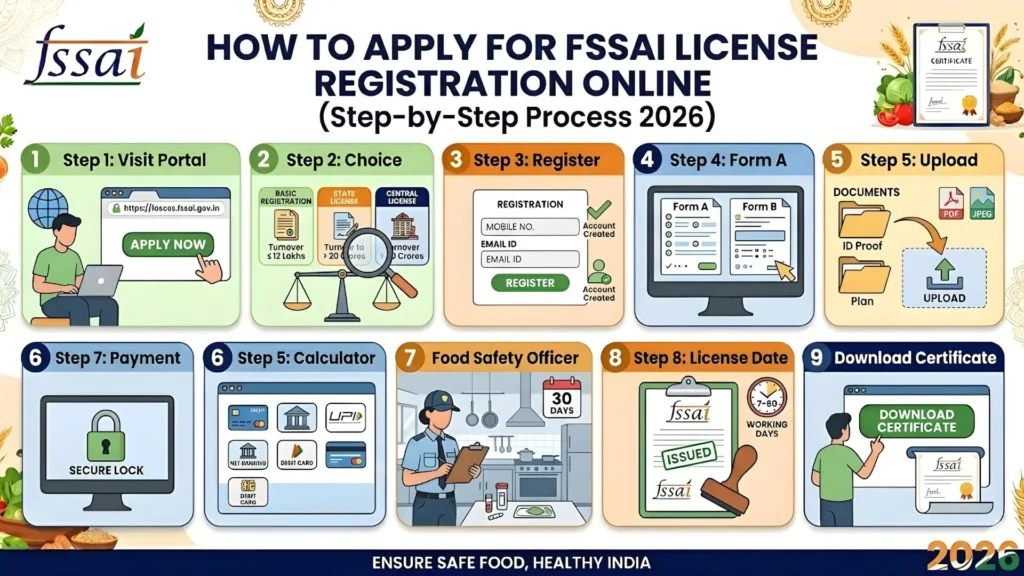
- Visit the FoSCoS portal (foscos.fssai.gov.in) and select the Instant (Tatkal) Registration or License option, as applicable to your turnover tier.
- Enter your business details — name, address, Kind of Business, and product categories.
- Upload the required identity/business documents (PAN, Aadhaar, GST, or CIN, depending on your category).
- Complete the self-declaration form, confirming your eligibility for the Tatkal route.
- Pay the applicable annual government fee upfront, in full — Tatkal doesn't offer the multi-year prepayment option available under the standard route.
- Your identity and business details are verified electronically against Aadhaar, PAN, GST, or CIN records.
- On successful verification, your license or registration certificate is typically issued within a very short window — commonly cited as within 48 hours of completing payment and verification, without a physical premises inspection.
FSSAI Tatkal Fee Structure
| License/Registration Type | Annual Government Fee | Issuance Timeline |
| Basic Registration (Tatkal) | ₹100 | Same fee as standard route; issued near-instantly on verification |
| State License (Tatkal, where eligible) | ₹2,000 – ₹5,000 (category-dependent) | Same fee as standard route; issued near-instantly on verification |
The government fee itself is identical whether you go through Tatkal or the standard process — what Tatkal changes is the speed of issuance, not the cost. Unlike the standard route, though, Tatkal requires the full annual fee to be paid upfront in one go, rather than offering the option to prepay for multiple years at once.
How Long Is a Tatkal License Valid?
This is one of the most important — and most frequently misunderstood — details about Tatkal, especially given FSSAI's broader move toward perpetual validity for licenses issued after 1 April 2026. A Tatkal-issued license or registration is valid for 1 year only, regardless of the perpetual-validity reform that now applies to standard-route approvals.
| Issuance Route | Validity |
| Standard route, issued on or after 1 April 2026 | Perpetual — no fixed expiry, subject to risk-based inspection and ongoing compliance |
| Standard route, chosen term (issued before 1 April 2026 or where perpetual validity doesn't yet apply) | 1 to 5 years, as selected and paid for at the time of application |
| Tatkal route | 1 year only, regardless of when it was issued |
After your Tatkal-issued approval's 1-year term ends, renewal follows the standard, non-instant process — you can't simply repeat the Tatkal route indefinitely as a way of avoiding the eventual standard renewal and its associated review.
What Happens After a Tatkal License Is Issued
It's worth understanding that Tatkal approval is issued on a self-declaration basis, which means the upfront speed comes with an important trade-off: FSSAI retains the right to verify your declared information after issuance, including through inspection. If your declared details turn out to be false or don't match the reality of your business, this can lead to suspension or cancellation of your Tatkal-issued approval, independent of the standard grounds for licensing action.
- Keep your business operating exactly as declared — the same premises, the same Kind of Business, the same product categories.
- Maintain basic hygiene and food safety practices appropriate to your category, even without an upfront inspection, since these can still be checked later.
- If your business circumstances change significantly (new address, new activity, ownership change), file a modification rather than assuming your Tatkal approval automatically covers the change.
Tatkal vs Standard FSSAI Application: Quick Comparison
| Tatkal | Standard Route | |
| Issuance speed | Near-instant (commonly within 48 hours of verification) | 7–10 days (Registration) to 30–90 days (State/Central License) |
| Physical inspection | None at the time of issuance | Typically required for State/Central License, at Basic Registration's discretion |
| Eligible categories | Specific low-risk KoBs only (wholesalers, retailers, transporters, etc.) | All categories |
| Validity | 1 year only | Perpetual (if issued on/after 1 April 2026) or 1–5 years as chosen |
| Fee payment | Full annual fee paid upfront, single year only | Can prepay for up to 5 years at once |
| Post-issuance risk | Subject to verification/inspection after issuance; false declarations can lead to suspension/cancellation | Standard compliance and inspection framework applies |
Conclusion
FSSAI Tatkal License Registration provides a faster and simpler compliance route for eligible low-risk food businesses that need their FSSAI approval quickly. The process is based on self-declaration and digital verification, which removes the need for a physical inspection before issuance and can significantly reduce the waiting time compared with the standard application route.
However, Tatkal is not available for every food business. It is mainly intended for eligible businesses such as wholesalers, distributors, retailers, transporters, importers, and certain small food sellers, while businesses dealing with dairy, meat, fish, catering, and certain storage activities are excluded.
Applicants should also remember that faster approval does not mean reduced compliance responsibility. The information provided through self-declaration must be accurate, and FSSAI can conduct verification or inspection after issuance. A false declaration may result in suspension or cancellation of the approval.
Most importantly, a Tatkal FSSAI approval is valid for one year only, unlike the perpetual validity applicable to qualifying standard-route approvals issued from 1 April 2026. After the Tatkal validity expires, renewal follows the standard process.
Frequently Asked Questions
What is FSSAI Tatkal license registration?
It's an instant-issuance route on FoSCoS that lets eligible low-risk food businesses get their FSSAI license or registration through digital self-declaration and identity verification, without waiting for a physical premises inspection.
Who is eligible for FSSAI Tatkal?
Wholesalers, distributors, retailers, transporters, storage operators without atmospheric control, importers, food vending agencies, direct sellers, merchant-exporters, petty snack/tea retailers, and hawkers are generally eligible, subject to state-specific rollout.
Which businesses cannot use Tatkal?
Businesses dealing in dairy, meat, or fish are excluded, along with caterers, cold/controlled-atmosphere storage operators, and anyone who already holds a license for the same premises or had one suspended/cancelled in the preceding 3 months.
Is FSSAI Tatkal available in every state?
It's available nationwide except in Chandigarh, Himachal Pradesh, and Meghalaya, where the scheme hasn't yet been extended.
How long does it take to get an FSSAI license through Tatkal?
Commonly cited at within 48 hours of completing payment and digital verification, though actual turnaround can vary slightly by category and state.
How much does FSSAI Tatkal registration cost?
The same government fee as the standard route — ₹100 per year for Basic Registration, or ₹2,000–₹5,000 per year for a State License, depending on category. Tatkal doesn't cost extra; it changes the speed, not the price.
How long is a Tatkal FSSAI license valid?
1 year only, regardless of the perpetual-validity rule that now applies to standard-route licenses issued after 1 April 2026. Renewal after that follows the standard, non-instant process.
What documents do I need for FSSAI Tatkal registration?
For most categories: PAN and Aadhaar (or Aadhaar alone for hawkers/snack sellers), plus a photograph of the shop owner in front of the shop showing its name/address board. State License Tatkal applications typically need GST and Aadhaar, or CIN and Aadhaar for registered companies.
Can I keep renewing through Tatkal every year?
No. After the 1-year Tatkal validity period ends, renewal follows FSSAI's standard, non-instant renewal process rather than repeating the Tatkal route indefinitely.
Can a cloud kitchen or restaurant use Tatkal?
Generally no — restaurants and food service businesses aren't on the standard Tatkal-eligible KoB list, which is focused on trading, storage, transport, and similar low-risk activities rather than food preparation and service.