- Smart rings sold or imported into India need WPC-ETA approval because they use Bluetooth/BLE, which is a de-licensed radio frequency.
- BIS (CRS) registration is currently not mandatory for smart rings, since the product category isn't on BIS's notified compulsory list.
- EPR registration under Plastic, Battery, and E-Waste rules applies to every smart ring brand, importer, and manufacturer.
- WPC-ETA approval has lifetime validity — no yearly renewal, unless you change the wireless module or product specs.
Introduction
Smart rings need WPC ETA approval before they can be sold, imported, or manufactured in India. Since a smart ring transmits data over Bluetooth or BLE — a de-licensed radio frequency — it falls squarely under the Wireless Planning & Coordination (WPC) Wing's Equipment Type Approval requirement, filed through the Saral Sanchar portal.
However, BIS registration is not currently required for smart rings, because the category hasn't been notified under the BIS Compulsory Registration Scheme (CRS) the way smartwatches have.
What does apply, apart from WPC-ETA, is Extended Producer Responsibility (EPR) registration under three separate rules: Plastic Waste Management, Battery Waste Management, and E-Waste Management.
Smart rings are one of the fastest-growing categories in India's wearable market right now, and if you're a brand, importer, or D2C seller planning to launch one, compliance is probably the part nobody explained to you clearly. Since a smart ring transmits data over Bluetooth or BLE, it's treated as a radio-frequency device under Indian law, which brings a specific set of approvals into play — and just as importantly, rules out one that a lot of people assume applies. Here's exactly what's mandatory for a smart ring in India, and what isn't.
Why Smart Rings Compliance Specifically Need WPC-ETA Approval
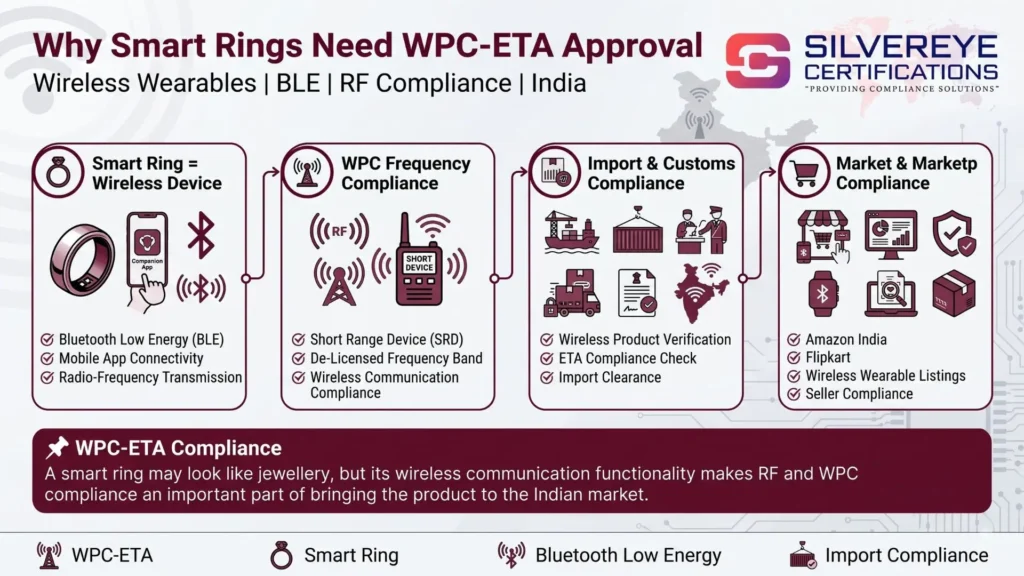
A smart ring might look like a piece of jewellery, but from a regulatory standpoint, it's a radio-frequency transmitting device — no different in principle from a smartwatch or a fitness band. Here's what makes it fall under WPC's jurisdiction:
- It uses Bluetooth Low Energy (BLE) to pair with a mobile app, which operates on a de-licensed frequency band regulated by WPC.
- It's classified as a Short Range Device (SRD) under WPC's frequency allocation rules, similar to wireless earbuds and fitness trackers.
- Customs authorities at Indian ports routinely check for a valid ETA number before releasing wireless-enabled electronics — without it, your shipment can be detained or seized.
- Marketplaces like Amazon India and Flipkart increasingly ask sellers to show WPC-ETA compliance for wireless-enabled wearables before listing approval.
Role of RF Testing in Smart Ring WPC-ETA Compliance
RF testing is the technical backbone of the entire WPC-ETA framework — it's what actually proves a smart ring's wireless module is safe to operate in India, rather than just paperwork confirming that you've applied. Every WPC-ETA approval is built on an RF test report generated by a NABL-accredited or WPC-recognized testing laboratory, and without a valid report, there's nothing for WPC to evaluate in the first place.
For a smart ring, RF testing looks at how the BLE (or NFC) module actually behaves once it's transmitting — not just what the chipset's datasheet claims on paper. That distinction matters, because two devices using the 'same' chipset can still test differently depending on antenna design, enclosure, and how the module is implemented on the ring's tiny circuit board.
What RF Testing Actually Checks
- Operating frequency band — Confirming the module transmits only within India's de-licensed bands (BLE and NFC typically operate in the 2.4 GHz ISM band).
- Transmission power (EIRP) — Checking the device doesn't exceed the maximum permitted radiated power for that frequency band.
- Spurious emissions — Making sure the module isn't leaking unwanted signal into frequency bands it has no business being in, which is the main way a device could interfere with other networks.
- Receiver characteristics — Confirming the module's receiver behaves within expected technical limits.
| Why this matters A device that 'should' comply on paper can still fail RF testing in practice — antenna placement inside something as small as a ring can genuinely shift how the module performs. This is exactly why WPC insists on an actual lab report rather than accepting a chipset manufacturer's general certification as sufficient on its own. |
Is a Smart Ring a Wearable or a Short-Range Device (SRD) Under WPC Rules?
WPC doesn't regulate devices by what they're marketed as — jewellery, fitness tracker, wearable — it regulates them by how they transmit signals. Under WPC's frequency allocation framework, a device that communicates over a short-range, de-licensed band using low transmission power is treated as a Short-Range Device (SRD), regardless of its physical form. A smart ring's BLE module places it squarely in this category, alongside wireless earbuds, fitness bands, and smartwatches.
This distinction matters because it's the transmission technology — not the product category name — that decides whether WPC-ETA applies. A brand can't argue its way out of approval by pointing to the ring's small size or its 'accessory' positioning; if it has a radio inside, WPC's jurisdiction kicks in.
Why Isn't BIS Certification Required for Smart Rings?
This is where most first-time brand owners, Importer and Manufacturers get confused, so let's be direct about it: BIS registration under the Compulsory Registration Scheme (CRS) is not currently mandatory for smart rings. Here's the reasoning, not just the conclusion.
BIS-CRS only applies to notified product categories. The Ministry of Electronics & IT (MeitY) maintains a specific, notified list of 75+ electronics and IT product categories under the Compulsory Registration Order — things like laptops, power banks, LED lights, wireless keyboards, and yes, smartwatches. A product needs BIS-CRS registration only if it's explicitly named on that list.
Smart rings are not on that notified list. Smartwatches are named categories under CRS; smart rings, as a distinct product form-factor, currently are not. Since BIS-CRS registration is based on specific notification — not a general 'all electronics' rule — a category that hasn't been notified doesn't trigger the mandatory registration requirement.
BIS periodically expands the CRS list as new device categories mature and become common in the market (this is exactly how smartwatches, power banks, and wireless earbuds got added over the years). Because of that, it's worth treating this as the current position rather than a permanent exemption, and re-checking applicability if you're planning a long-term product roadmap.
EPR Compliance for Smart Rings: Plastic, Battery & E-Waste
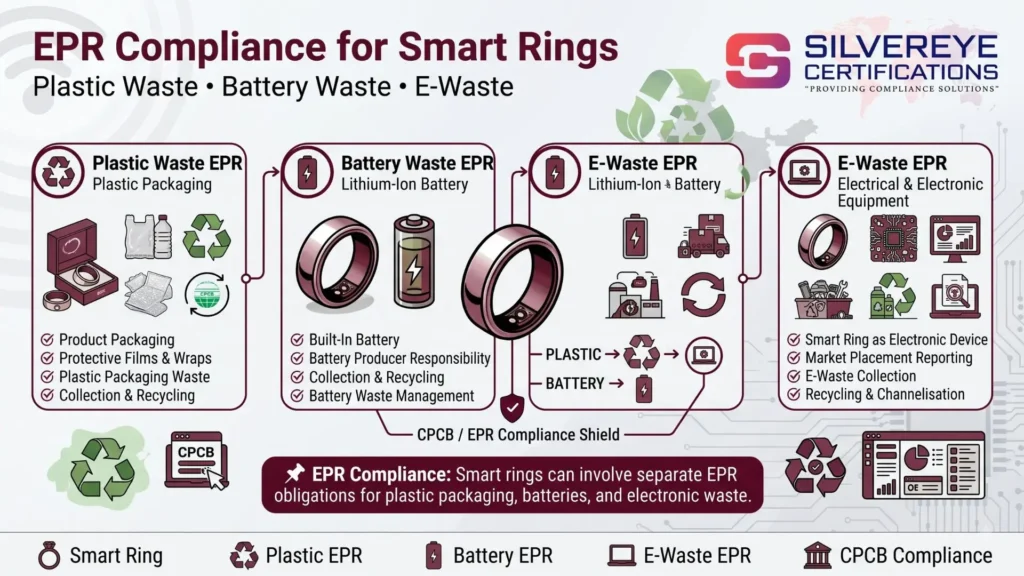
Extended Producer Responsibility (EPR) makes the brand, importer, or manufacturer legally responsible for what happens to a product after its useful life — from its plastic packaging to the lithium battery inside it. For smart rings, three separate EPR registrations typically apply, and each is handled through the Central Pollution Control Board (CPCB) portal.
1. EPR – Plastic Waste Management
Every smart ring ships in plastic packaging — blister packs, charging-case wrap, protective film, courier packaging. Under the Plastic Waste Management Rules, 2016 (as amended), any brand owner, importer, or producer using plastic packaging must register on the CPCB's EPR portal and commit to collecting and recycling an equivalent quantity of plastic waste each year.
2. EPR – Battery Waste Management
A smart ring runs on a small built-in lithium-ion battery. Under the Battery Waste Management Rules, 2022, the entity placing the battery-containing product in the Indian market — whether that battery is sold separately or embedded inside the device — must register as a producer and fulfil annual battery-collection and recycling obligations.
3. EPR – E-Waste Management
A smart ring is, at its core, an electrical and electronic device, which brings it under the E-Waste (Management) Rules, 2022. Manufacturers and importers must register as producers on the CPCB portal, report the volume of devices placed in the market, and meet prescribed e-waste collection and channelization targets.
Who Is Considered the Producer Under EPR for Private-Label Smart Rings?
A lot of smart ring brands in India don't manufacture the ring themselves — they source it from a contract manufacturer, put their own branding on the packaging, and sell it as their own product. This raises a genuine question: who's actually responsible for EPR in that setup?
Under India's EPR framework, the "producer" is defined broadly enough to include the brand owner and Importer, not just the factory doing the manufacturing. If your company's name is on the packaging and you're the one importing the product in the Indian market — even if a third party manufactures it — you're generally the one responsible for registering and meeting EPR obligations, not the manufacturer you sourced it from.
This is worth flagging early, because it's a common assumption among D2C and private-label sellers that EPR is 'the factory's problem.' It isn't. If your brand is on the box, the compliance obligation generally follows the brand.
Legal Metrology Declarations for Smart Ring Packaging
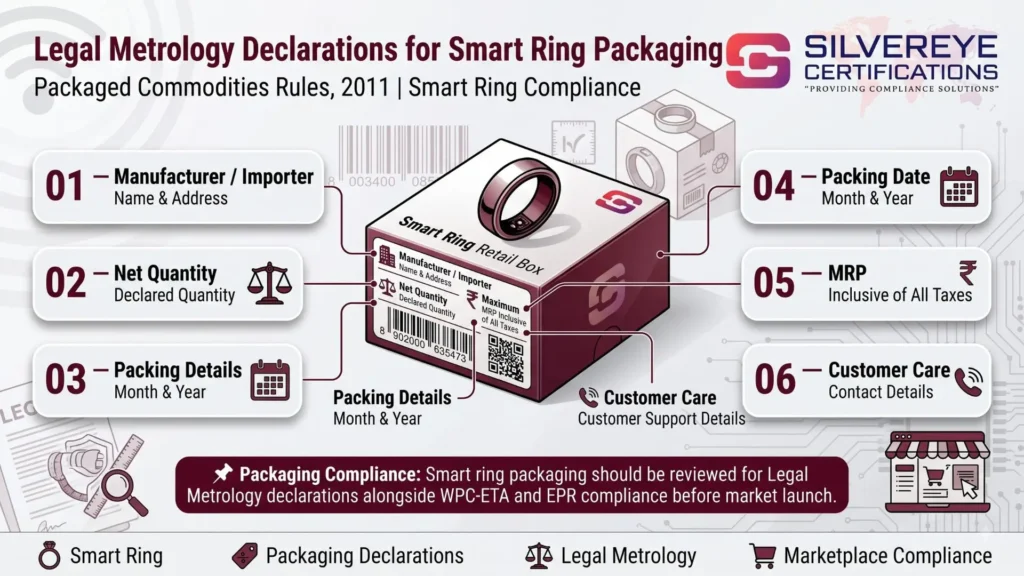
This one gets overlooked because it isn't specific to wireless devices — it applies to almost every pre-packaged product sold in India. Under the Legal Metrology (Packaged Commodities) Rules, 2011, any pre-packaged good, including a boxed smart ring, needs certain declarations printed on its packaging before it can be legally sold: the manufacturer's or importer's name and address, the net quantity, the month and year of packing, the Maximum Retail Price (MRP) inclusive of all taxes, and customer care contact details.
It's a separate requirement from WPC-ETA and EPR, but it sits in the same 'easy to miss until customs or a marketplace flags it' category. Marketplaces routinely reject listings that don't carry proper Legal Metrology declarations, so it's worth checking your packaging artwork alongside your wireless and EPR compliance, not after.
Who Needs WPC-ETA Approval for Smart Rings?
- Indian manufacturers produce smart rings domestically.
- Importers bringing smart rings into India from overseas manufacturing hubs.
- Foreign brands entering the Indian market, typically through an Authorized Indian Representative (AIR).
- E-commerce sellers and D2C brands who private-label or white-label a smart ring for the Indian market.
Benefits of Getting WPC-ETA & EPR Compliance Right
- Smooth customs clearance — Shipments with a valid ETA number rarely get held up at Indian ports.
- Legal protection — Avoids seizure of stock, fines, and forced product recalls.
- Marketplace approval — Amazon, Flipkart, and other platforms are increasingly asking sellers to declare compliance before listing wireless wearables.
- Investor and partner confidence — Clean regulatory paperwork matters during due diligence, funding rounds, or retail partnerships.
- Environmental accountability — EPR compliance builds genuine brand trust with increasingly eco-conscious consumers.
What Happens If You Skip WPC-ETA or EPR Compliance?
- Customs can detain or seize smart ring shipments arriving without a valid ETA number.
- Products already in the market can be pulled off shelves or delisted from e-commerce platforms.
- Monetary penalties can apply under the Indian Telegraph Act framework for operating uncertified wireless equipment.
- Non-compliance with EPR obligations can attract environmental compensation charges levied by the CPCB.
How Customs Verifies WPC-ETA Compliance for Smart Ring Shipments
For imported smart rings, WPC-ETA compliance is typically checked at the customs clearance stage, before the shipment is released into the country. Import documentation is expected to reference the product's ETA number, and customs officials can cross-check this against WPC's records. A shipment that arrives without a traceable ETA number with QR Code risks being held at the port while the importer sorts out compliance, which is exactly the kind of delay — and demurrage cost — brands are trying to avoid by getting approval sorted before the first shipment ever leaves the origin country.
This is also why it's worth getting WPC-ETA approval before finalizing bulk purchase orders, rather than after stock is already in transit — retrofitting compliance once a shipment is an route leaves very little room to fix problems if the RF test report doesn't hold up to scrutiny.
Common Mistakes Brands Make
- Assuming a smart ring is 'just jewellery' and skipping WPC-ETA entirely — the BLE chip inside is what matters, not the form factor.
- Applying for BIS registration unnecessarily, when the product category isn't currently on the notified CRS list — this wastes both time and money.
- Registering EPR for e-waste but forgetting the separate plastic packaging and battery obligations.
- Not updating the ETA when switching to a new Bluetooth chipset supplier mid-production run.
Why Work With Silvereye Certifications
Getting this right on your own is possible, but it eats time you'd rather spend building your product. Silvereye Certifications is a regulatory compliance consultancy that works specifically on WPC-ETA, BIS/CRS, and EPR (Plastic, Battery, E-Waste) approvals for electronics and wearable brands entering the Indian market. For a smart ring launch, that typically means:
- Assessing your product's wireless module and confirming exactly which approvals apply — and which don't.
- Coordinating RF testing with accredited labs and preparing the technical documentation WPC expects.
- Filing and tracking your application end-to-end on the Saral Sanchar portal.
- Registering and managing your Plastic, Battery, and E-Waste EPR obligations on the CPCB portal, including annual return filing.
- Acting as your point of contact for any queries raised by WPC or CPCB during processing.
If you're planning a smart ring launch in India, it's worth having a compliance partner who already knows which approvals genuinely apply to your product, so you're not paying for — or waiting on — certifications you don't need.
Pre-Launch Compliance Checklist for Smart Ring Brands
Before you finalise a bulk order or list your smart ring on a marketplace, it's worth running through this quickly:
- Confirm the wireless module (BLE, NFC, or both) and get it RF-tested for WPC-ETA.
- Verify your product category still isn't on BIS's notified CRS list — don't assume last year's answer still holds.
- Register on the CPCB portal for Plastic EPR, covering all packaging materials used.
- Register separately for Battery EPR, since the built-in lithium-ion cell isn't covered under Plastic or E-Waste filings.
- Register for E-Waste EPR as the producer, even if manufacturing is outsourced to a third party.
- Keep your ETA number ready in shipping and customs documentation before stock leaves the origin country.
- Re-confirm compliance status if you change chipset suppliers, add new features (like NFC payments), or rebrand the product.
Conclusion
Smart rings sit in a fairly specific compliance zone in India right now: WPC-ETA approval is mandatory because of the Bluetooth/BLE module inside, BIS registration currently isn't required because the category hasn't been notified under CRS, and EPR registration across Plastic, Battery, and E-Waste rules is non-negotiable because of the packaging, the built-in battery, and the electronic components. Getting this combination right the first time saves you from customs delays, marketplace listing issues, and penalties down the line — and it's a lot easier to sort out before your first shipment lands than after it's stuck at a port.
If you'd rather have someone who handles this daily take it off your plate, Silvereye Certifications works specifically on WPC-ETA, BIS/CRS, and EPR compliance for electronics and wearable brands, and can walk you through exactly what your smart ring needs — and what it doesn't — before you launch in India.
Frequently Asked Questions
Do smart rings need WPC-ETA approval in India?
Yes. Since smart rings use Bluetooth or BLE to connect with a companion app, they operate on a de-licensed radio frequency band, which makes WPC-ETA approval mandatory before sale, import, or manufacture in India.
Is BIS registration required for smart rings?
No, not currently. BIS/CRS registration only applies to product categories specifically notified by MeitY, and smart rings aren't on that notified list at present, unlike smartwatches, which are.
What is EPR, and why does it apply to smart rings?
EPR (Extended Producer Responsibility) makes brands responsible for the post-use disposal of their products. A smart ring involves plastic packaging, a built-in battery, and electronic components, so it needs EPR registration under Plastic Waste, Battery Waste, and E-Waste Management Rules.
Can I import smart rings into India without WPC-ETA approval?
No. Customs authorities can detain or seize shipments of wireless devices, including smart rings, that don't have a valid ETA number on record.
Who is responsible for EPR registration — the manufacturer or the seller?
The 'producer' under EPR rules is typically the brand owner, manufacturer, or importer who places the product in the Indian market — not the retailer or marketplace seller reselling it.
Is a separate EPR registration needed for the battery inside a smart ring?
Yes. Even though the battery is built into the device and not sold separately, the Battery Waste Management Rules, 2022 still require the producer to register and report on it separately from the E-Waste EPR filing.
Will smart rings ever need BIS registration in the future?
It's possible. BIS periodically expands its CRS notified list as new device categories become common in the market, similar to how smartwatches and wireless earbuds were added over time. It's worth re-checking applicability periodically rather than assuming the current exemption is permanent.
Can a foreign smart ring brand apply for WPC-ETA directly?
Foreign manufacturers usually need to appoint an Authorized Indian Representative (AIR) to file the WPC-ETA application on their behalf, since the WPC Wing requires an Indian point of contact for compliance and communication.
What happens if a smart ring brand skips EPR registration?
The CPCB can levy environmental compensation charges on brands that don't meet their Plastic, Battery, or E-Waste EPR obligations, and repeated non-compliance can affect a brand's standing during audits or marketplace checks.
Does WPC-ETA cover product safety, or just radio frequency?
Only radio frequency. WPC-ETA confirms a device's wireless module operates within permitted frequency bands and power limits — it doesn't assess general product safety, which is what BIS certification would normally cover for notified categories.