

- WPC Certificate for Import is legally mandatory for every wireless product — Bluetooth, Wi-Fi, RFID, Zigbee — entering India, no exceptions.
- Missing this approval means your shipment gets detained at customs, triggering demurrage fees that can exceed the product value itself.
- The WPC ETA carries lifetime validity per model — pay once, import that product forever without renewal.
- With the right documents in place, approval can be secured in as little as 1 to 3 working days via the Saral Sanchar portal.
- NEW IN 2026: GSR 47(E) dated 20 January 2026 has de-licensed the 5945–6425 MHz (lower 6 GHz) band. Wi-Fi 6E and Wi-Fi 7 importers must now include this band in their ETA applications.
Introduction
You have paid your supplier in China, the container has been loaded, and your freight forwarder just confirmed the shipment arrived at Nhava Sheva port. You are days away from launching on Amazon and Flipkart. Then your CHA calls — Customs has put a hold on the goods, and the officer is asking for something called a WPC Certificate for Import.
By the time you finish reading, you will know exactly what the WPC import licence is, why it exists, which products trigger the requirement, how to get it step by step, what it costs, and — most importantly — how the regulatory landscape has changed in early 2026 with new rules around the 6 GHz frequency band that will directly affect anyone importing Wi-Fi 6E routers, Wi-Fi 7 devices, or any next-generation wireless gear.
What Is a WPC Certificate for Import?
WPC stands for Wireless Planning and Coordination — a specialized wing operating under India's Department of Telecommunications (DoT). Its primary job is to manage and regulate the use of radio frequency spectrum across the country. Think of it as the traffic authority for airwaves — ensuring that your Bluetooth speaker does not accidentally interfere with aviation frequencies or military communications.
A WPC Certificate for Import, technically known as an Equipment Type Approval or ETA, is an official document issued by the WPC Wing confirming that a specific wireless product model operates within India's approved de-licensed frequency bands and at permissible power levels. Without this document, Indian Customs will not release your goods — period.
What Is an ETA Certificate?
A WPC Certificate for Import — technically known as an Equipment Type Approval (ETA) — is an official document issued by the WPC Wing confirming that a specific wireless product model operates within India's approved de-licensed frequency bands and at permissible power levels. Without this document, Indian Customs will not release your goods. Full stop.
ETA vs. WPC Import License — What Is the Difference?
These two terms are often used interchangeably in trade circles, but there is a meaningful distinction:
| Term | Meaning & Who Needs It |
| ETA (Equipment Type Approval) | Technical approval proving your product model complies with India's frequency regulations. The standard document for consumer electronics — Bluetooth, Wi-Fi, RFID, Zigbee, and from 2026, Wi-Fi 6E / Wi-Fi 7. |
| WPC Import Licence | A separate licensing requirement for products operating on non-de-licensed or restricted bands — specialised broadcast equipment, certain walkie-talkies, amateur radio gear. More complex; takes 30+ working days. |
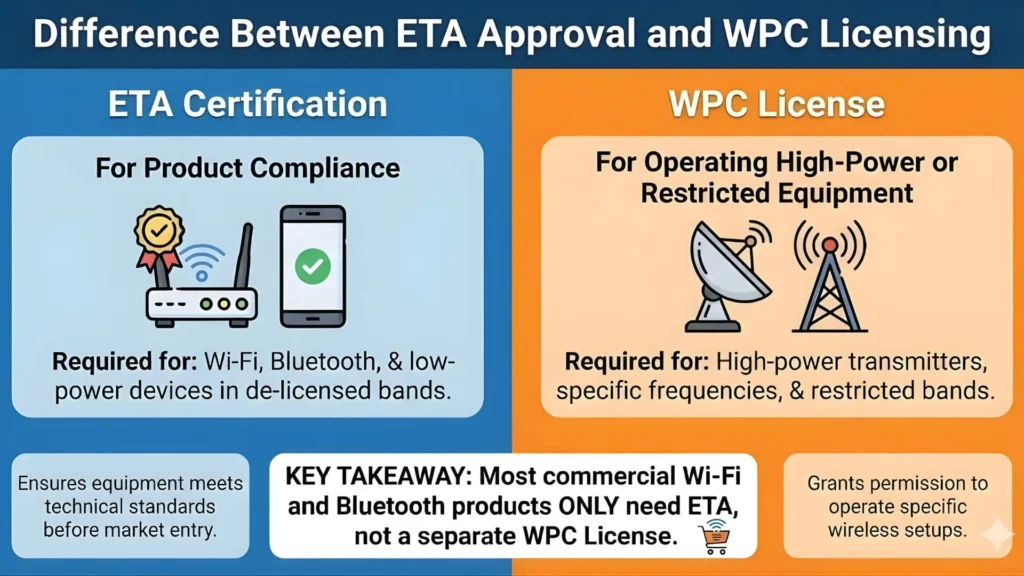
For the overwhelming majority of importers reading this — those dealing in consumer electronics, IoT devices, smart home products, or wearables — the ETA is what you need. When industry professionals say 'WPC import licence for customs clearance', they are almost always referring to the ETA.
Why Is the WPC Certificate for Import Legally Mandatory?
This is not bureaucratic overreach. There are concrete, well-reasoned justifications behind this compliance requirement — and understanding them actually helps you appreciate why enforcement has tightened significantly in 2025 and 2026.
The Indian Wireless Telegraphy Act, 1933
Under this legislation, possessing or importing any wireless telegraph equipment without lawful authority is a punishable offence. The ETA serves as your lawful authority — it certifies that your product has been reviewed and cleared for use within India's licensed spectrum environment. Customs officers are legally empowered to detain goods that lack this certification, and they do exercise that power routinely.
National Security and Spectrum Protection
India's defence forces, civil aviation, emergency services, and telecom infrastructure all operate on specific frequency bands. An uncertified device transmitting at wrong power levels or on the wrong frequency can cause genuine interference with critical systems. This is not theoretical — it is precisely why regulators worldwide, India included, enforce type approval at the border rather than after the product reaches consumers.
Real-Time Customs Integration with DoT Databases
Indian Customs is digitally linked with DoT databases. The moment a shipment's HS code indicates a wireless product, the system flags it automatically. Thecustoms officer will demand the WPC import approval certificate number before releasing the goods. There is no workaround, no escalation path, and no sympathetic senior officer who will let it go 'just this once'. It is a hard system block.
The Financial Cost of Getting It Wrong
Every day your goods sit detained at an Indian port without clearance, you pay demurrage — port storage fees that compound quickly. We have personally seen cases where importers paid storage costs higher than the actual value of the detained goods simply because they did not secure the WPC certificate before shipping. That is not a hypothetical or an exaggeration. It happens regularly and it is entirely avoidable.
| 2026 ENFORCEMENT UPDATE As part of India's push toward faster and cleaner trade facilitation, the WPC portal now flags shipments much earlier in the Customs process than it did even two years ago. Importers who used to 'get away with' applying post-shipment are finding that option is now firmly closed. Apply before you book the container — this is non-negotiable in 2026. |
Critical 2026 Regulatory Updates Every Importer Must Know
If you read an older guide about WPC certification and skipped straight here, this is what has changed since the start of 2026 — and it affects a significant portion of the wireless products currently being imported.
The 6 GHz Band Is Now De-Licensed in India (GSR 47(E), January 2026)
On 20 January 2026, India's Department of Telecommunications issued GSR 47(E), officially de-licensing the lower 6 GHz band (5945–6425 MHz) for low-power wireless use. This 500 MHz of clean spectrum opens the door for Wi-Fi 6E and Wi-Fi 7 technology in India — a development the industry had been anticipating since 2021.
What this means in practical terms for importers:
- Wi-Fi 6E routers and access points, and Wi-Fi 7 devices that support the 6 GHz band, can now be certified and imported into India.
- Products must operate on a contention-based protocol in this band.
- Indoor use only. Use in land vehicles (cars, trains) and on drones or UAVs is prohibited.
- Power limits are set at 30 dBm max EIRP for low-power indoor devices, and 14 dBm max EIRP for very low-power outdoor devices.
- The Saral Sanchar portal has been updated to allow applicants to declare operation in the 5945–6425 MHz band when filing an ETA-SD (Self-Declaration) application.
| 6 GHz Band Parameter | Specification |
| Frequency Range | 5945–6425 MHz (lower 6 GHz band) |
| Regulatory Instrument | GSR 47(E) dated 20 January 2026 |
| Indoor Low Power Max EIRP | 30 dBm |
| Outdoor Very Low Power Max EIRP | 14 dBm |
| Protocol Requirement | Contention-based protocol mandatory |
| Prohibited Use Cases | Land vehicles (cars, trains), drones, UAVs |
| Portal Status | Saral Sanchar updated; 6 GHz band now selectable in ETA-SD |
| Technologies Enabled | Wi-Fi 6E, Wi-Fi 7 |
Existing ETA Holders with 6 GHz-Capable Devices Must Re-Certify
This is the update that has caught many importers off-guard. If you already hold a WPC ETA certificate for a device that is technically capable of operating in the 6 GHz band — but that functionality was disabled during the original certification because the band was not de-licensed at the time — you cannot simply switch on that capability without re-certifying.
On 6 March 2026, the WPC Wing issued a public notice outlining compliance requirements specifically for this scenario. The rules are clear:
- If you plan to enable or market 6 GHz functionality in a previously certified device, you must first withdraw the existing ETA-SD certificate.
- You must then submit a fresh ETA application reflecting the updated radio capabilities and the 6 GHz band.
- Enabling or marketing devices with 6 GHz capability without an updated ETA may be treated as non-compliant.
| COMPLIANCE WINDOW EXTENDED — APRIL 2026 As of 6 April 2026, the WPC Wing has extended the compliance timeline for the 6 GHz band requirements by three months. This gives manufacturers and importers additional time to withdraw and reapply for ETAs on affected device models. However, this is a limited window — not a permanent grace period. If you have any device in your portfolio that technically supports the 6 GHz band, assess it now and begin the re-certification process immediately. |
Which Products Require WPC Import Approval?
The simplest rule: If your product transmits or receives radio signals without a physical wire, it needs WPC certification for import. Here is a detailed category-wise breakdown of the most common items we process:
Consumer Electronics
- Bluetooth headphones, earbuds, and TWS earbuds
- Wireless and Bluetooth speakers (portable and home theatre)
- Smartwatches and fitness bands
- Laptops and tablets with integrated Wi-Fi or Bluetooth
- Wireless gaming controllers and peripherals
Smart Home and IoT Products
- Wi-Fi routers, mesh systems, and modems
- Smart LED bulbs and plugs with Wi-Fi or Zigbee
- Wireless CCTV cameras and video doorbells
- Smart thermostats and home automation hubs
Industrial and Commercial Equipment
- RFID readers and RFID tags
- POS (Point of Sale) terminals with wireless capability
- Barcode scanners with Bluetooth
- Industrial wireless sensors and data loggers
Specialised Categories (Additional Regulations May Apply)
- Drones and UAVs — WPC compliance is just one layer; DGCA approval is also required separately
- Remote-controlled toys operating on specific frequency bands
- Wireless medical devices
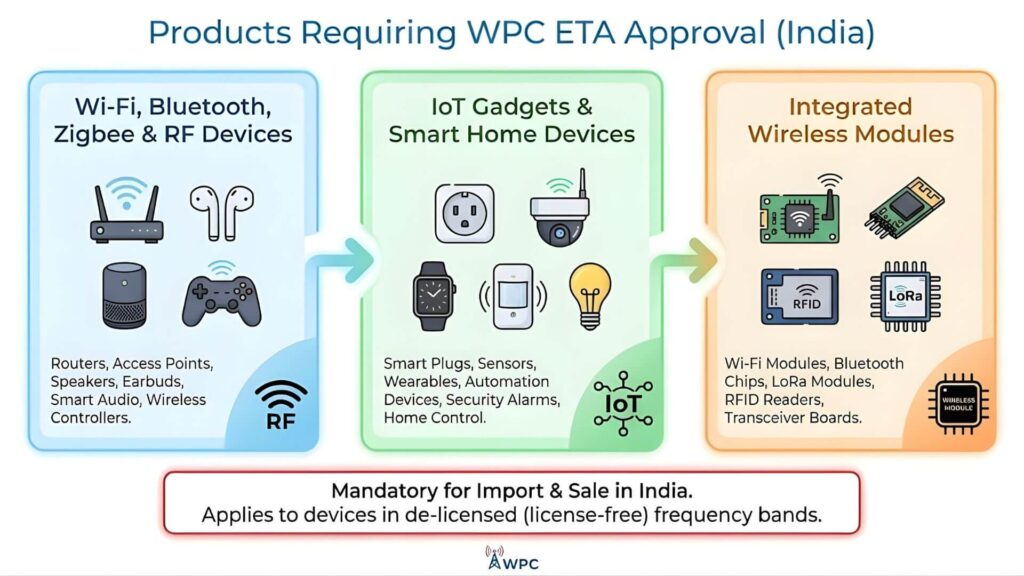
Quick Test: Pull up your product's specification sheet. If you see any of these terms — Bluetooth 5.0, Wi-Fi 6, 2.4 GHz, 5 GHz, Zigbee, Z-Wave, RFID, LoRa — your product requires a WPC Certificate for Import before it can enter India.
Types of WPC Certification for Imported Wireless Products
Broadly, there are two pathways to get WPC approval for import. The right one depends on your product type and the frequency bands it operates on.
| Certification Route | Best For | Processing Time | Test Report Requirement |
| Self-Declaration ETA (Saral Sanchar) | Standard consumer electronics on de-licensed bands — Bluetooth, Wi-Fi, RFID. This covers about 90% of import cases. | 1 to 5 working days | Valid RF report from NABL or ILAC-accredited lab (foreign reports accepted) |
| Regular ETA (Manual Review) | Products on non-standard or partially de-licensed bands, or those requiring officer-level technical scrutiny. | 20 to 30 working days | RF test report mandatory; sample testing may be requested |
| WPC Import License | Restricted-band devices — specialised broadcasting gear, certain walkie-talkies, amateur radio equipment. | 30+ working days | Full technical documentation and manual officer review required |
Note on the ETA-SD route: Four categories of products are excluded from the Self-Declaration pathway regardless of frequency band. These are radar equipment, jamming devices, drones/UAVs, and satellite equipment. These must follow the regular ETA route through the Regional Licensing Offices (RLOs) of the WPC Wing.
Who Is Eligible to Apply for WPC Import Certificate?
This is a question that trips up a surprising number of first-time importers — especially those whose manufacturer is based in China, Taiwan, or Vietnam.
- Only an Indian legal entity can be the applicant on the WPC portal. Foreign manufacturers and overseas brands cannot apply directly.
- If you are an Indian importer or trading company, you can apply in your own name using your company credentials.
- If you are a foreign brand or manufacturer without an Indian subsidiary, you must appoint an Authorised Indian Representative (AIR). This person or entity files the application on your behalf and takes on the compliance responsibility.
- Certification agencies like Silvereye Certifications regularly act as AIR for overseas manufacturers entering the Indian market, handling everything from document review to portal submission.
| Scenario | How to Apply |
| Indian importer or trading company | Apply directly on the Saral Sanchar portal using your company's GST, PAN, and CIN. |
| Foreign brand with Indian subsidiary or liaison office | The Indian subsidiary or liaison office acts as the AIR and files in that entity's name. |
| Foreign brand with Indian distributor or importer | The distributor or importer can act as AIR, or appoint a third-party certification agency. |
| Foreign brand with no India presence at all | Must appoint an authorised third-party Indian entity as AIR. Certification consultants like Silvereye regularly serve this role. |
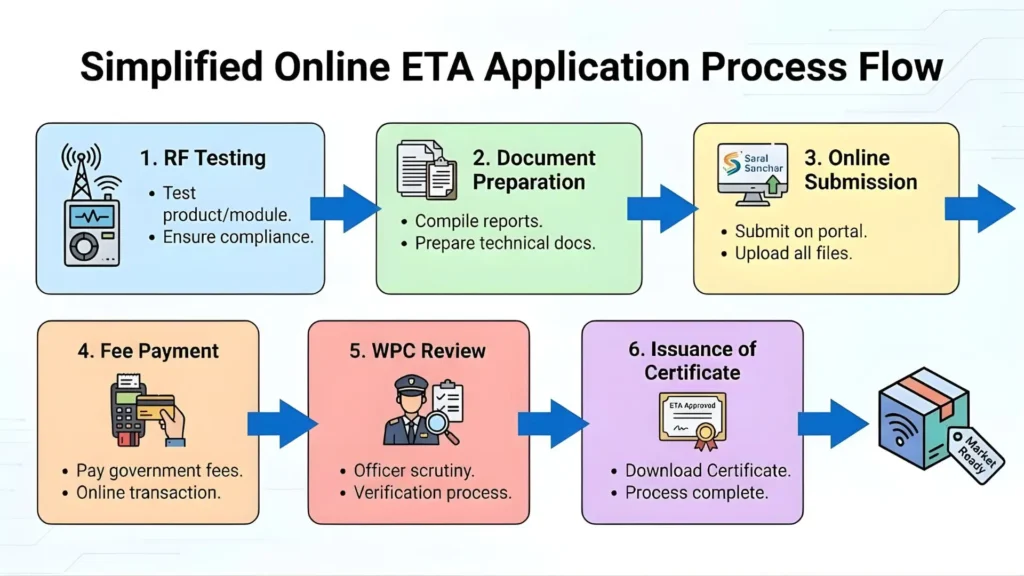
Step-by-Step Process to Get WPC Certificate for Import in 2026
Here is the exact workflow, broken down in plain language. This is the same process we follow for every client.
Step 1: Obtain a Valid RF Test Report
This is the single most important document in your application. An RF (Radio Frequency) Test Report is a technical laboratory report proving your device operates within India's permitted frequency bands and power levels.
- The lab must be ISO/IEC 17025 accredited.
- For the Self-Declaration ETA route, DoT accepts test reports from ILAC-accredited foreign laboratories — so if your Chinese factory has an existing report from Intertek, SGS, TUV Rheinland, Bureau Veritas, or similar, that report is usually acceptable.
- Critical check: The report must specifically cover RF emissions and frequency parameters. A CE safety report or an EMC report alone is not sufficient. Many importers make this mistake.
- If you do not have a valid RF report, local testing in India can be arranged through NABL-accredited labs — but this adds two to three weeks and testing costs to your timeline.
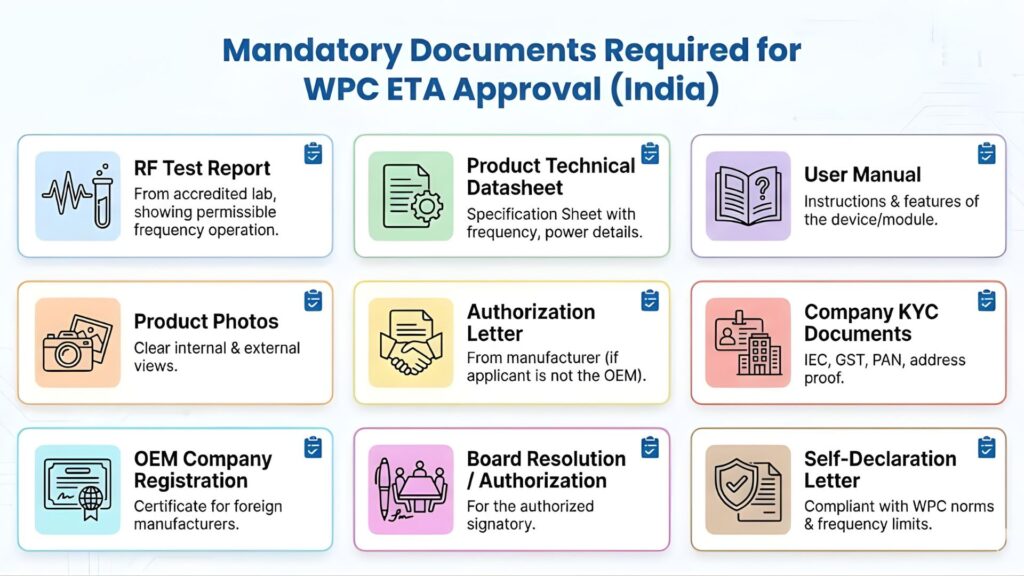
Step 2: Prepare Your Documents
Have these ready before you start the portal application. Missing even one document can delay your approval by days.
| Document | Details / What to Check |
| RF Test Report | Must cover specific frequencies like 2400–2483.5 MHz for Bluetooth/Wi-Fi. Verify the model number on the report matches exactly with your product invoice. |
| Product Technical Data Sheet | Should include model number, frequency bands, modulation type, output power (in dBm or mW), and antenna details. |
| Company KYC | GST Registration Certificate, PAN Card, Certificate of Incorporation (or Partnership Deed / Proprietorship proof). |
| Authorised Signatory ID Proof | Aadhaar card or PAN card of the person signing the application. |
| Letter of Authorisation | Required if a consultant or agent is filing on your behalf. |
| Sample Invoice or Product Photograph | Sometimes requested for verification — keep it handy. |
Step 3: Register on the Saral Sanchar WPC Portal
The Department of Telecommunications processes all WPC import applications through the Saral Sanchar digital portal. You will need to create a user profile linked to an active Indian mobile number for OTP-based verification. The portal handles submission, fee payment, and certificate issuance entirely online — no physical visits required.
Step 4: Submit the Application
During submission, you will be required to enter technical parameters precisely — including frequency band, modulation type, channel bandwidth, and maximum output power. Accuracy here is non-negotiable. A mismatch between what you enter and what the test report says will result in rejection or queries, adding days to your timeline.
Step 5: Pay the Government Fee
The government fee for an ETA is approximately Rs. 10,000 per model and is paid online via the Bharatkosh government payment portal. Payment is required before the application moves to the approval stage.
Step 6: Receive the WPC ETA Certificate
Once payment is confirmed and the submitted parameters are verified against the test report, the ETA is issued digitally through the portal. For Self-Declaration applications with clean documentation, this can happen within one to five working days. The certificate is issued against the specific model number and carries lifetime validity.
WPC Import Certificate Cost Breakdown
Here is an honest breakdown of what you should budget for:
| Cost Component | Description | Estimated Amount (INR) |
| Government Fee (ETA) | Mandatory fee payable to DoT via Bharatkosh portal | Rs. 10,000 per model |
| Consultant / Professional Fee | Charges for document review, technical parameter entry, portal management, and follow-up | Variable — contact for quote |
| RF Testing Fee (if required) | Only needed if you do not have a valid accredited test report. Cost varies by device complexity. | Rs. 15,000 to Rs. 50,000+ |
| Courier / Sample Charges | Only relevant if physical samples need to be tested locally in India | Varies by product size and origin |
Note: Government fee structures are subject to revision by DoT. Always verify the current fee on the official Saral Sanchar portal before applying. Consultant fees vary based on the complexity of the product and document readiness.
WPC Certificate Processing Timeline and Validity
| Parameter | Details | Key Notes |
| Self-Declaration ETA | 1 to 5 working days | Applies only when all documents — especially the RF report — are in order on day one. |
| Regular ETA (Manual Review) | 20 to 30 working days | Subject to WPC officer workload; queries from the officer can extend this further. |
| WPC Import License | 30+ working days | Complex cases involving restricted bands may take longer. |
| Certificate Validity | Lifetime validity | The ETA does not expire. It remains valid for the specific model indefinitely. |
| When to Re-Apply | Model or hardware change only | If you change the model number, frequency specs, or output power, a fresh application is required. |
| Renewal Requirement | Not applicable | No annual renewal — once issued for a model, it covers all future shipments of that exact model. |
Key Benefits of Getting WPC Import Approval (Why It Pays Off)
| Benefit | Real Business Impact |
| Zero Customs Delays | Your shipment clears port without holds, protecting your launch timelines and retailer commitments. |
| Legal Protection | Shields your business from fines, seizures, and action under the Indian Wireless Telegraphy Act. |
| Lifetime Coverage Per Model | A one-time payment and effort that covers every future shipment of the same model — excellent ROI for volume importers. |
| Competitive Advantage | Products with proper WPC compliance clear faster, helping you reach Amazon and Flipkart shelves before competitors who are still scrambling for approvals. |
| Importer Credibility | Corporate buyers, distributors, and large retail chains increasingly verify WPC compliance before placing bulk orders. |
| Technical Assurance | Proves your device operates safely without causing interference — protects your brand from post-sale regulatory issues. |
Common Mistakes Indian Importers Make (and How to Avoid Them)
After processing hundreds of WPC applications, here are the errors we see most often:
Submitting a Safety Report Instead of an RF Report
Electrical safety tests (LVD / IEC 62368) and EMC reports do not contain the RF parameters required for WPC approval. You need a specific RF test report covering frequency, power output, modulation, and channel bandwidth. Always verify with the lab or your supplier that the report explicitly covers RF testing.
Model Number Mismatch
Indian Customs cross-checks the model number on your WPC certificate against the invoice and packing list. A single character difference — 'Model X-100' vs 'Model X100' — is enough for rejection. Ensure the model number on the test report, the ETA certificate, and your commercial invoice are absolutely identical.
Importing Before the Certificate Is in Hand
We see this consistently. Importers assume they can apply while the goods are in transit and get the certificate before customs clearance. That worked occasionally in 2019. In 2026, it rarely does. Customs holds are tighter, and portal processing, while fast, is not instantaneous. Secure your WPC ETA before the goods leave the factory.
Assuming One Certificate Covers Multiple Models
Each model number requires its own ETA. If you import Model A and Model B from the same supplier, that is two separate applications, two government fees, and two certificates. There are no multi-model shortcuts.
Overlooking Simultaneous Compliance Requirements
WPC approval is necessary, but it is often not the only compliance you need. Many electronics categories also require BIS CRS (Compulsory Registration Scheme) registration under the Bureau of Indian Standards. Check both before you ship.
Conclusion
The WPC Certificate for Import is not optional, it is not bureaucratic noise, and it is not something you can sort out after the goods arrive at the Indian port. It is a hard legal requirement that exists to protect spectrum integrity, and Indian Customs enforces it without exception.
The good news is that the process is well-structured, reasonably fast for most consumer electronics, and genuinely affordable — a one-time government fee that buys you permanent import clearance for that model. The paperwork demands precision, not complexity. Get your RF test report right, match your model numbers exactly, register on the Saral Sanchar portal correctly, and in most cases you will have your ETA within a few days.
If the technical side of document review and portal navigation feels overwhelming, working with an experienced certification partner eliminates the guesswork entirely. At Silvereye Certifications, we review test reports, identify gaps before submission, manage the portal application, and act as your Authorised Indian Representative where needed — so your focus stays on your business, not on regulatory paperwork.
| Need WPC Import Approval Fast? Contact Silvereye Certifications for a free document review and get your ETA processed in as little as 1 to 3 working days. Do not let your shipment sit at the port. |
Frequently Asked Questions
Is a WPC Certificate mandatory for all imported products?
No — only for products that transmit or receive wireless signals. Products with no wireless capability do not require WPC approval. However, if the product has even a basic Bluetooth chip or a Wi-Fi module, the certification is compulsory.
Can I import without a WPC certificate and apply later?
Technically, your goods will arrive — but they will be detained at the port. You will pay demurrage charges every single day while you wait for the certificate, and there is no guarantee Customs will wait indefinitely. In worst-case scenarios, goods are re-exported at the importer's cost. The risk is not worth it.
Can a foreign manufacturer apply directly for WPC approval?
No. The applicant must be an Indian entity. Foreign brands must appoint an Authorised Indian Representative to file and hold the certificate on their behalf.
Is a physical product sample required for ETA?
Generally no — not for the Self-Declaration ETA route. If you have a valid RF test report from an ILAC-accredited lab, the approval process is entirely digital. Samples are typically only required if local testing in India becomes necessary.
What if my test report is from a foreign lab — is it accepted?
Yes. For ETA applications, DoT accepts test reports from laboratories accredited under ILAC (International Laboratory Accreditation Cooperation) mutual recognition arrangements. Reports from labs like Intertek, TUV Rheinland, SGS, Bureau Veritas, and similar internationally recognised organisations are accepted.
Does the WPC ETA need to be renewed every year?
No. The ETA has lifetime validity for the specific model it covers. You do not pay annual renewal fees. The only trigger for a new application is a change in the model number or hardware specifications (frequency or power parameters).
Is WPC certification enough for Customs clearance?
For most consumer wireless products, yes — the WPC ETA is the primary document Customs requires. However, depending on your product category, you may also need BIS CRS registration. It is worth checking both compliance requirements before shipping.
My product has Wi-Fi 6E or Wi-Fi 7. What does the 6 GHz de-licensing mean for my import?
If you are importing a brand-new Wi-Fi 6E or Wi-Fi 7 product and filing a fresh ETA, you should include the 5945–6425 MHz band in your application, provide an RF test report that covers this band, and ensure your product meets the power and protocol requirements set out in GSR 47(E). If you already have an ETA that was certified without the 6 GHz band enabled, and you wish to enable that functionality, you must withdraw the existing certificate and file a new application first.
Is WPC certification enough for customs clearance of most products?
For most consumer wireless products, the WPC ETA is the primary document Customs requires. However, depending on your product category, you may also need BIS CRS registration. It is worth verifying both compliance requirements before your shipment departs.