

The WPC ETA Certificate for Bluetooth Devices in India applies to every product using the 2.4 GHz band — no matter the category, price, or power level. Here's what this guide covers:
- Audio & Sound Devices — 15 Products - Earbuds, headphones, speakers & soundbars. Highest customs detention category — ETA required before any import or listing.
- Wearable Technology — 13 Products- Smartwatches, fitness bands & smart rings. LTE-enabled devices need separate WPC consideration on top of Self-Declaration.
- Smart Home & Lifestyle Devices — 14 Products- Smart bulbs, locks, TVs & BT keyboards. Port enforcement has been active since 2025 — especially for e-commerce imports.
- Healthcare & Medical-Adjacent Devices — 13 Products- Oximeters, glucometers & ECG devices. WPC ETA covers the radio — CDSCO registration is separately mandatory for notified medical devices.
- Industrial, IoT & B2B Devices — 14 Products- BLE sensors, beacons & data loggers. Most non-compliant category at customs — "industrial equipment" is not an exemption.
- Mobility, Automotive & Transport — 9 Products- OBD dongles, TPMS & GPS trackers. Cellular components require separate DoT approval alongside the BT Self-Declaration.
- Children's & Educational Devices — 6 Products- Kids tablets, RC drones & learning pens. Strictest retail verification — BIS toy safety standards apply alongside WPC ETA.
- Professional, Enterprise & Specialized — 11 Products- Conference phones, BLE shelf labels & agri sensors. Corporate and government buyers now verify WPC before vendor approval.
Note: This list covers 95 commonly imported Bluetooth products — but WPC ETA applies to any 2.4 GHz device sold in India. Always verify your product on saralsanchar.gov.in before importing.
Introduction
If you're importing, selling, or listing any Bluetooth device in India, you need a WPC ETA Certificate for Bluetooth Devices in India — no exceptions. It doesn't matter whether your product is a ₹500 neckband earphone or a high-end industrial IoT sensor. The moment a device transmits in the 2.4 GHz band on Indian soil, it falls under the Indian Wireless Telegraphy Act, 1933, and the WPC ETA is the legal certificate that covers it.
We've seen businesses lose shipments at customs, get their Amazon and Flipkart listings pulled, and face procurement rejections from corporate buyers — all because the WPC ETA was missing or tied to the wrong model number. It's not a minor paperwork issue. It's a hard compliance gate.
This guide covers 95 Bluetooth products across 8 categories — from TWS earbuds and smartwatches to BLE medical devices, industrial IoT sensors, and children's educational toys. For each product, we've listed the Bluetooth configuration, the applicable WPC approval route, whether BIS certification is also required, and the key compliance note you need to know before your goods leave the factory.
Whether you're a first-time importer or a compliance manager reviewing your product portfolio, this is the most complete, up-to-date WPC ETA product reference available for India in 2026 — built directly from the Saral Sanchar portal guidelines, NFAP 2022, and DoT Wireless Equipment Regulations 2021.
Understanding WPC Approval Routes Before Reading the Product List
WPC classifies Bluetooth devices under two primary approval routes. Knowing which route applies to your product determines how long your approval will take and what documentation is required.
| Approval Route | Applicable Products | Processing Time | Key Condition |
| Self-Declaration Route | Standard consumer and commercial Bluetooth devices operating at or below 100 mW EIRP in the 2400-2483.5 MHz band | 48 to 72 hours after portal submission | Device must carry valid FCC or CE certification from country of origin |
| Traditional ETA Route | High-power devices, multi-radio devices with cellular above 250 mW, specialized industrial or defesce-adjacent wireless equipment | 3 to 6 months | Manual technical review by WPC officials required |
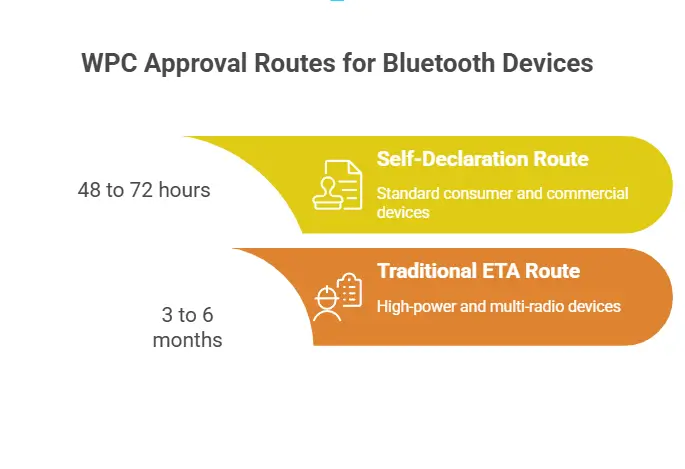
The vast majority of standard consumer Bluetooth products listed in this guide qualify for the faster Self-Declaration route. Where the Traditional ETA route applies, it is specifically noted in the product table.
Audio and Sound Devices
Audio devices are the highest-volume Bluetooth product category at Indian customs checkpoints. Earbuds, headphones, and speakers collectively account for the majority of WPC-related import detentions. Every product in this category — regardless of price point, brand, or technology generation — requires WPC ETA without exception.
| Category 1: Audio and Sound Devices — WPC ETA Required for All | ||||||
| Sr. | Bluetooth Config | BT Frequency | WPC Route | BIS Also Required | Key Compliance Note | |
| 1 | Classic BT + BLE | 2402-2480 MHz | Self-Declaration | Yes — IS 16102 | Highest customs detention category in India; ETA mandatory before any import | |
| 2 | BT 4.x / 5.x | 2402-2480 MHz | Self-Declaration | Yes | BT radio operates independently of the wire — ETA required for the wireless component | |
| 3 | BT 5.x | 2402-2480 MHz | Self-Declaration | Yes | Applies to all segments — budget to premium — no exemption by price | |
| 4 | BT 5.x | 2402-2480 MHz | Self-Declaration | Yes | Same requirements as over-ear; form factor does not affect WPC obligation | |
| 5 | BT 4.x / 5.x | 2402-2480 MHz | Self-Declaration | Yes | High retail volume in India; frequently imported without ETA — enforcement common | |
| 6 | BT 5.x | 2402-2480 MHz | Self-Declaration | Yes | Emerging category — WPC requirement applies from first commercial import | |
| 7 | BT 5.x | 2402-2480 MHz | Self-Declaration | Yes | BT-only gaming headsets follow standard route | |
| 8 | BT + 2.4 GHz proprietary | 2402-2480 MHz + 2400-2483.5 MHz | Self-Declaration (both radios) | Yes | Both the BT radio and the 2.4 GHz dongle need separate ETA assessments in the same application | |
| 9 | Classic BT / BT 5.x | 2402-2480 MHz | Self-Declaration | Yes | Most commonly sold through e-commerce — Amazon/Flipkart require ETA for listing | |
| 10 | BT 5.x | 2402-2480 MHz | Self-Declaration | Yes | Higher acoustic output does not affect WPC route — RF parameters remain standard | |
| 11 | BT 5.x multi-channel | 2402-2480 MHz | Self-Declaration | Yes | Multi-driver systems with single BT radio need one ETA per model | |
| 12 | BT 5.x + Wi-Fi 2.4/5 GHz | 2402-2480 MHz + Wi-Fi bands | Self-Declaration (each radio assessed) | Yes | Each wireless technology assessed independently; Wi-Fi also covered in same ETA application | |
| 13 | BT 5.x + Wi-Fi | 2402-2480 MHz + Wi-Fi bands | Self-Declaration (each radio) | Yes | Voice assistant functionality does not affect WPC scope; RF radios are the determining factor | |
| 14 | BT 5.x | 2402-2480 MHz | Self-Declaration | Yes | Increasingly imported for home and event use — WPC requirement fully applies | |
| 15 | BLE / BT 5.x | 2402-2480 MHz | Self-Declaration | Yes | Consumer hearing assistance products not classified as medical devices follow standard WPC route | |
Wearable Technology
Wearables are the fastest-growing Bluetooth product segment in India's consumer electronics market and one of the most compliance-intensive. Multi-radio configurations, health monitoring functions, and medical-adjacent features create specific questions about WPC scope — all of which are addressed in this table.
| Category 2: Wearable Technology — WPC ETA Required for All | ||||||
| Sr. | Bluetooth Config | BT Frequency | WPC Route | BIS Also Required | Key Compliance Note | |
| 16 | BT 4.x / 5.x | 2402-2480 MHz | Self-Declaration | Yes | Applies to all smartwatches regardless of health feature set | |
| 17 | BT 5.x + BLE | 2402-2480 MHz | Self-Declaration | Yes | Health monitoring does not alter WPC route; if device also has cellular, separate cellular approval needed | |
| 18 | BT + Wi-Fi + LTE | 2402-2480 MHz + Wi-Fi + LTE bands | Self-Declaration (BT/Wi-Fi) + Traditional ETA (LTE) | Yes | Cellular radio requires separate WPC consideration — LTE band approval is not Self-Declaration | |
| 19 | BLE | 2402-2480 MHz | Self-Declaration | Yes | BLE's low energy output does not exempt it from WPC — frequency band is the determining factor | |
| 20 | BLE + GPS (passive receive) | 2402-2480 MHz | Self-Declaration | Yes | GPS receiver is passive (receive-only) — does not require additional WPC approval | |
| 21 | BLE | 2402-2480 MHz | Self-Declaration | Yes | Emerging wearable category — WPC requirement applies from first commercial import | |
| 22 | BT 5.x open-ear | 2402-2480 MHz | Self-Declaration | Yes | Open-ear audio glasses with BT follow standard consumer electronics WPC route | |
| 23 | BT + Wi-Fi | 2402-2480 MHz + Wi-Fi bands | Self-Declaration (each radio) | Yes | Camera functionality does not affect WPC scope; wireless radios are assessed independently | |
| 24 | BLE + LTE/2G | 2402-2480 MHz + cellular | Self-Declaration (BT) + Separate (cellular) | Yes | Cellular band requires separate DoT consideration; BT component covered under Self-Declaration | |
| 25 | BT 5.x + BLE sensor | 2402-2480 MHz | Self-Declaration | Yes | Built-in HR sensor with BLE data transmission — covered under single ETA for the device | |
| 26 | BLE | 2402-2480 MHz | Self-Declaration | Verify with BIS | Consumer-grade CGM transmitters follow WPC standard route; medical-grade CGMs may need CDSCO clearance additionally | |
| 27 | BLE | 2402-2480 MHz | Self-Declaration | Verify per product | Wearable textiles with embedded wireless modules require ETA for each unique module/model | |
| 28 | BLE | 2402-2480 MHz | Self-Declaration | Yes | Consumer wellness devices with BLE connectivity fully covered under WPC framework | |
Smart Home and Lifestyle Devices
Smart home devices are increasingly imported by Indian distributors through e-commerce channels, often without adequate compliance documentation. This category has seen significant enforcement activity at ports in 2025-2026, particularly for smart lighting, locks, and display devices.
| Category 3: Smart Home and Lifestyle Devices — WPC ETA Required for All | ||||||
| Sr. | Bluetooth Config | BT Frequency | WPC Route | BIS Also Required | Key Compliance Note | |
| 29 | BLE / BT Mesh | 2402-2480 MHz | Self-Declaration | Yes — BEE also | BT Mesh protocol operates in same 2.4 GHz band — covered under standard Self-Declaration | |
| 30 | BLE | 2402-2480 MHz | Self-Declaration | Yes — BEE also | BEE (energy) and WPC (wireless) compliance both required for smart lighting | |
| 31 | BLE | 2402-2480 MHz | Self-Declaration | Yes | Consumer IoT devices with BLE — standard WPC route applies | |
| 32 | BLE | 2402-2480 MHz | Self-Declaration | Yes | Frequently imported under general hardware category — customs is now checking wireless compliance | |
| 33 | BLE + Wi-Fi | 2402-2480 MHz + Wi-Fi bands | Self-Declaration (each radio) | Yes | Both radios covered in single ETA application — each assessed independently | |
| 34 | BT 4.x / BLE | 2402-2480 MHz | Self-Declaration | Yes | Standalone BT remotes need their own ETA — cannot be covered under the TV's certificate | |
| 35 | BT 5.x | 2402-2480 MHz | Self-Declaration | Yes — multiple | Smart TVs typically require multiple certifications — WPC for BT/Wi-Fi, BIS for electrical safety, BEE for energy | |
| 36 | BT 5.x / BLE | 2402-2480 MHz | Self-Declaration | Yes | High import volume — frequently flagged for missing WPC documentation | |
| 37 | BT 5.x / BLE | 2402-2480 MHz | Self-Declaration | Yes | Same compliance requirements as BT keyboards | |
| 38 | BLE / BT | 2402-2480 MHz | Self-Declaration | Yes | Niche category with lower awareness of WPC requirement — compliance frequently missing | |
| 39 | BT 5.x | 2402-2480 MHz | Self-Declaration | Yes | Growing category with India's gaming market — WPC fully applies | |
| 40 | BLE | 2402-2480 MHz | Self-Declaration | Yes | BLE connectivity for photo transfer — covered under standard route | |
| 41 | BT 5.x / BLE | 2402-2480 MHz | Self-Declaration | Yes | Emerging smart home category — compliance requirements fully applicable from first import | |
| 42 | BT Mesh + Wi-Fi | 2402-2480 MHz + Wi-Fi | Self-Declaration (each radio) | Yes | Central hub devices controlling BT Mesh network require ETA covering all radios | |
Healthcare and Medical-Adjacent Devices
This category creates more compliance confusion than any other. Businesses frequently assume that medical classification or low BLE power output somehow exempts devices from WPC requirements. It does not. A BLE temperature sensor in a hospital cold chain has identical WPC obligations to a consumer fitness tracker.
Medical-grade devices (classified as medical devices under the Medical Device Rules, 2017) may require additional CDSCO clearance on top of WPC ETA. WPC ETA covers the radio frequency compliance — it does not substitute for medical device registration. Both may be required for your specific product.
| Category 4: Healthcare and Medical-Adjacent Devices — WPC ETA Required for All | ||||||
| Sr. | Bluetooth Config | BT Frequency | WPC Route | Additional Compliance | Key Compliance Note | |
| 43 | BLE | 2402-2480 MHz | Self-Declaration | BIS + CDSCO (if notified medical device) | Consumer BT thermometers widely sold without WPC — enforcement increasing | |
| 44 | BLE / BT 4.x | 2402-2480 MHz | Self-Declaration | BIS + CDSCO (notified medical device) | Notified medical device under MDR 2017 — both CDSCO MD-42 and WPC ETA required | |
| 45 | BLE | 2402-2480 MHz | Self-Declaration | BIS + CDSCO (notified medical device) | Post-COVID enforcement on oximeters has been significant — WPC is actively checked | |
| 46 | BLE / BT 4.x | 2402-2480 MHz | Self-Declaration | BIS + CDSCO (notified medical device) | Dual compliance (WPC + CDSCO) is mandatory — neither substitutes the other | |
| 47 | BLE | 2402-2480 MHz | Self-Declaration | BIS where applicable | Pharma logistics companies have faced significant customs delays for missing WPC on these devices | |
| 48 | BLE | 2402-2480 MHz | Self-Declaration | BIS where applicable | Hospital asset management devices — BLE does not exempt from WPC | |
| 49 | BLE | 2402-2480 MHz | Self-Declaration | CDSCO — medical device registration mandatory | Medical device with BLE data transmission — WPC for radio, CDSCO for medical device classification | |
| 50 | BLE | 2402-2480 MHz | Self-Declaration | CDSCO — medical device registration mandatory | Medical-grade hearing aids require both WPC ETA and CDSCO registration as medical device | |
| 51 | BLE | 2402-2480 MHz | Self-Declaration | CDSCO — medical device registration mandatory | Drug delivery device with BLE sensor — WPC covers the wireless component only | |
| 52 | BLE | 2402-2480 MHz | Self-Declaration | CDSCO where classified as medical device | Depending on CDSCO classification, additional medical device compliance may apply | |
| 53 | BLE | 2402-2480 MHz | Self-Declaration | BIS where applicable | Consumer safety device — standard WPC route applies; medical classification depends on claims made | |
| 54 | BLE | 2402-2480 MHz | Self-Declaration | BIS where applicable | Consumer wellness device — WPC ETA required; if medical claims are made, CDSCO may apply | |
| 55 | BT 5.x / BLE | 2402-2480 MHz | Self-Declaration | CDSCO — medical device | Medical professional device — WPC for wireless, CDSCO for medical device status | |
Industrial, IoT and B2B Devices
Industrial and IoT Bluetooth devices are the most frequently non-compliant category at Indian customs, primarily because importers classify them as 'industrial equipment' or 'sensors' and assume wireless regulations do not apply. They do — without exception.
| Category 5: Industrial, IoT and B2B Devices — WPC ETA Required for All | ||||||
| Sr. | Bluetooth Config | BT Frequency | WPC Route | Additional Compliance | Key Compliance Note | |
| 56 | BLE | 2402-2480 MHz | Self-Declaration | BIS where applicable | Low power does not equal exempt — frequency band determines WPC obligation | |
| 57 | BT 5.x / BLE | 2402-2480 MHz | Self-Declaration | BIS where applicable | Enterprise retail and logistics buyers now verify WPC before procurement | |
| 58 | BLE | 2402-2480 MHz | Self-Declaration | BIS where applicable | Same BLE compliance requirements regardless of use case | |
| 59 | BT 5.x / BLE | 2402-2480 MHz | Self-Declaration | BIS where applicable | Office and logistics equipment with BT connectivity — full WPC compliance required | |
| 60 | BLE | 2402-2480 MHz | Self-Declaration | BIS where applicable | Widely used in food storage, pharma cold chain, and data centres | |
| 61 | BLE | 2402-2480 MHz | Self-Declaration | BIS where applicable | Industrial IoT sensors for predictive maintenance — WPC applies regardless of mounting environment | |
| 62 | BLE / BT 5.x module | 2402-2480 MHz | Self-Declaration | Verify per end product | The OEM end product incorporating the module needs its own WPC ETA for the finished device | |
| 63 | BLE + Wi-Fi / Ethernet | 2402-2480 MHz + Wi-Fi | Self-Declaration (wireless radios) | BIS where applicable | Gateway collects BLE signals from tags/sensors — the BLE radio in the gateway needs ETA | |
| 64 | BLE / BT Mesh | 2402-2480 MHz | Self-Declaration | BIS + CEA regulations | Smart utility meters with BLE communication — multiple regulatory bodies involved | |
| 65 | BLE / BT 5.x | 2402-2480 MHz | Self-Declaration | BIS + RBI (payment security) where applicable | Point-of-sale devices with BT connectivity — financial regulators may add requirements | |
| 66 | BT 5.x | 2402-2480 MHz | Self-Declaration | BIS where applicable | Machine and equipment remote controls with BT — WPC fully applies | |
| 67 | BLE | 2402-2480 MHz | Self-Declaration | BIS where applicable | Retail, navigation, and advertising beacons — BLE beacons fully covered under WPC framework | |
| 68 | BLE | 2402-2480 MHz | Self-Declaration | BIS where applicable | Critical for pharma and vaccine logistics — customs enforcement has been specifically active here | |
| 69 | BLE | 2402-2480 MHz | Self-Declaration | BIS where applicable | Urban infrastructure devices — WPC compliance required for all wireless components | |
Mobility, Automotive and Transport Devices
Automotive Bluetooth accessories and mobility devices are a growing import category in India. Compliance awareness in this segment is lower than in consumer electronics, which makes it a frequent target for customs scrutiny.
| Category 6: Mobility, Automotive and Transport Devices — WPC ETA Required for All | ||||||
| Sr. | Bluetooth Config | BT Frequency | WPC Route | Additional Compliance | Key Compliance Note | |
| 70 | BT 5.x | 2402-2480 MHz | Self-Declaration | BIS where applicable | Common accessory — imported in high volumes; WPC compliance frequently missing | |
| 71 | BT + FM transmitter | 2402-2480 MHz + FM | Self-Declaration (BT) + separate (FM) | BIS where applicable | FM transmitter component requires separate WPC consideration — not covered under BT Self-Declaration | |
| 72 | BLE / BT 4.x | 2402-2480 MHz | Self-Declaration | BIS where applicable | Plugs into vehicle diagnostic port — BT radio requires WPC ETA | |
| 73 | BLE | 2402-2480 MHz | Self-Declaration | BIS where applicable | Vehicle safety accessory — BLE communication requires standard WPC ETA | |
| 74 | BT 5.x + Wi-Fi | 2402-2480 MHz + Wi-Fi | Self-Declaration (each radio) | BIS where applicable | Both BT and Wi-Fi radios need WPC ETA — assessed in same application | |
| 75 | BLE | 2402-2480 MHz | Self-Declaration | BIS + EV charging standards | EV infrastructure device — WPC for BLE radio, BIS and EV-specific standards separately | |
| 76 | BT 5.x | 2402-2480 MHz | Self-Declaration | BIS where applicable | Motorcycle intercom systems with BT — growing segment with increasing compliance checks | |
| 77 | BLE / ANT+ | 2402-2480 MHz | Self-Declaration | BIS where applicable | ANT+ operates in same 2.4 GHz band — if ANT+ radio present, it also requires WPC consideration | |
| 78 | BLE + GSM / LTE | 2402-2480 MHz + cellular | Self-Declaration (BT) + Separate (cellular) | BIS + DoT registration for GSM devices | Cellular component requires additional DoT type approval — BT component follows Self-Declaration | |
Children's Products and Educational Devices
Children's electronic products with Bluetooth connectivity require WPC ETA just as any other device does. Additionally, products intended for children are subject to heightened safety scrutiny — buyers, retailers, and e-commerce platforms all verify compliance more carefully for this category.
| Category 7: Children's Products and Educational Devices — WPC ETA Required for All | ||||||
| Sr. | Bluetooth Config | BT Frequency | WPC Route | BIS Also Required | Key Compliance Note | |
| 79 | BT 5.x + Wi-Fi | 2402-2480 MHz + Wi-Fi | Self-Declaration (each radio) | Yes — multiple | Children's electronic devices face the most stringent compliance verification by major retailers | |
| 80 | BLE / BT 5.x | 2402-2480 MHz | Self-Declaration | Yes + toy safety standards | BIS electrical safety and toy safety compliance required alongside WPC ETA | |
| 81 | BT 5.x | 2402-2480 MHz | Self-Declaration | Yes | Volume-limiting children's headphones — same WPC requirements as adult headphones | |
| 82 | BLE | 2402-2480 MHz | Self-Declaration | Yes | Educational tools with BLE connectivity — WPC applies from commercial import | |
| 83 | BLE / BT 4.x | 2402-2480 MHz | Self-Declaration | Yes | Cellular variants require additional WPC consideration for the cellular radio | |
| 84 | BT 5.x / 2.4 GHz proprietary | 2402-2480 MHz | Self-Declaration | Yes + DGCA for drones | Drones require DGCA compliance additionally; BT/2.4 GHz radio still needs WPC ETA | |
Professional, Enterprise and Specialized Devices
Professional devices are sometimes assumed to operate under different regulatory frameworks than consumer products. They do not. Enterprise Bluetooth devices have identical WPC ETA obligations — with the added consideration that institutional buyers in India's corporate and government sectors now routinely verify WPC compliance during vendor qualification.
| Category 8: Professional, Enterprise and Specialised Devices — WPC ETA Required for All | ||||||
| Sr. | BT Frequency | WPC Route | Additional Compliance | Key Compliance Note | ||
| 85 | 2402-2480 MHz | Self-Declaration | BIS where applicable | Corporate procurement teams increasingly check WPC before approving vendor | ||
| 86 | 2402-2480 MHz + Wi-Fi | Self-Declaration (each radio) | BIS where applicable | Both wireless radios covered under Self-Declaration in single application | ||
| 87 | 2402-2480 MHz | Self-Declaration | BIS where applicable | High-volume enterprise purchase — IT procurement requires WPC documentation | ||
| 88 | 2402-2480 MHz | Self-Declaration | BIS where applicable | RFID-adjacent BLE devices for access control — WPC applies fully | ||
| 89 | 2402-2480 MHz | Self-Declaration | BIS where applicable | Low awareness of WPC requirement in this niche — compliance gap common | ||
| 90 | 2402-2480 MHz | Self-Declaration | BIS where applicable | Increasingly deployed in organised retail — compliance verification by store chains is growing | ||
| 91 | 2402-2480 MHz | Self-Declaration | BIS where applicable | Industrial measurement instruments with BLE data output — WPC fully applies | ||
| 92 | 2402-2480 MHz | Self-Declaration | BIS where applicable | Professional photography/video equipment with BT remote control or transfer capabilities | ||
| 93 | 2402-2480 MHz | Self-Declaration | BIS where applicable | Studio and live sound equipment with BT connectivity — WPC requirement applies | ||
| 94 | 2402-2480 MHz | Self-Declaration | BIS where applicable | AgTech IoT devices — growing import category with low compliance awareness | ||
| 95 | 2402-2480 MHz | Self-Declaration | BIS where applicable | Maker and professional tools with BT control interfaces — WPC fully applicable | ||
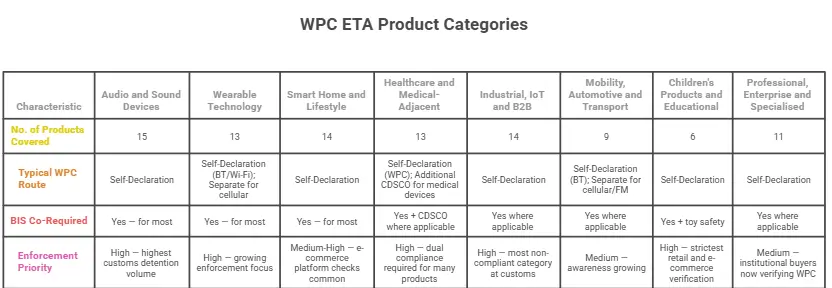
WPC ETA Product Categories at a Glance
| Category | No. of Products Covered | Typical WPC Route | BIS Co-Required | Enforcement Priority |
| Audio and Sound Devices | 15 products | Self-Declaration | Yes — for most | High — highest customs detention volume |
| Wearable Technology | 13 products | Self-Declaration (BT/Wi-Fi); Separate for cellular | Yes — for most | High — growing enforcement focus |
| Smart Home and Lifestyle | 14 products | Self-Declaration | Yes — for most | Medium-High — e-commerce platform checks common |
| Healthcare and Medical-Adjacent | 13 products | Self-Declaration (WPC); Additional CDSCO for medical devices | Yes + CDSCO where applicable | High — dual compliance required for many products |
| Industrial, IoT and B2B | 14 products | Self-Declaration | Yes where applicable | High — most non-compliant category at customs |
| Mobility, Automotive and Transport | 9 products | Self-Declaration (BT); Separate for cellular/FM | Yes where applicable | Medium — awareness growing |
| Children's Products and Educational | 6 products | Self-Declaration | Yes + toy safety | High — strictest retail and e-commerce verification |
| Professional, Enterprise and Specialised | 11 products | Self-Declaration | Yes where applicable | Medium — institutional buyers now verifying WPC |
| TOTAL | 95 products across 8 categories | Self-Declaration for vast majority | BIS required for most consumer categories | Active enforcement across all categories |
Important Notes on This Product List
This List Is Not Exhaustive
The products listed cover the most commonly imported and sold Bluetooth device categories in India as of 2026. The WPC ETA requirement is not limited to these 95 products — it applies to any device that transmits in the 2.4 GHz band commercially in India. If your product is not on this list, the obligation still exists if it uses Bluetooth.
Each Model Number Needs Its Own ETA
WPC ETA is product-model specific. A company importing three variants of the same wireless earbud — each with a different model number — needs three separate WPC ETA applications, three separate fees, and three separate certificates. The certificate for one model does not cover another, even if the hardware is identical.
Transferability of Certificates
Once a WPC ETA is issued for a specific model, any importer can reference that certificate number to import the same model without filing a fresh application. If your foreign supplier already holds WPC ETA for a model, request the certificate details before investing in your own application.
Hardware Changes Void Existing Certificates
Changing the Bluetooth chipset, antenna, or any RF parameter voids the existing WPC ETA — even if the new component is technically superior and still within permitted limits. A fresh application is required. This is particularly relevant for businesses whose suppliers make component substitutions due to chip shortages without notifying the Indian buyer.
Always verify the notification status of your specific product with the official Saral Sanchar portal (saralsanchar.gov.in) or consult a WPC compliance specialist before applying. Product classifications and compliance requirements can be updated through DoT notifications at any time.
Conclusion
If you're importing, selling, or listing any Bluetooth device in India — whether it's a pair of TWS earbuds, an industrial IoT sensor, or a BLE-enabled blood pressure monitor — WPC ETA is not optional. It's the law. And as customs enforcement has clearly stepped up through 2025–2026, the cost of skipping it is now higher than ever: detained shipments, blocked e-commerce listings, and damaged supplier relationships.
The good news? For the vast majority of consumer Bluetooth products, the Self-Declaration route through the Saral Sanchar portal gets you approved in 48 to 72 hours — as long as your device already carries a valid FCC or CE certificate. That's genuinely fast. The hard part isn't the process; it's knowing you need it in the first place.
This list of 95 products across 8 categories covers the most commonly imported Bluetooth device types in India. But remember — every unique model number needs its own WPC ETA application. A hardware change from your supplier — even a chipset swap — voids an existing certificate. Stay ahead of it.
The safest move is always to verify your product's current compliance status on the official Saral Sanchar portal (saralsanchar.gov.in) or work with a WPC compliance specialist before your goods land at the port. Paperwork done upfront costs a fraction of what a customs hold costs later.
Frequently Asked Questions
What is WPC ETA and why is it mandatory for Bluetooth devices in India?
WPC ETA is a government-issued certificate from India's Wireless Planning & Coordination Wing that legally allows you to import or sell any wireless device in India. Since Bluetooth operates in the 2.4 GHz band, it falls under the Indian Wireless Telegraphy Act — no exceptions. No ETA means your shipment can be detained at customs, and your product can't be listed on Amazon or Flipkart.
My product has FCC and CE certification. Do I still need WPC ETA?
Yes, always. FCC and CE are valid only in the US and Europe — they have zero legal standing in India. That said, having FCC or CE certification qualifies you for the Self-Declaration route, which gets your WPC ETA approved in 48–72 hours. So they speed up the process but don't replace it.
What's the difference between Self-Declaration and Traditional ETA routes?
Self-Declaration is for standard consumer Bluetooth devices (≤100 mW EIRP) — fast, portal-based, done in 48–72 hours if you have FCC/CE.
Traditional ETA is for complex devices — high-power, multi-radio with LTE above 250 mW, or industrial/defence equipment. This takes 3–6 months with manual WPC review. Most products on this list qualify for Self-Declaration.
I import 3 variants of the same Bluetooth speaker. Do I need 3 separate ETAs?
Only if they have different model numbers — and most variants do. WPC ETA is tied to the model number, not the product type. Same hardware, different model number = separate application, separate fee, separate certificate. Confirm this with your supplier before applying.
My supplier swapped the Bluetooth chipset without informing me. Is my ETA still valid?
No — it's void the moment the chipset, antenna, or any RF parameter changes. You need a fresh application, even if the new component is technically better. This catches a lot of importers off guard during chip shortages. Add a written notification clause in your supplier agreement to protect yourself.
My smartwatch has Bluetooth, Wi-Fi, and LTE. How does WPC handle multi-radio devices?
BT and Wi-Fi can both be covered in a single Self-Declaration application. LTE is different — it can't go through Self-Declaration and needs separate WPC consideration via the Traditional ETA route or DoT type approval. Don't assume approving one radio covers the rest
I'm importing Bluetooth glucometers and oximeters. Is WPC ETA enough?
No. These are notified medical devices under India's Medical Device Rules, 2017 — so they also need CDSCO registration (MD-42 import licence) on top of WPC ETA. WPC covers the wireless radio. CDSCO covers the medical device classification. Both are compulsory, and neither replaces the other.
My overseas supplier already has a WPC ETA for this model. Can I use it?
Yes — and this is one of the most overlooked shortcuts. WPC ETA certificates are referenceable by any importer for the same model. Ask your supplier for the certificate number and verify it on the Saral Sanchar portal before spending time on a fresh application. Just make sure the model number matches exactly.
Does a Bluetooth module for OEM use need its own WPC ETA?
Yes — twice over. The module itself needs a WPC ETA as a standalone component. And the finished product that incorporates it needs its own ETA as a complete device. The module's certificate doesn't carry over to the end product. Budget for both applications if you're building with third-party BT modules.
Where do I apply for WPC ETA and what documents are needed?
Apply through the official Saral Sanchar portal — saralsanchar.gov.in. For Self-Declaration, you'll typically need your FCC/CE test report, technical specs (frequency, EIRP), product photos, and a manufacturer declaration. Requirements can change with DoT notifications, so always check the current document checklist on the portal before starting.