
- Mandatory for food businesses with annual turnover above Rs. 20 crore or multi-state operations.
- Issued by FSSAI's Central Government — valid for 1 to 5 years; renewable before expiry.
- Required documents include Form B, FSS Act declaration, site plan, food safety management plan & more.
- Updated 2026 FSSAI notifications expand coverage to e-commerce FBOs and importers of food products.
What is FSSAI Central License Registration?
If you are running a food business in India at a large scale — or across multiple states — you almost certainly need an FSSAI Central License. This is not just a legal box to tick. It is your official permission from the Food Safety and Standards Authority of India (FSSAI) to operate, manufacture, process, distribute, or sell food products under the oversight of the Central Government.
FSSAI was established under the Food Safety and Standards Act, 2006, and it regulates all food-related businesses in India. Depending on the scale of your business, you will need either a Basic Registration, a State License, or a Central License. The Central License is the highest tier — designed for large food businesses operating at a national or international level.
In 2026, with FSSAI continuing to tighten compliance norms, getting your Central License right the first time is more important than ever. This guide covers everything: eligibility, documents, fees, process, timeline, validity, renewal, and the latest regulatory updates.
Who Needs FSSAI Central License? — Eligibility Criteria 2026
Not every food business needs a Central License. The requirement depends on your business's annual turnover, scale of operations, and type of activity. Here is a clear breakdown:
| Business Type | Annual Turnover / Scale | License Required |
| Manufacturer / Processor | Turnover above Rs. 20 crore | Central License |
| Importer of food products | Any scale (imports) | Central License |
| Exporters of food products | Any scale (exports) | Central License |
| Multi-state food operator | Operating in 2+ states | Central License |
| Food business at seaport / airport | Located at Central Govt. premises | Central License |
| Milk/dairy processing unit | Milk handling > 50,000 litres/day | Central License |
| Slaughterhouse | Capacity > 50 large animals/day | Central License |
| Vegetable oil processing | > 2 MT/day processing capacity | Central License |
| Food storage / cold chain unit | > 50,000 MT capacity | Central License |
| Food service in railways / airways | Catering onboard trains or flights | Central License |
| E-commerce FBO | Multi-state online food delivery | Central License (2025-26 update) |
| Meat processing unit | Capacity > 500 kg/day or multi-state | Central License |

Note: A business operating in only one state with a turnover between Rs. 12 lakh and Rs. 20 crore needs a State License. Below Rs. 12 lakh annual turnover, Basic Registration suffices. These thresholds were last updated by FSSAI in 2024-25 and remain in effect for 2026.
Benefits of Getting FSSAI Central License
Many food business owners see licensing as an added burden. But the reality is quite the opposite. An FSSAI Central License opens doors that would otherwise remain firmly shut. Here is why it matters:
- Legal Protection: You are fully authorized to operate. No risk of business closure, product seizure, or legal action for non-compliance.
- National Market Access: With a Central License, you can legally trade food products across all Indian states without additional state-level permissions.
- Export Readiness: A Central License is often a prerequisite for registering with APEDA, MPEDA, and other export promotion bodies.
- Consumer Trust: The 14-digit FSSAI License number displayed on packaging builds buyer confidence and brand credibility.
- E-commerce Eligibility: Platforms like Amazon, Flipkart, BigBasket and Swiggy Instamart mandate Central License proof for listing large-scale food sellers.
- Bank Loan Assistance: Financial institutions and NBFCs consider FSSAI Central License as a compliance credential when approving business loans.
- Government Tender Eligibility: Most government food supply tenders (defence, railways, hospitals) require a valid Central License.
- Brand Licensing: You can sub-license your brand to contract manufacturers, provided both parties hold appropriate FSSAI licenses.
Documents Required for FSSAI Central License Registration
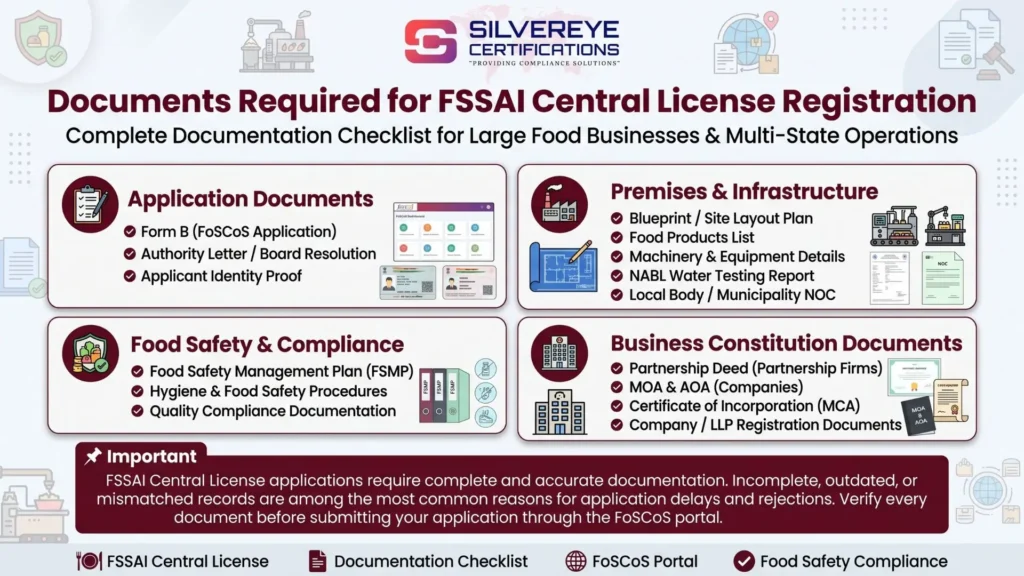
Getting your documentation right is the most critical step. Incomplete or mismatched documents are the number one reason for FSSAI Central License application rejections. Here is a comprehensive list updated for 2026:
Mandatory Documents — All Applicants
- Form B: Duly filled and signed application in Form B (available on the FoSCoS portal).
- Blueprint / Site Plan: Detailed layout of the food premises showing dimensions, entry/exit points, storage areas, and processing zones.
- List of Food Products: Complete list of food categories and products to be manufactured, handled, or sold.
- List of Machinery: Details of all equipment and machinery installed with manufacturer name and capacity.
- Food Safety Management Plan (FSMP): A documented plan showing how you will maintain hygiene and food safety at all stages.
- Water Testing Report: Lab-certified water quality report from a NABL-accredited lab (not older than 6 months).
- NOC from Local Body / Municipality: Approval letter from the local municipal authority for the premises.
- Partnership Deed / MOA & AOA: Depending on business structure — Partnership Deed for firms, MOA and AOA for companies.
- Certificate of Incorporation: From the Ministry of Corporate Affairs (MCA) for companies and LLPs.
- Authority Letter / Board Resolution: Authorizing the signatory to apply on behalf of the company or firm.
- Photo Identity of Proprietor / Directors: Aadhaar card, PAN card, or Passport.
Additional Documents — Category-Specific
| Business Type | Additional Documents Required |
| Manufacturer / Processor | IE Code (if exporting), lab test reports of product samples, HACCP / ISO 22000 certificate (if applicable) |
| Importer | Import Export Code (IEC) from DGFT, CA certificate for turnover, product specification |
| Exporter | APEDA / MPEDA registration, IE Code, phytosanitary certificates for plant-based products |
| Dairy / Milk Processing | Milk collection route map, farmer list, capacity certificate from local dairy authority |
| Slaughterhouse | NOC from Veterinary Department, CPCB clearance, building completion certificate |
| Cold Storage / Warehouse | Temperature log records, pest control certificate, BIS certificate (if applicable) |
| Food in Transport (Railways/Airways) | Contract copy with Indian Railways / airline, list of routes covered |
| E-commerce FBO | GST registration, list of partner kitchens or cloud kitchens, FSSAI license details of suppliers |
How to Apply for FSSAI Central License — Step-by-Step Process 2026
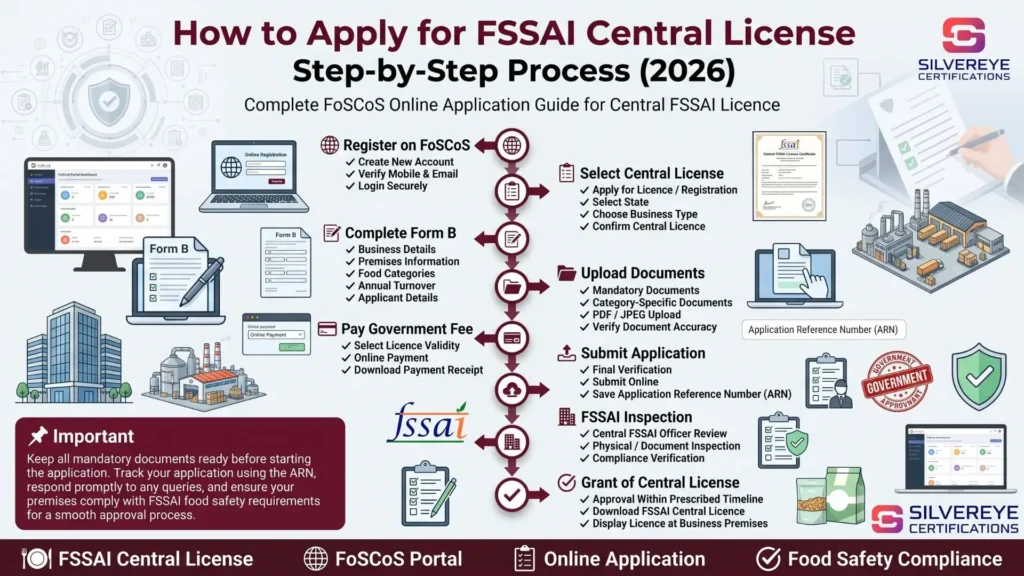
The entire FSSAI Central License application process is done online through the FoSCoS (Food Safety Compliance System) portal. Here is the step-by-step breakdown:
| Step | Action |
| Step 1 — Register on FoSCoS | Visit foscos.fssai.gov.in and create a new account using your email ID and mobile number. |
| Step 2 — Select License Type | Under 'Apply for License/Registration', choose 'Central License' and select your state and business type. |
| Step 3 — Fill Form B | Complete the online Form B with all required details — business name, premises, food categories, turnover, and proprietor information. |
| Step 4 — Upload Documents | Upload all mandatory and category-specific documents in the specified file format (PDF, JPEG — max 2MB per file). |
| Step 5 — Pay Application Fee | Pay the fee online through net banking, UPI, or debit/credit card. Fees vary by license duration (see fee table below). |
| Step 6 — Submit Application | Submit the completed application. Note your Application Reference Number (ARN) for tracking. |
| Step 7 — Inspection | A designated Central FSSAI Officer may schedule a physical or document-based inspection of your premises within 30 working days. |
| Step 8 — Grant of License | If all documents are found in order and inspection is cleared, the license is issued within 60 days from application date. |
| Pro Tip: Keep scanned copies of all documents ready in advance. The FoSCoS portal may time out if uploads are slow. Always save your ARN number — it is your primary tracking reference. |
FSSAI Central License Fees 2026
The fee for FSSAI Central License is fixed by the government and does not vary by business size within the Central License category. It depends only on the license duration you choose.
| License Duration | Application Fee | Total Payable (Approx.) |
| 1 Year | Rs. 7,500 | Rs. 7,500 |
| 2 Years | Rs. 15,000 | Rs. 15,000 |
| 3 Years | Rs. 22,500 | Rs. 22,500 |
| 4 Years | Rs. 30,000 | Rs. 30,000 |
| 5 Years | Rs. 37,500 | Rs. 37,500 |
Note: Fees are paid directly to FSSAI through the FoSCoS portal. Professional or consultant fees (if you hire a CA or FSSAI consultant) are separate and not regulated by FSSAI. There is no government GST levied on FSSAI license fees.
FSSAI Central License Processing Timeline
One of the most common questions food business owners ask is: how long does it take to get an FSSAI Central License? Here is a realistic timeline for 2026:
| Stage | Expected Timeline |
| Application submission | Day 1 — Immediately after online submission |
| Acknowledgement from FSSAI | Within 2 working days |
| Document scrutiny by FSSAI officer | 7 to 15 working days |
| Inspection (if required) | 15 to 30 working days from application |
| Inspection report submission | Within 7 working days of inspection |
| Deficiency notice (if raised) | FSSAI may raise queries — respond within 30 days |
| License grant | Within 60 days from date of application (statutory limit) |
| License certificate issued | Immediately upon approval — downloadable from FoSCoS |
| Important: If FSSAI does not respond or issue a deficiency notice within 30 working days of application, and if the application is complete in all respects, the license is deemed to be granted automatically under the deemed approval clause of the FSS Act. |
FSSAI Central License Validity and Renewal 2026
The Central License is valid for the period you choose at the time of application — anywhere from 1 year to 5 years. However, the validity period does not mean you can forget about it until the last month. FSSAI recommends initiating renewal at least 30 days before the expiry date.
Key Points on Validity
- License validity begins from the date of issuance by FSSAI.
- Maximum validity available is 5 years in a single application.
- The 14-digit license number remains the same across renewals — only the validity period is extended.
- Operating without a valid license after expiry can attract a penalty of up to Rs. 5 lakh under FSS Act, 2006.
Renewal Process
- Log in to FoSCoS portal at least 30 days before expiry.
- Select 'Renewal of License' and verify pre-filled details.
- Update any changes in business details, food categories, or premises.
- Upload updated documents (especially water test report, updated FSMP).
- Pay renewal fee (same as fresh application — based on chosen duration).
- If renewal is applied for within 30 days of expiry, there is no penalty. Delays attract late fees.
- Renewal can be done for a fresh period of 1 to 5 years.
Penalty for Late Renewal
| Days of Delay After Expiry | Penalty |
| 0 to 30 days | No penalty (if renewal applied before expiry) |
| 31 to 90 days | Rs. 100 per day of default |
| More than 90 days | Rs. 100 per day + possible suspension of license |
How to Modify FSSAI Central License Details
If there are any changes in your business — new food products added, change of premises, change of directors, or change in production capacity — you must update your FSSAI Central License through the modification process.
- Major Modifications: Change of premises, change of business name, addition of a new manufacturing unit. These require FSSAI officer approval and may involve inspection.
- Minor Modifications: Change in food category, addition of new products, change of authorized signatory. Generally processed within 7 to 10 working days.
- Process: Log in to FoSCoS, select 'Amendment of License', fill the amendment form, upload supporting documents, and pay the applicable modification fee (Rs. 1,000 to Rs. 2,000 depending on type).
Important: Do not operate under modified conditions before receiving the amended license — it is a violation under FSS Act.
Latest FSSAI Notifications and Updates 2025-2026
FSSAI has been particularly active in updating its regulatory framework in 2025-26. If you are applying for or renewing your Central License in 2026, you need to be aware of these changes:
| Notification / Update | Key Impact |
| FSSAI Circular — E-Commerce FBOs (2025) | All food delivery aggregators and cloud kitchens operating in 2+ states must obtain Central License. Single-state operators need State License. |
| FSSAI Food Products Standards Revision (2025) | New standards notified for dairy analogues, plant-based protein foods, and nutraceuticals. License categories updated accordingly. |
| FSSAI Annual Return Mandate (2025-26) | All Central License holders must file Annual Returns on FoSCoS by 31st May every year covering food category details, quantity produced/sold, and recalls if any. |
| FSSAI Safe & Nutritious Food (SNF) Campaign | Central licensees in manufacturing and processing are encouraged to display SNF marks on packaging. Voluntary in 2026 but expected to become mandatory. |
| FSSAI Import Surveillance — Strengthened (2026) | All importers holding Central License must submit test reports from NABL labs for each consignment of high-risk food categories. |
| Turnover-Based Reclassification (2024-25 Order) | Businesses that crossed Rs. 20 crore turnover must upgrade from State to Central License within 90 days of crossing the threshold. |
| FoSCoS Portal Migration | The legacy FLRS (Food Licensing and Registration System) has been fully replaced by FoSCoS. All applications must be made on foscos.fssai.gov.in. |
| Penalty Enhancement | FSSAI has enhanced penalties for adulteration and misbranding under FSS (Amendment) Act — Central License holders face stricter scrutiny. |
FSSAI Central License Compliance Calendar for 2026
Holding a Central License is not a one-time task. Here are the ongoing compliance obligations you must fulfil every year:
| Compliance Activity | Deadline / Frequency |
| Annual Return Filing | 31st May every year (for the preceding financial year) |
| Internal Food Safety Audit | At least once every 6 months |
| Water Testing Report Update | Every 6 months from a NABL-accredited lab |
| Pest Control Records | Monthly — must be documented and available for inspection |
| Staff Training Records | Annual food safety and hygiene training for all food handlers |
| Product Recall Register | Updated as and when a recall event occurs |
| FSMP Review | Annual review and update of Food Safety Management Plan |
| Display of License Number | Mandatory on all product labels and business premises |
| License Renewal | 30 days before license expiry date |
Common Reasons for FSSAI Central License Rejection
Here are the most frequent reasons why FSSAI Central License applications are rejected or returned with deficiency notices:
- Incorrect or mismatched business name in Form B vs. GST registration or incorporation documents.
- Site plan is hand-drawn without dimensions or does not match actual premises layout.
- Water test report is older than 6 months or issued by a non-NABL lab.
- Food category list is incomplete or includes categories not permitted for the declared premises type.
- Turnover certificate is missing or not certified by a Chartered Accountant.
- Documents uploaded in poor quality or in formats not accepted by FoSCoS.
- Authority letter is not on company letterhead or is unsigned.
- Applicant selects State License category when Central License is mandatory (turnover threshold breached).
- Food Safety Management Plan (FSMP) is generic and not tailored to the specific business process.
FSSAI Basic Registration vs. State License vs. Central License
| Feature | Basic Registration | State License | Central License |
| Annual Turnover | Up to Rs. 12 lakh | Rs. 12 lakh to Rs. 20 crore | Above Rs. 20 crore |
| Issuing Authority | FSSAI / State Dept. | State Food Authority | Central FSSAI |
| Application Portal | FoSCoS | FoSCoS | FoSCoS |
| License Fee (1 Year) | Rs. 100 | Rs. 2,000 to Rs. 5,000 | Rs. 7,500 |
| Inspection Required | No (generally) | Yes | Yes |
| Multi-state Operations | Not permitted | Not permitted | Permitted |
| Export Permission | No | No | Yes |
| E-commerce Eligibility | Limited | Single state only | Multi-state / national |
| Annual Return Filing | Not required | Required | Mandatory |
| Validity (Max) | 1 Year | 1 to 5 Years | 1 to 5 Years |
Understanding FSSAI Turnover Rules and Thresholds
One area that confuses many food business owners is how FSSAI calculates turnover for license classification. Here is what you need to know:
- What counts as turnover? Total revenue from the sale of food products in a financial year. This includes all food product categories sold under your business name.
- What does not count? Non-food income, rental income, and income from services unrelated to food handling are generally excluded.
- Crossing Rs. 20 crore threshold: If your business crosses Rs. 20 crore turnover during a financial year, you must upgrade to Central License within 90 days of the financial year close.
- Aggregated turnover for groups: If your group of companies collectively handles food under one brand or common ownership, FSSAI may consider aggregate turnover for classification.
- CA Certificate requirement: A Chartered Accountant-certified turnover certificate is required as proof. Self-declaration is not accepted for Central License applications.
FSSAI Food Categories Covered Under Central License
FSSAI classifies food products into 22 broad categories. Under a Central License, you can apply for permissions across multiple categories. The most common ones include:
| Category Code | Food Category |
| 01 | Dairy products and analogues |
| 02 | Fats, oils, and fat emulsions |
| 03 | Edible ices including ice cream and sherbet |
| 04 | Fruits and vegetables |
| 05 | Confectionery including candy and table top sweeteners |
| 06 | Cereals and cereal products including flours |
| 07 | Bakery wares |
| 08 | Meat and meat products including poultry |
| 09 | Fish and fishery products |
| 10 | Eggs and egg products |
| 12 | Salts, spices, soups, sauces, salads |
| 13 | Foodstuff intended for particular nutritional uses (nutraceuticals) |
| 14 | Beverages, non-dairy beverages, water |
| 17 | Prepared foods including food from hotels and restaurants |
| 18 | Food for special dietary use |
| 19 | Proprietary food |
Conclusion
FSSAI Central License registration is not just a legal requirement — it is a foundation for building a credible, scalable food business in India. Whether you are a large manufacturer, an importer, an exporter, or a growing e-commerce food brand, operating without a valid Central License in 2026 is a risk no business can afford.
The process is entirely online, the fees are transparent, and the compliance obligations are well-defined. If you start your documentation early and ensure accuracy in every form field, the approval process is smoother than most business owners expect.
With FSSAI continuing to update its regulations — especially around e-commerce, imports, and nutraceuticals — staying informed and compliant gives your business a genuine competitive edge.
Frequently Asked Questions
What is the minimum turnover for FSSAI Central License?
Any food business with an annual turnover exceeding Rs. 20 crore is required to obtain an FSSAI Central License. Businesses below this threshold require either a State License (Rs. 12 lakh to Rs. 20 crore) or Basic Registration (below Rs. 12 lakh).
Can I apply for FSSAI Central License without a physical shop?
Yes. If you are operating as an importer, exporter, e-commerce FBO, or a food business working from a home kitchen or cloud kitchen at national scale, you can apply. However, you still need to declare a registered business premises for the site plan and inspection.
How long does it take to get FSSAI Central License approved?
The statutory maximum is 60 days from the date of application. In practice, if all documents are complete and no inspection issues arise, most applications are resolved in 30 to 45 working days in 2026.
Is physical inspection mandatory for Central License?
Not always. FSSAI has introduced risk-based inspection under which not all applications require a physical visit. However, manufacturing units, food processing plants, and meat/dairy/cold storage units typically require on-site inspection.
Can a single FSSAI Central License cover multiple states?
Yes. That is one of the key advantages of a Central License. A single license allows you to operate food businesses across multiple states in India. However, each premises may need to be listed separately in the application.
What happens if my FSSAI Central License expires?
Operating with an expired license is a violation of the FSS Act and can attract penalties of Rs. 100 per day of delay, and in serious cases, suspension or cancellation of license. Always renew at least 30 days before the expiry date.
Is FSSAI Central License needed for selling food online (e-commerce)?
If you are a food aggregator or FBO selling food online across multiple states, you need a Central License as per the 2025 FSSAI circular. Single-state online sellers may operate with a State License.
Can I add new food products after getting a Central License?
Yes. You can apply for a modification (amendment) on the FoSCoS portal to add new food categories or products. Minor modifications are usually processed within 7 to 10 working days.
What is the penalty for operating without FSSAI Central License?
Under Section 63 of the FSS Act, 2006, carrying on food business without a license can attract imprisonment of up to 6 months and/or a fine of up to Rs. 5 lakh. For repeat offences, the penalties are enhanced.
Can a proprietorship firm apply for FSSAI Central License?
Yes. Sole proprietorships, partnerships, LLPs, private limited companies, public companies, and trusts can all apply for FSSAI Central License. The required supporting documents vary based on business structure.