
| Mandatory for every food business in India — from home kitchens to large manufacturers. |
| Three license types: Basic Registration, State License & Central License — based on your turnover. |
| Apply online via FoSCoS portal — get your 14-digit FSSAI number in as little as 7 working days. |
| Penalty for non-compliance: ₹5 lakh fine + 6 months imprisonment under FSS Act, 2006. |
What Is FSSAI License Registration?
If you run any kind of food business in India — be it a small tiffin service, a restaurant, a cloud kitchen, a food manufacturing unit, or an e-commerce food brand — FSSAI license registration is not optional. It is legally mandatory under the Food Safety and Standards Act, 2006 (FSS Act).
FSSAI stands for Food Safety and Standards Authority of India. It is the apex food regulatory body under the Ministry of Health & Family Welfare, Government of India. Every food business operator (FBO) must obtain a unique 14-digit FSSAI registration or license number before starting operations.
Think of the FSSAI license as your food business's identity proof. It tells your customers, distributors, and the government that you follow food safety standards, and it protects your business from heavy penalties. In 2026, the FSSAI continues to tighten compliance, making timely registration even more critical.
Why Is FSSAI License Registration Important in 2026?
A lot of food business owners still wonder — do I really need it? Here's the honest answer: yes, and here's why it matters more than ever in 2026.
- Legal Compliance: Operating without FSSAI registration is a criminal offence under Section 63 of the FSS Act.
- Consumer Trust: Displaying the FSSAI logo on your product packaging increases customer confidence significantly.
- Expand Your Business: E-commerce platforms like Swiggy, Zomato, Amazon, and Flipkart mandate a valid FSSAI number before listing any food product or service.
- Export Eligibility: To export food products, an FSSAI Central License is mandatory.
- Avoid Penalties: Non-compliance attracts fines up to ₹5 lakh and/or imprisonment up to 6 months.
- Government Contracts & Tenders: Government food supply contracts require a valid FSSAI license.
FSSAI Threshold Notification & Compliance Alert 2026
| FSSAI Compliance Thresholds You Must Know (Updated 2026) |
| Annual Turnover < ₹12 lakh → FSSAI Basic Registration required |
| Annual Turnover ₹12 lakh – ₹20 crore → State License required |
| Annual Turnover > ₹20 crore OR multi-state operations → Central License required |
| Important Alert: FSSAI has intensified surprise inspections across India in 2025–2026. Unregistered food businesses caught operating face immediate closure notices and penalties. |
| FSSAI Notification 2025: Food businesses operating on food delivery apps without valid FSSAI registration will face platform delisting. |
Types of FSSAI License Registration in India
Not every food business needs the same type of FSSAI license. The authority has categorized registrations into three types based on the scale and nature of your business. Choosing the wrong type can lead to rejection or legal issues, so let's break this down clearly.
1. FSSAI Basic Registration
| Parameter | Details |
| Eligibility | Annual turnover less than ₹12 lakh |
| Form | Form A |
| Issuing Authority | State/UT Food Safety Department |
| Registration Number | 14-digit FSSAI Registration Number |
| Validity | 1 to 5 years (as chosen) |
| Fees | ₹100 per year |
| Who Applies | Small food vendors, petty retailers, hawkers, home-based bakers, small food stalls |
2. FSSAI State License
| Parameter | Details |
| Eligibility | Annual turnover between ₹12 lakh and ₹20 crore |
| Form | Form B |
| Issuing Authority | State/UT Government – Designated Officer |
| Validity | 1 to 5 years (as chosen) |
| Fees | ₹2,000 – ₹5,000 per year (varies by category) |
| Who Applies | Mid-size restaurants, medium-scale food manufacturers, storage units, transporters within one state |
3. FSSAI Central License
| Parameter | Details |
| Eligibility | Annual turnover above ₹20 crore OR operations in more than one state |
| Form | Form B |
| Issuing Authority | Central Government – FSSAI, New Delhi |
| Validity | 1 to 5 years (as chosen) |
| Fees | ₹7,500 per year |
| Who Applies | Large food manufacturers, importers/exporters, hotels with 5-star ratings, airlines, multi-state food chains, e-commerce food operators |

FSSAI License Eligibility Criteria — Who Needs to Register?
Anyone who is involved in the manufacturing, processing, packaging, storage, transportation, distribution, import, or sale of food products in India must obtain FSSAI registration or license. This includes:
- Restaurants, hotels, dhabas, canteens, cloud kitchens, and food courts
- Food manufacturers, processors, and packagers
- Food importers and exporters
- Food storage units, cold chains, and warehouses
- Online food businesses, home bakers, and tiffin services
- Milk/dairy processors and meat processing units
- Proprietary food businesses and nutraceutical companies
- Caterers, banquet services, and event food vendors
- Vegetable oil processing units, flour mills, and grain milling units
- Railway catering services and airline food operators
| Exemption Note: Small, petty food vendors with an annual turnover below ₹12 lakh may qualify for basic registration instead of a full license. However, registration is still mandatory — there is NO complete exemption. |
Documents Required for FSSAI License Registration
Before you begin the FSSAI registration application, keep these documents ready. Missing even one can delay your application.
Documents for FSSAI Basic Registration
• Duly filled Form A
• Photo ID proof (Aadhaar card, PAN card, Voter ID, or Passport)
• Proof of business address (utility bill, rent agreement, or property documents)
• Passport-size photograph of the applicant
Documents for FSSAI State License
• Duly filled Form B
• Photo ID and address proof of the business owner
• Proof of business premises (rent agreement / ownership deed)
• Blueprint/layout plan of the processing unit (if manufacturing)
• List of food products to be manufactured or sold
• List of machinery and equipment installed
• Water testing report from a recognized/accredited laboratory
• NOC from municipality or local body
• Partnership deed / MoA / AoA / Certificate of Incorporation (as applicable)
• Food safety management system plan
Documents for FSSAI Central License
All documents required for State License, plus:
• IE Code (Importer Exporter Code) — for import/export businesses
• Certificate of incorporation from the Registrar of Companies (for companies)
• Form IX — Nomination of persons by a company along with Board Resolution
• Ministries of Tourism Certificate (for 5-star rated hotels)
• NOC from FSSAI (for manufacturers/importers of proprietary foods)
• Source of raw material for meat and milk (for slaughterhouses and dairy units)

How to Apply for FSSAI License Registration Online (Step-by-Step Process 2026)
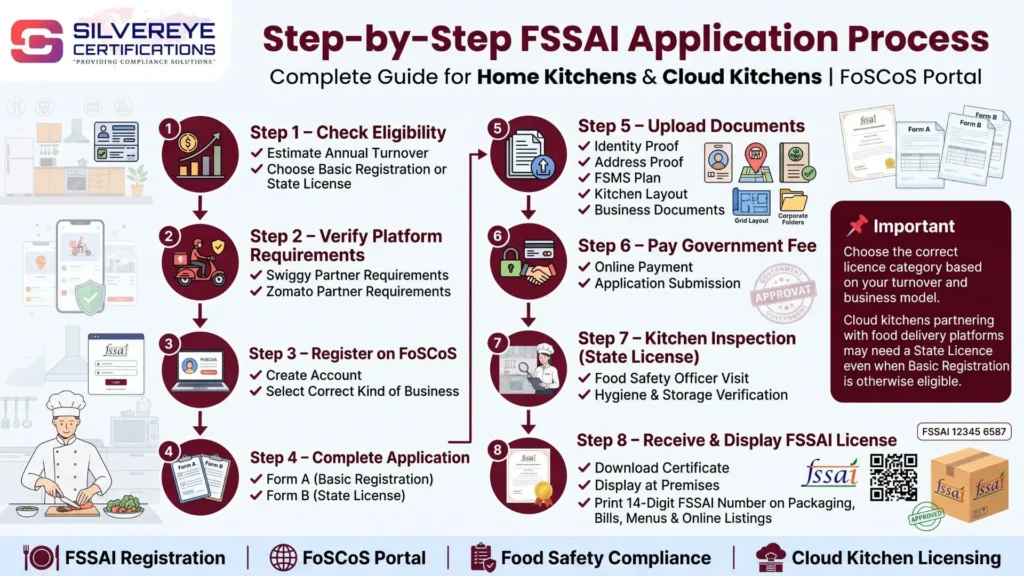
The entire FSSAI registration and license application process happens online through the FoSCoS (Food Safety Compliance System) portal. Here is how you do it in 2026:
- Step 1: Visit the FoSCoS Portal — Go to https://foscos.fssai.gov.in and click on 'Apply for License/Registration'.
- Step 2: Determine Your License Type — Based on your annual turnover and business scale, select Basic Registration, State License, or Central License.
- Step 3: Create an Account — Register with your mobile number and email ID to create a FoSCoS login account.
- Step 4: Fill in the Application Form — Fill out Form A (Basic) or Form B (State/Central) with accurate business details.
- Step 5: Upload Documents — Upload all required documents in the specified format (PDF, JPEG). Ensure the documents are clear and valid.
- Step 6: Pay the Application Fee — Pay the fee online through net banking, UPI, debit card, or credit card.
- Step 7: Inspection (if required) — For State and Central licenses, a food safety officer may visit your premises for inspection within 30 days.
- Step 8: Grant of License — If everything is in order, your FSSAI license number will be issued within 7–60 working days depending on the license type.
- Step 9: Download the Certificate — Log in to FoSCoS and download your FSSAI Registration Certificate or License.
| Processing Time: |
| • Basic Registration: 7 working days |
| • State License: 30 working days (after inspection) |
| • Central License: 60 working days (after inspection) |
| ⚠️ Note: Incomplete applications are rejected within 30 days. You will need to reapply. |
FSSAI License Registration Fees & Cost in 2026
One of the most searched questions is how much FSSAI registration costs. Here is a clear and updated breakdown:
| License Type | Government Fee (Per Year) | Validity Options | Total Govt. Fee (5 Yrs) |
| Basic Registration | ₹100/year | 1–5 years | ₹500 |
| State License (Small) | ₹2,000/year | 1–5 years | ₹10,000 |
| State License (Medium) | ₹3,000–₹5,000/year | 1–5 years | ₹15,000–₹25,000 |
| Central License | ₹7,500/year | 1–5 years | ₹37,500 |
| Pro Tip: Applying for 5 years at once saves you the renewal processing hassle every year. Many food businesses prefer 5-year registration to avoid annual renewal stress. |
FSSAI License Validity & Renewal Process
Validity Period
FSSAI licenses and registrations are valid for a minimum of 1 year and a maximum of 5 years, depending on the period you choose and pay for at the time of application.
FSSAI License Renewal — When and How?
You must apply for FSSAI license renewal at least 30 days before the expiry date. Here's what happens if you miss it:
- A penalty of ₹100 per day is charged for late renewal after the expiry date.
- Operating with an expired FSSAI license is treated as running an unlicensed food business.
- Your license may be cancelled, and you may face prosecution.
Steps to Renew FSSAI License
- Log in to FoSCoS portal using your registered credentials.
- Navigate to the 'Renewal' option under your license dashboard.
- Verify and update your business details if anything has changed.
- Upload fresh documents if required.
- Pay the renewal fee online.
- Submit the application and download the renewed certificate once approved.
Key Benefits of FSSAI License Registration for Your Food Business
| Benefit | How It Helps Your Business |
| Legal Protection | Protects your business from government prosecution and penalties |
| Consumer Confidence | Customers trust FSSAI-certified products more — better brand credibility |
| Business Expansion | Required to list on Swiggy, Zomato, Amazon, Flipkart, and other platforms |
| Loan & Investment | Banks and investors ask for FSSAI certification for food-related loans |
| Export Capability | Central License is mandatory to export food products internationally |
| Goodwill Building | Creates a positive brand image in the competitive food industry |
| FSSAI Logo Usage | Legally use the FSSAI logo on packaging — builds premium perception |
Penalties for Non-Compliance with FSSAI Regulations
Running a food business without FSSAI registration is a serious legal offence. The FSS Act, 2006 lays down strict penalties:
| Violation | Penalty |
| Operating without FSSAI registration/license | Imprisonment up to 6 months + ₹5 lakh fine |
| Sale of substandard food | Fine up to ₹5 lakh |
| Sale of unsafe food | Imprisonment up to 7 years + fine up to ₹10 lakh |
| Misleading advertisement | Fine up to ₹10 lakh |
| Non-compliance with FSSAI notices | License cancellation + legal action |
| Late renewal of license | ₹100 per day penalty after expiry |
Common Mistakes to Avoid During FSSAI License Registration
- Selecting the wrong license type based on incorrect turnover estimation — always choose based on projected annual turnover.
- Uploading blurry or expired documents — all documents must be current and clearly legible.
- Mentioning incorrect or incomplete address — your business address must match the documents submitted.
- Not mentioning all food products in your application — list every category of food you plan to sell or manufacture.
- Missing the renewal deadline — set a reminder at least 60 days before expiry to avoid penalties.
- Applying on third-party websites without verification — always apply through the official FoSCoS portal (foscos.fssai.gov.in).
Post-Registration FSSAI Compliance Checklist for Food Businesses
Getting your FSSAI license is just the beginning. Here's what you need to do to stay compliant in 2026:
- Display FSSAI Registration Certificate: It must be prominently displayed at your business premises.
- Print FSSAI Number on Packaging: Your 14-digit FSSAI number must appear on all food labels.
- Maintain Hygiene Registers: Keep daily records of food handling, storage temperatures, and hygiene practices.
- Annual Return Filing: FBOs with State/Central licenses must file Annual Returns (Form D1) on the FoSCoS portal.
- Respond to FSSAI Notices: Respond to any inspection notices from food safety officers within the stipulated time.
- Renew on Time: Renew at least 30 days before expiry to avoid penalties.
- Update on Business Changes: Any change in business name, address, products, or ownership requires a modification in your FSSAI license.
Conclusion: Get Your FSSAI License Today
FSSAI license registration is not just a compliance checkbox — it is your food business's legal foundation. In 2026, with FSSAI compliance enforcement stronger than ever, unregistered food businesses are at serious risk of penalties, closure, and reputational damage.
Whether you are a home baker just starting out or a food entrepreneur scaling a brand, getting the right FSSAI registration protects you, your customers, and your business. The process is entirely online, relatively affordable, and straightforward when you have the right information.
Apply through the official FoSCoS portal today, choose the right license type for your business, keep your documents ready, and secure your FSSAI number before your next food sale.
Frequently Asked Questions (FAQs) About FSSAI License Registration
Is FSSAI registration mandatory for a home-based food business?
Yes. If you are running a home-based food business — whether it is a cloud kitchen, home bakery, tiffin service, or food catering from home — FSSAI registration is mandatory. If your annual turnover is less than ₹12 lakh, you need a Basic Registration. Beyond ₹12 lakh, a State License is required.
How long does FSSAI license registration take in 2026?
Basic Registration is typically issued within 7 working days. State License takes up to 30 working days (including inspection). Central License can take up to 60 working days. These timelines assume your documents are complete and accurate.
Can I apply for FSSAI license registration offline?
In 2026, the FSSAI has fully moved to the FoSCoS online portal for applications. While some states may still accept physical applications at local food safety offices, the online route via foscos.fssai.gov.in is the standard and fastest method.
What is the difference between FSSAI Registration and FSSAI License?
FSSAI Registration (Form A) is for small food businesses with annual turnover below ₹12 lakh. FSSAI License (Form B) is for medium and large food businesses with higher turnover or multi-state operations. Both give you a 14-digit FSSAI number but the legal category and scope differ.
Can a single FSSAI license cover multiple business locations?
No. Each business premise (factory, warehouse, outlet) requires a separate FSSAI license or registration. However, a Central License covers all premises listed under a single entity across states.
What happens if I change my food products after getting FSSAI registration?
You must update your FSSAI registration by filing a modification application on the FoSCoS portal. Operating with unlisted food products can lead to penalties during inspections.
Is FSSAI registration required for selling food products on Instagram or WhatsApp?
Yes. If you are selling food products through social media platforms — even informally — FSSAI registration is mandatory. The FSSAI has clarified that any 'food business' activity, including online sales, requires a valid FSSAI number.
What is the FSSAI license number format?
An FSSAI registration/license number is a 14-digit number. The first digit indicates the type (1 for Central License, 2 for State License), followed by state code, year, and a unique identifier. This number must be printed on all food labels and packaging.
Can an NRI or foreign national apply for FSSAI license in India?
Yes. Foreign nationals or NRIs can apply for an FSSAI Central License for food import/export businesses. The application process requires Indian business registration documents such as a company incorporation certificate.
How do I check my FSSAI license status after applying?
Log in to the FoSCoS portal with your registered credentials. Navigate to 'Track Application Status' and enter your application reference number. You can track every stage of your FSSAI application from submission to issuance.