- CDSCO Registration is mandatory for manufacturing, importing, or selling medical devices and cosmetics in India under the Medical Device Rules, 2017.
- The process involves classifying your product (Class A-D), appointing an Authorized Indian Representative (AIR), and submitting technical dossiers via the SUGAM portal.
- Non-compliance leads to immediate regulatory bans, shipment seizures at customs, and heavy fines.
Introduction
Last year, a mid-sized medical device importer watched ₹40 lakh worth of diagnostic equipment sit at Nhava Sheva port for nineteen days. The goods were fine. The supplier was credible. The buyers were waiting. But there was no valid CDSCO Registration on record — and nothing moves at Indian Customs without one.
Nineteen days of demurrage. A distributor who walked away. And a re-filing process that took another four months.
Nobody plans for this. But it happens more than you think — at Mumbai, Chennai, Delhi Air Cargo, Kolkata, across every major entry point in the country. The paperwork feels like a back-office task until the moment it becomes your most urgent business problem.
The Medical Device Rules, 2017 fundamentally changed how India regulates healthcare products. Gone is the old approach of importing first and sorting compliance later. The Central Drugs Standard Control Organization now enforces a structured approval framework with real consequences for non-compliance — and this year, the enforcement got sharper.
On January 16, 2026, the CDSCO issued a formal public notice: applications sitting on the SUGAM portal with unanswered queries will now be automatically rejected after a 90-day response window. Three reminders. Thirty days apart. No response — your application is gone and your fees are forfeited. The February 14, 2026 deadline came and went, and hundreds of long-pending applications — some filed nearly a decade ago — were formally closed.
If you are entering the Indian market for the first time, this matters. If you already have an application in progress, it matters even more.
What Is the CDSCO Registration?
A CDSCO Registration is the regulatory license issued by India's Central Drugs Standard Control Organization that legally authorizes a business to manufacture, import, or sell medical devices, in-vitro diagnostics (IVDs), or cosmetics within India.
Without this certificate, your product does not legally exist in the Indian market — no matter how many international approvals it holds.
The Role of CDSCO in India's Healthcare Market
The Central Drugs Standard Control Organization operates under the Union Ministry of Health and Family Welfare. It is India's National Regulatory Authority (NRA) — the equivalent of the US FDA or the European Medicines Agency. The Drug Controller General of India (DCGI) heads the organization and issues final approvals.
CDSCO's core responsibilities include:
- Issuing import and manufacturing licences for medical devices and cosmetics
- Setting safety and quality standards for regulated products
- Reviewing technical dossiers and clinical data
- Managing the SUGAM portal — India's single-window regulatory platform
- Issuing public alerts and ban orders for non-compliant entities
The CDSCO is headquartered at FDA Bhawan, Kotla Road, New Delhi, and operates through six zonal offices, four sub-zonal offices, thirteen port offices, and seven testing laboratories spread across the country.
Why This Certificate Exists
The purpose behind the CDSCO registration process is patient safety, plain and simple. The government wants assurance that a pacemaker used in a hospital in Bhopal meets the same safety standard as one manufactured in Stuttgart or Minneapolis.
The certificate process forces companies to prove their quality management systems are active and audited, that clinical and performance data backs up the product's claims, and that post-market surveillance mechanisms are in place. It is gatekeeping with intent, not bureaucracy for its own sake.
Is CDSCO Registration Mandatory?
Yes, without exception.
Under the Drugs and Cosmetics Act, 1940, and the Medical Device Rules, 2017, manufacturing or importing a regulated product in India without a valid CDSCO certificate is a criminal violation — not a civil fine.
The transition period that once allowed previously unnotified devices some flexibility has officially ended. As of 2025, import licenses under MD-14/MD-15 are mandatory for all Class A (Sterile and Measuring), B, C, and D medical devices. There are no grace period carve-outs remaining.
Consequences of Operating Without a CDSCO License
| Violation | Consequence |
| Importing without MD-15 license | Shipment detained at port; demurrage charges accumulate daily |
| Selling unregistered devices | CDSCO publishes a public ban; hospitals and distributors stop procurement |
| Manufacturing without CLA/SLA license | Factory seal, forced recall, prosecution under the D&C Act |
| Failing to respond to SUGAM queries | Application rejected, government fees forfeited (January 2026 rule) |
| Repeat violations | Imprisonment of up to five years under Indian law |
Beyond the legal risk, there is a commercial one. Major hospital procurement networks — Apollo, Fortis, Max Healthcare, AIIMS — run compliance checks before supplier onboarding. Being on the CDSCO non-compliant list shuts you out of institutional tenders completely.
Who Needs a CDSCO Registration Certificate?
Domestic Manufacturers
Any Indian entity that manufactures medical devices or cosmetics — whether for the domestic market or for export — must hold a manufacturing license issued by the State Licensing Authority (SLA) or the Central Licensing Authority (CLA), depending on the product's risk class. This includes small-scale manufacturers of items like surgical gauze as well as large facilities producing dialysis equipment.
Importers of Foreign Goods
Foreign manufacturers cannot apply to the CDSCO directly. India requires an Authorized Indian Representative (AIR) — a locally incorporated entity with a valid wholesale drug license — to hold the import license on the foreign OEM's behalf. If you are the importer, the license is in your name. Legal accountability for the product's safety in India sits with you.
Traders and Distributors
Traders handling notified medical devices must source only from entities holding a valid CDSCO Certificate. They cannot legally move, repackage, or resell non-compliant product regardless of how it entered the supply chain.
The Authorized Indian Representative: What OEMs Get Wrong
This is the detail that trips up the most international brands.
A foreign company in the US, South Korea, Japan, or Germany cannot create a SUGAM portal account and submit a registration application. The system does not permit it. They must appoint an Authorized Indian Representative who:
- Is a registered legal entity in India
- Holds a valid Wholesale Drug Licence (Form 20B/21B)
- Signs the application and accepts full legal liability for the product in India
- Is the primary contact for the CDSCO in any recall, safety alert, or post-market query
The AIR is not a paperwork formality. If a class action or safety investigation is launched against your device in India, the AIR is the party the regulator summons. This role requires someone who understands regulatory compliance deeply — not a logistics company or a general trade agent.
Which Type of CDSCO License Do You Actually Need?
There is no single document called a "CDSCO Registration Certificate." The specific licence you require depends on two things: what activity you are performing (manufacturing, importing, or loan licensing) and what category of product you are dealing with (medical device or cosmetic). Selecting the wrong form is the leading cause of outright rejections.
Medical Device Licenses Under MDR 2017
Import License — Form MD-14 and MD-15
| Form | What It Is |
| MD-14 | The application form submitted by the importer or AIR via SUGAM |
| MD-15 | The actual import licence granted upon approval |
The MD-15 is the document your customs broker needs to file a Bill of Entry at any Indian port. Without it, the shipment does not move.
Important 2026 note: All data entered in the MD-14 application form — model names, model numbers, shelf life — must exactly match the technical documents in the dossier. A mismatch is flagged immediately and results in a query or rejection.
Manufacturing License
| Form | Use | Authority |
| MD-5 | Manufacturing licence for Class A and B devices | State Licensing Authority (SLA) |
| MD-9 | Manufacturing licence for Class C and D devices | Central Licensing Authority (CLA) |
| MD-3 / MD-4 | Application and grant for Loan Licence | SLA or CLA, depending on class |
Loan License
A Loan License allows you to manufacture products under your brand name at a third-party factory that already holds a valid manufacturing license. The host factory maintains GMP responsibility. You hold responsibility for product specification, labelling, and market performance. This is a common route for newer brands that want market presence in India before building or acquiring their own facility.
Cosmetic Licenses Under Cosmetics Rules, 2020
Import Registration
Previously known as Form 42 (application) and Form 43 (registration), these were redesignated under the Cosmetics Rules, 2020:
- COS-1 — Application for import registration
- COS-2 — Registration Certificate issued upon approval
- Valid for 5 years from date of issue
A Free Sale Certificate (FSC) from the country of origin is a mandatory submission requirement. Without it, the application is not processed.
Manufacturing License
- COS-5 — Application for manufacturing licence
- COS-8 — Manufacturing licence issued
- Issued by: State Licensing Authority (SLA)
- Requires a physical factory inspection by Drug Inspectors who assess GMP compliance, hygiene systems, water quality, and laboratory capabilities
Risk Classification of Medical Devices: Class A to D
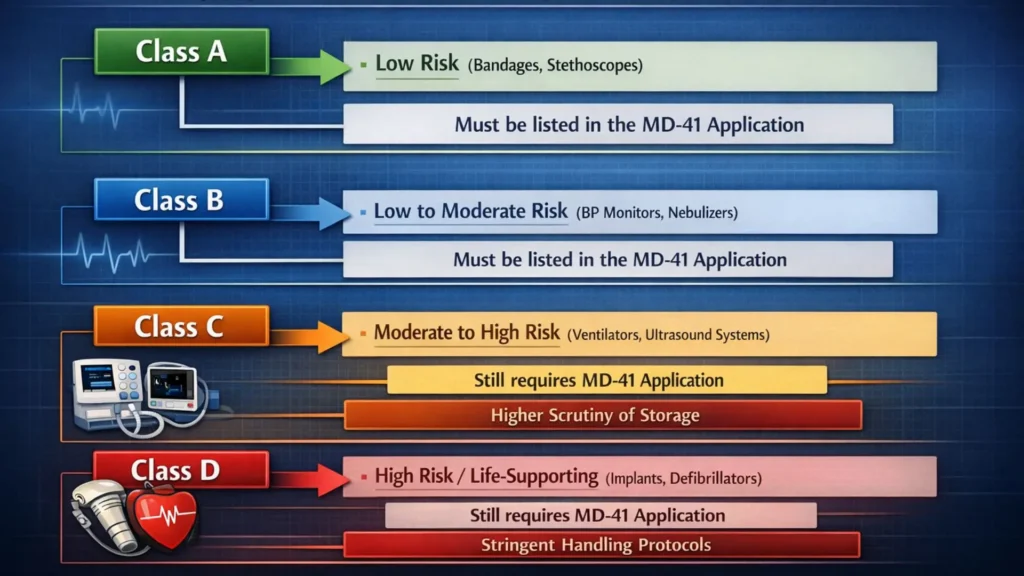
Your device's risk class determines your licensing authority, government fees, timeline, technical documentation depth, and whether your application goes to the State or Central authority. Misclassifying your device — either accidentally or intentionally to reduce fees — is consistently detected by CDSCO's technical reviewers.
In early 2025, the CDSCO carried out a significant risk-based reclassification of 553 medical devices across cardiovascular and neurological product segments. If your product falls in these categories, verify its current classification before filing.
| Class | Risk Level | Examples | Licensing Authority |
| Class A | Low Risk | Absorbent cotton, non-sterile surgical dressings, alcohol swabs | State (SLA) — some NSNM devices now exempt from licensing |
| Class B | Low-Moderate Risk | Blood pressure monitors, glucometers, hypodermic needles | State (SLA) |
| Class C | Moderate-High Risk | Dialysis machines, lung ventilators, orthopaedic implants | Central (CLA) |
| Class D | High Risk | Cardiac stents, pacemakers, angiographic catheters | Central (CLA) |
2025–2026 Update — Class A NSNM Exemption: Class A devices that are Non-Sterile and Non-Measuring (NSNM) are now exempted from mandatory licensing requirements. This is a meaningful simplification for manufacturers of basic Class A products. However, this exemption is category-specific. If your Class A device involves sterility or measurement — it still requires full registration.
2026 Update — Software as a Medical Device (SaMD): The CDSCO's 2026 classification revision has provided explicit regulatory clarity for digital health products. AI-driven diagnostic tools, health monitoring applications that carry clinical claims, and machine learning-based imaging software are now categorized under risk-based rules based on their intended use and potential for patient harm. If your product involves software with a clinical function, obtain a formal classification determination before filing.
If your device is not on the notified list: File a classification request using Form MD-13 with the Central Licensing Authority before submitting any registration application. This is a required step that many first-time applicants skip — causing delays of months when the CLA sends the application back for classification confirmation.
Documents Required for CDSCO Registration
Documentation failures are behind the majority of delayed and rejected applications. The DCGI Guidelines specify exact requirements, and the CDSCO's technical officers follow a structured review checklist. Submitting an incomplete or inconsistent dossier will trigger queries — and under the 2026 rules, unanswered queries within the 90-day window mean automatic rejection.
Corporate and Legal Documents
- Certificate of Incorporation of the applicant entity
- PAN Card and GST Registration Certificate
- Valid Wholesale Drug Licence (Form 20B/21B) — mandatory for the AIR or importer
- Power of Attorney from the foreign OEM to the AIR — apostilled or notarised as applicable
- Authorisation letter from the OEM/manufacturer
Technical Documents
Device Master File (DMF) — the core technical submission:
- Product description and intended use statement
- Labelling and Instructions for Use (IFU) in English
- Risk analysis report (per ISO 14971)
- Biocompatibility data (per ISO 10993 series)
- Sterility and shelf-life validation data
- Performance and safety testing reports
- Post-market surveillance plan
Plant Master File (PMF) — required for manufacturing applications:
- Factory site plan and layout
- Water system validation records
- Sterility assurance documentation
- Equipment qualification and calibration records
- GMP compliance documentation
ISO 13485 Certificate — Mandatory for all medical device applications. The certificate must be current, issued by a recognized accreditation body, and cover the specific product scope being registered. A certificate with an expired date, a scope mismatch, or issued by an unrecognized body will result in a query.
Note on ISO 13485: A 2025 CDSCO FAQ clarified that while ISO 13485 is not explicitly mandated in the text of MDR 2017 for domestic manufacturing licences, it functions as the primary proof of Quality Management System compliance in practice. For import applications, it remains a standard submission requirement.
Free Sale Certificate (FSC) for Importers
The FSC demonstrates that your product is legally marketed in its country of origin. Devices with approvals from GHTF founding member countries — USA, EU member states, Canada, Japan, and Australia — receive preferential technical review. CDSCO treats these as pre-screened products and may not require independent clinical data generation.
The FSC must be:
- Issued by the relevant national regulatory authority
- Apostilled if the country of origin is an Apostille Convention signatory
- Valid at the time of dossier submission
- Explicitly referencing the product and brand name being registered
Practical note: Request your FSC at least six to eight weeks before your planned filing date. Government agencies in many countries are slow to issue them. If the brand name appears on the FSC of an approved reference market country, include it clearly in your application. If it does not, state "Not Applicable" rather than leaving the field blank — the CDSCO FAQ 2025 update clarified this specifically.
The CDSCO Registration Process: Step by Step
Every application goes through the SUGAM portal. There is no physical file submission. Understanding how the portal works — and what the CDSCO has changed in its processing rules — is essential before you begin.
Step 1: Entity Registration on SUGAM
Create your company's profile on the SUGAM portal at sugam.gov.in. You will need:
- Digital Signature Certificate (DSC) of the authorised signatory
- Corporate KYC documents in the prescribed formats
- Details of your Wholesale Drug License
A common early mistake is uploading blurred scans or documents in non-accepted formats. This delays portal account activation before any application is even filed.
Step 2: Confirm Classification and Select the Correct Form
Before uploading documents or paying fees, confirm:
- The risk class of your product — using the CDSCO notified devices list or the new pre-filing consultation facility
- Whether you are the manufacturer, importer, or loan licensee
- The correct application form — MD-14 for imports, MD-5 or MD-9 for manufacturing, COS-1 for cosmetics
Government fees paid for the wrong form are non-refundable. Taking an extra day to verify the correct form is always worth it.
Step 3: Dossier Upload and Fee Payment
Upload the complete technical dossier for each product, then pay the government challan fee through the Bank of Baroda gateway integrated into the SUGAM portal. For importers, fees are payable in USD equivalent. For domestic manufacturers, fees are in INR.
Every uploaded document should be:
- In PDF format, within the portal's file size limits
- Clearly named to match document type
- Signed and stamped where applicable
- Consistent in all product details with the application form
Step 4: Technical Review and Query Management
CDSCO technical officers review the submitted dossier. If they require clarification or additional data, they raise a formal query through the SUGAM portal.
2026 Rule — Critical Update: Following a public notice dated January 16, 2026, the CDSCO now operates a structured 90-day query response window. Three reminders are issued at 30-day intervals. If no response is received within 30 days of the third reminder, the application is automatically rejected and the fee is forfeited. There is no appeal mechanism for missed query deadlines.
Set up a dedicated internal process for monitoring your SUGAM dashboard. Query notifications can otherwise sit unread while the 30-day counter runs.
For Class C and D devices, the Central Licensing Authority may refer the dossier to an Expert Committee for specialized technical review. This is standard process and adds time but does not indicate a problem with your application.
Step 5: Audit — For Manufacturing Applications
If you are applying for a manufacturing license, Medical Device Officers will conduct an on-site inspection of your facility. The audit examines GMP compliance, QMS implementation, equipment calibration records, and environmental monitoring for sterile manufacturing.
For import license applications, the audit is typically a desk review of the Plant Master File submitted for the foreign OEM's facility. For high-risk Class C and D devices, a physical inspection of the OEM's overseas facility may be required.
Step 6: Auto-Generated Compliance Certificates and Approval
A 2025 update to the SUGAM portal introduced auto-generation of Market Standing Certificates and Non-Conviction Certificates for licensed entities. These documents are now generated digitally through the portal rather than requiring separate applications — a practical improvement for companies managing multiple compliance filings.
Once the full review is complete and all queries are resolved, the CDSCO issues the Registration Certificate digitally through SUGAM. For medical device manufacturing and import licenses under MDR 2017, the certificate is valid in perpetuity subject to license retention fee payments. For cosmetic import registrations, validity is five years.
CDSCO Registration Fees and Timelines (2026)
A. Medical Device Import Fees — Form MD-14 (Foreign Manufacturers and Importers)
| Device Class | Risk Level | Govt. Site Fee (USD) | Govt. Fee Per Device (USD) | Inspection Fee (if applicable) |
|---|---|---|---|---|
| Class A (Sterile/Measuring) | Low Risk | ~$1,000 | $50 | N/A |
| Class B | Low-Moderate | ~$1,000 | $1,000 | N/A |
| Class C | Moderate-High | ~$3,000 | $1,000 | $5,000 (if site visit required) |
| Class D | High Risk | ~$3,000 | $1,000–$3,000* | $5,000 (if site visit required) |
Fees payable in USD equivalent via Bank of Baroda. Class A NSNM devices that meet the exemption criteria do not require a licence. Class A Sterile and Measuring devices require a licence under the above fee structure.
B. Medical Device Manufacturing Fees — Indian Manufacturers
| Device Class | Licensing Authority | Govt. Site Fee (INR) | Fee Per Product (INR) | Estimated Timeline |
| Class A (NSNM) | State (SLA) | Nil | Nil | Instant / 1 Day |
| Class A (S/M) | State (SLA) | ₹5,000 | ₹500 | 30 – 45 Days |
| Class B | State (SLA) | ₹5,000 | ₹500 | 3 – 5 Months |
| Class C | Central (CLA) | ₹50,000 | ₹1,000 | 6 – 8 Months |
| Class D | Central (CLA) | ₹50,000 | ₹1,000 | 6 – 9 Months |
C. Cosmetic Import Registration Fees — Form COS-2
| Fee Type | Amount (USD) | Notes |
| Registration Fee | $1,000 | Per Category (e.g., Skin care, Hair care) |
| Manufacturing Site Fee | $500 | Per factory location |
| Variant Fee | $50 | Per shade, pack size, or flavor |
| Inspection Fee | $5,000 | Only if CDSCO audits the overseas factory |
Estimated timeline: 3 to 6 months from complete dossier submission.
License Validity and Retention: A Critical Distinction
Medical Devices — Perpetual Validity with 5-Year Retention
Under MDR 2017, a CDSCO import or manufacturing license does not expire in the traditional sense. It remains valid indefinitely unless suspended or cancelled. However:
- A Licence Retention Fee must be paid every five years from the date of issue
- The retention fee equals the original government fees paid at registration
- Late payment: A late fee of 2% per month applies for up to 180 days after the due date
- After 180 days: The licence is treated as cancelled. Re-application from scratch is required
This catches many companies off guard. The license has no expiry date on its face, which creates an assumption that it runs forever without action. It does not. If you have a license approaching its fifth anniversary, set a payment reminder at least three months in advance.
Also note: All products registered under an import licence — including those added through endorsements or line extensions over the years — expire simultaneously with the base licence. If your base import licence was issued in 2021 and you added products in 2024, everything expires in 2026. This is a common source of unexpected lapses.
Cosmetics — Fixed 5-Year Validity
The cosmetic import registration (COS-2) is valid for exactly five years from date of issue. You must apply for renewal before expiry. There is no grace window — an expired COS-2 results in your shipments being blocked at customs immediately upon the expiry date.
Why Applications Get Rejected in 2026
Incomplete or Defective Documentation
Blurred PDFs, missing apostilles, expired ISO 13485 certificates, and documents where the product name or model number does not exactly match the application form are the most consistent causes of query-stage failures.
Misclassification of the Device
Attempting to register a Class C device as a Class B to reduce fees is caught reliably. CDSCO's technical officers are domain specialists. The 2026 classification revision has also made it harder to argue borderline cases without supporting rationale. Use the pre-filing consultation facility to settle this before you file.
Missing the 90-Day Query Response Window
Under the January 2026 rule, this is now the most financially damaging mistake an applicant can make. If your team is not monitoring the SUGAM portal dashboard regularly, queries can go unnoticed until the deadline has already passed. Fees are forfeited and the application must be re-filed from the beginning.
FSC Problems
An FSC from a country not on the GHTF reference list, a scope that does not cover the product being registered, or an un-apostilled certificate will trigger an immediate query. Request the FSC early, verify the scope covers your exact product, and confirm apostille requirements for the issuing country.
Mismatch Between Application Form and Technical Dossier
Model numbers, product names, intended use statements, and shelf-life data entered on the SUGAM form must match precisely with what appears in the Device Master File. Even minor discrepancies — a hyphen in the wrong place, an abbreviated model name — generate queries.
Benefits of Holding a Valid CDSCO Registration Certificate
- Market access without interruption. Once registered, your imports clear customs consistently. You can manage inventory planning and sales cycles with a level of predictability that is simply not possible without valid documentation.
- Institutional procurement eligibility. Major hospital groups require CDSCO compliance as a mandatory supplier qualification. Without the certificate, the institutional market — which represents a substantial share of India's medical device purchasing — is closed to you entirely.
- Government tender participation. Bidding on the Government e-Marketplace (GeM) portal, AIIMS procurement processes, and state government medical supply tenders requires a valid CDSCO Certificate as a technical qualification. The Indian government is among the country's largest medical device buyers. Compliance is the price of admission.
- Supply chain transparency. Post-market surveillance reporting and compliance tracking have become much easier since CDSCO's shift to a fully digital process. Auto-generated certificates, digital audit trails, and real-time SUGAM dashboard visibility all reduce administrative friction for registered entities.
- Brand trust in a competitive market. In a healthcare market where product quality variance is significant, a CDSCO Certificate is a verifiable signal to hospitals, distributors, and healthcare professionals that your product has been reviewed and approved by India's national regulatory authority.
What Has Actually Changed in 2025–2026
These are confirmed regulatory developments, not projections:
January 2026 — 90-Day Query Response Rule (Live): CDSCO issued a public notice on January 16, 2026, formally implementing automatic rejection of SUGAM applications where queries go unanswered through three 30-day reminder cycles. This affects drugs, medical devices, and IVDs. The February 14, 2026 deadline for historically pending applications has now passed.
2025–2026 — SaMD and AI Device Classification Clarity: The 2026 classification revision provides explicit regulatory placement for Software as a Medical Device, AI-powered diagnostic tools, and health monitoring software with clinical claims. These are no longer unclassified.
2025 — Risk Reclassification of 553 Devices: The CDSCO completed a risk-based reclassification of 553 medical devices in cardiovascular and neurological segments. If your product falls in these areas, verify its current class before filing or renewing.
2025 — Class A NSNM Exemption: Class A Non-Sterile, Non-Measuring devices are now exempted from mandatory licensing. This simplifies compliance for manufacturers of basic low-risk items.
2025 — Auto-Generated Compliance Certificates: Market Standing Certificates and Non-Conviction Certificates for Class C and D licensed entities can now be generated digitally through the SUGAM portal. No separate applications are required.
2025 — Mandatory In-Country Performance Evaluation for New IVDs: For new in-vitro diagnostic devices in Classes B through D, clinical evaluation conducted within India is now mandatory — even if the device holds approvals from other countries. This is a notable addition to the dossier requirements for IVD importers.
2026 — Pre-Filing Consultation Facility (Live): The CDSCO introduced a free pre-submission consultation mechanism that allows manufacturers and importers to confirm device risk classification before filing formally. This significantly reduces classification disputes during the review stage.
Conclusion
India's medical device and cosmetics market is one of the most significant growth opportunities in the world. But accessing that market requires working within a regulatory framework that has become progressively more rigorous — and in 2026, more strictly enforced than ever before.
A valid CDSCO Registration Certificate is not an administrative formality. It is the legal foundation on which your business in India stands. It is what allows your product to clear customs, enter hospital procurement lists, qualify for government tenders, and be sold legally across the country.
The companies that start the CDSCO Registration process early, get their documentation right the first time, and treat query responses as a priority — rather than something to address when time permits — are the ones that reach market without the delays that derail competitors.
If you have an existing application on the SUGAM portal, check your dashboard today. Under the 2026 rules, an unread query is a ticking clock.
For end-to-end CDSCO Registration support — including AIR services, technical dossier preparation, SUGAM query management, and license retention — contact Silvereye Certifications for a free compliance assessment.
Frequently Asked Questions
Can a foreign company apply directly to CDSCO without an Indian entity?
No. The SUGAM portal requires an Indian legal entity as the applicant. A foreign manufacturer must appoint an Authorised Indian Representative who holds a valid wholesale drug licence. The AIR applies on behalf of the OEM and holds legal liability in India.
Does US FDA 510(k) or CE marking replace the need for CDSCO Registration?
No. These international approvals strengthen your technical dossier and are given weight during review — especially for Class C and D devices from GHTF countries — but they do not substitute for Indian registration. You must still obtain CDSCO Approval to sell in India.
What is the new 90-day query response rule?
Effective January 16, 2026, the CDSCO issues three reminders at 30-day intervals for unanswered queries. If there is no response within 30 days of the third reminder, the application is automatically rejected and the government fee is forfeited. Applications pending for over two years with three reminders had to respond by February 14, 2026, or face rejection.
Is ISO 13485 mandatory for CDSCO Registration?
For import licence applications, a valid ISO 13485 certificate is a standard submission requirement. For domestic manufacturing licences, MDR 2017 does not explicitly mandate it, but it functions as the primary evidence of Quality Management System compliance in practice.
What happens if I import medical devices without an MD-15 licence?
The shipment is detained by the Assistant Drug Controller at the port. Demurrage charges begin accumulating. The CDSCO can direct re-export or destruction of the goods, and you may face prosecution under the Drugs and Cosmetics Act.
What is the pre-filing consultation facility?
Introduced in 2025–2026, this is a free service from the CDSCO that allows manufacturers and importers to get official confirmation of a device's risk classification before formally submitting a registration application. It is available for medical devices (excluding IVDs) and is particularly useful for products in borderline categories or those with software components.
What changed for Software as a Medical Device in 2026?
The CDSCO's 2026 classification update formally categorised AI-driven diagnostic tools, health monitoring applications carrying clinical claims, and machine learning-based imaging software under risk-based classification rules. Products in this category that were previously in a regulatory grey area now have a defined compliance pathway.
What is the SUGAM portal?
SUGAM is the CDSCO's single-window digital platform for all regulatory submissions — applications, document uploads, query responses, and fee payments. All CDSCO Registration applications must be filed through SUGAM. There is no provision for physical file submission.
How does a Loan License differ from a Manufacturing License?
A Manufacturing License applies when you own and operate the production facility. A Loan License lets you manufacture products under your brand at a third-party factory that already holds a valid manufacturing license. The host factory bears GMP compliance responsibility; you are responsible for the product specification and labelling.
If I change my Authorized Indian Representative, can I transfer the license?
there is no provision to transfer an existing import license from one AIR to another. A fresh import license application must be filed under the new representative. Factor this in when evaluating AIR partnerships — changing an AIR is not a quick or low-cost process.