

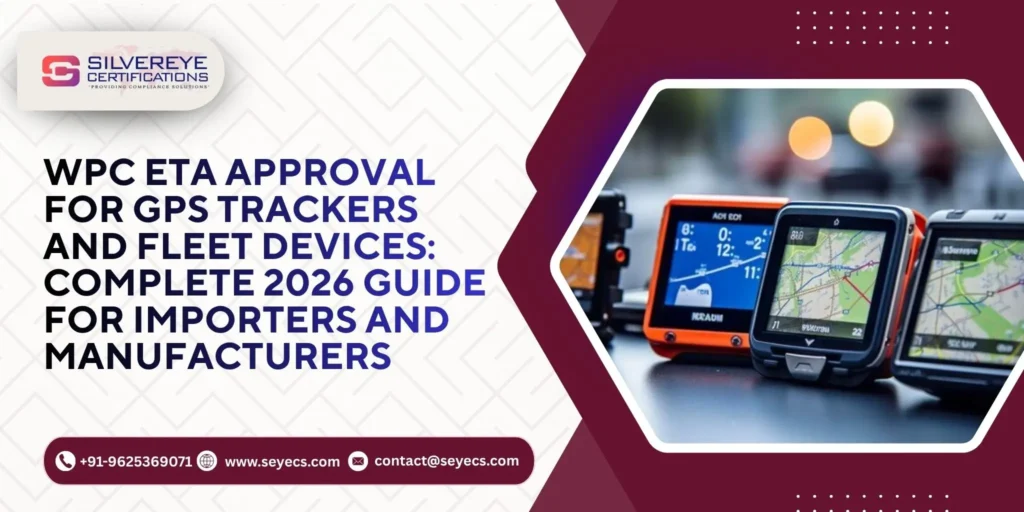
- WPC ETA approval for GPS Trackers is mandatory before you import, manufacture, or sell any GPS tracker or fleet telematics device in India.
- Covers vehicle trackers, AIS-140 devices, OBD trackers, asset trackers, fleet gateways, and connected dash cameras.
- Government fee is nominal per model; approval generally takes 2 to 6 weeks with a complete RF test report.
- Certificate validity runs for the life of the approved model — no renewal unless the design or frequency band changes.
Introduction
WPC ETA (Equipment Type Approval) is a mandatory certificate from the Wireless Planning and Coordination Wing, Department of Telecommunications, Government of India. It is required before any GPS tracker, vehicle tracking device, OBD dongle, AIS-140 unit, or fleet management device can be legally imported, manufactured, or sold in India.
The requirement applies because these devices carry a GSM, GPRS, 4G, Bluetooth, or Wi-Fi module alongside the GPS/GNSS chip. Importers and manufacturers apply online through the Saral Sanchar portal with an RF test report and company documents. Approval usually takes 2 to 6 weeks, and the certificate stays valid for the life of that product model.
What Is WPC ETA Approval?
WPC stands for Wireless Planning and Coordination — the wing of India's Department of Telecommunications (DoT) that manages the country's radio frequency spectrum. Set up in 1952 under the Indian Wireless Telegraphy Act, 1933, the WPC Wing is India's national radio regulatory authority, with its head office in New Delhi and regional offices in Mumbai, Chennai, Kolkata, and Guwahati.
ETA stands for Equipment Type Approval. It is the certificate the WPC Wing issues confirming that a wireless device — including a GPS tracker or fleet telematics unit — operates within India's approved frequency bands, stays within permitted transmission power, and will not cause harmful interference to licensed communication networks. WPC ETA, WPC certification, and WPC ETA approval all refer to the same underlying approval; only the terminology differs.
The entire process runs online through the Saral Sanchar portal, the DoT's single-window platform for wireless equipment approvals, import licences, and Authorized Indian Representative (AIR) registration.
Why GPS Trackers and Fleet Devices Fall Under WPC ETA
A pure GPS or GNSS chip only receives signals from satellites — it does not transmit, so a receive-only module is generally outside WPC ETA's scope. In practice, almost no commercial GPS tracker or fleet device is receive-only. To send location, ignition status, fuel data, or driver-behaviour data back to a server, these devices also carry a transmitter — typically a GSM/GPRS/3G/4G cellular module, and often Bluetooth, Wi-Fi, or RFID as well. The moment a device transmits on India's regulated frequency bands, it needs WPC ETA, regardless of how small or "simple" the tracker looks.
This is why virtually every vehicle tracker, AIS-140 device, fleet gateway, and connected dashcam sold in India needs WPC ETA — the GPS component is rarely the trigger; the cellular or Bluetooth radio inside it is.
Which GPS Trackers and Fleet Devices Need WPC ETA? (Product Coverage Table)
WPC ETA is not limited to one type of tracker. The table below covers the categories most fleet and mobility businesses deal with.
| Product Category | Typical Examples | Wireless Technology Used | WPC ETA Status |
| Vehicle GPS Trackers | OBD-II plug-in trackers, hardwired vehicle trackers | GSM / GPRS / 3G / 4G + GNSS | Mandatory |
| AIS-140 Trackers | Government-mandated commercial vehicle tracking units with panic button | GNSS + GSM/GPRS/4G | Mandatory (plus AIS-140 type approval) |
| Fleet Telematics Gateways | Fleet management control units, telematics control units (TCUs) | 4G/LTE, Bluetooth, Wi-Fi | Mandatory |
| Asset & Container Trackers | Cargo trackers, container and trailer trackers | LoRa, NB-IoT, GSM/GPRS | Mandatory |
| Two-Wheeler / Bike Trackers | Motorcycle and e-bike anti-theft trackers | GSM/GPRS + GNSS | Mandatory |
| Personal & Pet Trackers | Wearable location trackers | GSM/GPRS, Bluetooth | Mandatory |
| Connected Fleet Dash Cameras | AI dashcams with cloud upload | Wi-Fi, 4G, Bluetooth | Mandatory |
| Fuel & Sensor Add-ons | Wireless fuel sensors, temperature/tilt sensors for fleet | Bluetooth, RF module | Mandatory |
| RFID Fleet Identification | RFID-based toll and fleet ID tags | RFID | Mandatory |
| Standalone GNSS Receivers | Receive-only GPS/GNSS modules with no onward transmission | GPS/GNSS (receive-only) | Generally exempt |
Note: exemption for receive-only GNSS modules applies strictly to devices with no transmitting radio at all. If that same module is later paired with a GSM or Bluetooth chip on the same PCB — which is standard for commercial fleet products — the finished device needs WPC ETA.
Who Needs WPC ETA Approval For GPS Trackers and Fleet Devices: Importers vs. Manufacturers
For Importers of GPS Trackers and Fleet Devices
If you import GPS trackers, telematics hardware, or fleet devices manufactured overseas (commonly from China, Taiwan, or the EU) for resale in India, WPC ETA must be secured before customs clearance. Without it, customs can detain or seize the consignment at the port of entry.
- A foreign manufacturer without an Indian office must appoint an Authorized Indian Representative (AIR) to file and hold the ETA on its behalf.
- Indian importers also need an Importer-Exporter Code (IEC) and, in most cases, a WPC import license alongside the ETA.
- Each distinct product model and hardware/frequency configuration needs its own ETA — one certificate does not automatically cover every SKU in a product line.
For Manufacturers of GPS Trackers and Fleet Devices
Domestic manufacturers assembling GPS trackers or fleet devices in India also need WPC ETA before the finished product reaches the market, with a couple of practical nuances:
- If you build a device around a GSM/GPS module that already carries a valid WPC ETA for that exact configuration, a fresh certificate may not be required — but any change to the antenna, power output, or added radio (say, adding Bluetooth to a GSM-only tracker) needs a new approval.
- Manufacturers with an Indian branch office can apply directly, without going through an AIR.
- RF testing must still be done at an accredited lab even for domestically manufactured devices.
Eligibility Criteria for WPC ETA Approval For GPS Trackers and Fleet Devices
- A registered business entity in India — a private limited company, LLP, or proprietorship with valid GST registration — or an Authorized Indian Representative acting for a foreign manufacturer.
- A completed RF (radio frequency) test report from an accredited laboratory confirming the device operates within India's approved de-licensed or licensed frequency bands.
- Complete technical documentation of the product — block diagram, frequency bands used, transmission power, and antenna specifications.
- Valid Import-Exporter Code (IEC) for businesses importing the hardware.
- Registration on the Saral Sanchar portal with company KYC details.
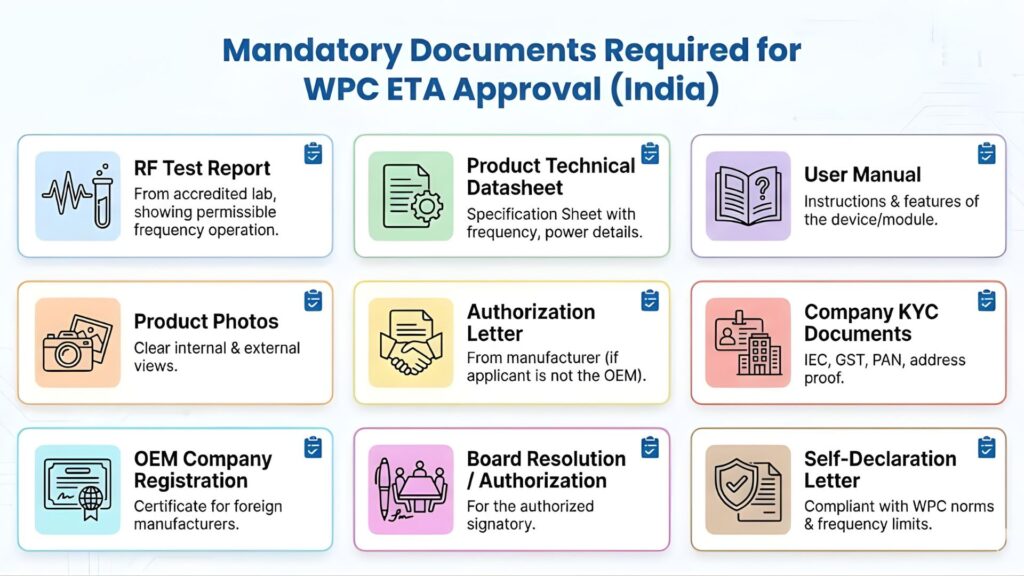
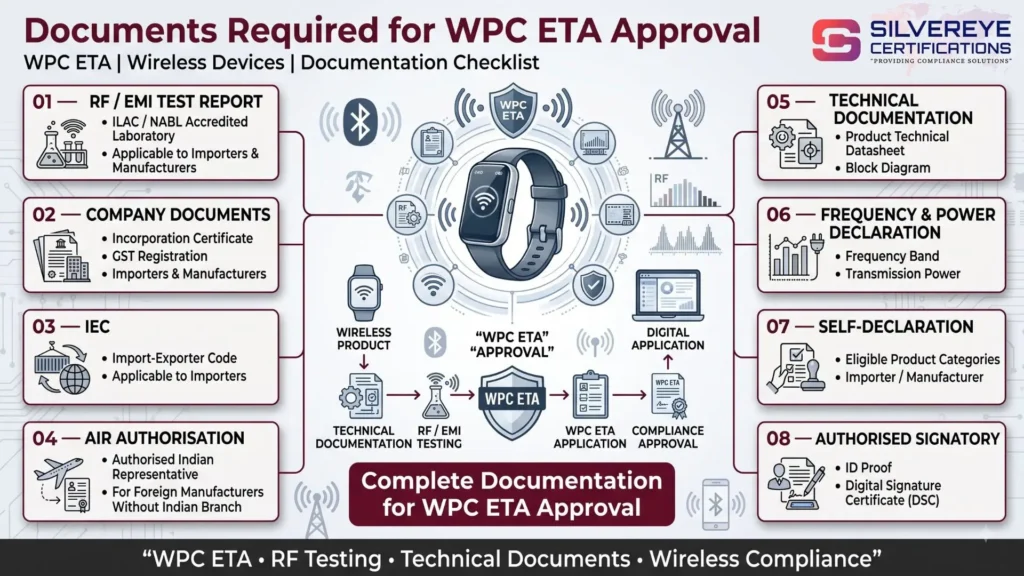
Documents Required for WPC ETA Approval For GPS Trackers and Fleet Devices
| Document | Applicable To |
| RF/EMI test report from an ILAC/NABL-accredited lab | Importers and manufacturers |
| Company incorporation certificate / GST registration | Importers and manufacturers |
| Import-Exporter Code (IEC) | Importers |
| Authorization letter for Authorized Indian Representative (AIR) | Foreign manufacturers without an Indian branch |
| Product technical datasheet and block diagram | Importers and manufacturers |
| Frequency band and transmission power declaration | Importers and manufacturers |
| Self-declaration form (for eligible product categories) | Importers and manufacturers |
| Authorized signatory ID proof and digital signature certificate (DSC) | Importers and manufacturers |
Step-by-Step WPC ETA Approval Process for GPS Trackers and Fleet Devices
- Register on the Saral Sanchar Portal — create your company profile with GST, IEC, and authorized signatory details.
- Identify the wireless technology in your device — GSM/GPRS, 3G/4G, Bluetooth, Wi-Fi, RFID, or LoRa — since this determines the exact WPC approval category and applicable Indian technical standard.
- Get RF testing done at an accredited laboratory (Indian NABL-accredited or an ILAC-recognised lab abroad) to confirm the device meets India's frequency and power limits.
- Submit the ETA application on the portal with the RF test report, technical documents, and company KYC. Products eligible for self-declaration can often be processed faster.
- WPC Wing review — the department verifies the test report and documentation against India's frequency allocation table.
- Respond to queries, if any — incomplete frequency declarations or mismatched test parameters are the most common reasons for delay at this stage.
- Receive the WPC ETA certificate once the WPC Wing is satisfied with the documentation and test results.
- Proceed with import clearance or market launch, quoting the ETA number on invoices and product documentation where required.
WPC ETA Government Fees for GPS Trackers and Fleet Devices
The government fee for WPC ETA is charged per product model rather than as a flat one-time business fee — meaning each distinct tracker or fleet device SKU needs its own filing and its own fee. Reported government fees for standard self-declaration categories run around ₹10,000 per model, in addition to RF testing charges, which vary by lab and by the number of frequency bands tested.
Because WPC periodically revises fee schedules, always confirm the current fee on the Saral Sanchar portal before filing, or verify it with a WPC-registered consultant.
Validity and Renewal of WPC ETA Certificate
For most GPS tracker and fleet device categories approved through the standard or self-declaration route, the WPC ETA certificate is valid for the life of that approved product model — there is no fixed expiry date, and no periodic renewal is required as long as the device is sold in the exact configuration that was approved.
Fresh approval is required only when the product itself changes — for example:
- Adding a new radio module (say, adding Wi-Fi to a GSM-only tracker)
- Changing the antenna design or transmission power
- Switching to a different frequency band (e.g., moving from 2G/3G to a 4G/LTE module)
- A change of manufacturer or OEM for the wireless module used inside the device
Since procedures and validity rules are updated by the WPC Wing from time to time, importers and manufacturers should reconfirm the current validity policy for their specific product category on the Saral Sanchar portal at the time of filing.
How Long Does WPC ETA Approval Take for GPS Trackers and Fleet Devices?
Timelines depend on how complete the application is and how quickly RF testing is completed:
- Self-declaration route (eligible categories, complete RF report): a few days to about 2 weeks
- Standard ETA route: typically 4 to 6 weeks
- Complex or first-time multi-radio devices (e.g., a fleet gateway combining 4G, Wi-Fi, and Bluetooth): up to 8 weeks in some cases
As a working rule, start the WPC ETA process at least 60 to 90 days before your planned shipment arrival or product launch date, so testing delays or documentation queries don't stall your go-to-market plan.
Benefits of WPC ETA Approval for GPS Tracker and Fleet Businesses
- Legal market access — your device can be imported, distributed, and sold in India without risk of customs seizure or penalty.
- Fleet operator and OEM trust — corporate fleet buyers and OEM integrators typically ask for the WPC ETA number before onboarding a tracker vendor.
- Smoother customs clearance — a valid ETA number on your shipping documents avoids inspection delays at Indian ports.
- Foundation for AIS-140 and other approvals — WPC ETA is usually a prerequisite before applying for AIS-140 certification for commercial vehicle trackers.
- Long-term cost saving — since approval covers the product's life (barring design changes), you avoid repeat certification costs for the same model.
Common Mistakes Importers and Manufacturers Make
- Assuming a GPS tracker is exempt because "it's just GPS" — the GSM/Bluetooth/Wi-Fi module inside almost always triggers the requirement.
- Filing one ETA and assuming it covers every hardware variant or frequency configuration in the product line.
- Starting the process after the shipment has already left the origin country, leaving no buffer for customs holds.
- Submitting an RF test report that doesn't match the exact frequency bands or power levels declared in the application.
- Not appointing an Authorized Indian Representative in time, which stalls filing for foreign manufacturers with no Indian office.
Conclusion
WPC ETA approval is not optional paperwork — it is the legal gate every GPS tracker, AIS-140 device, and fleet management product must pass through before it touches the Indian market. Building the timeline, documents, and RF testing into your product launch plan early — rather than after the shipment lands — is what keeps import schedules and fleet rollouts on track. Because WPC procedures, fees, and category classifications are updated periodically, always verify the latest requirements on the Saral Sanchar portal or with a WPC-registered consultant before filing.
Frequently Asked Questions
Do all GPS trackers need WPC ETA approval in India?
Almost all commercial GPS trackers need WPC ETA because they combine a GNSS chip with a GSM, GPRS, 4G, Bluetooth, or Wi-Fi module to transmit location data. Only a pure receive-only GNSS module with no transmitter is generally exempt.
Is WPC ETA the same as AIS-140 certification?
No. WPC ETA approves the device's radio frequency operation, while AIS-140 is a separate government mandate specifically for commercial vehicle tracking devices covering GPS accuracy, panic button, and data transmission standards. Commercial fleet trackers typically need both.
Who applies for WPC ETA — the importer or the manufacturer?
Either can, depending on the business model. Foreign manufacturers without an Indian office must appoint an Authorized Indian Representative (AIR) to file on their behalf; Indian importers and domestic manufacturers can apply directly through the Saral Sanchar portal.
How much does WPC ETA approval cost for a GPS tracker?
The reported government fee for standard/self-declaration categories is around ₹10,000 per product model, plus RF testing charges from the accredited lab, which vary by device complexity. Confirm the current fee on the Saral Sanchar portal before applying.
How long is the WPC ETA certificate valid?
For most GPS tracker and fleet device categories, the certificate is valid for the life of the approved model, with no fixed renewal date, unless the hardware, antenna, or frequency band changes.
How long does WPC ETA approval take for a GPS tracker?
Self-declaration cases with a complete RF report can be approved in a few days to about two weeks; standard applications generally take 4 to 6 weeks, and complex multi-radio devices can take up to 8 weeks.
Is factory inspection required for WPC ETA approval?
No. Factory inspection is not a standard requirement for WPC ETA; approval is based on the RF test report and technical documentation submitted.
Can one WPC ETA certificate cover multiple tracker models?
No. Each distinct hardware configuration or frequency variant typically needs its own ETA filing, since the approval is tied to the specific tested configuration, not the product brand as a whole.
What happens if I import GPS trackers without WPC ETA?
Customs can detain or seize the shipment at the port of entry, and selling non-approved wireless devices in India can attract regulatory penalties under the Indian Wireless Telegraphy Act.
Do fleet management gateways with Wi-Fi and Bluetooth need separate approvals for each radio?
Often yes — a device using multiple wireless technologies (for example, 4G plus Bluetooth plus Wi-Fi) may need each radio module evaluated and approved as part of the same or separate ETA filings, depending on WPC's current classification for that combination.