
- All three chapters, fully covered: Since September 2020, SIMS applies to every HS code within Chapters 72, 73, and 86 — not just a selected list, as was the case when the system first launched in 2019.
- Coverage expanded over time: The original 2019 notification covered 284 specific items; a follow-up DGFT notification in September 2020 broadened this to the entire scope of all three chapters.
- 500-plus tariff lines today: Current estimates place SIMS coverage at over 500 individual 8-digit HS codes across the three chapters, spanning raw steel through finished steel articles and railway components.
- A simple two-digit check tells you most of what you need: If your product's HS code begins with 72, 73, or 86, it almost certainly requires SIMS registration — the chapter-level prefix is your fastest first check.
Introduction
Which HS Codes Require SIMS Registration is required for falling under Chapters 72, 73, and 86 of the ITC(HS) — that's every tariff line covering iron and steel (Chapter 72), articles of iron or steel (Chapter 73), and railway or tramway rolling stock and track fixtures (Chapter 86).

This wasn't always the case: when SIMS launched in November 2019, it covered a specific list of 284 items. A DGFT notification dated September 28, 2020 expanded coverage to every HS code across all three chapters, which is the rule still in force today, covering 500-plus individual 8-digit tariff lines. If your product's HS code starts with 72, 73, or 86, it needs SIMS registration.
Which HS Codes Require SIMS Registration?
The Harmonized System (HS) is the internationally standardized numerical classification used to categorize traded goods, maintained globally and adapted for India as the ITC(HS) — the Indian Trade Classification based on the Harmonized System. Every product entering or leaving India is assigned an 8-digit HS code under this system, organized into 21 sections and 98 chapters.
The first two digits of any HS code identify the chapter — the broadest category a product belongs to. For SIMS purposes, this is the fastest way to check applicability: Chapters 72, 73, and 86 are the three chapters that fall under mandatory SIMS registration.
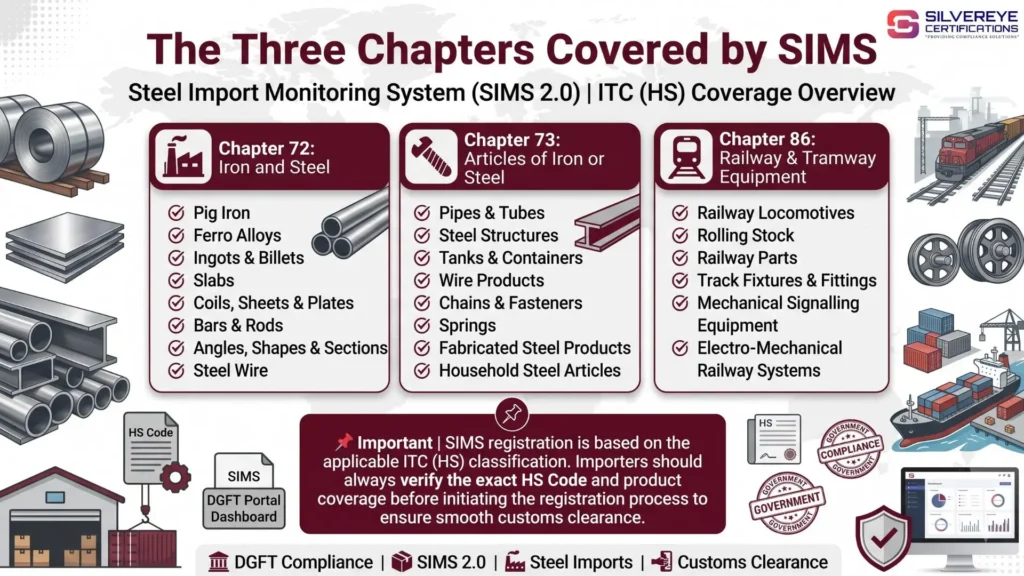
The Three Chapters Covered by SIMS, at a Glance
| Chapter | Title | What It Broadly Covers |
| 72 | Iron and Steel | Raw and semi-finished steel: pig iron, ferro-alloys, ingots, billets, slabs, flat-rolled coils/sheets/plates, bars, rods, angles, shapes, sections, and wire |
| 73 | Articles of Iron or Steel | Fabricated and finished steel products: tubes and pipes, structures, tanks, wire products, chains, fasteners, springs, and steel household articles |
| 86 | Railway or Tramway Locomotives, Rolling Stock, and Parts | Railway and tramway locomotives, rolling stock, track fixtures and fittings, and related mechanical/electro-mechanical signaling equipment |
Chapter 72: Iron and Steel — What's Included
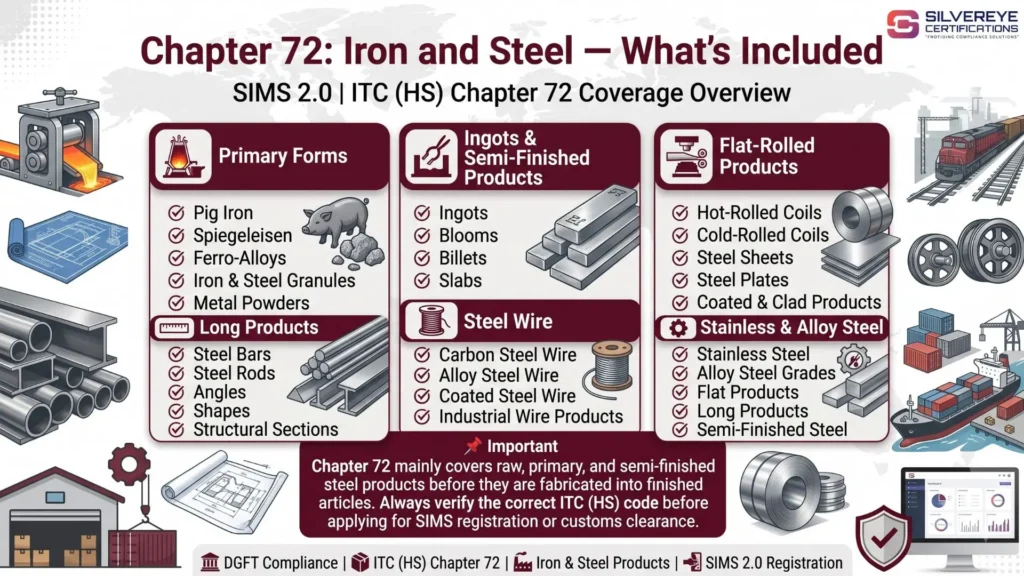
Chapter 72 covers steel in its raw and semi-finished forms — essentially, steel before it's been fabricated into a finished article. This is the chapter most steel importers and traders interact with most often.
- Primary forms: Pig iron, spiegeleisen, ferro-alloys, and granules or powders of iron and steel.
- Ingots and semi-finished products: Ingots, blooms, billets, and slabs — the intermediate forms steel takes before final rolling.
- Flat-rolled products: Hot-rolled and cold-rolled coils, sheets, and plates, including coated and clad variants.
- Long products: Bars, rods, angles, shapes, and sections, in both hot-rolled and cold-formed varieties.
- Wire: Steel wire in various grades and coatings, excluding certain finished wire articles that fall under Chapter 73 instead.
- Stainless and alloy steel: Separate headings within Chapter 72 cover stainless steel and other alloy steel grades in each of the above forms.
Chapter 73: Articles of Iron or Steel — What's Included
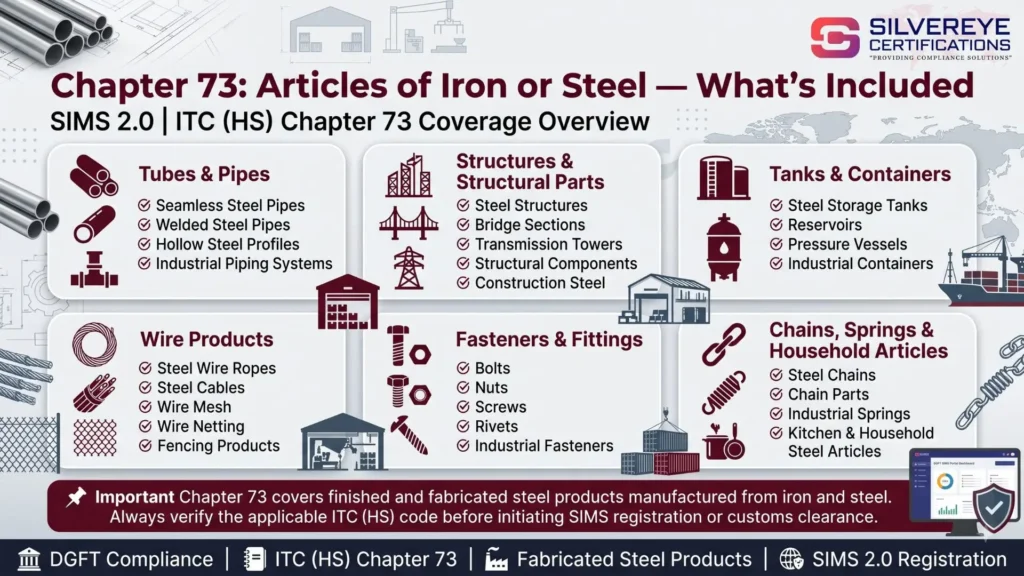
Chapter 73 picks up where Chapter 72 leaves off — it covers steel that has been fabricated, shaped, or manufactured into identifiable articles, rather than raw material forms.
- Tubes, pipes, and hollow profiles: Seamless and welded steel tubes and pipes used across construction, oil and gas, and industrial applications.
- Structures and structural parts: Prefabricated steel structures, bridge sections, towers, and structural components used in construction and infrastructure.
- Tanks, reservoirs, and containers: Steel storage vessels and containers of various capacities.
- Wire products: Stranded wire, ropes, cables, plaited bands, wire netting, and wire fencing.
- Fasteners and fittings: Nails, screws, bolts, nuts, rivets, and similar steel hardware.
- Chains, springs, and household articles: Chains and chain parts, springs, and steel articles for table, kitchen, or household use.
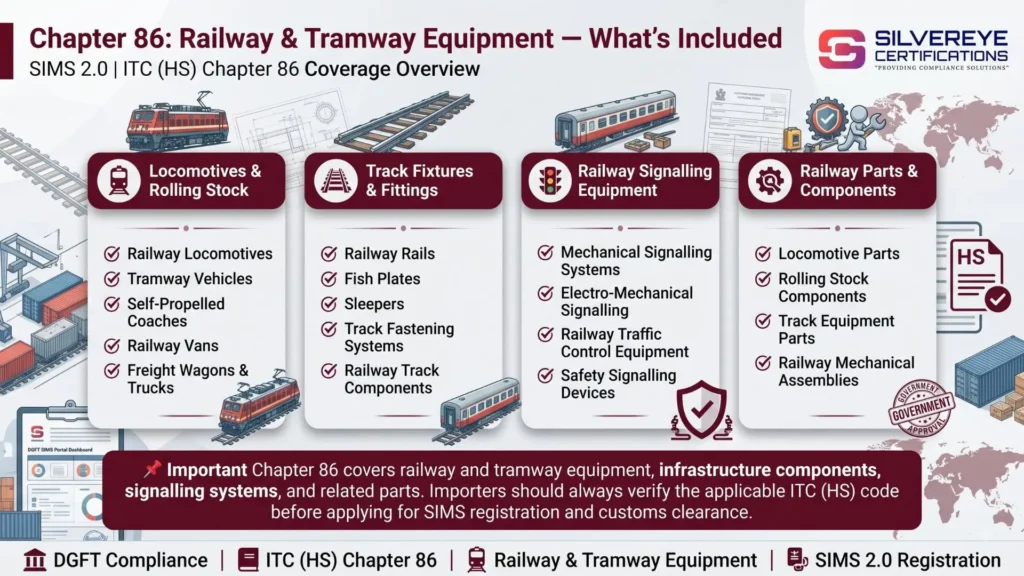
Chapter 86: Railway and Tramway Equipment — What's Included
Chapter 86 is the narrowest of the three chapters in terms of everyday relevance, but it's fully covered under SIMS nonetheless.
- Locomotives and rolling stock: Railway and tramway locomotives, self-propelled railway or tramway coaches, vans, and trucks.
- Track fixtures and fittings: Rails, fish-plates, sleepers, and other fixtures and fittings for railway or tramway tracks.
- Signaling equipment: Mechanical, including electro-mechanical, traffic signaling equipment used for railway and tramway systems.
- Parts: Parts of the locomotives, rolling stock, and track equipment described above.
How SIMS Coverage Expanded: From 284 Items to All of Chapters 72, 73, and 86
Understanding how SIMS coverage has changed over time helps explain why older articles or guides sometimes describe a narrower scope than what's actually in force today.
| Date | Coverage Change |
| September 5, 2019 (Notification No. 17/2015-2020) | SIMS launched, initially covering a specific annexed list of 284 items across Chapters 72, 73, and 86 |
| September 28, 2020 (Notification No. 33/2015-2020) | Coverage expanded to include all HS codes across the entirety of Chapters 72, 73, and 86 — the rule still in force today |
In practical terms, this means that if you're importing anything classified under these three chapters today, you should assume SIMS registration applies, rather than checking against the older, narrower 284-item list that some outdated sources still reference.
How Many HS Codes Are Covered Under SIMS Today?
Estimates from various trade and compliance sources place current SIMS coverage at over 500 individual 8-digit tariff lines across Chapters 72, 73, and 86 combined. The exact count can shift slightly as HS nomenclature itself is periodically revised at the international level (as happened with the move to ITC(HS) 2022), so it's worth treating any specific number as approximate rather than fixed.
Best way to verify your exact code: Cross-check your product's specific 8-digit HS code against the current list published directly on the SIMS portal, rather than relying on a static count from a secondary source.
What's NOT Covered: Common Points of Confusion
Since SIMS applies to entire chapters rather than a hand-picked list, most confusion isn't about exclusions within Chapters 72, 73, and 86 — it's about products that seem steel-related but fall under different chapters entirely.
| Product Type | Actual HS Chapter | SIMS Applicable? |
| Machinery and mechanical appliances (even if made mostly of steel) | Chapter 84 | No — not a SIMS-covered chapter, even though the machine is largely steel |
| Electrical machinery and equipment | Chapter 85 | No — falls outside Chapters 72, 73, and 86 |
| Vehicles (cars, trucks, and their steel bodies/chassis as complete units) | Chapter 87 | No — complete vehicles are classified separately from raw steel or steel articles |
| Copper, aluminum, and other non-ferrous base metals and articles | Chapters 74–83 | No — SIMS is specific to iron and steel; other base metals aren't covered |
| Steel cookware, cutlery, and household articles | Chapter 73 | Yes — these fall within Chapter 73's scope of articles of iron or steel |
| Steel tubes, pipes, and structural components | Chapter 73 | Yes — explicitly covered |
The key distinction: SIMS cares about what the product fundamentally is (raw steel, a steel article, or railway equipment), not simply whether steel was used somewhere in making it. A steel-bodied machine classified under Chapter 84 doesn't need SIMS registration; a steel pipe classified under Chapter 73 does.
How to Check If Your Specific Product Needs SIMS Registration
- Identify your product's 8-digit HS code: Check your commercial invoice, prior import documentation, or consult your customs broker if you're unsure.
- Look at the first two digits: If they're 72, 73, or 86, your product falls within a SIMS-covered chapter.
- Cross-check against the SIMS portal's current HS code list: Confirm the exact 8-digit code is listed, since chapter-level coverage is comprehensive but the specific code still needs to be entered correctly during registration.
- When in doubt, ask your customs broker or a trade compliance consultant: Especially for products with borderline classification (for example, steel components that could arguably fall under a machinery chapter instead), professional input avoids a costly misclassification.
Registration Basics for These Chapters
- Documents needed: IEC certificate, commercial invoice, Mill Test Certificate, product specification sheet, and BIS certificate where applicable — the same document set applies regardless of which of the three chapters your product falls under.
- Process: Register and apply through the SIMS 2.0 portal at sims.steel.gov.in, entering your specific HS code along with shipment and product details.
- Fees: Re. 1 per ₹1,000 of CIF value, minimum ₹500, maximum ₹1,00,000 — the fee formula is identical across Chapters 72, 73, and 86.
- Validity: Every registration, regardless of chapter, generates an Automatic Registration Number valid for 75 days from the date of registration.
Who Needs to Check HS Code Coverage? (Eligibility)
- Steel importers: Anyone importing raw steel, semi-finished steel, or finished steel articles under Chapters 72 or 73.
- Railway and infrastructure equipment importers: Businesses importing railway or tramway locomotives, rolling stock, or track equipment under Chapter 86.
- Manufacturers sourcing steel components: Companies importing steel articles like fasteners, tubes, or structural parts as inputs for further manufacturing.
- Customs brokers: Anyone filing a Bill of Entry needs to confirm the product's HS code and corresponding SIMS applicability before submission.
Common HS Code Mistakes That Affect SIMS Compliance
- Assuming steel content alone triggers SIMS: A product made of steel but classified under a different chapter (like machinery under Chapter 84) doesn't require SIMS registration — classification depends on the product's HS chapter, not its raw material.
- Relying on an outdated 284-item list: Some older resources still describe SIMS as covering only specific items from the original 2019 list — this hasn't been accurate since the September 2020 expansion to all HS codes in the three chapters.
- Misclassifying between Chapter 72 and Chapter 73: Confusing raw/semi-finished steel forms (Chapter 72) with fabricated steel articles (Chapter 73) can lead to an incorrect HS code entry, even though both require SIMS registration.
- Not verifying the exact 8-digit code: Confirming only the 2-digit chapter isn't enough — the SIMS application requires the precise 8-digit HS code, which must be entered correctly.
Conclusion
Figuring out whether your product needs SIMS registration comes down to one relatively simple check: does its HS code fall under Chapter 72, 73, or 86? Since September 2020, the answer has been comprehensive — every tariff line within these three chapters is covered, not just a hand-picked list. Where importers most often go wrong isn't within these chapters but around their edges — assuming that steel content alone triggers SIMS, when what actually matters is the product's own HS classification. When your product's classification is anything but obvious, a quick check against the current SIMS portal list, or a conversation with your customs broker, is worth the few minutes it takes compared to a rejected Bill of Entry at the port.
Frequently Asked Questions
Which HS code chapters require SIMS registration?
SIMS registration is mandatory for all products under Chapters 72 (Iron and Steel), 73 (Articles of Iron or Steel), and 86 (Railway or Tramway Locomotives, Rolling Stock, and Parts) of the ITC(HS).
Does SIMS cover every HS code within these three chapters, or only some?
Every HS code within Chapters 72, 73, and 86 is covered. This became the rule from September 28, 2020, when a DGFT notification expanded coverage from an initial list of 284 specific items to the entirety of all three chapters.
How many HS codes are covered under SIMS in total?
Estimates place current coverage at over 500 individual 8-digit HS codes across Chapters 72, 73, and 86 combined, though the exact figure can shift slightly with periodic HS nomenclature revisions.
Does a machine made mostly of steel need SIMS registration?
No, unless the product itself is classified under Chapter 72, 73, or 86. Machinery is generally classified under Chapter 84, and vehicles under Chapter 87 — the steel content alone doesn't bring a product under SIMS if its actual HS classification falls outside these three chapters.
Are stainless steel products covered under SIMS?
Yes. Stainless steel in raw or semi-finished form falls under specific headings within Chapter 72, and stainless steel articles fall under Chapter 73 — both are fully covered under SIMS.
Is steel cookware or kitchenware covered under SIMS?
Yes. Steel articles for table, kitchen, or household use are classified under Chapter 73 and require SIMS registration like other articles of iron or steel.
Do copper, aluminum, or other non-ferrous metal imports need SIMS registration?
No. SIMS is specific to iron and steel products under Chapters 72, 73, and 86. Other base metals like copper and aluminum fall under different HS chapters (74 through 83) and aren't covered by SIMS.
How do I find the exact HS code for my steel product?
Check your commercial invoice or prior import records for the declared HS code, or consult your customs broker. You should then cross-check the specific 8-digit code against the current list on the SIMS portal to confirm applicability.
Was SIMS coverage always this broad?
No. When SIMS launched on November 1, 2019, it covered a specific annexed list of 284 items. Coverage was expanded to include all HS codes across Chapters 72, 73, and 86 through a DGFT notification dated September 28, 2020.
Are railway equipment imports really covered under the same system as steel coils and sheets?
Yes. Chapter 86, covering railway and tramway locomotives, rolling stock, and track fixtures, is one of the three chapters under SIMS, alongside Chapter 72 (raw steel) and Chapter 73 (steel articles).
What happens if I import a product without checking its HS code against SIMS coverage first?
If the product falls under Chapters 72, 73, or 86 and you haven't registered, your Bill of Entry will be rejected by customs, leading to a shipment hold, demurrage charges, and the need for a fresh SIMS registration before clearance can proceed.
Is the fee or process different depending on which of the three chapters my product falls under?
No. The registration process, document requirements, fee formula, and 75-day validity period are identical across Chapters 72, 73, and 86 — only the specific HS code and product details you enter differ.