
- RoHS 6: The original six restricted substances under EU Directive 2002/95/EC are lead, mercury, cadmium, hexavalent chromium, polybrominated biphenyls (PBB) and polybrominated diphenyl ethers (PBDE).
- RoHS 3: Commission Delegated Directive (EU) 2015/863 added four phthalates — DEHP, BBP, DBP and DIBP — bringing the EU RoHS restricted-substance list to ten for the relevant equipment categories from 22 July 2019, subject to applicable exemptions.
- Concentration limits: The maximum limit is generally 0.1% (1,000 ppm) per homogeneous material for each restricted substance, except cadmium, which has a limit of 0.01% (100 ppm).
- Evidence of compliance: Businesses generally maintain a Bill of Materials (BOM), supplier material declarations, relevant laboratory test reports and a Declaration of Conformity. Compliance is an ongoing responsibility, not simply a one-time certificate.
Introduction
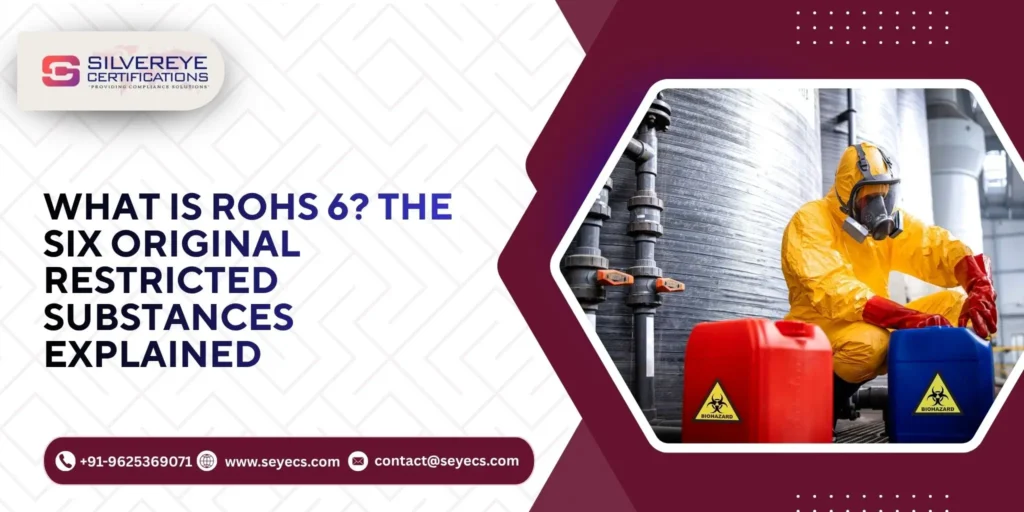
RoHS 6 refers to the original six restricted substances under the EU's first RoHS Directive (2002/95/EC): lead, mercury, cadmium, hexavalent chromium, polybrominated biphenyls (PBB) and polybrominated diphenyl ethers (PBDE). The maximum concentration is generally 0.1% (1,000 ppm) by weight in each homogeneous material, except cadmium, which is limited to 0.01% (100 ppm). The 2015 amendment, commonly called RoHS 3, added four phthalates, bringing the EU restricted-substance list to ten. Compliance is demonstrated through appropriate technical documentation, supplier material information, testing where necessary and an EU Declaration of Conformity. There is no universal government-issued RoHS certificate.
If you have come across the term RoHS 6 while researching electronics compliance, it refers to the original six hazardous substances restricted under the European Union's Restriction of Hazardous Substances (RoHS) framework. These restrictions were introduced to reduce the use of certain hazardous materials in electrical and electronic equipment (EEE) and support safer manufacturing, recycling and waste management.
Although the EU RoHS requirements have expanded from six to ten restricted substances, understanding the original RoHS 6 list remains important for manufacturers, importers and exporters. The six substances form the foundation of the current requirements, while later amendments introduced additional restrictions, including four phthalates under the 2015 amendment commonly known as RoHS 3.
This guide explains what RoHS 6 means, identifies the six original restricted substances, compares RoHS 6 with the current EU RoHS 10 requirements, and covers the applicable limits, compliance evidence and important considerations for businesses in 2026.
What Is RoHS 6?
RoHS 6 is an informal term for the six hazardous substances restricted under the European Union's original RoHS Directive, 2002/95/EC. The Directive was adopted in January 2003, and its substance restrictions applied to new electrical and electronic equipment (EEE) placed on the EU market from 1 July 2006.
RoHS stands for Restriction of Hazardous Substances. The regulation was introduced to reduce the use of certain hazardous materials in electrical and electronic equipment and limit the environmental and health risks associated with their manufacture, use and disposal.
The original directive restricted six substances: lead, mercury, cadmium, hexavalent chromium, polybrominated biphenyls (PBB) and polybrominated diphenyl ethers (PBDE). Each substance has a maximum permitted concentration by weight in a homogeneous material. This means the limit is assessed separately for individual materials within a product, rather than by calculating an average across the complete device.
RoHS 6 is not a separate certification or a standalone law. It describes the original six-substance restriction that remains part of the EU's current RoHS framework. Later amendments expanded the restricted-substance list to ten, so businesses must identify the applicable requirements for their product and destination market.
The Original 6 RoHS Substances, Explained
The original RoHS Directive identified six substances for restriction in electrical and electronic equipment. The table below summarises their names, chemical symbols, maximum concentration limits and common examples of where they may be encountered.
| Substance | Symbol | Maximum limit by weight in homogeneous material | Common applications or sources |
|---|---|---|---|
| Lead | Pb | 0.1% (1,000 ppm) | Solder, cable materials, certain alloys and electronic components |
| Mercury | Hg | 0.1% (1,000 ppm) | Fluorescent lamps, certain switches, relays and sensors |
| Cadmium | Cd | 0.01% (100 ppm) | Certain rechargeable batteries, pigments, coatings and plastics |
| Hexavalent Chromium | Cr(VI) | 0.1% (1,000 ppm) | Certain metal coatings and corrosion-protection treatments |
| Polybrominated Biphenyls | PBB | 0.1% (1,000 ppm) | Flame-retardant materials in certain plastics and electronic components |
| Polybrominated Diphenyl Ethers | PBDE | 0.1% (1,000 ppm) | Flame-retardant materials in plastic housings, cables and electronic components |
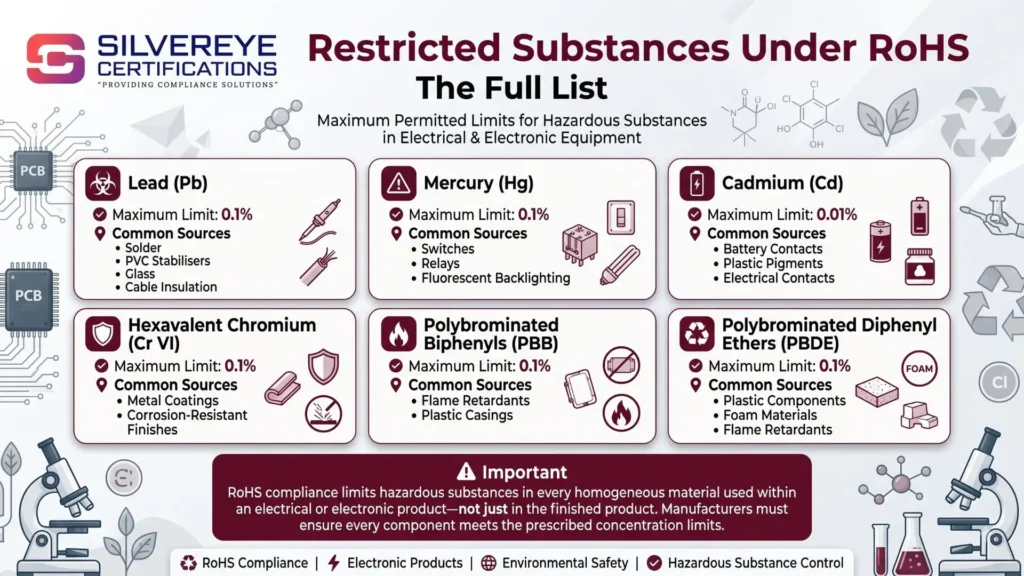
Important: These are the general concentration limits under EU RoHS. Specific applications may qualify for exemptions listed in the Directive's annexes. The applicable exemption, product category and validity period must be checked before concluding that a material is permitted.
1. Lead (Pb) — Maximum Limit: 0.1%
Lead is a heavy metal historically used in electronics manufacturing, particularly in solder, certain alloys and electronic components. It is restricted under RoHS because exposure to lead can affect the nervous system and other organs.
The maximum permitted concentration is 0.1% (1,000 ppm) by weight in each homogeneous material. Certain applications may qualify for specific exemptions, including some solder and alloy uses. These exemptions have defined conditions and should be checked against the current EU RoHS exemption list.
2. Mercury (Hg) — Maximum Limit: 0.1%
Mercury is a toxic metal that has been used in certain electrical and electronic applications, including fluorescent lighting, switches, relays and sensors.
RoHS restricts mercury to 0.1% (1,000 ppm) by weight in each homogeneous material. The restriction encourages manufacturers to use suitable alternatives where possible. However, certain applications may still fall under specific exemptions, so the relevant exemption conditions must be reviewed.
3. Cadmium (Cd) — Maximum Limit: 0.01%
Cadmium is restricted more strictly than the other five original RoHS substances. Its maximum permitted concentration is 0.01% (100 ppm) by weight in each homogeneous material.
Historically, cadmium has been used in certain rechargeable batteries, pigments, coatings and plastic materials. It is a recognised human carcinogen and can cause harm to the kidneys and other organs following exposure.
Because its permitted concentration is ten times lower than the general limit for the other five substances, businesses should pay particular attention to materials and components that may contain cadmium.
4. Hexavalent Chromium [Cr(VI)] — Maximum Limit: 0.1%
Hexavalent chromium is a specific chemical form of chromium used in certain industrial surface treatments, coatings and corrosion-protection processes.
It is restricted because exposure to certain Cr(VI) compounds can cause serious health effects, including cancer. The maximum permitted concentration under RoHS is 0.1% (1,000 ppm) by weight in each homogeneous material.
Manufacturers may use alternative surface-treatment processes, including suitable trivalent chromium systems, where technically and legally appropriate. However, the chemical form and applicable test method must be considered when assessing compliance.
5. Polybrominated Biphenyls (PBB) — Maximum Limit: 0.1%
Polybrominated biphenyls (PBB) are a group of brominated compounds historically used as flame retardants in certain plastic materials and electronic components.
They were included in the original RoHS restricted-substance list because of concerns about their persistence and potential environmental and health effects. The maximum permitted concentration is 0.1% (1,000 ppm) by weight in each homogeneous material.
Manufacturers should review the composition of plastic housings and other relevant components to identify whether PBB-containing materials are present.
6. Polybrominated Diphenyl Ethers (PBDE) — Maximum Limit: 0.1%
Polybrominated diphenyl ethers (PBDE) are a group of brominated flame-retardant substances that have been used in certain plastics, electronic housings and other components.
Some PBDEs are persistent in the environment and have raised concerns about potential effects on human health, including endocrine and neurological effects. Their use in covered electrical and electronic equipment is restricted under RoHS.
The maximum permitted concentration is 0.1% (1,000 ppm) by weight in each homogeneous material. Manufacturers should obtain reliable material information from suppliers and arrange appropriate testing where the composition of a component is uncertain.
RoHS 6 vs. RoHS 2 vs. RoHS 3 vs. RoHS 10: What Changed?
The EU RoHS framework has evolved since its introduction in 2003. It started with six restricted substances and later expanded to cover ten. Along the way, the legislation also widened its product scope and introduced additional conformity-assessment and documentation requirements.
The terms RoHS 1, RoHS 2, RoHS 3 and RoHS 10 are commonly used in industry. However, they do not represent four separate directives. The current EU legal framework is Directive 2011/65/EU, as amended.
| Legislation or common term | Year and application date | Main change |
|---|---|---|
| Directive 2002/95/EC (RoHS 1) | Adopted in 2003; restrictions applied from 1 July 2006 | Introduced restrictions on the original six substances in covered electrical and electronic equipment. |
| Directive 2011/65/EU (RoHS 2) | Adopted in 2011; entered into force on 21 July 2011 | Recast the original directive, established a broader product-scope framework and introduced CE-marking and conformity-assessment obligations. |
| Directive 2015/863 (commonly called RoHS 3) | Adopted on 31 March 2015; additional substance restrictions applied from 22 July 2019 for most covered categories | Added DEHP, BBP, DBP and DIBP to the restricted-substance list. |
| RoHS 10 | Common industry term, not a separate directive | Refers to the ten restricted substances currently listed in Annex II of the EU RoHS Directive. |
A separate change: Category 11. Directive 2011/65/EU expanded the scope of covered equipment, including Category 11, which covers other electrical and electronic equipment not covered by the preceding categories. This wider scope became applicable from 22 July 2019. Category 11 was not introduced by Directive 2015/863.
What Does This Mean for Manufacturers?
The original six substances remain part of the current EU RoHS requirements. The four additional phthalates expanded the list to ten:
- DEHP: Bis(2-ethylhexyl) phthalate
- BBP: Butyl benzyl phthalate
- DBP: Dibutyl phthalate
- DIBP: Diisobutyl phthalate
The four phthalate restrictions generally applied from 22 July 2019. For medical devices, including in-vitro medical devices, and monitoring and control instruments, including industrial instruments, the application date was 22 July 2021.
Therefore, businesses supplying products to the EU should assess the current ten-substance requirements, applicable product category and any valid exemptions. The exact obligations depend on the product and its intended market.
What Is RoHS 5/6?
The expression RoHS 5/6 sometimes appears in technical discussions and supplier documentation, but it is not an official compliance category defined by the EU RoHS Directive.
It may be used informally to describe a product that meets the limits for five of the original six substances but relies on an exemption for the sixth, often lead. However, this shorthand can be misleading because RoHS exemptions apply to specific substances, applications and product categories.
For example, certain lead applications in medical devices and monitoring or control instruments have been covered by specific exemptions. These exemptions do not provide a general permission to use lead throughout a product. Their conditions, scope and validity dates must be checked against the applicable version of Annex III or Annex IV.
Important: Do not treat a general statement such as "RoHS 5/6 compliant" as sufficient proof of conformity. The manufacturer should identify the restricted substance, the exact application, the applicable exemption and its validity. The product must still meet all other applicable RoHS requirements.
Who Needs to Comply With RoHS Restricted-Substance Requirements?
Businesses involved in manufacturing, importing or distributing electrical and electronic equipment may have obligations under the RoHS legislation applicable to their target market.
Under the EU framework, responsibilities depend on the economic operator's role in the supply chain.
- Manufacturers: Companies manufacturing electrical and electronic equipment for placement on the EU market must assess conformity, prepare technical documentation and issue the required EU Declaration of Conformity.
- Importers: Businesses importing covered equipment into the EU must verify that the manufacturer has fulfilled the applicable conformity obligations and that the required documentation is available.
- Distributors: Businesses making products available on the market must exercise due care and check relevant compliance information and markings.
- Brand owners: A business placing equipment on the market under its own name or trademark may be treated as the manufacturer and assume the corresponding obligations.
- OEMs and ODMs: Contract manufacturers and design manufacturers should provide accurate material information and technical evidence to the brand or manufacturer responsible for placing the product on the market.
The legal responsibilities are not identical for every supply-chain participant. They depend on the applicable legislation and the role the business performs.
Market-specific note: The EU, Great Britain, Northern Ireland, China and the UAE have their own regulatory frameworks. Meeting the EU RoHS requirements does not automatically establish compliance in every other market.
Products Covered Under the EU RoHS Framework
The EU RoHS Directive covers electrical and electronic equipment falling within its specified product categories, unless an exclusion or exemption applies.
Common examples include:
- Consumer electronics: Televisions, audio equipment, electronic accessories and household appliances.
- IT and telecommunications equipment: Computers, servers, networking equipment and communication devices.
- Industrial electronics: Control panels, automation equipment and electrical instruments.
- Lighting equipment: LED lamps, luminaires and other covered lighting products.
- Electrical and electronic tools: Certain power tools and equipment used for construction, manufacturing and maintenance.
- Toys and leisure equipment: Toys, leisure and sports equipment that fall within the Directive's scope.
- Medical devices: Covered medical and in-vitro diagnostic devices, subject to applicable exclusions and exemptions.
- Monitoring and control instruments: Equipment used for monitoring and controlling industrial or other processes.
- Other electrical and electronic equipment: Products falling under Category 11.
The scope is not determined simply by whether a product contains a circuit board or electronic component. Businesses must check the definitions, categories and exclusions in Article 2 and Annex I of Directive 2011/65/EU.
Benefits of RoHS Compliance
Maintaining RoHS compliance helps businesses demonstrate control over restricted substances and meet applicable product requirements in their target markets.
- Regulatory market access: Meeting applicable RoHS requirements is necessary for placing covered electrical and electronic equipment on regulated markets such as the EU and UK.
- Reduced compliance risk: Proper technical documentation and material controls help identify potential non-compliance before products are supplied.
- Buyer and distributor confidence: Supplier declarations, test reports and conformity documents provide evidence that restricted substances have been assessed.
- Improved material management: Reviewing components and supplier information helps manufacturers understand the materials used throughout their products.
- Better product lifecycle management: Controlling hazardous substances supports the broader environmental objectives of safer electronic waste handling and recycling.
- Preparation for additional markets: A well-maintained technical file can support further market assessments, although separate national requirements may still apply.
Does RoHS 10 Apply in the EU, UK, China and UAE?
Not automatically under one identical regulation. Each market has its own legal framework and implementation requirements.
| Market | Applicable framework | Important consideration |
|---|---|---|
| European Union | Directive 2011/65/EU, as amended | Restricts ten substances in covered EEE, subject to applicable exclusions and exemptions. |
| United Kingdom | RoHS Regulations 2012, as amended | Great Britain and Northern Ireland have their respective regulatory arrangements. Check the applicable UK guidance. |
| China | China RoHS requirements, including GB/T 26572 and its amendments | The revised requirements include four additional phthalates. GB 26572-2025 is scheduled to take effect on 1 August 2027. |
| United Arab Emirates | UAE RoHS requirements under the applicable conformity-assessment framework | Relevant products and certification requirements must be checked against the applicable UAE technical regulation and conformity-assessment scheme. |
For businesses exporting to multiple markets, the safest approach is to prepare a market-specific compliance assessment rather than assume that one EU RoHS report or declaration automatically satisfies every country's requirements.
RoHS Compliance Requirements and Eligibility
RoHS does not have a separate eligibility test or a universal registration process. Whether compliance is required depends on the product, its intended market, and the applicable regulations. Electrical and electronic equipment (EEE) covered by the relevant rules must meet the substance restrictions and maintain suitable evidence of compliance.
For businesses selling in the EU, this generally involves demonstrating compliance with the ten restricted substances under the current RoHS framework. In India, Rule 16 of the E-Waste (Management) Rules, 2022 covers six restricted substances for applicable equipment listed in Schedule I.
Depending on the target market and the responsible business's role, compliance evidence may include:
- Material composition information showing the levels of restricted substances in homogeneous materials.
- Supplier declarations and supporting material data for components and raw materials.
- Technical documentation covering product design, components and material composition.
- Laboratory test reports, where testing is needed to verify supplier information or investigate higher-risk materials.
- A Declaration of Conformity (DoC) where required under the applicable market's conformity-assessment framework, such as the EU RoHS requirements.
The exact evidence required should be checked against the regulations of each target market. A document prepared for EU RoHS compliance does not automatically establish compliance in India, China, the UK or the UAE.
Documents Required for RoHS Compliance
The documents required depend on the product, its components, the destination market and the available supplier evidence. Businesses commonly prepare the following records:
- Bill of Materials (BOM): A detailed list of components, sub-assemblies and materials used in the product.
- Supplier RoHS declarations: Declarations from component and raw-material suppliers, supported by relevant material data where available.
- RoHS laboratory test reports: Reports from a competent laboratory where testing is required. The test methods should be suitable for the substances and materials being assessed.
- Technical drawings and schematics: Documents that help identify components, materials and product construction.
- Product specification sheet: Information about the product's design, materials, features and intended use.
- Technical documentation: A consolidated record of the compliance assessment, supplier evidence, test results and applicable exemptions.
- Declaration of Conformity (DoC): Required under the relevant conformity-assessment framework. For EU RoHS, the manufacturer draws up and signs the EU Declaration of Conformity.
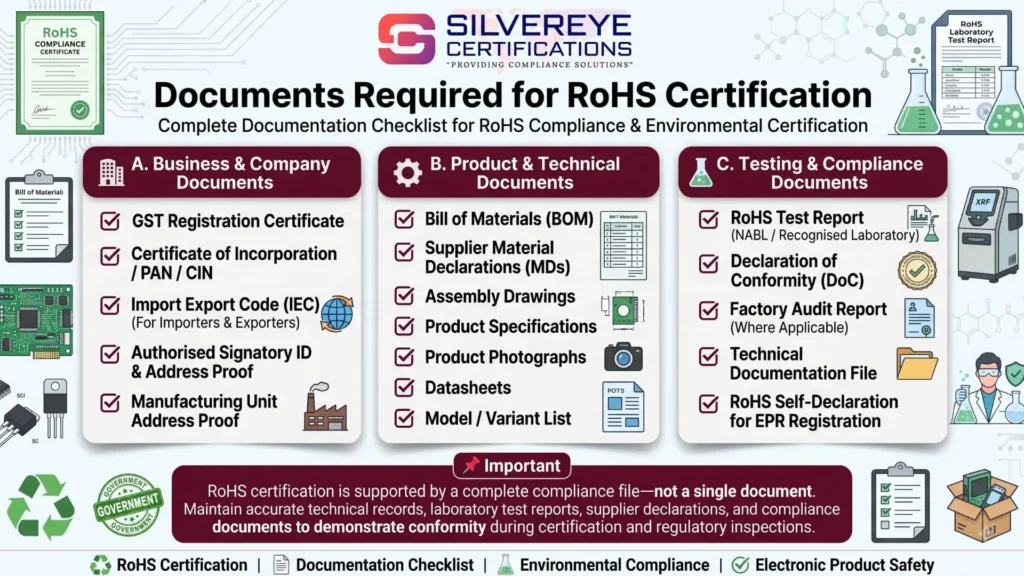
A test report alone does not establish complete RoHS compliance. It should be considered alongside the product's material records, supplier declarations and applicable regulatory requirements.
RoHS Compliance Process: Step by Step
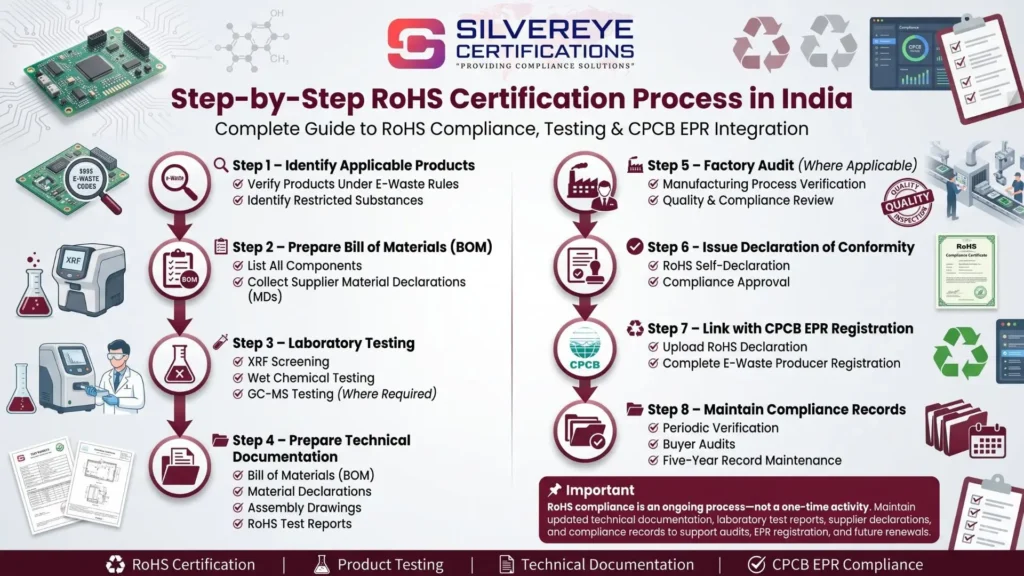
1. Product Scope and BOM Assessment
First, determine whether the product falls within the scope of the applicable RoHS rules. For EU compliance, check the equipment categories, exclusions and any relevant exemptions under Directive 2011/65/EU. For India, check the equipment covered by Schedule I of the E-Waste (Management) Rules, 2022.
Review the BOM and identify the components, coatings, plastics, alloys and other homogeneous materials that may contain restricted substances.
2. Supplier Data Collection
Collect RoHS declarations, material composition information and supporting documents from component and raw-material suppliers. Pay particular attention to higher-risk materials such as solder, metal coatings, cables, PVC parts and plastic components.
Check whether supplier declarations cover the actual component supplied, the relevant restricted substances and the applicable limits. Do not rely on generic or outdated declarations without verification.
3. Risk-Based Testing
Assess whether supplier documentation provides sufficient evidence. Where information is missing, inconsistent or unreliable, arrange suitable laboratory testing.
XRF screening can help identify certain elements, including lead, mercury, cadmium and total chromium. However, XRF alone cannot confirm compliance with all ten EU restricted substances or distinguish every restricted chemical form. Further chemical analysis may be needed for substances such as hexavalent chromium, PBB, PBDE and phthalates.
4. Gap Analysis and Exemption Review
Compare the available material data and test results against the applicable substance limits. Under EU RoHS, the maximum concentration values are generally 0.1% (1,000 ppm) for most restricted substances and 0.01% (100 ppm) for cadmium, measured in each homogeneous material.
Check whether a specific exemption applies to the product or material. Exemptions have defined conditions and validity periods; they should not be treated as blanket permission for a product to exceed a restricted-substance limit.
If a material does not comply and no applicable exemption is available, identify a suitable alternative and arrange verification where necessary.
5. Technical Documentation Preparation
Organise the BOM, supplier declarations, material data, laboratory reports, product specifications and exemption records into a traceable compliance file.
For EU-market products, the manufacturer must prepare the technical documentation and EU Declaration of Conformity in accordance with the applicable RoHS requirements. Under India's E-Waste Rules, producers must meet the relevant substance restrictions and maintain supporting evidence; this is not the same as obtaining a universal RoHS licence.
6. Declaration and Ongoing Compliance
Where required, the responsible manufacturer or other legally responsible entity completes and signs the applicable Declaration of Conformity. For EU RoHS, the manufacturer also follows the relevant CE-marking and conformity-assessment requirements.
Compliance should be maintained throughout production. Review supplier changes, component substitutions, material changes and updates to applicable exemptions or regulations. A previous test report may not be sufficient if the product's composition or design changes.
RoHS Compliance Cost: What Affects the Price?
There is no single universal government fee for RoHS compliance. The cost depends on the product, target market, amount of testing required and the quality of the available documentation. Businesses may incur laboratory charges and optional consultancy or documentation-support fees.
| Cost factor | Why it matters |
|---|---|
| Number of components and materials | More components, finishes and homogeneous materials can increase the work needed to collect and review supplier evidence. |
| Laboratory testing requirements | The number of samples, substances, materials and test methods affects laboratory charges. Confirmatory chemical analysis may cost more than initial screening. |
| Supplier documentation quality | Missing, inconsistent or outdated declarations can require additional verification and testing. |
| Target markets | EU, UK, India, China and UAE requirements are not identical. Separate regulatory reviews may be necessary. |
| Product complexity | Products with multiple materials, assemblies or variants may need more extensive assessment. |
| Consultancy support | Optional support for product-scope review, document preparation, testing coordination and compliance-file review may add to the overall cost. |
For an accurate estimate, first identify the product category, model or variant count, destination markets, BOM availability and existing test reports. Request an itemised quotation that separates laboratory charges from consultancy and documentation fees.
Typical RoHS Compliance Timeline
The time required depends on how quickly suppliers provide material information, whether laboratory testing is necessary, the number of product variants and whether any materials need corrective action.
The following figures are indicative planning estimates, not statutory deadlines or guaranteed completion times:
| Stage | Indicative duration |
|---|---|
| Product scope and BOM review | 1–2 working days |
| Supplier declaration collection and review | 7–14 working days |
| Laboratory testing, where required | 7–15 working days |
| Gap analysis and exemption review | 2–3 working days |
| Technical documentation preparation | 5–7 working days |
| Declaration review and sign-off | 1–2 working days |
These stages may overlap. If suppliers take longer to respond, additional testing is required, or non-compliant materials need replacement, the overall timeline will increase. The actual duration should be estimated after reviewing the product and its documentation.
Validity and Renewal of RoHS Compliance
RoHS compliance does not generally operate like a licence with a fixed renewal date. There is no universal renewal cycle for all RoHS markets. However, the evidence supporting compliance must remain relevant to the product and the regulations in force.
For EU RoHS compliance, manufacturers must maintain technical documentation and the EU Declaration of Conformity for 10 years after the electrical or electronic equipment is placed on the market. They must also have procedures to ensure that series production continues to meet the requirements.
Keep the following points in mind:
- Product and material changes: Changes to product design, components, materials or manufacturing processes should trigger a review of the existing compliance evidence. Additional testing may be necessary.
- Supplier changes: A new supplier or replacement component may have a different material composition. Obtain updated declarations and reassess the affected parts.
- Regulatory updates: Review changes to restricted-substance limits, product scope and applicable exemptions. EU RoHS exemptions are time-limited and may be revised or renewed.
- Record maintenance: Keep supplier declarations, test reports, BOMs and technical documentation organised and accessible in case a market surveillance authority or customer requests evidence.
- Periodic reassessment: Even without a product change, review documentation periodically to check that it remains accurate and reflects current requirements.
A previous test report or Declaration of Conformity should not automatically be treated as valid evidence for a modified product or a different market.
Common Challenges in RoHS Compliance
Businesses can face documentation, testing and supply-chain issues while establishing RoHS compliance. Common challenges include:
- Missing or outdated supplier declarations: Older components and imported parts may not have complete material composition information.
- Lead in legacy components: Solder, connectors, brass parts and certain metal finishes may contain lead above the applicable limit.
- Confusion between RoHS 6 and RoHS 10: The original six substances are not the complete list for EU RoHS today. The current EU framework restricts ten substances.
- Inadequate testing: XRF screening alone cannot confirm every restricted substance. Certain materials require specific chemical analysis.
- Unverified exemptions: Businesses may assume an exemption applies without checking its exact application, conditions and expiry date.
- Incomplete technical documentation: A test report or supplier declaration alone may not provide sufficient evidence of conformity.
- Different market requirements: EU, UK, India and China have their own regulatory frameworks, so one market's compliance documents may not satisfy another market's requirements.
Addressing these issues early helps reduce the risk of non-compliant materials reaching production or finished products entering the market without adequate supporting evidence.
RoHS vs. REACH: Quick Comparison
RoHS and REACH are two important EU chemicals regulations, but they serve different purposes. RoHS restricts certain hazardous substances in electrical and electronic equipment, while REACH regulates chemical substances more broadly across industries.
| Aspect | RoHS | REACH |
|---|---|---|
| Main purpose | Restricts specified hazardous substances in electrical and electronic equipment | Controls the risks associated with chemical substances through registration, evaluation, authorisation and restriction |
| Scope | Electrical and electronic equipment covered by the Directive, subject to exclusions and exemptions | Chemical substances on their own, in mixtures and, under specific provisions, in articles across different industries |
| Restricted substances | Ten substances under the current EU RoHS framework | Restrictions and authorisation requirements apply to substances identified under REACH; the Candidate List also creates communication obligations |
| Compliance approach | Substance concentration limits apply to each homogeneous material | Obligations depend on the substance, its use, quantity, supply-chain role and applicable REACH provisions |
| Key evidence | Technical documentation, material data, test reports where needed and EU Declaration of Conformity | Registration information where applicable, safety data sheets, substance communication and other required supply-chain records |
Electronics manufacturers may need to comply with both regulations. RoHS focuses on the specified restricted substances in covered equipment, while REACH can create additional obligations for chemicals and substances throughout the supply chain.
Important: RoHS compliance does not automatically establish REACH compliance, or vice versa. Businesses should assess the two regulations separately for their products and activities.
Recent Updates Affecting RoHS Compliance (2025–2026)
Several developments are relevant to manufacturers and exporters selling electrical and electronic products in China and the EU.
1. China's RoHS Restrictions Expanded to Ten Substances from 2026
From 1 January 2026, Amendment No. 1 to China's GB/T 26572-2011 introduced four additional phthalates: DEHP, BBP, DBP and DIBP. This expanded the controlled-substance list from six to ten.
The updated requirements also affect substance information and labelling. Businesses supplying products covered by China's relevant compliance management requirements should review the applicable assessment and transition provisions rather than relying only on older six-substance documentation.
2. China's Mandatory Standard GB 26572-2025 Is Scheduled for 2027
China published GB 26572-2025 on 1 August 2025. The mandatory standard is scheduled to take effect on 1 August 2027, replacing GB/T 26572-2011 and its associated amendment.
Manufacturers and importers should use the transition period to review material composition, testing, product marking and conformity-assessment requirements for products covered by the standard.
3. EU RoHS Lead Exemptions Have Been Updated
Commission Delegated Directive (EU) 2025/2363 amended specific lead-related exemptions in Annex III of the EU RoHS Directive. For example:
- Exemption 7(c)-I, covering specified electrical and electronic components containing lead in certain glass or ceramic materials, expires on 30 June 2027.
- Exemption 7(c)-II, covering specified lead in dielectric ceramic in certain capacitors, expires on 31 December 2027.
These dates apply to the particular exemption entries and applications described in the Directive. They should not be interpreted as expiry dates for all lead exemptions or as a general deadline for RoHS compliance.
Businesses relying on an exemption should check its exact scope, conditions and latest legal status before placing products on the market.
How Silvereye Certifications Can Help
Determining whether a product needs to meet the EU RoHS 10-substance requirements, India's six-substance restrictions or China's market-specific requirements can be challenging. Differences in product scope, technical documentation, testing methods and exemptions make a product-specific assessment important.
Silvereye Certifications is an India-based regulatory compliance consultancy that supports manufacturers, importers and exporters with the documentation and coordination involved in RoHS compliance.
Our support can include:
- Product applicability assessment: Reviewing product details and target markets to identify the relevant RoHS requirements.
- BOM and material review: Helping organise component information and identify materials that may need further verification.
- Supplier documentation: Assisting with the collection and review of supplier declarations and material data.
- Testing coordination: Coordinating with suitable laboratories for XRF screening or further chemical testing where required.
- Technical documentation support: Helping compile BOMs, declarations, test reports and other compliance records.
- Declaration support: Assisting with the preparation and review of the applicable conformity documentation.
Silvereye Certifications provides consultancy and documentation support; it does not issue government approvals or laboratory test reports. Testing is carried out by laboratories, while statutory requirements and regulatory decisions remain with the relevant authorities. The manufacturer or other legally responsible entity remains responsible for ensuring that its product meets the applicable requirements.
Conclusion
RoHS 6 refers to the original six restricted substances: lead, mercury, cadmium, hexavalent chromium, PBB and PBDE. However, businesses selling in the EU must consider the current RoHS 10 requirements, which include four additional phthalates. Other markets, including India and China, have their own requirements and implementation timelines.
RoHS compliance should be treated as an ongoing product and supply-chain responsibility rather than a one-time paperwork exercise. Keep your Bill of Materials accurate, obtain reliable supplier declarations, arrange suitable testing where necessary and review changes to applicable exemptions and regulations.
With current documentation and regular material checks, manufacturers and exporters can better manage compliance risks and prepare their electrical and electronic products for their intended markets.
Frequently Asked Questions
What is RoHS 6?
It refers to the original six substances restricted under the first RoHS Directive (2002/95/EC): lead, mercury, cadmium, hexavalent chromium, PBB, and PBDE. The term is used to distinguish this original list from the current RoHS 10 list.
Is RoHS 6 still the legal requirement today?
No. Since 22 July 2019, RoHS 3 (Directive 2015/863) requires compliance with 10 substances — the original 6 plus four phthalates — for most product categories sold in the EU.
Why do people still search for "RoHS 6"?
Because it's the historical baseline everyone learned first, and some older technical files, legacy exemptions, and non-EU regulations still reference only the original six substances.
What is RoHS 5/6?
RoHS 5/6 is industry shorthand for a product that meets 5 of the 6 original substance limits but has an active lead exemption, most often in Category 8 (medical) or Category 9 (monitoring and control) equipment.
What is the limit for lead under RoHS?
Lead is restricted to a maximum of 0.1% (1,000 ppm) by weight in each homogeneous material, with specific, time-limited exemptions for certain solders, alloys, and glass or ceramic uses.
Why is cadmium held to a stricter limit than the other five?
Cadmium is a known carcinogen that bio-accumulates even at very low exposure, so regulators set its limit ten times stricter — 0.01% versus 0.1% for the other substances.
Does RoHS 6 compliance need a government-issued certificate?
No. RoHS relies on self-declaration backed by a technical file: supplier declarations, test data, and a signed Declaration of Conformity, not a certificate issued by an authority.
How long is a RoHS Declaration of Conformity valid?
It has no fixed expiry date. It remains valid as long as the product's materials, components, and suppliers don't change; any material or design change requires reassessment.
Which products must comply with the restricted substances list?
Any electrical or electronic equipment (EEE) sold in a RoHS-regulated market — consumer electronics, IT and telecom hardware, industrial electronics, lighting, and applicable medical devices.
Is XRF testing enough to prove compliance, or is lab testing required too?
XRF screening is a fast, non-destructive first check, but cadmium and phthalate levels close to the threshold usually need confirmatory chemical (wet lab) analysis for a defensible result.
How is RoHS different from REACH?
RoHS restricts specific hazardous substances in finished electrical and electronic products; REACH registers and controls chemical substances across all industries, at the substance level rather than the product level.
What happens if a product fails RoHS testing?
It can be stopped at customs, rejected by distributors, delisted from online marketplaces, or subject to a recall and financial penalties in regulated markets.