
- RoHS Certification proves your electrical or electronic product stays within safe limits for lead, cadmium, mercury and other restricted substances.
- In India, it is governed by the E-Waste (Management) Rules, 2022, enforced by the CPCB under the Ministry of Environment, Forest and Climate Change.
- Getting certified needs a Bill of Materials, supplier material declarations, lab test reports, and a signed Declaration of Conformity.
- A RoHS certificate is valid for 5 years and is often the first thing EU and global buyers ask for before placing an export order.
Introduction
RoHS Certification confirms that an electrical or electronic product does not contain hazardous substances such as lead, mercury, cadmium, hexavalent chromium, PBB, and PBDE beyond permitted limits. In India, it falls under the E-Waste (Management) Rules, 2022, regulated by the Central Pollution Control Board (CPCB) under the Ministry of Environment, Forest and Climate Change (MoEFCC). Manufacturers, importers, and exporters need supporting documents — a Bill of Materials, supplier material declarations, lab test reports, and a Declaration of Conformity — to sell in India or export to the EU and other RoHS-regulated markets. The certificate is valid for 5 years and can be renewed.
What is RoHS Certification?
RoHS stands for Restriction of Hazardous Substances. It is a compliance requirement that limits how much of certain toxic materials — mainly heavy metals and flame retardants — can be present inside electrical and electronic equipment (EEE). Think of everything from a mobile charger and LED driver to an industrial control panel or a kitchen appliance.
The idea originated in the European Union. The original EU RoHS Directive (2002/95/EC) came into force in 2006 and was later replaced by RoHS 2 (Directive 2011/65/EU), then expanded by RoHS 3 (Directive 2015/863/EU), which added four phthalates to the restricted list. Today, versions of this rule exist in dozens of countries, and India has its own RoHS framework built into its e-waste law.
For an Indian manufacturer or exporter, “RoHS Certification” usually means a Declaration of Conformity (DoC) backed by lab test data — proof that the solder, wiring insulation, plastic housing, circuit board coating, and other components in your product stay under the allowed threshold for restricted substances. Without this proof, customs authorities in RoHS-regulated countries can detain, reject, or send back your shipment.
Why RoHS Certification Matters for Indian Manufacturers and Exporters
RoHS compliance isn't just a regulatory checkbox — it directly affects whether your goods clear customs, whether global buyers trust your factory, and whether you stay on the right side of Indian environmental law. Here's what it actually does for your business:
- Opens the door to the EU market: Most European buyers and distributors won't even review a quotation without RoHS documentation on file.
- Prevents shipment rejection: Customs and port authorities in RoHS-regulated countries can hold or return non-compliant consignments, which is expensive and damages your delivery record.
- Keeps you compliant with Indian law: The E-Waste (Management) Rules, 2022 make RoHS self-declaration mandatory for producers, importers, and brand owners of covered EEE categories.
- Builds buyer and investor trust: A documented RoHS file signals responsible sourcing, which matters increasingly to B2B buyers, OEM partners, and even domestic retail chains.
- Supports your EPR registration: RoHS self-declaration is a required attachment when you apply for Extended Producer Responsibility (EPR) authorization on the CPCB e-waste portal.
- Reduces recall and liability risk: Products within RoHS limits are less likely to trigger environmental or health-related recalls down the line.
- Gives you a competitive edge: In government and corporate tenders, RoHS-compliant vendors are frequently shortlisted first.
RoHS Certification in India: The Legal Framework
India's RoHS obligations trace back to the E-Waste (Management and Handling) Rules, 2011, with RoHS restrictions becoming enforceable from 12 May 2013. The framework was overhauled by the E-Waste (Management) Rules, 2022, notified by the Ministry of Environment, Forest and Climate Change (MoEFCC) and made effective from 1 April 2023.
These rules were further updated through the E-Waste (Management) Amendment Rules, 2023 (effective April 2023) and the E-Waste (Management) Second Amendment Rules, 2023 (notified 25 July 2023), which introduced Schedule I and Schedule II covering exempted EEE categories and components — including specific relief for spares placed on the market before defined cut-off dates.
Enforcement sits with the Central Pollution Control Board (CPCB) and the State Pollution Control Boards (SPCBs), working under MoEFCC. Under Rule 16(1) of the 2022 Rules, every producer must ensure their electrical and electronic equipment complies with RoHS thresholds and must maintain technical documentation that can be produced for verification whenever CPCB or SPCB officials ask for it.
It's worth noting that India's RoHS framework currently restricts six substances, not the ten covered under the EU's stricter RoHS 3 directive. If you're exporting to Europe, you should test for all ten to be safe, even though Indian law doesn't mandate the four phthalates yet.
RoHS 4, RoHS 6, RoHS 10 — What These Terms Actually Mean
If you’ve talked to a testing lab or read through a few compliance quotes, you’ve probably come across “RoHS 6,” “RoHS 10,” and sometimes “RoHS 4” and wondered whether these are different certificates you need to choose between. They’re not separate certifications, and there’s no such thing as a formal “RoHS 4 Directive” in EU law. These are informal, substance-count labels the compliance industry uses as shorthand for how many restricted substances a particular test report or declaration actually covers. Getting the distinction right matters, because it decides what your lab tests for and whether your paperwork will hold up with an EU buyer.
RoHS 6 — the original six substances
This is where RoHS began. When the EU’s first RoHS Directive (2002/95/EC) took effect in 2006, it restricted six substances: lead, mercury, cadmium, hexavalent chromium, PBB, and PBDE. “RoHS 6” is simply shorthand for a product that’s been tested and declared against this original list. It’s also, not by coincidence, the exact set of substances India’s E-Waste (Management) Rules, 2022 currently restrict — so when an Indian manufacturer selling only within India says their product is “RoHS compliant,” they usually mean RoHS 6.
RoHS 10 — the six plus four phthalates
When RoHS 3 (Directive 2015/863/EU) came into force, it added four more restricted substances, all plasticisers used to soften PVC and similar materials: DEHP, BBP, DBP, and DIBP. Add those four to the original six and you land on “RoHS 10” — the complete substance list the EU currently enforces. If your buyer sits in Germany, the Netherlands, or anywhere else in the EU, RoHS 10 is what they expect to see on a lab report, not RoHS 6. A report covering only six substances will usually come back with a request to re-test, which costs you both time and a shipment delay.
RoHS 4 — the four newer substances on their own
This is the term that causes the most confusion, mainly because people assume it means a fourth version of the directive. It doesn’t — there is no “RoHS 4 Directive.” In practice, labs and compliance consultants use “RoHS 4” to describe just the four phthalates added under RoHS 3, tested or referenced separately from the original six. You’ll typically hear it when a product already carries a valid RoHS 6 declaration and only needs supplementary testing for the four phthalates to bring it up to full RoHS 10 coverage, rather than re-testing everything from the ground up.
You may also see the term used loosely in industry discussions about substances the EU is evaluating for possible future restriction — these proposals are tracked internally as “RoHS Pack” reviews — but nothing beyond the original ten has been formally added to the directive so far. Until that changes, treat “RoHS 4” as shorthand for the phthalate group, not as a separate compliance milestone.
Why this distinction matters for Indian manufacturers
Because India’s E-Waste Rules currently stop at the original six substances, a product certified “RoHS compliant” for the Indian market could technically mean RoHS 6 coverage only — and that’s entirely legal for domestic sale. The gap shows up the moment that same product is headed for export. RoHS 6 alone won’t satisfy an EU buyer or EU customs; they’ll expect the full RoHS 10 list. Most experienced compliance consultants recommend testing for all ten substances from day one rather than doing RoHS 6 now and adding the RoHS 4 phthalates later.
It costs a little more upfront, but it saves you a second lab cycle, a possible shipment hold, and the hassle of reissuing your Declaration of Conformity mid-order.
| Term | Substances Covered | Governed By | Relevant For |
| RoHS 6 | Lead, mercury, cadmium, hexavalent chromium, PBB, PBDE | Original RoHS Directive (2002/95/EC) | India’s E-Waste Rules, domestic sale |
| RoHS 4 | DEHP, BBP, DBP, DIBP (phthalates) | RoHS 3 / Directive 2015/863/EU | Supplementary testing to reach full EU-level compliance |
| RoHS 10 | RoHS 6 + RoHS 4 combined | RoHS 3 / Directive 2015/863/EU | EU export, CE-marked products, global buyer requirements |
Restricted Substances Under RoHS: The Full List
RoHS certification is built around keeping these substances below defined thresholds in every “homogeneous material” used in the product — not just the finished item as a whole.
| Restricted Substance | Permitted Threshold | Commonly Found In |
| Lead (Pb) | 0.1% by weight | Solder, PVC stabilisers, glass, cable insulation |
| Mercury (Hg) | 0.1% by weight | Switches, relays, fluorescent backlighting |
| Cadmium (Cd) | 0.01% by weight | Battery contacts, plastic pigments, electrical contacts |
| Hexavalent Chromium (Cr VI) | 0.1% by weight | Metal coatings, corrosion-resistant finishes |
| Polybrominated Biphenyls (PBB) | 0.1% by weight | Flame retardants in plastic casings |
| Polybrominated Diphenyl Ethers (PBDE) | 0.1% by weight | Flame retardants in plastics and foam |
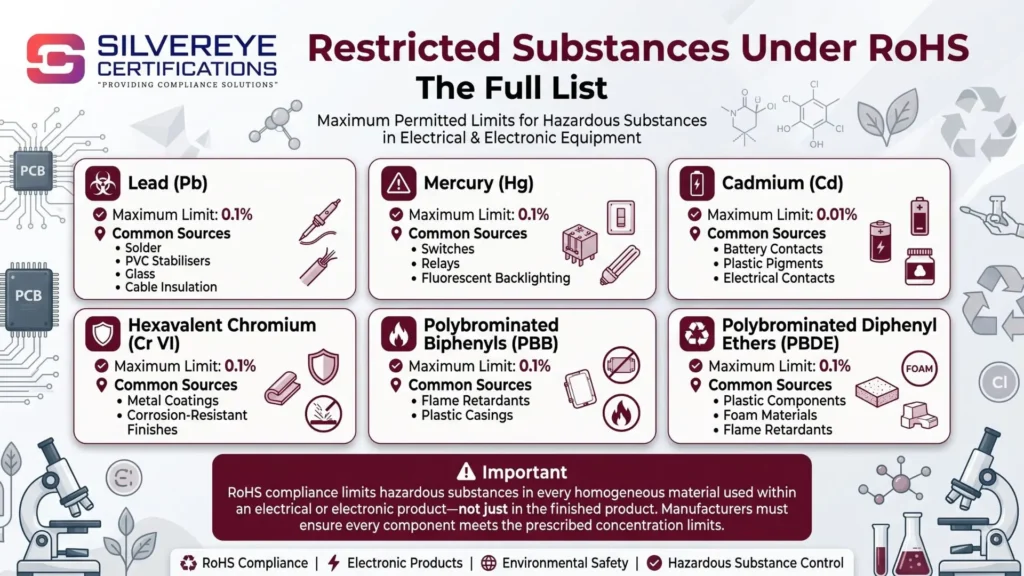
Note for exporters: EU RoHS 3 additionally restricts four phthalates — DEHP, BBP, DBP, and DIBP — each capped at 0.1% by weight. India's current rules don't cover these yet, but if your buyer is in the EU, get your lab to test for all ten substances rather than just the six recognized domestically.
Who Needs RoHS Certification?
RoHS compliance applies to a wide circle of businesses, not just large factories. You likely need it if you fall into any of these categories:
- Manufacturers producing electrical or electronic equipment (EEE) for sale in India.
- Importers bringing finished electronics or components into the country.
- Brand owners and assemblers selling products under their own label, even if manufacturing is outsourced.
- Exporters shipping to the EU, UK, or any other RoHS-aligned market.
- OEMs and component suppliers, since larger buyers usually demand RoHS documentation contractually as part of vendor onboarding.
- Small and medium manufacturers — MSMEs get some procedural relaxations and phased timelines under the E-Waste Rules, but this is not a blanket exemption from the substance-restriction requirement itself.
Products Typically Covered Under RoHS Rules
The scope is broad and keeps expanding with each amendment. Product categories commonly covered include:
- IT and telecom equipment — laptops, routers, mobile phones, servers
- Consumer electronics — televisions, audio and video equipment, cameras
- Large and small household appliances — refrigerators, washing machines, microwaves, mixers
- Electrical and electronic tools — drills, saws, soldering equipment
- Toys and leisure equipment with electronic components
- Medical devices, excluding implantable and infected devices
- Automatic dispensers
- Lighting equipment, including LED fixtures
- Monitoring, control, and laboratory instruments
Documents Required for RoHS Certification
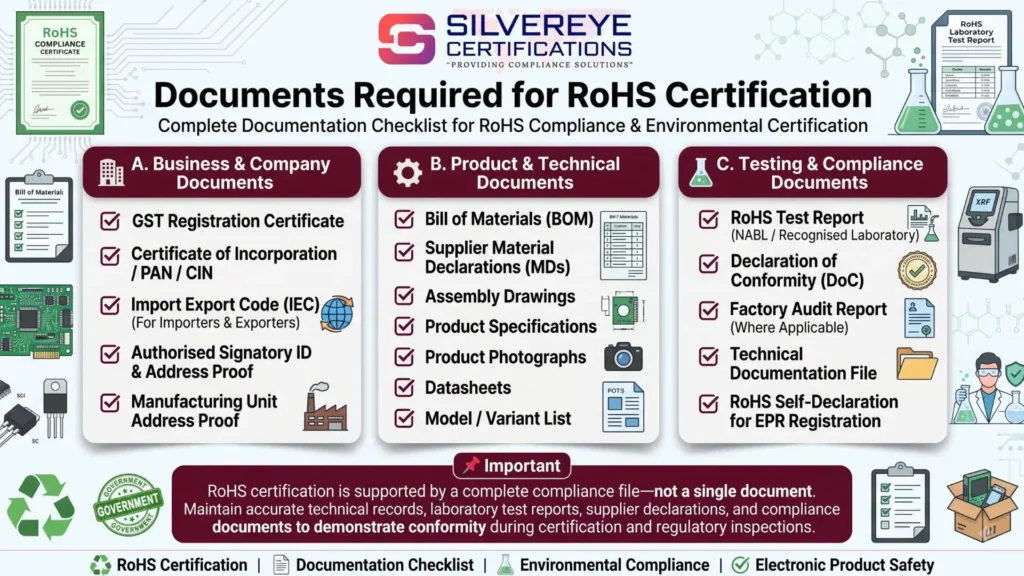
This is usually the part manufacturers get stuck on. RoHS documentation is not one single form — it's a compliance file made up of company records, technical papers, and test evidence. Here's what you'll need, grouped the way certification bodies and the CPCB actually ask for it.
Business and Company Documents
- GST registration certificate
- Certificate of incorporation / PAN card / CIN of the company
- Importer-Exporter Code (IEC), required for exporters and importers
- Authorized signatory's ID and address proof
- Address proof of the manufacturing unit or factory premises
Product and Technical Documents
- Bill of Materials (BOM) listing every component, part, and raw material used in the product
- Supplier Material Declarations (MDs) — signed statements from each component supplier confirming restricted substances are within limits
- Assembly drawings and detailed product specifications
- Product photographs, datasheets, and model/variant list
Testing and Compliance Documents
- RoHS test report from a NABL-accredited or recognized testing laboratory (XRF screening, with confirmatory wet-chemical testing where needed)
- Declaration of Conformity (DoC) — a self-declaration in the prescribed format stating the product meets RoHS thresholds
- Factory audit report, where applicable, especially for larger manufacturing set-ups
- A maintained technical documentation file, kept ready for CPCB/SPCB inspection at any time
- RoHS self-declaration attached to your EPR (Extended Producer Responsibility) registration application, if you're registering as a producer, importer, or brand owner
A practical tip: keep this file updated every time you change a supplier, switch a raw material, or redesign a component. RoHS compliance is tied to the exact materials used — a supplier change can silently push a substance over the limit even if nothing else about the product changes.
Step-by-Step RoHS Certification Process in India
Identify applicable products and substances: Confirm which of your product lines fall under Schedule I of the E-Waste Rules and which of the six (or ten, for export) restricted substances are relevant to your components.
- Prepare your Bill of Materials: List every part and raw material, then collect signed Material Declarations from each supplier.
- Send samples for lab testing: Products go through XRF screening first, followed by confirmatory wet-chemical or GC-MS testing for any substance close to the threshold.
- Compile the technical documentation file: Bring together BOM, MDs, assembly drawings, and test reports into one compliance record.
- Factory or on-site audit: Larger manufacturers may undergo a facility inspection to verify processes match what's on paper.
- Issue the Declaration of Conformity: Once testing and documentation check out, sign and issue the RoHS self-declaration.
- Link it to EPR registration: If you're a producer, importer, or brand owner, attach the RoHS declaration to your EPR application on the CPCB e-waste portal.
- Maintain records for renewal: Keep the file current so it's ready for periodic verification, buyer audits, or renewal after five years.
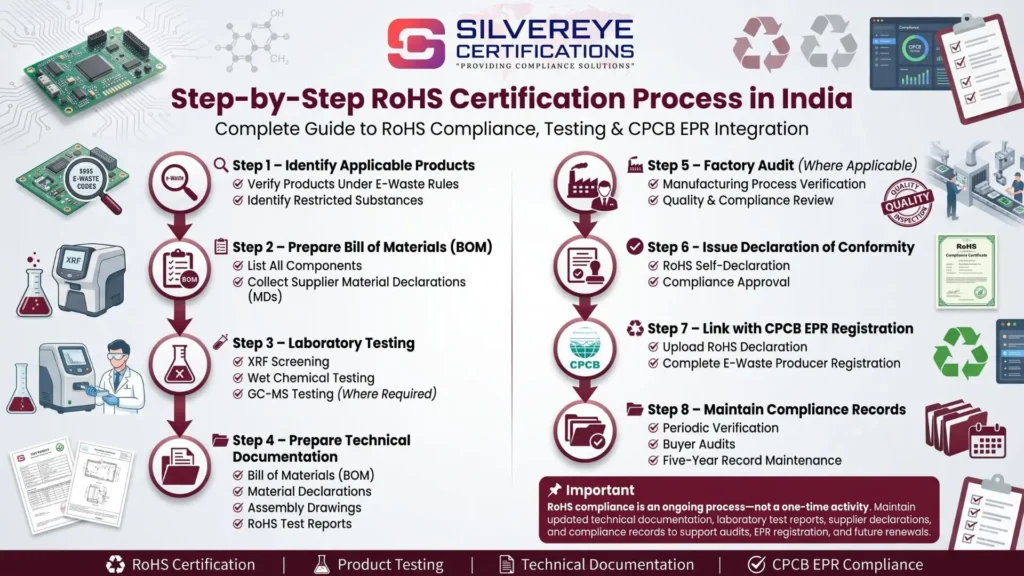
Timeline: most manufacturers complete the full process in 2 to 6 weeks, depending on how quickly documents are ready and how many product variants need testing. Simple, single-product certifications can move faster; multi-component product lines with several suppliers take longer.
RoHS Testing Methods Used in India
Testing labs typically use a two-step approach to confirm RoHS compliance:
- XRF (X-ray Fluorescence) screening: A fast, non-destructive method used to scan components for the presence of restricted metals like lead, cadmium, mercury, and chromium.
- Wet chemical analysis (ICP-OES) and GC-MS: Used to confirm results when XRF readings are borderline, and to detect substances like hexavalent chromium and phthalates that need more precise measurement.
For products headed to export markets, choosing a NABL-accredited lab (or one recognised by your buyer's country) makes the resulting test report far more likely to be accepted without a re-test at the destination.
RoHS Certification Cost in India
There's no single fixed government fee for RoHS certification in India — cost depends on the certification body, the number of components tested, and product complexity. Based on current market rates, here's a realistic range:
| Cost Component | Typical Range (INR) | What Affects It |
| Documentation & Declaration of Conformity | ₹3,500 – ₹5,000 | Product complexity, number of variants |
| Lab testing (per BOM/product) | ₹3,400 – ₹9,999+ | Number of components, substances tested |
| Factory audit (if applicable) | Varies by consultant/certifier | Facility size, number of product lines |
| Full certification package | ₹3,500 – ₹20,000+ | Certifying body, testing depth, urgency |
Additional costs to budget for include consultancy fees if you're using an outside compliance partner, employee training on RoHS record-keeping, and any re-testing needed after a design or supplier change. Larger companies with longer supply chains generally pay more simply because there's more to document and verify.
RoHS Certificate Validity and Renewal Timeline
A RoHS certificate or Declaration of Conformity in India is valid for 5 years from the date of issue. That said, validity isn't just about the calendar — if you change a raw material, switch a supplier, or redesign a component before the five years are up, you're expected to re-verify and, if needed, re-certify. A material change can alter substance content even if the product looks identical from the outside.
For renewal, most manufacturers repeat a lighter version of the original process: updated BOM, fresh supplier declarations, and a new round of lab testing to confirm nothing has drifted out of compliance. Keeping your technical file updated year-round makes renewal far faster than starting from scratch.
RoHS vs CE vs BIS vs WEEE: How They're Different
These four terms get mixed up often, but each one checks a different thing. Here's a quick side-by-side:
| Certification | What It Checks | Mandatory For | Governing Body |
| RoHS | Restricted hazardous substances in materials | EEE sold in India / exported to RoHS markets | CPCB / MoEFCC (India); European Commission (EU) |
| CE Marking | Overall product safety, EMC, and performance | Products sold in the European Economic Area | EU notified bodies / manufacturer self-declaration |
| BIS Certification | Indian quality and safety standards (CRS scheme) | Specified electronics sold in India | Bureau of Indian Standards |
| WEEE | End-of-life collection and recycling of e-waste | Producers under Extended Producer Responsibility | CPCB (India); EU member states (Europe) |
In practice, an Indian manufacturer exporting to Europe often needs RoHS compliance and CE marking together, since CE marking for electronics typically assumes the product is already RoHS-compliant. Domestically, BIS and RoHS are separate requirements that can both apply to the same product.
Common Mistakes Manufacturers Make During RoHS Certification
- Trusting supplier declarations without lab verification — self-reported compliance from a vendor isn't the same as tested proof.
- Testing only one sample BOM when the product actually has several variants or colour options with different material mixes.
- Forgetting to re-certify after a supplier or raw-material change, which is one of the most common reasons shipments get rejected later.
- Confusing RoHS with CE or BIS certification and assuming one covers the other.
- Keeping an incomplete technical file, which slows down both CPCB verification and buyer audits.
- Not linking the RoHS self-declaration with EPR registration, which can hold up import or bulk-sale approvals.
Conclusion
RoHS certification isn't just paperwork you file away after a lab test — it's what keeps your electronics moving smoothly through Indian regulations and international customs at the same time. For manufacturers, it means staying on the right side of the E-Waste (Management) Rules, 2022. For exporters, it's often the single document standing between a confirmed order and a rejected shipment at a European port.
The good news is that once you understand what's actually required — a clean Bill of Materials, verified supplier declarations, an accredited lab test report, and a properly signed Declaration of Conformity — the process itself is manageable, even for small and mid-sized manufacturers. Build your technical file early, keep it updated every time your supply chain changes, and treat the five-year validity window as a planning tool rather than a deadline to scramble against.
Get this right once, and RoHS compliance stops being a hurdle and starts working as a genuine trust signal — for regulators, for buyers, and for every export market you're trying to reach next.
Frequently Asked Questions
What is the full form of RoHS certification?
RoHS stands for Restriction of Hazardous Substances. It refers to compliance with limits set on hazardous materials like lead, mercury, and cadmium in electrical and electronic equipment.
Is RoHS certification mandatory in India?
Yes. Under the E-Waste (Management) Rules, 2022, manufacturers, importers, and brand owners of covered electrical and electronic equipment must ensure RoHS compliance and maintain supporting documentation for verification.
Who enforces RoHS certification in India?
The Central Pollution Control Board (CPCB), along with State Pollution Control Boards (SPCBs), enforces RoHS compliance under the Ministry of Environment, Forest and Climate Change (MoEFCC).
How long is a RoHS certificate valid?
A RoHS certificate or Declaration of Conformity is valid for 5 years from the date of issue, and should be renewed sooner if there's a major change in materials, design, or suppliers.
How much does RoHS certification cost in India?
Costs typically range from about ₹3,500 to ₹20,000, depending on the certifying body, the number of components tested, and product complexity. Documentation-only services can start under ₹5,000, excluding lab testing charges.
Can a manufacturer self-certify RoHS compliance?
Yes, self-declaration is an accepted route, but it must be backed by genuine lab test reports and a complete technical documentation file, since CPCB and buyers can ask to verify it at any time.
What documents are required for RoHS certification?
You'll need company documents like GST and IEC, product documents like a Bill of Materials and supplier declarations, and compliance documents like a lab test report and a Declaration of Conformity.
Does RoHS certification apply only to exporters?
No. It applies to domestic manufacturers, importers, and brand owners as well, since India's own E-Waste (Management) Rules, 2022 require RoHS compliance for products sold within the country.