

- Under the Tea Warehouses (Licensing) Order, 1989, warehouse owners carrying out tea storage, blending or packaging activities within the Order's scope must obtain a Tea Board warehouse license. The Order defines a warehouse as a covered shed or godown with a minimum floor area of 200 square metres.
- Tea Board's current online fee structure lists ₹14,000 plus 18% GST (₹16,520 in total) for both new and renewal applications. A warehouse license is valid for three years.
- Submit the prescribed, system-generated Form A through the Tea Board online application portal. Supporting documents include proof of ownership or a registered/notarized lease or rent agreement for the premises, along with a notarized declaration on ₹100 non-judicial stamp paper. Additional documents may apply depending on the warehouse category.
- Tea Board provides an online auto-renewal facility. The renewal option becomes available 30 days before the license expiry date. Pay the renewal fee through the portal before the existing license expires; otherwise, the license expires and cannot be revived through the auto-renewal facility.
Introduction
Tea warehouse registration means obtaining a warehouse license from the Tea Board of India under the Tea Warehouses (Licensing) Order, 1989. The licensing requirement applies to covered premises used for storing, blending or packaging tea.
To apply, the warehouse operator must submit Form A through the Tea Board's online portal, along with proof of ownership or a valid lease, and a notarized declaration on ₹100 non-judicial stamp paper confirming that the premises meet the specifications prescribed in Annexure B of the Order. An auction organiser's recommendation is also required when applying for an auction warehouse license.
Tea Board's online fee structure lists ₹14,000 plus applicable GST for a new or renewal application. The license is valid for three years. The Board also provides an online auto-renewal facility, which must be used before the existing license expires and subject to the prescribed requirements. Changes to the licensed warehouse details should be handled through the Board's prescribed modification process; floor-area changes are specifically addressed under the applicable guidelines.

Many traders discover the warehouse licensing requirement only after arranging a premises or starting their tea operations. A trader may sign a lease, bring in the first lot of tea chests and then realize that the warehouse needs Tea Board approval. Checking the licensing requirements before using the premises can help prevent avoidable compliance problems.
This guide explains who needs a tea warehouse license, the premises specifications under the 1989 Order, documents required, the online application process, government fees, license validity and renewal procedure. It draws on the Tea Board's warehouse licensing guidelines, the Tea Warehouses (Licensing) Order, 1989 and the official online fee structure. Where a detail is based on secondary industry reporting rather than an official Tea Board document, it should be treated as reported information and verified against the latest Board instructions.
What Is Tea Warehouse Registration?
Tea warehouse registration is the process of obtaining a warehouse license from the Tea Board of India to carry out specified tea-related activities, including storing, blending or packaging tea at a covered warehouse.
The license is governed by the Tea Warehouses (Licensing) Order, 1989, issued under the Tea Act, 1953. It is granted by the Tea Board's Licensing Authority after the applicant submits the prescribed application and the premises meet the applicable requirements.
Under the Order, a warehouse generally means a covered shed or godown with a floor area of at least 200 square metres, where tea is stored, blended or packaged. The license is premises-specific: it identifies the warehouse address and floor area approved by the Licensing Authority. The license issued in Form B is also non-transferable.
In everyday business language, this approval is commonly called a tea warehouse registration, tea godown license or Tea Board warehouse license. These terms generally refer to the same licensing requirement.
What Is the Law Behind Tea Warehouse Registration?
The Tea Warehouses (Licensing) Order, 1989 establishes the licensing requirement for covered tea warehouse activities.
Its key provisions include:
- Clause 3 – Requirement to obtain a license: A warehouse owner cannot carry out the covered activities of storing, blending or packaging tea without a license, subject to the exceptions provided in the Order.
- Clause 4 – Application: An applicant must apply to the Licensing Authority in Form A.
- Clause 5 – Grant or refusal: The Licensing Authority may grant the license in Form B or refuse the application for recorded reasons.
- Clause 6 – Validity: A license is ordinarily valid for three years from its date of issue, unless suspended or cancelled earlier.
- Warehouse specifications: The Order and its applicable requirements prescribe standards relating to the warehouse's suitability, construction, ventilation and protection of stored tea.
The Order provides an exception for certain warehouses located within port areas and owned by a Port Trust Authority. It also allows the Licensing Authority to exempt road carriers' warehouses used for short-term transit storage. These exceptions are specific; a warehouse should not be assumed to be exempt merely because it is located near a port.
Who Needs Tea Warehouse Registration?
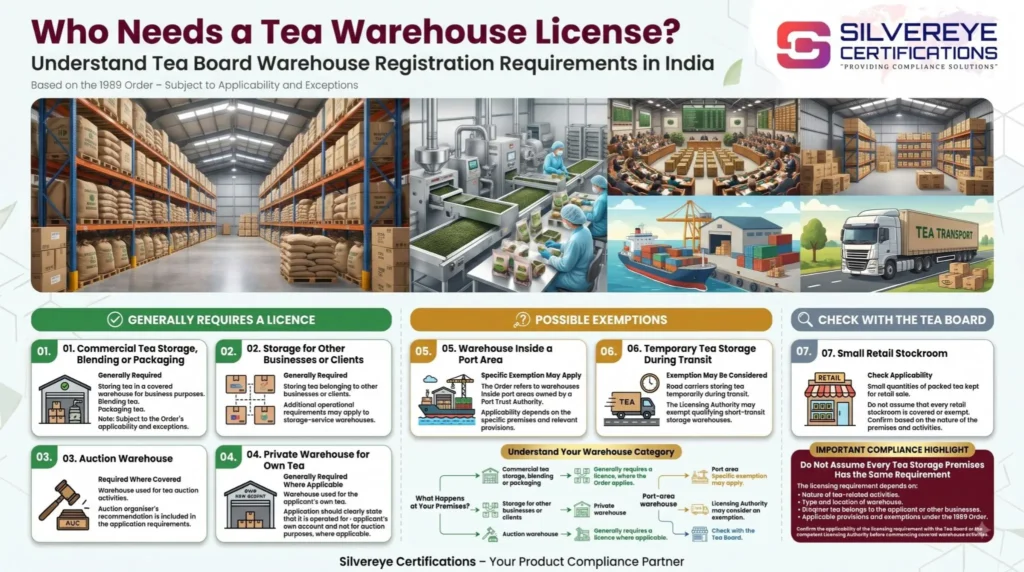
The licensing requirement depends on the activities carried out at the premises, the type of warehouse and the applicable provisions of the 1989 Order.
| Your Situation | Is a Warehouse Licence Required? | Important Consideration |
|---|---|---|
| You store, blend or package tea in a covered warehouse for business purposes | Generally, yes | These are the activities specifically covered by the Order, subject to its applicability and exceptions |
| You store tea belonging to other businesses or clients | Generally, yes | Additional operational requirements may apply to warehouses providing storage services |
| You operate an auction warehouse | Yes, where covered by the Order | An auction organiser's recommendation is included in the application requirements for an auction warehouse |
| You operate a private warehouse for your own tea | Generally, yes, where the Order applies | The application should clearly state that the warehouse is used for the applicant's own account and not for auction purposes, where applicable |
| Your warehouse is inside a port area | A specific exemption may apply | The Order refers to warehouses inside port areas owned by a Port Trust Authority |
| You are a road carrier storing tea temporarily during transit | An exemption may be considered | The Licensing Authority may exempt qualifying short-transit storage warehouses |
| You keep a small quantity of packed tea for retail sale | Check with the Tea Board | Do not assume that every retail stockroom is covered or exempt without checking the nature of the premises and activity |
Important: Tea warehouse licensing is separate from other approvals that may apply to your business. If you also blend, package, export, import or sell tea, check whether additional Tea Board, FSSAI, customs or other regulatory requirements apply to those activities.
Benefits of Tea Warehouse Registration
Obtaining the appropriate Tea Board warehouse license helps businesses operate their covered warehouse activities in accordance with the applicable legal requirements.
- Regulatory compliance: A valid license helps you meet the licensing requirement under the Tea Warehouses (Licensing) Order, 1989.
- Clear premises standards: The Annexure-B specifications provide a defined reference for maintaining suitable conditions for tea storage and handling.
- Support for auction-related operations: Businesses operating covered auction warehouses can meet the licensing requirement applicable to these premises and submit the required auction organiser's recommendation.
- Business documentation: A valid warehouse license provides documentary evidence of the premises approved by the Tea Board. Buyers, brokers or business partners may request these details during commercial or compliance checks.
- Better compliance management: Understanding the conditions attached to the license helps warehouse operators monitor premises standards and reduce the risk of violations that could lead to regulatory action.
Eligibility for Tea Warehouse Registration: What Does the Tea Board Expect?
Before applying, check whether you meet the basic premises and applicant requirements.
- Ownership or legal possession: You must own the warehouse, hold it under a valid lease or have the owner's permission to use the premises. Form A asks applicants to specify the basis on which they hold the warehouse.
- Minimum floor area: The warehouse must generally meet the minimum floor-area requirement of 200 square metres under the 1989 Order.
- Premises specifications: The warehouse must comply with the applicable Annexure-B requirements relating to construction, ventilation, hygiene, security and tea storage.
- Notarized declaration: Submit the prescribed declaration on ₹100 non-judicial stamp paper, duly notarized, confirming compliance with the applicable warehouse specifications and the required declaration concerning allegations from brokers and seller members.
- Authorized signatory: The application must be signed by the proprietor, a partner, a director or an authorized signatory, as applicable. An authorization letter should accompany an application signed by an authorized representative.
- Contact information: Provide valid email and telephone details so that the Tea Board can contact you about the application.
- Auction warehouse recommendation: If the application is for an auction warehouse, obtain the recommendation from the relevant auction organizer.
Additional compliance: If you carry out tea blending or packaging activities, check the separate FSSAI licensing or registration requirements applicable to your food business. A Tea Board warehouse license does not automatically replace an FSSAI approval.
Annexure-B: What Should Your Tea Warehouse Premises Look Like?
The Tea Board's premises specifications are an important part of the licensing process. Applicants must declare that their warehouse conforms to the prescribed requirements. These standards are intended to ensure that tea is stored and handled in suitable conditions.
The following table explains the main requirements in practical terms.
| Area | What the Tea Board Expects |
|---|---|
| Suitability for tea storage | The premises should be fit for storing tea. Only tea and materials connected with its storage, blending and packaging should be kept inside, as applicable |
| Walls and roof | Walls and roofs should be damp-proof and leak-proof to protect stored tea from moisture |
| Floor construction | The floor should have pucca construction, be properly cemented and remain damp-proof |
| Ventilation and pest protection | The warehouse should have adequate ventilation while remaining protected against pests, rodents, birds and insects |
| Lighting and electrical fittings | Adequate lighting and properly maintained electrical fittings should be available |
| Gates and loading facilities | Gates should be suitably sized for the movement of tea chests. Covered, leak-proof sheds should be available at entry and exit points for loading and unloading during rain |
| Security | Doors and windows should be properly secured |
| Surrounding area | The surroundings should be hygienic. New construction in waterlogging-prone areas should be avoided, while existing premises should have suitable flood-protection precautions |
| Staff and supervision | Adequate supervisory, clerical and operational staff should be available. Manual blenders should wear clean clothing and be free from contagious diseases |
| Storage of other people's tea | Service warehouses should meet the additional applicable requirements, including watch-and-ward arrangements, weighing scales, dumping pads, safe stacking, space between rows, parking and manoeuvring facilities, an adequate approach road and fire-fighting equipment |
| Working and operational space | Suitable space should be available for office work, receiving, delivery, sorting, sampling by brokers and blending or packaging activities, where applicable |
Practical tip: Before signing a lease or investing in warehouse infrastructure, compare the proposed premises with the Tea Board's current specifications. Check the floor area, damp-proofing, ventilation, loading facilities, security and operational space in advance. This can help identify infrastructure gaps before you submit your application.
Documents Required for Tea Warehouse Registration
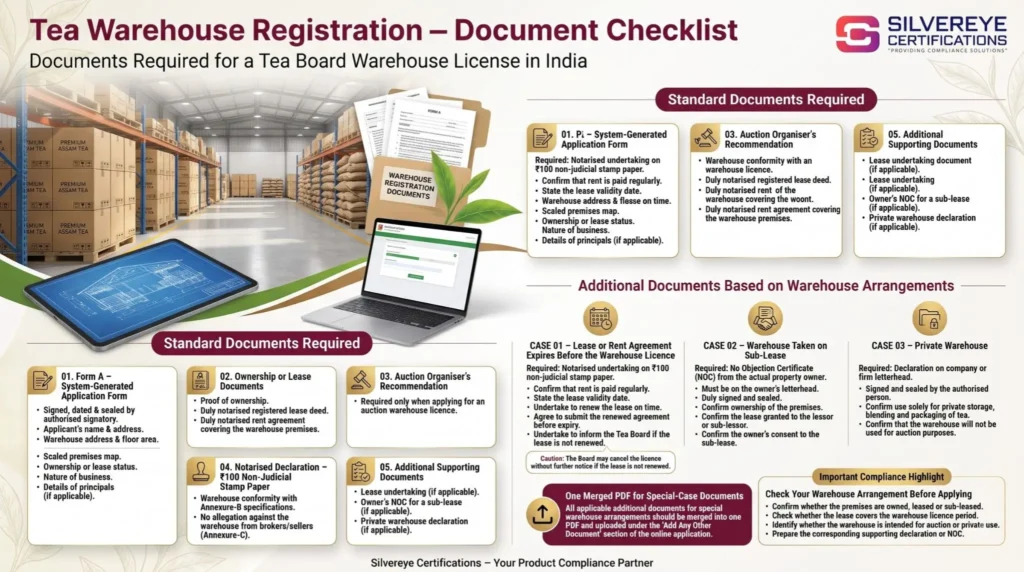
Tea warehouse license applications are submitted electronically through the Tea Board's online portal. Applicants must upload the system-generated Form A and the supporting documents specified in the Board's revised warehouse licensing guidelines.
For a new warehouse license, prepare the following documents:
| No. | Document | Requirements and Notes |
|---|---|---|
| 1 | Form A (system-generated application form) | Must be signed, dated and sealed by the proprietor, partner, director or authorised signatory. It includes the applicant's name and address, warehouse address, floor area, scaled premises map, ownership or lease status, nature of business and details of principals, where applicable. |
| 2 | Ownership or lease documents | Proof of ownership, a duly notarised registered lease deed or a duly notarised rent agreement covering the warehouse premises. |
| 3 | Auction organiser's recommendation | Required only when applying for an auction warehouse licence. |
| 4 | Notarised declaration on ₹100 non-judicial stamp paper | Must declare that the warehouse conforms to Annexure-B specifications and that there is no allegation against the warehouse from brokers or seller members, as specified in Annexure-C. |
| 5 | Additional supporting documents | Required depending on the applicant's circumstances, such as a lease undertaking, owner's NOC for a sub-lease or a private warehouse declaration. |
Additional Documents Required in Special Cases
The Tea Board's revised guidelines specify three additional document requirements for particular warehouse arrangements. These should be uploaded as one merged PDF under the "Add Any Other Document" section of the online application.
| If This Applies to Your Warehouse | Additional Document Required |
|---|---|
| Lease or rent agreement expires before the warehouse licence | A notarised undertaking on ₹100 non-judicial stamp paper confirming that rent is paid regularly, stating the lease's validity date, undertaking to renew it on time and submit the renewed agreement before expiry, and agreeing to inform the Tea Board if the lease is not renewed. The Board may cancel the licence without further notice if the lease is not renewed. |
| Warehouse taken on sub-lease | A No Objection Certificate (NOC) from the actual owner, on the owner's letterhead, duly signed and sealed. It must confirm ownership, the lease granted to the lessor or sub-lessor, and the owner's consent to the sub-lease. |
| Private warehouse | A declaration on the company's or firm's letterhead, signed and sealed by the authorised person, confirming that the warehouse will be used solely for private storage, blending and packaging of tea and will not be used for auction purposes. |
Step-by-Step Tea Warehouse Registration Process
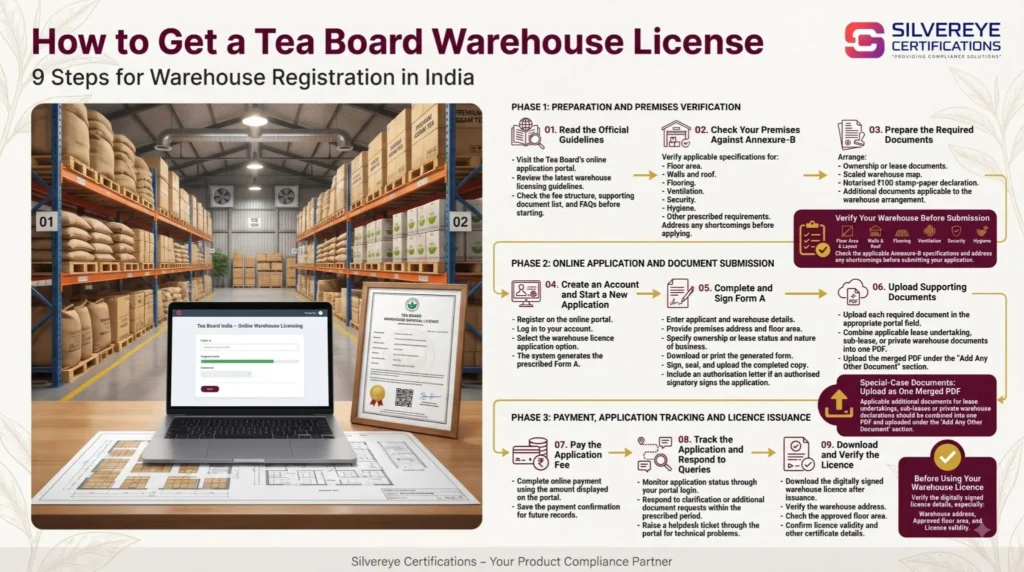
The Tea Board accepts new warehouse license applications through its official online portal. Follow these steps to complete the application.
- Read the official guidelines: Visit the Tea Board online application portal and review the latest warehouse licensing guidelines, fee structure, supporting document list and FAQs before starting.
- Check your premises against Annexure-B: Verify the warehouse's floor area, walls, roof, flooring, ventilation, security, hygiene and other applicable specifications. Address any shortcomings before applying.
- Prepare the required documents: Arrange your ownership or lease papers, scaled warehouse map, notarised ₹100 stamp-paper declaration and any additional documents applicable to your warehouse arrangement.
- Create an account and start a new application: Register on the online portal, log in and select the warehouse licence application option. The system generates the prescribed Form A.
- Complete and sign Form A: Enter the applicant and warehouse details, including the premises address, floor area, ownership or lease status and nature of business. Print or download the generated form, sign and seal it, and upload the signed copy. If an authorised signatory signs, include the authorisation letter.
- Upload supporting documents: Upload each required document in the appropriate portal field. If you have additional documents for a lease undertaking, sub-lease or private warehouse, combine those applicable papers into one PDF under the "Add Any Other Document" section.
- Pay the application fee: Complete the online payment using the amount displayed on the portal and save the payment confirmation for your records.
- Track the application and respond to queries: Monitor your application status through your login. If the Tea Board requests clarification or additional information, respond within the prescribed period. For technical problems, raise a helpdesk ticket through the portal.
- Download and verify the licence: Once issued, download the digitally signed warehouse licence. Check the warehouse address, approved floor area, licence validity and other details for accuracy.
How Long Does Tea Warehouse Registration Take?
According to the Tea Board's notice dated 6 November 2026, the prescribed disposal timeframe for a warehouse license application is 25 days from receipt of a complete application.
The notice also specifies that licenses covered by the schedule are issued every Wednesday between 4:00 PM and 5:00 PM, or on the next working day at the same time if Wednesday is a holiday.
The 25-day period is a prescribed disposal timeframe, not a guarantee that every application will be approved within that period. Incomplete documents, clarification requests or failure to respond can affect the application outcome.
Tea Warehouse Registration Fee in 2026
The Tea Board's official online fee structure lists the following charges for a warehouse license:
| Fee Component | Amount |
|---|---|
| New warehouse licence fee | ₹14,000 |
| GST at 18% | ₹2,520 |
| Total for a new application | ₹16,520 |
| Renewal warehouse licence fee | ₹14,000 |
| GST at 18% | ₹2,520 |
| Total for renewal | ₹16,520 |
Additional expenses may include:
- Stamp paper: At least ₹100 for the prescribed declaration and any applicable undertaking.
- Notary charges: Payable separately for notarisation.
- Consultancy charges: Vary depending on the professional assistance required. These are not Tea Board government fees.
What about the older ₹1,000 and ₹200 fee figures?
Some older Tea Board documents and third-party websites mention ₹1,000 for a new license and ₹200 for renewal. These figures relate to earlier fee provisions and should not be used as the current application charges. The Tea Board's current online fee structure lists ₹14,000 plus 18% GST, amounting to ₹16,520 for both new and renewal applications.
Always check the portal's payment screen before making payment.
Validity of Tea Warehouse Registration
A Tea Board warehouse license is generally valid for three years from its date of issue, unless it is suspended or cancelled earlier under the applicable provisions.
The license is premises-specific and non-transferable. It identifies the warehouse approved by the Licensing Authority, including its address and floor area.
The following points are important:
- Three-year validity: The official fee structure lists the warehouse license validity as three years.
- Suspension or cancellation: The Licensing Authority may suspend or cancel a license under the conditions prescribed by the 1989 Order.
- Change of premises: A license for one warehouse should not be treated as approval for a different building. A new application may be required.
- Change in floor area: The Tea Board's revised guidelines allow modification of an existing license only for an extension or reduction of the warehouse floor area.
Tea Warehouse Registration Renewal: How and When to Apply
The Tea Board has introduced an online auto-renewal facility for existing warehouse licenses. Applicants must complete the renewal process and pay the prescribed fee before the current license expires.
According to the Tea Board's auto-renewal guidelines:
- The renewal option becomes available on the portal 30 days before the existing license expires.
- An alert is displayed on the portal to remind the licensee to pay the renewal fee.
- The applicant must pay the renewal fee before the existing licence expiry date.
- Once the fee is paid within the prescribed period, the existing licence is automatically renewed on its expiry date.
- The digitally signed renewed licence is uploaded to the portal in due course.
- No inspection is carried out as part of this auto-renewal procedure.
- If the renewal fee is not paid before the existing licence expires, the licence expires automatically and cannot be revived through the auto-renewal facility. A fresh application may be submitted if required.
Tea Warehouse License Renewal Timeline
Although the portal activates the renewal option 30 days before expiry, starting preparations earlier gives you time to check the lease and premises.
| When to Start | What You Should Do |
|---|---|
| Six months before expiry | Check the warehouse lease or rent agreement. If it expires before the licence, arrange renewal and prepare the required undertaking or updated documents. |
| 90 days before expiry | Review the warehouse against Annexure-B. Check for leaks, dampness, pest problems, electrical issues, hygiene concerns and fire-safety requirements. |
| 30 days before expiry | Log in to the Tea Board portal when the auto-renewal option becomes available. Pay the prescribed renewal fee. |
| Before the existing licence expires | Confirm that payment has been completed successfully and retain the transaction record. |
| On or after the expiry date | Check the portal for the renewed digitally signed licence and download it when available. |
Do not wait until the last day to renew. If the license expires without the prescribed renewal payment, the auto-renewal facility cannot revive it. The warehouse operator may then need to submit a fresh application.
Modifying a Tea Warehouse Registration
If you extend or reduce the floor area of an already licensed tea warehouse, the Tea Board's revised guidelines provide an option to modify the existing license instead of applying for an entirely new one.
The modification facility is available through the designated link on the Tea Board's online portal. The permitted modification is limited to an extension or reduction in warehouse floor area.
Prepare the following documents before submitting a modification request:
- Signed application form: The prescribed modification application, duly completed and signed by the applicant or authorized signatory.
- Latest rent receipt: Required where the warehouse is rented or leased.
- Sketch map of the premises: A revised premises map prepared, signed and sealed by a registered surveyor, showing the updated floor area.
- Ownership or tenancy documents: Ownership proof, registered lease deed or notarized rent agreement, as applicable.
- Auction organiser's recommendation: Required where the premises are licensed as an auction warehouse.
- Notarized declaration: Declaration on ₹100 non-judicial stamp paper confirming compliance with the applicable Annexure-B and Annexure-C requirements.
- Existing warehouse license: A copy of the current Tea Board warehouse license.
- Other supporting documents: Any additional document requested by the Board for the particular modification.
Important: A change of warehouse address, ownership arrangement or business activity should not automatically be treated as a permitted floor-area modification. Contact the Tea Board and confirm the appropriate procedure before making such changes.
Common Mistakes in Tea Warehouse Registration
Many application problems can be avoided by checking the lease arrangement, premises specifications and supporting declarations before submitting Form A.
| Common Mistake | What Can Go Wrong | How to Avoid It |
|---|---|---|
| Signing a short-term lease without checking licence requirements | The lease may expire before the warehouse licence, creating a compliance risk | Check the lease period and submit the prescribed undertaking where applicable |
| Missing the owner's NOC for a sub-lease | The application may be treated as incomplete | Obtain the owner's signed and sealed NOC on the owner's letterhead |
| Declaring Annexure-B compliance without inspecting the premises | The warehouse may fail to meet the declared specifications | Inspect the building and correct infrastructure gaps before applying |
| Using ordinary paper for the required declaration | The declaration may not meet the prescribed documentation requirements | Use notarised non-judicial stamp paper of at least ₹100 |
| Uploading additional documents incorrectly | Supporting information may be overlooked or treated as incomplete | Merge the applicable additional documents into one PDF under the designated portal field |
| Waiting until the last few days to renew | You may have insufficient time to resolve payment or portal issues | Start checking the lease and premises around 90 days before expiry |
| Relying on an outdated fee | The payment may not match the current portal requirement | Verify the latest Tea Board fee structure before payment |
| Using a private warehouse for auction stock | The activity may conflict with the private-use declaration | Apply under the appropriate auction warehouse category and obtain the organiser's recommendation |
Other Approvals and Registrations Related to Tea Warehouse Operations
A Tea Board warehouse license covers the applicable warehouse activities under the Tea Warehouses (Licensing) Order, 1989. However, businesses involved in other tea-related activities may need additional registrations or approvals.
| Approval or Registration | When It May Be Required |
|---|---|
| FSSAI license or registration | For food business activities such as blending, packaging, processing or manufacturing tea, depending on the activity and applicable FSSAI requirements |
| Tea Board buyer registration | For businesses purchasing tea through the applicable Tea Board auction or buyer-registration system |
| Tea Board exporter licence and RCMC | For businesses exporting tea, subject to the applicable Tea Board exporter-registration requirements |
| Import-related compliance | For businesses importing tea, including compliance with applicable Tea Board import procedures and documentation requirements |
| Flavoured-tea registration or approval | Where the business manufactures or handles flavoured tea and a separate Tea Board requirement applies |
Note: These approvals serve different regulatory purposes. A warehouse license does not automatically provide permission to manufacture, import, export or sell tea under every applicable regulatory framework. Check the requirements for each activity separately.
Important Tea Warehouse Registration Updates in 2026
Tea Board licensing procedures and related compliance requirements have seen several developments in 2026. The following updates are relevant to warehouse owners, tea traders and importers.
- 8 January 2026 – Warehouse license processing timeline: Tea Board issued a notice concerning service-delivery timelines for warehouse licensing. A subsequent notice dated 6 November 2026 specifies a disposal timeframe of 25 days from receipt of a complete application. The later notice should be used when referring to the current processing timeline.
- February 2026 – Revised warehouse licensing guidelines: Revised guidelines clarified supporting-document requirements, including the lease undertaking, owner's NOC for sub-leased premises and private warehouse declaration. Applicants should follow the latest version published by Tea Board.
- 1 May 2026 – Imported tea testing requirements: Mandatory testing requirements for imported tea under the Tea Board's import-related SOP became relevant from this date. Importers and warehouse operators handling imported tea should check the prescribed sampling, testing, segregation and clearance procedures before moving or releasing the stock.
- 28 August 2026 – Online service delivery initiative: Tea Board constituted committees to design and operate an in-house online service-delivery platform for stakeholders. This indicates further development of digital services, but applicants should rely on the live official portal for current application procedures rather than assume that every proposed change is already operational.
Why Choose Silvereye Certifications for Tea Warehouse Registration?
Obtaining a Tea Board warehouse license involves more than submitting an online application. Applicants must meet the prescribed premises specifications, prepare the correct declarations and provide supporting documents according to their warehouse arrangement.
Silvereye Certifications helps businesses understand these requirements and prepare their applications with professional compliance support.
Here's how we can assist:
- Application Guidance: Get step-by-step guidance on the Tea Board's online warehouse licensing process, from account registration to application submission.
- Document Preparation Support: Get assistance in preparing Form A, ownership or lease documents, notarised declarations and other applicable supporting documents.
- Premises Compliance Guidance: Understand the Annexure-B specifications and identify the warehouse requirements that should be checked before applying.
- Special-Case Documentation: Get guidance on additional documents for auction warehouses, private warehouses, leased premises and sub-leased properties.
- Renewal and Modification Support: Understand the applicable renewal procedure, required documents and permitted floor-area modifications.
- Transparent Professional Assistance: Receive clarity on government fees, documentation requirements and professional service charges before proceeding.
Silvereye Certifications provides compliance consultancy, documentation guidance and application support. The Tea Board of India is the government authority responsible for examining applications and issuing warehouse licences. Silvereye Certifications does not issue the licence or guarantee approval.
Conclusion
Tea warehouse registration is an important compliance requirement for businesses carrying out covered tea storage, blending or packaging activities. Under the Tea Warehouses (Licensing) Order, 1989, applicants must obtain the appropriate license and ensure that their premises meet the prescribed specifications.
Before applying, verify the warehouse's floor area, ownership or lease arrangement, Annexure-B compliance and supporting documents. Also check the current application fee, three-year license validity, renewal procedure and any additional requirements applicable to auction, private or sub-leased warehouses.
Preparing the documents correctly and checking the premises in advance can help reduce application errors and avoidable delays. If you need assistance understanding the Tea Board's requirements or preparing your warehouse license application, Silvereye Certifications can guide you through the documentation and application process.
Frequently Asked Questions
What is tea warehouse registration?
Tea warehouse registration is the Tea Board warehouse license required under the Tea Warehouses (Licensing) Order, 1989 for storing, blending or packaging tea in a warehouse.
Who handles tea warehouse registration?
The Tea Board of India, through its Licensing Authority, on an online application.
How much does tea warehouse registration cost?
Tea Board’s portal fee structure lists ₹14,000 for new and renewal applications. Older documents show ₹1,000 and ₹200, but they are outdated. Confirm the amount, including any GST, on the portal.
How long is tea warehouse registration valid?
Three years, according to the portal fee structure.
What documents do I need for tea warehouse registration?
Form A, ownership proof or a notarised lease or rent agreement, an auction organiser’s recommendation for auction warehouses, and a notarised ₹100 stamp-paper declaration on Annexure-B and C. Extra papers apply for short leases, sub-leases and private warehouses.
Where do I apply for tea warehouse registration?
Through Tea Board’s online portal, onlineapps.teaboard.gov.in, as the revised guidelines state.
How long does approval take for tea warehouse registration?
The 8 January 2026 notice, as reported, sets 25 working days for a warehouse license once the application is complete.
How do I renew tea warehouse registration?
Apply before expiry through the portal’s auto-renewal option, which opens 30 days before the expiry date.
Can I change the floor area of my licensed warehouse?
Yes. Modification is allowed for extension or reduction of floor area, through the modification link on the portal.
What happens if my lease ends before the license?
You must file a notarised undertaking with your application, and the Board may cancel the license at any time if the lease is not renewed and you do not inform it.
Can a private warehouse be used for auctions?
No. The private-warehouse declaration says it is solely for private use and will not be used for auction purposes.
What if my application is rejected?
The guideline says there is no refund on rejection, and incomplete applications can lead to forfeiture of the fee. You would need to file a fresh application.