


The documents required for Tea Board Registration depend on your business activities, such as exporting, purchasing, manufacturing, blending, storing or transferring tea. Different activities may involve different licensing and documentation requirements.
- For Tea Exporters: The basic requirements include Form A, a self-attested copy of the Import Export Code (IEC) with matching business details and payment of the applicable exporter license fee. For RCMC registration, applicants must additionally submit Forms 19-A and 19-B, along with the prescribed supporting documents.
- For Manufacturers, Blenders and Warehouses: Businesses involved in tea manufacturing, blending, flavoured-tea production or storage may need additional documents, depending on the applicable activity and license category. These may include business constitution documents, FSSAI records, laboratory reports and premises-related documents, wherever required.
- Processing Time and Application Review: Tea Board's stated processing timelines apply to applications that are complete in all respects. Missing documents, incorrect details or incomplete declarations can result in rejection or additional compliance requirements. Applicants should carefully review the checklist before submission.
Introduction
Tea Board registration documents depend on the nature of your tea business and the activities you carry out. An exporter generally needs to submit Form A, a self-attested copy of the Import Export Code (IEC) with matching business details and the applicable online license fee. For RCMC registration, additional documents include Forms 19-A and 19-B, a copy of the valid Tea Board exporter license and the required monthly-returns declaration.
Businesses involved in tea purchasing, manufacturing, blending, flavoured-tea production or warehousing may need additional supporting documents depending on their activity and applicable license category. These may include GST registration, business constitution documents, FSSAI records, laboratory reports, premises proof and notarized declarations, wherever required. Since documentation requirements vary, applicants should check the relevant Tea Board checklist before filing.

Many delays in Tea Board registration arise from incomplete applications, mismatched business addresses, missing signatures or incorrect declarations. A document that appears complete may still fail to meet the requirements of the relevant application category.
This guide explains the Tea Board registration documents required for common business activities, how to prepare them and what to check before submitting an application. It also distinguishes information based on Tea Board guidelines and government notifications from details reported by compliance publishers, helping applicants understand which requirements need confirmation through the latest official checklist and portal instructions.
Why Do Tea Board Registration Documents Differ from One Tea Business to Another?
The documents required for Tea Board registration depend on the activities carried out by your business. The Tea Board of India has separate approval and registration requirements for activities such as tea exporting, purchasing, manufacturing, flavoured-tea production, warehousing and changes in ownership.
For example, a business that purchases finished tea, blends it at a rented facility, packs it under its own brand and exports it may need to comply with multiple Tea Board requirements. Each approval serves a different purpose, and one registration does not automatically replace another.
The following table explains the main activities and the corresponding approvals to check:
| Business Activity | Approval to Check | Governing Instrument / Guidelines |
|---|---|---|
| Exporting tea | Tea Exporter License, followed by RCMC | Tea (Distribution and Export) Control Order, 2005; Foreign Trade Policy |
| Purchasing tea from manufacturers or auctions | Buyer Registration | Tea (Marketing) Control Order, 2003 |
| Manufacturing tea in a factory | Manufacturing Unit Registration | Tea (Marketing) Control Order, 2003 |
| Producing flavoured tea | Flavoured Tea Registration | Tea Board's flavoured-tea guidelines, revised 4 February 2026 |
| Storing, blending or packing tea in a warehouse | Tea Warehouse Licence | Tea Warehouses (Licensing) Order, 1989 |
| Taking over a tea garden or factory | Change of Ownership Recording | Tea Board's change-of-ownership guidelines, dated 1 June 2026 |
Before applying, identify every activity your business performs, from purchasing raw tea to processing, packaging, storage and export. This will help you determine which Tea Board registration documents and approvals are relevant to your operations.
Tea Board Registration Documents Checklist
Although documentation requirements vary across approval categories, certain business records are commonly required when applying for Tea Board registrations. Keeping these documents organized in a digital folder can make the application process easier and help you prepare for additional registrations or amendments.
The following table provides a general document checklist. The exact requirements should be confirmed against the relevant Tea Board application form and current guidelines.
| Document | Why It Matters | What to Check |
|---|---|---|
| Incorporation or Constitution Documents | Establishes the legal identity of the business, such as a Certificate of Incorporation, MoA, AoA, partnership deed or proprietor declaration | Certification or notarisation, wherever required under the applicable checklist |
| Business PAN | Helps establish the legal identity of the business across registrations | Name should match the applicable business records |
| GST Registration Certificate | Relevant for buyer registration and may serve as supporting business or address proof | Principal place of business and business details |
| Import Export Code (IEC) | Required for the Tea Board exporter licence and RCMC application | Address and business name should match Form A |
| FSSAI Licence and Annexure | Relevant to applicable food-related activities, including flavoured-tea production | Product category and licensed premises details |
| Registered Office or Premises Proof | Establishes the business or operational premises | Current lease deed, rent agreement or ownership documents, as applicable |
| Signatory Authority Letter | Establishes the authority of a person signing on behalf of the business | Should be signed and issued according to the applicable requirements |
| Director, Partner or Proprietor Details | Helps verify the people responsible for the business | Names and contact details should be accurate and updated |

Important: This is a general preparation checklist, not a universal mandatory document list. Some documents may be required only for specific approval categories or business activities.
The Most Important Check: Consistency Across Tea Board Registration Documents
One of the important requirements highlighted in Tea Board's exporter licensing guidelines is that the address mentioned in the IEC must match the address provided in Form A.
The same principle of consistency should be followed when preparing documents for other Tea Board approvals. Differences between the GST certificate, IEC, FSSAI license, incorporation documents, premises proof and application forms may lead to clarification requests or processing delays.
Before submitting your application, compare the important business details across all supporting documents.
| Detail to Verify | Documents to Compare | Common Mismatch |
|---|---|---|
| Legal Business Name | PAN, GST, IEC, incorporation documents, FSSAI licence and Tea Board application | Using a trade name instead of the registered legal name or inconsistent company abbreviations |
| Business Address | IEC, GST, lease deed, FSSAI licence and Form A | Old address on the IEC or missing floor and unit details |
| Business Constitution | Incorporation documents, GST and IEC | Applying under a company name when the supporting records identify a proprietorship |
| Authorised Signatory | Application form, authority letter and applicable board resolution | Application signed by a person without the required authorisation |
| Business Activity | GST registration, Tea Board application and FSSAI product details | Business activity or tea-related products not clearly reflected in the supporting records |
A properly organised set of Tea Board registration documents starts with consistent business records. If you identify a discrepancy, check which authority issued the incorrect document and follow the relevant amendment procedure before submitting the Tea Board application.
For example, if your IEC contains an outdated address, check the DGFT amendment procedure. Similarly, if your GST registration contains incorrect business details, follow the applicable GST amendment process. Correcting the original record can help reduce avoidable clarification requests.
Tea Board Registration Documents for an Exporter License
Businesses planning to export tea from India must obtain the applicable Tea Board exporter license before proceeding with RCMC registration.
The 2021 amendment to the Tea (Distribution and Export) Control Order simplified the documentation requirements for a fresh exporter license. Tea Board's circular dated 7 August 2021 also recorded a reduction in the number of supporting documents required for the application.
The following table summarises the main requirements:
| Item | What to Submit | Important Details |
|---|---|---|
| Form A | Exporter licence application completed through the online process | Includes applicant details, correspondence address, licence category, premises information, fee details and IEC |
| IEC Copy | Self-attested copy of the DGFT Import Export Code | The address should match the details provided in Form A |
| Online Licence Fee | ₹2,800 plus applicable GST (₹3,304 at 18%) | Fee specified in the 2021 Gazette amendment; confirm the current amount on the official portal |
| Signature and Authorisation | Signature of the appropriate authorised person | Follow the applicable instructions for companies, producer companies, SHGs, partnership firms and proprietorships |
The official exporter license application document list is relatively short. However, it is advisable to keep other business records, such as the GST certificate, PAN, bank details, FSSAI license and signatory authorization, readily available where relevant. These documents may be required for other business registrations, verification or commercial transactions.

Before submitting Form A, carefully review the IEC details, business address, applicant category and payment information to reduce the possibility of application-related queries.
Tea Board Registration Documents for RCMC
The Registration-cum-Membership Certificate (RCMC) is a separate certificate obtained after securing the Tea Board exporter license. While the exporter license authorizes the relevant tea export activity, RCMC is used for applicable Foreign Trade Policy benefits.
For a detailed explanation of the application process, fees, validity and renewal, refer to our Tea Board Registration (RCMC) guide. The following table summarizes the documents listed in Tea Board's Annexure A.
| No. | Document | Remarks |
|---|---|---|
| 1 | Application in Forms 19-A and 19-B | Completed, signed, dated and sealed |
| 2 | Copy of IEC issued by DGFT | Self-attested |
| 3 | Copy of Tea Board Exporter Licence | Must be valid |
| 4 | Declaration on monthly export returns, including NIL returns | Undertaking relating to monthly returns, as required in Form 19-A |
| 5 | Authority Letter | Required when an authorised representative signs the application |
Check the Current Filing Route: Some compliance publishers report that DGFT provides a common e-RCMC module for exporters, while older Tea Board guidelines describe submission through the Board's offices or portal. Before preparing or sending a physical application, confirm the current filing procedure through the official DGFT and Tea Board websites.
Tea Board Registration Documents for Buyers
Traders, wholesalers, packers and blenders purchasing tea from manufacturers or public auctions for commercial purposes should check the buyer registration requirements under the Tea (Marketing) Control Order, 2003.
According to compliance publishers summarizing Tea Board's buyer registration checklist, the GST Registration Certificate is a key supporting document. Applicants may also need to provide evidence that tea is part of their business activities.
The commonly reported document requirements include:
- GST Registration Certificate: Should clearly show the legal business name and principal place of business.
- Proof of Tea Trading Activity: If the GST business description is general, supporting evidence may include sample invoices, business-object documents, a product list or a relevant declaration.
- Additional Documents or Payment Details: Submit any other documents or payment instruments requested through the applicable application process.
Ongoing Compliance: Registered buyers must also comply with applicable quarterly return-filing requirements. Tea Board reporting and compliance-related notices have highlighted issues involving non-filing of returns and outdated business addresses. Buyers should therefore maintain accurate contact and business address details and submit the required returns within the prescribed timelines.

Tea Board Registration Documents for a Tea Manufacturing Unit
Registering a tea manufacturing unit involves documentation relating to both the legal identity of the business and the manufacturing facility. In addition to the application form, the Tea Board may require details about installed machinery, factory approvals and the applicant's legal constitution.
Based on the requirements summarized by compliance publishers from Tea Board guidelines, the commonly listed documents include:
- Form A: Completed, signed and sealed application form.
- Machinery and Equipment List: Details of machinery installed at the manufacturing unit, including installation dates.
- Tea Board NOC: Copy of the No Objection Certificate issued for setting up the factory.
- Business Constitution Documents: Supporting documents based on the applicant's legal structure, as outlined below.
| Applicant Type | Constitution Document |
|---|---|
| Company | Memorandum and Articles of Association, certified by a director |
| Partnership Firm | Partnership deed certified by a court or notary; registered firms may also need the Registrar of Firms certificate |
| Cooperative Society | Registration certificate issued by the Registrar of Cooperative Societies |
| Sole Proprietor | Notarised declaration on non-judicial stamp paper of at least ₹100, containing the proprietor's name and residential address |
| Self-Help Group of Small Growers | Society registration certificate issued by the appropriate State Government authority |
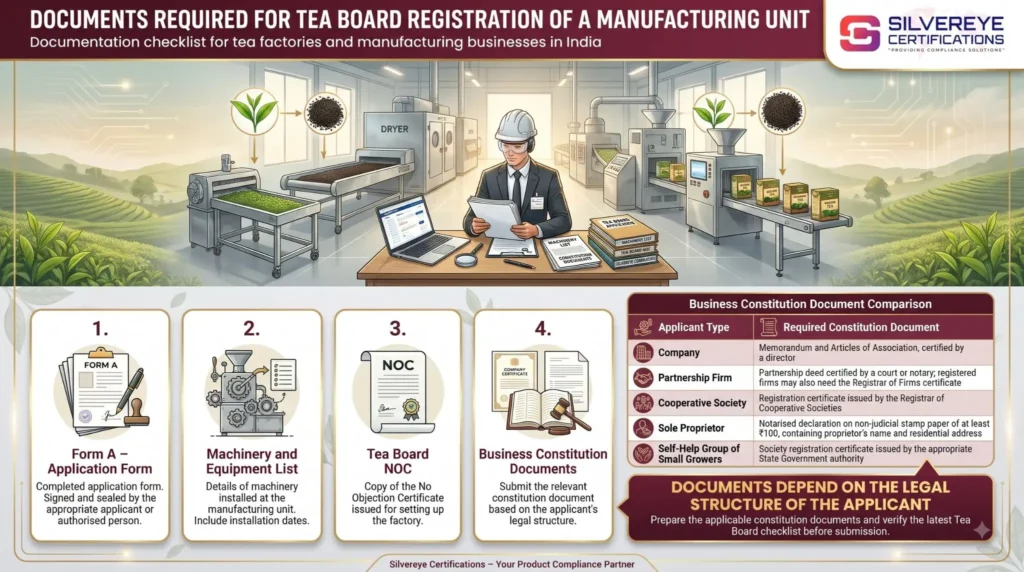
The exact documentation should be checked against the applicable Tea Board manufacturing-unit registration checklist before submission.
Tea Board Registration Documents for Flavoured Tea
Flavoured tea manufacturing and branding involve additional compliance considerations because the Tea Board's requirements cover the product, ingredients, food safety documentation and manufacturing or packing premises.
Tea Board revised its flavoured-tea guidelines on 4 February 2026. According to compliance publishers summarising these guidelines, the brand owner selling the flavoured tea is required to apply as the manufacturer under the applicable registration process.
The following table summarises the commonly reported document requirements:
| Document | Details |
|---|---|
| System-Generated Application | Application generated through the relevant process, signed and sealed |
| Constitution Documents | Proprietorship declaration on stamp paper of at least ₹100; partnership deed; or MoA, AoA and Certificate of Incorporation certified by a director |
| FSSAI Licence | Complete product annexure showing the authorised tea product and relevant blending or packing premises |
| Laboratory Test Reports | Reports covering biochemical parameters, pesticide residues and metal contaminants from a Tea Board-enlisted NABL-accredited laboratory, identifying the specific product, such as masala tea |
| Notarised Declaration | Declaration on stamp paper of at least ₹100 concerning FSSAI compliance and applicable conditions for flavouring materials |
| Flavour Source Documents | Declaration from the flavour manufacturer for processed flavours, essences or oils; for natural spices used directly, a detailed preparation method on company letterhead |
| Promoter Details | Names, residential addresses, email addresses and phone numbers of the proprietor, partners or directors, as applicable |
| Additional Supporting Documents | MSME certificate and product declarations, wherever relevant or requested |
Important: Laboratory reports and flavour-related declarations should correspond to the actual product and ingredients being submitted for approval. Applicants should confirm the latest testing and documentation requirements in the revised Tea Board guidelines.

Tea Board Registration Documents for a Warehouse License
A Tea Board warehouse license is associated with the specific premises where tea is stored. Therefore, the application generally requires documents establishing the applicant's control over the property and demonstrating that the warehouse meets the applicable storage requirements.
According to the revised warehouse guidelines reported for 11 February 2026, the commonly listed documents include:
- Form A: Completed application form with the required signature and business seal.
- Premises Ownership or Occupancy Proof: Ownership documents, registered lease deed or notarised rent agreement.
- Warehouse Layout: Scaled site map, floor area details and information about the proposed warehouse activities.
- Premises Compliance Declaration: Notarised declaration on ₹100 stamp paper confirming that the warehouse meets the prescribed specifications.
- Auction Organiser's Recommendation: Required where the warehouse is proposed to be used as an auction warehouse.
- Lease Renewal Undertaking: Declaration undertaking timely lease renewal where the existing lease does not cover the entire license period.
- Owner's NOC: Required where the applicant operates as a sub-lessee.
- Private Warehouse Declaration: Declaration confirming that a private warehouse will not be used for auctions, where applicable.

Tea Board Registration Documents for Change of Ownership
When ownership of a tea garden or manufacturing unit changes, the new owner must follow the applicable Tea Board procedure to record the change in ownership.
According to compliance publishers summarising the Tea Board guidelines dated 1 June 2026, the commonly listed documents include:
- Signed Application: Completed application requesting the recording of the ownership change.
- Original Tea Board Registration Certificate: Copy or original certificate, as required by the applicable procedure.
- Ownership Transfer Document: Registered sale deed, transfer deed, court order or registered lease deed, depending on the nature of the transaction.
- Indemnity Bond: If the original Tea Board certificate is lost, a notarized indemnity bond on ₹100 stamp paper may be accepted, subject to the Board's requirements.
- New Owner's Constitution Documents: Supporting documents establishing the legal constitution of the new owner, such as incorporation documents, partnership deed or proprietor declaration, as applicable.

Applicants should confirm the latest change-of-ownership checklist with the Tea Board before submitting their application.
How to Prepare Your Tea Board Registration Documents Without Errors
Preparing the correct documents is only one part of the application process. The files must also be properly scanned, signed, organized and submitted according to the applicable Tea Board instructions.
Follow these steps to reduce avoidable documentation errors:
- Scan Each Document Separately: Save individual supporting documents as separate PDF files where required by the Tea Board portal. Check the latest portal instructions for file format and upload requirements.
- Ensure Every Page Is Readable: Make sure all pages, signatures, dates, stamps and seals are clearly visible. Avoid blurry scans or incomplete documents.
- Self-Attest and Affix the Business Seal: Self-attest documents and use the business seal wherever specified in the relevant application checklist.
- Use Stamp Paper Where Required: Certain declarations relating to proprietorships, flavoured tea and warehouse licensing may require notarised declarations on stamp paper of at least ₹100, depending on the applicable guidelines.
- Attach an Authority Letter: If the application is signed by someone other than the proprietor, partner or director, include the required authorisation document.
- Use Clear File Names: Organise documents with descriptive names such as
IEC_Copy.pdf,Form_A_Signed.pdfandFSSAI_Licence.pdfto make identification easier. - Keep Original Documents Safely: Preserve original certificates, notarised declarations and supporting documents in case the Tea Board requests verification.
Timelines and Fees for Tea Board Registration
Tea Board's notice dated 8 January 2026 regarding the disposal of license applications provides processing timelines for different application categories. According to compliance publishers summarizing the notice, these timelines are calculated in working days from the receipt of an application that is complete in all respects.
Tea Board Registration Processing Timelines
| Application Category | Stated Processing Time |
|---|---|
| Exporter Licence, Permanent Exporter Licence and Buyer Registration | 10 working days |
| Flavoured-Tea Registration and Manufacturing-Unit Registration | 20 working days |
| Warehouse Licence and Mini Tea Factory | 25 working days |
These are stated processing timelines, not guaranteed completion dates. Applications requiring additional documents, corrections or clarifications may take longer.
Tea Board Registration Fees
The applicable government charges vary depending on the type of registration or license being requested.
| Cost Item | Amount | Source / Note |
|---|---|---|
| Exporter Licence (New, Renewal or Permanent) | ₹2,800 + GST | Gazette order dated 6 August 2021 |
| RCMC | Nil | Table 1 of Tea Board's RCMC guidelines; verify the current filing route |
| Tea Waste Export Licence | ₹3,300 + GST | Tea Board guideline for tea waste export licensing |
| Stamp Paper for Declarations | At least ₹100 each | Notary charges may apply separately |
| Consultant or Document Preparation Fee | Varies | Private professional service charge, not a government fee |
Important: Government fees and private professional charges are different. Always check the applicable fee through the official Tea Board portal or the concerned office before making a payment.
Validity and Renewal: Which Tea Board Registration Documents Should You Update?
Tea Board registrations and licenses may have different validity and renewal requirements. Exporters should track the validity of their exporter license and RCMC separately and check the dates printed on their issued certificates.
Under the 2021 amendment to the Tea (Distribution and Export) Control Order, the exporter license has a five-year validity period, with provision for further renewal. Tea Board's renewal instructions also describe an online renewal facility linked to payment of the applicable renewal fee.
The RCMC certificate carries its own "valid / renewed upto" date. Applicants should check the certificate and follow the applicable RCMC renewal instructions.
The following schedule can help businesses prepare their documents in advance:
| When | Documents and Actions |
|---|---|
| Around 3 months before expiry | Review the master document file and check whether IEC, GST and FSSAI records are current |
| About 30 days before licence expiry | Check the portal for the applicable exporter licence renewal facility and payment instructions |
| After licence renewal | Prepare updated RCMC documents, including the current license copy and required declarations |
| If business details have changed | Update relevant records, such as IEC and GST, and inform the Tea Board according to the applicable procedure |
| If a licence has expired | Contact the Tea Board to confirm whether renewal or a fresh application is required |
Practical Tip: Do not assume that renewing the exporter license automatically renews the RCMC. Check the validity date and renewal requirements of each certificate separately.
2026 Updates That May Affect Your Tea Board Registration Documents
Tea Board has issued and revised several guidelines and instructions during 2026. These developments may affect the documents required for different tea-related activities.
Important updates to keep in mind include:
- 8 January 2026 – Application Processing Timelines: Tea Board published a notice specifying timelines for the disposal of different license and registration applications.
- 4 February 2026 – Flavoured-Tea Guidelines: Revised guidelines were issued for registration as a manufacturer of tea with added flavour.
- 11 February 2026 – Warehouse Licensing: Revised warehouse licensing guidelines were reported, affecting the documentation and premises-related requirements.
- 1 June 2026 – Change of Ownership: Revised guidelines were reported for recording ownership changes involving tea gardens and factories.
- July 2026 – Tea Mark Certification: Tea Mark certification guidelines were reported. This is a separate certification and does not replace the applicable Tea Board licenses or registrations.
- Imported Tea for Re-Export: Tea Board issued an SOP under Directive 01/2026 dated 10 February 2026, followed by a corrigendum on 31 March 2026. The instructions include uploading complete packaging designs showing the country of origin. Exporters involved in re-exporting imported tea should consult the relevant SOP.
Since Tea Board may revise application forms, document checklists and filing procedures, always download the latest Tea Board registration documents checklist for your specific business activity before submitting an application.
Why Choose Silvereye Certifications for Tea Board Registration?
Understanding Tea Board registration requirements can be challenging because different business activities involve different licenses, application forms and supporting documents. Whether you are an exporter, tea manufacturer, buyer, flavoured-tea producer or warehouse operator, preparing the correct documentation is essential for a smooth application process.
Silvereye Certifications provides professional compliance assistance to businesses seeking Tea Board registrations and related approvals.
Here's how our team can help:
- Registration Requirement Assessment: We help identify the relevant Tea Board registration and documentation requirements based on your business activities.
- Document Preparation: Get assistance with preparing application forms, business records, declarations and supporting documents.
- Application Review: We help review your documents for missing information, inconsistent business details, signatures and other common documentation errors.
- Application Assistance: Our team guides you through the applicable application and submission process.
- Query Resolution Support: We assist in preparing responses and corrected documents when additional clarification is requested.
- Renewal and Compliance Assistance: Get support with renewal documentation and understanding ongoing compliance responsibilities.
Whether you need an Exporter License, RCMC, Buyer Registration, Manufacturing Unit Registration, Flavoured-Tea Registration or Warehouse License, Silvereye Certifications can guide you through the relevant documentation requirements.
Need help with Tea Board registration? Contact Silvereye Certifications for professional assistance with your application and documentation.
Conclusion
Preparing the correct Tea Board registration documents is an important part of obtaining the relevant license or approval for your tea business. The documentation requirements vary depending on whether you export, purchase, manufacture, blend, pack, store or transfer tea. Therefore, identifying the correct registration category should always be the first step.
From Form A, IEC and GST records to RCMC application forms, FSSAI licenses, laboratory reports, premises documents and ownership declarations, each application may require a different set of supporting documents. Keeping these records accurate, updated and consistent can help reduce documentation errors and avoid unnecessary processing delays.
Before submitting an application, review the latest Tea Board guidelines, verify the applicable fees and processing timelines, and confirm the required documents for your business activity.
If you need assistance preparing your application, Silvereye Certifications can help you understand the relevant requirements and organise your documentation for Tea Board registration.
Frequently Asked Questions
What documents are required for Tea Board registration?
It depends on your activity. Exporters need Form A and an IEC copy. The RCMC adds Forms 19-A and 19-B, a license copy and a returns declaration. Buyers need a GST certificate. Factories, flavoured-tea brands and warehouses need constitution papers and activity-specific proof.
What is the main document for a Tea Board exporter license?
Form A, signed, dated and sealed, along with a self-attested IEC copy. The address on the IEC must match the address on Form A.
Is IEC mandatory for Tea Board registration?
For the exporter license and the RCMC, yes. Both ask for a copy of the IEC issued by DGFT.
Do I need GST registration for Tea Board buyer registration?
Compliance publishers report that a GST certificate is the core document for buyer registration, along with proof that you trade in tea.
What documents does the RCMC need?
Forms 19-A and 19-B, an IEC copy, a copy of your Tea Board exporter license and a letterhead declaration on monthly export returns, including NIL returns. Add an authority letter if an authorized signatory signs.
What documents are needed for flavoured-tea registration?
A signed application, constitution papers, an FSSAI license with annexure, lab reports from an eligible NABL-accredited lab, a notarized declaration and flavour-source declarations.
Do I need stamp paper for any Tea Board document?
Yes, for some. Proprietor declarations, flavoured-tea declarations and warehouse declarations are reported to need non-judicial stamp paper of at least ₹100, notarized.
Can I send photos or phone scans of documents?
Scans must be clear and complete, showing every page, signature, date and seal. Use a proper scanner or a scanning app and save each document as a separate PDF.
What happens if my documents are incomplete?
The timeline does not start for an incomplete file. Publishers report that the Board may allow only one chance to fix gaps and that failure can lead to rejection and loss of the fee.
How long does processing take after I submit all documents?
Per the 8 January 2026 notice as reported: 10 working days for exporter license and buyer registration, 20 for flavoured-tea and manufacturing-unit registration, and 25 for warehouse licenses.
Which documents do I need to renew my exporter license?
The renewal fee is the main requirement, since the licence auto-renews on payment. Keep your IEC, GST and addresses updated, and prepare fresh RCMC papers with the renewed license copy.
Does a Tea Board registration replace FSSAI, GST or IEC?
No. Each comes from a different authority and serves a different purpose. Tea Board approvals sit alongside them.