

- Mandatory by law: Section 11 of the Spices Board Act, 1986 requires a registration certificate (CRES) before you export scheduled spices.
- Filed online: Fresh and renewal applications go through the DGFT e-RCMC portal, linked to your IEC.
- Published government fee: ₹11,800 for a merchant exporter and ₹17,700 for a manufacturer exporter, both including GST. Validity is three years.
- Manufacturers face a unit check: Your FSSAI license, pollution consent and premises proof must all show the same processing address.
Introduction
Spice Board registration in Delhi obtaining a Certificate of Registration as Exporter of Spices (CRES) before you ship any of the 52 scheduled spices. Delhi exporters apply online through the DGFT e-RCMC portal using a valid IEC, then upload their GST certificate, bank report and Central FSSAI license.
Manufacturers add Udyam, pollution consent and premises proof. Published fees are ₹11,800 for merchants and ₹17,700 for manufacturers, GST included. The certificate valid for three years and must be renewed before it lapses.
What Is Spice Board Registration?
Spice Board registration usually refers to CRES registration (Certificate of Registration as Exporter of Spices). The Spices Board issues it under the Spices Board Act, 1986, and the Spices Board (Registration of Exporters) Regulations, 1989. Without it, you cannot lawfully export the spices covered by the Act, and a valid Importer Exporter Code (IEC) alone is not sufficient.
For exporters in Delhi, the legal requirements are generally the same as those for exporters in Kochi or Guntur. The applicable fee and the stated three-year validity of CRES do not change simply because your business is based in Delhi. However, the practical requirements may differ depending on your business and processing location. Your documents must reflect your business details, and a processing unit in Delhi may need to meet applicable pollution-control and premises requirements. The Board's 2025 help desk list places Delhi under its New Delhi regional office.
Another important point is that, since April 2008, the Foreign Trade Policy has recognised CRES as the Registration-cum-Membership Certificate (RCMC) for spice exporters. Therefore, if your CRES fulfils the applicable RCMC requirement for your spice exports, you do not need a separate RCMC for the same purpose.
Who Needs Spice Board Registration in Delhi?
Businesses exporting scheduled spices or covered spice products from India may need Spice Board registration, whether they are small trading firms in Old Delhi or manufacturers operating from an industrial area. The Board distinguishes between two main categories: Merchant Exporter and Manufacturer Exporter. Choosing the correct category is important because it affects the applicable documents, fee and verification requirements.
| Point | Merchant Exporter | Manufacturer Exporter |
|---|---|---|
| Who is this? | Buys spices from growers, processors or suppliers and exports them in traded form. | Processes spices through activities such as cleaning, grinding, blending, sterilising or packing at its own unit. |
| Typical Delhi example | A trading firm sourcing spices from wholesale markets such as Khari Baoli. | A blending or grinding unit supplying packed spice products for export. |
| Premises verification | Requirements depend on the applicable checklist and application. | The processing facility may be subject to verification. |
| Published new-registration fee | ₹11,800, including GST. | ₹17,700, including GST. |
| Additional documents | Documents specified for the merchant exporter category. | May include Udyam registration, applicable pollution-control consent and premises proof. |
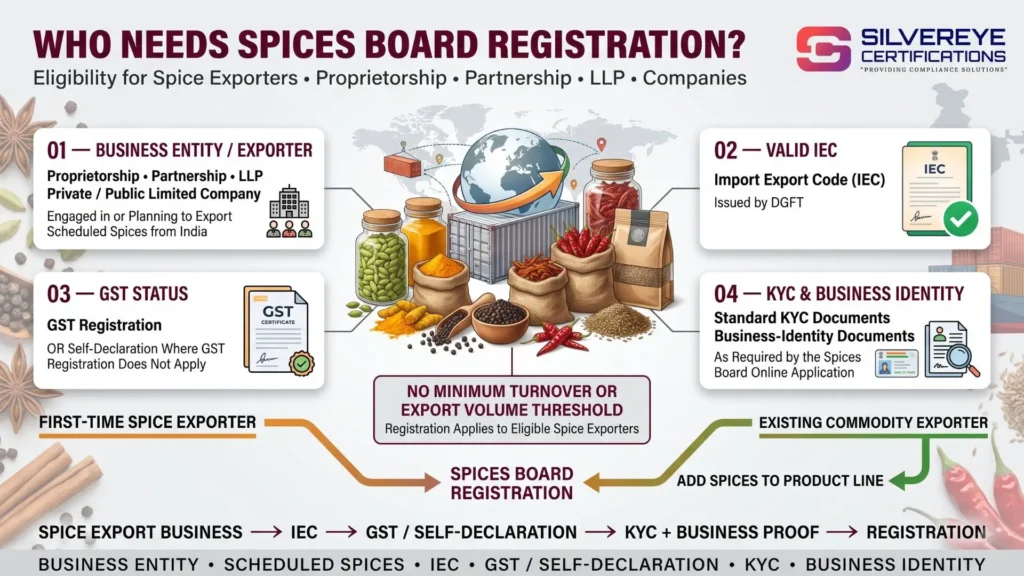
To apply, you generally need a valid IEC, a legally constituted business and the supporting documents required for your category. Business structures may include a proprietorship, partnership, LLP, company, HUF or cooperative, subject to the Board's applicable requirements. The CRES is issued to the registered holder and should not be treated as freely transferable.
What Are the Benefits of Spice Board Registration Before Your First Export?
- Legal authorization: CRES is required for exports covered by the applicable provisions of the Spices Board Act, 1986.
- RCMC recognition: CRES serves as the relevant RCMC for spice exports under the Foreign Trade Policy, subject to applicable requirements.
- Business credibility: A valid registration can help demonstrate that your business has completed the relevant exporter-registration process when dealing with buyers and business partners.
- Access to Board support: Registered exporters can approach the Spices Board for relevant quality guidance and export-related assistance.
- Better record management: Keeping registration details, amendments and applicable returns up to date can help you prepare for renewal and future regulatory checks.
What Documents Are Required for Spice Board Registration in Delhi?
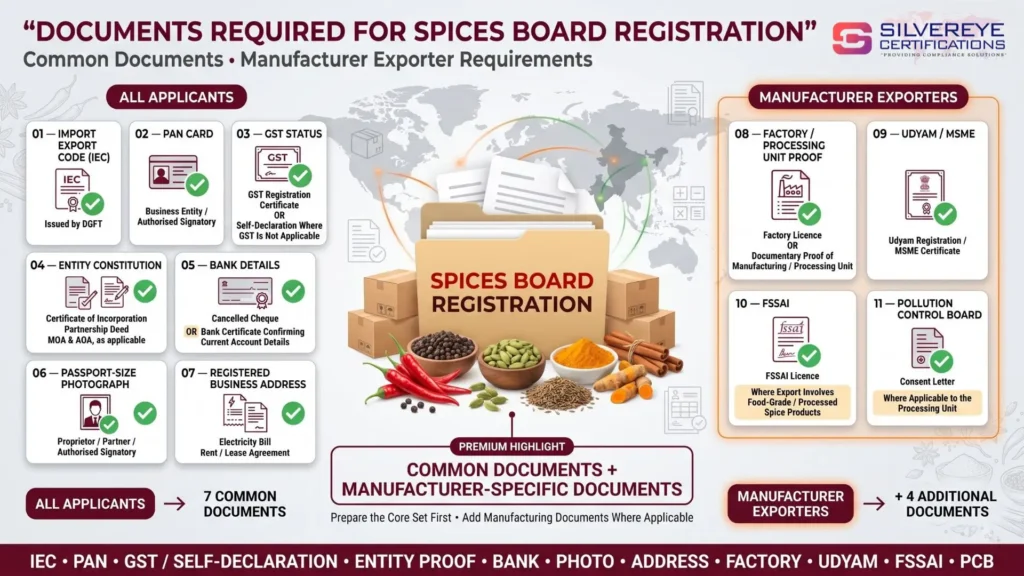
Preparing the correct documents before applying can help reduce avoidable queries. Check that your business name, IEC details, registered address and processing-unit address, where applicable, are consistent across the relevant records. Follow the current Spices Board and DGFT portal checklist when preparing your application.
Which Documents Does Every Applicant Need for Spice Board Registration?
| Document | What to check before uploading |
|---|---|
| Valid IEC and updated DGFT profile | Confirm that the firm name, address, contact details and relevant business information are current. |
| GST registration certificate | Check that the legal name and principal place of business match the relevant business records. Follow the current portal checklist for the required document. |
| Bank report in Annexure II format | Obtain the report in the prescribed format from your bank, with the required authentication. Do not substitute a bank statement or cancelled cheque unless the current instructions permit it. |
| Central FSSAI licence | Ensure the licence is valid and covers the relevant activity and premises, where required by the applicable checklist. |
| PAN and IEC copy | Keep these available for application preparation and clarification of any discrepancies. Upload them where the portal or Board requires them. |
What Additional Documents Do Manufacturer Exporters Need?
| Document | Why it matters |
|---|---|
| Udyam (MSME) registration | Keep the registration details consistent with the business applying for CRES, where this document is required. |
| Applicable pollution-control consent | A processing unit in Delhi may need the relevant consent from the Delhi Pollution Control Committee (DPCC), depending on the activity and applicable requirements. |
| Proof of ownership or lawful possession | Keep suitable premises documents, such as a lease or rent agreement or other accepted proof, as specified in the current checklist. |
| Consistent processing address | Check that the address matches across the relevant FSSAI, pollution-control and premises documents, where applicable. |
Which Documents Are Required for Different Business Types?
- Proprietorship: Keep the proprietor's PAN, IEC, GST certificate and relevant bank records ready, as required by the checklist.
- Partnership firm: Keep the partnership deed, current partner details and relevant authorisation documents ready.
- LLP: Prepare the certificate of incorporation, LLP agreement and current designated-partner details.
- Company: Keep the certificate of incorporation, Memorandum of Association (MoA), Articles of Association (AoA) and current director details available, where required.
- Cooperative society or HUF: Prepare the applicable registration or constitution documents and the details of the authorised representative.
- Authorization letter: Keep an authorization letter ready if a representative is submitting the application on behalf of the business, where required.
Are HACCP, ISO or BRC certificates mandatory for Spice Board registration?
Quality certificates such as HACCP, ISO and BRC do not replace CRES. Whether any additional quality documentation is required depends on the applicable registration instructions, product, destination market and buyer requirements. Do not assume that every certificate is mandatory for every applicant.
What Should Delhi and NCR Exporters Know About Spice Board Registration?
A general guide will not tell you how Delhi's business setup affects your Spice Board registration application. These are important points for Delhi and NCR applicants to check before applying.
- Sourcing hubs are not processing units. Buying from Old Delhi's wholesale spice markets generally fits the merchant exporter model. If you apply as a manufacturer exporter, make sure you have an eligible processing facility and the documents required for that category.
- Check the pollution board for your actual location. A unit inside Delhi may need to deal with the Delhi Pollution Control Committee (DPCC). If your unit is in Noida, Ghaziabad, Gurugram or Faridabad, check the requirements of the pollution-control authority for the state where the unit is located.
- Check zoning and premises requirements. Before investing in a processing unit in Delhi, confirm with the relevant authority that the premises are permitted for the intended industrial or food-processing activity. Your lease and premises documents should support the proposed use.
- Disclose your registered office and factory addresses correctly. Many Delhi businesses have a registered office in one location and a processing unit elsewhere in the NCR. Ensure that both addresses are correctly disclosed wherever required. An undisclosed facility or inconsistent address details can lead to queries during scrutiny or inspection.
- Plan your shipping route early. Delhi-based exporters may move cargo through inland container depots (ICDs) and onward to seaports. Ensure that your IEC, CRES and shipping documents contain consistent business and exporter details.
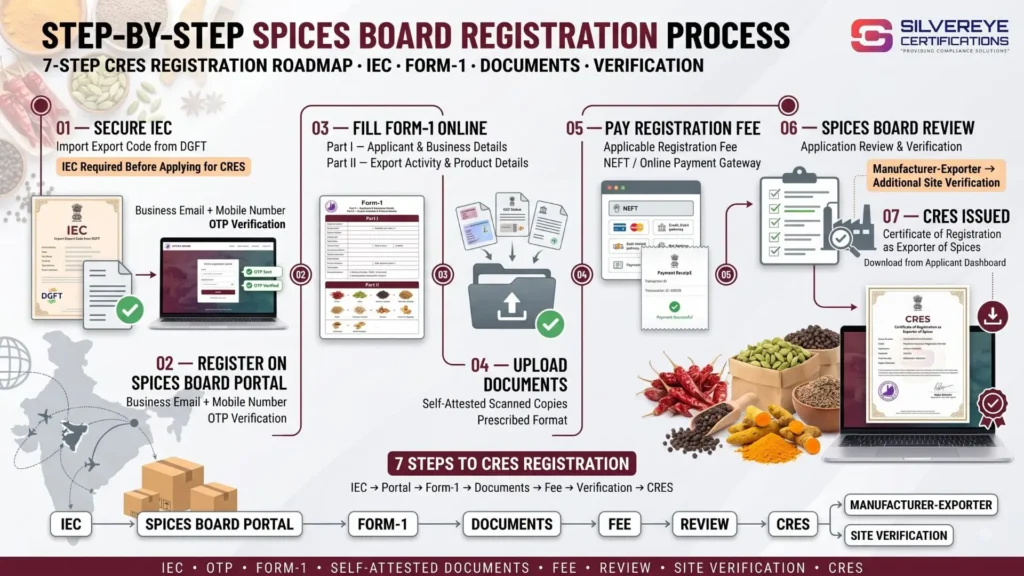
How Can You Apply for Spice Board Registration in Delhi Step by Step?
Older guides may describe demand drafts, printed forms and courier packets to a regional office. Applications should be prepared according to the current DGFT e-RCMC process and the latest instructions issued by the Spices Board.
| Step | What you need to do | Tip for Delhi applicants |
|---|---|---|
| 1 | Confirm your category: merchant exporter or manufacturer exporter. Identify the applicable ITC (HS) codes for your products. | Choose the correct category before submitting the application. |
| 2 | Update your IEC profile, including business name, address, contact details and relevant business information. | Keep your details consistent with your supporting documents. |
| 3 | Prepare the applicable documents, including the GST certificate, Annexure II bank report and Central FSSAI licence, where required, along with manufacturer-specific documents. | Arrange documents that may take time, particularly the bank report. |
| 4 | Log in to the DGFT portal and locate the e-RCMC application service. | Use the IEC holder's account or an appropriately authorised user account, as permitted. |
| 5 | Select the Spices Board as the registering authority and provide the required office, product and HS-code details. | Follow the current portal instructions when selecting the relevant details. |
| 6 | Upload the required documents and pay the applicable fee through the online payment system. | Verify your category and application details before payment. |
| 7 | Respond to any queries from the Board and complete any required facility verification if you are applying as a manufacturer exporter. | Keep the person responsible for the processing unit available to provide information. |
| 8 | Download the CRES certificate once it has been issued and retain it with your export records. | Record the certificate's issue and expiry dates so you can plan for renewal. |
What Are the Spice Board Registration Fees in 2026?
The following are the fee figures provided for Spice Board registration. Verify the current amount on the official DGFT portal or the latest Spices Board fee schedule before applying. These figures do not include professional charges or other expenses, such as document preparation or obtaining a required license.
| Exporter category | New registration | Renewal | Amendment (name or address change) |
|---|---|---|---|
| Merchant exporter | ₹11,800 (₹10,000 + 18% GST) | ₹8,850 | ₹5,900 (₹5,000 + GST) |
| Manufacturer exporter | ₹17,700 (₹15,000 + 18% GST) | ₹11,800 | ₹5,900 (₹5,000 + GST) |
Important: Some older websites may display different registration fees. Always check the amount shown on the official payment page before paying, and retain the payment receipt for your records.
How Long Does Spice Board Registration Take in Delhi?
The time required for CRES registration depends on document completeness, application scrutiny, queries and any required facility inspection.
| Stage | What to expect |
|---|---|
| Document preparation | Depends on how quickly you can arrange the required licences, bank report and business documents. |
| Merchant exporter application | Processing depends on document scrutiny and any queries raised by the Board. |
| Manufacturer exporter application | Additional time may be required for processing-facility verification or inspection, where applicable. |
| Possible delays | Mismatched business details, missing documents, resubmissions and inspection scheduling can extend the process. |
Treat any published processing-day figures as indicative rather than guaranteed. Check the latest Spices Board guidance for the applicable service timeline.
How Long Is Spice Board Registration Valid, and How Do You Renew It?
- Validity: CRES is generally issued for a three-year period, subject to the applicable registration rules.
- Renewal: Apply through the prescribed route before the certificate expires. Starting two to three months in advance is a practical precaution, not a statutory deadline.
- Late renewal: An application submitted after expiry may be treated differently from an ordinary renewal. Check the current Board rules to determine whether fresh registration is required in your case.
- Name or address change: Report changes through the prescribed amendment process and submit supporting documents. Confirm the applicable reporting deadline and fee against the current regulations.
- Change in constitution or ownership: A change involving the legal constitution, ownership or partnership may require additional scrutiny or fresh registration because CRES is not freely transferable. Confirm the correct procedure with the Spices Board before making the change.
What Happens After Spice Board Registration? Returns, Sampling and Penalties
Spice Board registration is not the end of your compliance responsibilities. Registered exporters must file applicable quarterly returns covering spice exports, purchases and imports through the Board's portal. The Board has indicated that pending returns can affect renewal, so keep your filings up to date.
It is also important to understand what CRES does not cover. It registers you as an exporter, but it does not certify that every shipment meets the importing country's pesticide residue limits, microbiological standards, labelling rules or health-certificate requirements. These requirements must be checked separately for each consignment, depending on the destination country and product.
What Penalties Can Apply for Violations of the Spices Board Act?
Following the Jan Vishwas (Amendment of Provisions) Act, 2023, amendments to the Spices Board Act, 1986 took effect from 9 August 2024. Violations such as exporting without registration, failing to file required returns or knowingly submitting false returns may attract monetary penalties under the applicable provisions. The amounts and consequences depend on the specific contravention and the relevant legal provision.
A CRES certificate may also be suspended or cancelled for a breach of its conditions, subject to the applicable procedure and the opportunity to be heard.
Why Do Spice Board Registration Applications Get Delayed?
| Common mistake | How to avoid it |
|---|---|
| Name or address mismatch between IEC, GST, FSSAI and bank records | Check your IEC profile first, then ensure that the supporting documents contain consistent details. |
| Using an outdated checklist that mentions demand drafts or hard-copy submissions | Follow the current DGFT e-RCMC portal instructions and the latest Spices Board guidance. |
| Submitting an unsuitable FSSAI document | Confirm the required FSSAI license category against the current CRES checklist before applying. |
| Submitting Consent to Establish instead of Consent to Operate | Check which pollution-control consent is required for your specific processing unit and activity. |
| Selecting manufacturer status without an eligible processing unit | If you only buy and trade spices, check whether the merchant exporter category applies to your business. |
| Missing the renewal date | Record the certificate's expiry date as soon as CRES is issued and prepare for renewal in advance. |
| Ignoring quarterly returns | File applicable returns on time and maintain organised purchase, import and export records. |
What Is the Difference Between Spice Board Registration, CRES, RCMC, IEC and FSSAI?
| Document | Issued by | Purpose for a spice exporter |
|---|---|---|
| IEC | Directorate General of Foreign Trade (DGFT) | Identifies the business for import-export activities and is required for the relevant export registration process. |
| CRES | Spices Board | Provides the applicable registration as an exporter of scheduled spices. It is generally valid for three years, subject to the applicable rules. |
| RCMC | Relevant export promotion council or authority | Serves as registration-cum-membership certification for applicable Foreign Trade Policy purposes. CRES serves this role for spice exporters, subject to applicable requirements. |
| Central FSSAI licence | Food Safety and Standards Authority of India (FSSAI) | Covers applicable food-business licensing requirements and must be provided where required by the current CRES checklist. |
| GST registration | Relevant GST authorities | Supports applicable tax and business-identification requirements and is required where specified by the current checklist. |
Should You Apply for Spice Board Registration Yourself or Hire a Consultant?
You can apply for Spice Board registration yourself through the online process if you understand the requirements and have the necessary documents ready. However, applicants may lose time because of an incorrect exporter category, mismatched business records, queries from the Board or missed returns at renewal.
Professional help may be useful if you are applying for the first time, operate a spice-processing unit that may require inspection, have inconsistencies in your IEC, GST or FSSAI records, or need support with an upcoming shipment.
Before hiring a Spice Board registration consultant, ask for written confirmation of what the service includes, such as:
- Document review before submission.
- CRES application filing through the prescribed online process.
- Assistance with Board queries and additional document requests.
- Support with facility verification, where applicable.
- Renewal reminders and guidance on required returns.
- A clear breakdown of the government registration fee and professional charges.
Choose a provider that explains the process clearly, identifies any outstanding requirements and does not guarantee approval.
Conclusion
Spice Board registration in Delhi becomes easier when your documents are complete and your business details match across records. A merchant exporter should prepare the required IEC, GST, bank report and FSSAI documents. A manufacturer exporter may need additional approvals and processing-unit verification. In both cases, choosing the correct category, following the current application process and renewing your CRES certificate on time can help avoid unnecessary delays.
Need Help with Spice Board Registration in Delhi?
Silvereye Certifications provides support for Spice Board registration in Delhi, helping exporters understand the application process and prepare the required documents. From selecting the appropriate exporter category and reviewing documents to filing the application, responding to queries and planning for renewal, our team can guide you through the key steps.
Whether you are a merchant exporter or manufacturer exporter, Silvereye Certifications can help you identify missing documents and understand the requirements before you submit your application and pay the applicable government fee.
Frequently Asked Questions
Is Spice Board registration in Delhi mandatory to export spices?
Yes. Section 11 of the Spices Board Act, 1986 requires a valid certificate to export scheduled spices. The IEC is needed as well, but it does not replace CRES registration in Delhi or anywhere else.
How much does Spice Board registration in Delhi cost?
The published government fee for Spice Board registration is ₹11,800 for a new merchant exporter and ₹17,700 for a new manufacturer exporter, both including GST. Renewal is ₹8,850 and ₹11,800 respectively. Professional fees for Spice Board registration, if any, are extra.
How long does Spice Board registration take in Delhi?
The Board's guidelines indicate about 5 working days for merchants and about 10 for manufacturers after complete documents and inspection. Actual time for CRES registration varies with queries and document preparation.
What documents are needed for Spice Board registration as a Delhi merchant exporter?
A valid IEC with an updated DGFT profile, GST certificate, bank report in Annexure II format and Central FSSAI licence, along with entity documents such as the partnership deed or company incorporation papers.
Do I need to visit the Spices Board office in Delhi for registration?
The Spice Board registration application is filed online through DGFT. The Board may contact you for clarification, and manufacturer units can be inspected. Confirm current contact routes on the Board's website before travelling.
Is Spice Board registration the same as RCMC?
For spice exporters, the Foreign Trade Policy treats the CRES as the RCMC. You do not need a separate RCMC for the same spice exports.
Can I get Spice Board registration without GST?
Older Board guidance allowed a declaration where GST was not available. The current online checklist asks for the GST certificate, so plan to have it ready.
Does a Delhi address matter if my unit is in the NCR?
Yes, the unit address matters. Your FSSAI, pollution consent and premises proof must all carry the actual processing address, and the pollution consent must come from the board that governs that location.
What is the validity of Spice Board registration, and how do I renew it?
Three years from issue. Renew through the DGFT route before expiry. A late application may be treated as a fresh registration.
What happens if my CRES expires?
You should not export scheduled spices on an expired certificate. Apply immediately, but be prepared for the Board to treat a post-expiry application as fresh