

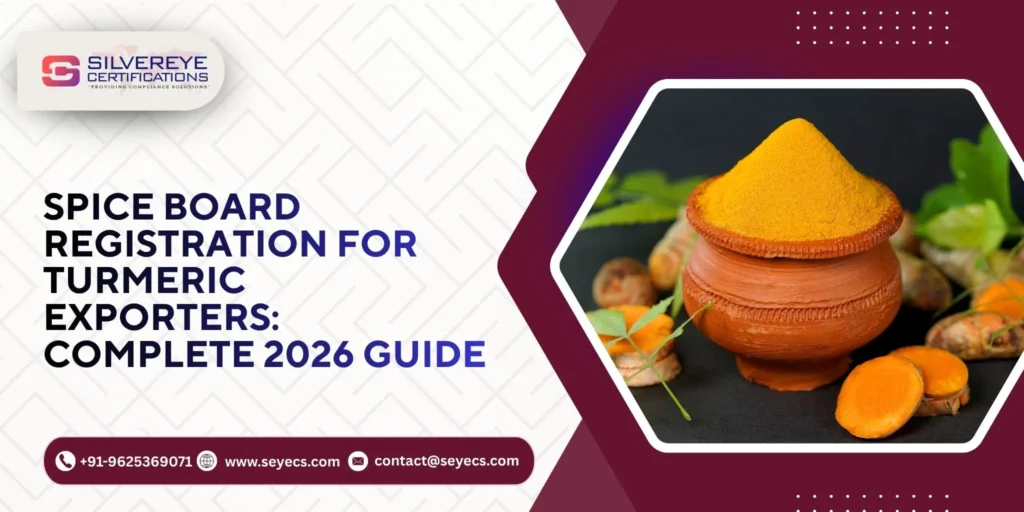
- Mandatory registration: A CRES (Certificate of Registration as Exporter of Spices) from the Spices Board of India is required for applicable turmeric exports, subject to current rules and exemptions.
- IEC requirement: Obtain a valid Import Export Code (IEC) from DGFT first. Ensure your business name and details match across your IEC and CRES application to avoid processing delays.
- Fee and validity: The stated new CRES registration fee is ₹5,000, with a validity of three years. A separate RCMC may be relevant for specific export promotion benefits, subject to scheme eligibility.
- Quality and testing: Turmeric exporters may need to verify curcumin content (HPLC), moisture, colour value and heavy metals such as lead, depending on buyer specifications and destination-country requirements. Testing can help identify adulteration risks, including lead chromate.
Introduction
Spice Board registration for turmeric exporters involves obtaining a CRES (Certificate of Registration as Exporter of Spices) from the Spices Board of India under the Spices Board Act, 1986. Registration requirements apply to businesses exporting whole, dried or powdered turmeric, subject to applicable rules and exemptions. Exporters must first obtain an active Import Export Code (IEC) from DGFT and then apply through the official Spices Board website.
Supporting documents may include PAN, GST registration, a bank certificate and a valid FSSAI license, where applicable to the business and facility. The stated government fee is ₹5,000, and the certificate is reported to be valid for three years. Processing time and any premises inspection depend on the current procedure and the individual application.
Why This Registration Matters for Turmeric Exporters
India is one of the world's leading producers, consumers and exporters of turmeric. The crop reaches international buyers in several forms, including whole turmeric fingers, dried turmeric, turmeric powder and curcumin extract for the nutraceutical industry. Each product has its own commercial specifications, but exporters must first confirm the applicable Spices Board registration requirements before shipping. A valid CRES (Certificate of Registration as Exporter of Spices) is required where applicable under current rules.
This guide covers everything a turmeric exporter needs to know, including eligibility, required documents, the online application process, fees, validity and renewal, HS codes, curcumin content, heavy-metal testing and common mistakes that can delay an application.
What Is Spice Board Registration (CRES)?
The Spices Board of India is a statutory body constituted under the Spices Board Act, 1986, functioning under the Ministry of Commerce and Industry, with its headquarters in Kochi, Kerala. It regulates 52 notified spice varieties, including turmeric (Curcuma longa) and ginger.
CRES stands for Certificate of Registration as Exporter of Spices. It is issued by the Spices Board to eligible spice exporters and serves as an important registration document for turmeric exports under applicable rules. Exporters should confirm the current registration requirements before shipping.
A separate certificate, the RCMC (Registration-cum-Membership Certificate), may be relevant for accessing specific DGFT trade policy benefits and export promotion schemes, subject to the applicable eligibility conditions. CRES and RCMC serve different purposes, so exporters should verify which certificates they need for their products and intended benefits.
Who Needs to Register and Who Is Eligible?
Spice Board registration requirements apply to businesses exporting notified spices, including whole turmeric, dried turmeric fingers and turmeric powder, subject to current rules and exemptions. Depending on the product classification and applicable regulations, requirements for turmeric-based blends and extracts may differ.
Eligible business categories may include:
- Merchant exporters who source turmeric from mandis, farmer cooperatives or processors in growing regions such as Erode, Salem, Nizamabad and Sangli and export it.
- Manufacturer-exporters who clean, polish, dry, grind or steam-sterilise turmeric before exporting it as powder or another processed product.
- Grower-exporters, including turmeric farmers and agricultural businesses selling directly to overseas buyers.
- Cooperative societies and Farmer Producer Organisations (FPOs) involved in turmeric processing and export.
- Nutraceutical and extract manufacturers exporting curcumin concentrate or standardised turmeric extract, subject to the applicable product classification and registration requirements.
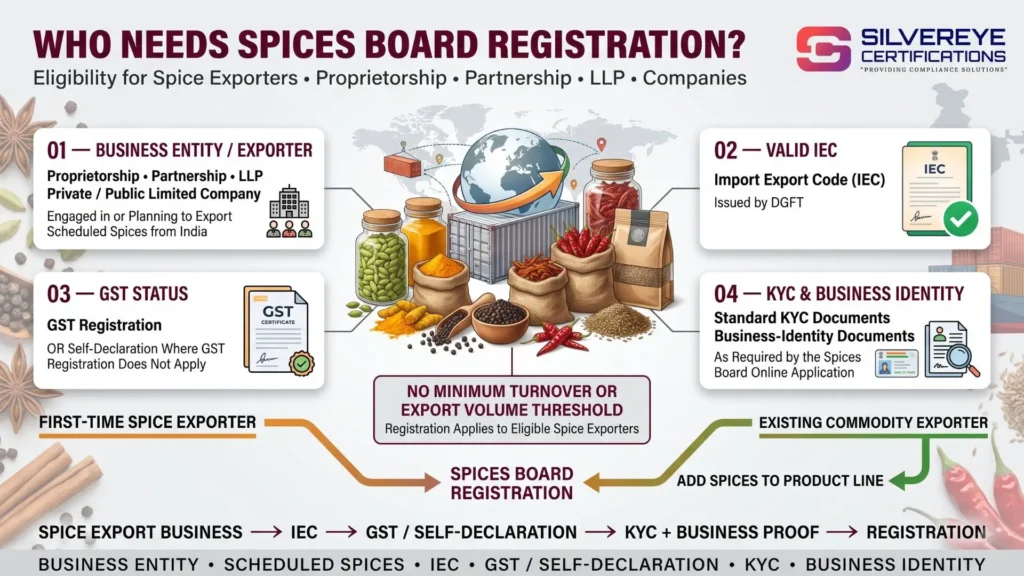
Eligibility depends on meeting the current requirements of the Spices Board and other relevant authorities. Before applying, confirm the following:
- The business is legally established in India, such as a proprietorship, partnership, LLP, private limited company, cooperative or FPO.
- It holds a valid, active Import Export Code (IEC) issued by DGFT, with details matching the CRES application.
- It has a valid GST registration (GSTIN), where applicable.
- It can provide the required information and supporting documents for its processing or storage premises, where applicable.
Businesses selling turmeric exclusively in the domestic Indian market generally do not need exporter registration solely for domestic trade. However, they must still comply with other applicable licensing and food safety requirements.
Documents Required for Turmeric Spice Board Registration
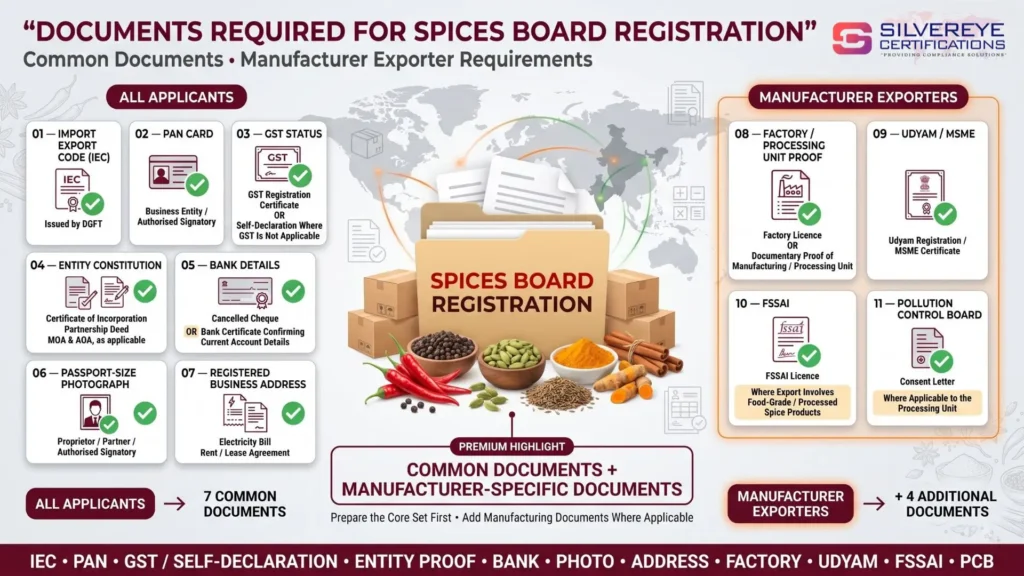
Prepare the required documents before starting the online application. Mismatched details across IEC, GST and FSSAI records can result in application queries and delays.
Business and Entity Documents
- Import Export Code (IEC) certificate from DGFT, with details matching the CRES applicant, including the applicable Pvt. Ltd. or LLP designation.
- PAN card of the business entity or proprietor.
- GST registration certificate (GSTIN), where applicable.
- Certificate of Incorporation, Partnership Deed or Memorandum and Articles of Association (MoA/AoA), depending on the business structure.
- Bank certificate on the bank's letterhead, signed and stamped by an authorised officer, if required under the current checklist.
- PAN and identity documents of directors, partners or the proprietor, as applicable.
Processing or Storage Premises Documents
- Valid FSSAI licence, where required for the turmeric processing, grinding or storage activities. Confirm the applicable licence category and facility requirements before applying.
- Lease deed or rent agreement, if the premises are rented and proof of occupancy is required.
- Pollution Control Board consent, where applicable to turmeric grinding, polishing, boiling or other processing activities.
- Warehouse or storage-related approvals from the relevant authorities, where applicable.
Optional but Useful Documents
- MSME/Udyam registration certificate, which may be relevant to certain support schemes.
- Quality certifications, such as HACCP, ISO 22000 or BRCGS, particularly for turmeric destined for the EU, US or Japan, or for nutraceutical-grade curcumin buyers where specified.
- Authorisation letter, if a representative submits the application on behalf of the applicant.
Important: The exact documentation depends on the exporter category, facility and current Spices Board procedure. Check the latest official checklist before submitting your application.
Step-by-Step Registration Process For Spice Board Registration For Turmeric Exporters
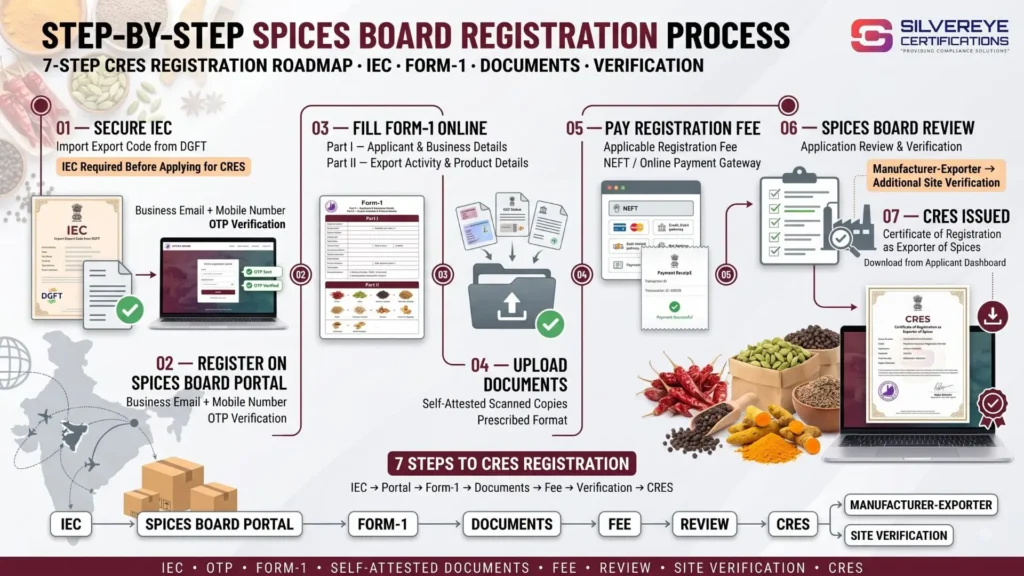
- Obtain your IEC from DGFT first. Apply through the official DGFT portal at dgft.gov.in. Confirm the current application fee and processing time before applying. If you already have an IEC, ensure it is active and registered under your current business name.
- Create an account on the Spices Board portal. Visit the official website at indianspices.com and follow the current exporter registration instructions. Complete the required email or mobile verification.
- Open the Exporter Registration section. Fill out the CRES application with your business details, IEC number, GSTIN where applicable, processing or storage address, and the turmeric products you intend to export, such as whole turmeric fingers, dried turmeric, powder or extracts.
- Upload the required documents. Follow the portal's file-format and size requirements. Ensure the business name, IEC, PAN and address details match across your documents.
- Pay the applicable registration fee. The stated fee for new CRES registration is ₹5,000. Confirm the current amount and accepted payment methods on the official portal before paying. Save your payment receipt.
- Respond to document queries or verification requirements. The Spices Board may review your application and request additional documents or premises verification, depending on the applicable procedure.
- Download your CRES certificate after approval. Check the registered entity name, IEC, address, approved spice category and validity details. Keep the certificate accessible for relevant export and buyer documentation.
Spice Board Registration Fees for 2026
| Registration Type | Government Fee | Validity |
|---|---|---|
| New CRES registration | ₹5,000 | 3 years, as stated |
| CRES renewal | ₹3,000 | Confirm current validity |
| RCMC (FIEO/EPC members) | ₹3,000 | Confirm with the issuing authority |
| RCMC (non-members) | ₹5,000 | Confirm with the issuing authority |
| Amendment (name/address change) | ₹1,000 | Confirm the applicable procedure |
These are the stated government fees and should be verified against the latest official Spices Board and DGFT guidance. Fees and validity conditions may change.
If you hire a consultant or facilitator for document preparation and filing, expect a separate professional service fee in addition to government charges. Request an itemised written quote.
CRES vs RCMC: What's the Difference?
| Point | CRES | RCMC |
|---|---|---|
| Full form | Certificate of Registration as Exporter of Spices | Registration-cum-Membership Certificate |
| Governing framework | Spices Board Act, 1986 | Foreign Trade Policy and applicable DGFT rules |
| Purpose | Registration as an exporter of spices under applicable rules | Registration for relevant trade policy benefits and export promotion support |
| Needed for customs clearance? | Required where applicable under current rules | Does not replace CRES |
| Needed for duty drawback, EPCG or MDA/MAI? | Does not itself establish eligibility | May be relevant for specific schemes, subject to their rules |
| Typical validity | Verify the current certificate terms | Depends on the issuing authority and applicable scheme |
In simple terms, CRES and RCMC serve different purposes. CRES relates to spice exporter registration, while RCMC may support eligibility for particular export promotion benefits. Turmeric exporters should confirm which registrations they need based on their export activities and intended schemes.
Validity, Renewal and Timeline For Spice Board Registration For Turmeric Exporters
- CRES validity: The stated validity is three years from the date of issue. Check the expiry date on your certificate.
- RCMC renewal: Track its validity separately and confirm the applicable renewal requirements with the issuing authority.
- CRES renewal: Apply well before expiry. Starting at least 30 days in advance is a practical precaution, but verify the official renewal deadline.
- Application processing: The previously stated estimate is 15–30 working days for a new application. Actual processing time depends on document review, verification requirements and the individual application.
- Renewal processing: Renewals may be quicker when details remain unchanged, but processing times are not guaranteed.
- Changes to business details: If your business name, address or processing/storage premises change, check the current procedure for updating your registration and obtaining an amended certificate.
- Export data returns: Confirm whether annual export data returns are required and check the applicable reporting period and submission deadline.
Important: Verify the stated renewal deadlines, amendment fee, processing timelines and annual reporting requirements against the latest official Spices Board instructions before publishing.
HS Codes for Turmeric Exports
Turmeric is classified under Heading 0910 of Chapter 09 of the Customs Tariff. Correct classification matters for shipping bills, invoices and applicable export benefit claims.
| Turmeric Form | Indicative HS Code | Notes |
|---|---|---|
| Fresh turmeric | 0910.30 | Confirm the applicable Indian tariff subheading |
| Dried turmeric (whole fingers) | 0910.30 | Common bulk export form |
| Turmeric powder | 0910.30 | Common form for retail and food-industry exports |
| Other turmeric preparations | Classification varies | Blends, extracts and processed products may fall under different headings |
The international six-digit HS code 091030 covers turmeric/curcuma under the relevant tariff classification, but national tariff codes may contain additional digits. Confirm the exact code for your product with your customs broker or the relevant authority, especially for fresh, dried, powdered and extracted forms, which may not share the same full classification.
Curcumin, Colour and Purity: What Turmeric Buyers Actually Check
CRES registration does not replace commercial quality specifications, food safety requirements or destination-country standards. Turmeric exporters should establish testing requirements with their buyers before finalising a shipment.
Curcumin Content
Curcumin content, measured using methods such as HPLC, is an important quality parameter for turmeric. The required level depends on the product grade and intended use. Food-grade turmeric and nutraceutical or pharmaceutical-grade extracts may have very different specifications.
Before confirming a buyer contract, verify the required curcumin percentage, testing method and acceptance criteria with the buyer and an appropriately accredited laboratory. Also check applicable FSSAI requirements for products sold as food in India.
Colour Value and Moisture
- Colour value: Buyers may specify colour-related parameters for turmeric powder based on its intended use in food products, curry blends or supplements. Confirm the measurement method and acceptable range in the contract.
- Moisture content: Moisture affects shelf life, weight-based pricing and mould risk during transport. Meet the moisture specification agreed with the buyer and applicable product standards.
Heavy Metals and Adulteration: A Key Turmeric-Specific Risk
Lead contamination and lead chromate adulteration have been reported as concerns in turmeric supply chains. Exporters should take steps to verify product purity and comply with the applicable limits in their destination markets.
Consider obtaining an appropriate heavy-metal laboratory report covering lead, arsenic, cadmium and mercury when required by the buyer or relevant regulations. An NABL-accredited laboratory with a suitable testing scope can help provide reliable results. Testing frequency should reflect product risk, supplier controls, destination requirements and buyer specifications.
Certifications That Support Turmeric Exports
- HACCP certification: May be required by buyers or food safety programmes, but it is not automatically mandatory for every CRES applicant. Verify current Spices Board support schemes and their eligibility conditions before quoting a subsidy.
- ISO 22000: May be requested by buyers sourcing turmeric or curcumin extracts for food, herbal or nutraceutical manufacturing.
- Phytosanitary certificate: Required when applicable under the importing country's plant-health rules. Confirm the requirement for each product and destination with the relevant Plant Quarantine authority.
- Laboratory testing: The Spices Board's laboratory network may offer relevant testing services. Confirm current availability, fees and subsidy eligibility for curcumin content, moisture, heavy metals and other buyer-specified parameters before shipment.
Benefits of Registering as a Turmeric Exporter
Market Development Assistance (MDA)
Market Development Assistance (MDA) may support eligible exporters with a share of international travel expenses for approved trade fairs and buyer meetings abroad. This can help turmeric exporters build relationships with nutraceutical buyers in the US, EU and Southeast Asia, subject to the applicable scheme guidelines.
Market Access Initiative (MAI)
The Market Access Initiative (MAI) supports eligible export promotion activities and participation in approved international exhibitions. Depending on the programme, support may include exhibition participation and promotional activities that help turmeric exporters connect with international buyers.
Duty Drawback and GST Refund
Eligible exporters may claim duty drawback on qualifying duties and GST refunds on zero-rated exports, subject to applicable customs and GST provisions. Exporters should verify the relevant eligibility conditions and documentation requirements before claiming these benefits.
EPCG Scheme
The Export Promotion Capital Goods (EPCG) Scheme may allow eligible exporters to import qualifying machinery for turmeric cleaning, polishing, grinding, drying or packaging at concessional or zero customs duty, subject to export obligations and current DGFT rules.
Access to Spice Parks
Spice Parks provide processing and infrastructure facilities that may help turmeric exporters access services such as cleaning, drying, polishing and packaging. Availability, charges and facilities vary by location, so exporters should confirm the current arrangements with the relevant Spices Board facility.
Quality Certification Subsidy
Eligible exporters may be able to access quality certification assistance under applicable Spices Board schemes. Support for certifications such as HACCP, ISO 22000 or BRC depends on the current scheme, approved certification scope and reimbursement conditions. Verify the latest subsidy percentage and maximum limit before including specific amounts in business planning.
Common Mistakes Turmeric Exporters Should Avoid
- IEC and applicant-name mismatch: Ensure the applicant details in the Import Export Code (IEC) and the CRES application are consistent with the applicable requirements, including the legal entity name.
- Incorrect FSSAI authorisation: Obtain the appropriate FSSAI licence or registration, as applicable to the business activity, premises and scale of operations.
- Address mismatch: Check that the processing-unit address in the relevant licences and the CRES application is consistent wherever required.
- Incorrect bank proof: Submit the bank certificate or other accepted bank document in the format specified by the Spices Board.
- Poor-quality document scans: Upload clear, complete and legible documents to help prevent avoidable queries and processing delays.
- Overlooking renewals: Track the validity and renewal requirements for CRES and RCMC separately, and confirm any annual reporting obligations that apply to your business.
- Skipping product testing: Arrange suitable heavy-metal, curcumin and other quality tests based on the product specifications and destination-market requirements. Use a competent laboratory and confirm whether buyer or regulatory requirements call for NABL-accredited testing.
How Silvereye Certifications Helps Turmeric Exporters
Silvereye Certifications supports turmeric exporters with the practical steps involved in Spices Board registration and export readiness. This may include reviewing IEC and CRES details, organizing documents such as the FSSAI license, GST records, bank certificate and business constitution documents, and assisting with the online application process and follow-up on document queries.
For exporters who also require RCMC guidance, HACCP support or laboratory testing coordination for curcumin and heavy metals, Silvereye Certifications can help organise the relevant steps and documentation. The objective is to reduce avoidable paperwork errors and help businesses prepare for export requirements more efficiently.
Conclusion
Spice Board registration is an important compliance step for businesses exporting turmeric from India. Whether you export whole dried turmeric fingers, turmeric powder or curcumin extracts, confirm the registration requirements applicable to your product and business activity before shipping.
Prepare accurate IEC and CRES details, the required FSSAI authorisation, acceptable bank documents and clear supporting records to reduce avoidable application delays. Also check whether an RCMC, export incentive or quality certification assistance scheme applies to your business, as eligibility and conditions can vary.
Treat registration and export compliance as ongoing responsibilities. Keep track of applicable renewals and reporting obligations, and arrange independent laboratory testing according to product specifications, buyer expectations and destination-market rules. Where documentation or testing requirements become complex, Silvereye Certifications can assist turmeric exporters with registration preparation and export-readiness support.
Frequently Asked Questions
Is Spice Board registration compulsory for turmeric exporters?
Yes. Any business commercially exporting whole turmeric, dried turmeric, turmeric powder or turmeric-based extracts from India must hold a valid CRES from the Spices Board before customs will clear the shipment.
What documents do turmeric exporters need for CRES?
A valid IEC, PAN, GST certificate, business constitution documents, a bank certificate on letterhead, and a State or Central FSSAI licence covering the processing or storage premises. Optional but useful documents include MSME/Udyam registration and HACCP or ISO 22000 certification.
Is IEC mandatory before applying for Spice Board CRES?
Yes. A valid IEC from DGFT is a mandatory prerequisite. The Spices Board issues CRES against the IEC number, and the applicant's name on both must match exactly.
What are the current Spice Board registration fees for turmeric exporters?
₹5,000 for a new CRES registration, ₹3,000 for CRES renewal, and ₹3,000 to ₹5,000 for RCMC depending on FIEO/EPC membership status. Always verify current fees on indianspices.com, since government fees can be revised.
How long does Spice Board registration take for a turmeric exporter?
Typically 15 to 30 working days from submission to certificate issuance, including document review and a physical inspection of the processing or storage premises. Renewals with no change in business details are usually faster.
What is the validity of a CRES certificate for turmeric export?
A CRES certificate is valid for 3 years from the date of issue. Renewal applications should be filed at least 30 days before expiry to avoid a gap in export clearance.
What is the difference between CRES and RCMC for turmeric exporters?
CRES is the mandatory export licence needed for customs clearance. RCMC is a separate membership certificate needed to claim duty drawback, EPCG benefits, and MDA/MAI scheme support. Turmeric exporters generally need both for full trade benefits.
Can a sole proprietor register as a turmeric exporter with the Spices Board?
Yes. There is no minimum turnover or export volume requirement. A sole proprietor needs their PAN, Aadhaar, IEC in their own name, GST registration, bank certificate and a valid FSSAI licence for the processing unit.
What HS code is used for turmeric export from India?
Turmeric falls under Heading 0910 of Chapter 09. Dried whole turmeric is typically classified under 0910.30.20 and turmeric powder under 0910.30.30 in the Indian tariff schedule, with fresh turmeric and other preparations under separate subheadings. Confirm the exact code with your customs broker for your specific product form.
What curcumin content do buyers expect in exported turmeric?
It varies by end use: food-grade turmeric commonly falls in the 2% to 4% curcumin range, while nutraceutical and pharmaceutical buyers typically require 5% or higher, with certain premium regional varieties reaching considerably higher levels. Curcumin content should always be verified through HPLC testing at an accredited lab before finalizing a shipment.
Why is lead contamination a concern for turmeric exports?
Some suppliers have historically added lead chromate to turmeric powder to intensify its colour, a documented adulteration issue in parts of the Indian trade. Regulated markets test incoming turmeric for lead and other heavy metals, so exporters should insist on an ICP-MS heavy-metal report from an NABL-accredited lab for every shipment rather than relying on a supplier's declaration.
Does Spice Board registration help with GST refunds on turmeric exports?
Yes. Exporters holding CRES along with an active RCMC can claim GST refunds on zero-rated exports under Section 16 of the IGST Act, 2017, whether exporting under LUT or with IGST payment and refund.
What happens if a turmeric shipment goes out with an expired CRES?
Exporting without a valid CRES is a violation of the Spices Board Act, 1986. Customs can detain the shipment, and repeated non-compliance can affect eligibility for Spices Board schemes and future registrations.
Is HACCP certification required to export turmeric?
It is not legally required for CRES, but it is close to a standard commercial requirement for turmeric shipments to the EU, US and Japan, and is often specifically requested by nutraceutical buyers. The Spices Board subsidises up to 25% of HACCP certification cost, capped at ₹1 lakh, for registered exporters.