

- Ginger is a scheduled spice, so businesses exporting ginger and ginger products must obtain a Certificate of Registration as Exporter of Spices (CRES) from the Spices Board.
- An active Importer Exporter Code (IEC) issued by DGFT is required before applying for CRES.
- CRES is valid for three years from its date of issue and must be renewed through the prescribed process. Renewal is not automatic.
- Businesses that process ginger into dry ginger, ginger powder or other processed products should check the Spices Board's manufacturer-exporter category and its additional document requirements before applying.
Introduction
Spice Board registration for ginger exporters means obtaining a valid Certificate of Registration as Exporter of Spices (CRES) from the Spices Board of India, in addition to an Importer Exporter Code (IEC) issued by DGFT. Ginger is one of the scheduled spices, so exporters must hold CRES to export it from India.
The application is submitted online through the DGFT portal with the prescribed documents, including IEC details, GST registration, Bank Report in Annex II, Central FSSAI licence and business constitution documents, as applicable. Manufacturer exporters must also provide additional documents, such as MSME registration, a valid Consent to Operate and proof of their processing-unit premises.
Applicants must pay the applicable government fee. CRES is valid for three years from its date of issue and requires renewal through the prescribed process. After registration, exporters must also submit the Board's quarterly export returns and meet applicable compliance requirements.
What Is Spice Board Registration for Ginger Exporters?
Spice Board registration for ginger exporters refers to obtaining a Certificate of Registration as Exporter of Spices (CRES) from the Spices Board of India. Ginger is a scheduled spice under the Spices Board Act, so businesses exporting ginger, including dry ginger and ginger powder, must obtain CRES along with a valid Importer Exporter Code (IEC) issued by the Directorate General of Foreign Trade (DGFT).
CRES serves as the registration required for spice exporters and also functions as the relevant Registration-cum-Membership Certificate (RCMC) for this category. It is not a separate certificate issued specifically for ginger; it covers the export of scheduled spices, subject to the Board's registration requirements.
How Does Ginger Exporter Registration Work?
The application process is completed online through the DGFT portal under the e-RCMC facility. Applicants need to select the appropriate exporter category and submit the documents prescribed by the Spices Board.
The two main categories are:
- Merchant exporter: A business that purchases ginger from suppliers and exports it without operating its own manufacturing or processing unit.
- Manufacturer exporter: A business that processes ginger into products such as dry ginger, ginger powder or other processed spice products. Additional documents, including MSME registration, a valid Consent to Operate and processing-unit premises proof, may be required under the current checklist.
Applicants must provide the applicable business, tax and banking documents, including the IEC, GST registration, Bank Report in Annex II and Central FSSAI license. The government registration fee depends on the selected exporter category.
Once the Spices Board approves the application, the CRES certificate can be downloaded through the DGFT portal. The certificate is valid for three years from its date of issue, and exporters must apply for renewal through the prescribed process. They must also submit quarterly export returns through the Board's Export Support System.
For ginger exporters, obtaining CRES is an important step towards meeting the registration requirements for spice exports from India. However, registration alone does not replace other applicable requirements, such as product testing, food-safety compliance, export documentation and the importing country's quality standards. These should be checked according to the product and destination market.
Why Ginger Exporters Need to Plan Their Registration and Documentation
India produces and exports ginger in different forms, including fresh ginger, dry ginger (sonth), ginger powder and other processed ginger products. Each product form may involve different handling, processing and destination-market requirements. Exporters should therefore identify their product category and business activity before starting the registration process.
The Spices Board of India, functioning under the Ministry of Commerce and Industry, is responsible for the export promotion of India's 52 scheduled spices. Its registration FAQ confirms that a Certificate of Registration as Exporter of Spices (CRES) is mandatory for the export and import of spices and spice products.
For ginger exporters, CRES is required in addition to an Importer Exporter Code (IEC) issued by DGFT. The application must be submitted through the prescribed online registration process, with documents matching the business details recorded in the IEC.
Ginger exporters should also consider the following points before applying:
- Product form: Identify whether you export fresh ginger, dried ginger, ginger powder or another processed product.
- Exporter category: Select merchant or manufacturer status according to your actual business operations.
- Processing-unit documents: Businesses manufacturing or processing ginger products should check the additional documents required for manufacturer exporters.
- Destination-market requirements: Check the importing country's applicable food-safety, pesticide-residue, quality and phytosanitary requirements.
- Additional export procedures: Fresh ginger exporters should check whether APEDA's HortiNet traceability and certification procedures apply to their particular consignment and destination.
Planning these requirements in advance helps exporters prepare the correct documents and understand their compliance responsibilities before shipment.
Fresh Ginger vs Dry Ginger and Ginger Powder: What Changes for Registration?
Fresh ginger, dry ginger and ginger powder are different commercial product forms. However, the product form alone does not determine whether an exporter must apply as a merchant or manufacturer. The actual business activity is important.
| Point | Fresh ginger | Dry ginger and ginger powder |
|---|---|---|
| Spices Board registration | CRES is required for export as a scheduled spice | CRES is required for export as a scheduled spice |
| Typical business model | Often sourced and exported by merchant exporters | Merchant or manufacturer exporter, depending on processing activity |
| Processing activity | May involve cleaning, sorting and packing | May involve drying, slicing, grinding and other processing |
| Exporter category | Depends on whether the business only trades or processes the product | Depends on whether the business purchases finished products or manufactures them |
| Additional considerations | Check applicable phytosanitary and APEDA HortiNet procedures | Check processing-unit documents, testing and destination-market quality requirements |
Does Fresh Ginger Export Require APEDA Registration?
This question needs careful consideration because APEDA's product registration and traceability requirements are not the same as Spices Board CRES registration.
APEDA's official HortiNet information includes fresh ginger in its list of vegetables covered by the system. It describes procedures involving registered farmers, approved packhouses, consignment and lot creation, laboratory testing and export documentation.
However, this does not establish that every fresh ginger exporter must obtain a separate APEDA RCMC. The applicable procedure should be checked against the product, destination and current APEDA instructions.
For businesses exporting fresh ginger, verify the relevant HortiNet, phytosanitary and importing-country requirements before arranging the shipment. For dry ginger and ginger powder, check the applicable Spices Board and destination-market requirements.
Who Needs CRES Registration to Export Ginger?
Businesses exporting ginger and ginger products from India need to obtain the applicable Spices Board CRES registration, along with a valid IEC.
The requirement applies to different business structures and exporter categories, including:
- Merchant exporters: Businesses that purchase fresh ginger, dry ginger or ginger powder from farmers, suppliers, traders or processors and export the products to overseas buyers.
- Manufacturer exporters: Businesses that process raw ginger into products such as dry ginger, ginger powder or other finished spice products and export them.
- Proprietorship firms: Individual business owners engaged in ginger exports with a valid IEC.
- Partnership firms and LLPs: Registered business entities exporting ginger under their respective IEC.
- Private limited and public limited companies: Companies involved in the export of ginger and ginger-based products.
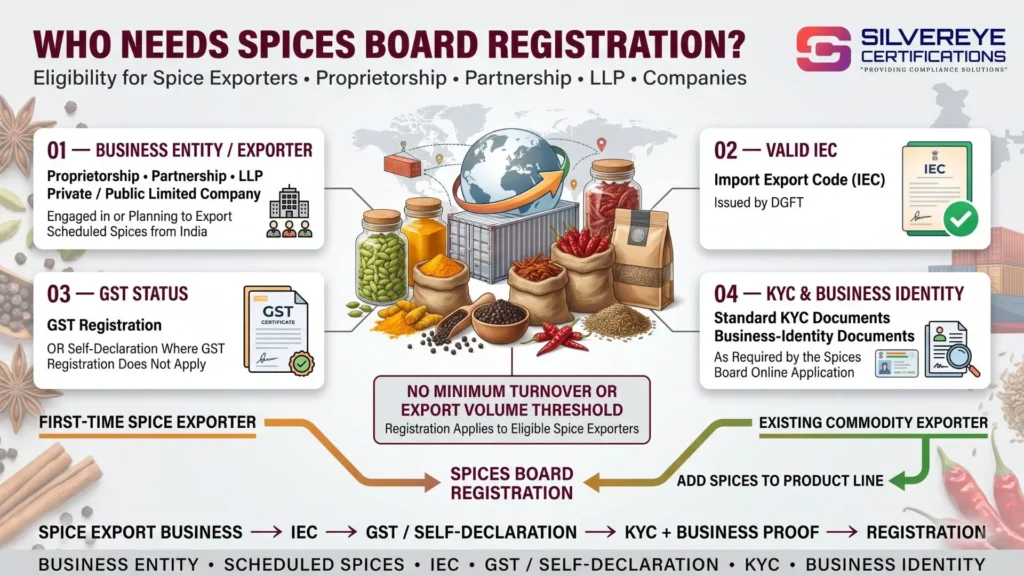
Important: CRES is an exporter registration. A business engaged only in domestic ginger trading does not need CRES solely for domestic sales. However, it must meet other licences and regulatory requirements applicable to its domestic activities.
Can One Business Have Multiple CRES Certificates?
The Spices Board's registration guidance states that only one CRES is issued against a single IEC. If a business operates additional branches under the same IEC, their addresses can be incorporated through the prescribed endorsement or amendment process rather than obtaining separate CRES certificates for each branch.
If the business changes its legal constitution, check the Board's current instructions because a fresh CRES application may be required.
CRES vs RCMC: Does a Ginger Exporter Need Both?
The Certificate of Registration as Exporter of Spices (CRES) is treated as the Registration-cum-Membership Certificate (RCMC) for exporters of spices under the Foreign Trade Policy.
Therefore, a business exporting ginger as a scheduled spice can submit its CRES wherever the relevant RCMC requirement applies. It does not ordinarily need a separate RCMC solely for exporting ginger through another export promotion council.
| Point | CRES | RCMC |
|---|---|---|
| Full form | Certificate of Registration as Exporter of Spices | Registration-cum-Membership Certificate |
| Issuing authority | Spices Board of India | Relevant Export Promotion Council or Commodity Board |
| Purpose | Registration of spice exporters | Recognition of exporters under the applicable Foreign Trade Policy requirements |
| Requirement for ginger exporters | Required for export of ginger as a scheduled spice | CRES is treated as the RCMC for spice exports |
| Application | Through the prescribed Spices Board/DGFT online process | Through the relevant authority's prescribed process |
Benefits of Spices Board Registration for Ginger Exporters
Obtaining CRES is an important compliance step for businesses exporting ginger from India. It provides the required registration under the Spices Board's exporter-registration framework.
Key benefits and practical advantages include:
- Meets the exporter-registration requirement: CRES fulfils the Spices Board registration requirement for exporting scheduled spices and spice products.
- RCMC recognition: CRES is treated as the RCMC for spice exporters under the applicable Foreign Trade Policy framework.
- Access to Board-related services: Registered exporters can use applicable Spices Board services, including online quarterly return filing and pre-shipment sampling facilities.
- Regulatory documentation: It provides an official record of the business's registration as a spice exporter.
- Compliance support: Registration helps businesses follow the Board's prescribed reporting and other applicable exporter obligations.
CRES should not be treated as a guarantee of customs clearance, buyer acceptance or product quality. Exporters must separately meet the applicable testing, documentation, food-safety and importing-country requirements.
Eligibility Requirements for Spice Board Registration for Ginger Exporters
Before applying for CRES, check whether your business meets the basic registration requirements and can provide the prescribed supporting documents.
| Requirement | Details |
|---|---|
| Valid IEC | An Importer Exporter Code issued by DGFT is required for the application. |
| Business constitution proof | Applicable documents such as a partnership deed, Certificate of Incorporation, MOA and AOA or LLP agreement. |
| PAN | PAN details of the applicant or business, as applicable. |
| GST registration | GST certificate or the declaration permitted under the Board's current checklist, where applicable. |
| Bank Report | Bank Report in the prescribed Annex II format. |
| Central FSSAI licence | Required as listed in the current online CRES application checklist. |
| Manufacturer documents | Manufacturer exporters must provide additional documents, including MSME/Udyam registration, valid Consent to Operate and proof of processing-unit premises, as applicable. |
Merchant Exporter vs Manufacturer Exporter
The Spices Board distinguishes between merchant and manufacturer exporters based on their business activities.
- Merchant exporter: Purchases ginger or ginger products from domestic suppliers or manufacturers and exports them to overseas buyers.
- Manufacturer exporter: Produces finished spice products from raw materials or semi-finished goods and exports them.
For example, a trader who purchases ready-to-export ginger powder from a processing unit and exports it may fall under the merchant category. A business that operates its own unit to dry, process or grind ginger into finished products should check the manufacturer category and its additional documentation requirements.
Select the correct category before submitting the application because the document checklist and government registration fee differ between merchant and manufacturer exporters.
Documents Required for Spice Board Registration for Ginger Exporters
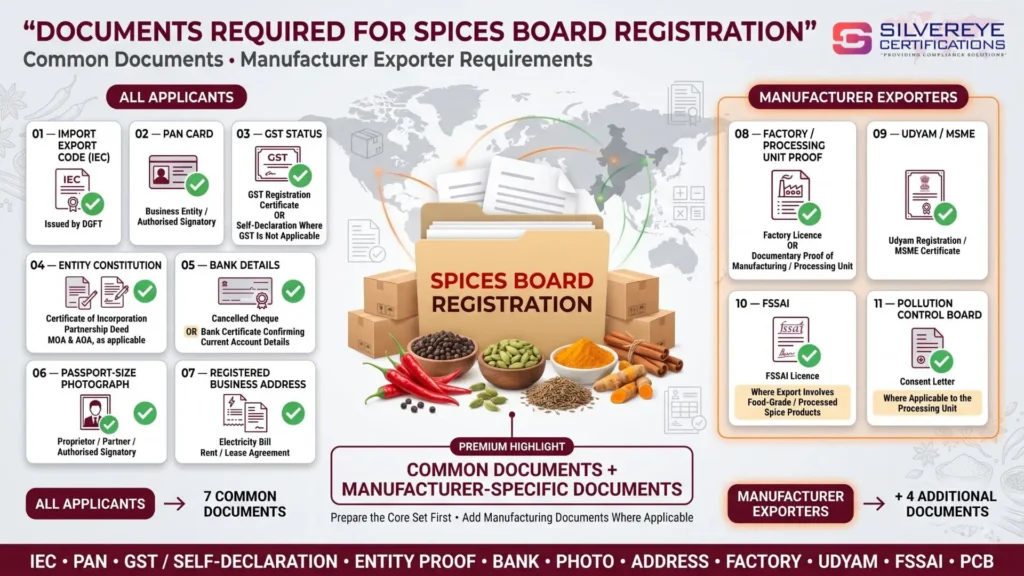
The Spices Board's current online CRES checklist specifies different document requirements for merchant exporters and manufacturer exporters. The documents below provide a practical checklist, but applicants should follow the latest requirements displayed on the DGFT portal when submitting their applications.
| Document | Applies to |
|---|---|
| Importer Exporter Code (IEC) issued by DGFT | All applicants |
| PAN card | All applicants |
| GST registration certificate | All applicants; check the Board's permitted declaration if GST is unavailable |
| Bank Report in Annex II | All applicants |
| Central FSSAI licence | All applicants, as listed in the current CRES checklist |
| Business constitution documents, such as partnership deed, Certificate of Incorporation, MOA and AOA or LLP agreement | As applicable to the business structure |
| List of current directors or partners with contact details | Companies, LLPs and partnership firms, as applicable |
| Authorisation letter | Where an authorised employee submits the application instead of the IEC holder |
| MSME/Udyam registration certificate | Manufacturer exporters |
| Valid Consent to Operate (CTO) issued by the Pollution Control Board | Manufacturer exporters |
| Processing-unit premises proof, such as a valid lease/rent agreement or recent property tax receipt | Manufacturer exporters |
The Board may request additional documents or clarification depending on the applicant's business structure and application details.
Practical tip: Before uploading documents, check that the business name, PAN, IEC details, registered address and bank information are consistent. For manufacturer exporters, also verify that the processing-unit details match the supporting documents.
Step-by-Step Process for Spice Board Registration for Ginger Exporters
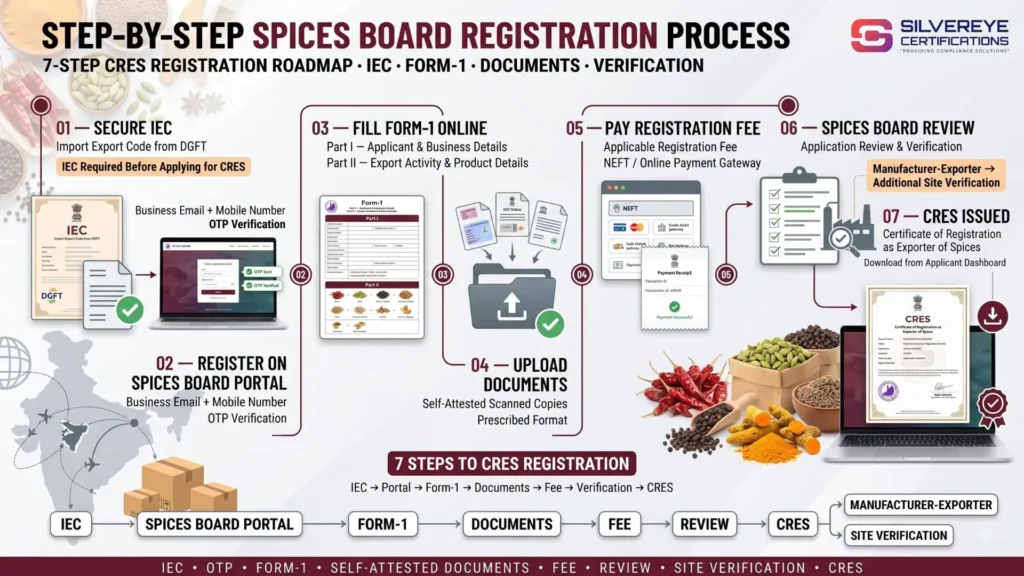
The Spices Board requires CRES applications to be submitted through the DGFT portal using the e-RCMC facility. Follow these steps:
- Obtain an active IEC: Apply for an Importer Exporter Code through DGFT if your business does not already have one.
- Choose your exporter category: Select merchant or manufacturer exporter based on your actual business activity. A business that buys finished ginger products for export may fall under the merchant category, while a business manufacturing or processing ginger products should check the manufacturer requirements.
- Arrange the required documents: Prepare your IEC, PAN, GST certificate, Bank Report in Annex II and Central FSSAI licence. Manufacturer exporters must also arrange the additional documents required for their processing unit.
- Log in to the DGFT portal: Open the e-RCMC application section using your registered DGFT account.
- Select Spices Board: Choose Spices Board (SBCB) as the Export Promotion Council/Commodity Board for the CRES application.
- Complete the application: Enter your business and IEC details, select the correct exporter category and provide the required information about your spice-export activities, including ginger.
- Upload supporting documents: Attach the prescribed documents in the formats accepted by the portal. Review the information before proceeding to payment.
- Pay the government fee: Make the applicable payment through the portal's payment gateway and submit the application.
- Track the application: Monitor the status through your DGFT dashboard or recent activities. If the Board raises a query, provide the requested clarification or documents.
- Download your CRES: Once the application is approved and the registration is completed, download the certificate through DGFT.
- Set up quarterly return filing: After registration, maintain your export records and submit the required Quarterly Export Returns (QERs) through the Spices Board's online system.
Important: The current online procedure does not require applicants to routinely send physical copies of the application within an old 10-day window. Follow the instructions displayed in the current DGFT application and any specific communication from the Spices Board.
Government Fees for Spice Board CRES Registration
The Spices Board's current online fee schedule specifies different charges for merchant and manufacturer exporters.
| Application type | Merchant exporter | Manufacturer exporter |
|---|---|---|
| Fresh CRES registration | ₹11,800 | ₹17,700 |
| CRES renewal | ₹8,850 | ₹11,800 |
The fees include 18% GST:
- Merchant fresh registration: ₹10,000 + ₹1,800 GST = ₹11,800.
- Manufacturer fresh registration: ₹15,000 + ₹2,700 GST = ₹17,700.
- Merchant renewal: ₹7,500 + ₹1,350 GST = ₹8,850.
- Manufacturer renewal: ₹10,000 + ₹1,800 GST = ₹11,800.
These are the CRES government registration charges. They do not include professional consultancy fees or charges for other registrations and licences.
Always check the fee displayed on the DGFT portal before making payment. If you engage a consultant, ask for the government fee and professional service charges to be listed separately.
How Long Does CRES Registration Take?
The processing time depends on the completeness of the application, the exporter category and whether the Spices Board requires clarification or verification.
| Stage | Working estimate or official guidance |
|---|---|
| Document preparation | Depends on how quickly the applicant obtains the bank report and other certificates |
| Online application | Can be completed in a day if all documents are ready |
| Board processing | The Spices Board FAQ states that CRES can be issued within one week after receiving the application and complete documents |
| Additional verification | May extend the processing time, particularly where manufacturer-unit verification is required |
The one-week period is the Board's stated guidance, not a guaranteed approval timeline. Manufacturer applications may require additional checks relating to the processing unit. Applicants should also allow time to respond to any clarification requests.
CRES Validity and Renewal for Ginger Exporters
The Certificate of Registration as Exporter of Spices (CRES) is valid for three years from its date of issue, according to the Spices Board's FAQ.
Ginger exporters should keep the following points in mind:
- Renewal is not automatic: Submit a renewal application through the prescribed DGFT process.
- Apply before expiry: The Board's FAQ states that renewal can be applied for on or before the certificate's expiry date.
- Check current renewal instructions: Follow the latest Spices Board circular and DGFT portal requirements for the applicable renewal period.
- Maintain export records: Keep shipping bills, invoices and shipment details organised to support your export and reporting records.
- Update business details: Address changes and additional branches must be reported through the prescribed amendment process. A change in the legal constitution of the business requires a fresh CRES under the Board's FAQ.
Practical advice: Start preparing your renewal documents well before the expiry date. Ginger exports may be seasonal, so keep track of the certificate's expiry independently of your sourcing and shipment calendar. Do not assume that a period without exports automatically extends the certificate or removes the renewal requirement.
Compliance Requirements After CRES Registration
Obtaining CRES is an important step, but exporters must continue to meet the Spices Board's reporting and other applicable requirements.
- Submit quarterly export returns: All registered exporters must submit their Quarterly Export Returns online through the Spices Board's Export Support System.
- Report address changes: Update the IEC details with DGFT and file the prescribed CRES amendment for changes in registered addresses or additional branches.
- Apply afresh after a change in constitution: If the legal constitution of the business changes, the Board's FAQ states that the existing certificate is deemed expired and a fresh certificate is required.
- Follow applicable sampling and testing requirements: Check the Spices Board's current instructions for pre-shipment sampling, testing and certification applicable to your ginger product and destination.
- Maintain food-safety compliance: Keep the required FSSAI licence and other applicable registrations valid according to your business activity.
- Check importing-country requirements: Confirm the applicable pesticide-residue limits, microbiological requirements, quality standards and other food-safety conditions before shipping.
- Maintain shipment records: Keep invoices, shipping bills, test reports and buyer specifications organised for business and regulatory reference.
Ginger-Specific Export Requirements to Consider
Ginger is exported in several forms, and the handling and quality requirements can differ significantly. Exporters should consider these points when preparing their products and shipments.
1. Fresh Ginger: Handling and Transport
Fresh ginger is a perishable agricultural product. Poor handling, unsuitable packaging or delays during transit can affect its condition and marketability.
Before shipping, exporters should:
- Agree on the required size, maturity, appearance and quality with the overseas buyer.
- Confirm suitable packaging and ventilation requirements.
- Coordinate storage, transit conditions and shipment schedules with the freight partner.
- Check whether applicable phytosanitary certification, APEDA HortiNet procedures or importing-country requirements apply to the consignment.
Do not assume that one storage or transport condition is suitable for every destination. Confirm the buyer's specifications and the applicable shipping requirements before dispatch.
2. Dry Ginger and Ginger Powder: Moisture and Storage
Dry ginger and ginger powder require careful drying, packaging and storage. Excess moisture or unsuitable storage conditions can increase the risk of mould, deterioration and quality rejection.
Exporters should pay attention to:
- Moisture content and suitable drying practices.
- Clean storage conditions that protect the product from moisture and contamination.
- Packaging that protects the product during transportation.
- Testing requirements specified by the buyer or importing country.
The required limits and test parameters depend on the product specification and destination market.
3. Product Specifications and Buyer Requirements
Different buyers may have different requirements for whole dry ginger, ginger slices and ginger powder. Before sourcing or processing the product, obtain the specifications in writing.
Depending on the product, these may cover:
- Size, colour and appearance
- Moisture content
- Fibre and volatile oil content
- Foreign matter
- Pesticide-residue limits
- Microbiological parameters
- Packaging and labelling requirements
Do not rely only on general market specifications. Check the buyer's requirements and the applicable importing-country standards for the specific product.
4. Ginger Products and Exporter Category
Whole fresh ginger, dry ginger, ginger slices, powder, oil and oleoresin involve different sourcing and processing activities.
If your business operates a processing unit, check the Spices Board's manufacturer-exporter requirements before applying. If you purchase finished products from another manufacturer and export them, check whether the merchant category applies to your business model.
Merchant vs Manufacturer Exporter for Ginger
The Spices Board provides separate CRES categories for merchant and manufacturer exporters. The correct category depends on the actual activities carried out by the applicant.
| Factor | Merchant exporter | Manufacturer exporter |
|---|---|---|
| Main activity | Purchases ginger or finished ginger products and exports them | Manufactures or processes ginger products for export |
| Processing unit | Does not operate its own manufacturing unit for the relevant export activity | Operates an eligible processing unit |
| Basic documents | IEC, PAN, GST, Bank Report in Annex II, Central FSSAI and applicable constitution documents | Same basic documents |
| Additional documents | No manufacturer-unit documents under the current checklist | MSME/Udyam certificate, valid Consent to Operate and processing-unit premises proof |
| Fresh CRES fee | ₹11,800, including GST | ₹17,700, including GST |
| Business model | Ginger traders and businesses exporting products sourced from suppliers | Ginger drying, grinding or other processing businesses |
Choose the category based on your actual business activity, not simply the product name. For example, buying ready-made ginger powder from a supplier and exporting it is different from operating a unit that grinds raw ginger into powder. If your activity involves sorting, cleaning, drying, slicing or packaging, confirm the appropriate category with the Spices Board before filing.
Common Mistakes Ginger Exporters Should Avoid
Avoiding documentation and compliance errors can make the CRES application and subsequent export activities easier to manage.
- Applying without an active IEC: CRES is linked to the IEC, so confirm that the code is valid before applying.
- Using inconsistent business details: Differences in the business name, address or other information across the IEC, PAN, GST and bank report can lead to queries.
- Selecting the wrong exporter category: Choose merchant or manufacturer status according to the actual business activity and the Board's requirements.
- Submitting an incomplete bank report: Obtain the Bank Report in the prescribed Annex II format and ensure that it is properly completed by the bank.
- Ignoring manufacturer-specific documents: Manufacturer exporters should arrange their MSME registration, Consent to Operate and processing-unit premises proof as required.
- Relying on outdated fee information: Verify the current merchant or manufacturer registration fee on the official portal rather than using old figures from third-party websites.
- Assuming physical submission is always required: Follow the current DGFT online application instructions instead of relying on older hard-copy submission procedures.
- Overlooking renewal dates: Track the CRES expiry date and submit the renewal application within the permitted period.
- Missing quarterly export returns: Registered exporters must submit the required QERs through the Spices Board's online system.
- Assuming APEDA registration applies to every ginger shipment: Check APEDA's current product scope and HortiNet procedures for fresh ginger instead of relying on unsupported general claims.
- Ignoring product-specific requirements: Confirm moisture, pesticide-residue, quality, packaging and phytosanitary requirements applicable to the product and destination.
- Planning shipments without checking product handling: Fresh ginger and dry ginger require different storage and transportation arrangements. Plan these with the buyer and logistics provider before dispatch.
Why Choose Silvereye Certifications for Spice Board Registration?
Obtaining Spice Board CRES registration for ginger exports involves selecting the correct exporter category, preparing the prescribed documents and completing the online application through the DGFT portal. Errors in business details or missing documents can lead to clarification requests and delays.
Silvereye Certifications provides consultancy and application support to businesses seeking CRES registration for ginger and other scheduled spices.
Here's how we can assist:
- Exporter category guidance: Help you understand whether the merchant or manufacturer exporter category is appropriate for your business activities.
- Document preparation support: Guide you in arranging the IEC, GST certificate, Bank Report in Annex II, Central FSSAI licence and other applicable documents.
- Application assistance: Support you through the online DGFT e-RCMC application process and help review the information before submission.
- Fee transparency: Explain the applicable government registration fee and professional service charges separately.
- Application follow-up: Assist with tracking the application and responding to document-related queries from the concerned authority.
- Ongoing compliance guidance: Help you understand quarterly export returns, CRES renewal, address amendments and other applicable requirements.
- Product-specific guidance: Help you identify additional compliance considerations for fresh ginger, dry ginger and ginger powder exports.
Silvereye Certifications works as a compliance consultancy, providing documentation guidance and application support. The Spices Board of India is the government authority responsible for reviewing applications and issuing CRES. Approval remains subject to the Board's applicable requirements and verification.
Conclusion
Spice Board registration is an essential requirement for businesses exporting ginger from India. Exporters must obtain a valid Importer Exporter Code (IEC) and the Certificate of Registration as Exporter of Spices (CRES) before exporting ginger and its covered products. Selecting the correct exporter category, preparing the prescribed documents and completing the DGFT application accurately are important steps in the process.
Businesses exporting fresh ginger should also check applicable phytosanitary, APEDA HortiNet and destination-market requirements. Those processing dry ginger or ginger powder should review the additional documentation required for manufacturer exporters. After receiving CRES, exporters must maintain their registration, submit quarterly export returns and follow applicable quality and food-safety requirements.
If you are planning to start or expand your ginger export business, Silvereye Certifications can assist with CRES documentation, application support and related export compliance guidance, helping you understand the requirements at each stage of the registration process.
Frequently Asked Questions
Is Spice Board registration compulsory for ginger export?
Yes. Ginger is a scheduled spice, and the Board states CRES is mandatory in addition to the IEC.
Can I export adrak with only an IEC?
No. The IEC allows international trade, but scheduled spices also need CRES.
Does fresh ginger need different registration from dry ginger?
Both are ginger, a scheduled spice. Check with the Board and APEDA whether any additional registration applies to fresh produce in your case.
Do I need a separate RCMC?
The Board says CRES is treated as RCMC for spice exporters, so you submit the CRES where RCMC is required.
How long is CRES valid?
Three years, issued as a block period.
What is the CRES fee?
The Board's FAQ lists ₹5,000 for a fresh application. Confirm the current figure on the portal.
How long does approval take?
The Board's FAQ indicates about a week after complete documents arrive. Manufacturer cases can take longer.
Can I hold more than one CRES?
No. One CRES is issued per IEC, and branches are added by endorsement.
What happens if I miss the renewal deadline?
Your application is treated as fresh, with fresh fees and full documents.
What if I did not export during the block period?
Per the Board's FAQ, the application is treated as fresh, not as a renewal.
Should I register as merchant or manufacturer for dry ginger?
If you process the ginger in your own unit, manufacturer is the usual fit. If you only buy and ship, merchant fits.