
RoHS (Restriction of Hazardous Substances) limits the use of 10 restricted substances in electrical and electronic equipment. These include lead, mercury, cadmium, hexavalent chromium, PBB, PBDE and four phthalates.
- Indian regulatory requirement: In India, restrictions on hazardous substances in electrical and electronic equipment are governed by the E-Waste (Management) Rules, 2022, as amended. Producers must meet the applicable substance limits and maintain supporting compliance records.
- Delhi and NCR businesses: Manufacturers, importers and exporters may need RoHS test reports or other compliance evidence to meet buyer specifications, tender conditions and export-market requirements. Products entering the European Union must also meet the applicable EU RoHS requirements.
- Typical compliance process: The process generally involves reviewing the product and its components, identifying applicable substance restrictions, arranging sample testing where required, obtaining test reports, preparing the necessary declarations and maintaining supporting records.
Introduction
RoHS certification is an important requirement for businesses involved in manufacturing, importing or exporting electrical and electronic products. It restricts the use of 10 hazardous substances, including lead, mercury, cadmium and four phthalates, to protect human health and the environment. In India, these restrictions are covered under the E-Waste (Management) Rules, 2022, as amended.
For businesses in Delhi and NCR, understanding RoHS requirements helps meet applicable Indian regulations, buyer specifications, tender conditions and export-market requirements, particularly for products supplied to the European Union. This guide explains the key RoHS limits, testing requirements, compliance process and documentation businesses should understand before placing products on the market.
What Is RoHS Certification in Delhi?
RoHS stands for Restriction of Hazardous Substances. It refers to requirements that restrict certain hazardous materials in electrical and electronic equipment (EEE). Businesses often use the term RoHS certification to describe the process of testing products, reviewing material composition and preparing documents to demonstrate compliance.
In India, there is no single government-issued RoHS certificate equivalent to a BIS licence. Instead, compliance with the applicable requirements under the E-Waste (Management) Rules, 2022, as amended, is supported by technical records, test reports and a declaration of conformity. Testing may be arranged through a competent laboratory, with NABL accreditation considered when required by a buyer, tender or applicable specification.
For manufacturers, producers and importers in Delhi and NCR, the relevant requirements depend on the product category, its components and the market where it will be sold. Businesses exporting to the European Union must separately assess the EU RoHS requirements, which cover ten restricted substances.
What Is RoHS and Why Does It Matter?
RoHS means Restriction of Hazardous Substances. The regulation originated in the European Union through Directive 2002/95/EC and was recast as Directive 2011/65/EU, commonly known as RoHS 2. It restricts the use of specified hazardous substances in electrical and electronic equipment to reduce risks to human health and the environment.
These substances may be present in circuit boards, solder, cables, plastic housings, coatings and other product components. Restricting their use helps reduce hazardous material in electronic products and supports safer waste management and recycling.
For a business in Delhi, RoHS certification matters for three main reasons:
- Indian regulatory compliance: The E-Waste (Management) Rules, 2022 restrict six hazardous substances in specified electrical and electronic equipment covered by the rules.
- Buyer and tender requirements: OEMs, distributors, institutional buyers and government procurement authorities may ask for RoHS test reports or declarations as part of their supplier qualification or tender conditions.
- Export market access: Businesses placing electrical and electronic equipment on the EU market must assess compliance with Directive 2011/65/EU and its amendments. RoHS conformity is part of the applicable EU product conformity and CE-marking requirements.
Is RoHS Certification Mandatory in India?
Yes, the hazardous-substance restrictions are mandatory for electrical and electronic equipment covered by the Indian rules, subject to the specified exemptions and conditions.
The E-Waste (Management) Rules, 2022 replaced the E-Waste (Management) Rules, 2016 and came into force on 1 April 2023. Rule 16 requires producers of electrical and electronic equipment, including applicable components, consumables, parts and spares listed in Schedule I, to ensure that new equipment does not exceed the prescribed concentration limits for the six restricted substances.
The rules also require producers to provide information about product constituents and a declaration of conformity in product user documentation, as and when required by the Central Pollution Control Board (CPCB). Imports and placement on the Indian market are also subject to the applicable restrictions.
One important distinction is that India does not issue a separate, universal government RoHS certificate. Businesses generally demonstrate compliance through appropriate technical documentation, test reports and declarations. A laboratory report is supporting evidence; it does not replace the producer's legal responsibility to comply with the rules.
Before assessing a product, businesses should check whether it falls under Schedule I, whether an exemption applies and whether any subsequent amendment affects its category.
Which Substances Are Restricted Under RoHS Certification?
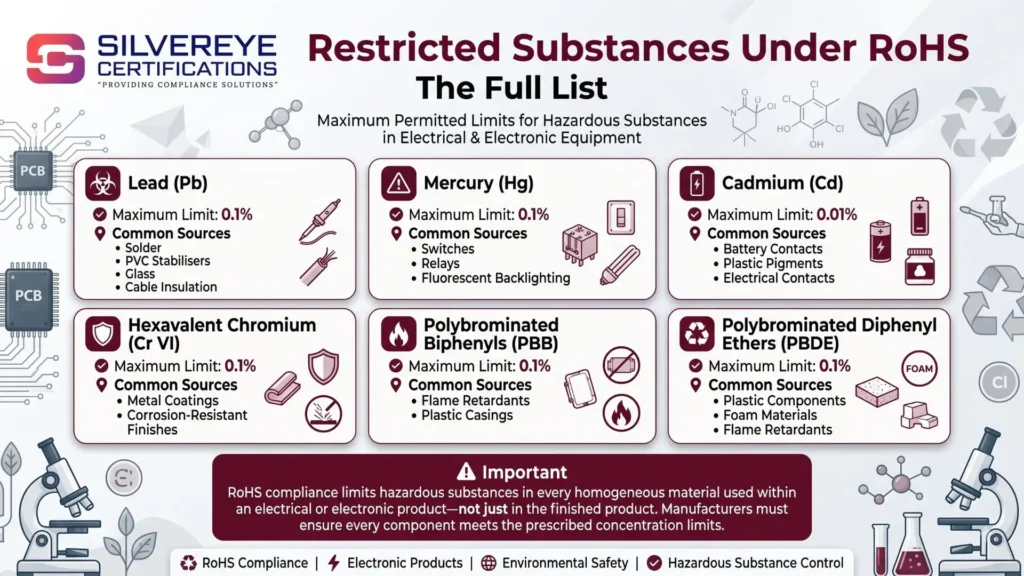
The substance list depends on the market. The EU RoHS Directive restricts ten substances, while India's E-Waste (Management) Rules, 2022 specify six substances under Rule 16. The four phthalates are included in the EU list but are not part of India's general six-substance restriction under Rule 16.
EU RoHS: Ten restricted substances
| Substance | Maximum limit by weight in homogeneous material |
|---|---|
| Lead (Pb) | 0.1% |
| Mercury (Hg) | 0.1% |
| Cadmium (Cd) | 0.01% |
| Hexavalent Chromium (Cr VI) | 0.1% |
| Polybrominated Biphenyls (PBB) | 0.1% |
| Polybrominated Diphenyl Ethers (PBDE) | 0.1% |
| Bis(2-ethylhexyl) phthalate (DEHP) | 0.1% |
| Butyl Benzyl Phthalate (BBP) | 0.1% |
| Dibutyl Phthalate (DBP) | 0.1% |
| Diisobutyl Phthalate (DIBP) | 0.1% |
India: Six substances covered by Rule 16
| Substance | Maximum limit by weight in homogeneous material |
|---|---|
| Lead (Pb) | 0.1% |
| Mercury (Hg) | 0.1% |
| Cadmium (Cd) | 0.01% |
| Hexavalent Chromium (Cr VI) | 0.1% |
| Polybrominated Biphenyls (PBB) | 0.1% |
| Polybrominated Diphenyl Ethers (PBDE) | 0.1% |
Note: These limits apply to each homogeneous material, not to the average weight of the complete product. A homogeneous material is a material that cannot be separated into different materials through mechanical actions such as cutting, unscrewing, crushing or grinding. For example, the plastic insulation around a cable and the solder in a circuit-board joint are assessed as separate materials.
Certain applications and components may qualify for specific exemptions or different limits under the applicable rules. Businesses should therefore check the relevant schedules and amendments rather than relying only on the general limits shown above.
Who Needs RoHS Certification Documentation in Delhi?
Businesses involved in manufacturing, importing, assembling or exporting electrical and electronic equipment may need RoHS certification documentation, depending on the product and the market in which it is sold.
Delhi and the wider NCR region have a broad electronics supply chain, including component traders, distributors, manufacturers and OEM suppliers. Businesses operating in areas such as Nehru Place, Lajpat Rai Market, Okhla, Mayapuri, Wazirpur and Bawana may encounter RoHS requirements through Indian regulations, buyer specifications or export conditions.
The following businesses commonly need RoHS testing or supporting documentation:
- Electronics manufacturers: Companies manufacturing consumer electronics, LED lighting, power supplies, chargers, adapters and other electrical or electronic equipment.
- Importers and own-brand sellers: Businesses importing covered electronic products or placing them on the Indian market under their own brand.
- Exporters: Manufacturers and suppliers exporting electrical and electronic products to the EU or other markets where buyers require RoHS evidence.
- Contract manufacturers and OEM suppliers: Businesses manufacturing components or finished products for larger brands that specify restricted-substance requirements.
- IT and telecom equipment suppliers: Businesses dealing in computers, communication equipment, networking products and related electronic devices.
- Appliance and equipment manufacturers: Companies making household appliances, electronic tools, monitoring equipment and other products covered by the applicable rules.
- Hardware startups: New businesses developing electronic products that need to establish material compliance before approaching distributors, OEMs or international buyers.
Important: Not every trader, retailer or distributor automatically has the same legal obligations as a producer under India's E-Waste Rules. Responsibilities depend on the business's role, the product category and whether it meets the relevant legal definition. Certain products and applications may also qualify for exemptions. Check the applicable rules before deciding whether a product needs RoHS certification evidence.
Benefits of RoHS Certification
RoHS certification can help businesses demonstrate control over hazardous substances in their electrical and electronic products. It also supports supplier qualification and market access where restricted-substance requirements apply.
- Buyer and tender readiness: RoHS test reports and declarations can help meet technical specifications set by OEMs, institutional buyers and procurement teams.
- Export preparation: Businesses supplying products to the European Union need to assess the applicable EU RoHS requirements as part of their product conformity obligations.
- Regulatory risk management: Maintaining test reports, material declarations and supplier records helps demonstrate how the business assesses and controls restricted substances.
- Greater buyer confidence: Documented material compliance can strengthen trust among distributors, customers and business partners.
- Better supplier control: Reviewing bills of materials and supplier declarations helps identify components that may contain restricted substances.
- Early identification of non-compliant materials: Testing during product development or before shipment can help identify problems before they lead to rejection, rework or costly product changes.
RoHS documentation does not guarantee tender selection, export clearance or exemption from other applicable product regulations. It is one part of a wider product compliance process.
Eligibility for RoHS Testing and Compliance Documentation
RoHS is not a single Indian government licence with a universal eligibility process. Businesses can approach a competent testing laboratory or compliance service provider to assess their products and prepare supporting documentation.
The information generally required includes:
- Business details: Name, address and legal identity of the manufacturer, importer or applicant.
- Product information: Product category, model number, brand, technical specifications and photographs.
- Bill of Materials (BOM): Details of components and materials used in the product.
- Supplier information: Material declarations, datasheets or other supporting information from component suppliers, where available.
- Product samples: Samples in the quantity and condition specified by the testing laboratory.
- Market information: Whether the product is intended for sale in India, the EU or another export market.
GST registration, import records and other business documents may be relevant depending on the applicant's business activity and the purpose of the compliance assessment. They should not be treated as universal prerequisites for RoHS laboratory testing.
Separate EPR requirement: Producers of electrical and electronic equipment covered by India's E-Waste (Management) Rules, 2022 may also need to fulfil applicable Extended Producer Responsibility (EPR) registration and compliance obligations through CPCB. EPR registration and RoHS substance compliance are separate requirements; completing one does not automatically fulfil the other.
Documents Required for RoHS Testing and Compliance
The documents required depend on the product, the applicable market requirements and the testing laboratory's assessment. Preparing the following information in advance can help define the testing scope and reduce avoidable delays.
| Document or information | Why it may be required |
|---|---|
| Business registration details | Identifies the manufacturer, importer or applicant |
| GST certificate, where applicable | Supports business and tax identification |
| Product list with model numbers and photographs | Defines the products and models being assessed |
| Bill of Materials (BOM) | Identifies components and materials for assessment |
| Supplier declarations or material datasheets | Provides information about substances used in components |
| Product datasheet and technical specifications | Helps understand product construction and intended use |
| Circuit, assembly or component details, where relevant | Helps identify suitable sampling points |
| Product samples | Enables laboratory testing, where required |
| Previous test reports, if available | Provides existing technical evidence for review |
| Import documents, where relevant | Helps establish product and manufacturer details for imported goods |
| Authorisation letter, where applicable | Confirms permission for a representative or consultant to coordinate the process |
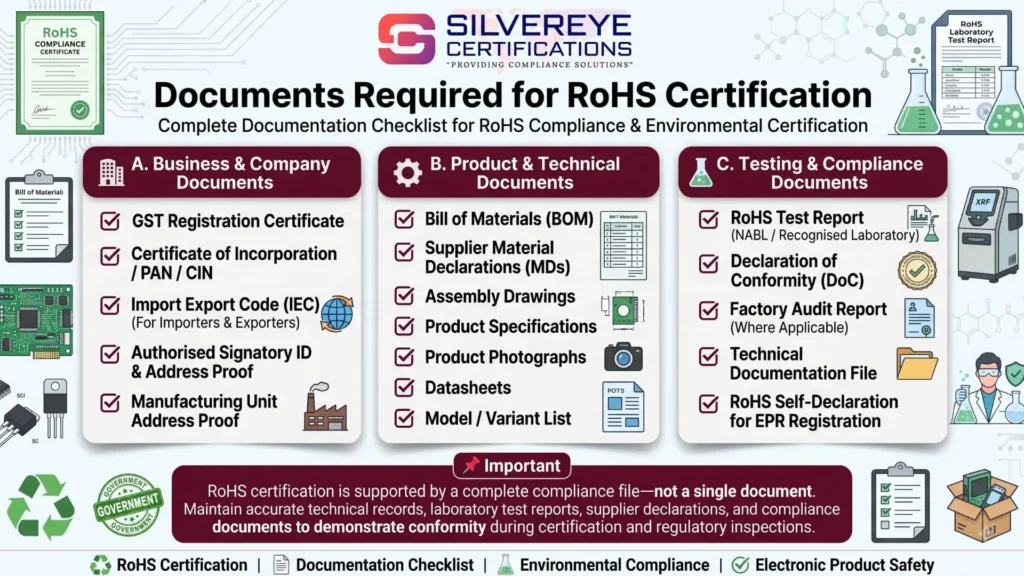
The laboratory or compliance provider may request additional information after reviewing the product. Previous test reports should not be assumed to replace fresh testing; their acceptance depends on factors such as product identity, model variation, test scope, methods and buyer or regulatory requirements.
RoHS Certification Process in Delhi: Step-by-Step
The RoHS certification process depends on whether the product is being assessed under India's E-Waste (Management) Rules, 2022, the EU RoHS Directive or both. The following steps provide a practical approach for businesses preparing compliance evidence.
- Check product scope: Identify the product category and confirm whether it falls under India's E-Waste Rules, EU RoHS or both. Review applicable exemptions before starting the assessment.
- Review product materials: Prepare the Bill of Materials (BOM) and collect material declarations, datasheets and other available information from suppliers. Pay particular attention to solder, plastics, cables, coatings and other components that may contain restricted substances.
- Identify samples and components: Determine which product models and individual materials need assessment. Similar models may sometimes share components, but grouping should be justified by their material composition and construction. Do not assume one sample represents an entire product range.
- Arrange laboratory testing, where required: Submit representative samples to a competent laboratory. For EU-oriented assessments, laboratories commonly use relevant methods from the IEC 62321 series. For Indian regulatory compliance, check the sampling and analysis methods and laboratory requirements specified by CPCB.
- Review the test results: Check the results against the limits applicable to the target market. If a substance exceeds the permitted limit, identify the affected component and investigate its material source.
- Take corrective action: Replace or modify the non-compliant material or component, obtain updated supplier information and arrange repeat testing where necessary.
- Prepare compliance documentation: Organise test reports, BOMs, supplier declarations and product details. Prepare the required self-declaration and other conformity documents applicable to the product and destination market.
- Maintain compliance records: Keep technical documents, test evidence, supplier information and declarations organised. These records may be requested by buyers or relevant authorities.
- Monitor product changes: Review compliance whenever you change a supplier, material, component, manufacturing process or product design. Reassessment or retesting may be necessary.
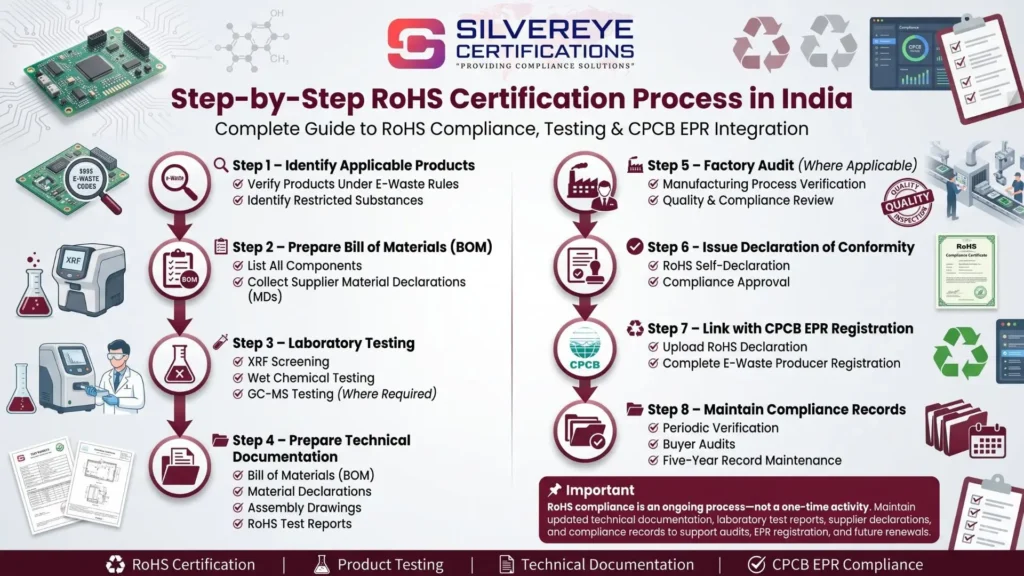
Important: Under India's Rule 16, producers of covered equipment must ensure compliance with the specified substance limits and provide information through self-declaration. CPCB also has provisions for random sampling and testing. A private laboratory report supports the assessment but does not replace the producer's legal responsibility.
How Does RoHS Testing Work?
RoHS testing involves examining materials used in electrical and electronic products to determine whether restricted substances exceed the applicable limits.
Laboratories may use different analytical techniques depending on the substance and material being examined.
- X-ray fluorescence (XRF) screening: XRF is commonly used for initial screening of certain elements, including lead, mercury, cadmium and chromium. It can help identify materials that need further investigation.
- Confirmatory chemical analysis: Where screening results are inconclusive or more precise measurement is needed, laboratories may use additional analytical methods.
- Phthalate testing: For EU RoHS assessments, phthalates such as DEHP, BBP, DBP and DIBP are generally analysed using suitable chemical techniques, including chromatographic methods.
- Hexavalent chromium analysis: Specific methods are used to distinguish and assess hexavalent chromium in relevant materials.
- Brominated flame-retardant analysis: Suitable methods are used to assess PBB and PBDE in materials such as plastics.
The IEC 62321 series provides recognised methods for determining certain regulated substances in electrotechnical products. However, the exact method depends on the substance, material, applicable requirement and testing scope.
Businesses should provide accurate product information and representative samples. Testing the wrong component or relying on an incomplete sample can produce results that do not adequately represent the finished product.
How Long Does RoHS Testing and Documentation Take?
There is no single statutory processing timeline for obtaining a general RoHS certificate in India because the rules do not establish a universal certificate-issuance procedure. The time required for testing and documentation depends on the product, number of components, sample availability and laboratory workload.
The following table gives indicative planning estimates, not guaranteed turnaround times:
| Activity | Indicative planning time |
|---|---|
| Product scope review and document collection | 2–5 working days |
| Sample preparation and dispatch | 1–3 working days |
| Laboratory testing and report preparation | Around 5–10 working days for suitable standard testing scopes |
| Technical documentation and declaration preparation | 2–4 working days |
| Corrective action and retesting | Depends on the component change and laboratory schedule |
Products with multiple models, complex assemblies or numerous homogeneous materials may require additional time. Confirm the laboratory's actual turnaround time and testing scope before placing an order.
RoHS Testing Cost in Delhi: What Determines the Fee?
There is no universal RoHS testing fee for every electrical or electronic product. Laboratories and compliance providers generally calculate costs according to the testing scope, sample requirements and documentation involved.
The main cost factors include:
- Number of products and models: Testing several models may increase the number of samples and assessments required.
- Number of materials and components: Products containing multiple plastics, cables, coatings and electronic components may require a broader testing scope.
- Applicable substance list: Testing for India's six restricted substances and testing for all ten EU RoHS substances are different scopes.
- Product complexity: A simple charger may require a different assessment from a complex device with multiple circuit boards and components.
- Testing methods: Screening and confirmatory chemical analysis may involve different laboratory charges.
- Retesting requirements: If a component fails, replacement and repeat testing can increase the total cost.
- Documentation support: BOM review, supplier declaration assessment and technical file preparation may involve separate consultancy charges.
- Urgent testing: Express laboratory services, where available, may cost more.
Before proceeding, request an itemised quotation that clearly separates laboratory testing charges, sample preparation costs and consultancy or documentation fees.
Be cautious of providers promising a guaranteed RoHS certificate without reviewing the product or arranging appropriate testing. A document without reliable supporting evidence may not satisfy regulatory, buyer or export requirements.
RoHS Report Validity and Re-Testing Requirements
A laboratory RoHS test report does not have one universal statutory expiry date applicable to every product and market. Its continuing relevance depends on whether it accurately represents the product being supplied and whether the buyer or applicable regulatory framework accepts it.
Businesses should consider the following points:
- Product or material changes: A change in supplier, component, material, solder, coating or product design may require a fresh assessment or retesting.
- Regulatory updates: Review changes to substance restrictions, product scope, exemptions and applicable testing requirements.
- Buyer requirements: Some buyers and tenders specify that reports must have been issued within a particular period. A one- or two-year requirement, where specified, is a buyer condition rather than a universal RoHS statutory validity period.
- EU technical documentation: Under Article 7 of Directive 2011/65/EU, manufacturers must retain the technical documentation and EU Declaration of Conformity for 10 years after the electrical or electronic equipment is placed on the EU market.
- Indian compliance records: Maintain the self-declarations and supporting evidence needed to demonstrate compliance with the applicable Indian rules. Do not assume that the EU's ten-year retention requirement automatically applies to every Indian RoHS record.
It is therefore more accurate to treat RoHS compliance as an ongoing product and material-control responsibility rather than a certificate that simply expires after a fixed period.
Common Reasons Products Fail RoHS Testing
A product may fail RoHS testing when a restricted substance exceeds the applicable concentration limit in a homogeneous material. Common sources include:
- Lead: May be present in solder, certain brass components and cable materials.
- Cadmium: May occur in certain pigments, coatings and plating materials.
- Hexavalent chromium: May be associated with certain metal surface treatments and corrosion-protection coatings.
- PBB and PBDE: May be found in certain brominated flame-retardant materials used in plastics.
- Restricted phthalates: DEHP, BBP, DBP and DIBP may occur in soft PVC, cable insulation and plasticised components. These four substances are relevant to the EU RoHS ten-substance assessment.
- Unverified components: Components purchased from suppliers without adequate material information can create compliance risks.
- Incomplete supplier records: Missing declarations and material traceability make it harder to demonstrate that the product meets the applicable limits.
When a product fails, the investigation should identify the specific non-compliant material or component. Corrective action may involve changing the supplier, replacing the material, modifying the component or updating the manufacturing process.
Supplier control is just as important as laboratory testing. A reliable BOM, updated supplier declarations and checks whenever materials change can help businesses prevent repeat compliance problems.
Why Choose Silvereye Certifications for RoHS Certification Support in Delhi?
RoHS compliance involves more than sending a product sample to a laboratory. Businesses must understand the applicable substance restrictions, identify the materials used in their products and maintain appropriate supporting documents. Silvereye Certifications (SEYECS) provides compliance guidance and documentation support to manufacturers, importers, exporters and electronics businesses in Delhi and NCR.
Here's how Silvereye Certifications can assist:
- Product scope assessment: Guidance on identifying applicable Indian and EU RoHS requirements based on the product category and target market.
- Documentation assistance: Support with organising product details, Bills of Materials (BOMs), supplier declarations and technical documents.
- Testing coordination: Assistance in understanding the testing scope and coordinating with suitable laboratories for the required analysis.
- Compliance report review: Guidance on understanding laboratory reports and identifying documentation gaps that may need attention.
- Declaration support: Assistance with preparing relevant compliance declarations and organising supporting evidence.
- Ongoing compliance guidance: Support when changes in materials, suppliers or product designs require a fresh compliance assessment.
Silvereye Certifications works as an independent compliance consultancy. Laboratories conduct testing, while the relevant authorities remain responsible for regulatory oversight. Silvereye provides guidance and application or documentation support; it does not issue government RoHS certificates or guarantee regulatory acceptance.
Conclusion
RoHS compliance is an important consideration for electrical and electronic product manufacturers, importers and exporters in Delhi. India's E-Waste (Management) Rules, 2022 restrict six hazardous substances in covered equipment, while the EU RoHS Directive covers ten substances, including four additional phthalates. Businesses should identify the rules applicable to their products, review material composition, arrange appropriate testing where required and maintain reliable compliance records.
A well-organised compliance process can help businesses address regulatory responsibilities, meet buyer specifications and prepare products for international markets. Silvereye Certifications can assist with product assessment, documentation, testing coordination and compliance guidance, helping businesses understand the requirements before placing their products on the market.
Frequently Asked Questions
Is RoHS certification mandatory in Delhi?
RoHS compliance applies across India, including Delhi, for electrical and electronic equipment covered by the E-Waste (Management) Rules. Whether your specific product is in scope depends on its category, so review the current schedule or ask a consultant.
Does India issue an official RoHS certificate?
Not as a stand-alone government certificate. Compliance is shown through test reports from a competent laboratory, a technical file and a declaration of conformity.
How do I get RoHS certification in Delhi?
Review your product scope, prepare the BOM and supplier declarations, send samples to an accredited lab, review the report, fix any failures and compile your declaration and records.
How long does RoHS testing take?
Standard products often take around one to two weeks at the lab, with extra days for preparation and documentation. Complex products or retests take longer.
What is the cost of RoHS certification in Delhi?
There is no single price. It depends on the number of models, materials and substances tested, plus any consultancy support. Ask for an itemized quote.
Which documents are needed for RoHS certification?
Business and GST proof, product list, BOM, supplier declarations, datasheets, samples and, for importers, import records.
How long is a RoHS report valid?
There is no fixed legal expiry. The report stays useful as long as the product, materials and suppliers do not change, though many buyers prefer recent reports.
Do importers need RoHS compliance?
Yes. Importers who place covered products on the Indian market are generally treated as producers and should hold compliance evidence from the overseas maker or get the product tested.
What is the difference between RoHS and BIS?
RoHS restricts hazardous substances. BIS registration deals with product safety and quality for notified products. Some products need both.
What happens if my product fails the test?
Identify the failing part, replace it or change the material, and retest. Do not ship or sell the product until it passes.
Can one test report cover multiple products?
Sometimes. If models share the same materials and construction, labs may allow grouping. The lab decides based on your documentation.
Is RoHS needed for exports to the EU?
Yes. RoHS compliance supports the CE marking process for in-scope products sold in the EU.