
- Walks through the actual online application journey — account creation, document upload, fee payment, and tracking — not just a list of requirements.
- Clarifies which states run fully online PSARA portals and which still require offline document submission or fee payment.
- Flags the upload-stage mistakes that most commonly delay an online PSARA application.
- Covers the May 2026 amendment that removed criminal liability under Sections 12 and 20(2) of the PSARA Act.
Introduction
PSARA license online registration is the process of applying for a Private Security Agencies (Regulation) Act, 2005 license through your state's official PSARA portal instead of filing entirely on paper. In most states, this means creating an account on the state Controlling Authority's portal, filling out Form-I with entity and director details, uploading scanned incorporation, identity, address, and training-institute MoU documents, and paying the government fee through an online payment gateway.
The fee itself still follows each state's own structure — commonly ₹5,000, ₹10,000, or ₹25,000 depending on whether the license covers a single district, up to five districts, or the whole state. Not every state has moved fully online: several, including Tamil Nadu, still rely on offline document submission and fee payment via demand draft or bank challan even where parts of the process are digital. A May 2026 MHA amendment also removed criminal liability for certain procedural lapses under Sections 12 and 20(2) of the Act, though the online application requirements themselves are unaffected.
What Does PSARA License Online Registration?
PSARA licensing has always been governed by the same central law — the Private Security Agencies (Regulation) Act, 2005 — but how you actually file the application depends entirely on your state. "Online registration" refers to states that have digitized some or all of this filing: creating an applicant account, submitting Form-I electronically, uploading scanned supporting documents, and in many cases paying the government fee through an online gateway rather than a physical demand draft.
It's worth being precise here, because the phrase can be misleading: even in states with an online portal, certain steps — particularly police antecedent verification — still happen offline, through the jurisdictional police station. "Online registration" speeds up document submission and tracking; it doesn't replace the underlying verification and review process.
Who Should Use the Online PSARA Registration Route?
Any proprietorship, partnership, LLP, or company applying for a PSARA license in a state that offers a digital portal can typically use it — there's rarely a reason not to, since it usually offers faster document handling and easier status tracking than a purely offline filing. This applies whether you're:
- A first-time applicant setting up a new private security agency and choosing how to file
- An agency expanding into a new state and comparing that state's process against one you've already been through elsewhere
- A consultant or in-house compliance team managing PSARA filings across multiple states with different portal setups
- An agency renewing a license in a state where the original application was filed on paper but renewal is now supported online
The one group that needs to plan differently is anyone applying in a state where the process remains largely offline — Tamil Nadu being a notable example — where budgeting extra time for physical document handling and bank-instrument payments is still the realistic expectation.
Benefits of Applying for a PSARA License Online
- Faster document submission — no need to physically deliver files to a district office or PSARA Cell in states with a working online portal.
- Easier application tracking, since most portals show status updates rather than requiring a phone call or in-person visit to check progress.
- Reduced risk of paperwork getting lost or damaged in transit, compared with physical submission.
- Digital record-keeping of what was submitted and when, which is useful if a query comes back from the Controlling Authority.
- In many states, online fee payment removes the need to physically visit a bank for a demand draft or challan.
Eligibility for PSARA License Online Registration
The eligibility criteria for an online application are identical to an offline one — going digital doesn't relax any requirement under the Act. This includes:
For the Agency
- Must be incorporated or registered in India — proprietorship, partnership, LLP, OPC, or company — with a registered office address in the state of application.
- The agency's name must include "Security Agency" or "Security Services" and must not imply government backing.
- Must have (or be arranging) an MoU with a training institute recognized by that state's Controlling Authority.
For Directors, Partners, and the Principal Officer
- Must be Indian citizens, generally between 18 and 65 years of age.
- Must be able to clear police antecedent verification, with no conviction involving moral turpitude.
- Must not have been dismissed from government service for misconduct.
For Guards and Supervisors
- Must meet the age, residency, and character requirements prescribed under the Act.
- Must complete the training prescribed under Section 9 before deployment, regardless of how the agency's license application was filed.
Documents to Prepare Before Starting the Online Application
| Category | What to Have Scanned and Ready |
| Entity Documents | Certificate of incorporation or partnership deed, PAN, GST registration, MoA/AoA for companies — clear, legible PDF scans |
| Office Proof | Lease agreement or ownership papers, a recent utility bill, and a landlord NOC if the premises is rented |
| Director / Principal Officer | Aadhaar, PAN, passport, or voter ID as identity proof; recent passport-size photographs; address proof |
| Affidavits | Affidavit of non-conviction and any other affidavit format your state's portal requires, typically notarised before scanning |
| Training Tie-Up | Signed MoU with a training institute recognised by your state — check the approved-institute list published on the portal before finalising this |
| Agency Branding | Photographs or details of the agency's uniform pattern and logo, where the state's application form asks for this |
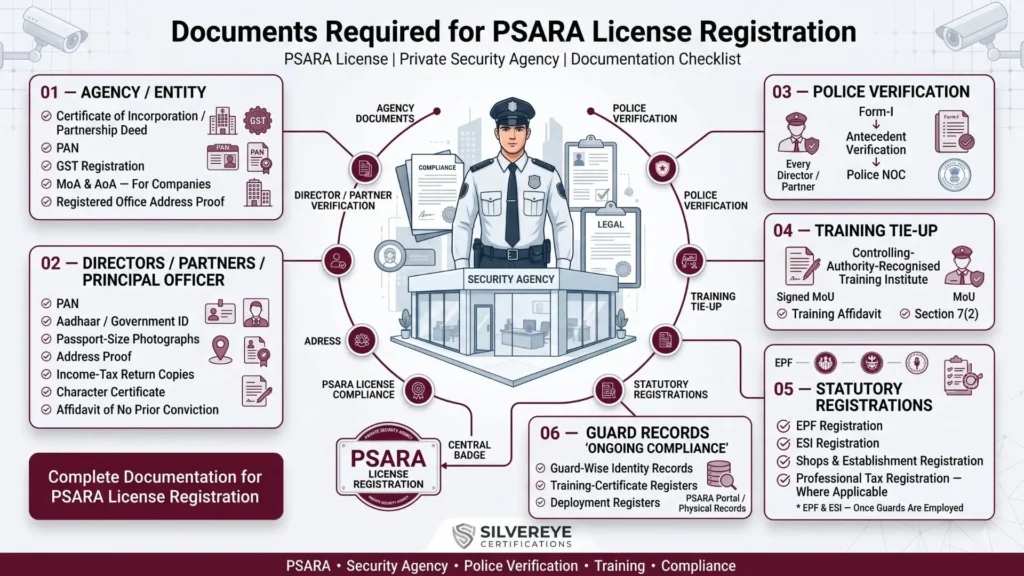
Scanning everything in advance — rather than mid-application — is the single biggest time-saver. Most portals expect PDF format within a defined file-size limit, and having to stop and re-scan a document partway through an online session is a common, avoidable source of frustration.
Step-by-Step: How to Apply for a PSARA License Online
- Confirm your state has a working online PSARA portal, and identify the correct one — search should lead you to your state Home Department's or Controlling Authority's official page, not a third-party consultant site.
- Create an applicant account on the portal using your agency's registered email and basic entity details.
- Log in and select the correct application type — fresh registration, not renewal — and choose your geographic coverage carefully, since single-district, five-district, and whole-state selections determine your fee slab and generally can't be changed after submission without a fresh filing.
- Fill out Form-I with entity, director, and Principal Officer details exactly as they appear on your supporting documents — mismatches between the form and the uploaded documents are a common cause of query-backs.
- Upload all scanned documents in the required format, double-checking each file opens correctly and is legible before submitting.
- Pay the government fee through the portal's payment gateway where available, or follow the offline instructions (demand draft/challan) if your state hasn't digitized this step.
- Submit the application and note your application/reference number for tracking.
- Respond promptly to any status updates or document queries shown on the portal — delayed responses are one of the most common reasons online applications stall.
- Once police verification (handled offline by the local station) and document review are both complete, the Controlling Authority grants the license, typically downloadable or dispatched per your state's process.
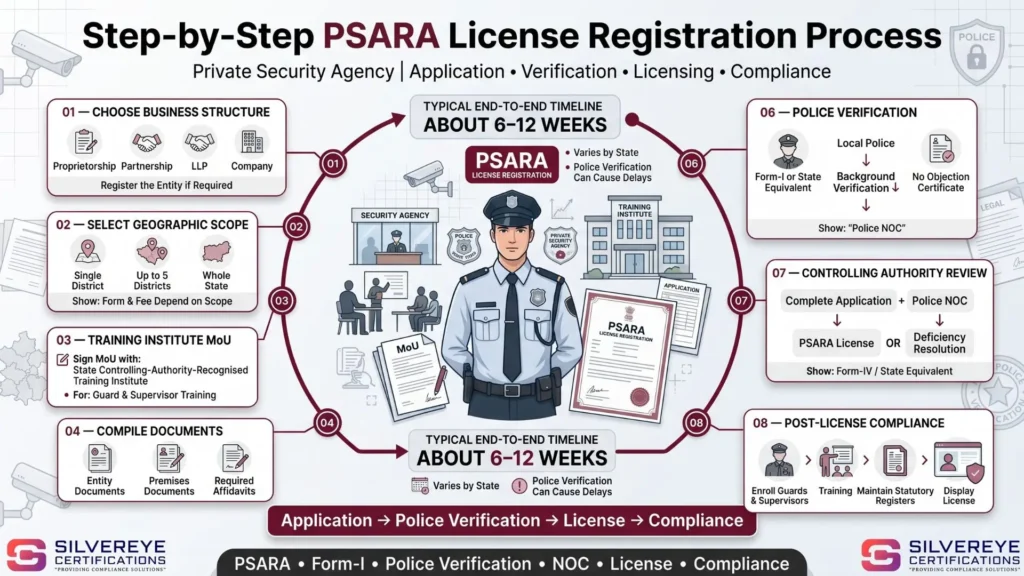
Even with a fully online front end, expect the overall timeline to be shaped mainly by police verification speed — the digital portal speeds up submission and tracking, not the background-check stage itself.
Which States Have Online PSARA Portals — and Which Don't
This is one of the most practically useful things to check before you start, since assuming your state works like a neighbouring one is a common planning mistake. Based on state-specific guidance:
| State | Online Registration Status |
| Maharashtra | Largely online via the state's official psara.gov.in portal, including application filing and, in many cases, fee payment |
| Karnataka | Partially online — application and payment can go through a digital portal, though some guidance still references offline demand draft/challan payment |
| Tamil Nadu | Largely offline — physical document submission and fee payment via demand draft, banker's cheque, or cash challan remain the norm |
| Uttar Pradesh, Delhi, Gujarat, Rajasthan | Application filing is generally supported through state portals, but confirm current fee-payment mode (online gateway vs. DD/challan) directly with the Controlling Authority, since this can change |
The safest approach for any state is to check the Controlling Authority's current process directly before assuming a fully digital or fully offline workflow — several states have been actively digitizing their PSARA process, so guidance even a year old can be out of date.
PSARA License Fees for Online Applications
The government fee doesn't change based on whether you apply online or offline — it's determined by your state and the geographic scope of the license, not the filing channel. Most states follow the same district-tiered model used under the Act's framework.
| License Scope | Government Fee (indicative)* |
| Single district | ₹5,000 |
| Up to five districts | ₹10,000 |
| Entire state | ₹25,000 |
These figures reflect the fee structure commonly cited across multiple states and are exclusive of training-institute charges, GST where applicable, and any consultant fees. There is no single national fee schedule — always check your specific state's portal or Controlling Authority for the exact current amount, since a small number of states (Karnataka, notably) have reported different or additional fee structures.
Validity After Online Registration
A PSARA license obtained through online registration carries the same five-year validity as one obtained offline — the filing channel has no bearing on how long the license lasts.
Renewal timelines also follow the same state-specific windows regardless of how the original application was filed; for a full state-by-state renewal comparison, this is covered in depth in our companion guide on PSARA license renewal.
The 2026 PSARA Update and Online Applications
The most significant regulatory change affecting PSARA compliance nationwide in 2026 came from the Ministry of Home Affairs. On 2 May 2026, the MHA issued a notification, effective 15 May 2026, omitting Section 12 and Section 20(2) of the Private Security Agencies (Regulation) Act, 2005.
This amendment doesn't change anything about how the online application itself works — the forms, documents, and portal steps are unaffected. What it changes is the consequence of certain post-licensing lapses. Before 15 May 2026, failing to display the license at the registered office (Section 12), or violating training or guard-eligibility norms under Sections 9 and 10, could be treated as a criminal matter under Section 20(2). From 15 May 2026 onward, these specific procedural lapses are no longer criminal offences, though the Controlling Authority can still take regulatory action — suspension or cancellation — for genuine non-compliance.
What remains fully unaffected, whether your original application was filed online or offline:
- Operating without a valid PSARA license remains a criminal offence under Section 4 read with Section 20(1), carrying a fine and imprisonment of up to one year.
- Training standards for guards and supervisors under Section 9 must still be fully met.
- Guard eligibility norms under Section 10 — age, citizenship, character verification, physical fitness — remain mandatory.
- The document and MoU requirements for a fresh online application are entirely unchanged by this amendment.
This change followed sustained industry advocacy at the national level, including a March 2026 MHA review meeting that also touched on the broader push toward digitization of guard-data submission on state PSARA portals — a trend that may mean more states move toward fuller online processes in the coming years, even though this specific amendment itself was about criminal liability, not the application channel.
Common Mistakes That Delay Online PSARA Applications
- Uploading blurry, cropped, or expired-looking document scans — portals generally reject or flag these, adding a resubmission cycle.
- Selecting the wrong geographic coverage at the start, which locks in the wrong fee slab and often requires a fresh application to correct.
- Entering director or entity details on the form that don't exactly match the uploaded documents — spelling and date mismatches are a common query-back trigger.
- Submitting the application before the training-institute MoU is finalized, assuming it can be added later.
- Assuming online filing means online police verification too — it almost never does, and this remains the step most likely to determine your overall timeline.
- Not tracking the application status regularly, and missing a portal query that had a response deadline.
How Silvereye Certifications Can Help
Navigating each state's specific PSARA portal — or knowing which states still require offline submission — while making sure every uploaded document is complete, correctly formatted, and consistent with the application form takes real attention to detail. Silvereye Certifications works with security agencies across India to prepare and file PSARA applications through the correct channel for each state, track application status, and resolve document queries quickly, so an avoidable upload mistake never becomes a weeks-long delay.
Frequently Asked Questions
Can I apply for a PSARA license fully online?
In several states, yes — application filing, document upload, and fee payment can all be done through the state's portal. In others, including Tamil Nadu, parts of the process still require offline document submission or fee payment.
Is there one national portal for PSARA license online registration?
No. PSARA licensing is administered state by state, so each state runs its own portal or process — there's no single central website covering all of India.
What documents do I need to upload for PSARA license online registration?
Typically entity incorporation proof, PAN and GST registration, director identity and address proof, office address proof, an affidavit of non-conviction, and a signed MoU with a recognised training institute, all as clear PDF scans.
Does applying online mean I skip police verification?
No. Police antecedent verification is carried out offline by the jurisdictional police station in virtually every state, regardless of whether the rest of the application was filed online.
How much does PSARA license online registration cost?
The government fee depends on your state and chosen geographic scope, commonly ₹5,000 for a single district, ₹10,000 for up to five districts, and ₹25,000 for the whole state — the filing channel itself doesn't change the fee.
Which states have a fully online PSARA application process?
Maharashtra's process runs largely through its psara.gov.in portal. Several other states support online application filing with either online or offline fee payment, while Tamil Nadu remains largely offline — always confirm the current setup with your specific state.
Can I choose the wrong district coverage and fix it later in the online application?
Generally not easily — geographic coverage determines your fee slab, and changing it after submission typically means filing a fresh application rather than editing the existing one, so choose carefully at the start.
What happens if my uploaded documents are rejected on the portal?
Most portals flag unclear or incomplete uploads and ask for resubmission, which adds time to the process — this is one of the most common and avoidable causes of delay.
Does the 2026 PSARA update change the online application process?
No — the May 2026 amendment removed criminal liability for certain post-licensing procedural lapses under Sections 12 and 20(2). It doesn't change the online application forms, documents, or steps themselves.
How long does the online PSARA application process take?
The online portions — form-filling, upload, payment — can be completed quickly, but overall approval timelines are still driven by offline police verification, which commonly takes several weeks depending on the state.
Can I track my PSARA application status online?
In most states with a digital portal, yes — you can typically log in and check status using your application or reference number, rather than needing to call or visit the Controlling Authority's office.
Is the online PSARA license valid for the same duration as an offline one?
Yes. A PSARA license is valid for five years regardless of whether the original application was filed online or offline.