

A Phytosanitary Certificate for Re-Export is used when plant products previously imported into India are subsequently exported to another country.
- Original certificate: The application generally requires the original phytosanitary certificate from the country of origin or a certified true copy, subject to the applicable procedure.
- Storage and handling: Storage conditions, repacking, or other handling activities may affect the certification requirements.
- Treatment requirements: If the goods undergo treatment or processing, the plant quarantine authority determines the appropriate certification based on the circumstances and destination country's requirements.
Before applying, confirm the applicable procedure with the relevant plant quarantine station to ensure the documentation meets the importing country's conditions.
Introduction
A Phytosanitary Certificate for Re-Export is an official plant health document issued by the authorized plant protection authority when plant products previously imported into India are exported to another country. It links the consignment to the original phytosanitary certificate issued by the country of origin.
In India, the Directorate of Plant Protection, Quarantine & Storage (DPPQS) oversees plant quarantine services. Applicants generally need the original phytosanitary certificate or a certified true copy, relevant import documents, and updated shipping details. Additional inspection may be required depending on the condition of the goods, storage arrangements, repacking, or treatment. Exporters should confirm the applicable requirements with the relevant plant quarantine station before applying.
What Is a Phytosanitary Certificate for Re-Export?
Imagine an Indian trader imports dried beans from another country, stores them in a warehouse, and later sells part of the consignment to a buyer in a third country. The buyer may require proof that the goods meet its plant health requirements. However, the original phytosanitary certificate was issued for the initial shipment and does not automatically cover the subsequent export from India.
A Phytosanitary Certificate for Re-Export addresses this situation. It is issued by the authorised plant protection authority in the country from which the goods are being re-exported. The certificate establishes the link with the original certificate and, where applicable, confirms that the consignment meets the importing country's phytosanitary requirements.
In simple terms, it helps establish that:
- Original shipment details: The goods were imported from a specified country and were covered by an original phytosanitary certificate.
- Condition of the goods: The consignment remains in its original packaging or has been repacked, with any necessary inspection or additional requirements addressed.
- Protection during storage: The goods have been handled and stored under conditions that meet the applicable phytosanitary requirements, including protection against infestation or infection.
The international framework for phytosanitary certification is established by the International Plant Protection Convention (IPPC). Its International Standard for Phytosanitary Measures, ISPM 12, provides guidance on the preparation and issuance of phytosanitary certificates, including certificates for re-export.
Export vs. Re-Export Certificate: What Is the Difference?
| Point of comparison | Phytosanitary certificate for export | Phytosanitary certificate for re-export |
|---|---|---|
| Origin of goods | Generally applies to plants or plant products exported from the country of certification | Applies to eligible goods that were imported from another country and are being exported onward |
| Supporting evidence | Based on applicable inspection, documentation, and importing-country requirements | Generally relies on the original phytosanitary certificate or a certified true copy, along with any required additional inspection |
| Certificate details | Records relevant information about the consignment and its phytosanitary status | Links the consignment to the original certificate and country of origin |
| Storage considerations | Depends on the applicable requirements and circumstances | Storage and handling must be considered when assessing whether the goods remained protected from infestation |
| Typical applicant | Exporter or authorised representative | Trader, importer-exporter, or another party responsible for re-exporting the goods |
For the standard export procedure, refer to our separate guide on Phytosanitary Certificate for Export in India.
When Do You Need a Phytosanitary Certificate for Re-Export?
You may need a re-export certificate when:
- You imported plant products into India and plan to sell them to a buyer in another country.
- You operate a trading company or consolidation business that ships imported plant products to overseas markets.
- You divide an imported consignment into smaller shipments for different international buyers.
- You store imported plant products in an Indian warehouse before exporting them onward.
- The destination country requires a phytosanitary certificate for goods that originated outside India.
Important: If the goods have undergone substantial processing or have changed in nature while in India, the appropriate certification route may differ. Consult the relevant plant quarantine station before applying to confirm which requirements apply to your shipment.
Benefits of Getting Your Re-Export Certificate Right
| Benefit | Why it matters |
|---|---|
| Smoother clearance | Complete and consistent documentation can help reduce questions during destination-country inspection |
| Lower risk of rejection | Meeting applicable plant health requirements can reduce the risk of shipment holds or refusal |
| Better traceability | The link between the original shipment and the re-exported goods is documented |
| Greater buyer confidence | Accurate paperwork supports a more reliable international trading process |
| Regulatory compliance | Following the applicable certification procedure helps demonstrate compliance with plant quarantine requirements |
Eligibility and Conditions for a Phytosanitary Certificate for Re-Export
The applicable procedure depends on the commodity, the importing country's requirements, and the circumstances of the shipment. Before applying, check the following:
- Proof of import: You have the relevant import documents showing how the goods entered India.
- IEC details: You have the applicable Importer-Exporter Code (IEC) and supporting exporter details, as required for your transaction.
- Original phytosanitary certificate: You can provide the original certificate or a certified true copy, as required by the relevant procedure.
- Safe storage and handling: The goods have been stored and handled in a manner consistent with the applicable phytosanitary requirements.
- Destination-country conditions: You have checked the importing country's current plant health requirements and any additional declarations or treatments that may apply.
- Repacking or additional inspection: If the goods have been repacked or otherwise handled, you can provide relevant records and arrange any inspection required by the authority.
If the original certificate is unavailable, or the consignment cannot meet the destination country's requirements, issuance may be delayed or refused. Confirm the requirements with the relevant plant quarantine station before finalizing the sale or shipment arrangements.
Documents Required for a Phytosanitary Certificate for Re-Export
The exact documentation requirements depend on the commodity, destination country, and applicable plant quarantine procedure. Confirm the final checklist with the relevant plant quarantine station before applying.
| Document | Why It Is Needed |
|---|---|
| Re-export certificate application | Initiates the certification request |
| Original phytosanitary certificate or certified true copy | Links the consignment to its original phytosanitary certification |
| Import documents, including bill of entry, invoice, and packing list | Helps establish the import history and identify the goods |
| New commercial invoice and packing list | Provides details of the onward shipment |
| Importer-Exporter Code (IEC) details | Identifies the exporter, where applicable |
| Import permit or destination-country plant health requirements | Helps establish the conditions the consignment must meet |
| Warehouse and storage records | Provides information about where and how the goods were stored |
| Treatment certificate, if applicable | Documents fumigation or other treatment, where required |
| Repacking details, if applicable | Explains packaging changes and supports any additional inspection requirements |
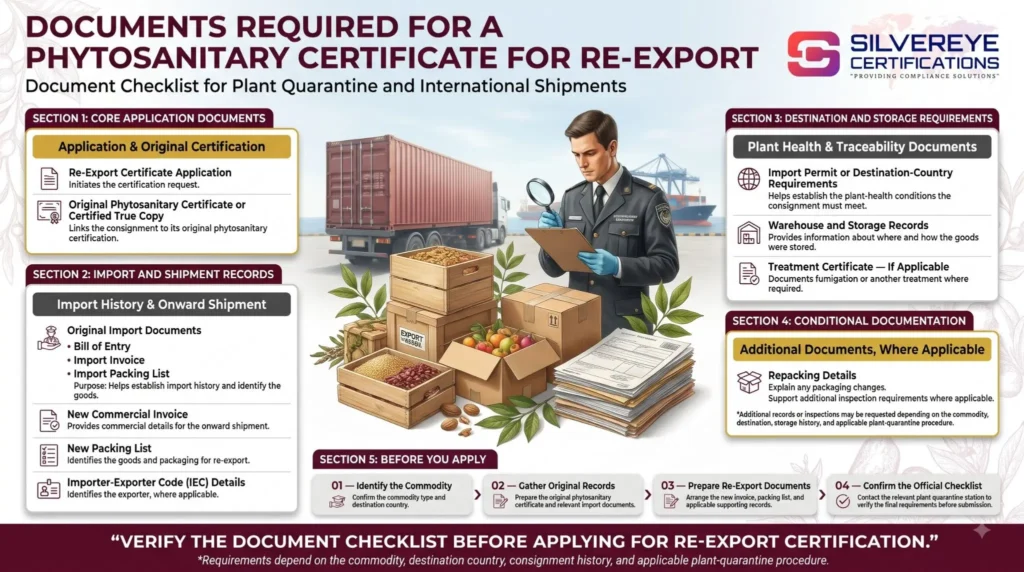
Practical tip: Maintain a separate file for each consignment, containing the original phytosanitary certificate, import documents, storage records, treatment records, and onward shipping documents. This makes verification easier and helps prevent missing-document delays.
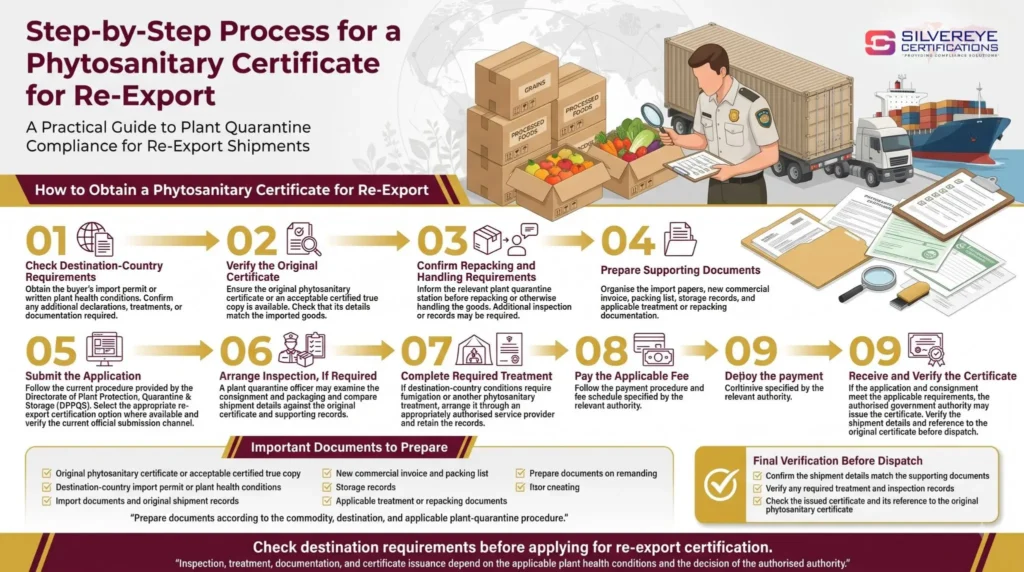
Step-by-Step Process for a Phytosanitary Certificate for Re-Export
Step 1: Check the destination country's requirements. Obtain the buyer's import permit or written plant health conditions. Check whether additional declarations, treatments, or specific documentation are required.
Step 2: Verify the original certificate. Ensure that the original phytosanitary certificate or an acceptable certified true copy is available. Check that its details correspond to the imported goods.
Step 3: Confirm repacking and handling requirements. If you intend to repack or otherwise handle the goods, inform the relevant plant quarantine station in advance. Additional inspection or supporting records may be required.
Step 4: Prepare the supporting documents. Organise the import papers, new commercial invoice, packing list, storage records, and any applicable treatment or repacking documentation.
Step 5: Submit the application through the official channel. Follow the current application procedure provided by the Directorate of Plant Protection, Quarantine & Storage (DPPQS) and select the appropriate re-export certification option, where available. Verify the current portal and submission requirements through official government sources.
Step 6: Arrange inspection, if required. A plant quarantine officer may examine the consignment, inspect its packaging, and verify the details against the original certificate and supporting documents.
Step 7: Complete any required treatment. If the destination country's conditions require fumigation or another phytosanitary treatment, arrange it through an appropriately authorised service provider and retain the relevant records.
Step 8: Pay the applicable fee. Follow the payment procedure and fee schedule specified by the relevant authority.
Step 9: Receive and verify the certificate. If the application and consignment meet the applicable requirements, the authorised government authority may issue the certificate. Check the shipment details and reference to the original phytosanitary certificate before dispatch.
Phytosanitary Certificate for Re-Export Fees
Government fees may vary according to the applicable service and inspection arrangements. Additional expenses may include fumigation, treatment, testing, storage, or handling charges.
Since fees and procedures can change, confirm the current charges with the relevant plant quarantine station or official government portal before applying.
If you engage a consultant, remember that consultancy fees are separate from government charges. Confirm the scope of assistance and the agreed service fee in writing before proceeding.
Validity and Processing Time
There is no single validity period or processing timeline that applies to every re-export consignment. Requirements depend on the destination country's plant health rules, the commodity, the condition of the goods, and the inspection or treatment required.
A re-export certificate relates to a specific consignment, rather than serving as an annual business licence. Before shipping, confirm how recently the certificate must be issued and whether any additional conditions apply.
| Situation | Recommended Action |
|---|---|
| Shipment is delayed | Confirm whether the existing certificate remains acceptable under the destination country's rules |
| One lot is divided into multiple shipments | Ask the issuing authority whether separate certificates or additional supporting documents are required |
| Quantity, consignee, or packaging details change | Contact the issuing authority to determine whether correction, replacement, or a new certificate is necessary |
| Original certificate details do not match the goods | Resolve the discrepancy with the relevant authority before proceeding |
Timeline tip: Processing time depends on document completeness, inspection availability, and any required treatment. Begin the process well before your planned shipment date rather than waiting until the container reaches the port.
Common Mistakes to Avoid
Exporters can reduce the risk of delays by avoiding these common mistakes:
- Applying without the original phytosanitary certificate or an acceptable certified true copy.
- Providing inconsistent product descriptions, quantities, or consignee details across documents.
- Storing goods in conditions that may expose them to pests or contamination.
- Repacking goods without checking whether the plant quarantine authority requires notification or inspection.
- Failing to confirm the destination country's current import conditions.
- Submitting the application too close to the shipping date.
- Confusing a phytosanitary certificate for re-export with a standard phytosanitary certificate for export.
Review the documents and shipment details carefully before submitting the application.
How Silvereye Certifications Can Help
Preparing a re-export application can be challenging because the documentation must connect the original import with the onward shipment and address the destination country's plant health requirements.
Silvereye Certifications can assist with:
- Reviewing the original phytosanitary certificate and supporting import documents.
- Identifying documentation gaps and inconsistencies.
- Understanding destination-specific requirements and applicable certification procedures.
- Organising application information and supporting records before submission.
The phytosanitary certificate is issued by the authorised government authority, not by a private consultancy. Silvereye Certifications provides documentation guidance and application support but does not replace official inspection or certification.
Before contacting us, keep your product name, quantity, country of origin, destination country, original phytosanitary certificate, import documents, and planned shipping date ready. These details will help establish the requirements relevant to your consignment.
Conclusion
Obtaining a Phytosanitary Certificate for Re-Export in India requires careful documentation, traceability to the original phytosanitary certificate, and compliance with the destination country's plant health requirements. By preparing accurate import and shipping records, maintaining proper storage conditions, and arranging any required inspection or treatment, exporters can reduce the risk of delays and shipment rejection.
Before dispatch, confirm the latest requirements with the relevant plant quarantine station and ensure that all certificate details match your consignment. Silvereye Certifications can help you review your documents, understand applicable requirements, and prepare your application for submission. With the right preparation and guidance, you can manage re-export documentation more confidently and keep your international shipments on track.
Frequently Asked Questions
What is a phytosanitary certificate for re-export?
It is an official plant health certificate for plant goods that were imported into a country and are now being shipped onward to another country.
Who issues phytosanitary Certificate in India?
The Directorate of Plant Protection, Quarantine & Storage (DPPQS), through its plant quarantine stations.
How is it different from a normal export certificate?
An export certificate covers goods produced in the exporting country. A re-export certificate covers imported goods and refers back to the original certificate.
Do I need the original phytosanitary certificate?
Generally yes. The original or a certified true copy is normally attached to or referred to in the re-export certificate.
Can I re-export if I repacked the goods?
Often yes, but additional inspection is usually part of the process. Tell the authority about repacking early.
What documents do I need for phytosanitary certificate?
Typically the application, original certificate or certified copy, import papers, new invoice and packing list, IEC and any destination import permit.
How long does it take?
It depends on file accuracy, inspection scheduling and treatment. Apply early and keep documents consistent.
How much does it cost?
The fee is set by the government and can vary. Check the official portal for the current amount. Treatment and other charges are separate.
How long is it valid?
There is no universal period. The importing country's rules decide, so confirm with your buyer or the official import conditions.
Can one re-export certificate cover two shipments?
Generally no. A certificate is issued for a specific consignment.
What if the goods were stored for a long time?
The certificate states that goods were not exposed to infestation during storage, so storage conditions matter. The authority may inspect before issuing.