- A phytosanitary certificate in India is issued by the national plant protection authority to confirm your plant consignment is free from quarantine pests.
- Most importing countries will not clear plants, grains, spices, fruits, seeds, or wood products without it.
- You need the right paperwork, a destination-specific check, and a timely inspection, so start before the goods are packed.
- Validity is set by the importing country, not by India, and an expired certificate is replaced by a new one, not renewed.
Introduction
A phytosanitary certificate in India is an official document issued by the Plant Quarantine authorities under the Ministry of Agriculture and Farmers Welfare. It certifies that your export consignment of plants or plant products was inspected and meets the importing country's plant health rules. To get one, you apply online with your IEC, invoice, packing list and any treatment or test reports, then an officer inspects and samples the goods. Fees, validity and timelines depend on the product and the destination, so confirm them before you ship.
Last reviewed: September 2026. Rules change, so use this guide to plan and then confirm the latest requirement with the issuing office or your destination country's plant health authority.
What Is a Phytosanitary Certificate?
The word "phyto" means plant, and "sanitary" means health. So a phytosanitary certificate, often called a phyto certificate or plant quarantine certificate, is a health certificate for plants and plant products. It tells the buyer's government that your consignment was inspected, is believed to be free from quarantine pests, and follows the import rules of that country.
The format and purpose are guided by the International Plant Protection Convention (IPPC), a treaty India is part of, and its standard on phytosanitary certificates (ISPM 12). That is why an Indian certificate is understood by customs and plant health officers in most countries.
It is worth being clear about what it is not. A phytosanitary certificate is not a quality certificate, not a food safety approval and not a substitute for a certificate of origin. It speaks only about plant health.
Why Exporters Need a Phytosanitary Certificate
If you export anything that comes from a plant, the certificate is often the paper that decides whether your container is released or held at the port. Here is what you actually gain from getting it right.
- Customs clearance abroad: many countries ask for the original or electronic certificate at the time of import.
- Fewer rejections and detentions: a consignment that arrives without a valid certificate can be held, treated, sent back or destroyed at your cost.
- Buyer and bank confidence: letters of credit and buyer contracts frequently list it as a mandatory shipping document.
- Market access: it helps you meet plant health conditions in strict markets such as the EU, the USA, Australia and the Gulf.
- Protection of your reputation: repeated pest interceptions can trigger extra checks on all your future shipments.
Who Issues the Phytosanitary Certificate in India?
India's National Plant Protection Organization is the Directorate of Plant Protection, Quarantine and Storage (DPPQS), which works under the Ministry of Agriculture and Farmers Welfare. Certificates are issued through its Plant Quarantine Stations located at major seaports, airports and land borders, and by authorized officers who inspect goods at or near the point of export.
Since the process has moved largely online, exporters generally apply through the government's online plant quarantine portal rather than by visiting the office with paper files. Which station handles your file depends on where the goods are stuffed or shipped from, so confirm this with the local Plant Quarantine Station.
Eligibility: Who Can Apply?
There is no complicated licence for the certificate itself, but you must be a genuine, registered exporter of the goods. In practice, these are the basics.
- You hold a valid Importer Exporter Code (IEC) and are the exporter of record, or you apply through your authorized representative or clearing agent.
- Your goods are plants, plant products, seeds, grains, pulses, fruits, vegetables, spices, cut flowers, wood or other regulated articles that the importing country wants certified.
- The consignment is available for inspection, correctly packed and clearly marked, either at your premises, packing house, warehouse or the port.
- You have checked the importing country's conditions, including any import permit, treatment or "additional declaration" requirement.
- For some products you may also need other registrations first. For example, spice exporters may need their Spices Board registration in place before shipping.
Products That Commonly Need a Phytosanitary Certificate
| Category | Examples |
|---|---|
| Grains and pulses | Rice, wheat, maize, chickpeas, lentils |
| Spices and condiments | Turmeric, chilli, cumin, black pepper, cardamom |
| Fresh produce | Mangoes, grapes, pomegranates, onions, potatoes |
| Seeds and planting material | Vegetable seeds, saplings, tissue culture plants |
| Oilseeds and nuts | Groundnuts, sesame, cashew, castor |
| Wood and plant-based items | Timber, wooden handicrafts, coir products, bamboo |
| Cut flowers and foliage | Roses, ornamental leaves, dried flowers |
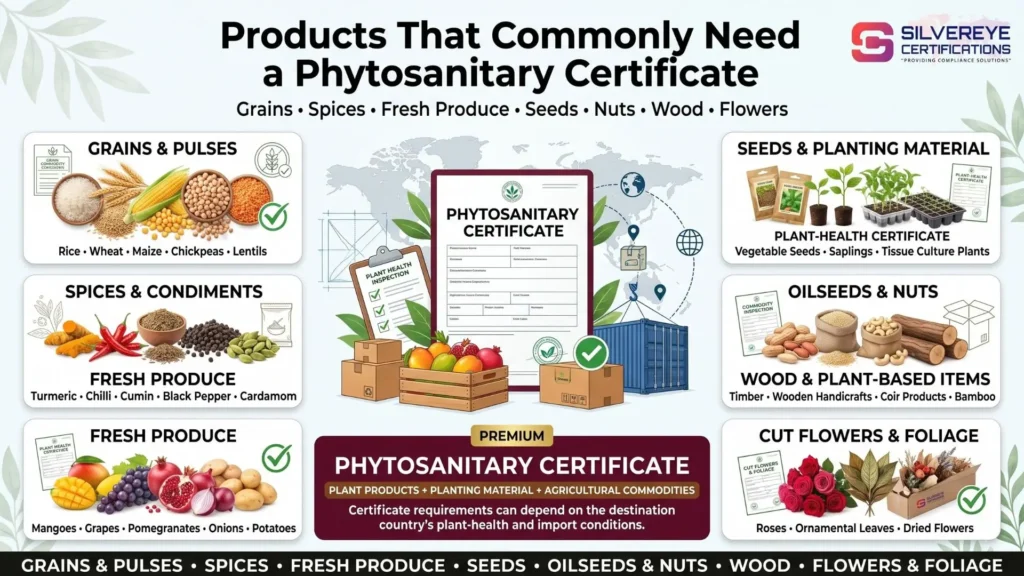
This is a practical list, not a rule. Whether your product needs a certificate is decided by the importing country. Always check its import conditions for your exact product and its form (raw, dried, processed).
Documents Required for Phytosanitary Certificate
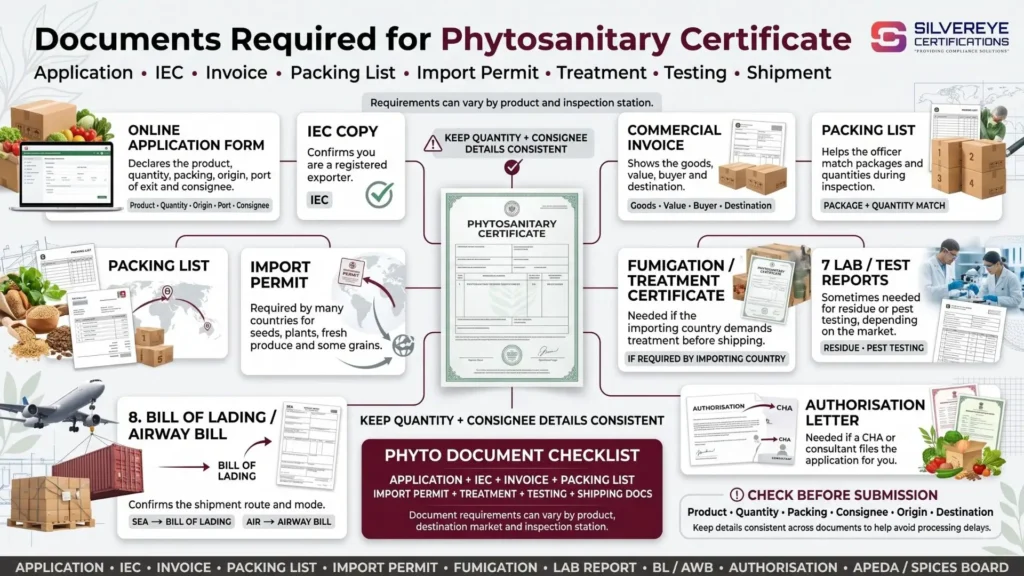
Document lists differ slightly by product and station, but the following are asked for most often. Keep clean, consistent copies, because a mismatch in quantity or consignee name is one of the common reasons for delay.
| Document | Why it is needed |
|---|---|
| Online application form | Declares the product, quantity, packing, origin, port of exit and consignee |
| IEC copy | Confirms you are a registered exporter |
| Commercial invoice | Shows the goods, value, buyer and destination |
| Packing list | Helps the officer match packages and quantities during inspection |
| Import permit of the destination country | Required by many countries for seeds, plants, fresh produce and some grains |
| Fumigation or treatment certificate | Needed if the importing country demands treatment before shipping |
| Lab or test reports | Sometimes needed, for example for residue or pest testing, depending on the market |
| Bill of lading or airway bill draft | Confirms the shipment route and mode |
| Authorisation letter | Needed if a CHA or consultant files the application for you |
| Other product registration | Where relevant, for example APEDA or Spices Board registration |
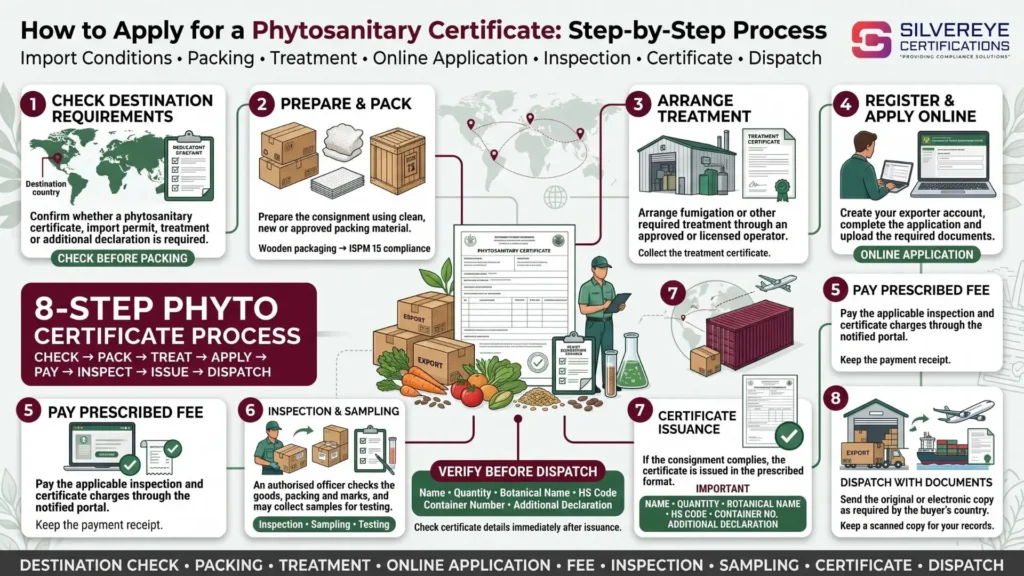
How to Apply for a Phytosanitary Certificate: Step-by-Step Process
- Check the destination country's import conditions. Confirm whether a phytosanitary certificate is required, whether an import permit is needed, and whether any treatment or additional declaration must appear on the certificate. Do this before you pack.
- Prepare and pack the consignment. Use clean, new or approved packing material. If you use wooden packaging, it should comply with the ISPM 15 requirements where applicable.
- Arrange treatment if required. Fumigation or other treatment should be done by an approved or licensed operator, and you should collect the treatment certificate.
- Register and apply online. Create your exporter account on the government's plant quarantine portal, fill in the application and upload your documents.
- Pay the prescribed fee. Pay the inspection and certificate charges through the portal as notified. Keep the receipt.
- Inspection and sampling. An authorised plant quarantine officer checks the goods, may draw samples, verifies packing and marks, and may send samples for testing if needed.
- Certificate issuance. If the consignment complies, the certificate is issued in the prescribed format. Check every detail immediately: names, quantity, botanical name, HS code, container number and additional declaration.
- Dispatch with your documents. Send the original or electronic copy as the buyer's country requires, and keep a scanned copy for your records.
How Long Does It Take?
The government does not promise one fixed turnaround that fits every product, so avoid planning around a single number. In real shipments, the time depends on how complete your file is, how soon an officer can inspect, whether a treatment or lab test is involved, and how busy the station is. A clean, well-prepared application for a standard product can move quickly. A shipment needing fumigation, retesting or corrections will take longer.
A useful rule: apply as soon as your goods are packed and ready, and keep a buffer of several working days before the vessel cut-off or flight departure.
Phytosanitary Certificate Fees in India
Fees for the certificate are set and notified by the government and can be revised, so check the current schedule on the official portal or with the Plant Quarantine Station before you budget. The official fee is only one part of your total cost. Here is a realistic view of what to plan for.
| Cost element | What to expect |
|---|---|
| Government inspection and certificate fee | Notified charge, paid online per application as per the current schedule |
| Fumigation or treatment | Charged by the treatment operator, and varies by product, volume and method |
| Laboratory testing | Applicable only if tests are required by you or the buyer's country |
| Sampling and packing support | Depends on where inspection is done and how goods are handled |
| Consultant or CHA service charges | Optional, depends on the scope of filing and follow-up |
| Delay or re-inspection costs | Storage, demurrage or re-filing if the first attempt has errors |
The most expensive mistake is rarely the fee. It is a rejected or delayed consignment.
Phytosanitary Certificate Validity
There is no single validity period that applies to every certificate. Each importing country decides how recent the certificate must be and how soon after issue the goods must be shipped or arrive. Many countries expect a fairly short window between inspection and shipment, and some specify it in their import conditions.
- Read the "validity" or "issue date" condition in the destination country's import requirements, not just general online advice.
- Do not get the certificate too early. If the shipment slips, the certificate may no longer be accepted.
- The certificate covers one specific consignment. It cannot be reused for another shipment, even of the same product to the same buyer.
Renewal, Reissue and Replacement
Strictly speaking, a phytosanitary certificate is not "renewed". Because it is tied to a single consignment, you normally apply for a fresh one. There are a few situations exporters run into.
| Situation | What usually happens |
|---|---|
| Certificate expired before shipment | You apply again and the goods are re-inspected. A new certificate is issued. |
| Error in details (name, quantity, container) | You request a correction or replacement through the issuing office, with proof of the mistake. |
| Certificate lost or damaged | A replacement (duplicate) certificate can be requested, and it refers to the original as per the international standard. |
| Goods stored and shipped later | If the destination requires a recent inspection, a new certificate may be needed. |
| Re-export of imported goods | A re-export phytosanitary certificate is issued, based on the original import certificate and inspection. |
Phytosanitary vs Fumigation vs Other Export Certificates
New exporters often mix these up. Each one answers a different question for the buyer's authorities.
| Certificate | What it confirms | Issued by |
|---|---|---|
| Phytosanitary certificate | Plant health status and compliance with import conditions | Plant Quarantine authority (DPPQS) |
| Fumigation certificate | That a specific treatment was carried out | Licensed treatment operator |
| Certificate of origin | Where the goods were produced or manufactured | Authorised chambers or agencies |
| Health or quality certificate | Food safety or quality parameters | Relevant food or commodity authority |
| ISPM 15 mark | Wooden packaging has been heat treated or fumigated | Approved treatment provider |
Common Reasons for Delay or Rejection
- Applying before checking the importing country's conditions or missing an import permit.
- Mismatch between the invoice, packing list and application, such as quantity, consignee or product description.
- Wrong or missing botanical name and HS code.
- Poor packing, untreated wooden pallets or visible pests, soil or plant debris in the consignment.
- Missing treatment certificate where treatment is compulsory.
- Applying too late and running into the shipping cut-off.
- Not checking the printed certificate before dispatch.
Get Help With Your Phytosanitary Certificate in India: Silvereye Certifications
Getting a phytosanitary certificate right the first time is mostly about preparation: the right documents, the right destination checks and the right timing. If you would rather not manage every step alone, Silvereye Certifications supports exporters with certification and registration paperwork, including guidance for Spices Board registration, so your shipments are not held up by avoidable errors.
Share your product, destination country and shipment date with Silvereye Certifications, and ask for a document checklist before you apply.
Frequently Asked Questions
What is a phytosanitary certificate in India?
It is an official document issued by India's Plant Quarantine authority confirming that an export consignment of plants or plant products has been inspected and meets the importing country's plant health requirements.
Who issues the phytosanitary certificate in India?
It is issued by authorized officers of the Directorate of Plant Protection, Quarantine and Storage through its Plant Quarantine Stations.
Is a phytosanitary certificate mandatory for all exports?
No. It is required when the importing country asks for it, which usually applies to plants, seeds, grains, fruits, vegetables, spices, wood and other plant-based goods. Check your destination's import conditions.
Which documents are required to apply?
Commonly the online application, IEC, commercial invoice, packing list and, where applicable, an import permit, treatment certificate, test reports and an authorization letter.
How do I apply for a phytosanitary certificate online?
Register as an exporter on the government's plant quarantine portal, submit the application with documents, pay the notified fee and book or await inspection.
How much does a phytosanitary certificate cost?
The government fee is notified and can change, so check the current schedule. Your total cost may also include treatment, testing and service charges.
How long is a phytosanitary certificate valid?
It depends on the importing country. The certificate is for one consignment, and many countries expect it to be issued shortly before shipment.
Can a phytosanitary certificate be renewed?
Not in the usual sense. If it expires or the shipment is delayed, you generally apply for a new certificate and the goods may be re-inspected.
What if my certificate has a mistake or is lost?
Contact the issuing office promptly. A corrected or replacement certificate can usually be requested with supporting documents.
Do I need fumigation along with the phytosanitary certificate?
Only if the importing country requires treatment. Fumigation is a separate step and is proved through a treatment certificate.
Can a consultant or CHA apply on my behalf?
Yes, with your written authorisation. Many exporters use one to avoid filing errors and to coordinate inspection.
What is an ePhyto?
It is an electronic version of the phytosanitary certificate exchanged between plant protection authorities. Whether you can use it depends on both India's and the destination country's systems.
Is a phytosanitary certificate the same as a fumigation certificate?
No. The first confirms plant health compliance. The second only confirms that a treatment was done.