

A Phytosanitary Certificate (PSC) is an official document confirming that a consignment of plants or plant products meets the applicable plant health requirements of the importing country.
- Government-issued certification: In India, Phytosanitary Certificates are issued by the authorized government plant quarantine authority, not by private consultancy firms.
- Accurate documentation: Incomplete applications, inconsistent shipment details and missing treatment records, where treatment is required, can lead to delays.
- Professional guidance: A compliance consultant can help exporters prepare the application, organize supporting documents and understand the applicable inspection and treatment requirements before submission.
Introduction
A Phytosanitary Certificate for Export is an official plant health document issued by India's National Plant Protection Organization (NPPO), through the Directorate of Plant Protection, Quarantine & Storage (DPPQS) and its authorized plant quarantine stations. It is required when exporting plants, seeds, fruits, vegetables, grains, spices or other regulated plant products to countries that require phytosanitary certification.
The process generally involves submitting an online application, providing supporting documents such as the commercial invoice and packing list, presenting the consignment for inspection and completing any prescribed treatment. Once the applicable requirements are satisfied, the authorized authority can issue the certificate. Always check the destination country's import regulations in advance, as they determine the applicable phytosanitary conditions and additional declarations, where required.
What Is a Phytosanitary Certificate?
A Phytosanitary Certificate (PSC) is an official plant health document confirming that a consignment of plants or plant products meets the applicable phytosanitary requirements of the importing country. It helps the destination country's authorities assess whether the shipment complies with relevant plant health regulations.
The term phytosanitary relates to plant health. The certificate follows the international framework established by the International Plant Protection Convention (IPPC), which helps standardise phytosanitary certification for international trade.
A Phytosanitary Certificate is issued by an authorized government plant quarantine authority, not by a private consultancy. However, a compliance consultant such as Silvereye Certifications can help exporters understand the applicable requirements, organize supporting documents and prepare their applications before submission.
Do You Need a Phytosanitary Certificate For Export?
Whether you need a Phytosanitary Certificate depends on the product you are exporting and the regulations of the destination country. Some importing countries require certification for a wide range of plant products, while others apply specific requirements based on the commodity, its processing and the risk of introducing regulated pests.
A certificate may be required for products such as:
- Fresh fruits and vegetables
- Rice, wheat, pulses and other grains
- Spices, tea and coffee
- Oilseeds and nuts
- Seeds, saplings and live plants
- Cut flowers
- Raw or unprocessed wood and certain wood products
- Selected processed plant products, depending on the destination country's requirements
The safest approach is to obtain the buyer's import permit or written confirmation of the applicable plant health requirements and verify them against the destination country's official regulations. Do not assume that the requirements for an earlier shipment will remain unchanged.
Benefits of Getting Your Phytosanitary Certificate Right
| Benefit | Why It Matters |
|---|---|
| Smoother clearance overseas | Complete and accurate documentation can help reduce avoidable questions from customs and plant quarantine authorities. |
| Lower risk of rejection | Meeting the applicable requirements can reduce the risk of refusal, additional treatment or return of the shipment. |
| Greater buyer confidence | Importers benefit from receiving consistent and complete export documentation. |
| Access to international markets | Some countries require a valid Phytosanitary Certificate before accepting regulated plant products. |
| Fewer shipment-related payment delays | Avoiding preventable documentation issues can help reduce delays that may affect shipping schedules and payment arrangements. |
Types of Phytosanitary Certificates
The type of certificate required depends on whether the goods are being exported from India or re-exported after having been imported.
| Certificate Type | When It Is Used |
|---|---|
| Phytosanitary Certificate for Export | Used for eligible plants and plant products exported from India when the importing country requires phytosanitary certification. |
| Phytosanitary Certificate for Re-export | Used for eligible plant products that were imported into India and are subsequently exported to another country, subject to the applicable requirements. |
For a re-export application, the original Phytosanitary Certificate or other relevant documentation from the country of origin may be required. The exact documents depend on the shipment history and the applicable re-export procedure.
Who Can Apply for a Phytosanitary Certificate?
The exporter or an appropriately authorized representative can apply through the designated government process, subject to the applicable requirements. Before submitting an application, prepare the following:
- Valid Importer Exporter Code (IEC): Keep your exporter identification details ready where required for the application.
- Consignment ready for inspection: Ensure the goods are properly packed and available for inspection according to the instructions of the relevant Plant Quarantine Station.
- Applicable registrations and approvals: Certain commodities or export arrangements may require additional registrations, approved packing facilities or treatment documentation.
- Destination-country import conditions: Check whether an import permit, additional declaration, prescribed treatment or other specific condition applies.
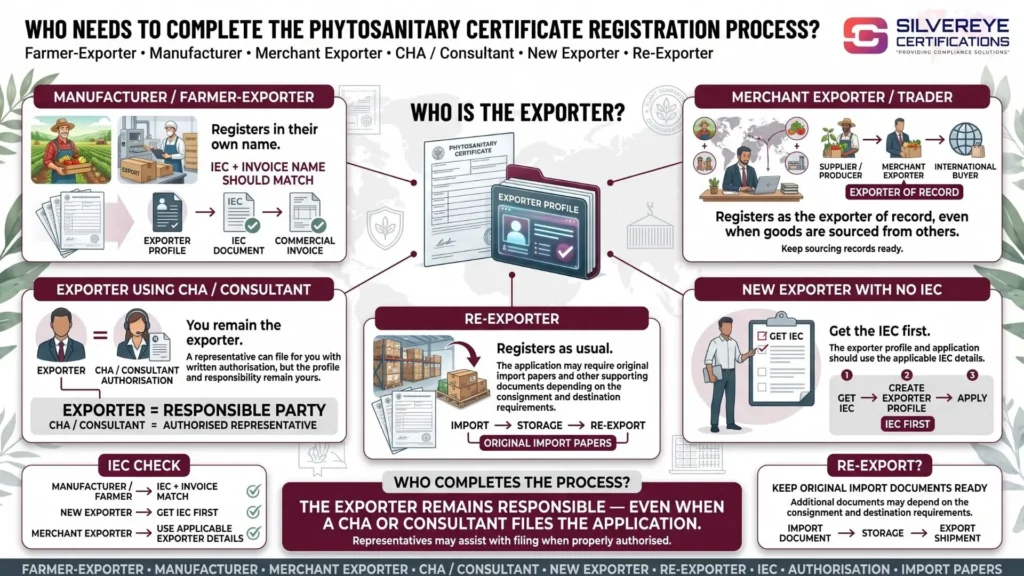
Merchant exporters sourcing products from farmers or processors should also maintain suitable traceability records. Details about the product's source, processing and handling may be requested during the inspection or certification process.
Documents Required for a Phytosanitary Certificate
The exact document requirements may vary depending on the commodity, destination country, and plant quarantine station. Before applying, confirm the applicable requirements with the relevant plant quarantine authority.
| Document | Purpose |
|---|---|
| Phytosanitary certificate application | Submitted through the applicable official portal |
| Commercial invoice | Provides details of the buyer, product, and transaction |
| Packing list | Specifies package count, net weight, and gross weight |
| Importer-Exporter Code (IEC) | Identifies the exporter, where applicable |
| Import permit or importing-country requirements | Specifies the plant health conditions set by the destination country |
| Treatment certificate | Required when fumigation or another treatment is prescribed |
| Certificate of origin or source details | Required where relevant to the commodity or shipment |
| Export licence or registration | Required only for regulated commodities, where applicable |
| Previous phytosanitary certificate | May be required for consignments being re-exported |
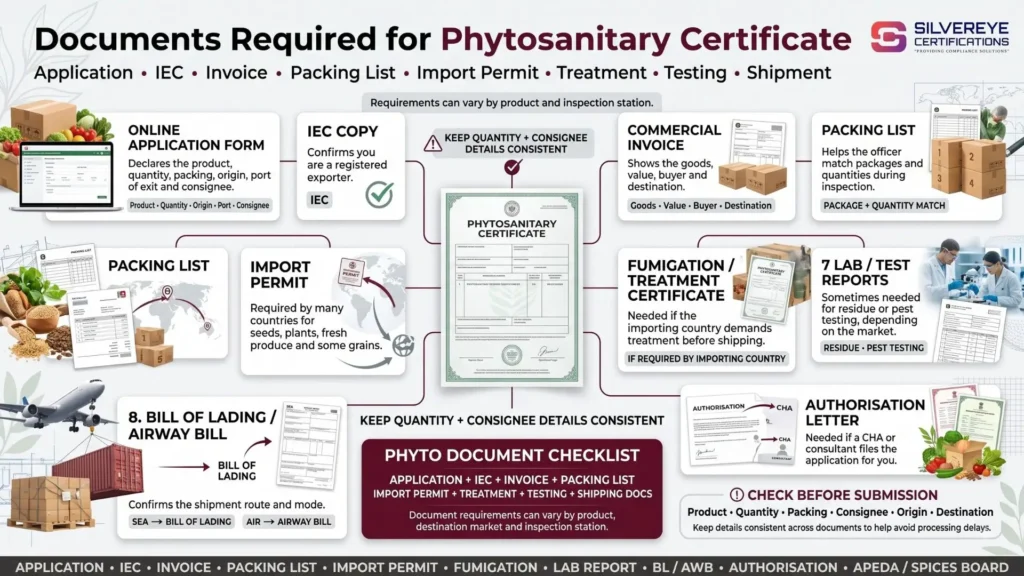
Two important tips: Ensure that names, addresses, product descriptions, and quantities match across all documents. Use the correct botanical name and product description consistently wherever required.
Step-by-Step Phytosanitary Certificate Process
Step 1: Check the importing country's requirements. Obtain the destination country's plant health conditions, including any specific treatment requirements or additional declarations that must appear on the certificate.
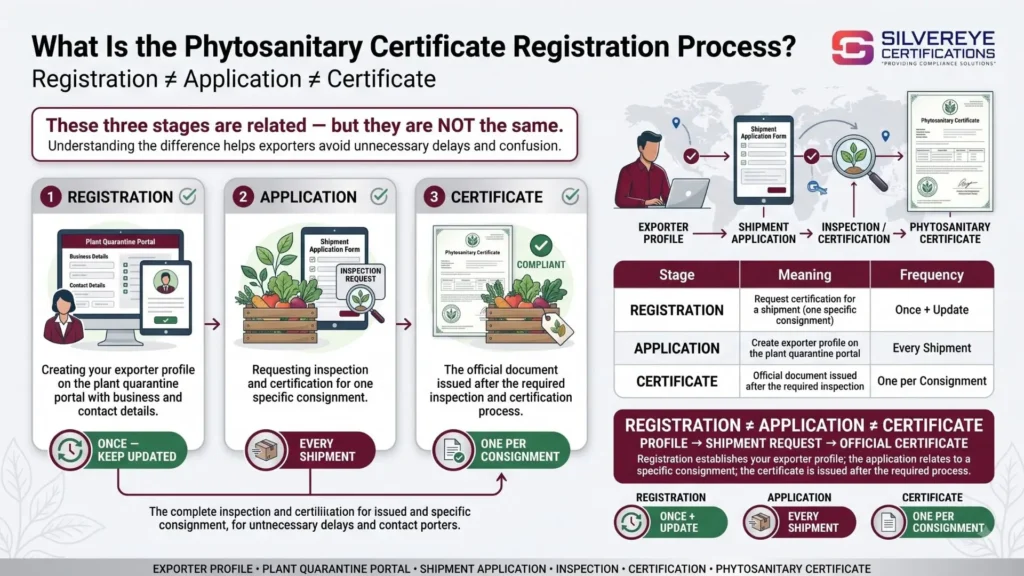
Step 2: Register or log in to the official portal. Access the applicable government plant quarantine system and confirm the current application procedure through the official DPPQS website or portal.
Step 3: Prepare the required documents. Keep scanned copies of the invoice, packing list, IEC details, import permit, and other applicable documents ready before starting the application.
Step 4: Submit the application. Select the appropriate certificate type—export or re-export—and enter the required details, including the consignee, commodity, quantity, and shipment information.
Step 5: Arrange the inspection. A plant quarantine officer may inspect the consignment or collect samples, depending on the commodity and applicable requirements. The inspection location may vary according to the authorised arrangements.
Step 6: Complete the required treatment. If fumigation or another phytosanitary treatment is prescribed, arrange it through an authorised or approved service provider, as applicable, and retain the supporting records.
Step 7: Pay the applicable government fee. Follow the payment instructions displayed on the official portal or provided by the relevant plant quarantine station.
Step 8: Receive and verify the certificate. If the consignment meets the applicable requirements, the authorised government authority may issue the phytosanitary certificate. Check all certificate details carefully before dispatch.
Phytosanitary Certificate Fees in India
The government fees for a phytosanitary certificate may depend on the applicable service, inspection arrangements, commodity, and current fee schedule. Charges for fumigation, sampling, testing, or other treatments may be additional.
As fees and procedures can change, check the latest applicable charges through the official DPPQS portal or the relevant plant quarantine station before applying.
If you hire a consultant, remember that the consultancy fee is separate from government charges. Confirm the scope of services and charges in writing before proceeding.
Validity of a Phytosanitary Certificate
A phytosanitary certificate does not have one universal validity period for every export shipment. The importing country's regulations may specify how recently the certificate must be issued or how much time can pass between inspection, certification, and shipment.
Before applying, confirm the destination country's requirements and coordinate the inspection and certificate issuance with your planned shipping date.
Practical tip: Avoid applying too early or leaving the process until the last minute. Plan the inspection and documentation around your shipment schedule and the importing country's requirements.
Phytosanitary Certificate Renewal and Processing Time
A phytosanitary certificate is generally issued for a specific consignment, rather than as an annual license. If shipment details change, the cargo is split, or the shipment is delayed, contact the relevant plant quarantine station to determine whether correction, replacement, or a new certificate is required.
| Situation | Recommended action |
|---|---|
| Shipment is delayed | Confirm whether the existing certificate remains acceptable under the importing country's rules |
| Incorrect name, quantity, or shipment details | Contact the issuing authority to request a correction or replacement, as permitted |
| Cargo is divided into separate shipments | Confirm whether separate certificates are required |
| Goods are rejected or returned | Check the applicable import and re-export requirements before shipping again |
Processing time: The timeline depends on document completeness, inspection availability, the commodity, and any required treatment or testing. Apply well before the planned shipment date to reduce the risk of delays. Do not assume that a certificate can be issued immediately when cargo reaches the port.
Common Mistakes That Cause Phytosanitary Certificate Delays
Exporters can avoid many application problems by checking the following points before submitting their documents:
- Applying without confirming the destination country's plant health requirements.
- Providing inconsistent information across the application, commercial invoice, and packing list.
- Missing treatment records or submitting incomplete supporting documents.
- Using packaging that does not meet applicable phytosanitary requirements, including requirements for regulated wood packaging.
- Submitting the application too close to the shipping date.
- Relying on outdated certificate formats or previously applicable import conditions.
Review the complete file before submission and confirm any commodity-specific requirements with the relevant authority.
Phytosanitary Certificate vs. Other Export Documents
A phytosanitary certificate serves a different purpose from other documents used in international trade. The documents required for a shipment depend on the commodity and destination country's regulations.
| Document | Purpose |
|---|---|
| Phytosanitary certificate | Certifies that the consignment meets the applicable plant health requirements |
| Certificate of origin | Identifies the country of origin of the goods |
| Fumigation certificate | Records a fumigation treatment when applicable |
| Food safety or health certificate | Demonstrates compliance with relevant food safety or health requirements, where applicable |
| Quality or inspection certificate | Provides evidence of specified product quality or inspection results |
These documents are not interchangeable. A phytosanitary certificate does not automatically replace a certificate of origin, fumigation record, food safety certificate, or quality certificate.
How Silvereye Certifications Can Help
Preparing a phytosanitary certificate application can be challenging for first-time exporters, particularly when the importing country has specific documentation, treatment, or declaration requirements.
Silvereye Certifications can assist exporters with:
- Understanding applicable phytosanitary documentation requirements.
- Reviewing supporting documents for completeness and consistency.
- Preparing application information and identifying common documentation errors.
- Providing guidance on shipment-specific compliance requirements.
The phytosanitary certificate is issued by the authorised government authority, not by a private consultancy. Silvereye Certifications provides guidance and documentation support but does not replace the official inspection or certification process.
Before contacting us, keep your product name, quantity, destination country, buyer details, planned shipment date, and available import permit or plant health requirements ready. This information helps establish which requirements may apply to your consignment.
Conclusion
Obtaining a Phytosanitary Certificate in India is an important step for exporters shipping plants and plant products to international markets. By checking the destination country's import requirements, preparing accurate documents, and arranging inspections or treatments where necessary, exporters can reduce the risk of shipment delays and compliance issues.
Before shipping, always verify the latest requirements with the relevant plant quarantine authority and ensure that your certificate matches the consignment details. Silvereye Certifications can help you understand the documentation requirements, review your application details, and prepare for the certification process. With the right preparation and guidance, you can manage phytosanitary compliance more confidently and keep your export shipments on track.
Frequently Asked Questions
What is a phytosanitary certificate for export?
It is an official plant health document confirming that your plant or plant product consignment was inspected and meets the importing country's requirements.
Who issues it in India?
The Directorate of Plant Protection, Quarantine & Storage (DPPQS), through plant quarantine stations, issues it on behalf of the Government of India.
Is it mandatory for every export?
No. It is required when the importing country asks for it, which is common for plants and plant products. Check the destination's rules for your product.
How do I apply For Phytosanitary Certificate?
Apply through the official online system of the plant quarantine authority, upload your documents, arrange inspection and pay the prescribed fee.
Which documents do I need For Phytosanitary Certificate?
Usually the application, commercial invoice, packing list, IEC and any import permit, plus treatment records or other papers if required for your product.
How long does it take for phytosanitary certificate registration?
It depends on file accuracy, inspection scheduling and treatment. Apply early and keep documents consistent to avoid delays.
How much cost for phytosanitary Certificate registration?
The fee is set by the government and can vary by service type. Check the official portal for the current amount, and remember treatment costs are separate.
How long is it valid for phytosanitary certificate registration?
There is no universal period. The importing country's rules decide, so ask your buyer or check the import conditions.
Can I use one certificate for two shipments?
Generally no. A certificate is issued for a specific consignment.
What if my shipment is delayed?
If the certificate falls outside the importing country's accepted window, you may need to apply again.
Do I need a fumigation certificate as well?
Only if the destination country or the commodity requires treatment. It is a separate record that supports the PSC.
Can a private company issue a phytosanitary certificate?
No. Only the official plant protection authority can issue it. Consultants like Silvereye Certifications can help with preparation and guidance.