- MD-14 is the application form, while MD-15 is the import license issued by CDSCO for eligible foreign-made medical devices.
- An Indian authorized agent submits Form MD-14 on behalf of the overseas manufacturer.
- The core documentation generally includes the Power of Attorney, Free Sale Certificate/Marketing Authorization, applicable quality certificates, Plant Master File (PMF) and Device Master File (DMF).
- Once granted, the MD-15 import licence remains perpetually valid, subject to payment of the applicable retention fee every five years and continued compliance with the Medical Devices Rules, 2017.
What Documents Are Required for MD-14 and MD-15?
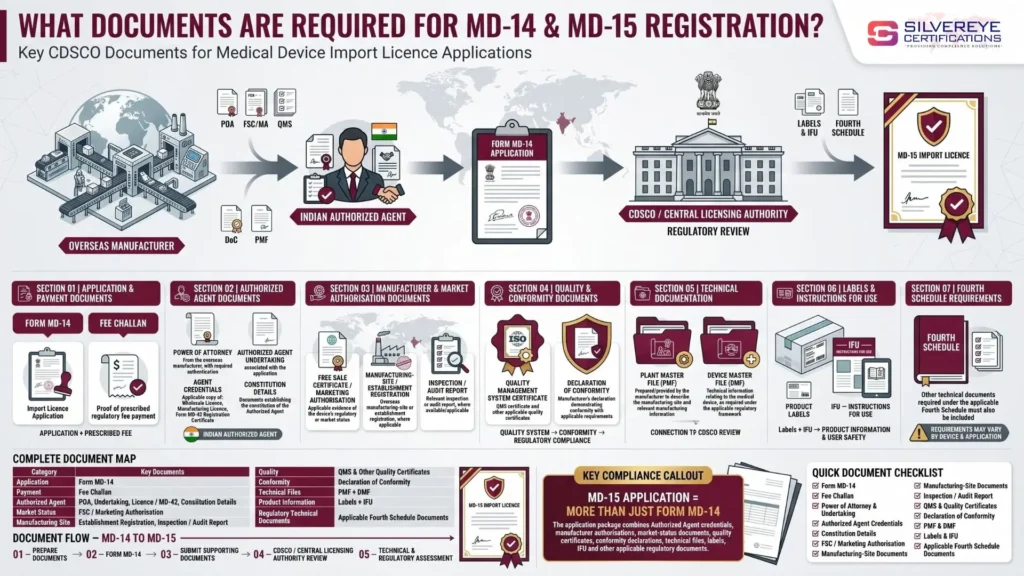
The MD-14 and MD-15 documents required for a CDSCO medical device import license generally include the Form MD-14 application, Power of Attorney, authorized agent's license or registration, Free Sale Certificate/Marketing Authorization, quality-management documentation, Plant Master File (PMF), Device Master File (DMF), labels and Instructions for Use (IFU), and proof of applicable fee payment.
The exact document set can vary depending on the device classification, product type, IVD status and applicable regulatory pathway. Applicants should always check the latest CDSCO checklist before filing.
CDSCO's current checklist also includes documents and undertakings relating to the existing import license, endorsements, post-marketing surveillance, quality certificates and changes to the Power of Attorney, where applicable.
Once the application is approved, CDSCO grants the import license in Form MD-15. The license remains valid subject to the applicable retention requirements and continued compliance under the Medical Devices Rules, 2017.
What Are Form MD-14 and Form MD-15?
Under the Medical Devices Rules, 2017, the import of regulated medical devices for sale or distribution is subject to the applicable licensing requirements of the Central Licensing Authority (CLA).
The process uses two main forms:
| Point | Form MD-14 | Form MD-15 |
|---|---|---|
| What is it? | Application for an import licence | Import licence issued by the Central Licensing Authority |
| Who files or holds it? | Filed by the Indian authorised agent on behalf of the overseas manufacturer | Issued to the eligible applicant after approval |
| When is it used? | Before applying for the import licence | After the import application is approved |
| Fee | Applicable government fee is paid with the application | Retention fee applies as prescribed |
| Portal | Submitted through the applicable CDSCO online system | Issued after approval through the regulatory system |
CDSCO's medical-device page specifically states that an applicant makes an application in MD-14 for grant of an import licence in MD-15.
Important Class A Exception
There is an important exception for Class A non-sterile and non-measuring medical devices. CDSCO's notification G.S.R. 777(E), dated 14 October 2022, exempted these devices from the licensing regime, subject to the applicable registration requirements.
Therefore, before preparing a full MD-14 application, first confirm the device's risk class and whether this exemption applies.
Who Needs an MD-15 Import License?
In general, an overseas manufacturer or its Indian authorized agent must follow the applicable import-licensing requirements when a regulated foreign-made medical device is imported into India for sale or distribution.
The licensing regime was implemented in phases. Class A and Class B devices came under the licensing regime from 1 October 2022, while Class C and Class D devices came under the licensing regime from 1 October 2023. CDSCO's official notices confirm these implementation dates.
Who Can Apply?
In practical terms:
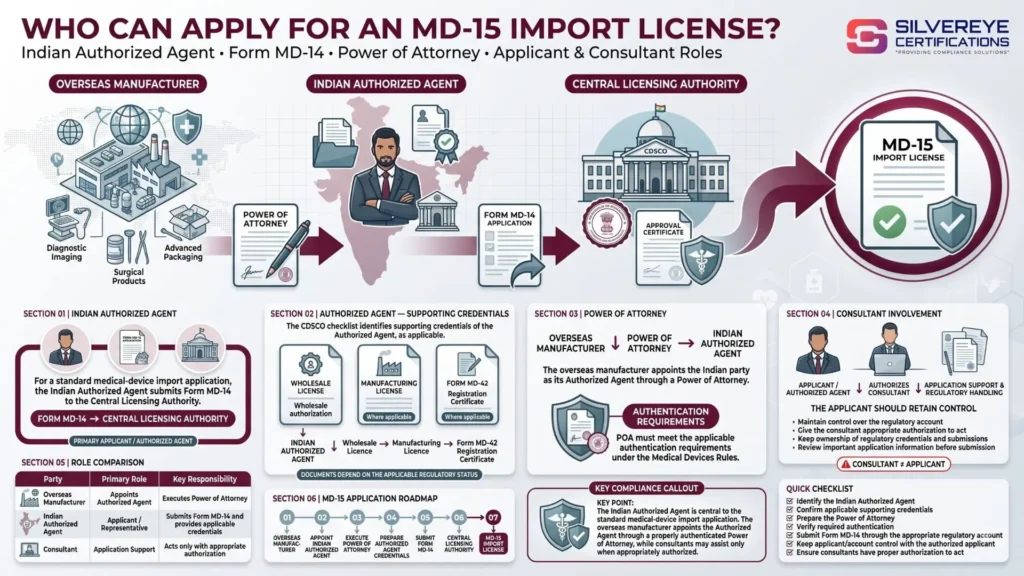
- The overseas manufacturer appoints an Indian authorised agent.
- The authorised agent submits the applicable MD-14 application to CDSCO.
- The agent must have the applicable manufacturing licence, wholesale licence or Form MD-42 registration certificate, as required for the application.
- The application must include the required technical, regulatory and quality documents.
- The device must be classified according to the applicable CDSCO risk-based classification.
CDSCO classifies medical devices into Class A, B, C and D, ranging from low risk to high risk.
What Are the Benefits of Having an MD-15 Import License?
1. Legal Market Access
For devices that require an import license, MD-15 provides the regulatory license needed for import for the permitted purpose.
2. Better Regulatory Compliance
The licence connects the Indian authorised agent, overseas manufacturer, manufacturing site and approved devices within the regulatory framework.
3. Long-Term License Validity
An MD-15 license is not simply a five-year license that expires automatically. The applicable rules provide for continuing validity subject to retention requirements and compliance.
4. Easier Commercial Documentation
An MD-15 licence can be important when dealing with hospitals, distributors, tenders and other business partners that request evidence of regulatory authorisation.
5. Ongoing Regulatory Record
The licence and its endorsements provide a formal record of the devices and manufacturing arrangements approved for import.
Important Note for Applicants
Do not assume that every imported medical device requires exactly the same MD-14 document set. The applicable requirements can differ based on risk class, IVD/non-IVD status, device grouping, manufacturing site and the specific CDSCO pathway.
Before filing, verify the current CDSCO checklist, Medical Devices Rules, applicable notifications and portal requirements for your device.
MD-14 and MD-15 Documents Required: The Full Checklist
The MD-14 and MD-15 documents required for a CDSCO medical device import license are based on the Fourth Schedule of the Medical Devices Rules, 2017 and the applicable CDSCO checklist.
The exact requirements can vary depending on the device class, IVD/non-IVD status, manufacturing site and regulatory pathway. CDSCO also maintains separate checklists for IVD applications, so always compare your file with the latest CDSCO checklist before submission.
A. Documents From the Indian Authorized Agent
| Document | What CDSCO Requires | Practical Tip |
|---|---|---|
| Form MD-14 | Completed application submitted through the applicable CDSCO online system | Keep product names, model numbers and addresses consistent across all documents |
| Power of Attorney and undertaking | Power of Attorney from the overseas manufacturer with the required authentication and authorised-agent undertaking | Start this document early because authentication can take time |
| Agent's licence/registration | Applicable wholesale licence, manufacturing licence or Form MD-42 registration, as applicable | Make sure the authorisation covers the relevant medical device activity |
| Fee payment proof | Proof of payment of the applicable Second Schedule fee | Confirm the applicable fee before making payment |
CDSCO's published checklist specifically requires the original Power of Attorney with the prescribed authentication and the authorised agent's undertaking.
B. Documents From the Overseas Manufacturer
| Document | What CDSCO May Require | Practical Tip |
|---|---|---|
| Free Sale Certificate / Marketing Authorisation | Valid regulatory certificate from the applicable authority, as required | Check that the manufacturer and product details match the application |
| Manufacturing site registration/licence | Valid registration or licence for the overseas manufacturing site, where applicable | The site address should match the PMF and other regulatory documents |
| Quality Management System certificate | Applicable QMS documentation, including ISO 13485 where required/applicable | Check that the certificate covers the relevant manufacturing site and scope |
| Quality/CE certificates | Production Quality Assurance, Full Quality Assurance, CE certificates or other applicable regulatory certificates | Submit the applicable certificates requested for your device |
| Declaration of Conformity | Manufacturer's declaration where required | Ensure the device and applicable standards are clearly identified |
| Plant Master File (PMF) | Site information, manufacturing activities and quality-system details in the prescribed format | Prepare the PMF for the specific manufacturing site |
CDSCO's checklists identify documents such as the overseas manufacturing-site registration, Free Sale Certificate, QMS certificate, applicable quality/CE certificates and Plant Master File. Some items are conditional rather than mandatory for every application.
C. Product and Technical Documents
| Document | What It Covers | Practical Tip |
|---|---|---|
| Device Master File (DMF) | Device description, intended use, design, materials, manufacturing, risk management and applicable verification/validation information | Keep the file structured and cross-referenced |
| Device/product list | Device names, models, variants and other applicable product information | Use consistent names and model numbers throughout the dossier |
| Labels and Instructions for Use (IFU) | Labelling information required under the Medical Devices Rules | Check importer/manufacturer details and applicable Indian labelling requirements |
| Clinical/performance evidence | Clinical, performance or evaluation information, as applicable | Requirements can be more extensive for higher-risk devices and IVDs |
| Sterilisation and stability information | Applicable validation, shelf-life and stability information | Include the relevant evidence for sterile or time-limited products |
The Device Master File is a central part of the technical review, but the exact supporting evidence depends on the product and its classification.
For IVDs, CDSCO maintains a separate MD-14 checklist that specifically includes an IVD Device Master File, performance-related documentation and other IVD-specific requirements.
What About the Import Export Code (IEC)?
An Import Export Code (IEC) is important for carrying out imports and customs-related activities, but it should not be presented as simply another technical document in the MD-14 dossier.
Keep the IEC details and customs requirements ready separately and ensure that the importing entity has the necessary import credentials before commercial shipments begin.
Does the Device Class Change the Documents Required?
Yes. The basic application structure remains similar, but the depth and type of supporting evidence can change according to the device.
| Device Type | What to Expect |
|---|---|
| Class A – where MD-14/MD-15 applies | Applicable import documents and technical information; certain non-sterile/non-measuring Class A devices follow an exemption pathway |
| Class B | Applicable technical, quality and regulatory documentation with greater review requirements than lower-risk devices |
| Class C and D | More extensive technical and clinical/regulatory scrutiny may apply; CDSCO may require additional information or inspection |
| IVD medical devices | Separate IVD-specific checklist, including applicable performance, stability and technical documentation |
CDSCO classifies medical devices according to risk as Class A, B, C and D, from low risk to high risk.
For IVDs, CDSCO separately identifies the Central Licensing Authority as the competent authority for import of all classes of IVDs and publishes a dedicated MD-14 checklist.
Step-by-Step: How to Get an MD-15 Import License
1. Confirm the device classification
Determine whether the product is a medical device or IVD and identify its applicable risk class. Also check whether any exemption applies.
2. Appoint an Indian authorized agent
The overseas manufacturer appoints an eligible Indian authorised agent and executes the required Power of Attorney and undertaking.
3. Collect the manufacturer's documents
Prepare the applicable Free Sale Certificate/Marketing Authorisation, manufacturing-site documents, QMS certificates, quality certificates and Declaration of Conformity.
4. Prepare the PMF and DMF
Prepare the Plant Master File (PMF) for the manufacturing site and the applicable Device Master File (DMF) for the device.
5. Complete the CDSCO online application
Register or maintain the applicant details on the applicable CDSCO online system and submit Form MD-14 with the required supporting documents.
CDSCO's official medical-device page confirms that an applicant makes an application in Form MD-14 for grant of an import licence in Form MD-15.
6. Pay the applicable government fee
Pay the fee prescribed under the Second Schedule of the Medical Devices Rules, 2017 and retain the payment record.
7. Respond to CDSCO queries
If CDSCO raises a deficiency or clarification query, provide the requested information and documents within the specified timeline.
8. Receive Form MD-15
Once CDSCO is satisfied with the application and applicable requirements, the MD-15 import licence is granted.
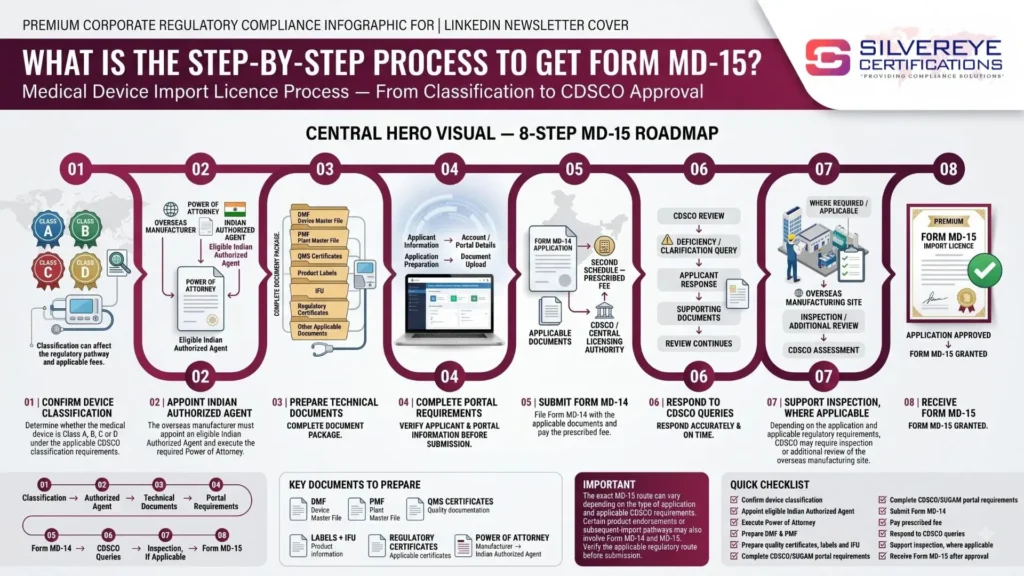
Important Final Check
Before submitting the application, cross-check the manufacturer's legal name, manufacturing-site address, product name, model numbers and authorised-agent details across the entire dossier. Small inconsistencies between the Power of Attorney, Free Sale Certificate, PMF, DMF and application form can lead to avoidable queries.
Always use the latest CDSCO checklist applicable to your specific device rather than relying on a generic MD-14 document list. CDSCO currently publishes separate checklists for medical devices and IVDs.
What Are the MD-15 Import License Fees in 2026?
The MD-15 import licence fees are prescribed under the Second Schedule of the Medical Devices Rules, 2017. The applicable fee depends on the device category, overseas manufacturing site and number of distinct devices covered by the application.
| Device Category | Fee per Overseas Site | Fee per Distinct Device |
|---|---|---|
| Class A – Non-IVD where MD-14/MD-15 applies | USD 1,000 | USD 50 |
| Class B – Non-IVD | USD 2,000 | USD 1,000 |
| Class C or D – Non-IVD | USD 3,000 | USD 1,500 |
| Class C or D – IVD | USD 3,000 | USD 500 |
Important: Certain Class A non-sterile and non-measuring devices are exempt from the MD-14/MD-15 licensing route, subject to the applicable registration requirements. Therefore, confirm the device classification and exemption status before calculating the licence fee.
IVD fee categories can differ according to the applicable class. Always check the current Second Schedule before making payment.
How Is the MD-15 Fee Calculated?
The site fee is generally charged for each applicable overseas manufacturing site, while the device fee is calculated for each distinct medical device covered by the application.
For example:
| Scenario | Calculation | Government Fee |
|---|---|---|
| Class B, 1 site, 2 devices | $2,000 + (2 × $1,000) | USD 4,000 |
| Class C, 1 site, 3 devices | $3,000 + (3 × $1,500) | USD 7,500 |
| Class C IVD, 1 site, 4 devices | $3,000 + (4 × $500) | USD 5,000 |
These figures represent government regulatory fees only. Expenses such as notarisation, apostille, document preparation, translation and consultant professional fees are separate.
The applicable fee should always be confirmed against the current Second Schedule and the specific application category before payment.
Is the MD-15 Import License Valid for Five Years?
No. An MD-15 licence does not have a fixed five-year expiry.
Under the current Medical Devices Rules, the import licence remains perpetually valid, subject to payment of the applicable retention fee every five years and continued compliance with the regulatory requirements.
| Point | What It Means |
|---|---|
| Licence validity | Perpetual, unless suspended, cancelled or otherwise discontinued under the applicable rules |
| Retention requirement | Applicable retention fee must be paid at the prescribed five-year intervals |
| Retention fee | Amount prescribed under the Second Schedule |
| Late payment | Late-payment provisions may apply; follow the current CDSCO rules and applicable communication |
| Failure to retain the licence | The licence may be subject to cancellation or other regulatory consequences under the applicable provisions |
| Changes after approval | Additional devices, manufacturing sites or other changes may require endorsement, amendment or a fresh application depending on the change |
How Long Does MD-15 Approval Take?
There is no single guaranteed approval timeline for every MD-15 application.
The actual time can depend on the device classification, completeness of the dossier, CDSCO queries, technical review, inspection requirements and the applicant's response time.
Instead of publishing consultant-reported ranges such as “3–9 months” or “6–12 months” as standard timelines, applicants should rely on the timeline prescribed under the applicable Medical Devices Rules and the status of their individual application.
| Stage | What Can Affect the Timeline? |
|---|---|
| Initial application review | Completeness and correctness of the submitted documents |
| Technical review | Device class, risk profile and technical evidence |
| CDSCO queries | Number and complexity of deficiency queries |
| Site inspection, where applicable | Scheduling and completion of inspection |
| Applicant response | How quickly complete responses are submitted |
| Final decision | Completion of all applicable regulatory requirements |
What Usually Causes Delays?
The biggest practical cause of delay is often inconsistency between documents. Before submitting MD-14, cross-check the:
- Power of Attorney
- Free Sale Certificate/Marketing Authorisation
- Manufacturing-site details
- ISO/QMS certificate
- Plant Master File
- Device Master File
- Labels and IFU
- Form MD-14
The manufacturer's legal name, manufacturing-site address, product name and model details should be consistent wherever they appear.
What Are the Common MD-14 and MD-15 Mistakes?
- Incorrectly authenticated Power of Attorney or a format that does not meet the applicable requirements.
- Expired or inconsistent Free Sale Certificate/Marketing Authorisation.
- Manufacturer or site names and addresses do not match across the PMF, QMS certificate and application.
- The Indian authorised agent does not have the appropriate licence or registration for the applicable activity.
- The application contains different device names or model numbers across documents.
- The Device Master File is incomplete or does not clearly support the device's classification and intended use.
- Required technical or regulatory documents are missing from the application.
- The applicant calculates the wrong government fee because the device category or number of distinct devices has been misunderstood.
Conclusion: Get Your MD-14 and MD-15 Import License Right
Importing a medical device into India requires more than simply submitting Form MD-14. You need the correct device classification, Indian authorised agent, technical documentation, Power of Attorney, Free Sale Certificate, PMF, DMF and applicable CDSCO fees.
Once the application is approved, Form MD-15 provides the applicable import licence, subject to ongoing compliance and the required five-year retention process.
Because document requirements can vary by device class, product type, manufacturing site and IVD status, preparing the application correctly from the beginning can help reduce avoidable queries and delays.
Why Choose Silvereye Certifications for MD-14 and MD-15 Registration?
Silvereye Certifications helps overseas manufacturers and Indian authorised agents navigate the CDSCO medical device import licensing process from documentation to post-approval compliance.
Why work with Silvereye Certifications?
- End-to-end application support: Assistance from device classification and document preparation to MD-14 filing and CDSCO query responses.
- Documentation expertise: Support with important documents such as the Power of Attorney, Free Sale Certificate, Plant Master File and Device Master File.
- Device-specific approach: The documentation and filing strategy is aligned with the device class, product type and applicable CDSCO requirements.
- Query response support: Assistance in preparing clear and complete responses when CDSCO raises deficiencies or clarification queries.
- Fee and process guidance: Help in understanding the applicable government fees, filing requirements and regulatory timelines.
- Post-licence support: Assistance with applicable endorsements, product additions, regulatory changes and licence retention requirements after MD-15 is granted.
- Transparent process: Government fees and professional charges are kept separate and clearly explained, so you know what you are paying for.
Ready to Start Your Medical Device Import?
If you are planning to import a medical device into India, Silvereye Certifications can help you understand the applicable MD-14 and MD-15 requirements and prepare your application according to the current CDSCO framework.
Talk to Silvereye Certifications today to discuss your medical device, manufacturing site and import requirements.
Frequently Asked Questions
What are the MD-14 and MD-15 documents required for an import licence?
A signed Form MD-14, a legalised Power of Attorney and undertaking, the agent's wholesale, manufacturing or MD-42 licence, a Free Sale Certificate, ISO 13485 certificate, Plant Master File, Device Master File, labels and IFU, and fee proof.
What is the difference between MD-14 and MD-15?
MD-14 is the application you file. MD-15 is the import license CDSCO grants after review.
Can a foreign manufacturer apply for MD-15 directly?
No. The application must come through an Indian authorized agent appointed by a Power of Attorney.
Who can act as the Indian authorized agent?
A company holding a valid wholesale license, manufacturing license or MD-42 registration that covers the device category.
How much does an MD-15 licence cost?
The government fee depends on class. For example, a Class C non-IVD device costs USD 3,000 per site plus USD 1,500 per device. Consultant and legalisation costs are extra.
Is a Free Sale Certificate mandatory?
It is one of the standard regulatory documents in CDSCO's checklist. It should be valid, notarised or apostilled, and issued by the relevant national authority.
Does the MD-15 license expire?
No fixed expiry applies. It stays valid as long as the retention fee is paid every five years and it is not cancelled or surrendered.
What happens if I miss the retention fee?
A late fee of 2% per month applies for a limited period. After that the license can be cancelled.
How long does it take to get MD-15?
Reported ranges run from a few months for lower-risk devices to a year or more for Class D, depending on queries.
Do I need a separate fee for each brand?
Yes. CDSCO states that a separate fee is required for each brand of a device.
Can I add new devices to an existing MD-15?
Yes, through the amendment or endorsement route, with the relevant documents and fee.
Is MD-16 the same as MD-14?
No. MD-16 is for importing limited quantities for clinical investigation or testing and results in an MD-17. MD-14 leads to the commercial MD-15.
Where do I file Form MD-14?
Online on the CDSCO portal, historically SUGAM, which is moving to the National Single Window System.