

- As of the FoSCoS Kind of Business matrix updated 1 April 2026, both cold storage and general warehousing are classified purely by annual turnover, using the same 2026 slabs as most other food businesses.
- A cold storage facility typically needs more than just an FSSAI license — WDRA registration, a Pollution Control Board NOC (due to refrigerant use), and Factory/Electrical Inspectorate approvals are commonly required alongside it.
- Government subsidies of 35–50% of eligible project cost are available for qualifying cold storage projects under schemes like PMKSY-ICCVAI (up to ₹10 crore) and the NHB Capital Investment Subsidy — separate from, but relevant to, your FSSAI compliance planning.
- FSSAI expects validated temperature control appropriate to the stored commodity — commonly 2–4°C for dairy and -18°C or lower for frozen goods — backed by documented temperature logs, not just a working refrigeration system.
Introduction
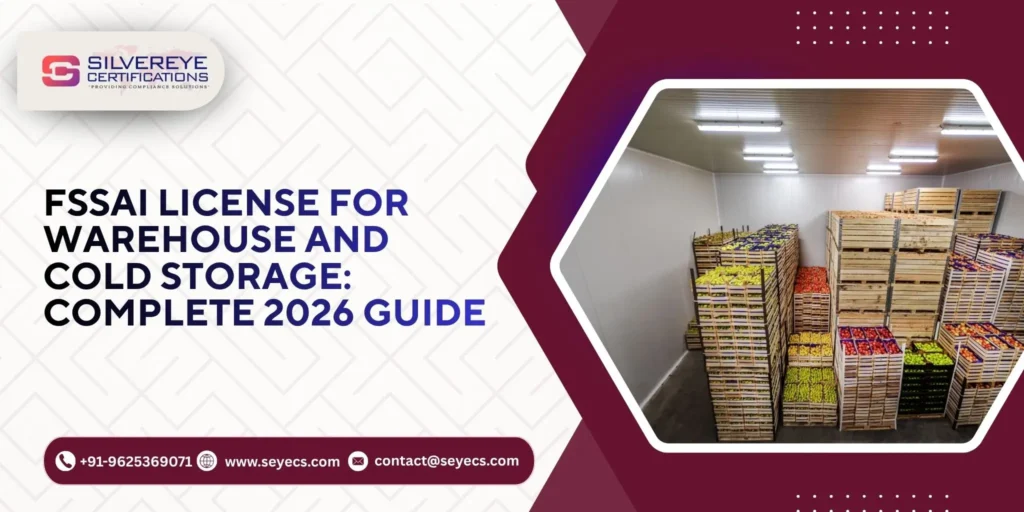
An FSSAI license for warehouse and cold storage businesses is the mandatory food safety approval every ambient warehouse, refrigerated store, or controlled-atmosphere facility needs before storing food commercially in India. As of the FoSCoS matrix updated 1 April 2026, both categories follow the standard turnover-based structure — Registration up to ₹1.5 crore, State License up to ₹50 crore (₹5,000/year), Central License above ₹50 crore (₹7,500/year).
Cold storage specifically also typically requires WDRA registration, a Pollution Control Board NOC for refrigerant handling, and validated temperature monitoring, and can qualify for 35–50% capital subsidies under government schemes like PMKSY and the NHB Capital Investment Subsidy.
What Is an FSSAI License for Warehouse and Cold Storage?
An FSSAI license for warehouse and cold storage businesses is the food safety approval required by any facility storing food commercially — whether at ambient temperature in a general godown, or under refrigeration and freezing in a cold store. Cold storage specifically covers facilities maintaining specific low-temperature ranges for perishables like dairy, meat, fish, fruits, and vegetables, while general warehousing covers dry goods, packaged food, and commodities that don't need temperature control.
FSSAI recognizes this as more than a single generic 'storage' category — its Kind of Business framework separately identifies Cold/Refrigerated Storage, Controlled Atmosphere + Cold Storage, and general Storage (ambient warehouses/godowns), each with its own compliance expectations even though they share the same turnover-based fee structure.
Why This License Matters for Warehouse and Cold Storage Operators
- Legal requirement: Storing food commercially without valid FSSAI registration or license is a punishable offence under the FSS Act, 2006.
- Investor and lender confidence: cold chain project financing, warehouse receipt financing, and government subsidy applications all require proof of proper FSSAI licensing as standard documentation.
- Client trust: FMCG brands, retailers, and pharmaceutical clients (for shared cold chain facilities) expect their storage partner to be FSSAI-registered alongside relevant quality certifications like HACCP or ISO 22000.
- Subsidy eligibility: government capital subsidy schemes for cold storage infrastructure generally expect the underlying facility to be properly licensed as a food storage business.
2026 FSSAI Turnover Update: Storage Licensing Simplified
FSSAI's Order No. RCD-01002/1/2021-Regulatory-FSSAI-Part(1), dated 13 March 2026, revised the turnover thresholds for food business categorisation under the Food Safety and Standards (Licensing and Registration of Food Businesses) Amendment Regulations, 2026 (Gazette notification dated 10 March 2026), effective 1 April 2026. The FoSCoS Kind of Business Eligibility Matrix, updated 1 April 2026, confirms that all storage categories — cold, controlled-atmosphere, and general — now follow this identical structure:
| License Type | Turnover Threshold (from 1 April 2026) | Annual Fee |
| Basic Registration | Annual turnover up to ₹1.5 crore | ₹100 |
| State License | Annual turnover above ₹1.5 crore up to ₹50 crore | ₹5,000 |
| Central License | Annual turnover above ₹50 crore | ₹7,500 |
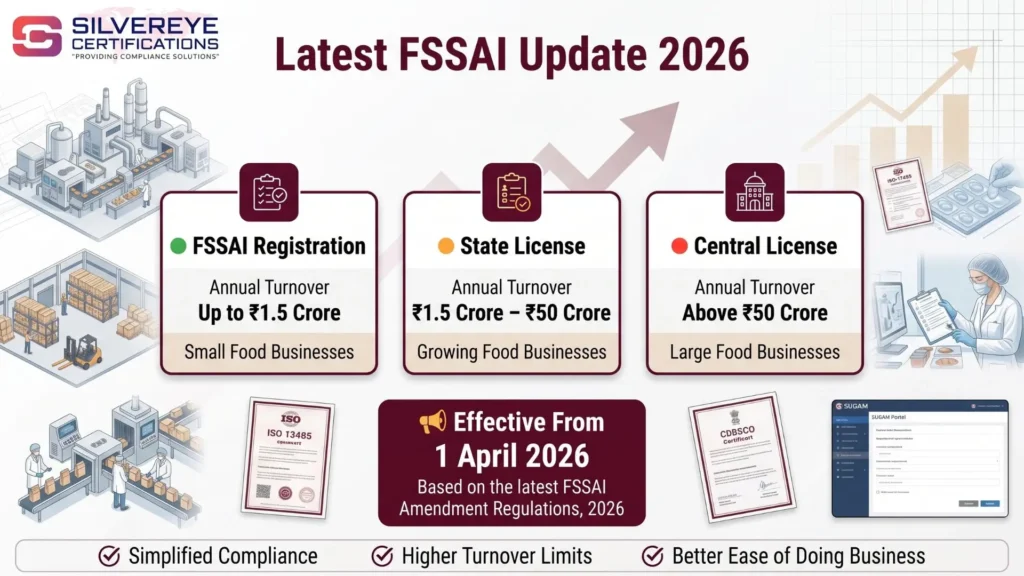
This is a meaningful simplification from older, capacity-based approaches some cold storage operators may still be working from — turnover, not tonnage capacity, is now the primary FSSAI categorization criterion for this sector. Perpetual validity also applies here: licenses/registrations issued on or after 1 April 2026 no longer expire on a fixed term, subject to risk-based inspections.
Cold Storage's Multi-Agency Licensing Reality
Here's the part that catches many new cold storage operators off guard: FSSAI is necessary, but it's rarely sufficient on its own for a cold storage facility. Because cold storage involves refrigerants, significant energy use, and specific structural requirements, several other regulators typically get involved before you can legally operate.
| Approval | Issuing Authority | Why It's Needed |
| FSSAI License/Registration | Food Safety and Standards Authority of India | Mandatory food safety compliance for any commercial food storage activity |
| WDRA Registration | Warehousing Development and Regulation Authority | Governs warehouse operations under the Warehousing (Development and Regulation) Act, 2007, particularly relevant for facilities issuing negotiable warehouse receipts |
| Pollution Control Board NOC | State Pollution Control Board | Consent to Establish and Consent to Operate, required due to refrigerant use and associated energy/environmental impact |
| Factory Inspectorate approval | State Factory Inspectorate/Labour Department | Applicable where the facility qualifies as a factory under labour law, given machinery and workforce involved |
| Electrical Inspectorate approval | State Electrical Inspectorate | Required given the high electrical load of industrial refrigeration systems |
Cold storage in India also operates under the backdrop of the Cold Storage Order, 1964 (issued under the Essential Commodities Act, 1955), which historically governed licensing, construction standards, and rate regulation for cold storages handling essential commodities — this sits alongside, not instead of, your FSSAI obligations. Exact state-level implementation and licensing procedure can vary, so confirm the current requirements with your state's designated authority before finalizing your compliance plan.
Temperature and Hygiene Requirements FSSAI Expects
Unlike a general ambient warehouse, cold storage compliance is fundamentally about maintaining and proving temperature integrity — FSSAI's expectations here go beyond simply having a working refrigeration unit.
| Product Category | Typical Required Temperature Range |
| Dairy products | Approximately 2–4°C |
| Frozen foods (general) | -18°C or lower |
| Multi-commodity cold storage (varies by product) | Broadly -25°C to +15°C, depending on the specific commodity stored |
- Validated refrigeration systems: equipment should be commissioned and periodically checked to confirm it reliably holds the required range, not just capable of reaching it briefly.
- Continuous temperature data logging: increasingly expected practice, and often a specific requirement for clients in pharmaceutical-adjacent or export-oriented cold chains, where audit-ready temperature records are standard.
- Insulation quality: adequate panel/insulation specification matters for maintaining consistent temperature and energy efficiency — a compliance and operational cost issue simultaneously.
- Product segregation: different commodities with different temperature and odour-transfer sensitivities (for example, dairy versus certain produce) should be stored with appropriate separation.
- Documented FSMS and HACCP-aligned practices: increasingly standard for cold storage operators serving FMCG, pharmaceutical-adjacent, or export clients, even where not strictly mandated by FSSAI alone.
Government Subsidy Schemes for Cold Storage Projects
If you're setting up a new cold storage facility, it's worth knowing that FSSAI compliance planning and subsidy eligibility often go hand in hand — most schemes expect a properly licensed, compliant facility as part of the funding conditions.
| Scheme | Administering Body | Subsidy Level |
| PMKSY–ICCVAI (Integrated Cold Chain and Value Addition Infrastructure) | Ministry of Food Processing Industries (MoFPI) | Grant of up to ₹10 crore, covering 35% of eligible project cost in general areas, 50% in difficult/hilly and North-Eastern areas |
| NHB Capital Investment Subsidy | National Horticulture Board | 35% credit-linked subsidy in general areas, 50% in North-Eastern/hilly areas, for qualifying cold storage infrastructure |
| State-level horticulture mission schemes / MIDH / NCDC schemes | Respective state and central agri-infrastructure bodies | Varies by scheme and state, often layered alongside central schemes |
Applications typically run through the Ministry of Food Processing Industries' SAMPADA portal via periodic Expression of Interest (EOI) calls, and capital subsidy is usually back-ended — released only after project commissioning and physical inspection, commonly several months after the facility becomes operational. This means FSSAI licensing and other statutory approvals generally need to be in place well before subsidy disbursement, not as an afterthought.
Documents Required for FSSAI Warehouse and Cold Storage License
Common documents (all categories)
- Photo ID proof of the Food Business Operator (Aadhaar, PAN, Voter ID, Passport, or Driving License)
- Address proof of the storage facility (electricity bill, rent agreement, or property tax receipt)
- List of food products/categories to be stored
Additional documents for State/Central License
- Business constitution certificate — GST registration, Certificate of Incorporation, Partnership Deed, or Udyam Registration
- Layout plan of the facility, showing storage zones, loading/unloading areas, and — for cold storage — refrigeration plant room location
- Refrigeration/temperature-control equipment specifications and capacity details, for cold and controlled-atmosphere storage
- Food Safety Management System (FSMS) plan, including temperature monitoring and product handling procedures
- Water testing report from an NABL-accredited laboratory, where applicable
Additional approvals for cold storage specifically
- Pollution Control Board Consent to Establish/Operate
- WDRA registration, where the facility will issue negotiable warehouse receipts
- Factory and Electrical Inspectorate approvals, as applicable to your facility's classification and load

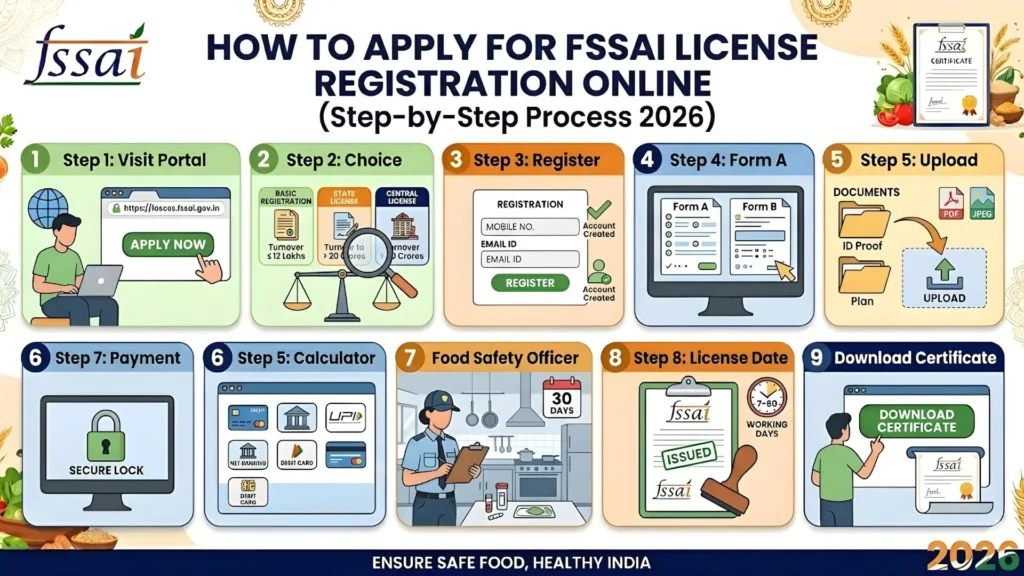
Step-by-Step FSSAI Application Process
- Identify your correct storage Kind of Business — Cold/Refrigerated, Controlled Atmosphere + Cold, or general Storage — based on how your facility actually operates.
- Register on the FoSCoS portal (foscos.fssai.gov.in) and confirm your license tier against the 2026 turnover thresholds.
- For general/ambient warehousing without atmospheric control, check Tatkal instant-issuance eligibility, subject to standard exclusions (dairy, meat, fish).
- Fill Form A (Basic Registration) or Form B (State/Central License), uploading your layout plan, refrigeration equipment details, and FSMS plan as applicable.
- Pay the applicable government fee online.
- Run your other required approvals — Pollution Control Board NOC, WDRA registration, Factory/Electrical Inspectorate clearances — in parallel, since these can each have their own multi-week or multi-month timelines.
- A Food Safety Officer inspects the facility before State/Central License approval, checking hygiene, temperature control validation, and storage practices.
- On approval, display your FSSAI certificate at the premises and reference your 14-digit number in client contracts and consignment documentation.
FSSAI Fee Chart for Warehouse and Cold Storage
| License Category | Government Fee (per year) | Typical Timeline |
| Basic Registration | ₹100 | Instant via Tatkal (ambient storage only) or 7–10 working days |
| State License | ₹5,000 | 30–60 working days (includes inspection; cold storage typically takes longer than ambient) |
| Central License | ₹7,500 | 60–90 working days (includes inspection) |
These are FSSAI government fees only. Total project setup cost for a cold storage facility is considerably higher once construction, refrigeration systems, and other statutory approvals are factored in — small-scale facilities (500–1,000 MT capacity) are commonly estimated in the ₹1.5–3.5 crore range, with larger multi-commodity or integrated facilities running considerably higher, though actual costs vary significantly by location, scale, and specification.
Renewal and Ongoing Compliance
- Perpetual validity: standard-route FSSAI licenses/registrations granted after 1 April 2026 no longer expire on a fixed term, subject to risk-based inspections.
- Older, fixed-term licenses: renew at least 30 days before expiry to avoid the ₹100-per-day late fee.
- Annual Return (Form D-1): due by 31 May every year for State/Central License holders.
- Ongoing temperature monitoring records: expect these to be reviewed during inspections and audits — maintaining logs isn't a one-time setup task but an ongoing operational discipline.
- Separate renewal cycles: your WDRA registration, Pollution Control Board consent, and other approvals each follow their own renewal schedules independent of your FSSAI license — track them separately.
Penalties for Non-Compliance
Operating a warehouse or cold storage facility without valid FSSAI registration or license is a punishable offence under the FSS Act, 2006 — penalties of up to ₹5 lakh and imprisonment of up to six months apply for operating without a license. Beyond FSSAI-specific penalties, operating without the Pollution Control Board's Consent to Operate, or without required Factory/Electrical Inspectorate clearances, can independently trigger closure or penalty action from those respective authorities.
Frequently Asked Questions
Is FSSAI license mandatory for a cold storage or warehouse business?
Yes. Any facility storing food commercially — ambient or refrigerated — needs FSSAI Basic Registration or a State/Central License, based on turnover.
Is cold storage licensing still based on tonnage capacity?
No, not as the primary criterion. As of the FoSCoS matrix updated 1 April 2026, cold storage is classified purely by annual turnover, the same as most other FSSAI categories.
Does a cold storage facility need more than an FSSAI license?
Yes, typically. Most cold storage facilities also need WDRA registration (if issuing warehouse receipts), a Pollution Control Board NOC due to refrigerant use, and Factory/Electrical Inspectorate approvals — FSSAI is necessary but rarely sufficient alone.
What temperature does FSSAI expect for cold storage?
It depends on the commodity — commonly around 2–4°C for dairy products and -18°C or lower for frozen foods, with multi-commodity facilities often operating across a broader -25°C to +15°C range depending on what's stored.
What government subsidies are available for cold storage projects?
Schemes like PMKSY-ICCVAI (up to ₹10 crore, 35–50% of eligible cost) and the NHB Capital Investment Subsidy (35–50%, credit-linked) are the primary central schemes, often supplemented by state-level horticulture mission programmes.
What is the FSSAI license fee for a warehouse or cold storage business?
₹100 per year for Basic Registration, ₹5,000 per year for a State License, and ₹7,500 per year for a Central License, based on turnover.
Can an ambient warehouse use FSSAI's Tatkal instant-issuance scheme?
Generally yes, for storage without atmospheric control and excluding dairy, meat, or fish handling. Cold and controlled-atmosphere storage typically go through the standard licensing route with inspection instead.
What documents are required for a cold storage FSSAI license?
At minimum: photo ID, premises proof, and a product list. State/Central applications additionally need a layout plan, refrigeration equipment specifications, an FSMS plan with temperature monitoring procedures, and typically supporting documentation for your Pollution Control Board and WDRA approvals.
How much does it cost to set up a cold storage facility in India?
Total project cost varies widely — small-scale facilities (roughly 500–1,000 MT capacity) are commonly estimated around ₹1.5–3.5 crore, with larger, multi-commodity, or integrated facilities costing considerably more, before accounting for available government subsidies covering 35–50% of eligible costs.
How long does it take to get an FSSAI license for a cold storage facility?
State Licenses typically take 30–60 working days and Central Licenses 60–90 working days, with cold storage facilities often taking longer than ambient warehouses due to more detailed inspection requirements.
Is the FSSAI license for cold storage now valid for a lifetime?
Licenses granted under the 2026 amended regulations carry perpetual validity, subject to periodic risk-based inspections — they no longer need renewal every 1–5 years.
What is the penalty for operating a cold storage facility without an FSSAI license?
Operating without a valid FSSAI license can attract a penalty of up to ₹5 lakh and imprisonment of up to six months under the FSS Act, 2006, independent of any penalties for missing other required approvals like a Pollution Control Board consent.