
- FSSAI License for Fish Processing: Under the FoSCoS Kind of Business matrix effective 1 April 2026, fish and fish product processing is classified by annual turnover: Basic Registration up to ₹1.5 crore, State License up to ₹50 crore (₹5,000/year), and Central License above ₹50 crore (₹7,500/year). Verify the applicable category and fee against the current FoSCoS requirements before applying.
- Hygiene and Food Safety: Even small fish-processing units must comply with applicable FSSAI hygiene, food-safety, and testing requirements. Basic Registration does not exempt a business from mandatory compliance.
- Seafood Export Approvals: Export-oriented seafood businesses may require MPEDA registration and EIC/EIA approval of processing establishments, as applicable. These are separate requirements and do not replace the FSSAI licence.
- HACCP and Export Compliance: Seafood exporters must meet applicable HACCP-based food-safety requirements and destination-country standards. Exports to the European Union (EU) are subject to additional establishment-approval and food-safety requirements.
Introduction
An FSSAI license for seafood and fish processing businesses is a mandatory food safety approval for applicable fish handlers, processors, and seafood exporters operating in India. Under the FoSCoS Kind of Business matrix updated on 1 April 2026, fish and fish products processing is classified by annual turnover: Basic Registration up to ₹1.5 crore, State License up to ₹50 crore, and Central License above ₹50 crore.
Businesses must comply with applicable food safety, hygiene, and testing requirements, regardless of their license category. Seafood exporters may also need separate MPEDA registration and EIC/EIA approval of processing establishments, depending on the applicable export requirements. HACCP-based food safety controls may also be required under the relevant regulatory and destination-market framework.
What Is an FSSAI License for Seafood and Fish Processing?
An FSSAI license for seafood and fish processing is the food safety approval issued by the Food Safety and Standards Authority of India (FSSAI) to applicable businesses that handle, process, pack, store, distribute, or transport fish and fish products. This covers fish markets and retail counters, fish processing plants, shrimp and prawn peeling units, canning and value-added seafood manufacturers, cold storage and freezing facilities for seafood, and export-oriented processing plants.
FSSAI's official Kind of Business (KoB) definition describes fish processing broadly — handling, processing, manufacturing of fish products, packing, storing, distribution, and transportation of fish and fish products — covering the entire chain from the point fish leaves the water to the point it reaches a consumer or an export container.
Why Seafood and Fish Businesses Need This License
- Legal requirement: Processing or selling fish and fish products without a valid FSSAI license or registration, as applicable, can be an offence under the Food Safety and Standards Act, 2006, with penalties depending on the specific violation.
- High contamination risk: Fish and seafood spoil quickly and carry specific risks, including histamine formation, microbial contamination, and parasite contamination, making licensing and hygiene compliance especially important in this category.
- Export market access: Seafood exporters may need FSSAI compliance, MPEDA registration, and EIC/EIA approval, depending on their activities and applicable export requirements.
- Retail and distribution trust: Supermarkets, seafood delivery platforms, and institutional buyers may check for valid FSSAI registration or licensing before sourcing from a fish supplier or processor.
2026 Update: Fish Processing Licensing Is Now Turnover-Based
This is important and frequently misunderstood, since some published guidance still treats fish and meat processing as automatically requiring a higher-tier license regardless of scale. FSSAI Order No. RCD-01002/1/2021-Regulatory-FSSAI-Part(1), dated 13 March 2026, revised the turnover thresholds for food business categorization under the Food Safety and Standards (Licensing and Registration of Food Businesses) Amendment Regulations, 2026, with the changes effective 1 April 2026.
The FoSCoS Kind of Business Eligibility Matrix, updated 1 April 2026, identifies Fish and Fish Products as a distinct Kind of Business classified by turnover:
| License Type | Turnover Threshold (from 1 April 2026) | Annual Fee |
|---|---|---|
| Basic Registration | Annual turnover up to ₹1.5 crore | ₹100 |
| State License | Annual turnover above ₹1.5 crore up to ₹50 crore | ₹5,000 |
| Central License | Annual turnover above ₹50 crore | ₹7,500 |
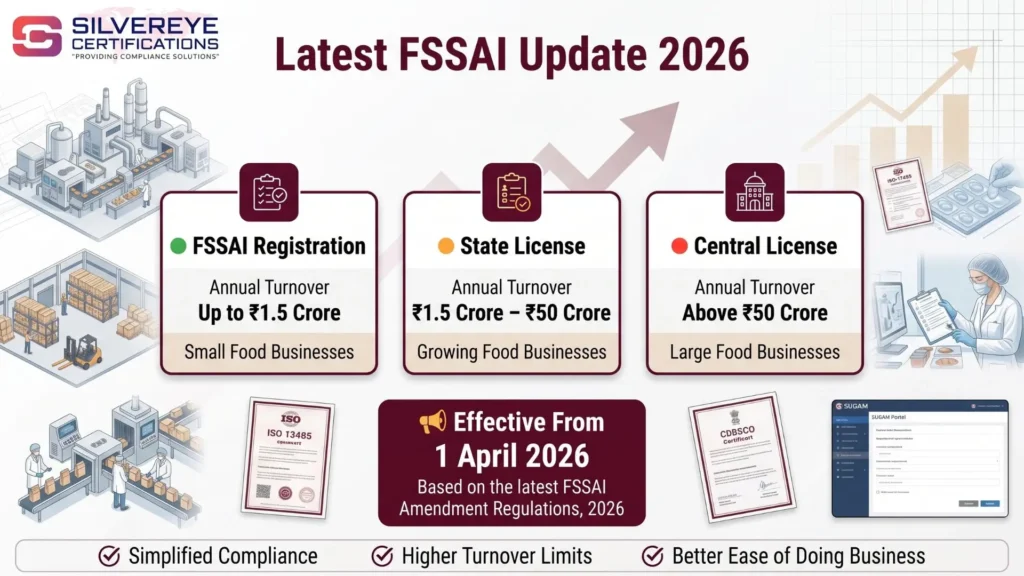
A key clarification worth stating plainly: fish processing businesses, dairy businesses, slaughtering units, and meat processing businesses may now qualify for Basic Registration if their annual turnover is up to ₹1.5 crore, subject to the applicable eligibility conditions.
FSSAI's FAQ dated 27 March 2026 also clarifies that these businesses must continue to comply fully with the applicable hygiene, food safety, and testing requirements, regardless of their license tier. In other words, Basic Registration does not relax food-safety obligations; it changes the applicable registration or licensing category for eligible small operators.
Fish Processing vs Meat Processing vs Slaughtering: Separate FSSAI Categories
FSSAI treats these as three distinct Kind of Business categories, even though they're often discussed together as high-risk food businesses. If your operation spans more than one category — for example, a combined poultry and fish retail counter — you may need to select multiple KoBs in your application.
| Kind of Business | What It Covers | License Basis |
|---|---|---|
| Fish and Fish Products | Handling, processing, manufacturing of fish products, packing, storing, distribution, and transportation of fish and fish products | Annual turnover — Registration up to ₹1.5 crore, State up to ₹50 crore, Central above ₹50 crore |
| Meat Processing Units | Further processing of slaughtered animals or poultry into meat and meat products, including packaging, storage, and transportation | Annual turnover, subject to the applicable category and eligibility conditions |
| Slaughtering Units | Activities involving the transport, stunning, butchering, dressing, processing, storage, and distribution of animals or poultry birds | Annual turnover, subject to the applicable category and eligibility conditions |
MPEDA Registration: A Separate Requirement for Seafood Exporters
If you plan to export seafood, FSSAI licensing alone is not enough — you also need registration with the Marine Products Export Development Authority (MPEDA), which operates under the Ministry of Commerce and Industry. MPEDA registration is generally mandatory for marine product exporters in India, subject to applicable exceptions, and operates independently of your FSSAI license.
- Manufacturer Exporters (MT): Businesses that own or operate an MPEDA-registered processing or handling facility and export marine products directly.
- Merchant Exporters (ME): Exporters who use the surplus capacity of an approved processing or handling facility without owning their own plant. The relevant facility and agreement requirements must be fulfilled.
- Quality and technical support: MPEDA supports exporters through quality improvement programmes, training, and guidance on food safety practices, including HACCP implementation.
- Export compliance: Exporting without the required MPEDA registration can cause export clearance and consignment issues, in addition to any separate FSSAI compliance consequences.
EIC/EIA Plant Approval and HACCP: Requirements for Export Units
In addition to MPEDA registration, seafood processing facilities may need approval from the Export Inspection Agency (EIA) under the Export Inspection Council (EIC) of India, depending on the product, destination market, and applicable export requirements. This is separate from the FSSAI license and MPEDA exporter registration. MPEDA's official exporter guidance describes obtaining EIA approval as a separate step in the registration process.
| Approval or Requirement | What It Involves | Applicable Market |
|---|---|---|
| Non-EU export plant approval | Applicable plant registration or approval, inspections, and compliance with relevant hygiene and food safety requirements | Countries outside the European Union, where required |
| EU-approved establishment | Compliance with applicable EU requirements and approval or listing of the establishment for eligible products | European Union, where required |
| US FDA requirements | Applicable FDA food facility registration, prior notice, seafood safety requirements, and other import conditions | United States |
HACCP (Hazard Analysis and Critical Control Points) is a food safety system for identifying, evaluating, and controlling hazards at different stages of processing. Seafood exporters must follow the HACCP-based controls and other food safety requirements applicable to their products and destination markets.
However, a separate third-party HACCP certificate should not be described as universally mandatory for every export-oriented seafood unit unless the applicable scheme, buyer, or importing market specifically requires it. Private standards such as BAP or ASC may also be relevant to certain aquaculture products and buyers.
Documents Required for FSSAI License for Fish and Seafood Businesses
Common Documents
- Photo ID proof of the Food Business Operator (FBO), such as Aadhaar, PAN, Voter ID, Passport, or Driving Licence.
- Address proof of the processing unit or premises, such as an electricity bill, rent agreement, or property tax receipt.
- Photograph of the processing or production unit, where required.
- List of fish and seafood products to be handled or processed.
Additional Documents for State or Central License
- Business constitution documents, such as a Partnership Deed or Certificate of Incorporation, as applicable.
- Layout plan of the processing unit, showing relevant areas for receiving, processing, chilling/freezing, and packaging.
- List of machinery and cold-chain equipment, including capacity details, where required.
- Food Safety Management System (FSMS) plan, addressing seafood-related hazards such as histamine formation, microbial contamination, and temperature abuse.
- Water testing report from an appropriately recognised laboratory, where applicable.
Additional Documents for Export-Oriented Units
- MPEDA exporter registration certificate, as applicable.
- EIC/EIA plant approval or registration documents, where required for the product and destination market.
- HACCP plan and supporting food safety records; a separate certificate may be needed if specifically required.
- Turnover or financial documents and Form IX nomination, where applicable to the selected FSSAI license category and application.
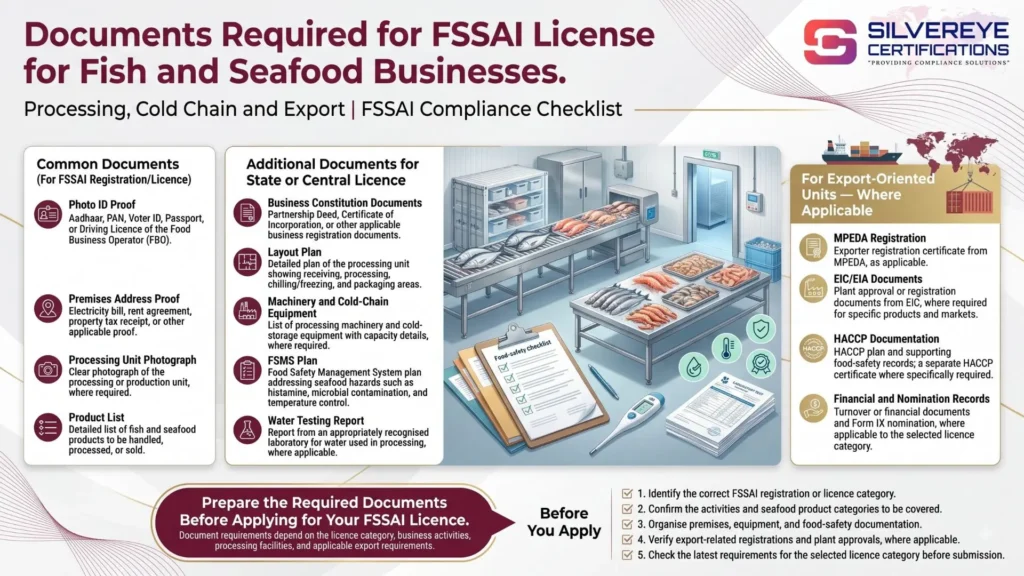
The exact document list can vary by license category, Kind of Business, facility type, and export destination. Check the current FoSCoS application checklist before submitting.
Step-by-Step FSSAI Application Process
- Register on FoSCoS: Visit foscos.fssai.gov.in and select Fish and Fish Products as your Kind of Business, if it matches your activities.
- Confirm the license category: Check the current turnover thresholds and any other applicable eligibility conditions instead of assuming that fish processing always requires a higher-tier license.
- Complete the application: Submit Form A for Basic Registration or Form B for a State or Central License, as applicable, with the required premises, product, and food safety details.
- Start export registrations separately: If exporting, arrange MPEDA registration and any required EIC/EIA plant approval through their respective application processes.
- Pay the applicable government fee: Complete the payment shown for your FSSAI application category.
- Prepare for scrutiny or inspection: The authority may examine your documents or inspect the processing unit, as applicable, including its hygiene practices, cold-chain controls, and processing conditions.
- Display and use your FSSAI number: Once approved, display the certificate as required and include the 14-digit FSSAI registration or license number on applicable product labels and business documentation.
- Check export-specific requirements before shipping: Confirm that the required MPEDA registration, plant approvals, food safety controls, and destination-market documents are current before dispatching seafood.
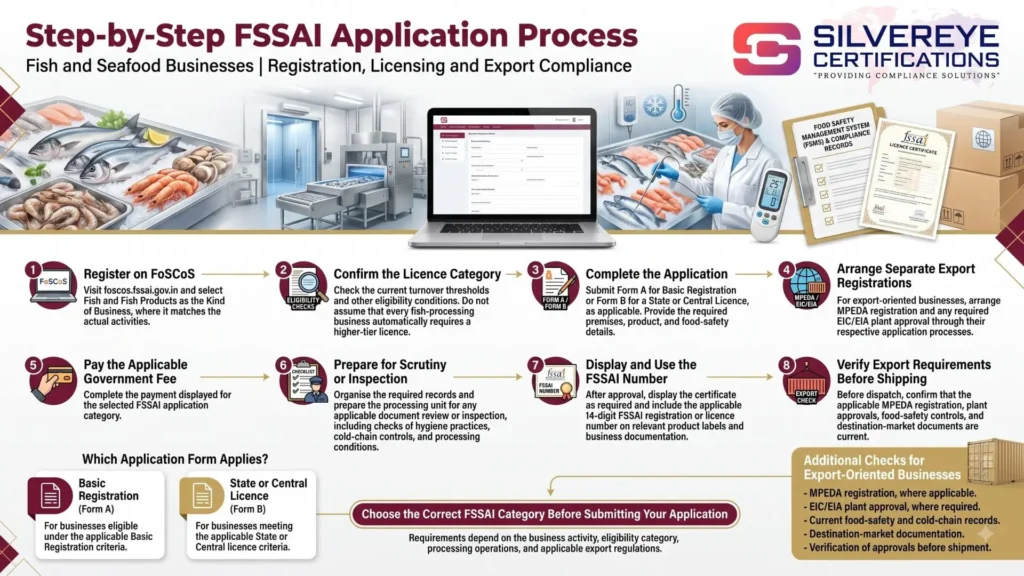
Important: FSSAI licensing, MPEDA exporter registration, EIC/EIA plant approval, and destination-country requirements are separate compliance matters. The approvals applicable to your business depend on what you process, the facility you use, and where you export.
MPEDA Registration: A Separate Requirement for Seafood Exporters
If you plan to export seafood, FSSAI licensing alone is not enough — you also need registration with the Marine Products Export Development Authority (MPEDA), which operates under the Ministry of Commerce and Industry. MPEDA registration is generally mandatory for marine product exporters in India, subject to applicable exceptions, and operates independently of your FSSAI license.
- Manufacturer Exporters (MT): Businesses that own or operate an MPEDA-registered processing or handling facility and export marine products directly.
- Merchant Exporters (ME): Exporters who use the surplus capacity of an approved processing or handling facility without owning their own plant. The relevant facility and agreement requirements must be fulfilled.
- Quality and technical support: MPEDA supports exporters through quality improvement programmes, training, and guidance on food safety practices, including HACCP implementation.
- Export compliance: Exporting without the required MPEDA registration can cause export clearance and consignment issues, in addition to any separate FSSAI compliance consequences.
EIC/EIA Plant Approval and HACCP: Requirements for Export Units
In addition to MPEDA registration, seafood processing facilities may need approval from the Export Inspection Agency (EIA) under the Export Inspection Council (EIC) of India, depending on the product, destination market, and applicable export requirements. This is separate from the FSSAI license and MPEDA exporter registration. MPEDA's official exporter guidance describes obtaining EIA approval as a separate step in the registration process.
| Approval or Requirement | What It Involves | Applicable Market |
|---|---|---|
| Non-EU export plant approval | Applicable plant registration or approval, inspections, and compliance with relevant hygiene and food safety requirements | Countries outside the European Union, where required |
| EU-approved establishment | Compliance with applicable EU requirements and approval or listing of the establishment for eligible products | European Union, where required |
| US FDA requirements | Applicable FDA food facility registration, prior notice, seafood safety requirements, and other import conditions | United States |
HACCP (Hazard Analysis and Critical Control Points) is a food safety system for identifying, evaluating, and controlling hazards at different stages of processing. Seafood exporters must follow the HACCP-based controls and other food safety requirements applicable to their products and destination markets.
However, a separate third-party HACCP certificate should not be described as universally mandatory for every export-oriented seafood unit unless the applicable scheme, buyer, or importing market specifically requires it. Private standards such as BAP or ASC may also be relevant to certain aquaculture products and buyers.
Documents Required for FSSAI License for Fish and Seafood Businesses
Common Documents
- Photo ID proof of the Food Business Operator (FBO), such as Aadhaar, PAN, Voter ID, Passport, or Driving Licence.
- Address proof of the processing unit or premises, such as an electricity bill, rent agreement, or property tax receipt.
- Photograph of the processing or production unit, where required.
- List of fish and seafood products to be handled or processed.
Additional Documents for State or Central License
- Business constitution documents, such as a Partnership Deed or Certificate of Incorporation, as applicable.
- Layout plan of the processing unit, showing relevant areas for receiving, processing, chilling/freezing, and packaging.
- List of machinery and cold-chain equipment, including capacity details, where required.
- Food Safety Management System (FSMS) plan, addressing seafood-related hazards such as histamine formation, microbial contamination, and temperature abuse.
- Water testing report from an appropriately recognised laboratory, where applicable.
Additional Documents for Export-Oriented Units
- MPEDA exporter registration certificate, as applicable.
- EIC/EIA plant approval or registration documents, where required for the product and destination market.
- HACCP plan and supporting food safety records; a separate certificate may be needed if specifically required.
- Turnover or financial documents and Form IX nomination, where applicable to the selected FSSAI license category and application.
The exact document list can vary by license category, Kind of Business, facility type, and export destination. Check the current FoSCoS application checklist before submitting.
Step-by-Step FSSAI Application Process
- Register on FoSCoS: Visit foscos.fssai.gov.in and select Fish and Fish Products as your Kind of Business, if it matches your activities.
- Confirm the license category: Check the current turnover thresholds and any other applicable eligibility conditions instead of assuming that fish processing always requires a higher-tier license.
- Complete the application: Submit Form A for Basic Registration or Form B for a State or Central License, as applicable, with the required premises, product, and food safety details.
- Start export registrations separately: If exporting, arrange MPEDA registration and any required EIC/EIA plant approval through their respective application processes.
- Pay the applicable government fee: Complete the payment shown for your FSSAI application category.
- Prepare for scrutiny or inspection: The authority may examine your documents or inspect the processing unit, as applicable, including its hygiene practices, cold-chain controls, and processing conditions.
- Display and use your FSSAI number: Once approved, display the certificate as required and include the 14-digit FSSAI registration or license number on applicable product labels and business documentation.
- Check export-specific requirements before shipping: Confirm that the required MPEDA registration, plant approvals, food safety controls, and destination-market documents are current before dispatching seafood.
Important: FSSAI licensing, MPEDA exporter registration, EIC/EIA plant approval, and destination-country requirements are separate compliance matters. The approvals applicable to your business depend on what you process, the facility you use, and where you export.
Conclusion
Obtaining the appropriate FSSAI license for fish and seafood processing is an important step toward operating a compliant food business in India. From selecting the correct license category to maintaining hygiene, cold-chain controls, and food safety records, every stage requires careful attention. Seafood exporters must also check applicable MPEDA registration, EIC/EIA plant approval, and destination-specific export requirements. Understanding these obligations helps businesses reduce compliance risks and build trust with buyers, distributors, and international customers.
Why Choose Silvereye Certifications?
Silvereye Certifications provides compliance support to businesses seeking FSSAI licensing and related regulatory approvals. Our team can help simplify the application process and guide you through the documentation and compliance requirements relevant to your business.
- License Category Guidance: Assistance in identifying the appropriate FSSAI registration or license based on your business activities and applicable eligibility criteria.
- Documentation Support: Help preparing and organising the required application documents and food safety information.
- Food Safety Compliance Guidance: Support with understanding applicable hygiene practices, sanitation procedures, and Food Safety Management System (FSMS) requirements.
- Export Compliance Guidance: Assistance in understanding separate requirements relating to MPEDA registration and EIC/EIA plant approval, where applicable.
- Application Assistance: Guidance through the relevant application steps and responses to queries or deficiencies raised by the authorities.
Whether you operate a fish processing unit, seafood manufacturing facility, cold storage business, or seafood export company, Silvereye Certifications can help you understand the applicable compliance requirements and prepare your application more effectively.
Need help with your FSSAI license for fish and seafood processing? Contact Silvereye Certifications for guidance tailored to your business activities and licensing requirements.
Frequently Asked Questions
Is FSSAI license mandatory for fish and seafood businesses?
Yes. Any business handling, processing, packing, storing, distributing, or transporting fish and fish products needs FSSAI Basic Registration or a State/Central License, based on turnover.
Can a small fish processing unit get Basic Registration?
Yes. As confirmed in FSSAI's FAQ dated 27 March 2026 and the FoSCoS Kind of Business matrix updated 1 April 2026, fish processing businesses with turnover up to ₹1.5 crore can obtain Basic Registration — though they must still meet the full hygiene, safety, and testing standards applicable to this high-risk category.
What is the FSSAI license fee for a fish processing business?
₹100 per year for Basic Registration (turnover up to ₹1.5 crore), ₹5,000 per year for a State License (₹1.5 crore–₹50 crore turnover), and ₹7,500 per year for a Central License (above ₹50 crore turnover).
Do I need MPEDA registration in addition to my FSSAI license?
Yes, if you export seafood. MPEDA registration is a separate, mandatory requirement from the Marine Products Export Development Authority, independent of your FSSAI license, and is required for anyone exporting marine products from India.
Is HACCP certification mandatory for all fish processing units?
It's specifically mandatory for export-oriented seafood units. Domestic-only processors aren't legally required to hold HACCP certification, though many voluntarily implement it as good practice, and larger buyers increasingly expect it regardless of export status.
What's the difference between EU-approved and non-EU approved seafood plants?
Non-EU approved units need HACCP implementation, EIA inspections, and GMP compliance to export to most countries. EU-approved units face the stricter standard — full HACCP compliance plus EU-standard infrastructure — and are issued a specific EU plant approval number, required for exporting to European Union countries.
Are fish and meat processing treated as the same FSSAI Kind of Business?
No. FSSAI treats 'Fish and Fish Products,' 'Meat Processing Units,' and 'Slaughtering Units' as three separate Kind of Business categories, even though all three follow the same turnover-based license structure.
Can a fish market or retail fish seller use FSSAI's Tatkal instant-issuance scheme?
Generally no — businesses handling fresh, unprocessed fish and meat are typically excluded from Tatkal for most Kind of Business categories, and should expect the standard licensing route instead.
What documents are required for an FSSAI license as a fish processor?
At minimum: photo ID, premises proof, a photograph of the unit, and a product list. State and Central applications additionally need a layout plan, machinery/cold chain details, FSMS plan, and water testing report.
Does the FSSAI license cover both domestic sale and export of seafood?
FSSAI licensing covers domestic food safety compliance. Exporting additionally requires MPEDA registration and EIC/EIA plant approval — these are separate approvals from separate authorities, not automatically included with your FSSAI license.
What happens if I export seafood without MPEDA registration?
You cannot legally export marine products from India without MPEDA registration — attempting to do so can lead to shipment issues at export, independent of and in addition to any FSSAI-related compliance problems.
What is the penalty for processing or selling fish without an FSSAI license?
Operating without a valid FSSAI license can attract a penalty of up to ₹5 lakh and imprisonment of up to six months under the FSS Act, 2006, in addition to possible unit shutdown orders.