

- Most home-based food sellers with turnover up to ₹1.5 crore qualify for simple Basic Registration (₹100/year) under the revised 2026 thresholds, effective 1 April 2026.
- Cloud kitchens are treated the same as any restaurant by FSSAI — Swiggy and Zomato require a valid FSSAI number before onboarding, and both platforms commonly insist on a State License rather than Basic Registration in practice.
- Street food vendors, hawkers, and food trucks already registered under the Street Vendors Act, 2014 are now deemed registered under FSSAI too — no separate application or extra fee needed.
- FSSAI licenses/registrations granted after 1 April 2026 carry perpetual validity, but will be automatically suspended if annual fees or returns aren't filed on time.
Introduction
An FSSAI license for cloud kitchens and home-based food businesses is the mandatory food safety approval every home baker, tiffin service, and delivery-only kitchen needs before selling food in India — online or offline. Home-based sellers with turnover up to ₹1.5 crore typically need only Basic Registration (₹100/year), while cloud kitchens usually need a State License (₹2,000–₹5,000/year), since Swiggy and Zomato routinely require it for onboarding regardless of turnover.
A 2026 regulatory update also removed duplicate registration for street food vendors already registered under the Street Vendors Act, and all licenses issued after 1 April 2026 now carry perpetual validity instead of a fixed renewal term.
What Is an FSSAI License for Cloud Kitchens and Home-Based Food Businesses?
An FSSAI license or registration for cloud kitchens and home-based food businesses is the food safety approval issued by the Food Safety and Standards Authority of India to anyone who prepares and sells food from a home kitchen or a delivery-only commercial kitchen — home bakers, tiffin and meal-prep services, dessert makers, dark/cloud kitchen operators, and multi-brand virtual restaurant setups.
FSSAI doesn't distinguish between a home kitchen and a commercial dine-in restaurant when it comes to legal obligation — anyone preparing food for sale needs either Basic Registration or a State/Central License, based on turnover, scale, and how the food reaches the customer (direct sale, social media orders, or delivery aggregator platforms like Swiggy and Zomato).
Why This License Matters for Home Cooks and Cloud Kitchen Founders
- Platform gatekeeping: Swiggy, Zomato, Blinkit, and similar platforms will not activate a listing without a valid, verified FSSAI number — this is checked at onboarding, not after.
- Legal requirement: Selling food without valid FSSAI registration is a punishable offence under the FSS Act, 2006, regardless of whether you operate from home or a commercial kitchen.
- Customer trust: Displaying your FSSAI number on packaging, bills, and social media listings signals legitimacy to customers ordering from a home-based or delivery-only business.
- Business growth readiness: A valid license makes it far easier to add distribution partners, apply for a current/business bank account, or eventually convert a home setup into a registered cloud kitchen brand.
2026 FSSAI Update: What Changed for Small and Home-Based Food Businesses
FSSAI's Order No. RCD-01002/1/2021-Regulatory-FSSAI-Part(1), dated 13 March 2026, revised the turnover thresholds for food business categorisation under the Food Safety and Standards (Licensing and Registration of Food Businesses) Amendment Regulations, 2026 (Gazette notification dated 10 March 2026), effective 1 April 2026.
| License Type | Old Turnover Limit (pre-2026) | New Turnover Limit (from 1 April 2026) |
| Basic Registration | Up to ₹12 lakh | Up to ₹1.5 crore |
| State License | ₹12 lakh – ₹20 crore | Above ₹1.5 crore up to ₹50 crore |
| Central License | Above ₹20 crore | Above ₹50 crore |
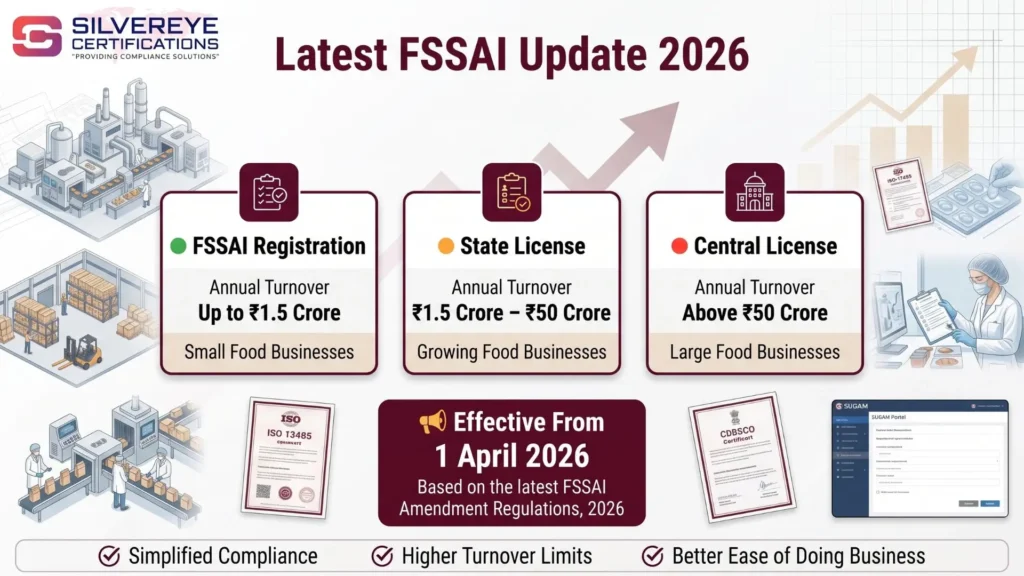
This is a major relief for home-based food businesses: most home bakers, tiffin services, and small cloud kitchens now comfortably fall under Basic Registration's much higher ₹1.5 crore ceiling, instead of the old ₹12 lakh limit that pushed many growing home businesses into State License territory.
The same amendment made two other changes directly relevant to this category:
- Removal of dual compliance for street food vendors: Vendors, hawkers, food trucks, and temporary stall holders already registered under the Street Vendors (Protection of Livelihood and Regulation of Street Vending) Act, 2014 are now deemed registered under FSSAI too, subject to meeting hygiene standards — no separate FSSAI application or extra fee is required.
- Expanded 'Petty Food Business Operator' definition: This term now explicitly covers street vendors, hawkers, itinerant vendors, temporary stall holders, food trucks, and vendors distributing food at religious or social gatherings — broadening who qualifies for simplified registration treatment.
- Perpetual validity with a catch: Registrations/licenses issued after 1 April 2026 no longer expire on a fixed term, but they will be automatically suspended if annual fees or returns aren't filed on time — so 'perpetual' doesn't mean 'set and forget.'
- Risk-based inspections: Routine inspections are moving to a computer-assisted, risk-based framework rather than blanket periodic checks, though high-risk food categories can still face closer scrutiny.
Home-Based Food Business vs Cloud Kitchen: Licensing at a Glance
| Aspect | Home-Based Food Business | Cloud Kitchen |
| Typical license needed | Basic Registration (turnover up to ₹1.5 crore) | State License in most practical cases — required by Swiggy/Zomato even where turnover alone might allow Basic Registration |
| Kitchen setup | Domestic kitchen used for both home and business cooking | Dedicated commercial kitchen space, delivery-only, no dine-in seating |
| Typical sales channel | Direct orders, WhatsApp, Instagram, local delivery, sometimes Swiggy/Zomato home-chef programs | Swiggy, Zomato, Blinkit, Zepto, and other aggregator platforms as the primary channel |
| Inspection expectation | Largely self-declared hygiene compliance for Basic Registration, subject to risk-based checks | Kitchen inspection typically required for State License approval |
| Multi-brand handling | Not usually applicable | Multiple virtual brands from one kitchen can often be covered under a single license for that premises, if under the same legal entity |
Types of FSSAI License
1. Basic Registration (turnover up to ₹1.5 crore)
The right fit for most home bakers, tiffin services, dessert sellers, and small single-brand cloud kitchens still under the turnover ceiling. Fee: ₹100 per year. Processing time: typically 2–7 working days, since it's largely a document-based, self-declared registration.
2. State License (₹1.5 crore–₹50 crore turnover, or platform requirement)
Required once turnover crosses ₹1.5 crore, or earlier in practice if you're onboarding onto Swiggy or Zomato, since both platforms commonly require a State License for restaurant and cloud kitchen partners as part of their own onboarding policy — this is a platform requirement layered on top of, not replacing, the legal FSSAI minimum. Fee: ₹2,000–₹5,000 per year. Processing time: 30–45 working days, including a kitchen inspection.
3. Central License (above ₹50 crore turnover, or multi-state operations)
Needed once a cloud kitchen brand's head office coordinates operations across more than one state — the head office typically takes the Central License, while each individual kitchen location still needs its own State License for that city/state. Fee: ₹7,500 per year.
Important nuance: FSSAI's legal minimum and a delivery platform's onboarding requirement are two different things. Even if your turnover alone would technically qualify you for Basic Registration, Swiggy and Zomato may still require a State License before activating your listing — always check current platform partner requirements alongside the FSSAI eligibility rule.

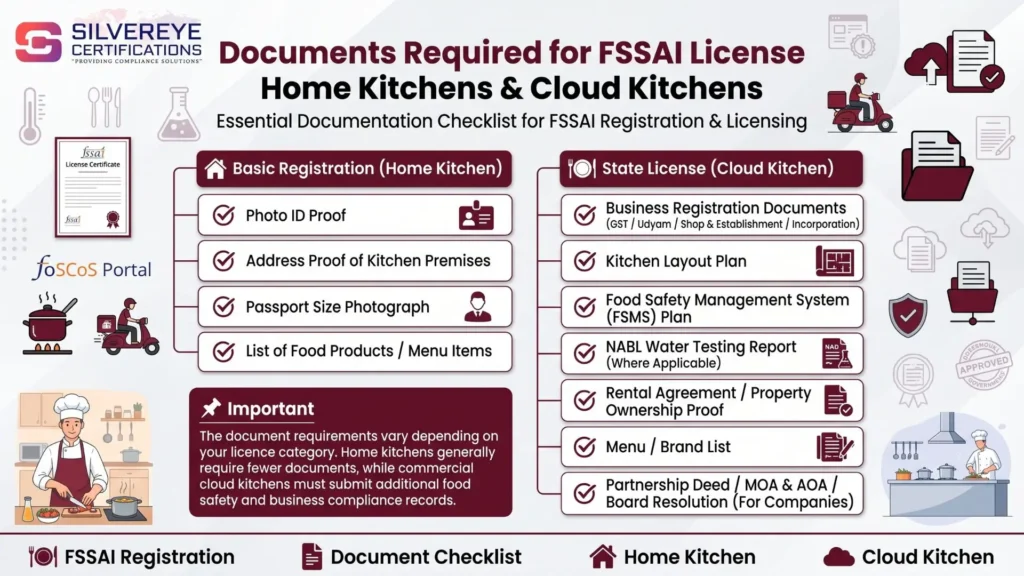
Documents Required for FSSAI License — Home Kitchens and Cloud Kitchens
For Basic Registration (home-based businesses)
- Photo ID proof of the Food Business Operator (Aadhaar, PAN, Voter ID, Passport, or Driving License)
- Address proof of the home/kitchen premises (electricity bill, rent agreement, or property tax receipt)
- Passport-size photograph of the applicant
- List of food items to be prepared and sold
For State License (cloud kitchens)
- Business constitution certificate — GST registration, Shop & Establishment certificate, Udyam Registration, or Certificate of Incorporation
- Kitchen layout plan, drawn to scale, showing food prep, storage, and packaging areas
- Food Safety Management System (FSMS) plan
- Water testing report from an NABL-accredited laboratory, where the kitchen uses significant process water
- Rental agreement or ownership proof for the commercial kitchen space
- List of menu items/brands to be operated from the kitchen, especially for multi-brand cloud kitchen setups
- Partnership deed / MOA & AOA, and board resolution authorising the signatory, for companies
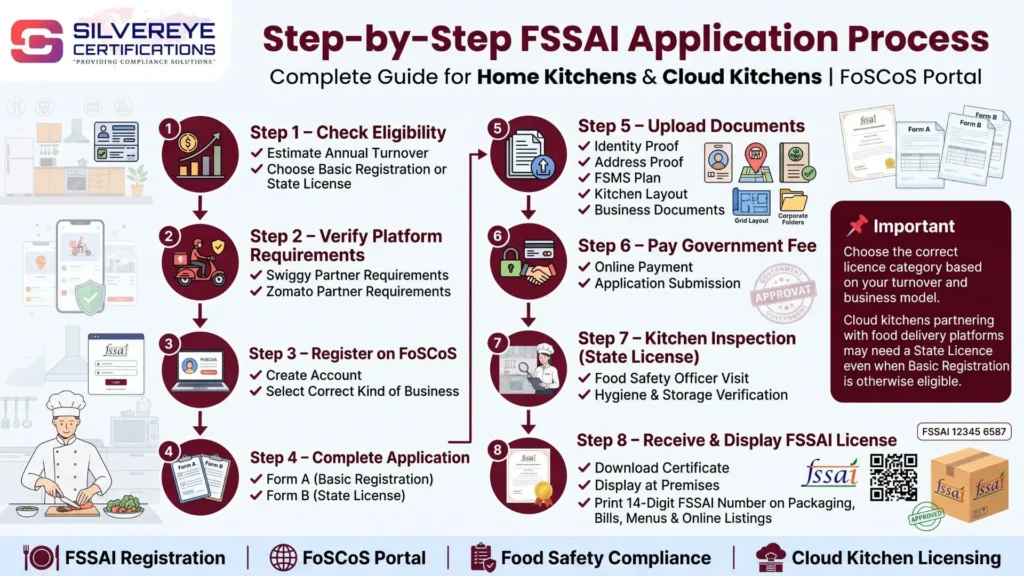
Step-by-Step FSSAI Application Process
- Estimate your annual turnover honestly against the 2026 thresholds to confirm whether Basic Registration or a State License applies to you.
- If you plan to list on Swiggy, Zomato, or similar platforms, check their current partner onboarding requirements — many require a State License even for smaller cloud kitchens.
- Register on the FoSCoS portal and select the correct Kind of Business — 'Petty Food Business Operator' for most home-based sellers, or 'Restaurant/Cloud Kitchen' for a delivery-only commercial setup.
- Fill Form A (Basic Registration) or Form B (State License) with your details, kitchen address, and product list.
- Upload the required documents — ID and address proof for Basic Registration; layout plan, FSMS plan, and business constitution documents for State License.
- Pay the government fee online.
- For State License applications, a Food Safety Officer inspects the kitchen for basic hygiene, storage, and food-handling practices before approval.
- On approval, display your FSSAI certificate at the premises and print the 14-digit number on packaging, bills, menus, and your platform/social media listings.
FSSAI Fee Chart for Home-Based Food Businesses and Cloud Kitchens
| License Category | Government Fee (per year) | Typical Timeline |
| Basic Registration | ₹100 | 1 working days |
| State License | ₹2,000 – ₹5,000 (scale-dependent) | 30–45 working days (includes kitchen inspection) |
| Central License (multi-state head office) | ₹7,500 | 60–90 working days |
These are government fees only. If you use a consultant or CA to handle the filing, expect an additional service fee on top of the government charge — this varies by provider and is not an FSSAI cost.
Street Food Vendors and the 2026 Deemed Registration Rule
If your home-based food journey includes or overlaps with street vending — food trucks, temporary stalls, or hawking — the 2026 amendment specifically simplified your compliance:
- If you already hold a valid vending certificate under the Street Vendors Act, 2014, you are now automatically treated as FSSAI-registered too.
- No separate FSSAI application or additional government fee is required for this deemed registration.
- You must still meet FSSAI's hygiene and sanitary standards under Schedule 4 — deemed registration doesn't remove the underlying safety obligation, only the duplicate paperwork.
- If you don't yet hold a vending certificate, you'll still need to apply for FSSAI Basic Registration directly as a Petty Food Business Operator.
Renewal, Suspension, and Ongoing Compliance
- Perpetual validity: licenses/registrations granted after 1 April 2026 no longer expire on a fixed 1–5 year term.
- Automatic suspension risk: if annual fees or required returns aren't filed on time, your registration/license is deemed suspended, and you cannot legally operate until it's cleared — 'perpetual' validity still requires active upkeep.
- Older, fixed-term licenses: renew at least 30 days before expiry to avoid the ₹100-per-day late fee and possible listing suspension on delivery platforms.
- Change of address: since FSSAI approval is premises-specific, moving your home kitchen or cloud kitchen location requires a fresh application, not just an address update.
- Business closure: notify the registering authority in writing at least 30 days before shutting down, and formally surrender your registration/license certificate.
Penalties for Non-Compliance
Selling food — from a home kitchen, food truck, or cloud kitchen — without valid FSSAI registration or license is a punishable offence under the FSS Act, 2006, with penalties of up to ₹5 lakh and imprisonment of up to six months. In practice, the more immediate consequence for most home and cloud kitchen sellers is losing access to delivery platforms, since Swiggy and Zomato will suspend or refuse listings for unverified or expired FSSAI numbers.
Frequently Asked Questions
Do I need FSSAI registration to sell food from home?
Yes. Any home-based food business — baking, tiffin services, home-cooked meals — needs at least FSSAI Basic Registration before selling, whether through direct orders, social media, or delivery platforms.
Is Basic Registration enough for a cloud kitchen, or do I need a State License?
Legally, turnover up to ₹1.5 crore qualifies for Basic Registration. In practice, though, Swiggy and Zomato commonly require a State License for cloud kitchen onboarding regardless of your turnover, so check current platform requirements before assuming Basic Registration will get you listed.
What is the FSSAI registration fee for a home-based food business?
₹100 per year for Basic Registration, which covers most home bakers and small tiffin services under the 2026 turnover threshold.
Can multiple food brands operate from a single cloud kitchen under one FSSAI license?
Yes, if all the brands operate under the same legal entity from the same premises, they can typically be covered under one FSSAI license for that kitchen — separate legal entities generally need separate licenses.
Do street food vendors still need to apply separately for FSSAI registration?
Not if they already hold a valid vending certificate under the Street Vendors Act, 2014 — the 2026 amendment deems them FSSAI-registered automatically, without a separate application or extra fee.
How long does it take to get an FSSAI license for a cloud kitchen?
Basic Registration typically takes 2–7 working days. A State License, which most cloud kitchens end up needing for platform onboarding, usually takes 30–45 working days, including a kitchen inspection.
Do I need a new FSSAI license if I relocate my home kitchen or cloud kitchen?
Yes. FSSAI registration and licenses are address-specific, so relocating to a new premises requires a fresh application rather than a simple address update.
Is FSSAI registration now valid for a lifetime?
Registrations and licenses granted after 1 April 2026 carry perpetual validity, but they will be automatically suspended if you don't pay annual fees or file required returns on time — so ongoing compliance still matters.
What documents do I need to register a home bakery with FSSAI?
At minimum: photo ID proof, address proof of the home kitchen, a passport-size photograph, and a list of food items you plan to sell.
Does a cloud kitchen need a Central License?
Only if the business operates across more than one state — typically the head office takes the Central License, while each individual kitchen location in a given state still needs its own State License.