

The four RoHS phthalates — DEHP, BBP, DBP and DIBP — were added to the EU RoHS restricted-substance list through Commission Delegated Directive (EU) 2015/863, commonly referred to as RoHS 3. This increased the number of restricted substances from six to ten.
- DEHP, BBP, DBP and DIBP are each restricted to a maximum concentration of 0.1% (1,000 ppm) by weight in each homogeneous material.
- The restrictions applied from 22 July 2019 to most covered electrical and electronic equipment.
- A later application date of 22 July 2021 applied to medical devices (Category 8), including in-vitro diagnostic medical devices, and monitoring and control instruments (Category 9), including industrial monitoring and control instruments.
- These phthalates are commonly used as plasticisers to make plastics more flexible. They may be found in flexible PVC, cable insulation, wire coverings, gaskets and other soft plastic components.
Cable and connector assemblies can therefore deserve particular attention during material assessment. However, phthalates are not limited to cables, so testing decisions should be based on the product's actual materials, supplier information and risk assessment rather than assuming that only cable assemblies need checking.
Introduction
The four RoHS phthalates are DEHP, BBP, DBP and DIBP. These chemical compounds are commonly used as plasticisers to make plastics more flexible. They were added to the EU RoHS restricted-substance list through Commission Delegated Directive (EU) 2015/863, commonly known as RoHS 3. Each phthalate has a maximum permitted concentration of 0.1% (1,000 ppm) by weight in each homogeneous material.
\The restriction applied from 22 July 2019 to most covered electrical and electronic equipment, and from 22 July 2021 to medical devices and monitoring and control instruments. Together with the original six restricted substances, the four phthalates bring the EU RoHS list to ten. Compliance evidence may include supplier declarations, material data, appropriate laboratory test reports and an EU Declaration of Conformity.

If you already know the original six RoHS substances — lead, mercury, cadmium, hexavalent chromium, PBB and PBDE — the four phthalates are the additional substances introduced under RoHS 3. They deserve just as much attention during compliance assessments because they can be present in everyday materials, particularly flexible PVC, cable insulation, wire coverings and soft plastic components.
Unlike some restricted metals, phthalates are organic compounds used to improve plastic flexibility. Their presence may not be obvious from a product's appearance, which makes reliable supplier information and appropriate testing important.
This guide explains what DEHP, BBP, DBP and DIBP are, why they were added to RoHS, where they may be found, how laboratories test for them, and what manufacturers, importers and exporters need to document when assessing compliance with EU RoHS requirements in 2026.
What Are the Four RoHS Phthalates?
Phthalates are a group of chemical compounds commonly used as plasticisers. These additives make plastics such as PVC softer, more flexible and easier to process. They may be used in electrical and electronic equipment (EEE), including cable insulation, flexible plastic components, coatings and other polymer-based materials.
Four specific phthalates — DEHP, BBP, DBP and DIBP — were added to the EU RoHS restricted-substance list through Commission Delegated Directive (EU) 2015/863, commonly known as RoHS 3. Published in the Official Journal on 4 June 2015, the amendment expanded the original six-substance list under Directive 2011/65/EU (RoHS 2) to ten substances.
All four phthalates are also identified as Substances of Very High Concern (SVHCs) under the EU REACH Regulation because of their reproductive toxicity. They have additionally been identified as having endocrine-disrupting properties. Their restriction under RoHS also reflects concerns about potential effects on human health and the environment during the treatment and recycling of electronic waste.
The 4 RoHS Phthalates, Explained
The following table summarises the four restricted phthalates, their chemical names, EU RoHS limits and examples of materials in which they may be found.
| Phthalate | Full name | EU RoHS limit | Potential applications in EEE |
|---|---|---|---|
| DEHP | Bis(2-ethylhexyl) phthalate | 0.1% (1,000 ppm) | Flexible PVC cables, wire insulation, tubing, gaskets and soft plastic components |
| BBP | Butyl benzyl phthalate | 0.1% (1,000 ppm) | Certain flexible plastics, coatings, adhesives and sealants |
| DBP | Dibutyl phthalate | 0.1% (1,000 ppm) | Certain plastics, adhesives, inks, coatings and sealants |
| DIBP | Diisobutyl phthalate | 0.1% (1,000 ppm) | Certain polymers, adhesives, coatings and flexible materials; it has also been used as a substitute for DBP |
Important: The 0.1% limit applies separately to each phthalate by weight in each homogeneous material. It is not a combined limit for the finished electronic product.
DEHP — Bis(2-ethylhexyl) Phthalate
DEHP is a plasticiser used to improve the flexibility of PVC and other polymer materials. In electrical and electronic equipment, it may be present in flexible PVC cables, wire insulation, tubing, gaskets and other soft plastic components.
Under EU RoHS, DEHP is restricted to 0.1% (1,000 ppm) by weight in each homogeneous material. Manufacturers should review flexible polymer components and obtain reliable material information from their suppliers.
BBP — Butyl Benzyl Phthalate
BBP is a plasticiser that has been used in certain flexible plastic applications, coatings, adhesives and sealants. Its possible presence in EEE depends on the materials and manufacturing processes used.
BBP is subject to the same 0.1% (1,000 ppm) EU RoHS limit as the other three phthalates. It was also subject to restrictions under the REACH Regulation before its inclusion in RoHS 3.
DBP — Dibutyl Phthalate
DBP is used as a plasticiser and may occur in certain polymer formulations, adhesives, coatings and other material applications. Its presence should be assessed through supplier declarations and material composition records rather than assumed from the product type alone.
The EU RoHS limit for DBP is 0.1% (1,000 ppm) by weight in each homogeneous material. Like DEHP and BBP, DBP is also subject to relevant restrictions under REACH.
DIBP — Diisobutyl Phthalate
DIBP is chemically related to DBP and has been used as an alternative plasticiser in certain applications. The EU RoHS amendment specifically notes that DIBP can be used as a substitute for DBP, which is one reason both substances were included in the restricted list.
DIBP is also limited to 0.1% (1,000 ppm) by weight in each homogeneous material. Manufacturers should therefore check supplier declarations for both DBP and DIBP rather than assuming that replacing one with the other resolves RoHS concerns.
RoHS Phthalates: Compliance Timeline by Product Category
The four phthalates were not subject to the same application date across every electrical and electronic equipment category. Under Commission Delegated Directive (EU) 2015/863, most covered equipment had to meet the new restrictions from 22 July 2019. Medical devices and monitoring and control instruments received a two-year extension, with the requirements applying from 22 July 2021.
| Product category | Examples | Phthalate restriction applied from |
|---|---|---|
| Categories 1–7 | Household appliances, IT and telecommunications equipment, lighting equipment, electrical tools, toys and leisure equipment, and other covered equipment | 22 July 2019 |
| Category 10 | Automatic dispensers | 22 July 2019 |
| Category 11 | Other EEE not covered by Categories 1–10 | 22 July 2019 |
| Category 8 | Medical devices, including in-vitro diagnostic medical devices | 22 July 2021 |
| Category 9 | Monitoring and control instruments, including industrial monitoring and control instruments | 22 July 2021 |
These dates mark when the four additional phthalate restrictions became applicable to the respective categories. They do not mean that the original six RoHS substance restrictions began on those dates; those restrictions were already in force.
Why Were DEHP, BBP, DBP and DIBP Added to RoHS?
The four phthalates were added because of concerns about their effects on human health and the environment. Their inclusion also brought the RoHS restricted-substance list closer to the chemical controls already established under EU REACH legislation.
The main reasons include:
- Substances of Very High Concern: All four phthalates are identified as SVHCs under the EU REACH framework.
- Reproductive and endocrine-related health concerns: These substances have been identified as having reproductive toxicity and endocrine-disrupting properties.
- Waste management and recycling: Their presence in electronic products can create additional concerns during waste treatment, recycling and material recovery.
- Availability of alternatives: The European Commission considered the availability of alternatives when assessing the restrictions, although suitable substitutes still need to be evaluated for individual applications.
The restrictions aim to reduce the use of these substances in covered electrical and electronic equipment and limit associated risks throughout the product lifecycle.
Which Products Are Affected by the RoHS Phthalate Restriction?
The restriction can affect any covered electrical or electronic equipment containing homogeneous materials in which one or more of the four phthalates exceed the permitted concentration. Flexible plastics and PVC-based components deserve particular attention because phthalates have commonly been used as plasticisers in these materials.
Potential areas to assess include:
- Power cables and wire harnesses: Flexible PVC insulation and cable coverings may contain plasticisers.
- Connectors and cable assemblies: Soft plastic parts, grommets and insulating components may require material verification.
- Gaskets and seals: Flexible polymer materials used for sealing or vibration protection should be checked.
- Adhesives, sealants and coatings: Certain formulations may contain phthalates.
- Soft-touch housings and external components: Flexible plastic grips, covers and other polymer parts may need assessment.
- Medical equipment: Tubing, cables and flexible components in covered medical devices are subject to the Category 8 requirements.
The presence of flexible plastic does not automatically mean that a component contains restricted phthalates. Manufacturers should use supplier information, material records and suitable testing to establish its composition.
Who Needs to Comply With the RoHS Phthalate Restriction?
The obligations depend on the product's destination market and the business's legal role in the supply chain. Under EU RoHS, the main economic operators have specific responsibilities.
Businesses that should assess the requirements include:
- EEE manufacturers: Companies manufacturing covered electrical and electronic equipment for the EU market.
- Importers: Businesses placing equipment manufactured outside the EU on the EU market.
- Brand owners and private-label sellers: Companies placing products on the market under their own name or trademark may have manufacturer responsibilities.
- Component and material suppliers: Suppliers of cables, connectors, plastics and other parts should provide reliable composition information to support downstream compliance.
- Medical device manufacturers: Manufacturers of covered Category 8 equipment must account for the phthalate restrictions that applied from 22 July 2021.
- Monitoring and control equipment manufacturers: Businesses supplying Category 9 products, including industrial instruments, must also assess the applicable restrictions.
The exact legal obligations differ by role. A component supplier does not automatically have the same conformity-assessment responsibilities as the manufacturer placing the finished equipment on the market.
Benefits of Staying Compliant With RoHS Phthalate Restrictions
Managing phthalate compliance helps manufacturers maintain reliable product documentation and reduce the risk of restricted substances entering the supply chain.
Key benefits include:
- More complete compliance records: Including all four phthalates helps avoid relying on documentation that covers only the original six substances.
- Better market-readiness: Appropriate compliance evidence supports the process of placing covered products on the EU market.
- Fewer supply-chain gaps: Reviewing flexible plastics, cables and other components helps identify potential material risks earlier.
- Improved buyer confidence: Current supplier declarations and relevant test reports make it easier to respond to customer and distributor requests.
- Reduced regulatory risk: Documented assessments and appropriate corrective action help businesses manage the risk of non-compliant products, enforcement action and potential product withdrawal.
Compliance documentation does not guarantee customs clearance or prevent every market-surveillance issue, but it gives businesses a stronger basis for demonstrating conformity when evidence is requested.
RoHS Phthalate Requirements and Eligibility
There is no separate approval or registration process specifically for the four phthalates. They form part of the ten-substance EU RoHS requirement. Manufacturers must demonstrate that DEHP, BBP, DBP and DIBP each remain within the permitted concentration of 0.1% (1,000 ppm) by weight in every homogeneous material.
The supporting compliance evidence may include:
- Supplier declarations: Obtain declarations that cover the four phthalates, alongside the other applicable RoHS substances. Check that the declarations relate to the actual components and materials supplied.
- Bill of Materials (BOM): Identify flexible plastics, PVC cables, coatings, adhesives, sealants and other components that may contain plasticisers.
- Material composition records: Collect technical data and supporting information from suppliers to establish the composition of relevant materials.
- Laboratory test reports: Where supplier information is missing or the material presents a higher risk, arrange suitable phthalate testing. GC-MS or GC-MS/MS methods can be used for determining phthalates in polymer materials, depending on the applicable test method and laboratory scope.
- Technical documentation: Maintain the BOM, supplier declarations, test reports, assessment records and any applicable exemption information.
- EU Declaration of Conformity: The manufacturer must prepare and sign the EU DoC under the applicable conformity-assessment requirements. The supporting technical documentation should demonstrate compliance with all ten restricted substances, not just the four phthalates.
The assessment should consider the complete product and its homogeneous materials. Testing only a cable or one flexible plastic component does not establish compliance for every other material in the finished equipment.
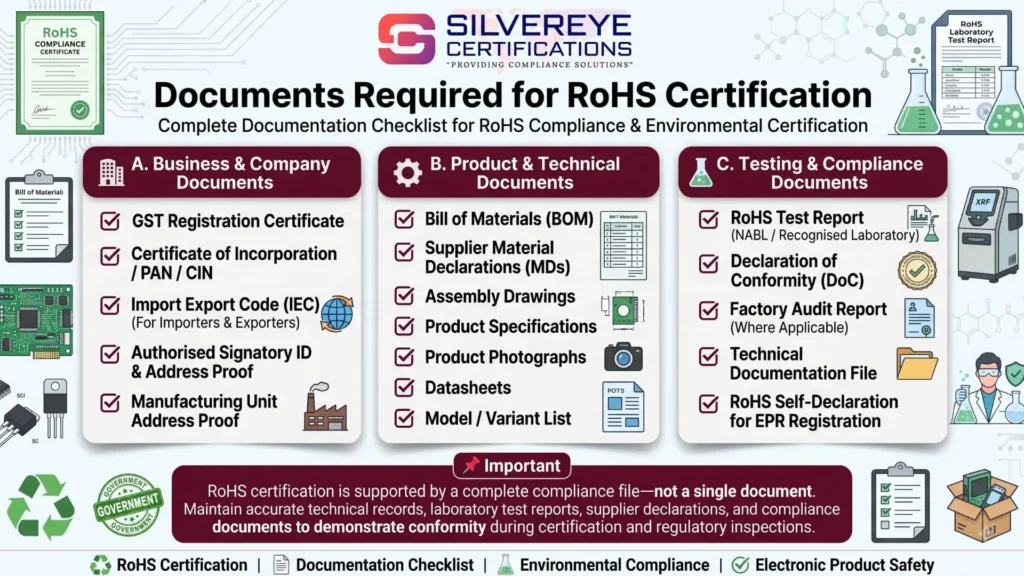
Documents Required for RoHS Phthalate Compliance
Manufacturers need supporting evidence to demonstrate that DEHP, BBP, DBP and DIBP remain within the EU RoHS limits. The documents required depend on the product design, materials, supplier information and available test results.
Commonly required documents include:
- Bill of Materials (BOM): A detailed list identifying components made from flexible plastics, PVC, cables, coatings, adhesives, sealants and other relevant materials.
- Supplier declarations: Material-specific or component-specific declarations covering all four phthalates and the other applicable RoHS restricted substances.
- RoHS laboratory test reports: Reports from a suitably competent laboratory, using appropriate analytical methods such as GC-MS or GC-MS/MS for phthalate analysis where testing is required.
- Technical drawings: Drawings or schematics identifying components that use flexible or plasticised materials.
- Product specifications: Information about the product, its materials, components and intended use.
- EU Declaration of Conformity (DoC): The manufacturer's signed declaration identifying the applicable EU legislation and confirming conformity with the relevant requirements.
A general supplier RoHS declaration may be sufficient if it clearly covers all ten restricted substances and the relevant components. If it only refers to the original six substances, obtain updated evidence covering the four phthalates.
RoHS Phthalate Compliance Process: Step by Step
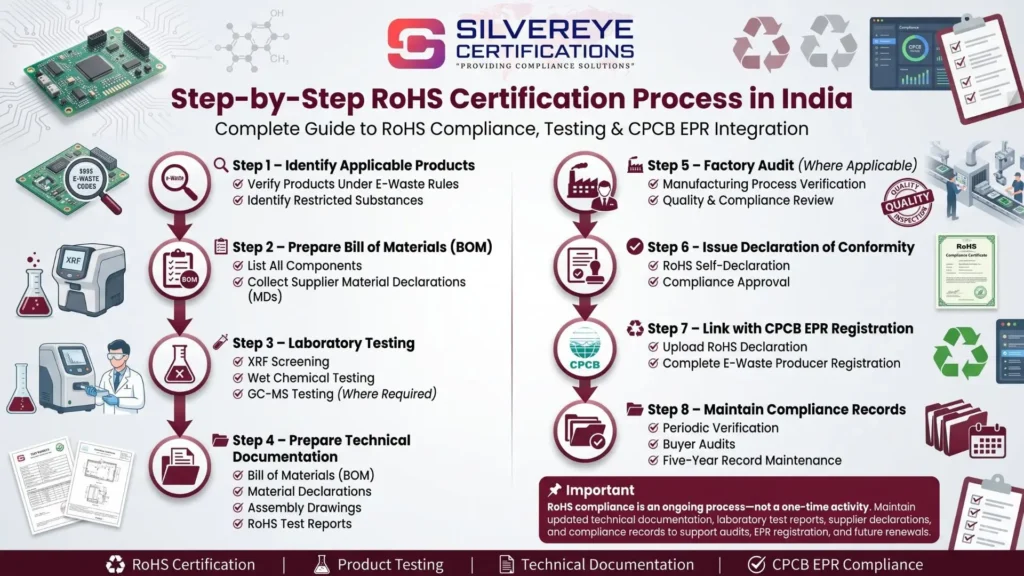
1. Identify Components With Potential Phthalate Risk
Review the Bill of Materials and identify materials that may contain plasticisers. Pay particular attention to flexible PVC cables, wire insulation, gaskets, soft-touch housings, adhesives, coatings and sealants.
The purpose is to identify materials that need supplier verification or further testing. Flexible plastics should not automatically be treated as non-compliant.
2. Collect Supplier Declarations
Request updated RoHS declarations and material composition information from suppliers of cables, connectors, plastics and other relevant components.
Check whether the declarations explicitly cover DEHP, BBP, DBP and DIBP, as well as the other six restricted substances. Verify that the documents relate to the actual component or material being used.
3. Arrange Laboratory Testing Where Needed
If supplier information is missing, outdated or insufficient, arrange suitable laboratory testing.
GC-MS (Gas Chromatography-Mass Spectrometry) is commonly used to identify and quantify phthalates in materials. Depending on the material and analytical requirements, GC-MS/MS or another validated method may also be appropriate.
XRF screening is useful for certain restricted elements, but it cannot reliably detect organic phthalates. Therefore, an XRF result alone cannot demonstrate compliance with the four phthalate restrictions.
4. Conduct a Compliance Gap Analysis
Compare supplier declarations and laboratory results against the EU RoHS concentration limits.
Each of the four phthalates has a maximum permitted concentration of 0.1% (1,000 ppm) by weight in each homogeneous material.
Identify materials that exceed the applicable limit or lack sufficient supporting evidence. Where necessary, work with suppliers to investigate alternative materials, reformulation or component replacement.
5. Update the Technical Documentation
Add the phthalate-specific supplier declarations, material information and laboratory reports to the existing RoHS technical documentation.
The compliance file should cover all ten restricted substances, not just the original six. Maintain records of the assessment, applicable exemptions and any corrective actions.
6. Review the Declaration of Conformity
For products placed on the EU market, the manufacturer must prepare and sign the EU Declaration of Conformity under the applicable RoHS conformity-assessment requirements.
Review the existing DoC and supporting technical documentation to ensure that they cover the applicable RoHS requirements, including DEHP, BBP, DBP and DIBP. A separate phthalate certificate is not generally required under the EU RoHS framework.
RoHS Phthalate Testing Cost: What Affects the Price?
There is no single government application fee for EU RoHS phthalate compliance. Costs generally arise from laboratory testing, documentation work and optional consultancy support.
The actual amount depends on the product, number of materials requiring assessment and quality of existing supplier evidence.
| Cost factor | Why it matters |
|---|---|
| Number of flexible and plastic components | More cables, gaskets, coatings and soft plastic parts may require additional material assessments or samples. |
| Availability of supplier data | Missing or outdated declarations increase the work needed to verify material composition. |
| GC-MS testing requirements | Phthalate analysis requires suitable chemical testing. The number of samples, analytes and test methods affects laboratory charges. |
| Product category and existing documentation | Older technical files, including those for Category 8 and Category 9 equipment, may need review to establish whether the four phthalates were adequately assessed. |
| Product variants | Different models, formulations or component specifications may require separate assessments. |
| Consultancy support | Optional support for BOM review, supplier documentation, testing coordination and technical-file preparation may add to the overall cost. |
For an accurate quotation, provide the product details, BOM, number of variants, existing supplier declarations and any previous laboratory reports. Ask for laboratory charges and consultancy fees to be itemised separately.
Validity and Renewal of RoHS Phthalate Compliance
RoHS phthalate compliance does not generally have a fixed expiry date or a separate renewal process. However, the supporting evidence must remain relevant to the product and the applicable regulatory requirements.
Keep the following points in mind:
- Declaration of Conformity: An EU DoC does not have a universal fixed expiry date. However, it must be reviewed when changes affect the product's conformity or the applicable legislation.
- Supplier and material changes: Replacing a cable supplier, PVC formulation, adhesive or other component should trigger a review of the existing compliance evidence. Additional testing may be necessary.
- Older technical files: Documentation prepared before the 2019 deadline for most EEE, or the 2021 deadline for Category 8 and Category 9 equipment, should be checked to confirm that it covers all four phthalates.
- Regulatory updates: Review changes to substance restrictions, exemptions and applicable technical requirements.
- Record retention: Under EU RoHS, manufacturers must retain the technical documentation and EU Declaration of Conformity for ten years after the equipment has been placed on the market.
Market surveillance authorities may request supporting compliance documentation. Manufacturers should therefore keep supplier declarations, material records and relevant test reports organised and accessible.
Common Challenges With RoHS Phthalate Compliance
Businesses can overlook phthalates when their existing RoHS documentation focuses mainly on the original six restricted substances. Other common challenges include:
- Incomplete supplier declarations: Older supplier documents may cover only the original six substances and not DEHP, BBP, DBP and DIBP.
- Overlooking flexible materials: PVC cables, connectors, gaskets and soft plastic components may contain plasticisers that need assessment.
- Confusing DBP and DIBP: These are different chemical substances. Replacing one with the other does not automatically resolve compliance concerns because both are restricted under EU RoHS.
- Using outdated technical files: Documentation prepared before the applicable 2019 or 2021 deadlines may not contain evidence covering all ten substances.
- Relying only on XRF screening: XRF can screen for certain elements, such as lead and cadmium, but cannot reliably identify or quantify organic phthalates.
- Choosing unsuitable testing methods: Testing must be appropriate for the material and the substances being investigated. A laboratory report should clearly identify the analytical method and tested sample.
- Ignoring product changes: Changes in material formulation, suppliers or component specifications can make existing test reports or declarations less representative of the current product.
A risk-based assessment, supported by accurate supplier information and appropriate chemical testing, helps address these problems.
RoHS Phthalates vs. the Original Six Substances
The four phthalates differ from the original six restricted substances in their chemical properties and the analytical methods commonly used to assess them.
| Aspect | Original 6 substances | 4 RoHS phthalates |
|---|---|---|
| Introduced through | Directive 2002/95/EC (RoHS 1) | Directive (EU) 2015/863 (RoHS 3) |
| Substances | Lead, mercury, cadmium, hexavalent chromium, PBB and PBDE | DEHP, BBP, DBP and DIBP |
| Chemical type | Metals and brominated flame retardants | Organic plasticiser compounds |
| Maximum concentration | 0.1% for five substances; 0.01% for cadmium | 0.1% for each phthalate |
| Common testing approaches | XRF screening and substance-specific confirmatory chemical analysis | GC-MS, GC-MS/MS or another suitable validated analytical method |
| Application date under EU RoHS | 1 July 2006 under the original RoHS framework | 22 July 2019 for most covered EEE; 22 July 2021 for Categories 8 and 9 |
Both groups are part of the current EU RoHS restricted-substance framework. Manufacturers must assess all ten substances rather than treating phthalate testing as a replacement for the original six-substance assessment.
How Silvereye Certifications Can Help
Phthalate compliance can be overlooked when businesses rely on older RoHS reports or supplier declarations that do not clearly cover DEHP, BBP, DBP and DIBP. Since these are organic compounds, they also require a different testing approach from the elemental screening commonly used for metals.
Silvereye Certifications supports manufacturers, importers and exporters with the documentation and coordination involved in RoHS compliance. Our assistance can include:
- BOM assessment: Reviewing flexible plastics, PVC cables, coatings, adhesives and other components that may require phthalate assessment.
- Supplier documentation: Helping collect and review declarations covering all ten RoHS restricted substances.
- Testing coordination: Coordinating suitable GC-MS or other appropriate chemical testing with competent laboratories.
- Technical-file support: Organising material information, supplier declarations and laboratory reports into a structured compliance file.
- DoC support: Assisting with the preparation and review of the applicable Declaration of Conformity documentation.
Silvereye Certifications is an independent regulatory compliance consultancy. It does not issue government certificates or laboratory test reports. Testing is carried out by laboratories, while the manufacturer remains responsible for demonstrating product conformity under the applicable regulatory framework.
Conclusion
DEHP, BBP, DBP and DIBP are four restricted phthalates under EU RoHS. Although they may receive less attention than lead or cadmium, they can be present in flexible PVC cables, gaskets, adhesives, coatings and other polymer components used in electrical and electronic equipment.
Because phthalates are organic compounds, GC-MS-based analysis or another suitable chemical method is needed when laboratory verification is required; XRF screening alone is not sufficient.
Manufacturers should include all four phthalates in their RoHS assessment, collect updated supplier declarations, review flexible plastic components, arrange testing where necessary and maintain technical documentation covering the full ten-substance list. This makes phthalate compliance part of the regular product-control process rather than an overlooked addition to the original six-substance requirements.
Frequently Asked Questions
What are the 4 RoHS phthalates?
DEHP, BBP, DBP, and DIBP — four plasticiser chemicals added to the RoHS restricted substances list by Directive (EU) 2015/863, also known as RoHS 3.
What is the limit for each RoHS phthalate?
Each of the four phthalates is capped at 0.1% (1,000 ppm) by weight in any homogeneous material, the same threshold used for lead, mercury, hexavalent chromium, PBB, and PBDE.
When did the phthalate restriction become mandatory?
From 22 July 2019 for most electrical and electronic equipment, and from 22 July 2021 for medical devices (Category 8) and monitoring and control instruments (Category 9).
Why were these four phthalates restricted?
They are classified as substances of very high concern (SVHC) and can disrupt hormone function; they also complicate safe recycling of plastic components at end of life.
Where are phthalates most likely to be found in electronics?
Mainly in flexible PVC — cable insulation, wire jacketing, gaskets, tubing, and soft plastic housings — since phthalates are used specifically to keep PVC pliable.
Can XRF testing detect phthalates?
No. XRF (X-ray fluorescence) detects metals like lead and cadmium but cannot reliably measure organic compounds such as phthalates; GC-MS lab testing is required instead.
Does a pre-2019 RoHS Declaration of Conformity still count as compliant?
Not on its own. If it doesn't reference DEHP, BBP, DBP, and DIBP, it needs to be updated to reflect the current 10-substance RoHS 3 requirement.
Are DBP and DIBP treated the same under RoHS?
Both are restricted at the same 0.1% limit, but they are chemically distinct substances; a declaration or test result for one doesn't automatically cover the other.
Do medical devices need to comply with the phthalate restriction?
Yes, medical devices (Category 8) and monitoring/control instruments (Category 9) were required to comply from 22 July 2021, two years after most other product categories.
Is phthalate testing required for every product, or only flexible plastic parts?
Testing is generally targeted at components that use plasticised or flexible materials — rigid plastics, metals, and ceramics carry a much lower phthalate risk.
How is phthalate compliance documented?
Through supplier declarations specific to phthalate content, GC-MS lab test reports where needed, and inclusion in the product's overall RoHS Declaration of Conformity.
Does RoHS phthalate compliance ever expire or need renewal?
There's no fixed expiry or renewal date. Compliance remains valid as long as materials and suppliers stay the same; any change to flexible or plastic components requires re-assessment.