- Mandatory once a factory or shop-type establishment crosses 10 employees (20 in a few states) with wages up to Rs 21,000/month
- Fully online via the Shram Suvidha portal - no government fee, registration filed within 15 days of the Act becoming applicable
- 4% combined contribution (employer 3.25% + employee 0.75%) unlocks medical, maternity, sickness and disablement benefits
- 2026 update: wage ceiling stays at Rs 21,000, but a fresh Central Government clarification (S.O. 2351(E), 8 May 2026) and the new Code on Social Security wage definition (effective 21 Nov 2025) change how employers must treat borderline salaries
Introduction
If you run a factory, shop, hotel, restaurant, cinema, educational institution, or a road-transport or newspaper establishment in India and your headcount has crossed the government-notified limit, ESI registration is not optional. It's a statutory obligation under the Employees' State Insurance Act, 1948, and skipping it exposes an employer to interest, damages and, in serious cases, prosecution.

This guide walks through applicability, eligibility, documents, the exact online process, fees, timelines, renewal, penalties, and everything that has changed for 2026 - written for business owners, HR teams, and compliance professionals who want the full picture in one place.
What Is ESI Registration?
The Employees' State Insurance (ESI) scheme is a self-financing social security and health insurance programme run by the Employees' State Insurance Corporation (ESIC), a statutory body under the Ministry of Labour and Employment. It was created by the ESI Act, 1948, to protect workers earning modest wages against the financial shock of sickness, workplace injury, disability, and maternity.
ESI registration is the act of enrolling an eligible establishment - and every eligible employee on its payroll - into this scheme. Once registered, the employer deducts a small contribution from each covered employee's wages, adds its own larger share, and deposits both with ESIC every month. In return, employees and their dependants get access to a network of ESIC hospitals and dispensaries, along with cash benefits during periods they can't work.
It helps to think of ESI registration as two linked actions rolled into one online application: registering the establishment (which earns it a permanent 17-digit Employer Code) and registering each eligible worker (who then gets a lifelong Insurance Number and an e-Pehchan e-card).
Why ESI Registration Matters - Benefits for Employers and Employees
ESI isn't just a compliance checkbox. For a genuinely low-cost monthly contribution, it gives workers a safety net that would otherwise be missing, and it gives employers legal cover, better retention, and a credible HR policy to point to.
Benefits for Employees and Their Families
- Free, comprehensive medical treatment for the insured person and dependants at ESIC hospitals and dispensaries, with no cap on treatment cost for the covered ailment
- Sickness benefit - cash compensation during certified illness
- Maternity benefit with paid leave for confinement, miscarriage or sickness arising from pregnancy
- Disablement benefit - periodical payment for temporary or permanent disability caused by employment injury
- Dependants' benefit - monthly payment to family members if the insured person dies due to an employment injury
- Funeral expenses, unemployment allowance under specific schemes, and confinement expenses where treatment isn't available at an ESI facility
Benefits for Employers
- Legal compliance - avoids interest, damages, and prosecution under the ESI Act
- No separate group health insurance liability for eligible employees, since ESIC absorbs the medical cost
- Stronger employee trust and retention, since staff see a tangible welfare benefit reflected in every payslip
- Smoother statutory audits and tender eligibility, since ESIC registration is frequently asked for in government and corporate vendor empanelment
Who Needs ESI Registration? Applicability and Employee Threshold
Coverage under the ESI Act is triggered by two things together: the type of establishment and its headcount. Section 1(5) of the Act lets state governments extend coverage to additional classes of establishments, which is why the exact headcount trigger isn't perfectly uniform across India.
| Establishment Type | General Threshold | Notes |
|---|---|---|
| Factories using power | 10 or more employees | Covered under the core ESI Act, 1948 |
| Factories not using power | 10 or more employees (varies by state notification) | Some states set this at 20 |
| Shops, hotels, restaurants, cinemas | 10 or more employees in most states | A few states/UTs still apply a 20-employee threshold |
| Road-motor transport, newspaper establishments | 10 or more employees | Covered under state-specific notifications |
| Private educational and medical institutions | 10 or more employees in many states | Coverage depends on the state's notification |
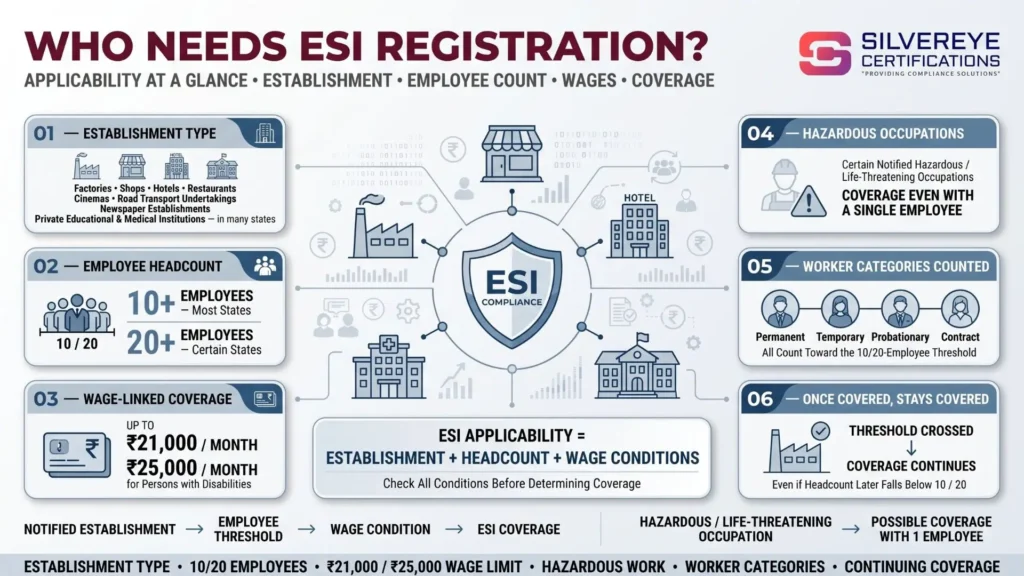
Important: because thresholds are notified state by state, and a handful of states still apply 20 instead of 10 for shops and commercial establishments, always verify the current number with your state labour department, the ESIC regional office, or a compliance professional before assuming your unit falls outside coverage.
The headcount is based on employees actually on the rolls - contract and daily-wage workers engaged through a contractor are generally still counted for this purpose, since the Act looks at who works at the establishment, not merely who is on its direct payroll.
Eligibility Criteria: Who Is a Covered Employee?
Once an establishment is covered, individual employees become eligible for ESI based on their wages, not their designation.
- Employees earning gross wages up to Rs 21,000 per month are covered
- The ceiling is higher, at Rs 25,000 per month, for employees with disability
- "Gross wages" for this purpose means wages actually paid or payable in a wage period - basic pay, dearness allowance, and most regular allowances; overtime is generally excluded from the eligibility calculation
- Employees whose average daily wage is up to Rs 176 are exempt from paying their own 0.75% share, though the employer must still deposit its 3.25% contribution for them
- If an employee's wages cross the Rs 21,000 ceiling in the middle of a contribution period (April-September or October-March), coverage continues for the rest of that contribution period; the employee only drops out of eligibility from the start of the next contribution period
- An employee cannot opt out of ESI once they fall within the wage ceiling at a covered establishment - participation is compulsory, not voluntary
ESI Contribution Rate 2026: Employer and Employee Share
The contribution rates were last revised on 1 July 2019 and remain unchanged through 2026. Together, they add up to 4% of gross wages.
| Contributor | Rate | On Rs 21,000 Gross Wages |
|---|---|---|
| Employee | 0.75% of gross wages | Approx. Rs 158/month |
| Employer | 3.25% of gross wages | Approx. Rs 683/month |
| Total combined contribution | 4.00% of gross wages | Approx. Rs 841/month |
Before July 2019, the combined rate stood at 6.5% (4.75% employer + 1.75% employee). The reduced 4% rate has stayed constant since then, including through FY 2025-26 and FY 2026-27, despite periodic speculation about a wage-ceiling revision.
Documents Required for ESI Registration Online
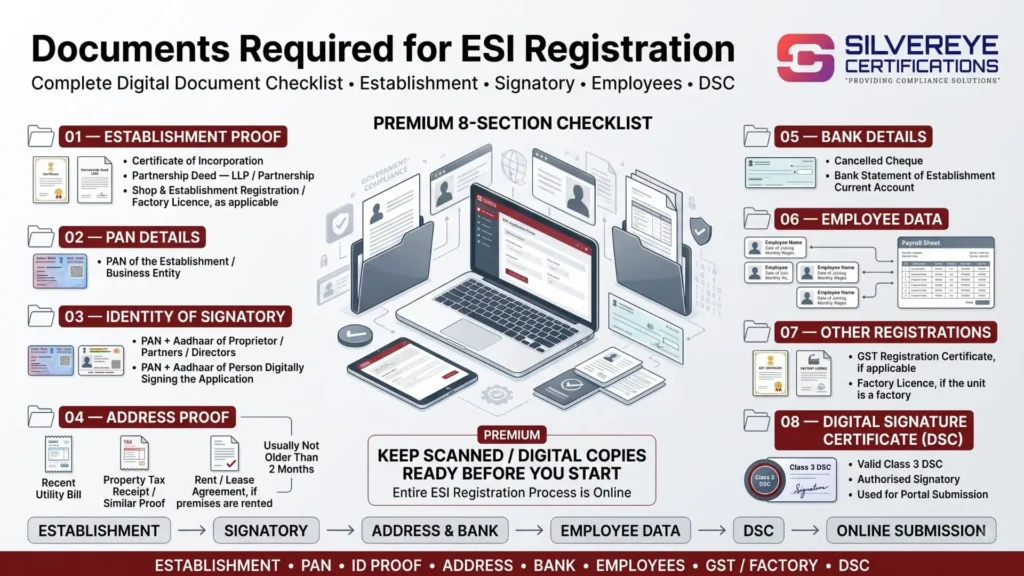
Keep scanned copies of these ready before starting the online application - incomplete uploads are the most common reason applications get stuck.
For the Establishment
- PAN card of the business entity
- GST registration certificate
- Certificate of Incorporation, Partnership Deed, or LLP Agreement, depending on entity type
- Address proof of the registered establishment - a recent electricity bill, property tax receipt, or a notarised rent/lease agreement with a landlord's NOC
- Bank account details of the establishment, including a cancelled cheque or bank statement
- Digital Signature Certificate (DSC) of the authorised signatory, or Aadhaar for e-Sign
- List of directors, partners, or proprietor, as applicable
For Employees
- Aadhaar number of each employee
- Bank account details for salary/benefit disbursal
- Recent passport-size photograph
- Family details, for dependant benefit purposes
- Date of joining and monthly wage details
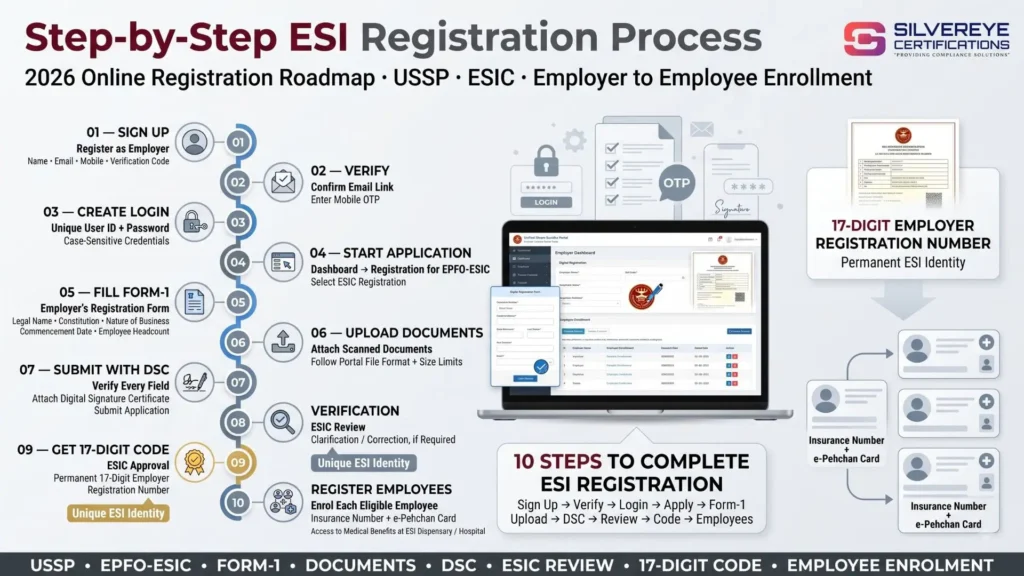
Step-by-Step ESI Registration Process Online
ESI registration is completed through the Government of India's Unified Shram Suvidha Portal, which also handles EPF and a few other labour-law registrations in one place. Here is the process in order.
- Create a portal account - Visit the Shram Suvidha Portal and sign up as the principal employer. Verify your email and mobile number through OTP, then set a password.
- Enter preliminary employer details - Provide the company name, type of establishment, state, district, nature of business, and contact details.
- Fill in establishment information - Add the full address, date the business started, current employee count on the rolls, and the date the headcount first crossed the coverage threshold. Accuracy here matters - discrepancies can trigger compliance questions later.
- Add employee details - Enter each eligible employee's name, Aadhaar number, date of joining, and wage details.
- Upload supporting documents - Attach scanned copies of all establishment and employee documents in the prescribed format (usually PDF).
- e-Sign the application - Authenticate and submit using Aadhaar-based e-Sign or the authorised signatory's Digital Signature Certificate.
- Submit and receive acknowledgement - On submission, the portal generates an acknowledgement and, after processing, emails the ESIC Registration Number.
- Receive the Employer Code and employee credentials - The establishment gets a permanent 17-digit Employer Code for all future ESIC transactions. Each registered employee receives an Insurance Number and an e-Pehchan card, which they use to access ESIC medical facilities.
| Registration Deadline |
|---|
| An establishment must apply for ESI registration within 15 days of the ESI Act becoming applicable to it - that is, within 15 days of crossing the employee threshold. Filing late doesn't just risk a penalty for the registration delay itself; interest and damages accrue on contributions from the date coverage actually began, not from the date the employer eventually registers. |
ESI Registration Fees - Is There Any Government Charge?
There is no government fee to register an establishment under the ESI Act. The Shram Suvidha portal does not charge for filing the application itself.
That said, many employers choose to route the filing through a compliance consultant, since accurate wage classification, document formatting, and coordination between EPF and ESI filings can be time-consuming to handle in-house. Professional service fees for end-to-end ESI registration support typically start in the range of a few thousand rupees and scale with company size and the number of employees being enrolled - it's worth getting a clear, itemised quote before engaging any consultant.
Validity, Renewal, and the ESI Compliance Calendar
A common question employers ask is how often ESI registration needs to be renewed. The answer is straightforward: it doesn't expire.
- The ESIC Registration Certificate and the 17-digit Employer Code are valid for the entire lifetime of the establishment - there is no renewal requirement or expiry date
- What does recur is compliance: monthly contribution payments and half-yearly returns, for as long as the establishment remains covered
- If a newly registered establishment hasn't yet reached the 10-employee threshold, it can be tagged as "Dormant" on the ESIC portal for up to 180 days at a time, and this dormant status must be manually renewed every six months until the threshold is actually crossed
Compliance Calendar to Remember
| Compliance Item | Frequency / Due Date |
|---|---|
| Monthly contribution deposit (challan) | By the 15th of the following month |
| Contribution periods | 1 April - 30 September, and 1 October - 31 March |
| Corresponding benefit periods | 1 January - 30 June, and 1 July - 31 December |
| Half-yearly return of contributions | Typically due around 11 May and 11 November each year |
| New employee addition on ESIC portal | As soon as an eligible employee joins, before the next contribution deadline |
| NIL return | Still required for a month with no coverable employees or contribution |
Penalties for Non-Registration or Late ESI Payment
The ESI Act treats registration and timely payment as serious obligations, and the penalty structure reflects that. Employers should treat these numbers as a strong reason to stay current rather than absorb the cost of catching up later.
- Failure to register or pay contributions on time is an offence under Section 85(a) of the Act, punishable with imprisonment of up to 3 years (not less than 1 year for withheld employee contributions) and a fine
- Simple interest of 12% per annum applies on every day of delayed contribution, under Regulation 31-A of the ESI (General) Regulations, 1950
- In addition to interest, ESIC can levy damages under Regulation 31-C, graded by how long the delay runs: 5% per annum for delays under 2 months, 10% for 2-4 months, 15% for 4-6 months, and 25% per annum for delays beyond 6 months
- Deducting an employee's 0.75% share from wages and failing to deposit it is treated as a serious breach and can additionally attract prosecution under Section 85(b)
- Obstructing an ESIC inspector, or failing to maintain and produce required records, carries its own separate fines and, in some cases, imprisonment
The practical takeaway: interest and damages are calculated from the date the liability actually arose - meaning the date the headcount crossed the threshold - not from whenever the employer eventually gets around to registering. Delay compounds the cost.
ESIC Updates and New Rules for 2026
The core numbers - the Rs 21,000 wage ceiling and the 4% combined contribution rate - have not changed for 2026. What has changed is the regulatory and compliance environment around them, and employers who assume nothing is new can get caught out on the details.
1. Central Government Clarification on Contribution-Period Continuity (S.O. 2351(E), 8 May 2026)
A notification issued on 8 May 2026 clarified how an employee's covered status should be treated when wages cross the notified ceiling partway through a contribution period. It reaffirms that coverage continues for the remainder of the ongoing contribution period once an employee is already covered at its start, closing ambiguity that payroll teams had been resolving inconsistently.
2. New Wage Definition Under the Code on Social Security
The wage definition introduced under the Code on Social Security, which took effect from 21 November 2025, changes how "wages" are computed for social security purposes, including ESI. Broadly, it requires that at least 50% of an employee's total remuneration be treated as "wages" for contribution calculations, which can pull certain allowances that were previously kept outside the wage base back into scope. Employers restructuring CTC components should re-check ESI eligibility calculations against this definition rather than relying on pre-2025 payroll logic.
3. No Confirmed Hike in the Wage Ceiling
There has been ongoing industry discussion about raising the ESI wage ceiling from Rs 21,000 to somewhere between Rs 25,000 and Rs 30,000 - the last revision was back in January 2017. As of this update, that increase remains a proposal under review and has not been notified by the government. Employers should continue applying the Rs 21,000 (Rs 25,000 for PwD) ceiling until an official notification says otherwise, and should be cautious of third-party content online that states a higher ceiling as if it were already in force.
4. Tighter Enforcement and Digital Audits
ESIC has stepped up digital cross-verification of employer filings, matching data across the Shram Suvidha portal, payroll declarations, and its own records more closely than before. The SPREE-style enrolment drive for bringing eligible-but-unregistered establishments into the net also continues, alongside more frequent scrutiny of borderline wage classifications. In practice, this means fewer employers are able to stay under the radar by under-reporting headcount or misclassifying wages.
ESI vs EPF: How the Two Schemes Differ
Employers often handle ESI and EPF registration together, since both are filed through the Shram Suvidha portal, but the two schemes serve different purposes and follow different rules.
| Parameter | ESI (ESI Act, 1948) | EPF (EPF & MP Act, 1952) |
|---|---|---|
| Purpose | Health insurance and social security | Retirement savings and provident fund |
| Applicability threshold | 10+ employees (20 in a few states) | 20+ employees (voluntary above 10) |
| Wage ceiling | Rs 21,000/month (Rs 25,000 for PwD) | Rs 15,000/month (for mandatory PF applicability) |
| Combined contribution | 4% of gross wages | 24% of basic wages (12% + 12%) |
| Governing body | ESIC, Ministry of Labour & Employment | EPFO, Ministry of Labour & Employment |
Common Mistakes Employers Make with ESI Registration
- Waiting past the 15-day window after crossing the employee threshold, which triggers interest and damages from the actual coverage date
- Counting only direct payroll staff and ignoring contract or outsourced workers who also count toward the 10/20-employee threshold
- Treating the Rs 21,000 figure as basic salary instead of gross wages, which leads to wrongly excluding employees who are actually eligible
- Deducting the employee's 0.75% share but delaying the deposit, which is treated far more seriously than a simple late payment
- Forgetting to file a NIL return in a month with no coverable employees, assuming no filing is needed
- Not updating employee records promptly when new hires cross into eligibility mid-year
- Assuming a higher wage ceiling is already in force based on outdated or speculative online content, instead of checking the latest official notification
Getting ESI Registration Right, the First Time
ESI registration looks simple on paper - an online form, a set of documents, a 15-day deadline - but the details that actually matter (correct wage classification, contribution-period continuity, timely monthly filings, and staying current with notifications like the 2026 wage-definition changes) are where most employers run into trouble. Getting it right the first time saves far more in avoided interest, damages, and audit stress than it costs to do properly.
| Need Help With ESI Registration? Silvereye Certifications helps employers complete end-to-end ESI registration and ongoing ESIC compliance - from document preparation and portal filing to monthly contribution support and half-yearly returns - so you can stay fully compliant without the guesswork. If you're planning to register your establishment or want an existing filing reviewed, Silvereye Certifications can guide you through the process accurately and on time. |
|---|
Frequently Asked Questions
Is ESI registration mandatory for all businesses in India?
No. It is mandatory only for factories and specified establishments (shops, hotels, restaurants, cinemas, road-transport and newspaper establishments, and others notified by the state) that employ 10 or more persons (20 in a few states) and pay wages within the notified ceiling. Businesses below the threshold are not required to register, though some choose to opt in voluntarily in certain states.
What is the current ESI wage limit in 2026?
The wage ceiling for coverage remains Rs 21,000 per month for general employees and Rs 25,000 per month for employees with disability. This has not changed since January 2017, despite ongoing discussion about a possible future revision.
How long does ESI online registration take?
Once all documents are ready and uploaded correctly, the online application on the Shram Suvidha portal is usually processed within a few working days, after which the employer receives the 17-digit Employer Code by email.
Is there a government fee for ESI registration?
No. ESIC does not charge a government fee for registering an establishment. Any fee you pay is a professional service charge if you engage a consultant to handle the filing.
Does the ESI registration certificate need to be renewed every year?
No. The registration is a one-time, permanent enrolment for the life of the establishment. What recurs is ongoing compliance - monthly contribution payments and half-yearly returns - not the registration itself.
Can an employee refuse to be covered under ESI?
No. Once an employee's wages fall within the notified ceiling at a covered establishment, ESI coverage is compulsory, not optional, for both the employer and the employee.
What happens if an employee's salary crosses Rs 21,000 mid-year?
Coverage continues for the remainder of the ongoing contribution period (April-September or October-March). The employee becomes ineligible only from the start of the next contribution period, not immediately.
Are contract or outsourced workers covered under ESI?
Generally yes, if they work at a covered establishment and earn wages within the ceiling - they are typically counted both for the employee threshold and for individual coverage, even if they are on a contractor's payroll rather than the principal employer's direct rolls.
What is the penalty for not registering under ESI on time?
Non-registration or delayed contribution payment can attract simple interest of 12% per annum, damages ranging from 5% to 25% per annum depending on the length of delay, and prosecution under Section 85 of the ESI Act, which can include imprisonment and fines.
Is overtime pay included while calculating ESI eligibility?
No. Overtime wages are generally excluded when checking whether an employee's wages fall within the Rs 21,000 eligibility ceiling, although the position on inclusion in the contribution base itself should be confirmed against the latest wage-definition rules under the Code on Social Security.
Can a business with fewer than 10 employees register for ESI voluntarily?
Coverage is primarily threshold-driven under the Act, and voluntary registration below the threshold is not a standard route in most states. Employers below the threshold should confirm their specific state's position before assuming they can opt in.
What documents are needed for ESI registration renewal?
None are needed, because there is no renewal. What you do need on an ongoing basis are updated employee records, wage data, and challan payments for each contribution cycle.