
- ESI registration is mandatory for factories and establishments with 10 or more employees (20 in some states) where staff earn up to ₹21,000 a month.
- The entire ESI registration process is free and fully online through the Shram Suvidha Portal, completed within 15 days of becoming eligible.
- The combined ESI contribution for FY 2026-27 stays at 4% of gross wages — 3.25% employer share and 0.75% employee share.
- The Code on Social Security's revised wage definition, effective since 21 November 2025 and mandatory from 8 May 2026, has widened who counts as "covered," even though the ₹21,000 ceiling itself hasn't changed.
Introduction
The ESI registration process is mandatory for factories and establishments employing 10 or more people (20 in a few states) where employees earn up to ₹21,000 a month, or ₹25,000 for persons with disabilities. An employer must register within 15 days of crossing this threshold, using the Shram Suvidha Portal by filling Form-1 with PAN, address proof, incorporation documents, and employee details.

There is no government fee. After paying a six-month advance contribution, the employer receives the C-11 registration letter carrying a 17-digit registration number. The combined contribution for FY 2026-27 remains 4% of wages — 3.25% employer and 0.75% employee.
What Is ESI Registration?
ESI stands for Employees' State Insurance, a self-financed social security and health insurance scheme created under the Employees' State Insurance Act, 1948. It is administered by the Employees' State Insurance Corporation (ESIC), a statutory body functioning under India's Ministry of Labour and Employment. The scheme went live on 24 February 1952 in Kanpur and has since expanded to cover establishments across the country.
ESI registration is the process by which an eligible factory or establishment enrols itself, and its employees, with ESIC. Once registered, covered employees and their families become entitled to cashless medical treatment, cash benefits during sickness or maternity, disability compensation, and dependent benefits — funded through a joint monthly contribution from the employer and the employee.
For employers, ESI registration is not optional once the applicability criteria are met — it is a statutory obligation, and delaying it invites interest, damages, and in serious cases, prosecution. This guide walks through eligibility, documents, the exact registration steps, contribution rates, validity, renewal, penalties, and what has genuinely changed for 2026 — verified against the ESI Act, the Code on Social Security, 2020, and the current ESIC/Shram Suvidha framework.
Why ESI Registration Matters for Your Business
- Legal compliance: Registration is compulsory under Section 2(12) of the ESI Act once the employee threshold is crossed — non-registration is a punishable offence, not a paperwork oversight.
- Employee welfare and retention: Access to cashless treatment, maternity leave at full pay, and sickness benefit makes a workplace more attractive and helps retain staff.
- Avoids retrospective liability: If ESIC discovers an unregistered but eligible establishment, contributions are demanded from the date of applicability, with interest — not from the date of discovery.
- Builds credibility: Many government tenders, contracts, and vendor empanelments ask for proof of active ESI and EPF compliance before onboarding a business.
Who Needs ESI Registration?
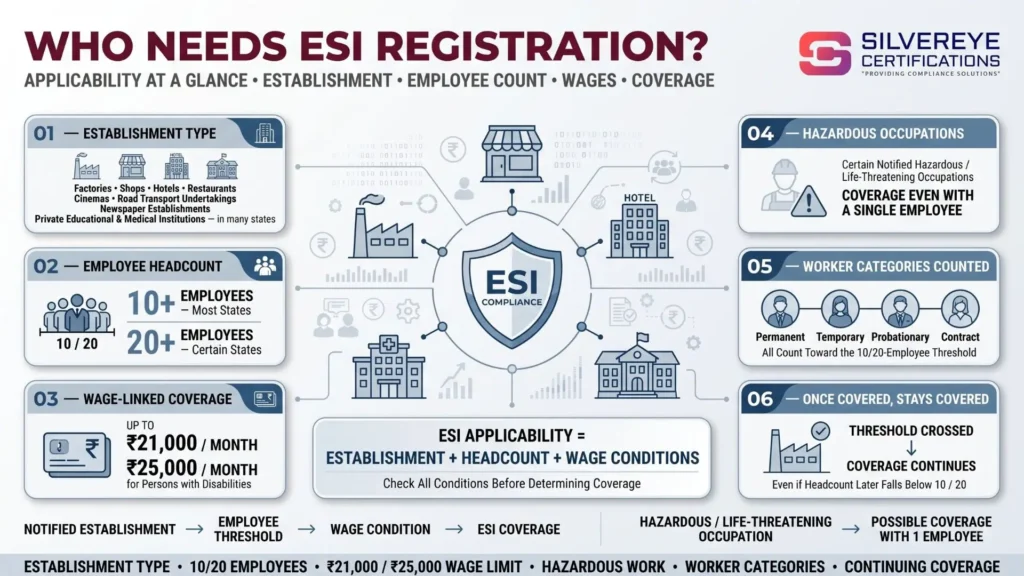
Under Section 2(12) of the ESI Act, 1948, ESI registration is mandatory for any non-seasonal factory or establishment employing 10 or more persons. In a handful of states, the threshold notified for shops and commercial establishments is 20 employees instead of 10 — always confirm the exact figure with your regional ESIC office, since state notifications can differ.
The employee count includes every person on the rolls — permanent, temporary, contract, and casual workers — not just those earning below the wage ceiling. Once the headcount crosses the threshold on any day in the preceding 12 months, the obligation to register is triggered and does not go away even if staff strength later dips below the limit.
Wage Ceiling for Coverage
| Category | Monthly Wage Ceiling |
| General employees | ₹21,000 (in force since 1 January 2017) |
| Employees with disabilities | ₹25,000 |
| Employees earning above the ceiling | Excluded from ESI; covered instead under the Employees' Compensation Act, 1923 |
Sectors and Establishments Typically Covered
- Factories registered under the Factories Act
- Shops, restaurants, and hotels engaged in sales or service (where notified)
- Cinemas and theatres
- Road motor transport establishments
- Newspaper establishments not covered under the Factories Act
- Private educational and medical institutions (in notified states)
Establishments below the threshold can still opt for voluntary ESI registration in many states. If you're unsure whether your business is covered, it's worth getting a quick applicability check done rather than guessing — a wrong assumption either way can be costly.
Documents Required for ESI Registration
The entire process is paperless — every document is uploaded online, nothing is submitted physically. Keep clear scanned copies (PDF/JPEG) ready before you start.
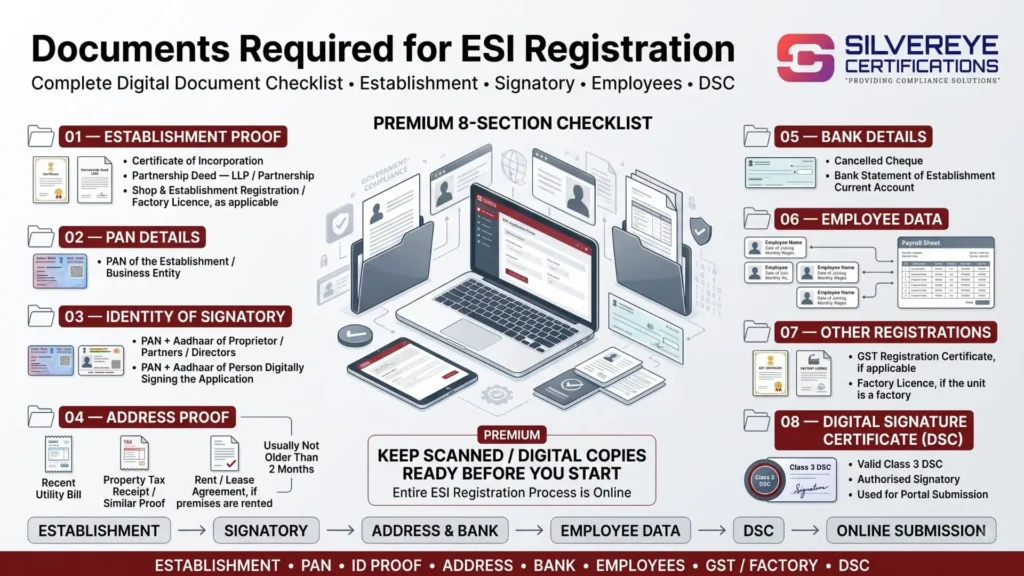
For the Employer / Establishment
- Registration certificate under the Factories Act, or the Shops and Establishment Act
- Certificate of Incorporation (for companies/LLPs) or Partnership Deed (for partnership firms)
- Memorandum of Association (MOA) and Articles of Association (AOA), where applicable
- PAN card of the business entity
- GST registration certificate
- Address proof of the establishment — recent utility bill, or rent/lease agreement if premises are not owned
- Cancelled cheque of the establishment's bank account
- List of directors, partners, or shareholders as applicable
- Digital Signature Certificate (DSC) of the authorized signatory
For Employees
- PAN card and Aadhaar card of each employee
- List of employees with salary/compensation details
- Employee attendance register
- Bank account details of employees
- Passport-size photographs (as requested during individual employee registration)
ESI Registration Process: Step-by-Step (2026)
ESI and EPF registrations are now unified through the Shram Suvidha Portal, run by the Ministry of Labour and Employment. Here is the exact sequence an employer follows:
- Sign up on the Shram Suvidha Portal. Enter your name, email ID, mobile number, and the verification code, then submit. A verification link is sent to your registered email.
- Verify and create login credentials. Click the verification link, then set your preferred User ID and password to activate the account.
- Log in and open the registration module. On the dashboard, go to the "Registration" section and select "Registration for EPFO-ESIC" (or ESIC alone, if you already have an EPF code).
- Fill Employer's Registration Form-1. Provide establishment details (name, address, nature of business, date of commencement), employer/owner details, and bank account information.
- Add employee details. Enter the count of employees and, where required at this stage, basic details of those earning within the wage ceiling.
- Upload supporting documents. Attach the scanned copies of all documents listed above in the prescribed format.
- Review and submit the application. Cross-check every field carefully — mismatched PAN or address details are among the most common reasons applications get sent back for correction.
- Pay the advance contribution. On submission, you're directed to the payment page to deposit six months' contribution in advance through the SBI payment gateway.
- Receive the C-11 Registration Letter. Once payment is confirmed, ESIC issues a system-generated Registration Letter (C-11) by email, carrying a unique 17-digit registration number — this is your establishment's legal proof of ESI registration.
- Register individual employees and issue Pehchan Cards. Log in to the ESIC portal's employee module to generate each covered employee's Insurance Number and their e-Pehchan (biometric health) card, used to access treatment at ESIC hospitals and dispensaries.
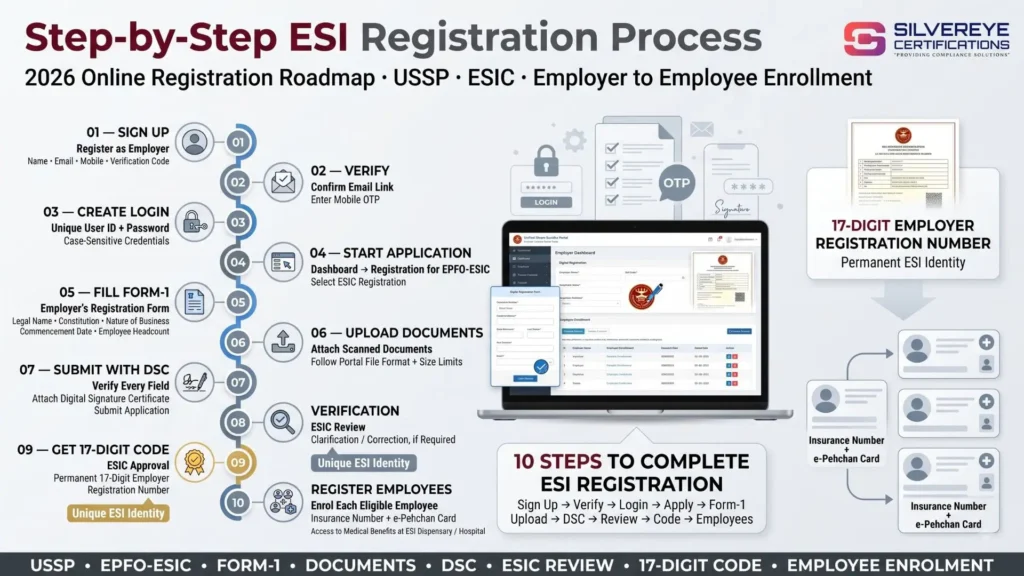
Typical turnaround, when documents are in order and details match official records, runs anywhere from a few days to about two weeks. Delays almost always trace back to document mismatches, not the portal itself.
ESI Registration Fees: Is There a Government Charge?
There is no government fee for ESI registration. ESIC does not charge anything to enrol an establishment or issue the 17-digit employer code — signing up on the Shram Suvidha Portal is completely free.
The only cost an employer actually incurs is the ongoing statutory contribution, which is not a one-time registration fee but a recurring monthly payment tied to payroll. If you engage a consultant or compliance firm to handle the paperwork, their professional fee is separate from — and not charged by — the government.
ESI Contribution Rates for FY 2026-27
| Contributor | Rate | In Force Since |
| Employer's share | 3.25% of gross wages | 1 July 2019 |
| Employee's share | 0.75% of gross wages | 1 July 2019 |
| Combined contribution | 4.00% of gross wages | 1 July 2019 |
Employees earning up to ₹176 a day are exempt from paying their own share, though the employer's share is still payable on their behalf. ESI wages generally include basic pay, dearness allowance, HRA, city compensatory allowance, and other regular allowances; overtime, gratuity, bonus, and pure reimbursements are typically excluded from the wage base used for contribution.
Contribution deducted from an employee's wages is treated in law as money held in trust for the government — so delaying its deposit is viewed far more seriously than an ordinary payment delay. Both shares must be deposited by the 15th of the following month.
ESI Registration Certificate: Validity and Renewal
The C-11 registration letter and the 17-digit ESIC code are permanent — there is no periodic renewal requirement for the registration itself, and it stays valid as long as the establishment remains operational and covered under the Act. What does need ongoing action is compliance: monthly contribution payments, half-yearly returns, and updating employee records whenever staff join, leave, or cross the wage ceiling.
Contribution and Benefit Periods
| Contribution Period | Corresponding Cash Benefit Period |
| 1 April to 30 September | 1 January to 30 June of the following year |
| 1 October to 31 March | 1 July to 31 December |
If an establishment's employee strength falls below the applicable threshold after registration, coverage generally continues rather than lapsing automatically — de-registration is not simply a matter of dropping below the headcount and should always be confirmed with the regional ESIC office rather than assumed.
Benefits of ESI Registration for Employees
- Medical benefit: Cashless treatment for the insured person and dependent family members at ESIC hospitals and dispensaries.
- Sickness benefit: Cash compensation at 70% of average daily wages for up to 91 days a year during certified illness.
- Maternity benefit: Full pay for 26 weeks of maternity leave, with additional provisions for adoption and miscarriage.
- Disablement benefit: Periodic payments for temporary or permanent disablement arising from employment injury.
- Dependants' benefit: Monthly payment to dependants if an insured employee dies due to an employment injury.
- Funeral expenses: A fixed lump-sum amount paid toward funeral costs.
- Other benefits: Confinement expenses, vocational rehabilitation, and old-age medical care for retired/disabled insured persons.
Penalties for Delayed or Non-Registration
| Default | Consequence |
| Non-registration despite eligibility | Penalty plus back-dated contribution with interest from the date of applicability |
| Delay in depositing contribution | Interest at 12% per annum under Section 39(5)(a) |
| Contribution delayed beyond 6 months | Damages of up to 25% of the arrears under Section 85-B |
| Employer fails to pay contribution | Imprisonment up to 3 years and a fine up to ₹10,000 under Section 85 |
| Employee's deducted share not deposited | Minimum imprisonment of 1 year plus a mandatory ₹10,000 fine |
These penalties fall on the employer, not the employee — but if you're an employee and suspect your 0.75% share is being deducted and never deposited, that history matters and is worth raising with ESIC directly.
What's New in the ESI Registration Process for 2026
No sweeping overhaul of ESI registration itself has been notified for 2026 — the ₹21,000 wage ceiling, the 4% combined contribution, and the core online registration workflow are unchanged. That said, a few genuine developments are reshaping compliance this year:
- Wage definition under the Code on Social Security: The Code on Social Security, 2020 folds the ESI Act into a unified framework and revises how "wages" are defined for social-security purposes. This new definition has been effective since 21 November 2025, and compliance with the Central Social Security Rules became mandatory from 8 May 2026 — it widens which pay components count toward coverage calculations, even though the headline ₹21,000 ceiling has not moved.
- Regulatory clarifications: ESIC has begun issuing written clarifications on the revised framework — including a letter dated 4 June 2026 to the Telangana Labour Law Consultants Association confirming the effective and compliance dates above.
- Gig and platform workers: Under the Code on Social Security, aggregators and platform companies are, for the first time, formally brought within India's social security net, with obligations to contribute a percentage of turnover or worker payouts toward a dedicated Social Security Fund — a structural shift that runs alongside, rather than inside, the existing ESI scheme.
- Continued demand to raise the wage ceiling: Industry bodies have repeatedly asked for the ₹21,000 limit to be raised to ₹25,000 or ₹30,000 to reflect wage inflation. As of 2026, this has not been implemented — the ceiling remains ₹21,000 (₹25,000 for persons with disabilities).
- Compliance focus shifting to accuracy, not paperwork: With most of the registration and filing workflow already digital, ESIC's current emphasis is on accurate wage classification, timely deposits, and payroll audits, rather than procedural changes to the registration process itself.
Conclusion
The ESI registration process itself hasn't been rewritten for 2026 — the ₹21,000 ceiling, the 4% contribution, and the online Shram Suvidha workflow all remain as they were. What has genuinely shifted is the wage-definition framework under the Code on Social Security, and that alone is enough to change how some businesses classify coverage this year. Getting the classification, documentation, and filing timeline right the first time saves far more in avoided penalties and interest than it costs in professional support.
Need help getting it right the first time? Silvereye Certifications assists employers with end-to-end ESI and labour-law registration — from eligibility assessment and document preparation to filing on the Shram Suvidha Portal and ongoing compliance support — so your business stays compliant without the guesswork.
Frequently Asked Questions
Is ESI registration compulsory for every business?
No. It is mandatory only for non-seasonal factories and establishments employing 10 or more persons (20 in some states) where at least some employees earn up to the ₹21,000 wage ceiling. Smaller establishments can often opt in voluntarily, but registration isn't compulsory for them.
What is the current ESI wage limit in 2026?
₹21,000 per month for general employees and ₹25,000 per month for employees with disabilities. This limit has been unchanged since 1 January 2017.
Is there a fee to register for ESI?
No. ESI registration through the Shram Suvidha Portal is completely free. The recurring cost is the monthly statutory contribution, not a registration fee.
How many days does an employer have to register after becoming eligible?
15 days from the date the establishment crosses the applicability threshold (10 or 20 employees, as applicable).
What documents are needed for ESI registration?
Key documents include the establishment's registration certificate, PAN, GST certificate, incorporation/partnership documents, address proof, a cancelled cheque, and employee details with salary information. A full checklist is covered earlier in this guide.
What is the C-11 certificate?
C-11 is the system-generated ESIC registration letter issued after the employer pays the initial six-month advance contribution. It carries the establishment's unique 17-digit ESIC registration number and serves as legal proof of registration.
Does the ESI registration certificate need to be renewed?
No. The registration itself is permanent and doesn't need periodic renewal. What continues indefinitely is compliance — monthly contributions and half-yearly returns for as long as the establishment stays covered.
What happens if an employee's salary later crosses ₹21,000?
Coverage for that contribution period generally continues; the change typically applies from the start of the next contribution cycle. Always verify the exact treatment with your regional ESIC office, since practical application can vary by case.
What are the penalties for not registering on time?
Non-registration invites back-dated contribution demands with 12% annual interest, damages of up to 25% of arrears after six months, and — in serious cases of unpaid contributions — imprisonment up to 3 years with a fine up to ₹10,000 under Section 85 of the ESI Act.
Can a business with fewer than 10 employees register voluntarily?
In many states, yes — voluntary ESI coverage is available for smaller establishments that want to offer the benefit to staff, though the exact provisions vary by state notification.
How do employees get their ESI card?
After the employer registers them on the ESIC portal, each employee receives a unique Insurance Number and can generate their e-Pehchan (biometric health) card online, which is used to access treatment at ESIC hospitals and dispensaries.
Has the ESI contribution rate changed for 2026?
No. The combined rate remains 4% of gross wages (3.25% employer + 0.75% employee), unchanged since 1 July 2019.