
- Core document list: PAN, incorporation/registration certificate, address proof, and employee wage details are the four non-negotiables for every ESI application.
- 100% online and free: ESIC charges no government fee — registration is done entirely on the Shram Suvidha portal using a Digital Signature Certificate.
- 2026 update: The Code on Social Security, 2020 went live on 21 November 2025, extending ESIC coverage nationwide and formally including gig and platform workers.
- Turnaround time: Most establishments receive their 17-digit ESIC employer code within 7–15 working days of submitting complete, accurate documents.
Introduction
ESI registration documents required in 2026 include the establishment's PAN card, incorporation certificate (Certificate of Incorporation, Partnership Deed, GST certificate, or Shops & Establishment license), address proof (utility bill, rent agreement, or property tax receipt), a cancelled cheque or bank statement, digital signature certificate of the employer, and employee details (Aadhaar, bank account, date of joining, and salary structure). Any non-seasonal factory or establishment with 10 or more employees (20 in a few states) earning up to ₹21,000 a month must register with ESIC within 15 days of becoming eligible. Registration is free and done entirely online at esic.gov.in.

If you're an HR manager, a founder crossing the 10-employee mark, or a compliance consultant preparing a client's filing, this guide walks through every document, eligibility rule, fee, deadline, and genuine regulatory changes that apply to ESI registration in 2026 — without the guesswork or outdated figures that circulate online.
What Is ESI Registration?
The Employees' State Insurance (ESI) scheme is a self-financing social security programme run by the Employees' State Insurance Corporation (ESIC), an autonomous body under India's Ministry of Labour and Employment. It gives eligible employees and their families access to medical care, sickness benefit, maternity benefit, disability cover, and dependent benefits, funded by a small monthly contribution from both the employer and the employee.
ESI registration is the process by which an eligible employer enrols its establishment with ESIC and receives a permanent 17-digit employer code. Once registered, the employer must enrol every eligible employee, deduct and deposit monthly contributions, and file half-yearly returns. Getting the ESI registration documents right the first time is what keeps this entire compliance chain running smoothly — incomplete or mismatched paperwork is the single biggest reason applications get delayed.
Who Needs ESI Registration? Eligibility & Applicability in 2026
ESI registration eligibility depends on two factors: the number of employees and their wages. Under Section 1(5) of the ESI Act, 1948 (now operating within the Code on Social Security, 2020 framework), the following thresholds apply:
| Criterion | Threshold (2026) |
|---|---|
| Minimum employee count | 10 or more employees (20 or more in a small number of states/UTs for certain establishment types) |
| Wage ceiling for coverage | ₹21,000 gross wages per month; ₹25,000 per month for employees with disabilities |
| Registration deadline | Within 15 days of the establishment first becoming eligible |
| Establishment types covered | Factories, shops, hotels and restaurants (sales-only), cinemas, road transport, newspaper establishments, educational and medical institutions (private), and more |
| Hazardous occupations | The 10-employee minimum is removed — even a single worker in a notified hazardous process requires coverage |
| Voluntary coverage | Establishments with fewer than 10 employees may opt in voluntarily if both employer and employees agree |
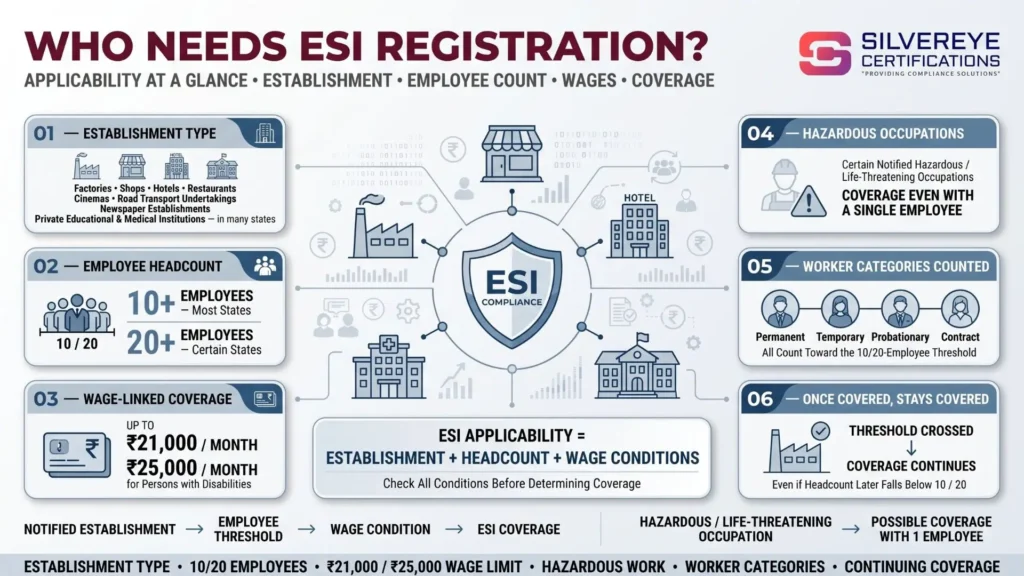
A common misconception is that the whole workforce must earn under ₹21,000 for ESI to apply. In reality, just one employee crossing into that wage bracket is enough to trigger applicability for the entire establishment. And once an establishment is registered, that obligation does not switch off later even if headcount temporarily drops below 10 — coverage, once triggered, continues.
State-level thresholds occasionally cause confusion. For example, Maharashtra is widely quoted as a 20-employee state in older articles, but a state notification (ESIC 2015/C.R.150/RAKAVI-2) lowered shops and establishments there to 10 employees, effective 1 October 2020. Always confirm the current threshold for your specific state before assuming a higher limit applies.
Documents Required for ESI Registration (Complete Checklist)
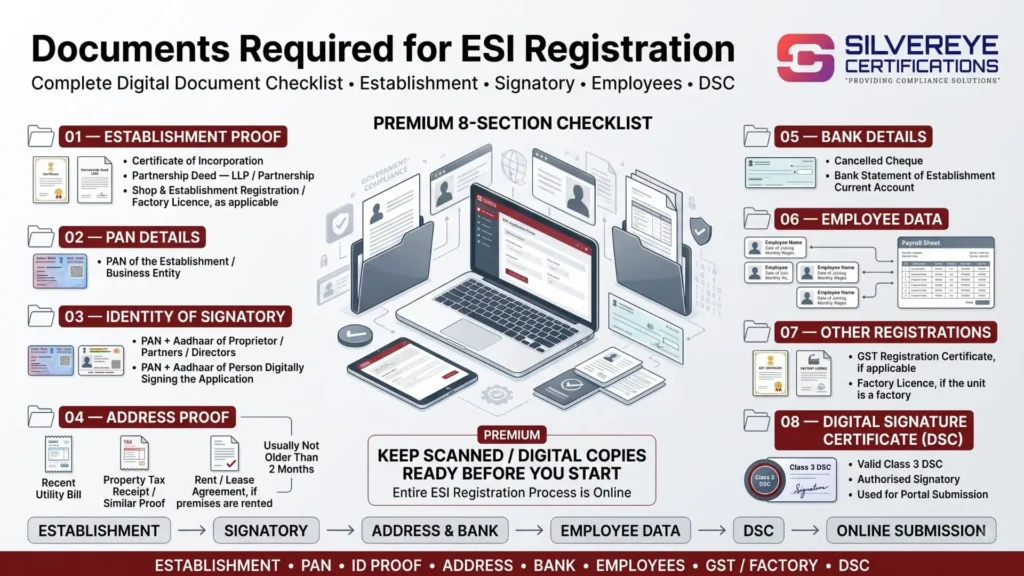
The ESIC registration documents list is organized around four categories: establishment identity, business registration proof, address proof, and employee/bank details. Since the process is entirely online, you will scan and upload these rather than submit physical copies.
1. Establishment & Business Identity Documents
- PAN card of the establishment or company
- Certificate of Incorporation (for a private limited or public company) issued by the Registrar of Companies
- Partnership deed (for a partnership firm) or LLP agreement (for an LLP)
- Memorandum of Association (MOA) and Articles of Association (AOA), where applicable
- GST registration certificate of the establishment
- Registration certificate under the Factories Act, 1948, or the applicable state Shops & Establishment Act
- Import Export Code (IEC), if the business is engaged in international trade
2. Address Proof of the Establishment
Any one of the following, generally not older than three months:
- Electricity bill, water bill, or telephone bill of the premises
- Rent agreement or lease deed of the business premises
- Property tax receipt for owned premises
- Bank statement or passbook showing the registered business address
3. Employer & Signatory Details
- PAN and Aadhaar card of the proprietor, partners, or directors
- Digital Signature Certificate (DSC — Class 3) of the employer or authorised signatory, used to validate Form-1 online
- List of directors/partners with their personal identification details
- Specimen signature of the employer or authorised signatory
- A cancelled cheque or recent bank statement of the establishment's current account, for contribution payments
4. Employee Details Required for ESI Registration
For every employee to be covered from day one, the employer must upload:
- Full name, date of birth, and gender as per Aadhaar
- Aadhaar number of each employee (linked to the ESIC record for identity verification)
- Date of joining the establishment
- Salary/wage structure showing the gross monthly wage
- Bank account details (account number and IFSC) for benefit disbursement
- Nominee/family details for dependent benefit purposes, where applicable
5. Register of Employees (Post-Registration Filing)
Once registered, ESIC also expects employers to maintain and, when asked, submit ongoing compliance records for half-yearly returns, including the Register of Attendance, Form 6 (Register of Employees), wage register, and an accident register (where relevant to the industry). These aren't part of the initial application but are essential for staying compliant afterwards.
ESI Registration Process: Step-by-Step (2026)
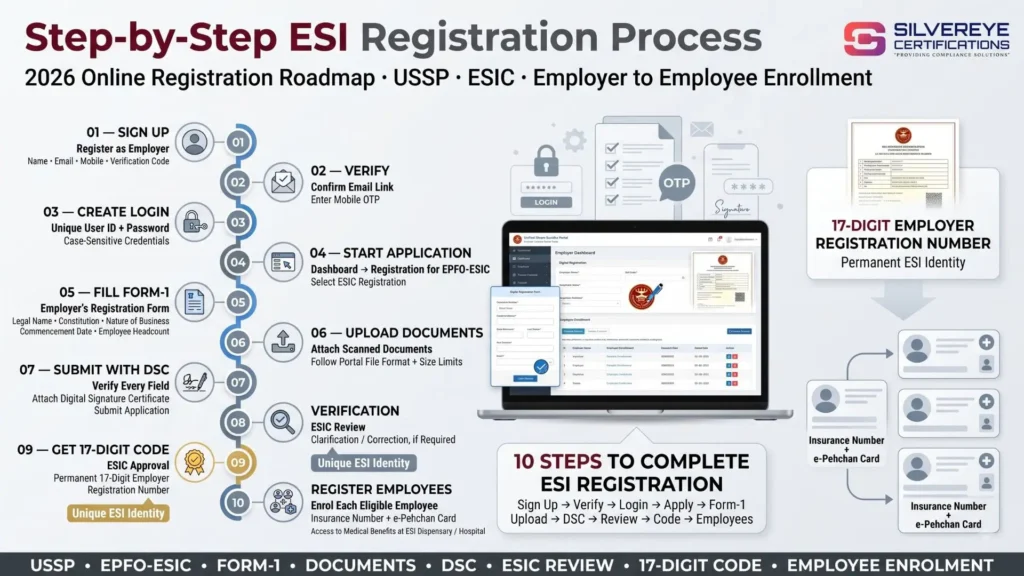
All ESI registrations are completed online — paper applications are no longer accepted. Here is the current process on the Shram Suvidha portal / ESIC self-service portal:
- Create an employer account: Visit esic.gov.in, select "Employer Login," and sign up using the establishment's name, email address, and mobile number. Login credentials arrive by email after OTP verification.
- Fill Form-1 (Employer's Registration Form): Log in and open the New Employer Registration form. Enter establishment details, nature of business, date of commencement, PAN, address, and the initial employee count.
- Upload supporting documents: Attach PAN, incorporation/registration proof, address proof, and the employee list in the accepted formats (PDF/JPG).
- Validate with Digital Signature Certificate: The authorised signatory verifies and signs the form electronically using a Class 3 DSC.
- Pay advance contribution, if applicable: Certain categories of establishments (such as manpower supply agencies) are required to pay an advance contribution at this stage.
- Submit and await verification: ESIC reviews the application and uploaded documents; unclear or mismatched details may trigger a clarification request.
- Receive the 17-digit ESIC employer code: On approval, the system generates a permanent registration letter (Form C-11) containing the unique 17-digit code used for every future filing.
- Register individual employees: Log back in to enrol each eligible employee, generating their personal Insurance Number and e-Pehchan card for accessing ESIC dispensaries and hospitals.
ESI Registration Fees
There is no government fee to register an establishment with ESIC — the process itself is free when completed directly on the official portal. The only cost employers actually bear afterwards is the ongoing statutory contribution deducted from wages, not a one-time registration charge. Establishments that hire a chartered accountant, company secretary, or compliance firm to prepare and file the application will pay that professional's service fee, which varies by provider and is separate from any government charge.
How Long Does ESI Registration Take?
In practice, employer code generation typically takes about 7 to 15 working days from submission, assuming the documents are accurate and consistent on the first attempt (the most common cause of delay is a PAN or name mismatch between documents). Some straightforward applications are approved faster. Employee-level enrolment, by contrast, is usually instant once the employer code is active.
ESI Contribution Rate 2026
| Contributor | Rate | Notes |
|---|---|---|
| Employer | 3.25% of gross wages | Payable on total wages of all covered employees |
| Employee | 0.75% of gross wages | Deducted from wage; employees earning ≤ ₹176/day are exempt from this share, though the employer's share still applies |
| Total contribution | 4% of gross wages | In force since 1 July 2019 and unchanged as of 2026 |
| Monthly deposit deadline | 15th of the following month | Delay attracts 12% p.a. simple interest plus applicable damages |
ESI wages are calculated on gross pay — Basic, Dearness Allowance, House Rent Allowance, and other regular allowances — while components like overtime, statutory bonus, gratuity, and one-off reimbursements are generally excluded from the contribution base.
Validity, Renewal & Ongoing Compliance
ESI registration, once granted, is permanent. The 17-digit employer code does not expire and does not require annual renewal — it remains valid for the establishment's lifetime unless the business is formally closed, merged, or de-registered. However, "permanent" does not mean "passive": employers must continue to comply on a recurring basis:
- Monthly: Deduct, deposit, and generate the Monthly Contribution (MC) challan by the 15th of the following month.
- As employees join: Enrol every new eligible employee within the prescribed period, without waiting for a fixed cycle.
- Half-yearly: Maintain attendance, wage, and employee registers for the return-filing periods (April–September and October–March).
- On inspection: Keep accident registers, wage records, and contractor labour documentation ready for statutory checks.
Key Benefits of ESI Registration for Employers and Employees
- Medical benefit: Full medical care for the insured employee and dependent family members at ESIC hospitals and dispensaries, with no ceiling on treatment expenditure.
- Maternity benefit: Paid leave for eligible women employees, in line with statutory maternity provisions.
- Disability benefit: Periodical payments for temporary or permanent disablement arising from employment injury.
- Dependant benefit: Monthly payment to dependants in the event of an employee's death due to an employment injury.
- Funeral expenses & unemployment allowance: Additional support covering funeral costs and, under specific conditions, unemployment allowance schemes like Atal Bimit Vyakti Kalyan Yojana.
- Employer benefit — compliance credibility: A valid ESIC code strengthens an employer's standing in tenders, audits, and labour inspections, and signals genuine employee welfare commitment.
Penalties for Not Registering or Delayed Compliance
Skipping ESI registration when eligible, or delaying employee enrolment and contribution payments, carries real financial and legal exposure — not just a warning notice:
- Back-dated contributions with 12% per annum interest from the date the establishment first became eligible
- Damages ranging up to 25% of the arrears, depending on the length of the delay
- Monetary penalties that can run into several thousand rupees per default under the applicable provisions
- In serious or repeated cases, prosecution with imprisonment provisions under the Act
Because employee-share contributions deducted from wages are legally treated as money held in trust for the government, any delay in depositing them is viewed more seriously than an ordinary payment delay.
What's New for ESI Registration in 2026
This is the section most guides get outdated fastest, so here is what has genuinely changed, sourced from official notifications rather than speculation:
1. The Code on Social Security, 2020 is now in force
The Central Government brought the major provisions of the Code on Social Security, 2020 into effect on 21 November 2025 through Gazette Notification No. S.O. 5319(E). This consolidates nine earlier labour laws — including the ESI Act, 1948 — into a single unified framework. ESIC subsequently issued an implementation and awareness circular in December 2025 as part of its SPREE (Scheme for Promotion of Registration of Employers and Employees) initiative, urging establishments to prioritise registration ahead of full rule notification.
2. ESIC coverage is now nationwide by design
Previously, ESI Act applicability had to be specifically notified area-by-area. Under the new Code framework, that geographic limitation is removed: if an establishment and its wages meet the eligibility criteria, ESIC coverage applies regardless of which city, town, or district it operates in.
3. Gig and platform workers are formally recognized
For the first time in Indian labour law, gig workers and platform workers (delivery riders, app-based drivers, and digital freelancers) are recognised under Sections 113 and 114 of the Code on Social Security, with aggregators (digital platforms) expected to contribute toward their social security. Detailed operational rules on contribution structure and benefit design were still being finalised as this guide was prepared, so employers and aggregators should track official ESIC and Ministry of Labour circulars for implementation specifics.
4. Expanded definitions of "family" and "dependant"
Following an ESIC Headquarters Circular dated 28 November 2025, the statutory definitions of "family" and "dependant" have been widened — for instance, extending recognition to widowers, grandparents, and in-laws in specified circumstances. This directly affects who can claim dependant and medical benefits, so HR teams should update employee declaration records accordingly.
5. The ₹21,000 wage ceiling has NOT changed
Despite persistent industry demand to raise the ceiling to ₹25,000 or ₹30,000, no gazette notification revising the ₹21,000 monthly wage limit (₹25,000 for persons with disabilities) had been issued as of the latest available update. The Code on Social Security gives the Central Government power to revise this ceiling without a fresh parliamentary amendment, so a change can happen at any time — employers should apply ₹21,000 until an official notification states otherwise, and should not act on figures circulating in social media posts or unverified articles.
6. Hazardous occupations lose the 10-employee threshold
For notified hazardous or life-threatening processes, ESIC coverage is now mandatory even for a single worker, removing the earlier minimum headcount requirement for such establishments.
7. Voluntary ESIC membership for smaller establishments
Establishments with fewer than 10 employees can now opt into ESIC voluntarily, provided both the employer and the employees agree — a route smaller businesses can use to offer social security even before they cross the mandatory threshold.
Because rules under the new Code are still being operationalised in phases, employers should treat this section as a living checklist: confirm the latest position on esic.gov.in or with a registered compliance professional before making payroll or coverage decisions based on any single article, including this one.
Common Mistakes That Delay ESI Registration
- Name/PAN mismatches: The establishment name on PAN, incorporation certificate, and address proof must match exactly — even a punctuation difference can trigger a rejection query.
- Uploading outdated address proof: Utility bills or rent agreements older than the accepted window are a frequent cause of delay.
- Incomplete employee data: Missing Aadhaar numbers or incorrect wage figures at the time of initial enrolment slow down employee-level activation.
- Ignoring state-specific thresholds: Assuming a 20-employee threshold applies everywhere, when several states have since moved to 10.
- Treating registration as a one-time task: Registering the establishment but not building a recurring process for monthly contributions and half-yearly returns.
Get ESI Registration Done Right — With Silvereye Certifications
Gathering the correct ESI registration documents, avoiding PAN or address mismatches, and setting up monthly contribution compliance from day one can feel like a lot to manage alongside running a business. Silvereye Certifications helps employers handle the entire journey — from checking eligibility and preparing the document checklist, to filing Form-1 on the ESIC portal, obtaining the 17-digit employer code, and setting up ongoing monthly and half-yearly compliance.
Whether you're registering for the first time after crossing the 10-employee mark, correcting an earlier filing error, or need help tracking the latest ESIC and Code on Social Security updates, Silvereye Certifications provides accurate, up-to-date, and fully documented support so your establishment stays compliant without the guesswork.
Frequently Asked Questions
What documents are required for ESI registration?
You need the establishment's PAN card, incorporation or registration certificate (company, partnership, or Shops & Establishment license), GST certificate where applicable, address proof (utility bill, rent agreement, or property tax receipt), a cancelled cheque, the employer's Digital Signature Certificate, and employee-level details including Aadhaar, date of joining, and wage structure.
Is ESI registration mandatory for 10 employees?
Yes. Any non-seasonal factory or establishment employing 10 or more people (20 in a few states) and paying wages up to the notified ceiling must register with ESIC within 15 days of becoming eligible. Missing this deadline leads to back-dated contributions with interest, not just a compliance note.
What is the current ESI wage limit in 2026?
The wage ceiling remains ₹21,000 per month in gross wages for general employees and ₹25,000 per month for employees with disabilities. This has been unchanged since January 2017, though the Code on Social Security allows the Central Government to revise it without a parliamentary vote.
Is there a government fee for ESI registration?
No. ESIC does not charge any government fee to register an establishment or generate the 17-digit employer code. Any fee you pay is for a professional service provider's assistance, not for the registration itself.
How long does it take to get the ESIC employer code?
Most applications with complete, accurate documents receive their 17-digit employer code within 7 to 15 working days. Errors such as PAN or name mismatches are the most common reason for delay.
Does ESI registration expire or need renewal?
No. ESI registration is permanent once granted. The 17-digit code stays valid for the life of the establishment unless the business closes, merges, or formally de-registers. What does require ongoing action is monthly contribution payment and half-yearly return filing.
What documents are needed for individual employees under ESI?
For each employee, the employer needs Aadhaar details, date of birth, date of joining, gross wage structure, and bank account information (account number and IFSC) so contributions and benefits can be processed correctly.
What happens if an employer doesn't register for ESI on time?
Non-registration or delayed contribution deposit can result in back-dated contributions with 12% annual interest, damages of up to 25% of arrears, monetary penalties, and, in serious cases, prosecution under the applicable labour code provisions.
Can a business with fewer than 10 employees register for ESI voluntarily?
Yes. Under the current framework, establishments below the mandatory threshold can opt into ESIC voluntarily if both the employer and the employees agree, allowing smaller businesses to offer social security ahead of the mandatory trigger.
What changed in ESI registration rules for 2026?
The biggest structural change is the Code on Social Security, 2020 coming into force on 21 November 2025, which brought nationwide ESIC coverage (removing earlier area-based notification limits), formal recognition of gig and platform workers, and wider statutory definitions of "family" and "dependant." The ₹21,000 wage ceiling itself has not changed.
Are gig and platform workers covered under ESI in 2026?
They are formally recognised under the Code on Social Security, 2020 for the first time, with digital platforms (aggregators) expected to contribute toward their social security. Detailed contribution and benefit mechanics are still being finalised through subsequent rules, so this space should be monitored for operational notifications.
Which address proof documents are accepted for ESI registration?
Acceptable options include a recent electricity, water, or telephone bill of the premises, a registered rent or lease agreement, a property tax receipt for owned premises, or a bank statement showing the business address — generally not older than three months.