
- CPCB Registration Requirement: Producers, Importers, Brand Owners (PIBOs), refurbishers, dismantlers, and recyclers dealing with electrical and electronic equipment must assess and comply with the applicable registration requirements under the E-Waste (Management) Rules, 2022.
- Online Application and Compliance: Applications and applicable compliance submissions are handled through the official CPCB E-Waste EPR Portal, subject to the relevant portal procedures and current CPCB instructions.
- Documents Required: Applicants may need business registration records, GST and PAN details, Schedule I product information, applicable RoHS declarations, and facility-related documents. Requirements vary by entity type and activity.
- EPR Targets and Digital Verification: E-waste recycling and EPR obligations follow the applicable targets and compliance provisions under the E-Waste (Management) Rules, 2022, as amended. Businesses should check current CPCB requirements for target calculations, record-keeping, and verification procedures.
Introduction
E-Waste EPR Registration is a regulatory requirement administered by the Central Pollution Control Board (CPCB) under the E-Waste (Management) Rules, 2022, which came into effect on 1 April 2023 and replaced the earlier 2016 Rules. The applicable registration requirements cover Producers, Importers, Brand Owners (PIBOs), Refurbishers, Dismantlers, and Recyclers involved in electrical and electronic equipment (EEE), according to their respective roles.
Applications are submitted through the official CPCB E-Waste EPR Portal. Depending on the applicant's category, the required documents may include business incorporation proof, PAN, GST registration, Schedule I product details, and Consent to Establish (CTE) or Consent to Operate (CTO) for applicable processing facilities.
After registration, businesses must meet their applicable Extended Producer Responsibility (EPR) obligations, maintain the required records, obtain EPR certificates where applicable, and submit prescribed returns through the relevant digital system. Processing times and annual targets depend on the applicant category and current CPCB requirements, so verify the latest official instructions before applying.
What Is EPR E-Waste Registration?
EPR E-Waste Registration refers to registration and compliance under the E-Waste (Management) Rules, 2022, administered by the Central Pollution Control Board (CPCB). Extended Producer Responsibility (EPR) makes eligible businesses responsible for meeting prescribed obligations related to the collection, channelization, and environmentally sound management of electrical and electronic equipment (EEE) at the end of its useful life.
Electronic waste can contain hazardous substances such as lead, mercury, cadmium, and hexavalent chromium. Proper collection and recycling help reduce environmental contamination and support responsible resource recovery.
The E-Waste (Management) Rules, 2022, notified by the Ministry of Environment, Forest and Climate Change (MoEFCC), came into effect on 1 April 2023, replacing the earlier 2016 Rules.
Key regulatory developments relevant to E-Waste EPR include:
- E-Waste (Management) Amendment Rules, 2023: Introduced amendments affecting the treatment of certain imported used electrical and electronic equipment under applicable EPR requirements.
- E-Waste (Management) Amendment Rules, 2024: Amended provisions relating to EPR certificate pricing and other aspects of the regulatory framework. Businesses should consult the notified amendments for the precise scope and applicability.
- Environmental Compensation: CPCB's applicable guidelines establish the framework for addressing non-compliance, including shortfalls against prescribed EPR obligations.
- Digital compliance requirements: Applicants and registered entities must follow the applicable CPCB portal procedures for registration, record-keeping, certificate management, and return filing.
Some regulatory provisions, including EPR certificate pricing and environmental compensation, may be subject to legal proceedings or subsequent government directions. Businesses should verify the latest applicable notifications, CPCB instructions, and court orders before making compliance decisions.
Who Needs EPR E-Waste Registration?
The E-Waste (Management) Rules, 2022, prescribe registration requirements for specified entities involved in electrical and electronic equipment and e-waste management. Applicability depends on the entity's role and the relevant provisions of the Rules.
| Entity type | Who they are |
|---|---|
| Producer | Businesses manufacturing or producing covered electrical and electronic equipment under the applicable Rules |
| Importer | Businesses importing covered electrical and electronic equipment into India |
| Brand Owner (BO) | Businesses marketing covered electrical and electronic equipment under their own brand, as defined by the Rules |
| Refurbisher | Entities refurbishing covered electrical and electronic equipment |
| Dismantler | Entities dismantling e-waste to recover components or materials |
| Recycler | Entities processing e-waste through authorised recycling operations |
| Producer Responsibility Organisation (PRO) | Organisations that may support producers in fulfilling EPR obligations, subject to applicable regulatory requirements |
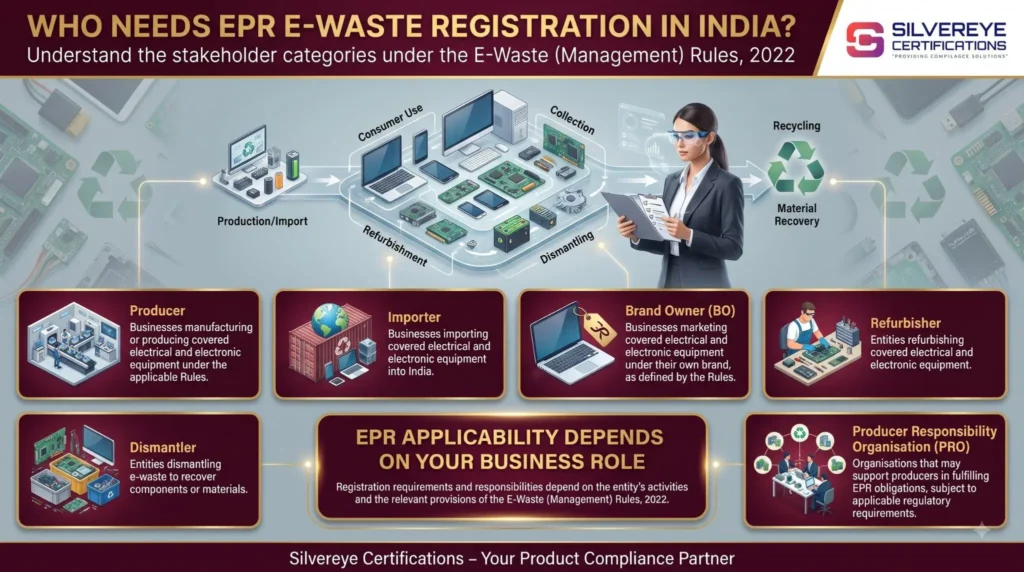
Businesses should determine their registration category before applying. The exact obligations differ by entity type, and the requirements applicable to one category should not automatically be applied to another.
Which Products Are Covered Under E-Waste EPR?
Schedule I of the E-Waste (Management) Rules, 2022, specifies the electrical and electronic equipment covered by the framework. Businesses should match their actual products against the applicable Schedule I entries rather than relying only on broad product descriptions.
Examples of product groups that may fall within the framework include:
- IT and telecommunications equipment: Computers, laptops, servers, mobile phones, printers, and scanners, where covered by the relevant entries.
- Consumer electrical and electronic equipment: Televisions, refrigerators, washing machines, and air conditioners, subject to the applicable product classification.
- Lighting equipment: Covered lamps and lighting products specified in Schedule I.
- Electrical and electronic tools: Specified power tools and other covered equipment.
- Medical equipment: Medical electrical and electronic equipment included in the applicable Schedule I entries.
- Monitoring and control instruments: Covered instruments such as specified detectors, thermostats, and control devices.
- Automatic dispensers: Equipment included in the relevant Schedule I categories.
Additional products or components may be affected by subsequent amendments. In particular, verify the current Schedule I and amendment wording before classifying solar photovoltaic modules, cells, panels, or electric-vehicle-related equipment.
Important: Do not assume that every product in a broad category automatically requires the same registration or documentation. Confirm its exact classification and the applicable Rules before manufacturing, importing, or selling it.
What Documents Are Required for EPR E-Waste Registration?
Preparing the correct documents can help reduce errors during an EPR application. The documentation depends on whether the applicant is a producer, importer, brand owner, refurbisher, dismantler, or recycler.
The following table provides a preliminary checklist based on common application requirements and the document categories in your draft.
| Document | Potentially applicable to |
|---|---|
| Certificate of Incorporation or Partnership Deed | Businesses, as applicable to their legal structure |
| PAN of the company or firm | Applicants where required |
| GST registration certificate | Applicants where applicable |
| Authorised signatory details and identification | Applicants, as required by the portal |
| Factory, trade, or other relevant licence | Applicants where applicable |
| Details of products manufactured or imported, including Schedule I classification | Relevant producers, importers, and brand owners |
| Consent to Establish (CTE) and Consent to Operate (CTO) | Processing facilities where required by applicable environmental regulations |
| Client or OEM details | Where required for the applicant's activity |
| Facility layout or site plan | Relevant processing facilities, as required |
| Facility photographs, video, or geo-location information | Where specified by current CPCB portal instructions |
| Technology and process description | Relevant dismantling and recycling facilities |
| RoHS compliance information or declaration | Where applicable to the product and regulatory requirements |
| Previous-period collection, processing, or channelization records | Where required for the relevant return, renewal, or compliance submission |
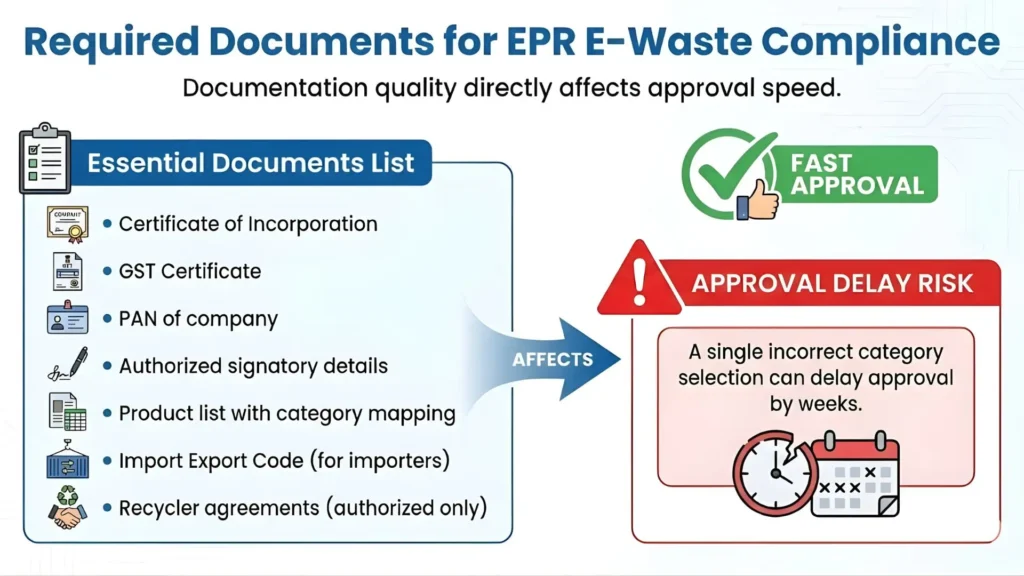
The final document list should be confirmed using the current CPCB portal instructions for the specific applicant category. Requirements for processing facilities can differ from those for producers, importers, and brand owners.
Can You Reuse Documents for Different EPR Registrations?
Some basic business documents, such as incorporation records, PAN, GST details, and authorised signatory information, may also be needed for other EPR registrations.
However, E-Waste EPR documentation is category-specific. Product classification, applicable RoHS information, environmental consents, facility details, and processing-related documents must be prepared according to the relevant e-waste requirements. Do not assume that a document accepted under another EPR framework will automatically satisfy CPCB's e-waste requirements.
Latest E-Waste EPR Notifications and Regulatory Updates (2022–2026)
The E-Waste (Management) Rules, 2022, and subsequent amendments establish the registration, recycling, certificate, and reporting requirements for covered electrical and electronic equipment. Businesses should review the latest notifications and CPCB portal announcements before submitting applications or returns.
| Notification or development | Date / period | Key compliance implication |
|---|---|---|
| E-Waste (Management) Rules, 2022 | Effective 1 April 2023 | Replaced the 2016 Rules and introduced the current EPR registration and recycling-target framework. |
| E-Waste (Management) Amendment Rules, 2023 | 2023 | Introduced amendments to the framework, including provisions relevant to imports of used electrical and electronic equipment. Check the applicable notification for the exact obligations. |
| E-Waste (Management) Amendment Rules, 2024 | 8 March 2024 | Established provisions for an EPR certificate exchange platform and a price range linked to environmental compensation. |
| E-Waste (Management) Second Amendment Rules, 2024 | 12 November 2024 | Amended the provisions concerning action for contravention of the Rules. |
| Environmental Compensation Guidelines | 25 August 2025 | Set out the framework for calculating environmental compensation for specified violations and non-compliance. |
| Annual return deadline for FY 2025–26 | Extended to 30 September 2026 | The CPCB portal announced an extension for filing the annual returns for that financial year. |
| EPR certificate transfers | Portal announcement in 2026 | CPCB announced that certificate transfers had resumed and were operational on the portal. |
Businesses registered before the 2024 amendments should review their existing product classifications, registration details, and applicable compliance documents. Confirm any newly applicable requirements directly against the relevant notification and portal instructions.
How to Complete EPR E-Waste Registration: Step-by-Step Process
The EPR E-Waste Registration process is conducted through CPCB's online portal. The documents and procedure depend on whether you are applying as a manufacturer, producer, refurbisher, or recycler.
- Create an account: Visit the official CPCB E-Waste EPR Portal and follow the current registration instructions.
- Select your entity category: Choose the appropriate registration category based on your business activity.
- Prepare the documents: Gather business registration records, PAN, GST details, product information, and other category-specific documents.
- Complete the application: Enter the required business, product, capacity, or facility details and upload the prescribed documents.
- Review the applicable fees: Check the current CPCB registration fee and annual maintenance charges for your category before making any payment.
- Submit the application: Review the information for accuracy and retain the acknowledgement or application reference.
- Respond to clarification requests: Provide any additional documents or explanations requested by CPCB.
- Receive registration and manage compliance: Once approved, maintain your registration details and fulfil the applicable EPR targets, certificate, and return-filing requirements.
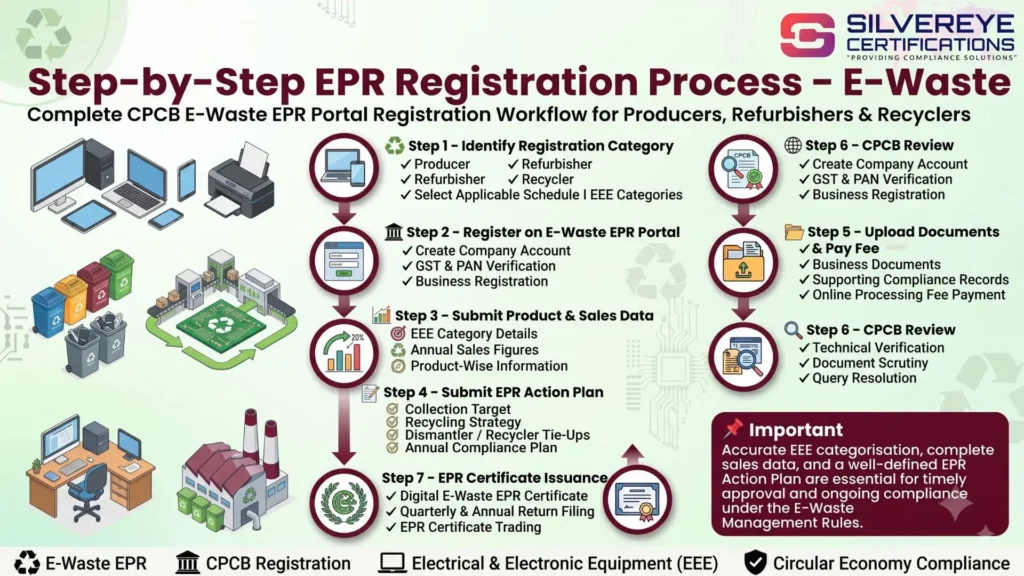
Incomplete records or inconsistencies may delay processing. The time required for approval depends on the application category, documentation, and any clarification or verification requirements.
How Long Does E-Waste EPR Registration Take?
A processing estimate of 30–60 working days may be used for preliminary planning only if it is supported by current, applicable CPCB guidance. It should not be presented as a universal official processing guarantee.
What Are the Fees for EPR E-Waste Registration?
CPCB's registration and annual maintenance charges depend on the applicable category and fee schedule. In particular, producer-registration fees may depend on the annual recycling target rather than a single flat amount.
The following is a general guide to the costs businesses should check before applying.
| Cost component | How the charge is determined |
|---|---|
| Producer registration or renewal | Applicable CPCB fee schedule, including the prescribed annual recycling-target band |
| Manufacturer registration | Fee specified in the current CPCB procedure |
| Recycler registration | Fee specified in the applicable recycler-registration procedure |
| Refurbisher registration | Fee specified in the applicable refurbisher-registration procedure |
| Annual maintenance charges | Applicable CPCB charges for the registered stakeholder category |
| Additional professional support | Depends on the consultant and scope of services |
CPCB's published producer-registration procedure lists different processing fees according to annual recycling-target bands and specifies annual maintenance charges separately. Therefore, the amounts should be checked against the current official schedule instead of assuming every applicant pays ₹10,000.
Before payment: Confirm the current fee, payment instructions, and any annual maintenance charge on the official portal. Do not rely solely on older fee tables.
What Are the E-Waste EPR Recycling Targets?
Under the E-Waste (Management) Rules, 2022, producers must fulfil their applicable EPR obligations through recycling by registered recyclers. The prescribed target is calculated by reference to the quantity of electrical and electronic equipment placed on the market in an earlier year, taking account of the average life specified for the product.
The target schedule in the Rules is as follows:
| Financial year | Prescribed recycling target |
|---|---|
| FY 2023–24 | 60% |
| FY 2024–25 | 60% |
| FY 2025–26 | 70% |
| FY 2026–27 | 70% |
| FY 2027–28 onward | 80% |
These percentages reflect the general schedule for applicable producer obligations. The quantity required for a particular business depends on its product category, relevant historical sales, average product life, and applicable provisions.
Producers should check the recycling targets assigned to their registration on the CPCB EPR portal before finalising their annual compliance plan.
How Do EPR Certificates Work Under the E-Waste Rules?
EPR certificates are generated by eligible registered recyclers through the prescribed system for qualifying recycling activity. Producers use the required certificates to fulfil their assigned recycling obligations under the Rules.
The process generally involves:
- Recycling by a registered recycler: E-waste is processed in accordance with the applicable requirements.
- Certificate generation: Eligible recycling activity is recorded and verified through the prescribed portal procedure.
- Certificate transfer: Certificates are transferred between eligible registered entities through the applicable portal mechanism.
- Producer compliance: Producers use the required certificates to meet their assigned EPR obligations.
- Record maintenance: Relevant parties retain the records needed to demonstrate compliance.
What Is the EPR Certificate Price Range?
Rule 15(9) and (10), inserted through the E-Waste (Management) Amendment Rules, 2024, provide for the highest and lowest exchange prices for EPR certificates to be linked to environmental compensation at 100% and 30%, respectively.
Businesses should check the current portal mechanism and any subsequent government directions or applicable court orders before relying on a particular certificate price. The price range in the Rules should not be confused with a fixed market price for every certificate.
How Long Are EPR Certificates Valid?
The CPCB E-Waste EPR Portal states that EPR certificates are valid for two years under the E-Waste (Management) Rules, 2022.
Producers should plan certificate purchases and transfers around their assigned recycling obligations and applicable validity requirements. Check the current portal instructions for certificate balances, transfer availability, and any restrictions that apply to your registration.
E-Waste EPR Registration Validity, Renewal and Annual Compliance
Businesses registered under the E-Waste (Management) Rules, 2022 must maintain valid registration and fulfil the reporting and EPR obligations applicable to their category. Registration validity, renewal procedures, and reporting requirements can differ depending on the type of entity and the applicable CPCB instructions.
For producers, the CPCB registration procedure specifies a five-year registration validity, with a renewal application to be submitted through the portal 120 days before expiry. Always check the validity period printed on your certificate and the latest instructions for your registration category.
Key compliance responsibilities include:
- Registration renewal: Submit the renewal application within the prescribed period and provide updated information and supporting documents as required.
- Quarterly returns: File the required returns through the CPCB portal within the applicable reporting schedule.
- Annual returns: Submit the prescribed annual return by the applicable deadline. The general deadline under the Rules is the end of the month following the relevant year, subject to category-specific provisions and any official extension.
- EPR target fulfilment: Producers must meet their assigned recycling obligations using eligible EPR certificates obtained through the prescribed portal mechanism.
- Record maintenance: Keep accurate records of products placed on the market, recycling obligations, certificates, and other applicable compliance information.
The CPCB portal may announce extensions or additional instructions for specific financial years. For example, the portal announced that the annual return filing deadline for FY 2025–26 was extended to 30 September 2026. Check the current portal notices before relying on a particular deadline.
What Are the Penalties for E-Waste EPR Non-Compliance?
Businesses that fail to meet their obligations under the E-Waste (Management) Rules, 2022, may face regulatory action. Depending on the violation, consequences can include environmental compensation, notices, registration suspension or cancellation, and other action under the applicable environmental laws.
| Non-compliance issue | Potential consequence |
|---|---|
| Operating without required registration | Regulatory action under the applicable Rules |
| Failure to meet assigned EPR targets | Environmental compensation based on the applicable framework |
| Failure to submit quarterly or annual returns | Notice, environmental compensation, or other action under the applicable guidelines |
| Dealing with unregistered entities where prohibited | Regulatory action under the applicable Rules |
| Submitting false information or concealing information | Possible suspension or cancellation of registration, along with other applicable action |
| Improper generation, transfer, or use of EPR certificates | Environmental compensation and potential registration-related action |
CPCB's Environmental Compensation Guidelines establish specific procedures for different violations. The applicable consequence depends on the nature of the non-compliance, the relevant provisions, and the circumstances of the case.
What Are the Benefits of E-Waste EPR Registration?
Obtaining the required E-Waste EPR registration and maintaining compliance helps businesses meet their regulatory responsibilities while supporting environmentally sound management of electronic waste.
Key benefits include:
- Regulatory compliance: Helps businesses meet the registration and reporting requirements applicable to their activities.
- Continuity of operations: Reduces the risk of regulatory action arising from missing registration, unfulfilled obligations, or incomplete returns.
- EPR target management: Enables eligible producers to fulfil assigned recycling obligations through the prescribed certificate mechanism.
- Business credibility: Demonstrates a structured approach to environmental responsibility and electronic waste management.
- Sustainability reporting: Provides documented information that may support environmental, social, and governance (ESG) reporting and business due diligence.
- Formal recycling ecosystem: Helps eligible registered recyclers participate in the prescribed EPR certificate system, subject to applicable requirements.
Registration alone does not guarantee import clearance, government tender eligibility, or acceptance by every buyer. Businesses should check the specific requirements of the relevant authority, customer, or procurement policy before relying on these benefits.
How Silvereye Certifications Helps With E-Waste EPR Compliance
Silvereye Certifications provides regulatory compliance assistance to businesses seeking guidance on E-Waste EPR registration and related product-compliance requirements.
The support offered can help businesses organise documentation, understand applicable requirements, and prepare for registration and ongoing compliance.
E-Waste EPR Registration Support
- Category-wise document checklist: Identify the documents relevant to your business category and Schedule I product classification.
- Application review: Check business details, product information, and supporting documents for inconsistencies before submission.
- Facility documentation support: Help organise applicable environmental consents, facility information, and process documentation for recyclers and other processing facilities.
- EPR certificate guidance: Understand the prescribed certificate mechanism and how eligible producers can plan to meet their assigned obligations.
- Return-filing and compliance assistance: Organise reporting information, maintain compliance schedules, and prepare for applicable filing deadlines.
- Renewal planning: Track certificate validity and prepare the required documents within the prescribed renewal period.
Support for Other Product Compliance Requirements
Businesses that need E-Waste EPR registration alongside other regulatory approvals may also require support with BIS certification, CDSCO requirements, WPC-ETA approval, and TEC/MTCTE compliance, depending on their products and activities.
Coordinating documentation across relevant compliance requirements can help businesses organise their records and reduce avoidable duplication.
Need assistance with E-Waste EPR registration? Contact Silvereye Certifications to discuss your business category, documentation requirements, and applicable CPCB compliance obligations.
Conclusion
EPR E-Waste Registration is an ongoing compliance responsibility, not just a one-time registration process. Businesses must maintain accurate documentation, meet applicable EPR targets, submit required returns within the prescribed timelines, and keep track of updates to the E-Waste Management Rules. Timely renewal, correct Schedule I product classification, and proper documentation of recycling certificates can help reduce compliance risks and avoid regulatory action.
Silvereye Certifications helps businesses manage their E-Waste EPR compliance journey, from CPCB registration and document preparation to return filing and renewal support. Whether you need assistance with e-waste, plastic, battery, tyre, or used-oil EPR requirements, our team can guide you through the applicable process and documentation.
Need help with E-Waste EPR Registration? Contact Silvereye Certifications for professional compliance support tailored to your business requirements.
Frequently Asked Questions
What documents are required for EPR E-Waste registration?
You need core documents (incorporation certificate, PAN, GST, authorized signatory proof) plus category-specific documents such as Schedule I product classification and RoHS declarations for Producers/Importers, or Consent to Establish/Operate, site plans, and geo-tagged facility videos for Dismantlers and Recyclers.
Is EPR E-Waste registration mandatory for small businesses and startups?
Yes. The E-Waste (Management) Rules, 2022 carry no turnover-based exemption. Any entity that manufactures, imports, or sells EEE in India must register, though small businesses can partner with a registered Producer Responsibility Organization (PRO) to manage target fulfilment more easily.
How long does EPR E-Waste registration take to get approved?
On average, 30 to 60 working days from complete application submission. If CPCB raises a query for clarification or additional documents, the timeline can extend further, so apply well ahead of your intended launch or import date.
Where do I apply for EPR E-Waste registration?
Applications are filed exclusively through CPCB's centralized E-Waste EPR Portal. There is no offline route, and from FY 2025-26 onward, even quarterly and annual returns must be filed digitally.
What are the current e-waste EPR collection targets?
Targets started at 60% of estimated e-waste generation in the first two years of the 2022 Rules, industry guidance places FY 2025-26 and FY 2026-27 around 70%, and the target is expected to plateau near 80% from FY 2027-28. Confirm your exact category's target on the CPCB portal, as figures are periodically clarified.
What happens if I miss my annual e-waste collection target?
CPCB levies a financial penalty (Environmental Compensation) linked to the size of the shortfall. The unmet portion must generally be covered in subsequent years in addition to that year's fresh target, and repeated shortfalls can risk suspension of your EPR certificate.
Can I sell electronic products while my EPR registration is being processed?
Strictly, EPR registration should be in place before sales or imports begin. CPCB can issue show-cause notices for sales made before registration is obtained, so it's safest to complete registration ahead of any product launch or import shipment.
What is a Producer Responsibility Organisation (PRO), and do I need one?
A PRO is a CPCB-registered body that helps PIBOs meet their EPR obligations collectively. If you lack the infrastructure for your own collection and channelization network, partnering with a PRO is often the most practical route — the PRO manages recycler tie-ups and reports on your behalf.
Is EPR E-Waste registration the same as BIS registration?
No. BIS (Bureau of Indian Standards) registration governs product quality and safety standards. EPR E-Waste registration governs end-of-life collection and recycling responsibility. Many electronic products need both — they are separate, complementary compliance requirements.
How do I renew my EPR E-Waste registration?
E-Waste EPR registration is typically valid for one year. Renewal involves submitting updated documents, paying the renewal fee, and filing the previous year's annual return on the CPCB portal — start the process at least 60 days before expiry to avoid a compliance gap.
What are EPR certificates (credits), and how do they work for e-waste?
Registered Recyclers and Dismantlers generate EPR certificates for verified e-waste processing, which PIBOs then purchase on CPCB's centralized exchange to meet their annual targets. Since 2026, unused certificates lapse after two financial years, and pricing is banded to 30–100% of the applicable Environmental Compensation rate.