- Every DGFT Registration needs four core documents: PAN card, identity proof, address proof, and bank proof.
- The exact document set changes by entity type — a partnership deed for firms, a Certificate of Incorporation for companies and LLPs.
- Companies and LLPs must sign digitally with a Class 3 DSC; individual proprietors can now complete the process using Aadhaar-based e-Sign.
- Unclear scans, mismatched names, or an outdated utility bill are the top reasons DGFT documents get rejected on first submission.
What Documents Are Needed for DGFT Registration?
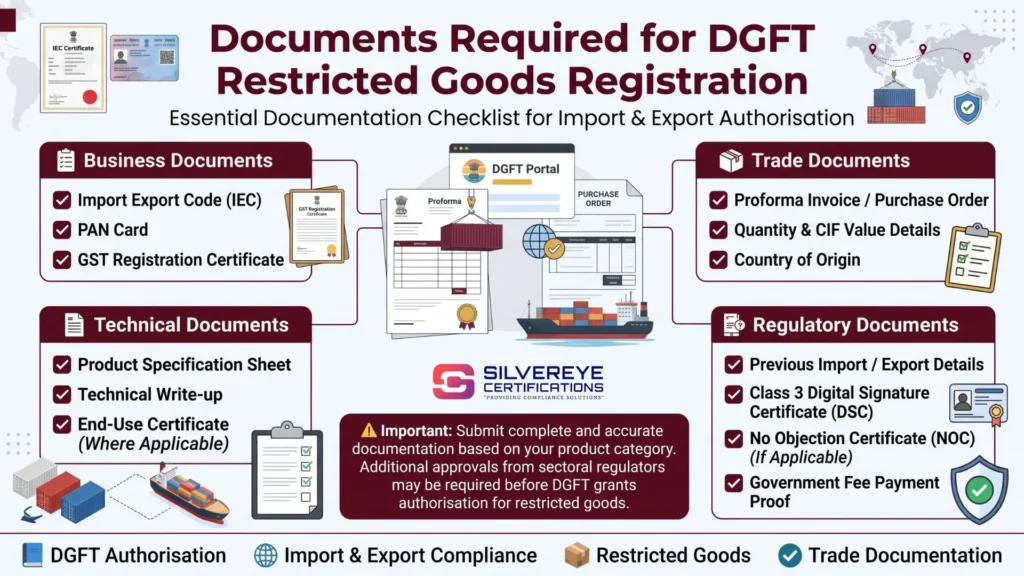
DGFT Registration documents fall into four core categories that apply to every applicant: a PAN card, identity proof of the authorised signatory, address proof of the business, and bank proof such as a cancelled cheque or bank certificate. On top of these, each entity type needs one additional "constitution document" — a partnership deed for firms, an LLP agreement or Certificate of Incorporation for LLPs and companies, or nothing extra for a sole proprietor, since the proprietor's own PAN establishes the business.

Companies and LLPs also need a Class 3 Digital Signature Certificate (DSC) to sign the application, while individual proprietors can instead complete verification through Aadhaar-based e-Sign. All documents must be uploaded as clear, valid-format scans through the DGFT portal under Form ANF-2A.
Why Is It Important to Submit the Correct DGFT Documents?
DGFT verifies every application against the documents you upload, and even a small mismatch — a name spelt differently on your PAN versus your bank certificate, or an address that doesn't match your electricity bill — can put your IEC application on hold or get it rejected outright.
Since the ₹500 government fee is non-refundable, an incomplete or incorrect document set doesn't just cost you time; it can mean paying the fee twice. Getting the paperwork right the first time is the fastest way to receive your e-IEC certificate within the standard 1–3 working day window.
Which Core Documents Are Required for Every DGFT Registration?
Regardless of your business structure, DGFT asks for these four categories of proof at a minimum:
| Document Category | Accepted Documents |
|---|---|
| PAN Card | PAN of the individual, firm, LLP, or company applying for the IEC |
| Identity Proof | Aadhaar card, passport, voter ID, or driving licence of the authorised signatory |
| Address Proof | Utility bill (not older than 2 months), rent agreement with NOC, sale deed, or property tax receipt |
| Bank Proof | Cancelled cheque bearing the entity's pre-printed name, or a bank certificate in the prescribed format |
| Contact Details | Active, Aadhaar-linked mobile number and email ID for OTP-based verification |
What Documents Are Required Based on Your Business Entity Type?
Beyond the core four, DGFT asks for one additional "constitution document" depending on how your business is structured. Here's the breakdown:
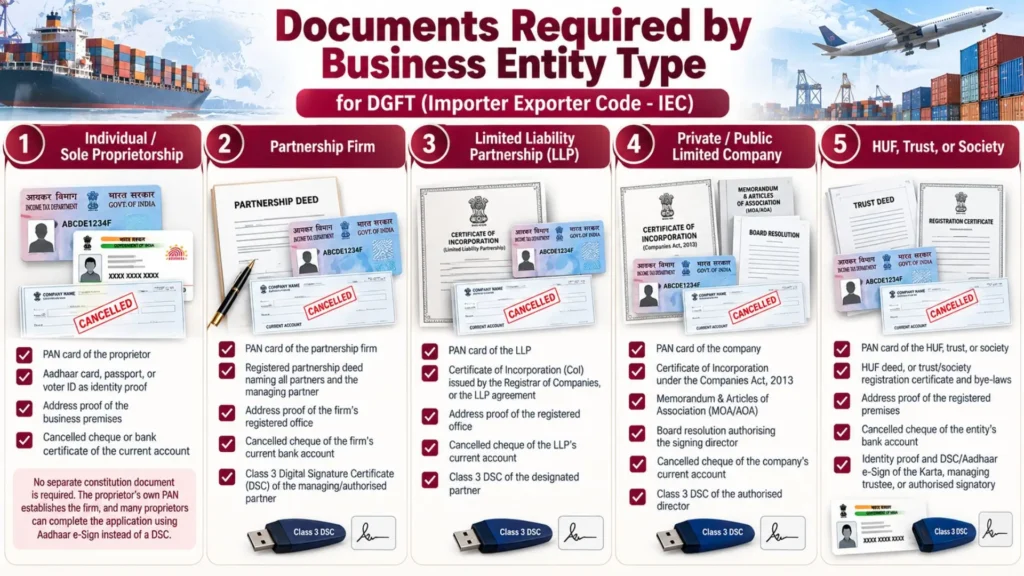
What Documents Are Required for an Individual or Sole Proprietorship?
- PAN card of the proprietor
- Aadhaar card, passport, or voter ID as identity proof
- Address proof of the business premises
- Cancelled cheque or bank certificate of the current account
No separate constitution document is required — the proprietor's own PAN establishes the firm, and many proprietors can now complete the application using Aadhaar e-Sign instead of a DSC.
What Documents Are Required for a Partnership Firm?
- PAN card of the partnership firm
- Registered partnership deed naming all partners and the managing partner
- Address proof of the firm's registered office
- Cancelled cheque of the firm's current bank account
- Class 3 Digital Signature Certificate (DSC) of the managing/authorised partner
What Documents Are Required for an LLP?
- PAN card of the LLP
- Certificate of Incorporation (CoI) issued by the Registrar of Companies, or the LLP agreement
- Address proof of the registered office
- Cancelled cheque of the LLP's current account
- Class 3 DSC of the designated partner
What Documents Are Required for a Private or Public Limited Company?
- PAN card of the company
- Certificate of Incorporation under the Companies Act, 2013
- Memorandum & Articles of Association (MOA/AOA)
- Board resolution authorising the signing director
- Cancelled cheque of the company's current account
- Class 3 DSC of the authorised director
What Documents Are Required for an HUF, Trust, or Society?
- PAN card of the HUF, trust, or society
- HUF deed, or trust/society registration certificate and bye-laws
- Address proof of the registered premises
- Cancelled cheque of the entity's bank account
- Identity proof and DSC/Aadhaar e-Sign of the Karta, managing trustee, or authorised signatory
What Document Format and Validity Rules Should You Follow?
- Address proof (utility bill) must not be older than 2 months from the date of application.
- All scanned documents should be uploaded in the specified file format and size limit set by the DGFT portal — usually PDF or JPEG under a defined size cap.
- The applicant's name must appear identically across the PAN, bank proof, and address proof — spelling mismatches are a leading cause of rejection.
- A cancelled cheque must carry the entity's pre-printed name; handwritten names on a cheque are generally not accepted.
- GSTIN, where applicable, should be linked and allowed to sync with the DGFT system (this can take up to 24 hours after upload).
How Are Documents Used in the DGFT Registration Process?
- Create your DGFT portal account using PAN, email, and mobile number, verified via OTP.
- Log in and open the IEC application form (ANF-2A), which auto-fills some fields from your PAN data.
- Select your entity type and upload the matching constitution document, address proof, and bank proof.
- Sign the application using a Class 3 DSC (companies/LLPs/partnerships) or Aadhaar e-Sign (individuals).
- Pay the ₹500 government fee online and submit the completed application for DGFT verification.
- Once documents are verified, DGFT issues the e-IEC certificate, typically within 1–3 working days.
What Are the DGFT Registration Fees Linked to Documentation?
| Particulars | Fee (Approx.) |
|---|---|
| New IEC application (government fee) | ₹500 (one-time, non-refundable) |
| Re-application after rejection (document mismatch) | ₹500 (fresh payment required) |
| Modification of submitted documents/details | ₹200 |
| Duplicate IEC certificate | ₹200 |
| Annual profile confirmation (April–June) | Free |
What Common Document Mistakes Can Delay DGFT Approval?
- Uploading a blurred or partially cropped scan of the PAN card or bank certificate.
- Submitting an address proof older than the accepted 2-month window.
- Name mismatch between PAN, Aadhaar, and bank account records.
- Using a personal bank account instead of the business's current account for bank proof.
- Forgetting to attach the board resolution or DSC for company/LLP applications.
- Applying with an unlinked or unsynced GSTIN, causing a validation delay.
How Long Are DGFT Registration Documents Valid After Approval?
Once your IEC is approved, you don't need to resubmit documents every year. The IEC itself has lifetime validity, but DGFT requires a free annual confirmation between April 1 and June 30 to keep the profile active.
If your bank account, address, or authorised signatory changes in the meantime, you'll need to update the relevant document on the DGFT portal (a ₹200 modification fee applies) — keeping this current avoids your IEC being flagged inactive during the annual update cycle.
How Can Silvereye Certifications Help With DGFT Registration?
Sorting out exactly which document goes with which entity type — and getting the format, validity window, and signatory details right — is where most DGFT applications lose time. Silvereye Certifications reviews and prepares your complete document set before filing, matches it against DGFT's format and validity rules, and manages DSC or Aadhaar e-Sign coordination, so your IEC application goes through in one clean submission instead of a back-and-forth of resubmissions.
What Should You Know Before Completing DGFT Registration?
The documents you need for DGFT Registration are largely the same for every business — a PAN card, identity proof, address proof, and bank proof — with just one additional constitution document depending on whether you're a proprietor, partnership, LLP, company, or trust.
The real work is in the details: matching names exactly, keeping your address proof current, and using the right signing method for your entity type. Get this checklist right, and your e-IEC certificate is typically issued within 1 to 3 working days. If you'd rather have your documents reviewed and filed correctly the first time, Silvereye Certifications can manage the entire process for you, end to end.
Frequently Asked Questions
What are the basic documents required for DGFT registration?
A PAN card, identity proof, address proof, and bank proof (cancelled cheque or bank certificate) are required from every applicant, regardless of business type.
Do sole proprietors need a separate constitution document?
No. A proprietor's own PAN and identity proof are enough to establish the business — no partnership deed or incorporation certificate is needed.
Is a Digital Signature Certificate (DSC) compulsory for DGFT registration?
It's compulsory for partnerships, LLPs, and companies. Individual proprietors can instead use Aadhaar-based e-Sign to complete the application.
What documents does a private limited company need for IEC?
A PAN card, Certificate of Incorporation, MOA/AOA, board resolution, cancelled cheque, and a Class 3 DSC of the authorized director.
How old can the address proof be for DGFT registration?
Utility bills used as address proof should generally not be older than 2 months from the date of application to be accepted.
Can I use a personal bank account for IEC bank proof?
No. The cancelled cheque or bank certificate must be from the business's current account, with the entity's name pre-printed on it.
What happens if my documents don't match across PAN, Aadhaar, and bank records?
A name or address mismatch across documents is one of the most common reasons DGFT applications are delayed or rejected outright.
Do I need to resubmit documents every year for DGFT?
No. Once approved, your IEC has lifetime validity. You only need to confirm your profile details annually between April and June, without resubmitting fresh documents unless something has changed.
What documents are needed for a partnership firm's IEC application?
A PAN card of the firm, the registered partnership deed, address proof, a cancelled cheque, and the managing partner's DSC.
Can I update a document after my IEC is already approved?
Yes. You can update address, bank, or signatory documents on the DGFT portal any time, subject to a modification fee of ₹200.
What file format should IEC documents be uploaded in?
Documents should be uploaded as clear scans in the file format and size limit specified on the DGFT portal, typically PDF or JPEG.
Who can help me prepare and verify my DGFT documents before filing?
You can self-check documents against the DGFT checklist, or have a professional service like Silvereye Certifications review, format, and file them on your behalf for a smoother approval.