

- Cosmetic License For Handmade soap for profit — even from home — puts you under the Drugs and Cosmetics framework, not a legal grey zone.
- GMP compliance (Schedule M-II / BIS-aligned hygiene and process standards) is the realistic starting point for a home-based, no-factory soap maker.
- A Cosmetic Manufacturing License (COS-8) becomes necessary once you set up a dedicated commercial unit or scale production and distribution.
- Loan licenses and contract manufacturing let you sell under your own brand without owning a licensed facility, if you'd rather not build one yet.
Introduction
If you make soap at home and haven't set up a dedicated manufacturing unit yet, you don't hold a full Cosmetic Manufacturing License from day one. What you need first is a GMP-compliant home setup — clean, pest-free, well-documented production space that meets Schedule M-II hygiene and process standards — along with basic registrations like Udyam (MSME) and GST.
GMP License signals that your process is safe and consistent. A Cosmetic Manufacturing License (Form COS-8) under the Drugs and Cosmetics Act, 1940 becomes mandatory once you scale into a dedicated commercial manufacturing premise, sell at volume, or supply to retailers. Below is the full compliance path, documents, costs, and renewal timeline.
Is Handmade Soap Actually Regulated in India?
Yes. Under Section 3(aaa) of the Drugs and Cosmetics Act, 1940, a cosmetic is any article meant to be rubbed, poured, sprinkled, or applied to the human body for cleansing or beautifying. Unlike some countries where true soap is carved out of the cosmetics definition, Indian law does not exempt soap — bar soap, liquid soap, and bathing bars are all treated as cosmetics.
That means every soap maker who sells commercially, regardless of batch size, falls under the Cosmetics Rules, 2020, and the oversight of the Central Drugs Standard Control Organization (CDSCO) and the State Licensing Authority (State Drug Controller) of the state where the unit is located.
This is exactly why the compliance journey for a home-based soap seller usually has two stages: an early stage built around GMP License while you're still working from home, and a licensing stage once you set up a proper manufacturing or commercial space.
What Are the GMP Requirements for a Handmade Soap Business?
Good Manufacturing Practice (GMP License) is a set of operating standards that make sure every bar of soap you make is safe, consistent, and free from contamination. For cosmetics manufactured in India, the relevant benchmark is Schedule M-II of the Drugs and Cosmetics Rules, which lays down requirements for premises, equipment, personnel hygiene, raw material handling, batch records, and testing.
Many home-based and small-batch manufacturers also look at BIS standard IS 4011 for toilet soap and international frameworks like ISO 22716 as reference points for building a clean, well-documented process, even before they're ready to apply for a full state cosmetic license.
For someone soaping in a spare room or a converted home studio, GMP is less about a single certificate and more about a way of working: dedicated, non-residential-mixed workspace where possible, covered work surfaces, labelled and dated raw materials, batch and cure logs, basic pest control, and staff (even if it's just you) following simple hygiene steps like handwashing and clean aprons before each batch. This is the foundation regulators and buyers expect, whether you're selling on Instagram, at a local market, or through an e-commerce marketplace.
Importance and Applicability of GMP License for Handmade Soap Businesses
For small and home-based soap businesses, GMP (Good Manufacturing Practices) compliance is important because handmade soaps are still considered cosmetic products when they are manufactured for sale or distribution. The Cosmetics Rules, 2020 require a person intending to manufacture cosmetics for sale or distribution to obtain the applicable manufacturing license from the State Licensing Authority.
Importance of GMP License for Handmade Soaps
GMP License provides a structured framework to ensure that soaps are manufactured under clean, hygienic, controlled and consistent conditions. It covers areas such as premises, personnel hygiene, equipment, raw materials, water quality, manufacturing processes, storage, packaging, quality control and record keeping. The Seventh Schedule of the Cosmetics Rules, 2020 specifically lays down GMP and requirements for premises, plants and equipment for cosmetic manufacturing.
- For a handmade soap business, GMP compliance helps to:
- Maintain consistent quality and composition from batch to batch.
- Reduce the risk of contamination, adulteration and manufacturing errors.
- Ensure proper handling and storage of oils, fragrances, colours, additives and other raw materials.
- Establish proper batch records and manufacturing procedures.
- Improve consumer confidence in the safety and quality of the product.
- Support regulatory compliance when applying for a cosmetic manufacturing licence.
- Provide a professional foundation for expanding from a home-based business to a commercial manufacturing operation.
Applicability to Home-Based / Small Soap Manufacturers
A common misconception is that GMP or a cosmetic manufacturing licence is not applicable if soaps are made at home or on a very small scale. The important factor is not simply the size of the business or whether the owner calls it a "home business"; it is whether cosmetic products are being manufactured for sale or distribution.
Under Rule 23 of the Cosmetics Rules, 2020, a person intending to manufacture cosmetics for sale or distribution is required to apply for a manufacturing licence or loan licence through the State Licensing Authority. The application requires, among other things, details of the manufacturing premises, layout, machinery/equipment, competent technical staff, cosmetic formulations and a self-certificate of compliance with GMP in Form COS-7.
However, simply manufacturing soap inside an ordinary residential kitchen does not automatically make the premises suitable for a cosmetic manufacturing licence. The GMP requirements specify that the manufacturing premises should be sanitary, hygienic, clean and properly ventilated, and the manufacturing area should be designed to prevent contamination. The Seventh Schedule also contains specific requirements for cosmetic manufacturing premises and equipment.
For toilet soaps, the Seventh Schedule provides specific equipment and area requirements. The prescribed requirements include suitable equipment for saponification, heating, stirring, storage, mixing, cutting, pressing/stamping and weighing, among other equipment. The Schedule also specifies a 100 m² minimum area recommendation for small-scale manufacture of toilet soaps.
Cosmetic Manufacturing License (COS-8) — Once You Have a Commercial or Manufacturing Area
The moment you move from a hobby kitchen to a dedicated manufacturing space — even a small one — and plan to sell soap commercially (online, in stores, at exhibitions, or via marketplaces), you are legally required to hold a Cosmetic Manufacturing License.
This is issued under the Cosmetics Rules, 2020, framed under the Drugs and Cosmetics Act, 1940, by the State Licensing Authority (also called the State Drug Controller) of the state where your unit is located.
Who Needs It
- Home-based or small-batch soap makers who want to sell commercially, not just gift or test
- Sellers listing soap on e-commerce marketplaces, their own website, or through retail/wholesale channels
- Anyone manufacturing soap under a brand name for sale or distribution in India
Eligibility
- Applicant should be an Indian citizen or a registered business entity (proprietorship, partnership, LLP, or company)
- A technical/competent person overseeing production should have passed the intermediate examination with chemistry as a subject, or hold an equivalent qualification recognised by the Licensing Authority
- A defined manufacturing premises — owned or rented — that can be laid out and inspected for GMP compliance
If You Import Soap Into India
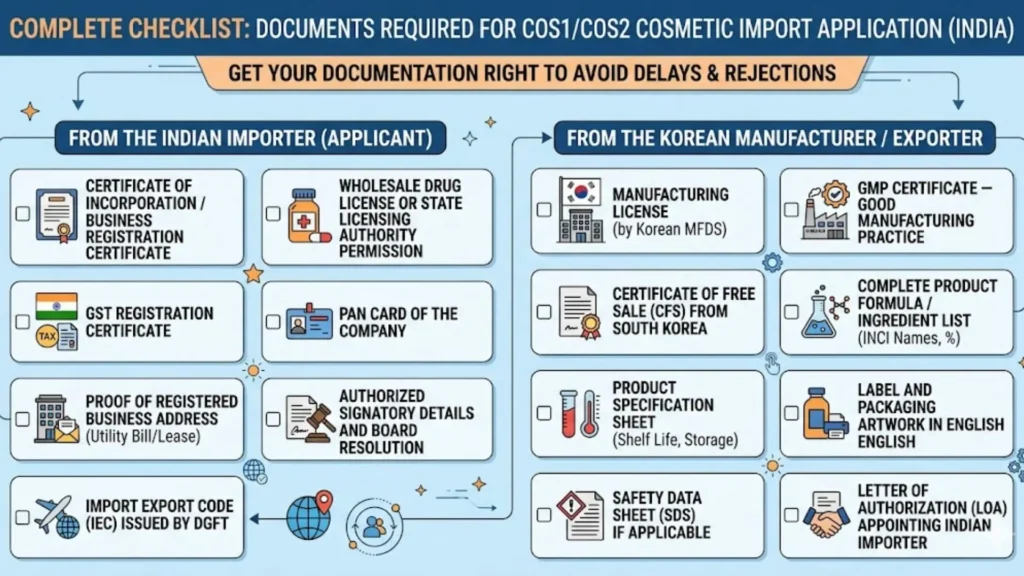
If you're bringing finished soap in from another country to sell under your own or a licensed brand in India, manufacturing licenses don't apply to you — you need an Import Registration Certificate instead, issued by the Central Licensing Authority (CDSCO), not the state authority.
How it works:
- The application is filed in Form COS-1 on the CDSCO SUGAM portal.
- Once approved, CDSCO issues the Import Registration Certificate in Form COS-2.
- No cosmetic can legally enter India without this certificate — post-import registration isn't permitted, meaning you cannot import first and register afterward.
- The certificate is typically valid for 5 years from issuance, renewable on payment of the applicable fee, and remains valid in perpetuity subject to that periodic renewal.
Who can apply:
- The overseas manufacturer directly
- An authorised agent, distributor, or subsidiary of the manufacturer based in India
- An independent Indian importer who isn't yet an established business, provided documentation requirements are met
Typical documentation includes:
- Free Sale Certificate from the country of origin
- Manufacturing license or marketing authorisation from the country of origin's regulator
- Non-animal testing declaration
- Heavy metal and hexachlorophene compliance declaration
- List of ingredients with percentage composition
- Authorisation letter from the manufacturer (if applying through an agent)
- Labels and pack inserts
Import restrictions to know: Cosmetics cannot be imported into India if they are banned for manufacture, sale, or distribution in their country of origin; if the "use before" or "use by" date is less than six months from the date of import; if they contain hexachlorophene; or if they've been tested on animals after 12 November 2014.
If your soap formulation includes a genuinely new active ingredient not previously used in cosmetics anywhere, or makes a "new cosmetic" claim, you'll need prior permission under Form COS-3 from the Central Licensing Authority before the standard import registration can proceed.
If You're a Wholesaler, Distributor, or Retailer
This is the least discussed part of soap compliance, mainly because the rules genuinely are lighter here than most people expect. Under the earlier Drugs and Cosmetics Rules, 1945, cosmetics (like drugs) required separate wholesale and retail sale licenses. The Cosmetics Rules, 2020 removed that requirement — there is no standalone "wholesale cosmetic license" or "retail cosmetic license" that a trader, stockist, or shop needs to hold simply to buy and resell finished soap.
That doesn't mean wholesalers operate with zero responsibility, though. In practice, if you're distributing or stocking soap in bulk, you should still:
- Verify your source is properly licensed. Only buy from manufacturers holding a valid COS-8 (or COS-9 loan license) or importers holding a valid COS-2 registration. If a batch turns out to be from an unlicensed manufacturer, the liability trail can reach the wholesaler too, especially in the event of a consumer complaint or product recall.
- Maintain purchase records and invoices showing the manufacturer's or importer's license details — this is your paper trail if a regulator or a marketplace platform ever asks.
- Check labelling compliance under the Legal Metrology (Packaged Commodities) Rules — MRP, net quantity, manufacturer/importer details, batch number, and manufacturing date must all be correctly declared on every unit you're distributing.
- Register your own business (GST, Udyam if applicable) even though a dedicated cosmetic trading license isn't required.
- Cooperate with voluntary recalls. If a manufacturer or the State Licensing Authority initiates a recall over a safety concern, distributors and wholesalers are expected to pull affected stock from circulation promptly.
If you're a wholesaler who also gets soap private-labelled — buying in bulk from a manufacturer and selling under your own brand name — you effectively become the "brand owner" for labelling and consumer-facing compliance purposes, even though the physical manufacturing license sits with the factory you're sourcing from. Get this arrangement documented properly (a manufacturing/supply agreement referencing the manufacturer's COS-8 or COS-9 license) so responsibility is clear if something goes wrong.
Documents Required for Cosmetic License For Handmade Soaps
| Category | Documents |
| Business proof | Business registration certificate / incorporation documents; PAN; GST registration (if applicable) |
| Premises proof | Ownership document or rent/lease agreement of the manufacturing site; site plan and plant layout |
| Manufacturing details | List of machinery/equipment, manufacturing process flow, product formula and specifications |
| GMP compliance | GMP self-declaration (Form COS-7) confirming the site meets Schedule-prescribed GMP requirements |
| Technical staff | Qualification proof of the technical/competent person responsible for production |
| Product details | List of cosmetic products/categories to be manufactured, with labels/artwork in triplicate |
| Statutory | Fee payment receipt; undertaking of compliance with the Cosmetics Rules, 2020; Pollution Control Board NOC (as applicable to your unit) |

Step-by-Step Process For Cosmetic License For Handmade Soaps
- Set up your manufacturing/commercial space and align it with GMP requirements (layout, hygiene, equipment, storage, records).
- Register your business (proprietorship/LLP/company) and get PAN and GST registration if applicable.
- Prepare the Site Master File, plant layout, equipment list, product formulas, and technical staff qualification proof.
- File Form COS-5 with your State Licensing Authority (through the applicable state or CDSCO SUGAM portal), along with Form COS-7 (GMP self-declaration) and the prescribed fee.
- The Licensing Authority scrutinises your documents and schedules a physical inspection of your premises, typically within 30 days.
- Address any deficiencies or queries raised by the inspecting drug officer.
- On satisfactory verification, the State Licensing Authority grants the Cosmetic Manufacturing License in Form COS-8, usually within 45 days of completed document verification.
- Print your manufacturing license number on all product labels as required under the Cosmetics Rules, 2020.

Benefits of GMP License for Handmade Soaps
GMP License (Good Manufacturing Practices) helps handmade and small-scale soap businesses maintain hygienic, consistent, and controlled manufacturing practices.
- Builds Customer Trust: Demonstrates commitment to hygiene, quality, and product safety.
- Ensures Consistent Quality: Helps maintain uniform quality, fragrance, texture, and appearance across batches.
- Reduces Contamination Risks: Promotes proper cleaning, sanitation, storage, and handling practices.
- Supports Regulatory Compliance: Helps businesses meet applicable cosmetic manufacturing requirements.
- Improves Documentation: Enables proper batch records, raw material records, and product traceability.
- Strengthens Brand Credibility: Provides a more professional image when dealing with customers, retailers, and distributors.
- Supports Business Growth: Establishes systematic processes that make it easier to scale production.
Cost for GMP License & Cosmetic Manufacturing License – Handmade Soaps
For a small/home-based soap business in India, the cost generally depends on whether the client already has a compliant manufacturing premises or needs assistance with setting one up.
| Particulars | Approx. Cost |
| Government fee for Cosmetic Manufacturing Licence (COS-8) | ₹10,000* |
| GMP documentation & compliance support | ₹15,000 – ₹30,000 |
| Product/soap testing, if required | ₹3,000 – ₹10,000+ |
| Documentation & application support | ₹5,000 – ₹15,000 |
| Professional service package | ₹20,000 – ₹40,000+ |
The official Cosmetics Rules, 2020 prescribe ₹10,000 for a COS-8 manufacturing licence covering up to 10 items in each category; additional items attract additional fees.
Important for Home-Based Units
If the applicant does not have a dedicated manufacturing unit, the cost may increase because the premises may need to be made compliant with applicable GMP and licensing requirements. Alternatively, a loan licence (COS-9) may be considered where appropriate; its government fee is also ₹10,000 for up to 10 items in a category.
Timeline, Validity, Renewal & Retention
As per the Cosmetics Rules, 2020, the applicable details for a Cosmetic Manufacturing Licence (COS-8) are:
| Particular | Details |
| Application Timeline | The licence is processed by the State Licensing Authority after scrutiny of the application and documents. The rules do not prescribe a fixed number of days for grant of COS-8. |
| Validity | Perpetual — the licence remains valid unless suspended or cancelled. |
| Retention | Retention fee must be paid before completion of every 5 years from the date of issue of the licence. |
| Renewal | There is no conventional renewal every 5 years. Instead, the licence continues through payment of the applicable retention fee. |
| Late Payment | A late fee of 2% of the retention fee per month or part thereof applies for up to 180 days. If the fee remains unpaid during this period, the licence is deemed cancelled. |
| Inspection | Licensed premises may be inspected at least once every 3 years, or as required under a risk-based approach. |
Why Choose Silvereye Certifications For Cosmetic License For Handmade Soaps?
- Expert Regulatory Guidance: Our team provides practical guidance on cosmetic licensing, GMP requirements, documentation, and compliance.
- End-to-End Support: From initial consultation and document preparation to application filing and follow-up, we assist throughout the process.
- Specialized Cosmetic Compliance: Silvereye provides support for cosmetic manufacturing and loan manufacturing licence requirements.
- Accurate Documentation: We help prepare and review the required documents to minimise errors, objections, and unnecessary delays.
- Transparent Process & Pricing: Clear communication and structured support without hidden charges.
- Dedicated Client Support: Our team remains available to guide clients through regulatory queries and compliance requirements.
Conclusion
For handmade and small-scale soap businesses, following the applicable GMP and cosmetic manufacturing requirements is an important step toward establishing a safe, consistent, and professionally managed business. With the right documentation and regulatory guidance, businesses can avoid common compliance issues and build a stronger foundation for growth.
Silvereye Certifications provides end-to-end consultancy and documentation support to help clients navigate the cosmetic licensing and GMP compliance process efficiently. Government licences and approvals are issued by the respective authorities; Silvereye provides professional consulting support throughout the process.
Frequently Asked Questions
Do I need a license to sell homemade soap in India, even in small quantities?
Yes. Soap counts as a cosmetic under Indian law, so even small-batch or home sellers fall under the Cosmetics Rules, 2020 — there's no size exemption.
What's the difference between GMP compliance and a Cosmetic Manufacturing License?
GMP is about following clean, documented processes — something you can start at home. The Cosmetic Manufacturing License (COS-8) is the official approval, required once you set up a dedicated commercial unit.
Can I get licensed while still working from my home kitchen?
Usually not. Regulators expect a separate, ventilated space designed to prevent contamination — a regular kitchen typically doesn't qualify.
Is there a minimum space requirement for manufacturing?
Around 100 m² is recommended for small-scale toilet soap units, along with proper equipment for mixing, saponification, and storage.
What if I don't want to set up my own unit yet?
A loan license (COS-9) lets you sell under your own brand while manufacturing through an already-licensed facility.
Who can oversee production for licensing purposes?
Someone with at least intermediate-level chemistry (or an equivalent qualification) must be responsible for production.
How much does licensing cost?
The government fee is ₹10,000 for COS-8 (up to 10 items). With documentation and setup support, total costs often run ₹20,000–₹40,000+.
Do I need to renew the license every year?
No. It's valid indefinitely, but you must pay a retention fee every 5 years to keep it active.
What does the application process involve?
File Form COS-5 with the GMP self-declaration (COS-7), go through a premises inspection, then receive the license as Form COS-8.
What documents do I need to apply?
Business registration, PAN/GST, premises proof and layout, product formulas, technical staff qualifications, and label artwork in triplicate.