- BIS issued fresh CRS classification guidance (Ref: Reg/2026/G-01, dated 13 Aug 2026) for Audio Glasses, Smart Glasses, AR Glasses and MR Glasses.
- Every wearable glasses type now needs its own separate license — there is no single "smart glasses" umbrella registration.
- BIS Scheme-II licenses are now granted for 5 years at first grant and renewable for a further 5 years, with fees payable annually in advance.
- Missing the annual fee or production-detail deadline can trigger suspension, deferment or cancellation of an active BIS CRS license.
Introduction
Under the Compulsory Registration Scheme (CRS), wearable glasses are not registered as one generic product. BIS classifies them by function: Audio Glasses fall under Wireless Earphones and Headphones, Smart Glasses fall under Digital Camera or Video Camera categories depending on whether they capture photos only or photos and video, and AR Glasses and MR Glasses fall under Extended Reality Products.

Each product name needs a separate BIS CRS license. Following the 25 February 2026 amendment to the BIS (Conformity Assessment) Regulations, 2018, Scheme-II licenses are granted for 5 years, renewable for another 5 years, with fees paid annually in advance.
What Changed Under BIS CRS Update in 2026
If you manufacture or import wearable glasses, AR headsets, VR headsets or MR devices for the Indian market, two regulatory updates from the Bureau of Indian Standards directly affect how you apply, what you apply for, and how long your license stays valid. This guide brings both together in one place, in plain language, so you know exactly what to do next.
The first update is a classification circular (Ref: Reg/2026/G-01, dated 13 August 2026) issued by the Registration Department of BIS. It clarifies, in more detail than before, exactly which product category, sub-category and product name a wearable glasses device should be registered under.

The second update is a revision to licence validity and renewal under Scheme-II, following an amendment dated 25 February 2026 to the BIS (Conformity Assessment) Regulations, 2018. Both updates operate under the Electronics and Information Technology Goods (Requirement of Compulsory Registration) Order, 2021 — the Quality Control Order (QCO) that originally brought this category of electronics into compulsory registration.
The QCO That Governs This: Electronics and IT Goods (Compulsory Registration) Order, 2021
Every classification rule and validity rule on this page sits under the Electronics and Information Technology Goods (Requirement of Compulsory Registration) Order, 2021. This QCO makes it mandatory for specified categories of electronic and IT hardware — including wireless earphones and headphones, digital and video cameras, and Extended Reality products — to carry the BIS Standard Mark before they can be manufactured, imported, stored, sold or distributed in India. The 13 August 2026 circular does not introduce a new QCO; it explains how newer device types such as Audio Glasses, Smart Glasses, AR Glasses and MR Glasses map onto the categories already notified under this 2021 Order.
Note for the publisher: if BIS issues a fresh gazette notification amending the 2021 QCO itself (rather than the classification circular referenced here), add that exact notification number and date in this section before the page goes live, so the citation stays fully accurate.
Product Classification Table: Wearable Glasses (Audio, Smart, AR & MR)
This is the exact classification released by BIS on 13 August 2026. Match your device to the row that describes its features before starting a CRS application.
| S.No. | Product Category | Sub-category / Product Name | What It Covers |
| 1 | Wireless Earphones and Headphones | Audio Glasses | Bluetooth or other wireless connectivity, microphone and speaker, audio calling and music playback, along with similar functionalities including an AI-based voice assistant. |
| 2 | Digital Camera | Smart Glasses | Features of Audio Glasses (with or without them), plus a camera capable of capturing photographs only. |
| 3 | Video Camera | Smart Glasses | Features of Audio Glasses (with or without them), plus a camera capable of capturing both photographs and videos. |
| 4 | Extended Reality Products (AR / VR / MR etc.) | AR Glasses | Features of Smart Glasses (with or without them), plus an overlay display visible through the lenses. |
| 5 | Extended Reality Products (AR / VR / MR etc.) | MR Glasses | Same base features as AR Glasses; registered separately as MR Glasses. |
Read this table as a ladder: Audio Glasses is the base feature set, Smart Glasses adds a camera, and AR/MR Glasses adds a display overlay on top of that. Where your product sits depends on the highest feature tier it actually has.
Product Classification Table: Extended Reality (AR, VR & MR) Products
Beyond wearable glasses, BIS has also laid out how the wider Extended Reality product category should be split for CRS applications:
| S.No. | Product Category | Sub-category | Product Name |
| 1 | Extended Reality Products (AR / VR / MR etc.) | AR Glasses | AR Glasses |
| 2 | Extended Reality Products (AR / VR / MR etc.) | Other AR Devices | Other AR Devices |
| 3 | Extended Reality Products (AR / VR / MR etc.) | VR Headset | VR Headset |
| 4 | Extended Reality Products (AR / VR / MR etc.) | MR Glasses | MR Glasses |
| 5 | Extended Reality Products (AR / VR / MR etc.) | Other MR Devices | Other MR Devices |
BIS has been explicit on one point that trips up a lot of first-time applicants: a separate license is required for each product name listed above. You cannot cover a VR Headset and an MR Glasses device under one composite CRS license, even if both are made by the same company on the same production line.
Product-Wise Breakdown: What Each Category Actually Means
Audio Glasses
Audio Glasses are registered under Wireless Earphones and Headphones. If your device's main job is wireless audio — calls, music, a built-in voice assistant — with no camera and no display, this is the category and product name to apply under.
Smart Glasses
Smart Glasses sit under Digital Camera or Video Camera, depending purely on what the camera can do. A photo-only camera means Digital Camera; a photo-and-video camera means Video Camera. The presence of audio features does not change this — it is the camera capability that decides the category.
AR Glasses
AR Glasses are classified as Extended Reality Products. They carry everything a Smart Glasses device has (camera, audio, or both) plus a display overlay the wearer sees through the lens. AR Glasses also appear as their own line item in the Extended Reality Products table, since that table governs the full XR category, not just glasses.
MR Glasses
MR Glasses follow the same logic as AR Glasses — same base features, plus the overlay display — but are registered as a distinct product name. BIS treats AR and MR as separate licences even when the hardware is very similar, so don't assume one covers the other.
VR Headsets and Other AR / MR Devices
VR Headset, Other AR Devices and Other MR Devices are the three additional product names under Extended Reality Products for devices that don't fit the "glasses" form factor — for example, immersive headsets or non-glasses AR/MR hardware. Each still needs its own dedicated CRS licence.
New in 2026: BIS License Validity Extended to 5 Years
Alongside the classification update, BIS has revised how long a Scheme-II licence lasts. Following the amendment dated 25 February 2026 to the BIS (Conformity Assessment) Regulations, 2018, the rules for validity, renewal and continuation of a Scheme-II licence — which is what CRS registration falls under — now read as follows:
| What Changed | Revised Rule |
| Initial grant | The licence to use the Standard Mark is granted for an initial period of 5 years. |
| Fee payment (initial period) | Fees for the 5-year period are paid on an annual basis, not as one lump sum upfront. |
| Renewal | On renewal, the licence is granted for a further period of 5 years. |
| Fee payment (renewal period) | Renewal-period fees are also paid annually. |
| Timing of payment | Fees for grant, renewal and continuation of the licence must be paid annually in advance, by the prescribed due date. |
| Non-payment consequence | If the annual fee and production details are not submitted by the due date, the licence becomes liable for suspension/deferment and, subsequently, cancellation/expiry under the BIS (Conformity Assessment) Regulations, 2018, as amended. |
In practical terms: getting a 5-year licence does not mean five years of no contact with BIS. You still owe an annual fee and an annual production-details submission every single year of that 5-year window — miss one, and the licence itself is at risk, regardless of how much validity is technically left on paper.
Benefits of BIS CRS Registration for Wearable and XR Devices
- Legal market access — CRS-covered electronics cannot be lawfully manufactured, stored, sold, or imported into India without a valid BIS registration.
- Longer validity window — a 5-year initial grant means fewer full re-applications compared to shorter validity cycles, reducing the administrative load per product.
- Clearer classification — the 13 Aug 2026 circular removes the ambiguity that previously existed around which category a hybrid device (e.g., camera + display glasses) should be filed under.
- Customer and retailer trust — the BIS Standard Mark signals that a product has cleared India's safety and quality conformity requirements.
- Import clearance — customs authorities check for a valid CRS registration number on notified electronic goods, so registration is directly tied to smoother import processing.
Who Needs to Apply: Eligibility for BIS CRS Registration
BIS CRS registration applies to manufacturers and brand owners placing a notified product in the Indian market — whether the goods are made domestically or imported. In practical terms, this covers:
- Domestic manufacturers of Audio Glasses, Smart Glasses, AR Glasses, MR Glasses, VR Headsets, or other AR/MR devices.
- Foreign manufacturers who want to import and sell these products in India (registration is granted to the manufacturer, with an Authorized Indian Representative where applicable).
- Brand owners or importers who source finished wearable/XR devices and sell them under their own brand name in India.
- Anyone launching a new product name under an existing license — since BIS treats each product name (e.g., AR Glasses vs MR Glasses) as needing its own registration, even for an already-registered manufacturer.
Documents Typically Required for a BIS CRS Application
Exact document checklists can vary slightly by product and by whether the applicant is a domestic manufacturer or a foreign one applying through an Authorised Indian Representative. As a general working list, applicants are typically expected to keep the following ready:
- Company/manufacturer identity and address proof (incorporation certificate, GST registration, factory address proof).
- Product test report from a BIS-recognized or BIS-approved laboratory against the applicable Indian Standard for that product category.
- Technical documentation — product datasheet, schematic/block diagram, and a list of critical components.
- Manufacturing process details and, for domestic units, factory/production facility details.
- Authorization letter for an Indian Representative, where the applicant is based outside India.
- Trademark or brand ownership proof, where the product is sold under a specific brand name.
- Declaration of conformity and other undertakings as prescribed on the BIS registration portal at the time of filing.
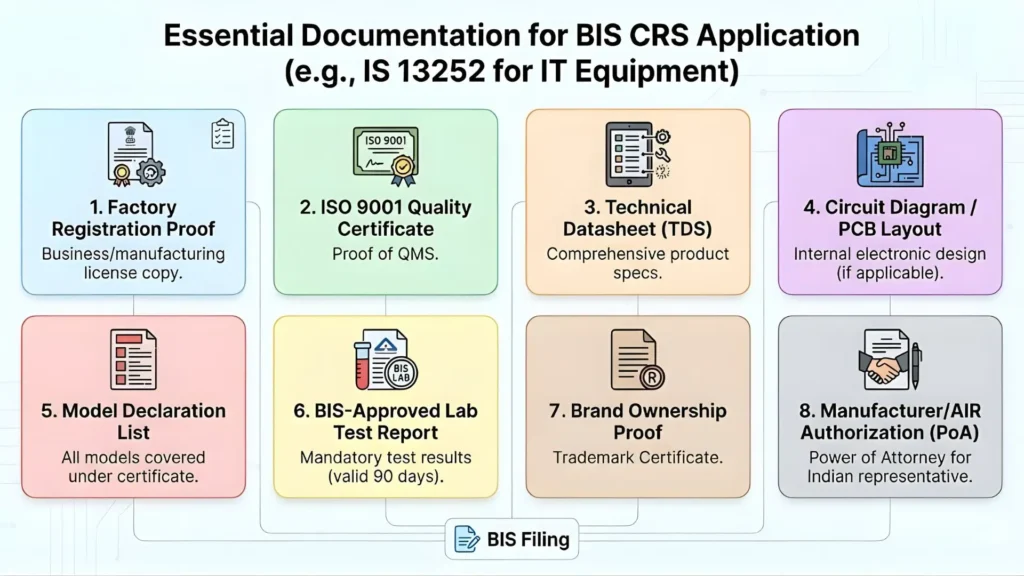
Always confirm the current document checklist on the official BIS CRS portal for your specific product name before filing, since laboratory and documentation requirements are set per Indian Standard and can be updated by BIS from time to time.
BIS CRS Application Process: Step-by-Step
- Identify the correct product category, sub-category and product name using the classification tables on this page.
- Get the product tested at a BIS-recognized laboratory against the Indian Standard notified for that product name.
- Prepare and organize the supporting documentation — company proof, test report, technical files, and authorization letters where applicable.
- Submit the application on the BIS CRS online portal, selecting the exact product category and product name identified in Step 1.
- Respond to any queries or deficiency remarks raised by BIS during file scrutiny.
- Once approved, pay the applicable fee and receive the CRS registration/license number for that product name.
- Apply the BIS Standard Mark and registration number on the product and its packaging as prescribed.
- Track the annual fee due date and annual production-details submission every year of the 5-year validity period to keep the licence active.
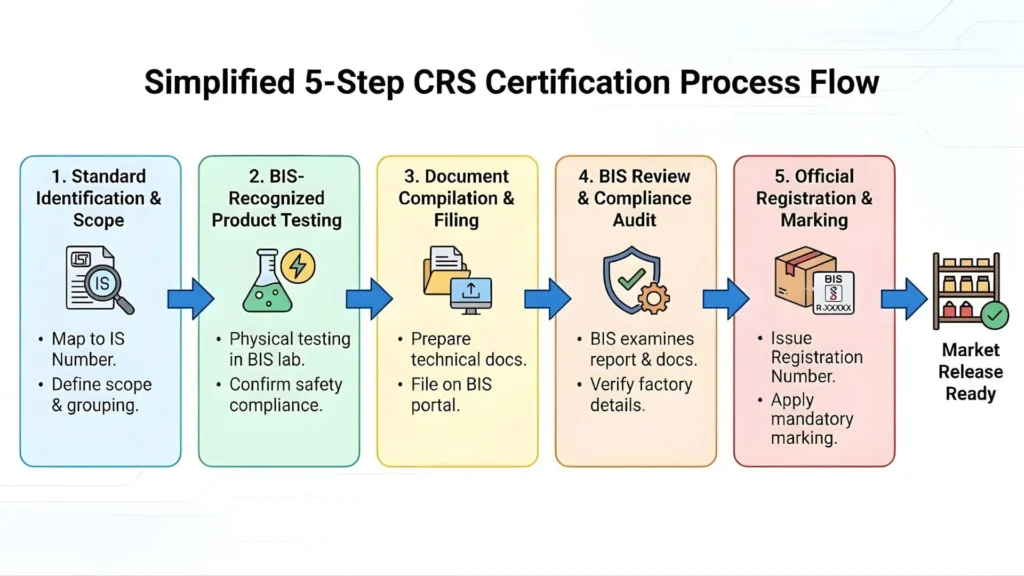
Processing timelines depend on the completeness of the application, the laboratory turnaround for testing, and the volume of queries raised during scrutiny — there is no single fixed number of days that applies uniformly across all product names, so build in buffer time rather than working backwards from a launch date.
Renewal Timeline: What to Track Every Year
Because fees are now payable annually in advance even within a single 5-year validity block, renewal isn't a once-in-five-years event — it's an annual checklist item that culminates in a full renewal filing when the 5-year period ends:
- Every year: pay the annual fee and submit production details by the prescribed due date.
- If a due date is missed: expect the licence to move toward suspension/deferment, and if unresolved, toward cancellation/expiry.
- Before the 5-year mark: file for renewal in advance of expiry so there's no gap in valid registration.
- On approval: the renewed licence is valid for a further 5 years, again with fees due annually in advance.
Set a recurring internal reminder well ahead of each annual due date — the regulation places the responsibility for timely payment and disclosure squarely on the applicant/licensee, not on BIS to chase you.
Fees: What the Regulation Confirms (and What to Verify Separately)
What is confirmed by the 25 February 2026 amendment is the structure of fee payment, not a fixed rupee amount: fees for grant, renewal and continuation of a Scheme-II licence are payable annually, in advance, by the prescribed due date. The actual fee schedule — the specific amount per product category — is published and periodically revised by BIS, so it should always be checked on the current official BIS fee schedule or confirmed with a registration consultant at the time of filing, rather than assumed from older figures.
Need Help With BIS CRS Filing? Talk to Silvereye Certifications
Classification alone can be the difference between a smooth BIS CRS approval and months of back-and-forth over the wrong product category. Silvereye Certifications works as a dedicated BIS CRS consultant, helping manufacturers, importers and brand owners correctly classify wearable glasses and Extended Reality products, prepare test-ready documentation, and manage the full application through to licence grant and annual renewal.
- Correct product category and product name mapping before you file — no rejected or misclassified applications.
- End-to-end support: lab coordination, documentation, portal filing, query resolution.
- Ongoing licence management — annual fee tracking, production-detail submissions, and renewal filing before the 5-year window closes.
- Guidance across Audio Glasses, Smart Glasses, AR Glasses, MR Glasses, VR Headsets and other CRS-notified electronics.
If you're planning to launch or import wearable or XR devices in India, get your classification confirmed with Silvereye Certifications before you file — it's the step most applicants get wrong, and the one that costs the most time to fix later.
Frequently Asked Questions
Do Audio Glasses, Smart Glasses, AR Glasses and MR Glasses need separate BIS registrations?
Yes. Each product name — Audio Glasses, Smart Glasses, AR Glasses, MR Glasses, VR Headset, Other AR Devices, Other MR Devices — needs its own dedicated CRS licence, even if made by the same company.
Under which category are Smart Glasses registered — Digital Camera or Video Camera?
It depends on the camera's capability. If it can only capture photographs, it's registered under Digital Camera. If it can capture both photographs and videos, it's registered under Video Camera.
Are AR Glasses and MR Glasses the same product category for BIS purposes?
No. Although both fall under Extended Reality Products and share a similar base feature set, AR Glasses and MR Glasses are registered as two separate product names and need separate licenses.
How long is a BIS CRS license valid now?
Following the 25 February 2026 amendment to the BIS (Conformity Assessment) Regulations, 2018, a Scheme-II licence is granted for an initial period of 5 years, and renewal is also granted for a further 5 years.
Is the 5-year fee paid as a single upfront payment?
No. Even though the license validity is 5 years, the applicable fee is payable annually, in advance, by the prescribed due date — every year within that 5-year period.
What happens if the annual fee or production details are not submitted on time?
The license becomes liable for suspension or deferment, and if the lapse continues, for cancellation or expiry, as per the BIS (Conformity Assessment) Regulations, 2018, as amended.
Does Audio Glasses need a camera or display to qualify for that category?
No. Audio Glasses is defined by wireless connectivity, microphone, speaker, calling and music playback, and similar functionality including an AI-based voice assistant — no camera or display is required for this category.
Which Order governs BIS CRS registration for these products?
The Electronics and Information Technology Goods (Requirement of Compulsory Registration) Order, 2021 — the QCO under which wireless audio devices, cameras, and Extended Reality products are notified for compulsory registration.
Can one BIS CRS licence cover both a VR Headset and an MR Glasses device from the same brand?
No. BIS requires a separate licence for each product name, so a VR Headset and an MR Glasses device need two distinct registrations even under the same brand.
Who should apply for BIS CRS registration — the manufacturer or the importer?
Registration is typically obtained by the manufacturer (domestic or foreign, the latter through an Authorised Indian Representative) or by the brand owner placing the product in the Indian market, depending on the business structure.
Where can I find the exact BIS CRS fee amount for my product?
The specific fee schedule is published by BIS and revised periodically, so it should be checked on the current official BIS portal or confirmed directly with a BIS registration consultant at the time of filing.