
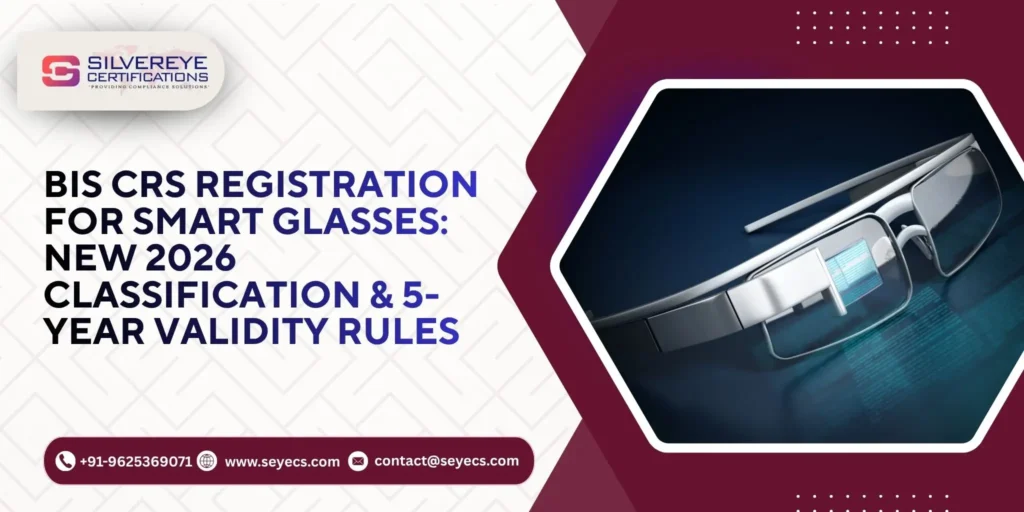
- BIS's 13 August 2026 guidance classifies Smart Glasses under “Digital Camera” (photo-only) or “Video Camera” (photo + video) product categories, depending on what the built-in camera can capture.
- Even though both variants share the same product name “Smart Glasses,” BIS treats them as different product categories and requires a separate license for each.
- BIS CRS (Scheme-II) licenses are now valid for 5 years from grant, up from the earlier 2-year term, per the 25 Feb 2026 regulation amendment.
- Annual fee payment and production-data submission remain compulsory every year, even within the new 5-year validity window.
Introduction
BIS CRS Registration For Smart Glasses sold or imported in India must carry a BIS CRS registration mark under the Electronics and IT Goods (Compulsory Registration) Order, 2021. As of BIS's 13 August 2026 guidance, Smart Glasses fall under the “Digital Camera” category if the built-in camera captures photographs only, or under “Video Camera” if it captures both photographs and videos — each needs its own license, distinct from Audio Glasses, AR Glasses and MR Glasses.

A related update effective from the 25 February 2026 regulation amendment extends Scheme-II license validity to 5 years (renewable for a further 5 years), though fees and production data are still filed annually. Manufacturers should apply through the BIS CRS portal with test reports from a BIS-recognized lab.
What Is BIS CRS Registration?
The Compulsory Registration Scheme (CRS) is administered by the Bureau of Indian Standards under the Electronics and Information Technology Goods (Requirement of Compulsory Registration) Order, 2021. It requires specified categories of electronic and IT products sold in India — audio devices, wearables, cameras and similar goods — to be tested against Indian safety standards and registered with BIS before they can legally be manufactured, imported or sold. Once registered, the product must carry the BIS Standard Mark, which signals to buyers, retailers and e-commerce platforms that the device has cleared mandatory safety and quality checks.

Smart Glasses fall within scope because they combine wireless connectivity, a battery, a microphone/speaker assembly and an onboard camera — functionally overlapping with the audio-wearable and camera-device categories BIS already regulates under CRS.
Why Smart Glasses Need BIS CRS Registration
Smart Glasses are one of the fastest-growing wearable-electronics categories in India, and BIS treats them as connected camera-and-audio devices rather than plain eyewear. Registration matters for three practical reasons:
- Legal sale: Without a valid BIS CRS license, Smart Glasses cannot be legally manufactured in India, imported, stocked, sold, or listed on marketplaces such as Amazon and Flipkart.
- Import clearance: Customs authorities check for BIS registration before releasing imported smart-glasses consignments; unregistered shipments face detention or return.
- Consumer trust and EEAT signalling: The BIS mark reassures buyers on battery safety, radio-frequency compliance and build quality — increasingly a purchase-decision factor for camera-enabled wearables.
New BIS Classification for Smart Glasses (13 August 2026 Guidance)
BIS's Registration Department issued fresh guidance on 13 August 2026 clarifying how wearable glasses should be classified under CRS. The notification resolves earlier ambiguity for Smart Glasses specifically: the product name stays “Smart Glasses,” but the product category it falls under depends entirely on the camera's capture capability. This is the classification table every applicant should reference before filing:
| S. No. | Product Category | Sub-Category / Product Name | What It Covers |
| 1 | Wireless Earphones and Headphones | Audio Glasses | Bluetooth/wireless connectivity, mic and speaker, calling and music playback, may include an AI voice assistant — no camera. |
| 2 | Digital Camera | Smart Glasses | All Audio Glasses features (optional) plus a camera that can capture photographs only. |
| 3 | Video Camera | Smart Glasses | All Audio Glasses features (optional) plus a camera that can capture both photographs and videos. |
| 4 | Extended Reality Products (AR/VR/MR) | AR Glasses | All Smart Glasses features (optional) plus an overlay display visible through the lenses. |
| 5 | Extended Reality Products (AR/VR/MR) | MR Glasses | Same as AR Glasses, classified separately as a distinct product name. |
Photo-Only vs. Photo-and-Video Smart Glasses: Why the Category Differs
This is the detail most applicants miss: BIS does not classify Smart Glasses purely by product name. A photo-only Smart Glasses model is registered under “Digital Camera,” while a model that can also record video — even with the same brand name and design — must be registered under “Video Camera.” If your product line includes both a photo-only variant and a video-capable variant, treat them as two separate CRS applications, not one.
Classification for Extended Reality Devices (AR, VR, MR)
The same 13 August 2026 guidance also fixes the sub-categories and product names for the broader Extended Reality Products group, relevant if your Smart Glasses roadmap extends into AR or MR variants with an overlay display:
| S. No. | Product Category | Sub-Category | Product Name |
| 1 | Extended Reality Products (AR/VR/MR Etc.) | AR Glasses | AR Glasses |
| 2 | Extended Reality Products (AR/VR/MR Etc.) | Other AR Devices | Other AR Devices |
| 3 | Extended Reality Products (AR/VR/MR Etc.) | VR Headset | VR Headset |
| 4 | Extended Reality Products (AR/VR/MR Etc.) | MR Glasses | MR Glasses |
| 5 | Extended Reality Products (AR/VR/MR Etc.) | Other MR Devices | Other MR Devices |
Major Update: BIS CRS Licenses Now Valid for 5 Years
Separately, BIS has amended the BIS (Conformity Assessment) Regulations, 2018, with effect from 25 February 2026, revising how long a Scheme-II license — the scheme under which CRS registrations, including Smart Glasses, are granted — stays valid. This directly affects renewal planning for Smart Glasses manufacturers and importers:
- Initial license validity: A license to use the Standard Mark is now granted for 5 years from the date of grant, instead of the earlier 2-year term.
- Renewal term: On renewal, the license is extended for a further 5 years, again under the same annual fee structure.
- Annual fee payment continues: Even though the license itself now runs for 5 years, fees for grant, renewal and continuation of operation must still be paid annually, in advance, by the prescribed due date.
- Non-payment consequence: If the annual fee and production details are not submitted by the due date, the license becomes liable for suspension/deferment and eventually cancellation/expiry under the amended regulations.
Eligibility Criteria for BIS CRS Registration
Both Indian manufacturers and foreign manufacturers can apply for BIS CRS registration for Smart Glasses:
- Indian manufacturers apply directly for a license to their own manufacturing unit.
- Foreign manufacturers must apply through an Authorized Indian Representative (AIR) based in India, who acts as the point of contact with BIS.
- The product must be tested at a BIS-recognized or BIS-approved testing laboratory against the applicable Indian Standard for the relevant category — Digital Camera or Video Camera — before an application is filed.
- Each factory location manufacturing the Smart Glasses, and each distinct product name/model/category combination, generally requires its own registration or endorsement.
Documents Required for BIS CRS Registration
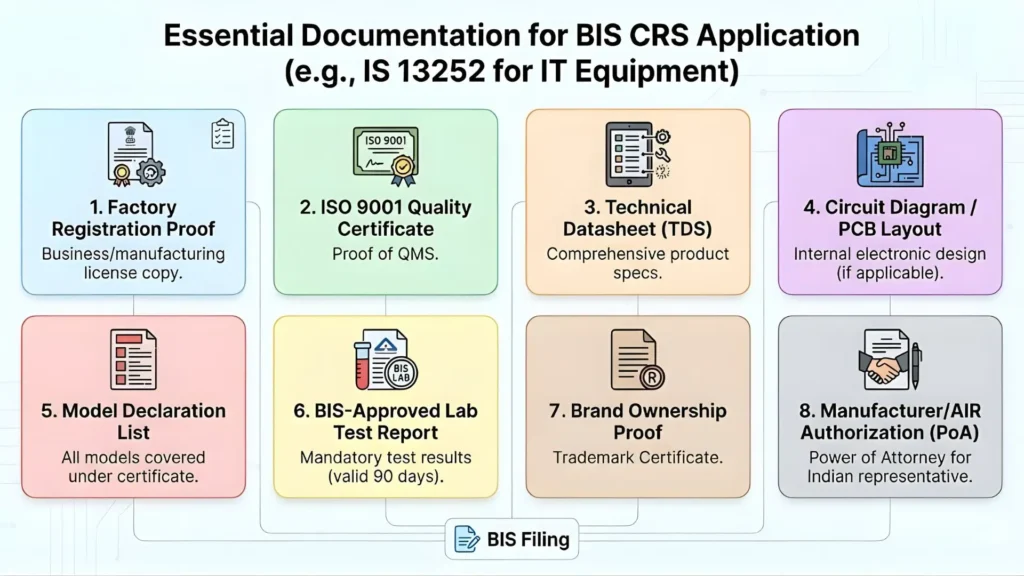
- Company incorporation and business registration proof (Certificate of Incorporation, GST registration, or equivalent).
- Authorized Indian Representative (AIR) appointment letter and AIR's own business proof, for foreign manufacturers.
- Test report from a BIS-recognized laboratory covering the applicable safety and performance standard for the Smart Glasses model, matched to its correct category (Digital Camera or Video Camera).
- Product technical documentation — schematics, bill of materials, camera and battery specification, and user manual.
- Brand authorization letter, if the Smart Glasses are sold under a brand different from the manufacturer's name.
- Manufacturing unit details, including factory address and process flow, for Indian manufacturers.
- Digital signature certificate (DSC) of the authorized signatory for online submission on the BIS CRS portal.
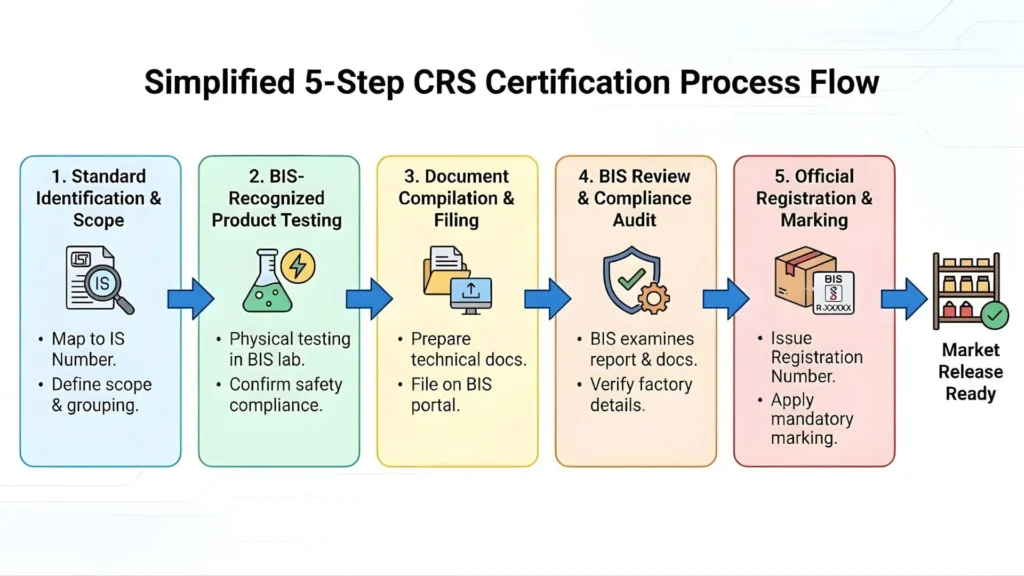
Step-by-Step BIS CRS Registration Process for Smart Glasses
- Confirm the camera capability first: Establish whether the model captures photographs only (Digital Camera category) or photographs and video (Video Camera category), since this decides your entire filing path.
- Identify the correct classification: File under the matching product category and “Smart Glasses” product name, per the August 2026 guidance.
- Get the product tested: Send samples to a BIS-recognized laboratory for testing against the applicable Indian Standard for that category.
- Create a BIS CRS portal account: Register the manufacturer (or AIR, for foreign manufacturers) on the BIS CRS online portal.
- Submit the application: Upload the test report, company documents and product details, and pay the prescribed application fee.
- Respond to BIS queries: Address any clarification or deficiency remarks raised by the BIS Registration Department promptly to avoid delays.
- Receive the license: On successful review, BIS grants the CRS license and Registration Number, valid for 5 years under the current rules.
- Apply the Standard Mark: Affix the BIS Standard Mark and Registration Number on the product and its packaging before sale.
- File annual returns: Submit annual production details and pay the annual fee by the due date to keep the license active through its 5-year term.
Fees for BIS CRS Registration
BIS CRS fees typically include an application/grant fee, an annual license fee, and applicable testing charges from the laboratory, with concessional rates generally available for MSME-registered manufacturers. Because fee schedules are revised periodically by BIS, this pillar page intentionally does not quote fixed figures.
Typical Registration Timeline
Processing time depends on how quickly test reports and documents are ready and how many clarification rounds BIS raises. As a general pattern, applicants can expect sample testing to take the longest single stretch, followed by portal application review, and finally license grant once all queries are resolved. Applying with a complete, error-free document set, correctly matched to the right camera-capability category, is the single biggest factor in avoiding delays.
Renewal and Validity: What Changes and What Doesn't
| Aspect | Before 25 Feb 2026 | From 25 Feb 2026 Onward |
| Initial licence validity | 2 years | 5 years |
| Renewal term | 2 years per renewal cycle | 5 years per renewal cycle |
| Fee payment frequency | Annual, in advance | Annual, in advance — unchanged |
| Production data filing | Required annually | Required annually — unchanged |
| Consequence of missed payment | Suspension/deferment, then cancellation/expiry | Suspension/deferment, then cancellation/expiry — unchanged |
Benefits of BIS CRS Registration for Smart Glasses Brands
- Legal market access across India, including e-commerce marketplaces that require BIS proof before listing camera-enabled wearables.
- Smoother customs clearance for imported Smart Glasses, reducing the risk of consignment holds.
- Stronger consumer confidence, since the BIS mark signals independently verified safety and quality on a camera-and-connectivity device.
- Longer license cycle (5 years) reduces the administrative burden of repeat renewal filings compared with the earlier 2-year term.
Why Choose Silvereye Certifications for BIS CRS Registration
Classification rules for wearable electronics like Smart Glasses, Audio Glasses, AR Glasses and MR Glasses are evolving quickly, and BIS notifications like the 13 August 2026 guidance and the 25 February 2026 validity amendment can directly change how a brand plans its filings and renewals. Silvereye Certifications works as a dedicated BIS CRS consultant, tracking these regulatory updates as they are issued and translating them into a clear filing plan for Smart Glasses manufacturers and importers — including correctly separating photo-only and video-capable variants at the application stage.
From confirming the correct product category and test standard, to preparing documentation, coordinating with BIS-recognised laboratories, and managing the 5-year renewal cycle, Silvereye Certifications is positioned as the best consultant for BIS CRS certification for wearable and smart-glasses brands entering or operating in the Indian market.
Reach out to Silvereye Certifications to get your Smart Glasses classified correctly and registered under BIS CRS without avoidable delays.
Frequently Asked Questions
Is BIS CRS certification mandatory for Smart Glasses in India?
Yes. Smart Glasses fall under the Electronics and IT Goods (Compulsory Registration) Order, 2021, and cannot be legally manufactured, imported or sold in India without a valid BIS CRS registration.
Under which BIS product category are Smart Glasses registered?
Per BIS's 13 August 2026 guidance, Smart Glasses are registered under “Digital Camera” if the camera captures photographs only, or under “Video Camera” if it captures both photographs and videos.
Do photo-only and video-capable Smart Glasses need separate BIS licences?
Yes. Even though both share the product name “Smart Glasses,” BIS classifies them under different product categories — Digital Camera versus Video Camera — so each needs its own registration.
What changed in the August 2026 BIS notification for Smart Glasses?
The notification formally fixed the product category, sub-category and product name for Smart Glasses (alongside Audio Glasses, AR Glasses and MR Glasses) and confirmed that classification depends on camera capability.
How long is a BIS CRS licence valid now?
Following the amendment effective 25 February 2026, a Scheme-II license (which covers CRS registrations) is valid for 5 years from grant, renewable for a further 5 years.
Do I still need to pay BIS fees every year if the licence is valid for 5 years?
Yes. Even under the new 5-year validity, applicable fees for grant, renewal and continuation of operation must be paid annually, in advance, by the prescribed due date.
What happens if the annual BIS fee is not paid on time?
The license becomes liable for suspension/deferment, and can proceed to cancellation/expiry, under the BIS (Conformity Assessment) Regulations, 2018, as amended.
Can a foreign Smart Glasses manufacturer apply for BIS CRS directly?
A foreign manufacturer must apply through an Authorised Indian Representative (AIR) based in India, who handles the application and ongoing compliance on the manufacturer's behalf.
What documents are essential for filing a BIS CRS application for Smart Glasses?
Core documents include company/business registration proof, a BIS-recognized lab test report matched to the correct category, product technical documentation, brand authorization (if applicable) and a valid digital signature certificate for portal submission.
How long does BIS CRS registration for Smart Glasses usually take?
Timelines vary with test report turnaround and how many clarification rounds BIS raises; applying with a complete, accurate document set matched to the right category is the most reliable way to avoid delays.
Is Smart Glasses the same registration as AR Glasses or MR Glasses?
No. AR Glasses and MR Glasses fall under the Extended Reality Products category because they add an overlay display, while Smart Glasses without a display are registered under Digital Camera or Video Camera — each needs its own licence.
Who can help with BIS CRS registration and classification for Smart Glasses?
A specialist regulatory consultancy that tracks BIS notifications closely, such as Silvereye Certifications, can help confirm the correct product category, prepare documentation and manage the filing end to end.