

- Mandatory Compliance: The 2026 Quality Control Order (QCO) covers specified heating appliances listed in its table, including hot plates, water boilers, heating pads, and room heaters.
- Implementation Deadlines: 1 October 2026 for general manufacturers, 1 January 2027 for small enterprises, and 1 April 2027 for micro enterprises, subject to the applicable provisions of the Order.
- Applicable Standard: IS 302 (Part 1):2024, aligned with IEC 60335-1:2020, along with the relevant product-specific Part where applicable.
- Certification Route: BIS Scheme-I, which generally involves product testing, factory assessment, and obtaining a BIS licence to use the ISI Mark.
Introduction
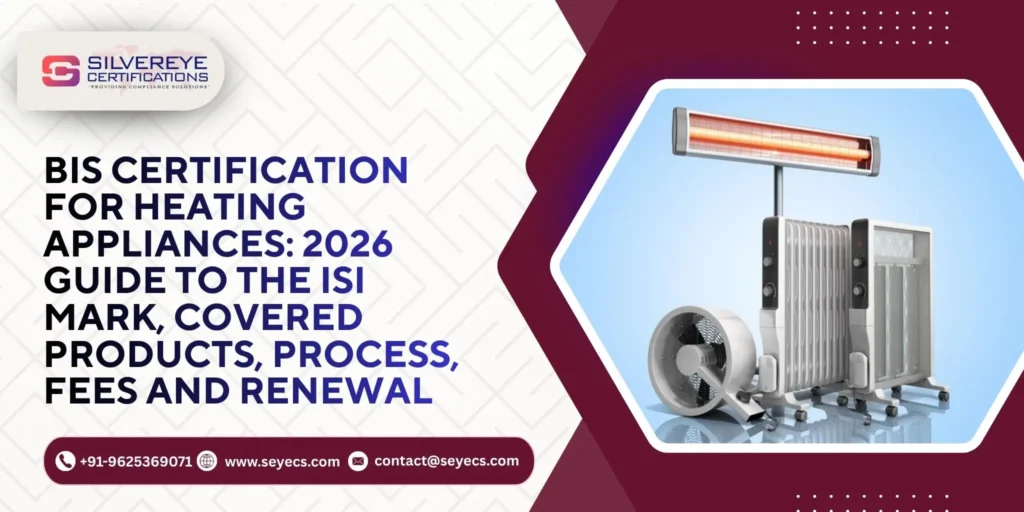
BIS Certification for Heating Appliances is a license issued by the Bureau of Indian Standards (BIS) that authorizes manufacturers to use the ISI Mark on covered products, such as electric water boilers, hot plates, deep fat fryers, heating pads, and room heaters. Under the applicable provisions of the 2026 Quality Control Order (QCO), specified heating appliances must comply with the relevant Indian Standards within the deadlines prescribed for general, small, and micro enterprises.

The certification process generally involves product testing against IS 302 (Part 1):2024 and the applicable product-specific standard, a factory assessment, and obtaining a valid BIS license. Manufacturers and importers should verify the product's coverage and implementation deadline under the Order before manufacturing, importing, or selling regulated products in India.
What Is BIS Certification for Heating Appliances?
Heating appliances are designed to generate heat, which makes electrical safety, fire prevention, temperature control, and protection against electric shock important considerations. BIS certification helps establish that a covered appliance complies with the applicable Indian Standard.

The Bureau of Indian Standards (BIS) issues a license authorizing the manufacturer to use the ISI Mark on products covered by that license. Under the Safety of Household, Commercial and Similar Electrical Appliances (Quality Control) Order, 2026, specified appliances must comply with the applicable requirements and bear the Standard Mark within the prescribed implementation timelines.
The certification process generally involves four key elements:
- BIS License: The manufacturer obtains a license after meeting the applicable product testing and factory assessment requirements. Compliance may also be subject to subsequent surveillance.
- Product Testing: Samples are tested at an appropriate BIS-recognized laboratory for applicable safety requirements, which may include temperature rise, electrical insulation, abnormal operation, and resistance to heat and fire.
- Factory Assessment: BIS assesses the manufacturer's production facilities and quality-control arrangements to determine whether products can consistently meet the applicable standard.
- ISI Mark and License Details: Once licensed, the manufacturer must mark the covered product according to the applicable BIS marking requirements.
The 2026 Order specifies the Scheme-I certification route under the BIS (Conformity Assessment) Regulations, 2018. This is different from the Compulsory Registration Scheme (CRS), which applies to specified product categories under a separate certification framework.
What Does the BIS Quality Control Order, 2026 Say?
On 6 April 2026, the Ministry of Commerce and Industry, through the Department for Promotion of Industry and Internal Trade (DPIIT), issued S.O. 1739(E), titled the Safety of Household, Commercial and Similar Electrical Appliances (Quality Control) Order, 2026. The Order supersedes the 2025 Order, subject to its stated transitional provision. It was issued under Section 16 of the Bureau of Indian Standards Act, 2016.
| Requirement | Details under the 2026 Order |
|---|---|
| Scope | Electrical appliances intended for household, commercial, or similar applications, rated up to 250 V for single-phase appliances and 480 V for other appliances, including DC-supplied and battery-operated appliances |
| Applicable standard | IS 302 (Part 1):2024, aligned with IEC 60335-1:2020 |
| Certification scheme | Scheme-I under Schedule II of the BIS (Conformity Assessment) Regulations, 2018 |
| Products covered | The Order lists 90 appliance categories in its Table, including multiple heating and heat-generating appliances |
| Standard version | The Order states that the latest version of the applicable Indian Standards will apply |
| Certification and enforcement authority | Bureau of Indian Standards |
| Penalties | Contraventions may attract penalties under the BIS Act, 2016 |
| Exclusions | Appliances covered by another Quality Control Order under the BIS Act or notified for mandatory BIS certification under another Act are excluded from this Order |
Implementation deadlines
| Manufacturer category | Implementation date |
|---|---|
| General category, excluding micro and small enterprises | 1 October 2026 |
| Small enterprises | 1 January 2027 |
| Micro enterprises | 1 April 2027 |
The small- and micro-enterprise categories are determined under the Micro, Small and Medium Enterprises Development Act, 2006. As of 27 October 2026, the general implementation date has passed, while the stated deadlines for small and micro enterprises are upcoming. Applicable exemptions and transitional provisions should also be checked before determining compliance obligations.
Related reading: Explore our guides on BIS Certification for Electric Heating Tools and BIS Certification for Personal Care Appliances for information about narrower product categories.
Which Heating Appliances Are Covered by the Order?
Heating appliances are not limited to one entry in the 2026 Order. Several categories in the Table relate to appliances that generate, retain, or transfer heat.
The following selection highlights relevant entries and their serial numbers in the Order.
| Serial number | Appliance category listed in the Order | Typical examples |
|---|---|---|
| 6 | Warming plates and similar appliances | Food-warming plates |
| 7 | Frying pans, deep fat fryers, and similar appliances | Electric deep fryers and frying pans |
| 8 | Appliances for heating liquids | Kettles and similar liquid-heating appliances |
| 15 | Electric water boilers | Electric water boilers |
| 37 | Electric hot plates | Portable electric hot plates |
| 11 | Electric heating tools | Soldering irons and glue guns |
| 43 | Blankets, pads, clothing, and similar flexible heating appliances | Electric blankets and heating pads |
| 68 and 89 | Foot warmers and heating mats, including DC- and battery-operated variants | Electric foot warmers and heating mats |
| 61 | Thermal storage room heaters | Thermal storage room heaters |
| 65 | Water-bed heaters | Electric water-bed heating units |
| 66 | Fixed immersion heaters | Fixed immersion heating elements |
| 50 | Clothes dryers and towel rails | Heated towel rails |
| 56 | Sauna heating appliances and infrared cabins | Sauna heating appliances |
| 53 and 54 | Commercial appliances for keeping food and crockery warm; commercial bains-marie | Commercial food-warming equipment |
| 38 and 10 | Single-walled baking ovens; electric forced-convection ovens, steam cookers, and steam-convection ovens | Specified electric baking and convection ovens |
This is a selection of relevant categories, not the complete list of 90 entries. The applicable requirement depends on the exact product category, design, rated voltage, intended use, and whether another Quality Control Order applies.
The general standard, IS 302 (Part 1):2024, covers general safety requirements. Where an applicable product-specific standard or particular requirement applies, it must also be considered. Manufacturers should verify the product's exact classification and certification route before arranging testing or investing in compliance.
Who Needs a BIS License for Heating Appliances?
The requirement for BIS certification depends on the product's coverage under the applicable Quality Control Order and the manufacturer's role in the supply chain.
- Indian manufacturers: Manufacturers producing heating appliances covered by the 2026 Order must obtain the applicable BIS certification within the prescribed implementation timeline, unless an exemption applies.
- Foreign manufacturers: Overseas manufacturers supplying covered appliances to India generally need certification through the applicable BIS route, including the Foreign Manufacturers Certification Scheme (FMCS), where applicable. An Authorized Indian Representative (AIR) is generally required under FMCS.
- Importers and brand owners: Importers and brand owners should verify that the overseas manufacturer holds the required license for the relevant product. An importer cannot use its own business registration as a substitute for the manufacturer's product certification.
- Retailers, e-commerce sellers, and distributors: Businesses selling covered appliances should verify that products comply with the applicable requirements and deadlines. The sale of non-compliant products may be restricted once the relevant provisions take effect, subject to applicable exemptions and transitional arrangements.
Why Is BIS Certification Important for Heating Appliances?
BIS certification plays an important role in product safety, regulatory compliance, and market access.
- Regulatory compliance: Manufacturers and suppliers of covered appliances must meet the applicable certification requirements within the prescribed timeline.
- Fire and burn protection: Testing evaluates relevant safety risks, including excessive temperature rise, overheating, and abnormal operating conditions.
- Retail and marketplace requirements: Buyers, distributors, and online marketplaces may request valid BIS licence details before accepting covered products.
- Quality assurance: Product testing and factory assessment help verify compliance with applicable safety requirements and manufacturing controls.
- Customer confidence: The authorized ISI Mark provides an identifiable indication that the product is covered by a valid BIS license.
Applicable BIS Standards for Heating Appliances
The 2026 Quality Control Order specifies IS 302 (Part 1):2024, aligned with IEC 60335-1:2020, as the general safety standard for covered electrical appliances. Depending on the product category, the applicable product-specific Indian Standard must also be considered.
The following IEC 60335-2 references illustrate the particular requirements associated with different appliance types. The corresponding Indian Standard, its current edition, and its applicability should be confirmed with BIS and the testing laboratory before testing begins.
| Appliance type | Relevant IEC 60335-2 reference |
|---|---|
| Warming plates and similar appliances | IEC 60335-2-12 |
| Deep fat fryers and frying pans | IEC 60335-2-13 |
| Appliances for heating liquids | IEC 60335-2-15 |
| Blankets, pads, and similar flexible heating appliances | IEC 60335-2-17 |
| Clothes dryers and towel rails | IEC 60335-2-43 |
| Portable heating tools | IEC 60335-2-45 |
| Sauna heating appliances | IEC 60335-2-53 |
| Thermal storage room heaters | IEC 60335-2-61 |
| Water-bed heaters | IEC 60335-2-66 |
| Fixed immersion heaters | IEC 60335-2-73 |
| Foot warmers and heating mats | IEC 60335-2-81 |
Important: The Quality Control Order's reference to Part 1 does not, by itself, establish every product-specific testing requirement. Confirm the applicable Indian Standard and current edition for your exact model. The BIS website also lists the Transition Facilitation (Quality Control) Order, 2026, dated 25 June 2026, which provides a separate conditional route for eligible applicants. Check the official provisions before deciding which certification route applies to your business.
Latest Update: What the 2026 Order Means for You
The Safety of Household, Commercial and Similar Electrical Appliances (Quality Control) Order, 2026 was notified through S.O. 1739(E) on 6 April 2026 and came into force on 1 October 2026. It superseded the 2025 Order, subject to the stated transitional provision. The Order specifies implementation dates for general manufacturers and importers, small enterprises, and micro enterprises.
Implementation deadlines
| Business category | Implementation date | Recommended action |
|---|---|---|
| General category, excluding micro and small enterprises | 1 October 2026 | Review compliance immediately and confirm the required certification status |
| Small enterprises | 1 January 2027 | Complete product testing and application preparation before the deadline |
| Micro enterprises | 1 April 2027 | Prepare the factory, documentation, and testing arrangements in advance |
As of 27 October 2026, the general implementation date has passed. Small and micro enterprises should use the remaining time to confirm their eligibility category and complete the applicable certification process.
Existing stock and transitional provisions
The 2026 Order includes a provision for certain goods manufactured domestically or imported before the applicable implementation date. Eligible manufacturers that are BIS-certified or have applied for certification may be permitted to sell, display, or offer declared stock for up to six months from the applicable implementation date, subject to making the required declaration to BIS.
| Business category | Potential stock-clearance date | Important condition |
|---|---|---|
| General category | Up to 1 April 2027 | Eligibility and the required stock declaration must be confirmed |
| Small enterprises | Up to 1 July 2027 | The provision applies subject to the applicable conditions |
| Micro enterprises | Up to 1 October 2027 | The provision applies subject to the applicable conditions |
These dates are calculated by adding six months to each implementation date. Do not assume that all existing inventory automatically qualifies. Confirm the stock's eligibility, documentation, and declaration procedure with BIS before relying on this provision.
The separate Transition Facilitation Order, S.O. 3417(E), dated 25 June 2026, also provides a conditional certification pathway for eligible applicants. It does not mean every manufacturer or importer can automatically bypass the standard certification process. Verify the eligibility conditions and current implementation guidance before making a compliance decision.
Documents Required for BIS Certification of Heating Appliances
The required documents depend on the product, factory, application route, and current BIS procedure. Use the following as a preliminary checklist and verify the final list on the official BIS portal before submitting an application.
| Document | Purpose |
|---|---|
| Application through the BIS online system | Initiates the certification application |
| Business registration documents | Establish the legal identity of the applicant |
| Udyam registration certificate, where applicable | Supports a claim for small or micro enterprise classification |
| Factory address and layout | Provides information required for factory assessment |
| Factory ownership or lease documents | Supports verification of the manufacturing premises |
| Manufacturing process flow chart | Explains the production process |
| Machinery and in-house testing equipment lists | Demonstrates production and testing capabilities |
| Calibration records | Supports the reliability of measuring and testing equipment |
| Quality control plan and production test records | Shows how product quality is monitored |
| Product test report from an appropriate BIS-recognised laboratory | Provides evidence of conformity with applicable requirements |
| Product specifications and model details | Identifies ratings, heating elements, thermal protection, and other design features |
| Circuit diagrams and critical component details | Supports the technical assessment of the product |
| User manual and product labels | Helps verify product information and marking requirements |
| Authorised signatory documents | Establishes who can represent the applicant |
| AIR appointment and foreign manufacturer details, where applicable | Supports an application under the Foreign Manufacturers Certification Scheme |
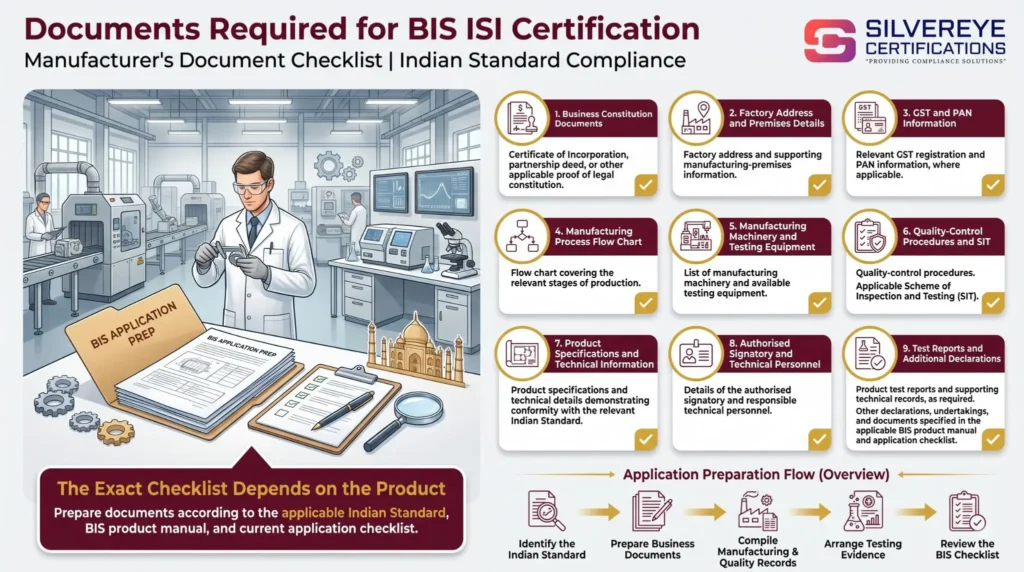
Before applying: Check that your product's model details, ratings, circuit diagrams, critical components, and test samples are consistent. Missing documents or differences between the submitted information and the actual product can delay the certification process.
BIS Certification Process for Heating Appliances: Step by Step
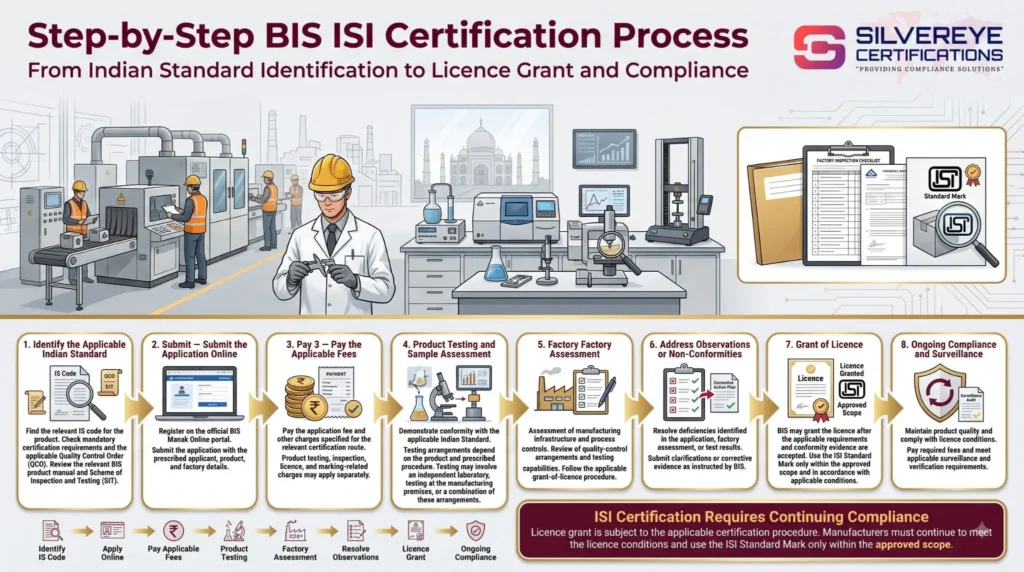
Obtaining BIS certification for heating appliances involves product classification, laboratory testing, factory assessment, and approval from the Bureau of Indian Standards. Following the correct sequence can help manufacturers avoid unnecessary delays.
Step 1: Confirm the product category and applicable standard. Identify the relevant entry in the 2026 Quality Control Order and confirm the applicable Indian Standard, including any product-specific requirements.
Step 2: Prepare the factory. Establish suitable production controls, maintain calibrated testing instruments, and organise quality-control procedures and production records.
Step 3: Submit the BIS application. Apply through the official BIS online system under the applicable Scheme-I procedure. Submit the required documents and pay the prescribed fees.
Step 4: Arrange laboratory testing. Submit product samples to a laboratory recognised by BIS for the relevant testing scope. The laboratory evaluates the samples against the applicable requirements and issues a test report.
Step 5: Complete the factory assessment. BIS assesses the manufacturing facilities, quality-control arrangements, and relevant testing capabilities. The officer may also examine product samples and supporting records.
Step 6: Address non-conformities. Respond to queries, provide additional information, and implement corrective actions if any issues are identified during testing or assessment.
Step 7: Obtain the BIS licence. Once the applicable requirements are satisfied, BIS may grant the licence and assign the relevant licence number.
Step 8: Apply the ISI Mark correctly. Mark products in accordance with the conditions of the licence and the applicable BIS marking requirements.
Step 9: Maintain ongoing compliance. Keep production and testing records updated, comply with surveillance requirements, and notify BIS of changes requiring approval or amendment.
How Long Does BIS Certification Take?
The processing time depends on laboratory availability, the complexity of the appliance, factory inspection scheduling, document completeness, and how quickly any non-conformities are resolved.
Some applicants may plan for approximately two to three months, but this is only an indicative planning estimate, not an official processing guarantee. Products with multiple models or design variations may require additional assessment.
If you manufacture several heating appliances, discuss model grouping and testing requirements with the laboratory or a qualified consultant before finalising your budget and schedule.
BIS Certification Fees, Validity and Renewal
BIS certification costs depend on the applicable fee schedule, inspection requirements, laboratory charges, product models, and certification route. Because fees and procedures may change, confirm the current amounts through the official BIS portal before applying.
| Fee component | What it covers | Important consideration |
|---|---|---|
| Application fee | Processing the Scheme-I application | Pay according to the current BIS fee schedule |
| Inspection fee | Factory assessment by BIS | Confirm the applicable inspection charges and requirements |
| Licence and marking fees | Licence-related charges and authorised use of the Standard Mark | Applicable charges depend on the current BIS rules |
| Laboratory testing charges | Testing of product samples | Varies according to the product, tests, and number of models |
| Foreign manufacturer certification charges | Applicable FMCS-related costs and requirements | Confirm the relevant procedure and Authorised Indian Representative requirements |
| Consultancy or application support | Optional professional assistance | Agreed separately with the service provider |
BIS License Validity and Renewal
| Licence aspect | What manufacturers should know |
|---|---|
| Validity | Check the validity period stated in the licence and the applicable BIS regulations |
| Renewal | Submit the renewal application within the prescribed period through the official BIS process |
| Renewal requirements | May include applicable fees, updated documents, and evidence of continued compliance |
| Expired licence | Do not assume that an expired licence authorises continued use of the ISI Mark |
| Changes during validity | Inform BIS of relevant changes to the product, manufacturing premises, or ownership and obtain approval where required |
Important: Do not rely on a general validity period without checking the current rules for your license. Plan renewal well before expiry and confirm the applicable conditions directly with BIS.
Exemptions and Transition Rules Under the 2026 Order
The Quality Control Order includes specific exemptions and transitional provisions. Their applicability depends on the product, manufacturer, and circumstances.
- Products manufactured exclusively for export: The Order excludes goods manufactured domestically for export, subject to the terms of the applicable provision.
- Imports for research and development: Up to 200 units per year may qualify for the specified R&D exemption for manufacturers of household and similar electrical appliances. These goods must not be sold commercially, may be disposed of as scrap, and must be recorded annually as prescribed.
- Existing stock: Certain goods manufactured domestically or imported before the applicable implementation date may qualify for a sell-through period of up to six months. This is conditional on the relevant manufacturer being BIS-certified or having applied for certification and making the required declaration to BIS.
- Later implementation dates for smaller enterprises: The Order provides separate implementation dates for eligible small and micro enterprises.
As of October 2026, the general implementation date of 1 October 2026 has passed. The specified dates for small and micro enterprises are 1 January 2027 and 1 April 2027, respectively.
Before relying on an exemption, verify the exact wording, eligibility conditions, and documentation requirements in the official Order. The existence of an exemption does not automatically exempt every product or business in a particular category.
Penalties for BIS Non-Compliance
The 2026 Quality Control Order states that violations are punishable under the Bureau of Indian Standards Act, 2016. Depending on the nature of the contravention and the applicable statutory provisions, non-compliance may lead to financial penalties and other legal consequences.
Manufacturers and businesses should not assume that an application in progress automatically permits them to use the ISI Mark or sell covered products after the applicable deadline. The treatment of existing stock and any transitional relief must be assessed separately.
To reduce compliance risks:
- Verify whether the appliance is covered by the Order.
- Obtain the applicable certification before the relevant deadline, unless a valid exemption or transitional provision applies.
- Use the ISI Mark only as authorised under a valid licence.
- Maintain accurate production, testing, and marking records.
- Confirm the legal requirements with BIS or a qualified adviser when the applicability is uncertain.
The applicable legal consequences should be checked against the current BIS Act and relevant orders.
Common Mistakes to Avoid During BIS Certification
Manufacturers can prevent avoidable delays and compliance issues by avoiding these common mistakes:
- Assuming that a product is exempt because it is intended for commercial use, without checking the Order's scope.
- Overlooking an existing Quality Control Order that applies to the product.
- Testing against the general safety standard without confirming the applicable product-specific requirements.
- Selecting a laboratory that is not recognised by BIS for the relevant testing scope.
- Assuming an importer can replace the manufacturer's required product certification with its own business registration.
- Changing critical components, such as heating elements, thermostats, or thermal cut-outs, without checking whether BIS approval or a licence amendment is required.
- Missing licence renewal deadlines or failing to maintain required records.
- Applying the ISI Mark before obtaining the necessary authorisation.
Review the product design, documentation, testing requirements, and applicable certification conditions before proceeding with commercial production or sales.
Why Choose Silvereye Certifications?
BIS certification projects can be delayed by incorrect product classification, incomplete documents, testing issues, or inadequate factory preparation. Silvereye Certifications can help manufacturers organise the process and understand the requirements applicable to their products.
Our support can include:
- Product and standard mapping: Reviewing your appliance category and identifying the applicable standards and certification route.
- Document preparation: Helping organise and review application documents before submission.
- Laboratory and inspection coordination: Assisting with testing arrangements and factory assessment preparation.
- Clear scope and cost planning: Explaining the expected process, key milestones, and relevant cost components.
- Post-certification assistance: Providing guidance on renewals, amendments, and ongoing compliance requirements.
The final certification decision and licence issuance remain with BIS. Silvereye Certifications provides consultancy and application support; it does not issue the government licence.
To discuss your requirements, share your product list, factory details, target launch date, and current certification status. This information will help establish the likely certification route and a practical compliance plan.
Conclusion
BIS Certification for Heating Appliances is an important compliance requirement for manufacturers and other businesses dealing with products covered by the Safety of Household, Commercial and Similar Electrical Appliances (Quality Control) Order, 2026. Products such as electric water boilers, hot plates, deep fryers, heating pads, and thermal storage room heaters may require the applicable Indian Standard, laboratory testing, factory assessment, and a valid BIS licence to use the ISI Mark.
Start by confirming your product's exact classification and applicable standard. Then prepare the required documents, arrange testing, and plan the factory assessment around the implementation deadline that applies to your business. Keep track of licence conditions, renewal dates, and any applicable exemptions or transitional provisions.
Silvereye Certifications can help you understand the requirements, prepare your documentation, and plan the certification process. Since regulatory requirements, fees, and procedures can change, verify the latest information with BIS before making compliance decisions.
Frequently Asked Questions
Is BIS certification mandatory for heating appliances?
Yes, for the heating appliances named in the 2026 Order's Table. The ISI Mark is compulsory from the dates given above.
What is the deadline for heating appliances?
1 October 2026 for general manufacturers, 1 January 2027 for small enterprises and 1 April 2027 for micro enterprises.
Which standard applies for heating appliances?
IS 302 (Part 1): 2024, aligned with IEC 60335-1:2020, usually tested with the product-specific part for the appliance type.
Are electric water boilers and kettles covered?
Electric water boilers and appliances for heating liquids are both named in the Table, at Sl. No. 15 and Sl. No. 8.
Are electric blankets and heating pads covered?
Yes. Blankets, pads, clothing and similar flexible heating appliances are listed at Sl. No. 43.
Do room heaters need the ISI Mark under this Order?
Thermal storage room heaters are listed at Sl. No. 61. For other types of room heater, confirm with BIS or a consultant whether this Order or another one applies.
Can an importer get the license?
The license is issued to the manufacturer. A foreign manufacturer applies under FMCS, usually with an Authorized Indian Representative.
How long is the license valid for heating appliances?
Generally one or two years, at the manufacturer's option, and it must be renewed before expiry.
How long does certification take?
There is no fixed time. Many applicants plan for roughly two to three months, depending on testing and inspection.
Can I sell stock made before the deadline?
Possibly. Certified manufacturers, or those who have applied, may sell declared stock for up to six months from the implementation date, subject to a declaration to BIS.