
- Scope Check First: Facial massagers are not explicitly named in the 2026 order. Confirm whether your specific product falls within its scope before deciding which certification requirements apply.
- Key Compliance Deadlines: The stated implementation dates are 1 October 2026 for general manufacturers, 1 January 2027 for small enterprises and 1 April 2027 for micro enterprises. Verify the applicable classification and deadline for your business.
- Certification Route: Products covered by the order must follow the applicable BIS Scheme-I licensing process for use of the ISI Mark, including laboratory testing against the relevant Indian Standards and factory assessment, where required.
- Non-Compliance Risk: Violations of applicable Quality Control Order requirements may attract penalties under the BIS Act, 2016.
Introduction
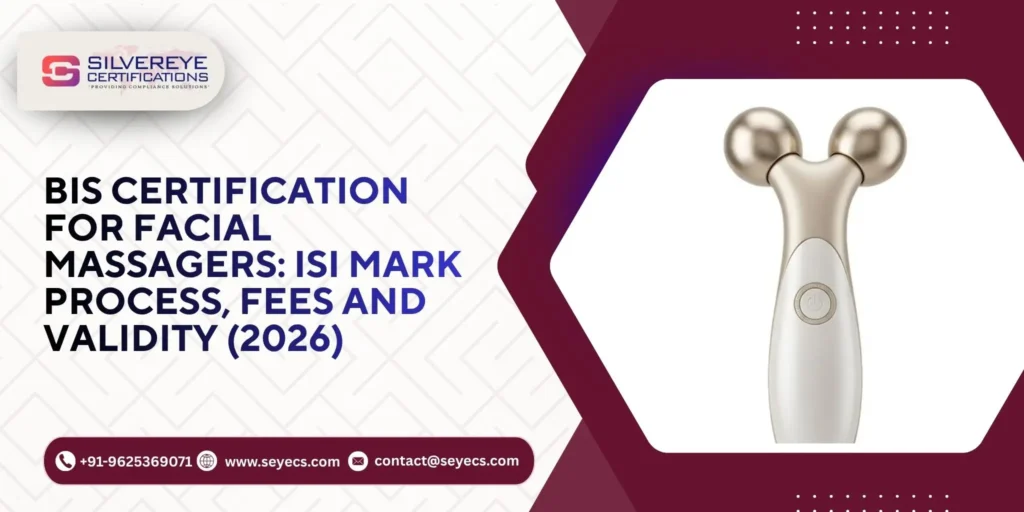
BIS Certification for Facial Massagers refers to obtaining a license to use the ISI Standard Mark under Scheme-I of the BIS (Conformity Assessment) Regulations, 2018, where certification is applicable. Under the Safety of Household, Commercial and Similar Electrical Appliances (Quality Control) Order, 2026 (S.O. 1739(E)), covered appliances must comply with the applicable Indian Standards and meet the relevant marking requirements.
The stated implementation dates are 1 October 2026 for general manufacturers, 1 January 2027 for small enterprises and 1 April 2027 for micro enterprises. As facial massagers are not explicitly identified by name in the information provided, their applicability must be assessed based on the product's design, intended use and relevant QCO entries, such as massage appliances or other applicable categories. Manufacturers should confirm the applicable standards and requirements before proceeding with certification.
What Is BIS Certification for Facial Massagers?
The Bureau of Indian Standards (BIS) is India's national standards body. BIS Certification for a facial massager, where applicable, involves obtaining a license to use the ISI Standard Mark after the product meets the relevant Indian Standards and the manufacturer satisfies the applicable certification requirements.
Under Scheme-I of Schedule-II of the BIS (Conformity Assessment) Regulations, 2018, certification generally involves product testing and an assessment of the manufacturer's production and quality control arrangements.
It is important to distinguish this process from the Compulsory Registration Scheme (CRS), which applies to specified product categories. The applicable certification route depends on the product and the relevant regulatory requirements.
In simple terms, there are three key elements:
- The standard: IS 302 (Part 1):2024, aligned with IEC 60335-1:2020, specifies general safety requirements for household and similar electrical appliances. Additional particular requirements may apply to a specific product.
- The licence: BIS grants the licence after evaluating the application, applicable test results and other required assessments.
- The mark: The ISI Standard Mark may be used only on products covered by a valid BIS licence and in accordance with the applicable marking requirements.
2026 Regulatory Update: Safety of Household, Commercial and Similar Electrical Appliances (QCO) 2026
The following summary is based on the order details provided. Manufacturers should consult the official Gazette notification and any subsequent amendments before making compliance decisions.
Order details
| Item | Details |
|---|---|
| Name | Safety of Household, Commercial and Similar Electrical Appliances (Quality Control) Order, 2026 |
| Notification | S.O. 1739(E), dated 6 April 2026, as cited in the supplied details |
| Issuing authority | Ministry of Commerce and Industry, Department for Promotion of Industry and Internal Trade (DPIIT) |
| Legal basis | Section 16 of the Bureau of Indian Standards Act, 2016 |
| Effect on earlier order | Supersedes the 2025 order, subject to the applicable saving provisions |
| General commencement date | 1 October 2026, according to the supplied order details |
Clause 1: Application
According to the supplied text, the order applies to electrical appliances intended for household, commercial or similar applications, subject to its scope and exclusions.
- Voltage limits: Up to 250 V for single-phase appliances and 480 V for other appliances, including DC-supplied and battery-operated appliances.
- Exclusions: Appliances covered by another Quality Control Order or notified for mandatory BIS certification under another Act may fall outside this order, as specified in its provisions.
Clause 2: Compulsory use of the Standard Mark
The supplied order details state that goods listed in column (2) of its table must conform to the corresponding Indian Standard and bear the Standard Mark under a BIS licence in accordance with Scheme-I of Schedule-II of the BIS (Conformity Assessment) Regulations, 2018.
The general safety standard identified is IS 302 (Part 1):2024, titled Household and Similar Electrical Appliances: Safety, Part 1 — General Requirements, aligned with IEC 60335-1:2020.
The supplied text also states that the latest applicable version of the Indian Standards is to be used for the purposes of the order. The relevant standard and any product-specific requirements should therefore be confirmed before testing.
Implementation dates
| Enterprise category | Stated implementation date |
|---|---|
| General manufacturers, excluding micro and small enterprises | 1 October 2026 |
| Small enterprises | 1 January 2027 |
| Micro enterprises | 1 April 2027 |
The general implementation date has passed as of October 2026. Manufacturers should verify their applicable category and compliance position rather than assume that the same deadline applies to every business.
Exemptions and provisos under Clause 2
The supplied order details describe the following provisions. Their exact conditions should be checked against the official notification.
- Export goods: The order provides an exclusion for goods manufactured domestically for export.
- Small and micro enterprises: Eligible enterprises, as defined under the applicable MSME legislation, must comply from their specified implementation dates.
- Research and development imports: The supplied text describes an allowance of up to 200 units per year for qualifying R&D purposes, subject to restrictions on commercial sale, recordkeeping and other stated conditions.
- Existing stock: A transitional provision may allow eligible goods manufactured domestically or imported before the relevant implementation date to be sold, displayed or offered for sale for up to six months, subject to the specified eligibility conditions and declaration to BIS.
Important: These provisions should not be treated as blanket exemptions. Confirm eligibility, declaration requirements, recordkeeping obligations and applicable dates before relying on them.
Clause 3: Certification and enforcement authority
The supplied order identifies BIS as the certifying and enforcing authority for the goods listed in its table.
Clause 4: Penalty
Contravention of applicable requirements may attract penalties under the Bureau of Indian Standards Act, 2016.
QCO entries relevant to facial massagers
The following entries are identified in the order details supplied for this guide:
| Serial number | Product category |
|---|---|
| 9 | Massage Appliances |
| 44 | Appliances for Skin Exposure to Optical Radiation |
| 78 | Beauty Care Appliances Incorporating Lasers and Intense Light Sources |
| 80 | Skin Beauty Care Appliances |
| 86 | DC-supplied or battery-operated massage appliances |
The supplied table does not explicitly use the term facial massager. Consequently, the correct entry must be determined by assessing the device's design, intended use, operating principle and power source against the actual QCO wording.
Does Your Facial Massager Fall Under the QCO?
The answer depends on the device's intended function, technology, design and power supply. The table below is a preliminary scoping guide, not a definitive classification of individual products.
| Type of facial device | Possible entry to assess | Reason for assessment |
|---|---|---|
| Mains- or USB-powered vibrating or sonic facial massager | Serial No. 9 and/or No. 80 | Its primary function may be massage or skin beauty care |
| Cordless, rechargeable or battery-operated facial massager | Serial No. 86 and/or No. 80 | Its function and DC or battery-powered design may be relevant |
| LED light therapy mask or wand | Serial No. 44 and/or No. 80 | The device exposes the skin to optical radiation and may also perform a beauty-care function |
| IPL- or laser-based skin or hair device | Serial No. 78, subject to scope | The device incorporates laser or intense-light technology |
| Heated, cooled, microcurrent or ultrasonic facial device | Serial No. 80 or another applicable entry, subject to verification | Classification depends on its principal function and the wording of the relevant entry |
Two important checks before applying
- Voltage and power supply: Confirm that the product falls within the order's applicable voltage and product scope. Low operating voltage alone does not establish whether a device is covered.
- Other mandatory requirements: Check whether the product or its components are subject to separate mandatory certification requirements. Chargers, adapters and lithium cells may have their own applicable requirements, depending on their category and intended use.
If the applicable entry is unclear, seek a documented product-scope assessment before submitting the application or arranging testing. This helps reduce the risk of selecting the wrong standard or certification route.
Benefits of BIS Certification for Facial Massagers
Obtaining BIS Certification for Facial Massagers, where required, can help manufacturers demonstrate compliance with applicable electrical safety requirements and build confidence among buyers.
- Regulatory compliance: Once the applicable Quality Control Order takes effect for your product and enterprise category, covered products must meet the relevant requirements. Non-compliance may attract action under the BIS Act, 2016.
- Smoother import planning: Having the required BIS licence and product marking in place can help businesses prepare for applicable import compliance checks.
- Retailer and marketplace readiness: Distributors, retailers and online marketplaces may request certification or licence details before accepting electrical products.
- Consumer confidence: The authorised ISI Mark indicates that the product is covered by a BIS licence and meets the applicable certification requirements.
- Improved safety controls: Testing and factory quality controls help assess relevant electrical safety risks and support consistent product quality.
- Brand credibility: In a competitive facial beauty device market, applicable certification can strengthen a brand's compliance credentials and customer confidence.
Who Can Apply for BIS Certification? Eligibility Criteria
Eligibility and the application route depend on the product category, manufacturing arrangement and applicable BIS certification scheme.
| Applicant | Applicable route or arrangement | Key consideration |
|---|---|---|
| Indian manufacturer | Scheme-I licence, where applicable | Must meet the applicable manufacturing, testing and quality control requirements |
| Foreign manufacturer | Foreign Manufacturers Certification Scheme (FMCS), where applicable | Must meet BIS requirements for foreign manufacturing units and appoint an Authorised Indian Representative where required |
| Importer or trader | Sources products from a suitably BIS-licensed manufacturer | Must verify that the licence covers the relevant product and that marking and other requirements are met |
| Brand owner using contract manufacturing | Certification arrangement linked to the actual manufacturing unit | Confirm how the brand, product models and manufacturing arrangement must be declared to BIS |
| Micro or small enterprise | Applicable certification route with relevant implementation provisions | Verify enterprise classification and the implementation date applicable under the QCO |
Important: Udyam registration may help establish MSME classification, but eligibility for a particular implementation date or fee concession depends on the applicable rules and official conditions.
Requirements for BIS Certification of Facial Massagers
Before applying for BIS Certification for Facial Massagers, manufacturers should confirm the applicable standards and prepare their products and factory for the certification process.
- Product conformity: IS 302 (Part 1):2024 is identified in the supplied QCO details. Additional particular requirements may apply depending on the device's design and classification. Confirm the complete list of applicable standards before testing.
- Product testing: Arrange testing through a BIS-recognised laboratory in accordance with the applicable certification requirements. Any in-house testing arrangement must meet the relevant BIS conditions.
- Factory readiness: Maintain appropriate quality control procedures, calibrated testing equipment, incoming inspection records for critical components and routine finished-product testing.
- Marking and labelling: Ensure the product carries the authorised ISI Mark and applicable licence details, along with the required rating and safety information.
- Production and marking records: Maintain accurate records of production, marking and testing as required by BIS. These records may also be relevant to applicable marking fee calculations and licence maintenance.
Documents Required for BIS Certification of Facial Massagers
The exact documentation depends on the product and application route. The following Documents checklist covers common document categories.
| Category | Documents |
|---|---|
| Applicant identity | Incorporation or partnership documents, GST registration where applicable, and authorised signatory details |
| Factory details | Manufacturing premises address proof, factory layout and machinery list |
| Enterprise classification | Udyam registration, where relevant to MSME classification or applicable concessions |
| Product information | Model list, rating label artwork, circuit diagram, critical component list and user manual |
| Quality management | Manufacturing process flow chart, quality control plan, testing scheme and test equipment list with relevant calibration records |
| Product testing | Test reports from a BIS-recognised laboratory, as required |
| Foreign manufacturer application | Authorised Indian Representative appointment documents, manufacturing unit details and other required FMCS authorisations |
| Existing stock | Declaration and supporting records, where an applicable transitional stock provision is available and the manufacturer qualifies |
BIS Certification Process for Facial Massagers: Step-by-Step Guide
The process for obtaining a BIS licence generally involves the following stages, subject to the applicable product category and certification scheme.
- Confirm the product scope. Identify the relevant QCO entry, verify whether the facial massager is covered and establish the applicable Indian Standards. Check whether any components are subject to separate mandatory requirements.
- Prepare product samples and documents. Finalise the models, technical specifications and critical components before testing. Changes to components or product design may require additional evaluation or testing.
- Complete laboratory testing. Submit samples to a BIS-recognised laboratory for testing against the applicable general and particular safety requirements.
- Submit the online application. File the application through the applicable BIS online system, upload the required documents and pay the prescribed fees.
- Prepare for factory assessment. Where required, BIS assesses manufacturing facilities, quality control procedures, production processes and testing arrangements. Foreign manufacturers may be subject to assessment at their overseas facilities.
- Complete any additional sample verification. BIS may require further sampling or testing in accordance with the applicable certification procedure.
- Obtain the licence. BIS evaluates the application and supporting evidence. The licence is granted only after the applicable requirements and fee conditions have been satisfied.
- Apply the ISI Mark and maintain compliance. Once authorised, mark only the products covered by the licence. Continue to maintain production and testing records and comply with applicable surveillance, inspection and renewal requirements.
How Long Does BIS Certification for Facial Massagers Take?
The timeline for BIS Certification for Facial Massagers depends on laboratory availability, document readiness, factory preparedness and the time required to resolve queries. The following estimates are indicative and are not guaranteed BIS processing timelines.
| Stage | Indicative timeline |
|---|---|
| Product scoping and document preparation | 1–2 weeks |
| Laboratory testing | 2–4 weeks, depending on the number of models and laboratory workload |
| Application submission and scrutiny | 1–2 weeks |
| Factory inspection scheduling and assessment | 2–4 weeks |
| Licence grant after compliance | 1–2 weeks |
| Overall estimated timeline | Approximately 2–3 months, provided the required documents and samples are ready |
These stages may overlap, and additional testing, inspection findings or incomplete documentation can extend the timeline.
For manufacturers whose applicable implementation deadline has already passed, confirming product coverage and starting the compliance process promptly is especially important.
BIS Certification Fees for Facial Massagers
The total cost of BIS Certification for Facial Massagers depends on the applicable BIS fee schedule, laboratory testing requirements, factory location and number of product models. The following table outlines the main cost components; the stated figures and concessions should be verified against current official notifications before budgeting.
| Fee component | Indicative amount or basis | Important details |
|---|---|---|
| Application fee | ₹1,000, as stated in the supplied information | Confirm the current prescribed fee before applying |
| Annual licence fee | ₹1,000 per year, as stated in the supplied information | Verify the applicable rate and payment requirements |
| Minimum marking fee | Product-specific | Check the current BIS marking fee schedule for the applicable standard and production category |
| Marking fee payment | Payment schedule as prescribed by BIS | Confirm the current application-stage and licence-grant payment requirements |
| MSME concessions | Subject to current eligibility and notifications | Verify the applicable concession rates, enterprise criteria and validity period |
| Laboratory testing | Charged by the laboratory | Depends on product design, model grouping and required tests |
| Factory inspection | As applicable | Costs may vary by location and inspection arrangements |
| Consultant fees | Quoted according to scope | Depends on documentation, model count, factory location and support required |
Budgeting tip: Where BIS grouping guidelines permit, similar models may be grouped under one application. Confirm the permitted grouping with the laboratory or certification consultant before finalising the testing plan.
Do not assume that all variants can be covered under one licence or that a concession applies automatically. Confirm the current fee schedule and eligibility conditions before making payments.
Validity and Renewal of a BIS License
The validity period and renewal conditions depend on the applicable BIS regulations and the terms of the licence granted.
| Aspect | Details |
|---|---|
| Initial validity | Check the applicable regulations and the validity stated in the licence |
| Renewal | Apply for renewal in accordance with the current BIS requirements |
| Annual payments | License and marking fee obligations depend on the applicable payment schedule |
| When to apply | Apply well before expiry and follow the current BIS renewal guidance |
| Renewal documents | May include production and marking records, compliance information, applicable fees and clearance of outstanding dues |
| If the licence lapses | Delayed renewal or non-compliance may affect licence continuity and may lead to suspension or cancellation, as applicable |
| New models and variants | Obtain the required approval or extension of scope before using the ISI Mark on additional products |
A longer license validity does not remove ongoing compliance obligations. Manufacturers must continue to meet applicable surveillance, fee-payment, recordkeeping and product-marking requirements.
Importing Facial Massagers: What Changes?
Importers and foreign manufacturers should confirm the applicable certification requirements before shipping facial massagers to India.
- Foreign manufacturer route: Where the Foreign Manufacturers Certification Scheme (FMCS) applies, the overseas manufacturer must follow the applicable BIS procedure and meet the requirements for an Authorized Indian Representative, where required. Products must meet the applicable licensing and marking requirements before being placed on the Indian market.
- Existing stock: A transitional sell-off provision may apply to eligible goods manufactured domestically or imported before the relevant implementation date, subject to the conditions in the QCO and any required declaration to BIS. It should not be treated as an automatic exemption.
- Research and development samples: The supplied QCO details describe an allowance of up to 200 imported units per year for qualifying R&D purposes, subject to restrictions on commercial sale, recordkeeping and other applicable conditions.
- Supplier agreements: Include applicable BIS license, product marking and compliance requirements in purchase orders and supplier agreements. Confirm compliance before shipment to reduce the risk of delays and additional costs.
Common Mistakes to Avoid During BIS Certification
Avoid these common mistakes when preparing facial massagers for the Indian market:
- Assuming all facial massagers are exempt: Verify the applicable QCO entry based on the product's design, intended use and operating principle.
- Testing only one model without checking variant differences: Changes to motors, batteries, chargers or other critical components may affect testing and licence scope.
- Confusing Scheme-I with CRS: Confirm the certification route applicable to the specific product instead of assuming both schemes are interchangeable.
- Ignoring accessories: Check whether chargers, adapters and batteries are subject to separate mandatory requirements.
- Misusing the existing-stock provision: A transitional sell-off window, where applicable, concerns eligible pre-deadline stock and is subject to the QCO's conditions. It does not automatically authorise new non-compliant production.
- Underestimating the budget: Account for laboratory testing, applicable marking fees, inspection-related expenses and professional support, not just the application fee.
- Delaying renewal: Track licence validity and prepare the required records well before the expiry date.
Why Choose Silvereye Certifications for BIS Certification?
BIS certification applications can face delays because of incorrect product classification, incomplete component records or inadequate factory preparation. Silvereye Certifications supports businesses with regulatory compliance services, including BIS, CDSCO, WPC and related certification requirements.
For BIS Certification for Facial Massagers, our support includes:
- Product scope assessment: Reviewing your facial device against the applicable QCO entries and identifying potential separate compliance requirements for components.
- Laboratory coordination: Helping plan sample submission and model grouping in line with applicable testing requirements.
- Application and documentation support: Assisting with document preparation, online filing, fee-payment procedures and application follow-up.
- Factory inspection preparation: Providing a checklist to help your team prepare manufacturing records, testing facilities and quality control procedures.
- Importer and foreign manufacturer support: Guidance on applicable FMCS procedures, Authorised Indian Representative requirements and eligible existing-stock declarations.
- Post-licence assistance: Support with renewal planning, marking fee requirements and adding models to the licence scope where permitted.
Not sure whether your facial massager requires the ISI Mark? Contact Silvereye Certifications with your product details and model list to discuss the applicable requirements, documentation and estimated certification costs.
Conclusion
BIS Certification for Facial Massagers begins with confirming whether the product falls within the scope of the applicable Quality Control Order. The 2026 order details discussed in this guide specify different implementation dates for general, small and micro manufacturers, making it important to establish the correct enterprise category and compliance deadline.
The recommended approach is to confirm product classification, identify the applicable Indian Standards, prepare the required documents, arrange testing and ensure factory readiness. Manufacturers and importers should also plan for applicable marking fees, license maintenance and renewal obligations.
Where a transitional stock-sale provision applies, verify its eligibility conditions and declaration requirements before relying on it. Careful preparation can help reduce avoidable delays and support a smoother certification process.
For assistance with product scoping, documentation and the BIS application process, contact Silvereye Certifications to discuss the requirements for your facial massager.
Frequently Asked Questions
Is BIS certification mandatory for facial massagers in India?
If your facial massager falls within the scope of the 2026 Quality Control Order, yes. The order requires covered appliances to bear the Standard Mark under a BIS license. Facial massagers are not named, so scoping confirms the applicable entry.
Which Indian Standard applies?
The order specifies IS 302 (Part 1):2024, which corresponds to IEC 60335-1:2020. It also says the latest version of the Indian Standards applies. Your lab will confirm any product-specific parts.
Which mark do I need?
The ISI Standard Mark, under a license from BIS as per Scheme-I of Schedule-II of the BIS (Conformity Assessment) Regulations, 2018.
What are the deadlines?
1 October 2026 for general manufacturers, 1 January 2027 for small enterprises and 1 April 2027 for micro enterprises.
Does the order cover battery-operated facial massagers?
Yes. The order applies to direct current supplied and battery-operated appliances, and the Table has a separate entry for DC supplied or battery-operated massage appliances.
Is an LED mask covered?
Devices that expose skin to light may map to the optical radiation entry or the skin beauty care entry. Laser and intense light devices map to a separate entry. Confirm during scoping.
Can I sell my existing stock?
Goods made or imported before the implementation date by a BIS-certified manufacturer, or one who has applied, can be sold or offered for sale for up to six months from the implementation date. A declaration to BIS is required.
Can I import samples for testing or R&D?
Up to 200 units per year can be imported for R&D by manufacturers of household and similar electrical appliances. They cannot be sold commercially, and records must be maintained.
Are export-only products exempt?
Goods manufactured domestically for export are outside the order.
How much does certification cost?
Government fees include a Rs 1,000 application fee, a Rs 1,000 annual license fee and a product-specific minimum marking fee. Testing and inspection are charged at actuals. Verify current figures on the BIS portal.
How long is the license valid?
Under the 2026 amendment, up to 5 years initially and renewable for up to 5 years. Annual fees still apply.
Can a foreign manufacturer apply?
Yes, through FMCS with an Indian representative. BIS may inspect the overseas factory.
What is the penalty for non-compliance?
The order says contravention is punishable under the BIS Act, 2016.