

- BEE certification is mandatory for all room air conditioners sold in India -- no BEE star label means no legal sale.
- Star ratings run from 1 to 5 -- a 5-star inverter AC can cut your electricity bill by up to 40% versus a 1-star model.
- The BEE label schedule is revised every 2 years, so a 5-star AC in 2022 may now carry only 3 stars under the 2024-26 norms.
- Registration, testing, renewal and compliance fees are prescribed by BEE and must be paid through the official BEE portal.
Introduction
If you have ever bought an air conditioner in India, you have seen that yellow-and-green label stuck on the front panel -- the BEE star rating label. But what does it actually mean? Who decides the rating? What happens if a brand sells an AC without it? And as a consumer, how do you use this label to save money every month?
This pillar guide covers every angle of BEE certification for air conditioners -- from the legal framework and eligible product categories to the complete registration process, fees, validity periods, and renewal timelines. Whether you are a manufacturer, an importer, a dealer, or simply a homeowner shopping for a new AC, this guide gives you everything you need.
What Is BEE Certification for Air Conditioners?
BEE stands for Bureau of Energy Efficiency, a statutory body established under the Energy Conservation Act, 2001 and operating under the Ministry of Power, Government of India. BEE runs the Standards & Labelling (S&L) Programme, which mandates that certain energy-consuming products must carry a star-rated energy label before they are sold in the country.
For air conditioners, the S&L programme is mandatory. Every room air conditioner sold in India -- whether it is a basic window unit or a sophisticated multi-split inverter system -- must carry a valid BEE energy label. Without it, the product cannot be legally marketed or sold in India.
The label tells the buyer how energy-efficient the appliance is on a scale of 1 to 5 stars. More stars mean lower electricity consumption for the same cooling output, which directly translates to lower electricity bills over the product's lifetime.
Why Was the BEE Labelling Programme Created?
India is one of the fastest-growing markets for air conditioners. AC usage contributes significantly to peak electricity demand, especially during summer months. By pushing manufacturers to produce more efficient models -- and by making efficiency visible to consumers at the point of purchase -- BEE aims to:
- Reduce the country's overall energy consumption and carbon footprint
- Lower electricity costs for households and businesses
- Drive innovation in energy-efficient cooling technology
- Bring Indian energy efficiency norms closer to international benchmarks
- Reduce the need to build expensive new power generation capacity
Legal Basis: The Energy Conservation Act and EC Rules
The BEE certification mandate for air conditioners is backed by law. The Energy Conservation Act, 2001 (amended in 2010 and 2022) empowers BEE to notify mandatory Standards & Labelling for specified equipment and appliances. Room air conditioners were among the first products brought under mandatory labelling.
The Energy Conservation (Amendment) Act, 2022 has further strengthened BEE's powers, extending the scope of energy efficiency requirements and enabling carbon credit markets. Any manufacturer, importer, or assembler who sells an AC without a valid BEE label or with a false rating is liable to penalties under the Act.
Types of Air Conditioners Covered Under BEE Certification
BEE certification covers a wide range of air conditioner types sold in India. Below is a complete overview of each category and its current labelling status.
| AC Type | Technology | BEE Status | Efficiency Metric | Label Schedule |
| Window AC | Fixed Speed | Mandatory | EER (W/W) | 2024–2026 |
| Split AC (Non-Inverter) | Fixed Speed | Mandatory | EER (W/W) | 2024–2026 |
| Split AC (Inverter) | Inverter / Variable | Mandatory | ISEER (W/W) | 2024–2026 |
| Cassette AC | Fixed / Inverter | Mandatory | EER / ISEER | 2024–2026 |
| Floor-Standing / Console AC | Fixed / Inverter | Mandatory | EER / ISEER | 2024–2026 |
| Tower (Vertical) AC | Fixed / Inverter | Mandatory | EER / ISEER | 2024–2026 |
| Multi-Split AC | Inverter | Mandatory | ISEER | 2024–2026 |
| Portable / Spot AC | Fixed Speed | Voluntary / Under Review | EER | TBD |
| Ductable / Ducted Split AC | Fixed / Inverter | Voluntary (Moving to Mandatory) | ISEER / COP | TBD |
| Variable Refrigerant Flow (VRF/VRV) | Inverter / Modular | Voluntary (Large Commercial) | IPLV / NPLV | Under Expansion |
Note: EER = Energy Efficiency Ratio (for fixed-speed units). ISEER = Indian Seasonal Energy Efficiency Ratio (for inverter/variable-speed units). ISEER is a more realistic metric because it accounts for varying weather conditions across Indian climatic zones throughout the year.
BEE Star Rating System Explained
The BEE star rating system for air conditioners is based on the energy efficiency metric -- either EER or ISEER -- depending on the type of AC. Here is how the rating structure works for the current 2024–2026 schedule.
Fixed-Speed AC (Window & Non-Inverter Split) -- EER-Based
| Star Rating | EER Range (W/W) | What It Means | Typical Annual Units* |
| 1 Star | 2.50 – 2.69 | Minimum efficiency, higher bills | ~1,400–1,500 kWh |
| 2 Star | 2.70 – 2.89 | Below average efficiency | ~1,250–1,380 kWh |
| 3 Star | 2.90 – 3.09 | Average efficiency | ~1,100–1,230 kWh |
| 4 Star | 3.10 – 3.29 | Good efficiency | ~950–1,090 kWh |
| 5 Star | 3.30 and above | Best efficiency, lowest bills | ~820–940 kWh |
*Approximate annual consumption based on 8 hours/day, 120 days/year usage for a 1.5-ton unit. Actual consumption depends on usage patterns, room size, insulation, and ambient temperature.
Inverter AC (Split Inverter, Multi-Split, Tower) -- ISEER-Based
| Star Rating | ISEER Range (W/W) | What It Means | Typical Annual Units* |
| 1 Star | 3.30 – 3.49 | Entry-level inverter | ~950–1,000 kWh |
| 2 Star | 3.50 – 3.99 | Mid-range inverter | ~850–940 kWh |
| 3 Star | 4.00 – 4.49 | Good inverter efficiency | ~750–840 kWh |
| 4 Star | 4.50 – 4.99 | High-efficiency inverter | ~650–740 kWh |
| 5 Star | 5.00 and above | Best-in-class inverter | ~550–640 kWh |
ISEER thresholds are stricter than EER thresholds because ISEER accounts for part-load efficiency -- meaning the AC must be efficient not just at full load but at 25%, 50%, and 75% loads, which reflects real-world Indian usage.
Who Needs to Get BEE Certification?
The following entities are required to obtain BEE certification before marketing or selling air conditioners in India:
- Indian manufacturers producing room air conditioners for the domestic market
- Importers bringing foreign AC brands or models into India
- Original Equipment Manufacturers (OEMs) assembling ACs for other brands
- Brand owners who outsource manufacturing but sell under their own label
- Any entity that affixes or causes a BEE label to be affixed on an AC unit
Dealers and retailers are generally not required to obtain BEE registration themselves, but they are legally responsible for not selling AC units without valid BEE labels. Selling unlabelled or incorrectly labelled ACs is an offence under the Energy Conservation Act.
Eligibility Criteria for BEE Certification
Before applying for BEE certification, an AC manufacturer or importer must meet the following eligibility conditions:
| Eligibility Condition | Details |
| Valid Business Registration | Company / LLP / Partnership / Sole Proprietor registered under Indian law. Importers must have a valid IEC (Import Export Code). |
| GST Registration | Active GSTIN is required at the time of BEE registration. |
| Accredited Test Report | Test reports from NABL-accredited laboratory (or BEE-designated lab) confirming the AC meets the minimum energy efficiency norms. |
| Minimum Efficiency Compliance | The product must meet at least the 1-star energy performance level under current BEE norms. Products below minimum are not eligible. |
| Unique Model Identification | Each model variant must have a unique model number that matches the test sample. |
| Authorised Signatory | A Director, Partner, or Authorised Representative must sign the BEE registration documents. |
Documents Required for BEE Certification of Air Conditioners
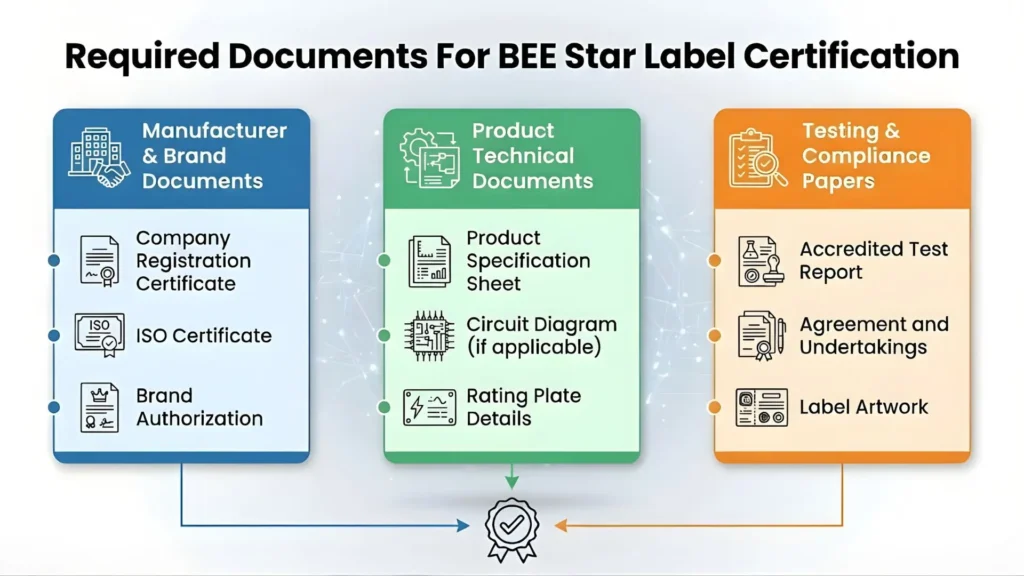
The following documents must be prepared and submitted through the BEE online portal at the time of application:
For Indian Manufacturers
- Certificate of Incorporation / Partnership Deed / Registration Certificate
- PAN Card of the company or firm
- GST Registration Certificate (GSTIN)
- Valid NABL-accredited test report for each model being registered
- Technical specifications sheet -- rated capacity (BTU/hr or kW), rated power input (W), EER or ISEER value
- Sample label artwork (showing brand name, model number, star rating, annual energy consumption, and the BEE logo)
- Declaration of conformity signed by the Authorized Signatory
- Filled BEE application form (online via BEE portal)
- Demand Draft / online payment proof for registration fees
- Factory license or manufacturing license (where applicable)
Additional Documents for Importers
- Import Export Code (IEC) issued by DGFT
- Principal Manufacturer's authorization letter -- confirming you are the exclusive or authorized importer
- Test reports from the country of origin (if done at the foreign factory) -- must be from ILAC-MRA signatory accredited labs
- Product brochure or technical catalogue
- Copy of the shipping invoice / commercial invoice for the first import batch
BEE Certification for Air Conditioner Process -- Step by Step
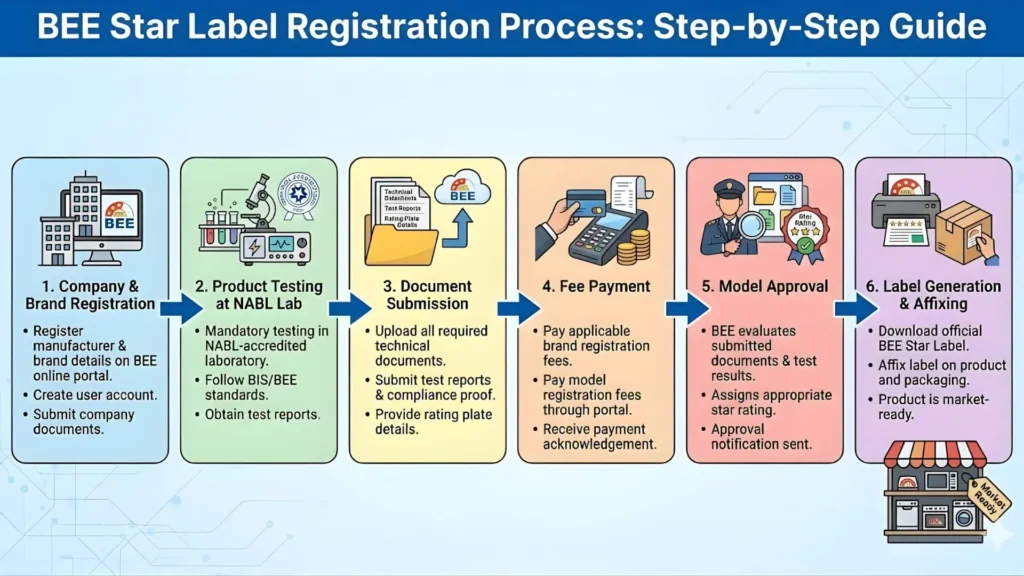
Here is the complete step-by-step process to obtain BEE certification for an air conditioner model in India:
| Step | Stage | What You Need to Do |
| 1 | Product Testing | Send AC unit samples to a NABL-accredited laboratory for energy performance testing. The lab tests the unit for rated cooling capacity, power input, EER/ISEER, and verifies nameplate data. The test must follow BIS standards IS 1391 (Part 1 or 2) and BEE's specified test procedures. |
| 2 | Obtain Test Report | Once testing is complete, the accredited lab issues a formal test report with results, lab accreditation number, test date, and sample identification. Ensure the model number on the test sample exactly matches the model you plan to sell. |
| 3 | Create BEE Portal Account | Register as a manufacturer or importer on the official BEE Appliance portal at bee.gov.in. You will need a valid business email, mobile number, GSTIN, and PAN for account creation. |
| 4 | Fill Online Application | Log in to the BEE portal and fill the online S&L application form for each AC model. Enter product details, efficiency parameters, model number, brand name, and upload the test report. |
| 5 | Upload Documents | Upload all required documents in the prescribed formats: test report, company registration, GST certificate, authorisation letter (for importers), and label artwork. |
| 6 | Pay Registration Fees | Pay the prescribed registration and label licence fees online through the BEE portal using net banking, debit/credit card, or UPI. A receipt will be generated. |
| 7 | BEE Review & Scrutiny | BEE officials review the application. They may request additional documents, clarification, or an inspection visit to the factory. This stage typically takes 30 to 60 working days. |
| 8 | BEE Certificate Issued | Upon successful review, BEE issues the Registration Certificate and approves the star rating for the model. The certificate includes the approved ISEER/EER value, star rating, and registration number. |
| 9 | Print BEE Label | Print BEE-approved energy labels and affix them on every unit of the registered model before despatch from factory or before sale in India. |
| 10 | Market Surveillance & Compliance | BEE and State Designated Agencies (SDAs) conduct random market surveillance to verify that labels on products match BEE records. Ensure your records are up to date. |
How Long Does the BEE AC Certification Process Take?
The total timeline from testing to receiving the BEE certificate is typically 60 to 120 calendar days, broken down approximately as follows:
- Product testing at accredited lab: 15 to 30 days
- Document preparation and BEE portal application: 5 to 10 days
- BEE review, scrutiny, and approval: 30 to 60 working days
- Any rectification / clarification rounds: 10 to 20 additional days
Manufacturers who have prior BEE approvals for similar models and complete documentation tend to get faster approvals. First-time applicants should plan for the longer end of the timeline.
BEE Certification Fees for Air Conditioners
BEE charges fees at different stages of the certification and label licensing process. Below are the indicative fee structures. Note that BEE revises fees periodically, so always verify current fees on the official BEE portal before applying.
| Fee Type | Amount (Approx.) | Remarks |
| Registration Fee (per model) | Rs. 5,000 – Rs. 10,000 | One-time fee per model at initial registration |
| Label Licence Fee (per model, per year) | Rs. 5,000 – Rs. 25,000 | Annual fee for the right to carry and affix BEE labels |
| Renewal Fee (per model, per cycle) | Rs. 5,000 – Rs. 10,000 | Paid at each label schedule renewal (every 2 years) |
| Testing Cost (NABL Lab -- approx.) | Rs. 15,000 – Rs. 50,000 | Per model; varies by lab and test type (EER or ISEER) |
| Late Renewal Penalty | As per BEE notification | Payable if renewal is filed after the deadline |
For large portfolios (10+ models), BEE may allow consolidated fee payments. The fees listed above are indicative and based on publicly available BEE notifications. Official confirmed fees are available at bee.gov.in.
Validity and Renewal of BEE Certification
How Long Is a BEE Certificate Valid?
A BEE energy label registration for air conditioners is valid for the duration of the current label schedule -- typically two years. BEE announces new label schedules with revised efficiency thresholds (usually stricter). When a new schedule comes into effect, all registered models must be renewed under the new criteria.
| Label Schedule | Valid From | Valid Until |
| Schedule 6 | 1 January 2018 | 31 December 2019 |
| Schedule 7 | 1 January 2020 | 31 December 2021 |
| Schedule 8 | 1 January 2022 | 31 December 2023 |
| Schedule 9 (Current) | 1 January 2024 | 31 December 2026 |
| Schedule 10 (Upcoming) | Expected 1 January 2027 | Expected 31 December 2028 |
With each new schedule, BEE typically raises the efficiency bar. A model that earned 5 stars under Schedule 8 may only qualify for 3 stars under Schedule 9 if its ISEER value has not improved. Manufacturers must re-test and re-register their models for each new schedule.
BEE AC Certification Renewal Timeline
- BEE typically issues a gazette notification 3 to 6 months before the new schedule takes effect
- Manufacturers should begin re-testing their models 6 to 9 months before the schedule end date
- Renewal applications should be submitted on the BEE portal at least 60 to 90 days before the current schedule expires
- Any units manufactured under the old schedule before the expiry date can continue to be sold until stock is exhausted, subject to BEE guidelines
- After the renewal deadline, sale of ACs carrying the old label schedule's ratings is prohibited
Benefits of BEE Certification For Air Conditioners
Benefits for Consumers
- Makes it easy to compare energy efficiency of different AC models at the point of sale
- Higher-star ACs directly reduce monthly electricity bills -- a 5-star AC uses up to 30–40% less power than a 1-star AC of the same capacity
- Protects buyers from substandard products making false efficiency claims
- Helps consumers make informed decisions aligned with their budget and usage
Benefits for Manufacturers and Importers
- BEE certification is a legal licence to sell -- without it, ACs cannot be marketed in India
- Higher star ratings are a strong marketing differentiator and drive premium pricing
- Compliance with BEE norms protects manufacturers from penalties and market bans
- BEE-registered brands appear on the official portal, building consumer trust
Benefits for the Nation
- Reduces peak electricity demand during summer months -- benefiting the grid and reducing the need for expensive peaking power plants
- Lowers India's overall energy import bill (less fuel for power generation)
- Supports India's climate commitments -- reducing carbon emissions from the power sector
- Drives technology upgradation in the domestic AC industry
Penalties for Non-Compliance
Selling an air conditioner in India without a valid BEE label or with an incorrect BEE label is a serious offence under the Energy Conservation Act, 2001. Penalties include:
- First offence: Fine of up to Rs. 10 lakh per contravention
- Subsequent offences: Fine of up to Rs. 10 lakh plus an additional Rs. 10,000 per day for each day the violation continues
- Market recall orders issued by BEE or SDAs requiring the company to withdraw non-compliant products
- Blacklisting of the brand from BEE's portal, effectively banning all future label registrations until the violation is resolved
- Criminal prosecution in extreme or repeat cases
Dealers should request and verify BEE registration certificates from manufacturers before accepting stock. Consumers can verify whether an AC model is BEE-registered by checking the BEE Appliance Portal at bee.gov.in.
How to Verify a BEE-Certified AC?
Before purchasing an AC -- or when verifying a dealer's stock -- you can confirm BEE certification in two ways:
Check the Physical Label
- The BEE label is typically yellow and green and is affixed on the front panel of the AC unit
- It shows the brand name, model number, star rating, annual energy consumption in kWh, and the BEE registration number
- Ensure the star count on the label matches the star count displayed in the product advertisement
- Check the label validity period -- it should fall within the current schedule (2024–2026)
Verify on the BEE Portal
- Visit bee.gov.in and navigate to the Standards & Labelling section
- Use the Appliance Search tool to search by brand name or model number
- The portal will show whether the model is registered, its official star rating, and certificate validity
- If the model is not found on the portal, it is not BEE certified -- do not purchase
BEE Certification vs. BIS Certification -- What Is the Difference?
Many people confuse BEE certification with BIS certification. They are different:
| Parameter | BEE Certification | BIS Certification (ISI Mark) |
| Issuing Body | Bureau of Energy Efficiency (Ministry of Power) | Bureau of Indian Standards (Ministry of Consumer Affairs) |
| Focus | Energy efficiency -- how much electricity the AC consumes | Safety, quality, and performance -- whether the AC is safe to use |
| Mandate for AC | Mandatory under Energy Conservation Act, 2001 | Mandatory under BIS (Compulsory Registration Scheme / CRS) |
| Label on Product | Yellow-green BEE Star Label | ISI Mark (for safety) / R-Number (for CRS products) |
| Renewal Cycle | Every 2 years (with each new label schedule) | Annual (for most product categories) |
An AC legally sold in India must have both BEE certification (for energy efficiency) and BIS CRS registration (for safety and quality). A 5-star BEE rating does not mean BIS approval, and vice versa.
Conclusion
BEE certification for air conditioners is not just a regulatory checkbox -- it is a foundational pillar of India's energy efficiency strategy. For consumers, it is the single most reliable tool to compare AC efficiency and make a purchase decision that saves real money every month. For manufacturers and importers, it is a legal requirement and a competitive differentiator.
With the current label schedule running through 2026 and the next schedule expected in 2027, now is the right time for manufacturers to start planning for higher-efficiency product lines, and for consumers to verify that the AC they are buying carries a current, valid 5-star or 4-star BEE label.
When in doubt, always cross-check the model on bee.gov.in before making a decision. The information on the official BEE portal is the authoritative, real-time source for all certified AC models in India.
Frequently Asked Questions
Is BEE certification mandatory for all air conditioners in India?
Yes. All room air conditioners -- including window ACs, split ACs (fixed speed and inverter), cassette ACs, tower ACs, and floor-standing ACs -- must carry a valid BEE star label before they are sold in India.
What is the difference between EER and ISEER in BEE rating?
EER (Energy Efficiency Ratio) measures cooling output divided by power input under a single standard test condition. ISEER (Indian Seasonal Energy Efficiency Ratio) measures efficiency across multiple load conditions (25%, 50%, 75%, and 100%) that reflect real-world seasonal usage in India.
How often does BEE revise the star rating thresholds?
BEE revises the star rating thresholds every two years through a new label schedule. Each revision raises the efficiency bar, meaning a product that earned 5 stars in a previous schedule may only qualify for 3 or 4 stars in the next schedule if it has not been upgraded.
Can I sell my AC stock with an old BEE label after the new schedule begins?
Yes, but only for units manufactured before the new schedule's effective date. Once the new schedule begins, you cannot manufacture or import AC units with the old label. Existing old-labelled stock can usually be sold until it is exhausted, subject to BEE guidelines -- but check the specific gazette notification for each schedule change.
How do I check if an AC model is BEE certified?
Visit the BEE Appliance Portal at bee.gov.in, go to the Standards & Labelling section, and search by brand name or model number. The portal will show the registered star rating, certificate number, and validity period. If the model is not listed, it is not BEE certified.
What is the penalty for selling an AC without a BEE label?
Under the Energy Conservation Act, 2001, the penalty for selling a non-labelled or incorrectly labelled AC can go up to Rs. 10 lakh per contravention for the first offence, with additional daily penalties for continuing violations. Repeat offenders may face criminal prosecution and market bans.
How long does it take to get BEE certification for a new AC model?
The complete process from product testing to receiving the BEE certificate typically takes 60 to 120 calendar days. Testing alone takes 15 to 30 days. BEE's review and approval process takes 30 to 60 working days.
Do imported AC brands need BEE certification in India?
Yes. Importers must obtain BEE registration for every AC model they bring into India, regardless of what certifications the product holds in its country of origin. Test reports from ILAC-MRA signatory accredited labs abroad may be accepted, but the BEE registration must be obtained separately in India.
Is a 5-star AC always the best choice?
From a pure energy savings perspective, yes -- a 5-star AC costs less to run annually. However, 5-star models usually carry a higher upfront price. The right choice depends on how many hours per day you use the AC, local electricity tariffs, and how long you plan to keep the unit.
What happens to BEE certification if I upgrade the AC compressor or components?
If you make any hardware change that could affect the energy efficiency of a registered AC model -- such as changing the compressor, refrigerant type, or heat exchanger -- you must re-test the modified product and apply for a fresh BEE registration. Selling a modified product under the old BEE certificate is not permitted and violates the Energy Conservation Act.