

- Two APEDA registrations for rice exports: Obtain an APEDA Registration-cum-Membership Certificate (RCMC) first, then apply for a Registration-cum-Allocation Certificate (RCAC) for each export contract
- Both rice types are covered: RCAC registration applies to basmati rice and non-basmati rice. Non-basmati rice was included under DGFT Notification No. 33/2025-26, dated 24 September 2025.
- Registration fees: The figures provided are ₹5,900 (including GST) for RCMC and ₹8 per MT plus 18% GST, subject to a ₹50 minimum, for contract registration. Confirm the applicable fee on the APEDA portal before payment; I could not independently verify both amounts from the retrieved official pages.
- Important 2026 update: Under DGFT Notification No. 07/2026-27, dated 10 April 2026, the Certificate of Inspection (CoI) waiver for non-basmati rice exports to European countries outside the EU, UK, Iceland, Liechtenstein, Norway and Switzerland runs until 1 October 2026. As today is 21 October 2026, this waiver period has ended; check for a further DGFT notification before exporting.
Introduction
APEDA Registration for Rice Exporters involves two steps. First, obtain a Registration-cum-Membership Certificate (RCMC) through the DGFT e-RCMC portal. The fee is ₹5,900 (₹5,000 + 18% GST), and the certificate is valid for five years. Next, register each export contract with APEDA to obtain a Registration-cum-Allocation Certificate (RCAC).

This requirement applies to basmati rice and, since 24 September 2025, non-basmati rice as well. The standard RCAC shipment validity is 45 days from the date of issue, subject to applicable extensions announced by APEDA.
What Is APEDA Registration for Rice Exporters?
The Agricultural and Processed Food Products Export Development Authority (APEDA) operates under the Ministry of Commerce and Industry, Government of India. It promotes the export of agricultural and processed food products, including basmati and non-basmati rice.
For rice exporters, APEDA registration involves two separate requirements: the Registration-cum-Membership Certificate (RCMC) and the Registration-cum-Allocation Certificate (RCAC). Understanding the difference between these certificates is essential before starting export operations.
| Item | What it means | When you need it |
|---|---|---|
| RCMC | Registration-cum-Membership Certificate that registers an exporter with APEDA | Obtain it before applying for RCAC; maintain a valid certificate |
| RCAC | Registration-cum-Allocation Certificate issued after export contract registration | For each applicable rice export contract |
The RCMC application is submitted through the DGFT e-RCMC portal. APEDA introduced the online facility through DGFT in July 2023. The RCAC application, however, is submitted through APEDA's online system using the registered exporter's login credentials. A valid RCMC is mandatory for applying for an RCAC.
Which Rice Exports Are Covered Under APEDA Registration?
APEDA requires contract registration for basmati rice and specified categories of non-basmati rice.
Under DGFT Notification No. 33/2025-26, dated 24 September 2025, contract registration became a condition for exporting non-basmati rice under the following ITC (HS) codes. APEDA issued its related trade notice on 25 September 2025.
- 10063011
- 10063019
- 10063091
- 10063099
- 10064000
Basmati rice exports are also covered by the RCAC mechanism under the applicable DGFT policy. Organic non-basmati rice follows a separate APEDA registration procedure, including the relevant organic certification requirements.
| Rice category | RCMC required? | Contract registration |
|---|---|---|
| Basmati rice | Yes | RCAC required |
| Non-basmati rice under the listed HS codes | Yes | RCAC required |
| Organic non-basmati rice | Yes | Follow APEDA's separate organic rice procedure |
| Rice by-products and processed rice products | Depends on product classification | Check the applicable HS code and export policy |
Important: Before quoting a price or accepting an export order, verify the product's HS code, current DGFT export policy and destination-country requirements. Export conditions can change through government notifications.
Benefits of APEDA Registration for Rice Exporters
- Regulatory compliance: Obtain the required RCMC and register applicable rice export contracts through the RCAC process.
- Export documentation: Access the online RCAC and obtain a copy for submission to customs along with other required export documents.
- Access to APEDA programmes: Eligible registered members can explore APEDA's export promotion schemes, training and market information, subject to the conditions of each programme.
- Destination-specific compliance: Identify additional requirements relating to inspections, laboratory testing, approved rice establishments and other importing-country conditions.
- Better export planning: Register the correct contract quantity and review certificate validity before arranging shipment.
Note: APEDA registration alone does not guarantee customs clearance, buyer acceptance, financial approval or market access. Exporters must also meet the applicable DGFT rules, customs requirements and destination-country regulations.
Who Can Apply? Eligibility for APEDA Registration for Rice Exporters
Businesses intending to export APEDA-scheduled products can apply for an APEDA RCMC, subject to the applicable registration requirements. The business must have a valid Importer Exporter Code (IEC) and the required supporting details.
Common business structures include:
| Exporter type | Typical rice export activity |
|---|---|
| Merchant exporter | Purchases rice from mills or suppliers and exports it in its own name |
| Manufacturer exporter | Operates a rice mill or processing unit and exports its products |
| Manufacturer-cum-merchant exporter | Exports its own production and rice sourced from other suppliers |
A merchant exporter does not necessarily need to own a rice mill. However, certain destination markets impose additional conditions on the establishment from which the rice is sourced.

For example, under APEDA's published non-basmati rice export procedure for Saudi Arabia, merchant exporters must upload a certificate from the Saudi Food and Drug Authority (SFDA)-accredited rice establishment from which the rice was purchased before the RCAC can be issued. The applicable establishment and destination requirements should be checked before applying.
Documents Required for APEDA Registration for Rice Exporters
The documents required for APEDA registration for rice exporters depend on whether the applicant is a merchant exporter or a manufacturer exporter. Additional documents may be required when registering an export contract for a specific destination.
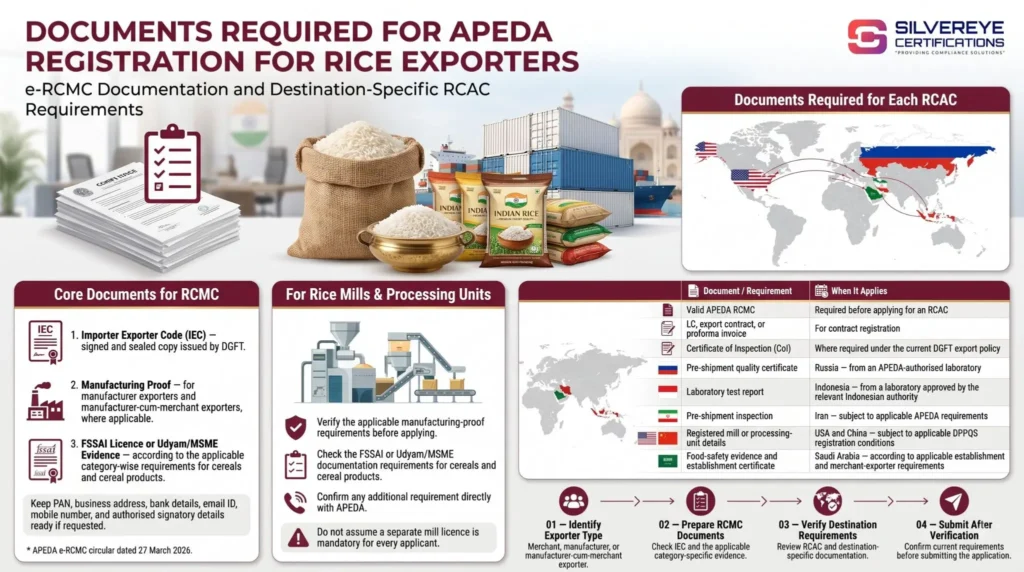
For RCMC (APEDA Registration)
According to APEDA's e-RCMC circular dated 27 March 2026, the principal documents are:
- Signed and sealed copy of the Importer Exporter Code (IEC) issued by DGFT.
- Manufacturing proof for manufacturer exporters and manufacturer-cum-merchant exporters, as applicable to the product category.
- FSSAI licence or Udyam/MSME registration evidence, where applicable under APEDA's category-wise requirements for cereals and cereal products.
Keep your PAN, business address, bank details, email ID, mobile number and authorised signatory details ready if requested during the application process.
Additional Documents for Manufacturer Exporters
Rice mills and processing units should check the applicable manufacturing-proof requirements before submitting their e-RCMC application. APEDA's circular lists FSSAI or Udyam/MSME documentation for cereals and cereal products. Do not assume that a separate mill licence is mandatory for every applicant; confirm any additional requirement with APEDA.
Documents Required for Each RCAC
| Document or requirement | When it applies |
|---|---|
| Valid APEDA RCMC | Mandatory before applying for an RCAC |
| Letter of Credit (LC), export contract or proforma invoice | Required for contract registration |
| Certificate of Inspection (CoI) | Where required under the current DGFT export policy |
| Pre-shipment quality certificate | For exports to the Russian Federation, from an APEDA-authorised laboratory |
| Laboratory test report | For Indonesia, from a laboratory approved by the relevant Indonesian authority |
| Pre-shipment inspection | For Iran, subject to the applicable APEDA requirements |
| Registered mill or processing-unit details | For exports to the USA and China, subject to the applicable DPPQS registration conditions |
| Food-safety evidence and establishment certificate | For Saudi Arabia, according to the applicable establishment and merchant-exporter requirements |
For Saudi Arabia, merchant exporters must provide the required certificate from the SFDA-accredited rice establishment from which the rice was purchased. Applicable food-safety requirements, including ISO 22000 or HACCP, must also be checked.
Important: APEDA's published rice-export trade notice specifies destination-specific conditions. Since export requirements can change, verify the latest DGFT notifications and APEDA advisories before applying.
Process of APEDA Registration for Rice Exporters
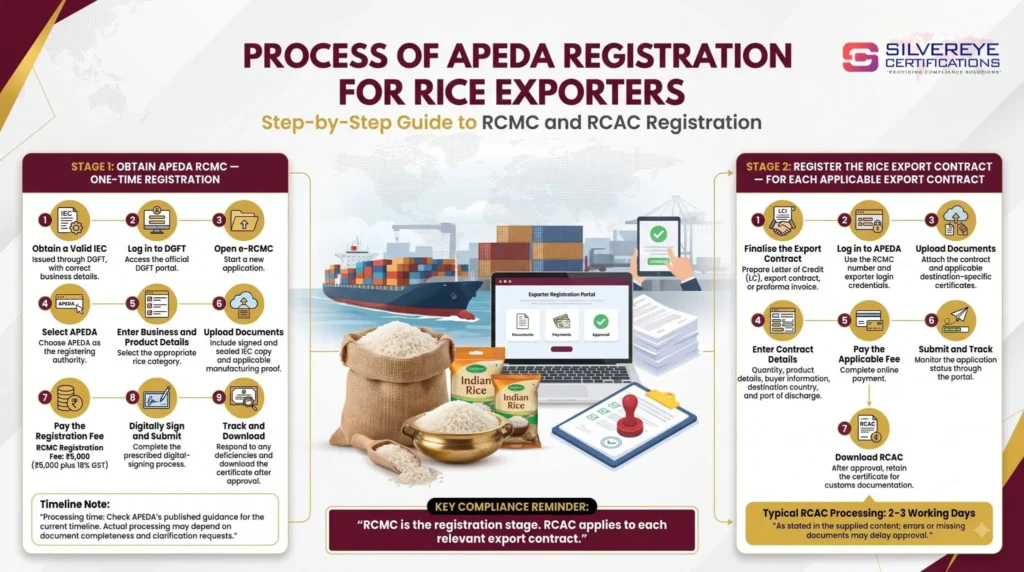
APEDA registration involves two stages: obtaining the RCMC and registering each applicable rice export contract for an RCAC.
Part A: RCMC Registration (One-Time Registration)
- Obtain a valid IEC from DGFT and check that your business details are correct.
- Log in to the DGFT portal.
- Open the e-RCMC service and start a new application.
- Select APEDA as the registering authority.
- Enter the exporter and product details, selecting the appropriate category for rice.
- Upload the required documents, including the signed and sealed IEC copy and applicable manufacturing proof.
- Pay the RCMC registration fee of ₹5,900, comprising ₹5,000 plus 18% GST.
- Complete the prescribed digital signing process and submit the application.
- Track the application status, respond to any deficiencies and download the certificate after approval.
Processing time: APEDA's published guidance should be consulted for the current RCMC processing timeline. The actual time may depend on document completeness and any clarification requested by the authority.
Part B: RCAC Registration (For Each Applicable Export Contract)
- Finalise the export contract and keep the LC, contract or proforma invoice ready.
- Log in to APEDA's portal using your RCMC number and exporter login credentials.
- Upload the contract document and applicable destination-specific certificates.
- Enter the contract quantity, product details, buyer information, destination country and port of discharge.
- Pay the applicable processing fee online.
- Submit the application and track its status through the portal.
- Download the RCAC after approval and retain it for customs documentation.
APEDA states that RCAC applications are normally processed within 2–3 working days, although errors or missing documents can delay approval.
The standard RCAC validity is up to 45 days from the date of issue. Apply for the quantity you expect to ship within the applicable period. Check APEDA's extension circulars to determine whether a particular certificate qualifies for an extension.
Shipment Route Conditions for Rice Exports
APEDA's trade notice provides for exports through Customs EDI ports. Exports are also permitted through specified non-EDI Land Customs Stations on the Indo-Bangladesh and Indo-Nepal borders, subject to registration of the export quantity with the designated DGFT Regional Authorities.
The notice names Kolkata and Patna for this purpose, along with any other regional authorities subsequently notified by DGFT.
Exporters should verify the latest export policy and applicable port conditions before arranging transportation or shipment.
APEDA Registration Fees for Rice Exporters
| Fee or service | Applicable amount |
|---|---|
| RCMC registration | ₹5,900, including GST |
| RCMC renewal | ₹5,900, including GST, according to APEDA's published procedure |
| RCMC amendment or modification | No additional fee stated in APEDA's e-RCMC circular |
| RCAC contract registration | ₹8 per MT plus 18% GST, subject to a minimum fee of ₹50 |
| Laboratory testing and inspection | Separate charges, depending on the destination and agency |
| Consultancy services | Varies by service provider |
Validity and Renewal of APEDA Registration for Rice Exporters
| Topic | What exporters should know |
|---|---|
| RCMC validity | Five years, as specified in APEDA's published procedure |
| RCMC renewal | Apply through the DGFT e-RCMC module and check the certificate's expiry date |
| RCAC validity | Standard shipment validity is up to 45 days from issue |
| RCAC extension | Check the applicable APEDA extension circular and eligibility conditions |
| RCAC amendment | APEDA permits amendments to specified fields, including brand name, crop year and port of loading |
| Change in business details | Notify APEDA and update registration details as required |
| Change in legal entity or PAN | Review whether a new IEC and RCMC are necessary |
| Cancellation or deregistration | Subject to the applicable rules and prescribed procedure |
APEDA's RCAC FAQs state that quantity and value cannot be amended after issuance. If the shipment plan changes, contact APEDA to determine the correct procedure rather than assuming the existing certificate can be modified.
2026 Updates Rice Exporters Should Know
Rice exporters should monitor the latest APEDA circulars, DGFT notifications and export policy amendments before accepting contracts or arranging shipments.
| Date | Update | What it means for you |
|---|---|---|
| 24–25 September 2025 | DGFT Notification 33/2025-26 and APEDA Trade Notice APEDA-CRL/20/2025-CD | Non-basmati rice export contracts must be registered with APEDA under the applicable policy. |
| 27 March 2026 | APEDA circular on the e-RCMC procedure | Explains category-wise documents, fees, renewal and amendment procedures. |
| 10 April 2026 | DGFT Notification 07/2026-27 | A Certificate of Inspection (CoI) from EIC/EIA is required for rice exports to EU Member States, the UK, Iceland, Liechtenstein, Norway and Switzerland. A six-month waiver for other European countries ran until 1 October 2026. |
| 1 October 2026 | End of the six-month CoI waiver | Check the latest DGFT notification before shipping rice to other European destinations, as the stated waiver period has ended. |
| 26 June 2026 | Jan Vishwas amendment framework | Verify the relevant provisions, commencement date and enforcement procedure against the official legislation before relying on this update. |
| 20 July 2026 | DGFT Trade Notice No. 14/2026-27 | Verify whether the proposed ₹10,000 FOB exemption from RCMC requirements for certain FTP benefits remains a draft or has been formally adopted. |
Important policy note: Do not rely solely on secondary reports about minimum export prices, export duties or quantity restrictions. Check the current DGFT export policy for the relevant rice HS code before quoting a price or accepting an order. Keep a dated copy of the applicable policy and consider including a change-in-law clause in your export contract.
Common Mistakes Rice Exporters Make
- Treating RCMC as sufficient and forgetting the required contract-level RCAC registration.
- Applying for more quantity than can realistically be shipped within the applicable RCAC validity period.
- Missing the Certificate of Inspection or other destination-specific requirements.
- Overlooking country conditions, such as mill registration for the USA and China.
- Using the wrong HS code, which can affect export eligibility and applicable fees.
- Selecting the manufacturer-exporter category without the required manufacturing documents.
- Allowing name, PAN or address mismatches across IEC, FSSAI, Udyam and other business records.
- Relying on an outdated trade notice instead of the latest official notification.
- Allowing the RCMC to expire without completing the required renewal process.
Tip: APEDA has published RCAC validity-extension circulars, including one dated 24 August 2026. Check whether your certificate qualifies for an extension instead of assuming that every RCAC follows only the standard 45-day period.
How to Choose an APEDA Registration Partner
Exporters can file RCMC and RCAC applications themselves. However, a compliance partner can help manage documentation and destination-specific requirements, especially when handling frequent shipments to multiple countries.
Before choosing a consultant, ask:
- Will you verify my HS code and current DGFT export policy before I quote?
- Which country-specific certificates and inspections apply to my destination?
- Are your professional fees clearly separated from government fees?
- Who will manage contract registration, deficiency replies and renewal reminders?
- Will you provide links to official APEDA and DGFT sources instead of promising guaranteed approvals or timelines?
Why Choose Silvereye Certifications?
Silvereye Certifications supports businesses with APEDA registration and export compliance assistance, helping rice exporters understand the applicable requirements and prepare their documentation.
Whether you are a merchant exporter, rice mill owner or manufacturer-cum-merchant exporter, our team can guide you through the relevant registration procedures and compliance checks.
- RCMC Registration Assistance: Guidance on the DGFT e-RCMC application, supporting documents and registration requirements.
- RCAC Contract Registration Support: Assistance with preparing and submitting applicable rice export contract registrations through APEDA.
- HS Code and Export Policy Guidance: Help reviewing the relevant rice classification and checking applicable DGFT policy conditions.
- Country-Specific Compliance Guidance: Assistance in identifying destination-related requirements, including inspection certificates, laboratory reports and approved mill documentation where applicable.
- Document Review: Help identifying inconsistencies in business details across IEC, PAN, FSSAI, Udyam and other relevant records.
- Renewal and Amendment Assistance: Guidance on RCMC renewal, amendments and applicable updates to registration details.
- Transparent Service Charges: Clear communication about professional fees, government charges and the documents required before proceeding.
At Silvereye Certifications, our focus is on making export compliance easier to understand and helping businesses prepare their applications with greater confidence. Requirements and approval timelines depend on the applicable rules and the decisions of the relevant authorities.
Planning to export basmati or non-basmati rice? Contact Silvereye Certifications for assistance with APEDA RCMC registration, RCAC contract registration and destination-specific export compliance.
Conclusion
APEDA registration for rice exporters involves two key stages: obtaining the RCMC to register as an exporter and completing the applicable RCAC contract registration before export.
Start with a valid IEC and RCMC, ensure your documents are consistent, verify your rice HS code and destination-country requirements, and apply for the RCAC with the correct contract details and quantity. Check the applicable certificate validity and any extensions before arranging shipment.
Review the latest DGFT export policy and APEDA notifications before quoting prices or signing contracts, and maintain a reminder for RCMC renewal.
If you need help confirming your HS code, preparing documents, filing the RCMC, registering export contracts or understanding destination-specific conditions, Silvereye Certifications can assist you throughout the APEDA registration and export compliance process.
Silvereye Certifications — Your partner for APEDA registration and export compliance.
Frequently Asked Questions
Do I need APEDA registration to export rice?
Yes. You need the RCMC as a registered exporter, and each rice export contract must be registered with APEDA to obtain an RCAC.
What is an RCAC?
It is the Registration-cum-Allocation Certificate APEDA issues online after scrutinising your contract. You print it for customs along with other export documents.
Is contract registration mandatory for non-basmati rice?
Yes. Under DGFT Notification 33/2025-26 dated 24 September 2025, non-basmati rice export is permitted only upon registration of contracts with APEDA.
What is the fee for contract registration?
₹8 per MT plus 18% GST on the contracted quantity, with a minimum of ₹50.
How long is an RCAC valid?
For shipment up to 45 days from the date of issue. Apply for the quantity you plan to ship in that period.
What is the fee for the RCMC?
₹5,000 plus 18% GST, so ₹5,900. Confirm on the portal when paying.
How long is the RCMC valid?
Five financial years. Check the exact dates on your certificate.
Can a rice trader register without owning a mill?
Yes, as a merchant exporter with an active IEC. Some destinations ask for certificates from the mill the rice came from.
Do I need a Certificate of Inspection for Europe?
It is mandatory for rice exports to EU Member States, the UK, Iceland, Liechtenstein, Norway and Switzerland. The waiver for other European countries ran to 1 October 2026, so check DGFT for the current position.
Which export routes are allowed?
Customs EDI ports, and non-EDI Land Customs Stations on the Indo-Bangladesh and Indo-Nepal borders subject to quantity registration with DGFT regional authorities.
Does the RCMC allow me to ship immediately?
No. You also need an RCAC for the contract and any country-specific certificates, plus customs and destination-country compliance.
Is the ₹10,000 RCMC exemption in force?
It was proposed in DGFT Trade Notice 14/2026-27 as a draft. Check DGFT for a final notification before relying on it.