

- Every exporter of scheduled agricultural or processed food products needs a valid Registration-Cum-Membership Certificate (RCMC) from APEDA before shipping goods out of India.
- Since July 2023, APEDA registration is processed as e-RCMC entirely through the DGFT portal, using your existing IEC — no separate offline paperwork trail.
- Core documents needed are IEC copy, PAN, GST certificate, bank certificate/cancelled cheque, incorporation proof, and FSSAI license (for food categories).
- The current government fee is ₹5,900 (₹5,000 + 18% GST), and the certificate stays valid for 5 financial years before renewal is required.
What Documents Do You Need for APEDA Registration?
To complete APEDA registration Documents, you need a valid Import Export Code (IEC) from DGFT, your firm's PAN card, GST registration certificate, a bank certificate or cancelled cheque, the last two months' bank statement, and proof of business constitution (incorporation certificate, partnership deed, or proprietorship proof). Food product exporters also need an FSSAI license.

As of 2026, the entire APEDA registration process runs as "e-RCMC" on the DGFT common digital platform — you no longer register on a separate APEDA portal first. The government fee is ₹5,900 (inclusive of 18% GST), and the Registration-Cum-Membership Certificate (RCMC) remains valid for five financial years from the date of issue.
Working with a registration partner like Silvereye Certifications can help you avoid document rejection, which is the single biggest reason APEDA registration applications get delayed.
What Is APEDA Registration and Why Was It Created?
The Agricultural and Processed Food Products Export Development Authority (APEDA) is a statutory body of the Government of India, set up in December 1985 under the APEDA Act, 1985, and it functions under the Ministry of Commerce and Industry. It replaced the earlier Processed Food Export Promotion Council and was given a clear mandate: develop and promote the export of "scheduled products" from India, set quality standards, provide financial assistance to the industry, and maintain trade statistics.
APEDA also acts as the Secretariat to the National Accreditation Board (NAB) for the National Programme for Organic Production (NPOP), which is the reason organic exporters interact with APEDA even outside standard RCMC registration. When people search for "APEDA registration documents," what they are really looking for is the paperwork needed to get the RCMC — the certificate that legally authorizes export of scheduled agricultural and processed food products.
Is APEDA Registration Mandatory?
Yes. If your business exports any product listed in the First Schedule of the APEDA Act, RCMC registration is compulsory, not optional. Exporters are required to apply for registration within one month of undertaking the export business. APEDA can extend this deadline only for sufficient cause, and only at its own discretion — there is no automatic grace period.
Shipping scheduled products without a valid RCMC is not permitted, and the certificate is also a prerequisite for availing several Foreign Trade Policy benefits such as RoDTEP, Duty Drawback, and the Export Promotion Capital Goods (EPCG) scheme, where the specific council-issued RCMC is a scheme requirement.
Who Needs to Apply for APEDA Registration?
Any Indian entity that exports scheduled products is eligible and required to register, regardless of size or turnover. This includes:
- Individual/sole proprietorship exporters
- Partnership firms and LLPs
- Private and public limited companies
- Merchant exporters (traders who export without manufacturing)
- Manufacturer-exporters and processors of scheduled food products
- Farmer producer organisations (FPOs) exporting agricultural produce
- Startups and home-based food brands exporting even small consignments
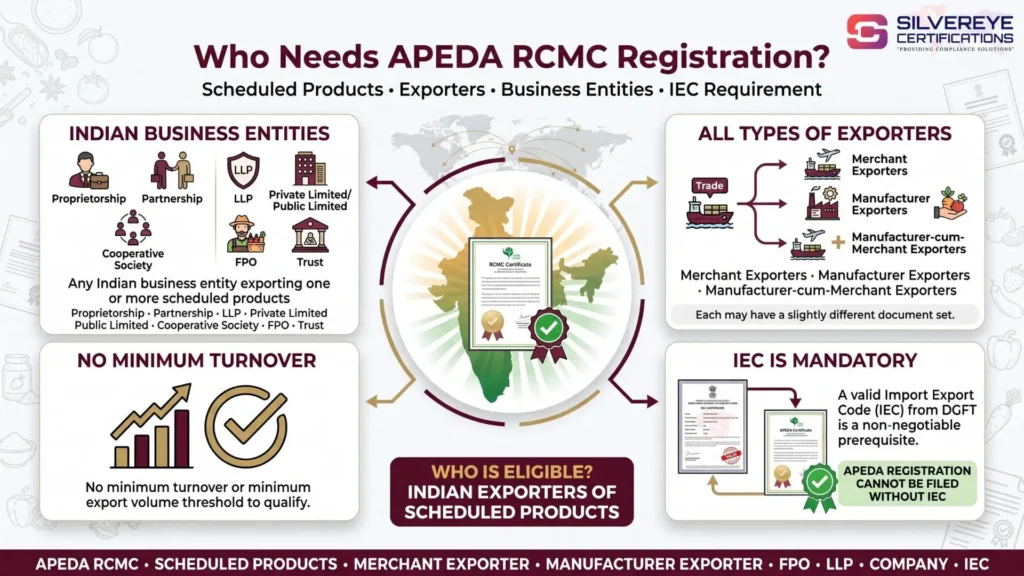
There is no minimum export value or business size exemption — a small home-grown snack brand shipping a single carton to the UAE needs the same RCMC as a large processed-food company shipping in bulk.
APEDA Scheduled Products List (First Schedule)
APEDA registration is product-specific — it applies only to items falling under the First Schedule of the APEDA Act. The current scheduled product categories are:
| S.No. | Scheduled Product Category |
| 1 | Fruits, Vegetables and their Products |
| 2 | Meat and Meat Products |
| 3 | Poultry and Poultry Products |
| 4 | Dairy Products |
| 5 | Confectionery, Biscuits and Bakery Products |
| 6 | Honey, Jaggery and Sugar Products |
| 7 | Cocoa and its Products, Chocolates of All Kinds |
| 8 | Alcoholic and Non-Alcoholic Beverages |
| 9 | Cereal and Cereal Products |
| 10 | Groundnuts, Peanuts and Walnuts |
| 11 | Pickles, Papads and Chutneys |
| 12 | Guar Gum |
| 13 | Floriculture and Floriculture Products |
| 14 | Herbal and Medicinal Plants |
| 15 | De-oiled Rice Bran |
| 16 | Green Pepper in Brine |
| 17 | Cashew Nuts and its Products |
Basmati Rice sits in the Second Schedule of the APEDA Act and has its own registration track. Products handled by other commodity boards — spices (Spice Board), marine products (MPEDA), tea (Tea Board), and coffee (Coffee Board) — are excluded from APEDA and need registration with that specific board instead.
Always verify your product's HS code against the current APEDA schedule before assuming registration is (or isn't) required — this is one of the most common compliance gaps new exporters run into.
Complete List of APEDA Registration Documents
This is the checklist most exporters are actually searching for. Documents required for APEDA registration are grouped below by category so you can assemble them before starting the online application.
1. Mandatory Documents (Every Applicant)
- Valid Import Export Code (IEC) certificate issued by DGFT — this must exist before you can apply for e-RCMC
- Self-certified copy of the firm/company PAN card
- GST registration certificate
- Bank certificate in the prescribed format, signed and sealed by the bank
- Bank account statement for the latest two months
- Cancelled cheque showing the account holder's name and IFSC code
- Duly signed and sealed copy of the APEDA application form
2. Business Constitution Proof (Based on Entity Type)
- Proprietorship: Aadhaar and proprietorship declaration
- Partnership firm: Registered partnership deed
- LLP: Certificate of Incorporation and LLP agreement
- Private/Public Limited Company: Certificate of Incorporation and Memorandum & Articles of Association
3. Additional Supporting Documents
- Address proof of registered office/branch office (electricity bill, rent agreement, or property document)
- List of directors/partners with individual ID proof
- FSSAI license — mandatory for exporters of processed food products
- Udyam (MSME) registration certificate — specifically required for the Cereals and Cereal Products category
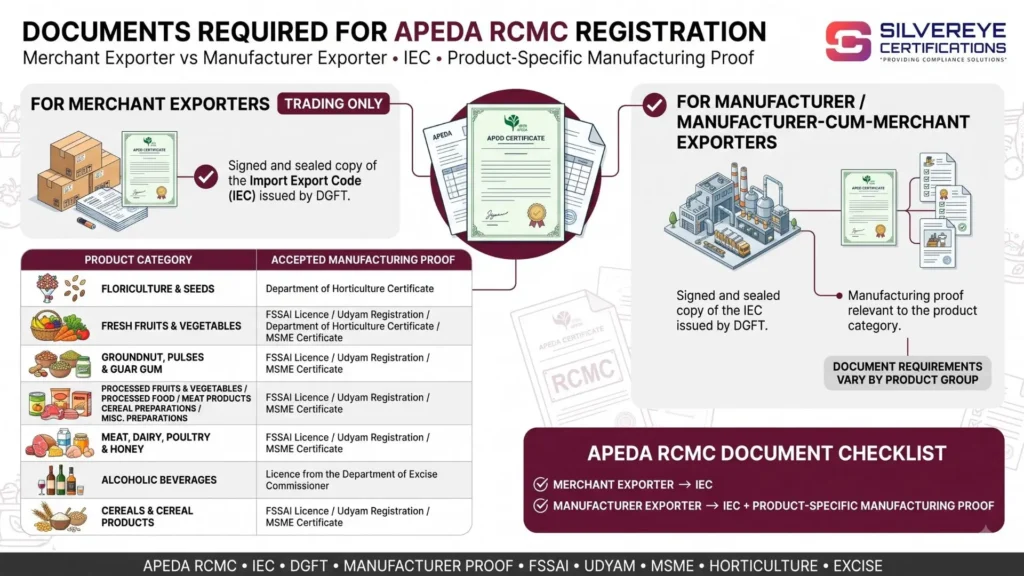
Keep scanned copies under the file-size limits specified on the DGFT e-RCMC page, and make sure names on PAN, GST, IEC and bank documents match exactly — mismatched spellings are the most frequent reason applications get sent back for resubmission.
Step-by-Step APEDA Registration Process (2026)
Since 17 July 2023, in compliance with DGFT Trade Notice 35/2021-22 dated 24 February 2022, APEDA registration is no longer filed on a separate APEDA-only login. Every RCMC application, including for APEDA, is filed as e-RCMC directly through the DGFT portal. This remains the current, unchanged process through 2026.
- Get or confirm your IEC. If you don't already hold an Import Export Code from DGFT, apply for it first — it is a prerequisite for e-RCMC.
- Log in to the DGFT portal and go to Services > e-RCMC. This is the single-window entry point for RCMC issuance across all export promotion councils and commodity boards, including APEDA.
- Select APEDA as the registering authority and choose your applicable scheduled product category from the drop-down list.
- Fill in business, bank and product details exactly as they appear on your supporting documents.
- Upload the required documents (see checklist above) in the specified format and size.
- Pay the registration fee online via credit card, debit card, net banking, or demand draft in favour of "APEDA," payable at your city.
- Track your application status using the IEC and application number on the portal until APEDA processes it.
- Resolve any deficiency memo. If APEDA flags a document issue, you'll need to correct and resubmit online — the certificate isn't issued until this is cleared.
- Download your RCMC certificate once approved. Login credentials are also sent to your registered email, and the certificate is accessible under the relevant menu on the portal.
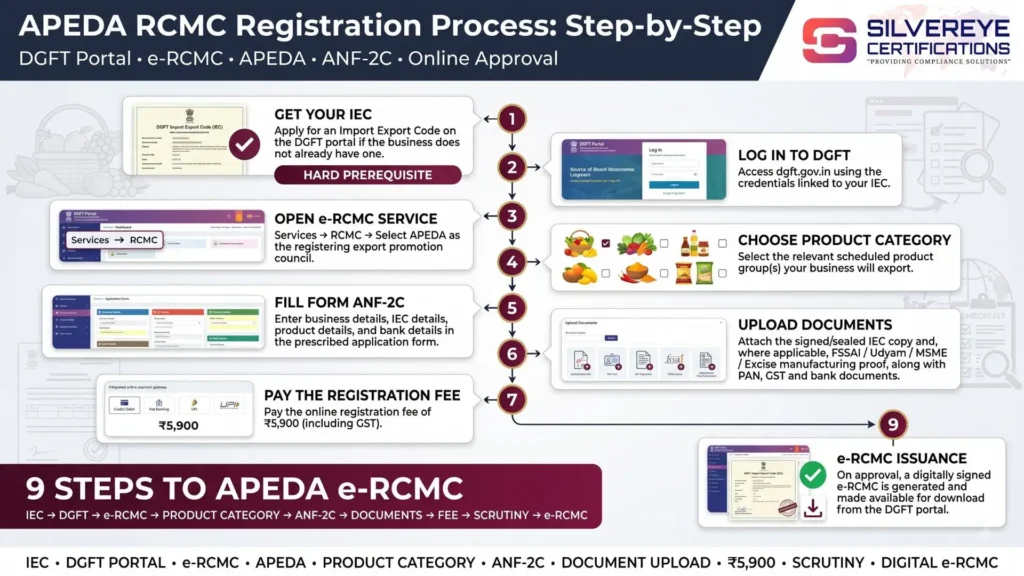
This full digital, single-window issuance through DGFT is the most significant procedural shift exporters should know about in 2026 — there is no separate physical visit or offline submission required at any stage.
APEDA Registration Fees and Validity (2026)
| Particular | Details |
| Online Registration Fee | ₹5,900 (₹5,000 registration fee + 18% GST of ₹900) |
| Online Renewal Fee | ₹5,900 (same structure as fresh registration) |
| Certificate Validity | 5 financial years from the date of issue |
| Amendment/Modification Fee | No fee — free of cost after RCMC is issued |
| Payment Modes | Credit card, debit card, net banking, or demand draft in favour of "APEDA" |
Beyond the government fee, if you engage a consultancy or registration service provider for document preparation and filing support, their professional fee is charged separately and is not fixed or regulated by APEDA.
APEDA RCMC Renewal Process: What Happens After 5 Years?
An APEDA RCMC issued through the DGFT e-RCMC framework is valid for five financial years and needs to be renewed before it lapses. Renewal is processed through the same DGFT e-RCMC portal, using the same fee structure as fresh registration (₹5,900). It's worth building in a buffer — start the renewal process at least 60 days before expiry, since a lapsed RCMC can interrupt your ability to claim FTP-linked export benefits until it's reinstated.
A few points exporters often get wrong about renewal:
Renewal is not automatic — you must actively file it before expiry
- The 5-year validity clock runs from the original issue date, not from when you last logged in or used the certificate
- Membership dues, if any are charged separately by the registering authority, are distinct from the RCMC renewal fee itself
- An expired RCMC generally cannot be renewed retroactively for the lapsed period — you may need to reapply as a fresh registration
How to Amend or Modify Your APEDA RCMC
If your business details change — a new branch address, updated bank account, change in product category, or a change in authorised signatory — you can apply for amendment or modification of your RCMC directly on the portal after it has been issued. Unlike registration and renewal, this amendment process does not attract any government fee.
Benefits of APEDA Registration for Exporters
- Legal authorization to export scheduled agricultural and processed food products from India
- Eligibility to apply for financial assistance schemes run by APEDA for infrastructure, quality development and market access
- Access to APEDA's market information, trade data, and buyer-seller meet participation
- A prerequisite for claiming several Foreign Trade Policy benefits, where the relevant council-issued RCMC is a scheme condition
- Credibility with overseas buyers, banks and freight partners who recognise RCMC as proof of a compliant, government-registered exporter
- Access to testing, certification and packaging improvement support that APEDA extends to registered members
APEDA RCMC vs Registration With Other Export Councils
India has multiple export promotion councils and commodity boards, each responsible for a specific product basket. Registering with the wrong one — or assuming IEC alone is enough — is a common and costly mistake.
| Authority | Product Scope |
| APEDA | Scheduled agricultural and processed food products (fruits, vegetables, meat, dairy, cereals, beverages, honey, etc.) |
| Spice Board of India | Spices and spice products |
| MPEDA | Marine products (seafood, fish, prawns) |
| Tea Board | Tea and tea products |
| Coffee Board | Coffee and coffee products |
APEDA's schedule effectively acts as the residual category for agricultural exports that aren't already covered by one of these specialised boards. And crucially, an IEC alone is not sufficient — IEC is a general trade licence required for any import-export activity, while RCMC is the product-specific authorisation layered on top of it.
What's New for APEDA Registration in 2026?
The most relevant update for exporters heading into 2026 is that the DGFT-integrated e-RCMC system, first rolled out in July 2023, is now the fully settled, exclusive route for APEDA registration, renewal and amendment. APEDA's own registration circulars have been reissued and republished through 2026 reconfirming the same process, document list and fee structure — meaning there is no separate legacy APEDA login for new applicants to worry about, and no parallel offline paper-based route running alongside it.
Practically, this means:
- One IEC-linked digital identity is now used across DGFT and APEDA, reducing duplicate data entry
- Application tracking, deficiency memos, and certificate download all happen on a single portal
- Renewal and amendment follow the same digital workflow as fresh registration, with amendment continuing to be free of charge
- APEDA continues to expand its organic-export push (including recent efforts to brand and promote organic produce from regions like Ladakh), which is a good reminder that RCMC registration is only the compliance layer — market access support is a separate, ongoing part of what APEDA offers registered exporters
There has been no change to the base government fee of ₹5,900 as of this update. Always cross-check the live fee and document list on the DGFT e-RCMC page before filing, since government portals can revise procedural details without wide advance notice.
Common Mistakes That Delay APEDA Registration
- Applying before obtaining a valid IEC — e-RCMC cannot be filed without it
- Name mismatches between PAN, GST, IEC and bank documents
- Uploading an outdated bank statement (older than two months)
- Selecting the wrong scheduled product category, which can misalign your registration with the products you actually export
- Missing the FSSAI license for processed food categories where it's required
- Letting the 1-month window from the start of export business lapse without applying
- Forgetting to renew before the 5-year validity ends, resulting in a lapsed certificate
How Long Does APEDA Registration Take?
When documents are accurate and complete, e-RCMC applications are typically processed within a few working days to about two weeks. Timelines extend if APEDA raises a deficiency memo and you need to correct and resubmit documents — which is why getting the document set right on the first attempt matters more than almost any other factor in speeding up approval.
Get Your APEDA Registration Documents Right the First Time
APEDA registration is not complicated once you know exactly which documents to prepare and which portal to file through. The core requirements — IEC, PAN, GST, bank proof, and business constitution documents — rarely change, and the 2026 process is simpler than it was a few years ago because everything now runs through one DGFT-integrated e-RCMC workflow. What still trips up most exporters is small, avoidable errors: mismatched names across documents, an outdated bank statement, or missing the FSSAI license where it's required.
If you'd rather not risk a deficiency memo or a delayed shipment schedule, Silvereye Certifications helps exporters prepare, verify and file complete APEDA registration documents correctly the first time — from initial eligibility checks and document collection to e-RCMC filing, tracking, renewal and amendment support. Whether you're a first-time exporter or renewing an existing RCMC, Silvereye Certifications can guide you through the entire APEDA registration process with accuracy and speed.
Frequently Asked Questions
Is APEDA registration the same as IEC?
No. IEC (Import Export Code) is a general license required for any import or export activity from India. APEDA registration (RCMC) is a separate, product-specific authorization required only if you export items listed in the APEDA Act's First Schedule. You need a valid IEC before you can even apply for APEDA RCMC.
What documents are compulsory for APEDA registration?
At minimum: IEC copy, PAN card, GST certificate, bank certificate or cancelled cheque, two months' bank statement, and proof of business constitution (incorporation certificate, partnership deed, or proprietorship proof). Food exporters additionally need an FSSAI license.
How do I apply for APEDA registration online in 2026?
You apply through the DGFT portal's e-RCMC service under Services > e-RCMC, selecting APEDA as the registering authority. There is no separate standalone APEDA registration portal for new applicants anymore.
What is the current APEDA registration fee?
The online registration fee is ₹5,900, which includes a base fee of ₹5,000 plus 18% GST (₹900). The same amount applies for renewal.
How long is an APEDA RCMC valid?
An RCMC issued through the e-RCMC system is valid for five financial years from the date of issue, after which it must be renewed.
Is there a fee to amend or modify RCMC details?
No. Once your RCMC is issued, amendments or modifications to details like address or bank account can be made online without any additional fee.
What happens if I export scheduled products without RCMC?
You are not permitted to export scheduled agricultural or processed food products without a valid RCMC, and you also become ineligible for several Foreign Trade Policy benefits that require the relevant council's RCMC as a condition.
Which products are exempt from APEDA and need a different board?
Spices go through the Spice Board, marine products through MPEDA, tea through the Tea Board, and coffee through the Coffee Board. Basmati rice falls under the APEDA Act's Second Schedule with its own process.
Can a proprietorship or small home-based business apply for APEDA registration?
Yes. Any Indian entity exporting scheduled products can apply, including individual proprietors and small home-based food brands — there is no minimum turnover or business-size threshold.
How soon after starting to export should I apply for APEDA registration?
You are required to apply within one month of undertaking export business. APEDA can extend this only for valid reasons and at its own discretion, so it's best not to rely on an extension being granted.
Do I need a FSSAI license along with APEDA registration?
If you're exporting processed food products, yes — FSSAI licensing is a standard requirement alongside APEDA registration, and it's part of the document checklist for most food-category applicants
Can I track my APEDA RCMC application status online?
Yes. You can track the status using your IEC and application number on the DGFT e-RCMC portal until the certificate is approved and issued.