

- APEDA RCMC registration Process is legally mandatory for exporting any of the 17 scheduled product categories, from fresh fruit to cocoa and cashew.
- Registration now runs through the DGFT e-RCMC portal, not APEDA's own website, and requires a valid IEC before you can even apply.
- The certificate costs Rs. 5,900 online, stays valid for 5 years, and must be renewed for the same fee before it lapses.
- A new compliance layer — the APEDA (Adjudication of Penalties) Rules, 2026 — came into force on 19 August 2026 and directly affects registered exporters.
Introduction
APEDA registration is a mandatory Registration-Cum-Membership Certificate (RCMC) that every Indian exporter of scheduled agricultural and processed food products must hold before shipping goods abroad. Since 17 July 2023, APEDA issues this certificate as an e-RCMC through the DGFT portal, after the exporter already has a valid Import Export Code (IEC).

The online registration fee is Rs. 5,900 (Rs. 5,000 plus 18% GST), the certificate stays valid for 5 years, and renewal costs the same Rs. 5,900. Approval typically takes 7 to 15 working days once documents and the IEC are verified.
What Is the APEDA RCMC Registration Process?
The Agricultural and Processed Food Products Export Development Authority (APEDA) is a statutory body set up under an Act of Parliament in December 1985, functioning under India's Ministry of Commerce and Industry. Its job is straightforward: develop and promote the export of agricultural and processed food products listed in the APEDA Act's First Schedule, and make sure Indian exporters meet the quality, packaging and documentation standards that international buyers expect.
APEDA registration — formally called the Registration-Cum-Membership Certificate (RCMC) — is the authority's way of keeping a verified record of who is exporting scheduled products from India. Without it, customs authorities will not clear a shipment of a scheduled product, and the exporter cannot access any APEDA-linked financial assistance, market development support, or export incentive schemes tied to Foreign Trade Policy benefits such as RoDTEP or EPCG.
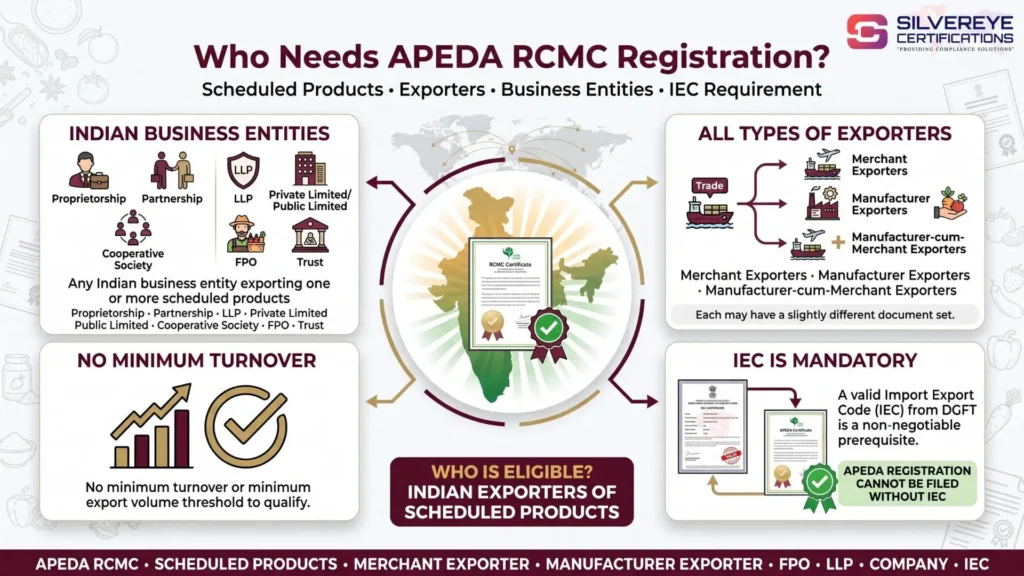
Who Needs APEDA RCMC Registration?
Any Indian entity — an individual, sole proprietorship, partnership firm, LLP, private limited company, public company, cooperative society, or trust — that exports even one product listed in APEDA's First Schedule must obtain RCMC. There is no turnover threshold and no exemption for small or first-time exporters. A home-based spice brand shipping 10 kilograms of pickles to Dubai falls under the same requirement as a large agri-processing company.
APEDA rules require the application to be filed within one month of starting the export business. If an exporter misses this window for a genuine reason, only APEDA has the authority to extend the deadline — it isn't automatic.
Who Does not Need APEDA Registration?
If your product is regulated by a different commodity board — such as spices (Spices Board), tea (Tea Board), coffee (Coffee Board), or marine products (MPEDA) — you register with that board instead of APEDA. APEDA's schedule is the primary category for agricultural and processed food products not specifically carved out to another board.
APEDA Scheduled Products List (First Schedule)
APEDA registration is product-specific — it applies only to the categories notified under the Act. Here is the complete, current list:
| S.No. | Scheduled Product Category |
| 1 | Fruits, vegetables, and their products |
| 2 | Meat and meat products |
| 3 | Poultry and poultry products |
| 4 | Dairy products |
| 5 | Confectionery, biscuits, and bakery products |
| 6 | Honey, jaggery, and sugar products |
| 7 | Cocoa and its products, chocolates of all kinds |
| 8 | Alcoholic and non-alcoholic beverages |
| 9 | Cereal and cereal products |
| 10 | Groundnuts, peanuts, and walnuts |
| 11 | Pickles, papads, and chutneys |
| 12 | Guar gum |
| 13 | Floriculture and floriculture products |
| 14 | Herbal and medicinal plants |
| 15 | De-oiled rice bran |
| 16 | Green pepper in brine |
| 17 | Cashew nuts and its products |
Basmati rice sits separately in the Second Schedule of the APEDA Act because of its strategic export importance, and APEDA also monitors sugar imports. If your export catalogue matches any row above, RCMC is not optional — it's a legal precondition to shipping.
Benefits of APEDA Registration for Exporters
- Legal authorisation to export scheduled agricultural and processed food products — customs will not clear shipments without a valid RCMC.
- Access to APEDA's financial assistance schemes covering market development, infrastructure, quality improvement, and packaging upgrades.
- Eligibility for brand publicity support, including participation in international trade fairs, buyer-seller meets, and advertising campaigns.
- Free technical guidance on product standards, target markets, and country-specific import regulations.
- Access to APEDA's training programmes on packaging, quality control, and export documentation.
- A registration number that adds credibility with international buyers who specifically look for RCMC-holding, government-recognised exporters.
Documents Required for APEDA RCMC Registration
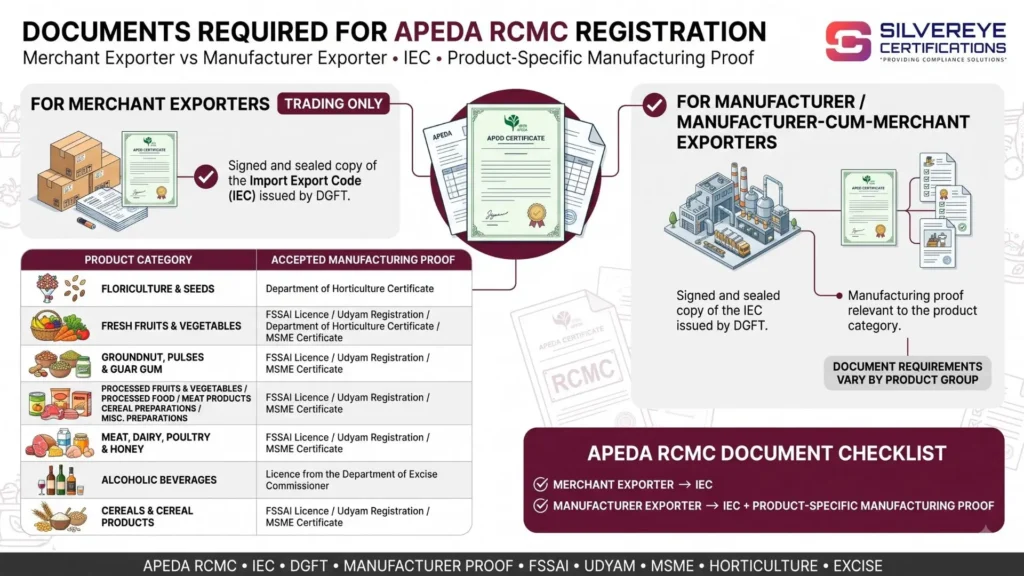
The document list depends on whether you are a merchant exporter (trading finished scheduled products you don't manufacture) or a manufacturer / manufacturer-cum-merchant exporter. This is drawn directly from APEDA's official e-RCMC circular.
For a Merchant Exporter
- Signed and sealed copy of the Import Export Code (IEC) issued by DGFT.
For a Manufacturer or Manufacturer-cum-Merchant Exporter
- Signed and sealed copy of the IEC issued by DGFT.
- Signed and sealed proof of manufacturing, matched to your product category (see table below).
| Product Category | Manufacturing Proof / Certifying Authority |
| Floriculture and seeds | Department of Horticulture |
| Fresh fruits and vegetables | FSSAI / Udyam registration / Department of Horticulture / MSME certificate |
| Groundnut, pulses, guar gum | FSSAI / Udyam registration certificate (Ministry of MSME) |
| Processed fruits, vegetables, food products, meat products, cereal preparations, misc. preparations | FSSAI / Udyam registration certificate (Ministry of MSME) |
| Meat, dairy, poultry, honey | FSSAI / Udyam registration certificate (Ministry of MSME) |
| Alcoholic beverages | Department of Excise Commissioner |
| Cereals and cereal products | FSSAI / Udyam registration certificate (Ministry of MSME) |
Portal-level requirements: Because APEDA now issues RCMC through the DGFT e-RCMC platform, exporters also need a working DGFT login (IEC-linked), a valid mobile number and email for OTP verification, a registered bank account (with a cancelled cheque or bank certificate on file), and — for most applicants — a digital signature certificate (DSC) or Aadhaar-based e-sign to authenticate the online application.
Step-by-Step APEDA (e-RCMC) Registration Process
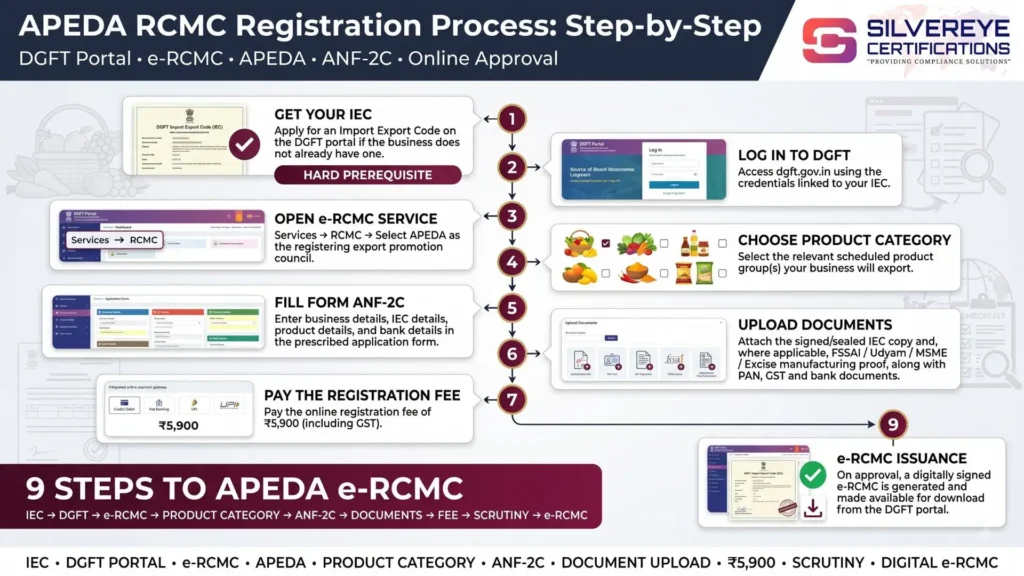
Under DGFT Trade Notice 35/2021-22 and APEDA's own circular dated 21 July 2023, APEDA has issued RCMC exclusively through the DGFT e-RCMC portal since 17 July 2023 — not through APEDA's legacy registration page. This is the current, functioning process as of 2026.
- Get your IEC first. You cannot start an APEDA application without an active Import Export Code from DGFT. If you don't have one, apply for it before touching the RCMC form.
- Go to the DGFT e-RCMC portal (linked under the “Services” menu on DGFT's website) and choose APEDA as your registering authority.
- Log in using your IEC-linked DGFT credentials, then select the specific scheduled product category or categories you plan to export.
- Upload the required documents — your signed and sealed IEC copy, and (for manufacturers) the relevant manufacturing proof from the table above.
- Enter your bank details and upload supporting proof such as a cancelled cheque or bank certificate where the portal asks for it.
- Pay the online registration fee of Rs. 5,900 through the portal's payment gateway.
- Submit the application. APEDA's registering authority reviews the documents and product classification, and typically approves or queries the application within 7 to 15 working days.
- Once approved, the e-RCMC certificate is generated on the DGFT portal and is available for download and verification, valid for 5 years from the date of issue.
APEDA Registration Fees (2026)
| Particulars | Fee (Inclusive of 18% GST) |
| Online registration fee | Rs. 5,900 (Rs. 5,000 base fee + Rs. 900 GST) |
| Online renewal fee (after 5 years) | Rs. 5,900 (same as fresh registration) |
| Amendment / modification in an issued RCMC | No fee |
Validity and Renewal of APEDA RCMC Registration
One point of confusion online is worth clearing up directly: older guides describe APEDA RCMC as a one-time, indefinite registration. That was accurate under the pre-2023 system. Under the current e-RCMC framework operated through DGFT, APEDA's own circular explicitly states a validity period of 5 years, with a renewal fee of Rs. 5,900 to keep it active. Treat your RCMC as a 5-year certificate, not a lifetime one, and track its expiry date.
- Renewal follows the same portal, the same document checklist, and the same fee as a fresh application.
- Apply for renewal before the certificate lapses — an expired RCMC means you legally cannot export scheduled products or claim APEDA-linked benefits until it's renewed.
- Any change in business details — address, directors, partners, bank account, or product list — should be updated through an amendment request, which APEDA processes free of cost.
- A practical habit: set a reminder about 60 days before expiry so renewal documents (updated FSSAI/Udyam proof, bank statements) can be gathered without a last-minute rush.
Get Your APEDA Registration Process Done Right — With Silvereye Certifications
APEDA registration looks simple on paper, but the details — matching the correct manufacturing proof to your product category, keeping IEC and RCMC data aligned, and staying ahead of the 5-year renewal window — are exactly where applications get delayed or queried. And with the new 2026 Adjudication of Penalties Rules now in force, accuracy at the registration stage matters more than ever.
Silvereye Certifications helps exporters handle the entire APEDA / e-RCMC journey end-to-end: eligibility checks, document preparation, DGFT portal filing, fee payment, and renewal tracking, so your export business stays compliant without you having to decode government circulars yourself. If you're applying for a fresh RCMC, renewing an existing one, or simply want your documentation reviewed before the 5-year deadline, Silvereye Certifications can guide the process from application to approval.
Frequently Asked Questions For APEDA RCMC Registration Process
Is APEDA registration mandatory for exporting agricultural products?
Yes. If your product appears in APEDA's First Schedule, registration (RCMC) is a legal requirement, not an optional membership. Customs will not clear a shipment of a scheduled product without a valid RCMC.
How much does APEDA registration cost in 2026?
The online registration fee is Rs. 5,900, which includes Rs. 5,000 as the base fee and Rs. 900 as 18% GST. Renewal after 5 years costs the same amount.
How long does APEDA registration take to process?
Most applications are processed within 7 to 15 working days from submission, provided the IEC is valid and documents match the product category correctly.
Is APEDA RCMC a one-time registration or does it expire?
Under the current e-RCMC system (in effect since 17 July 2023), APEDA RCMC is valid for 5 years and must be renewed before expiry. It is no longer treated as a lifetime, one-time certificate.
Can I apply for APEDA registration without an IEC?
No. A valid Import Export Code from DGFT is a mandatory prerequisite. The e-RCMC portal application cannot be completed without an active IEC.
Where do I apply for APEDA registration — APEDA's website or DGFT?
Since 17 July 2023, APEDA registration is processed exclusively through the DGFT e-RCMC portal, accessible via the “Services” menu on the DGFT website, not through APEDA's own legacy registration page.
What documents does a manufacturer exporter need for APEDA registration?
A signed and sealed copy of the IEC, plus signed and sealed manufacturing proof relevant to the product — typically an FSSAI licence or Udyam/MSME registration certificate, or a Department of Horticulture or Excise Commissioner certificate depending on the product category.
Does APEDA registration cover Basmati rice?
Basmati rice is covered separately under the Second Schedule of the APEDA Act, distinct from the First Schedule categories listed in this guide, but it still falls under APEDA's regulatory oversight.
What happens if my APEDA RCMC expires?
You cannot legally export scheduled products or claim APEDA-linked benefits until you renew it. Renewal follows the same process and fee as a fresh application, so it's best to start at least 60 days before expiry.
Is there a fee for updating details on an existing RCMC?
No. APEDA processes amendments or modifications to an already-issued RCMC — such as an address or bank account change — free of cost.
What is the new APEDA penalty rule introduced in 2026?
The APEDA (Adjudication of Penalties) Rules, 2026, effective 19 August 2026, set out a formal, time-bound process — show-cause notice, hearing, penalty order, and a right of appeal to APEDA's Chairman — for penalising contraventions of the APEDA Act by registered exporters.
Do I need APEDA registration if I already have a Spice Board or Tea Board license?
Only if you also export a product listed under APEDA's First Schedule. Registration is product-specific: each commodity board covers its own notified product list, and you register with the board that matches what you're actually exporting.