


- Honey is an APEDA-scheduled product: Exporters can apply for an APEDA Registration-cum-Membership Certificate (RCMC) through the DGFT e-RCMC portal after obtaining an IEC. The published registration fee is ₹5,900, including 18% GST.
- Honey exports require quality control and inspection: Under the Export of Honey (Quality Control, Inspection and Monitoring) Rules, 2002, honey consignments must meet applicable quality standards and undergo the prescribed inspection and certification process before export.
- Minimum Export Price (MEP): As per DGFT Notification No. 09/2026-27, dated 10 April 2026, natural honey exports under ITC (HS) code 04090000 are subject to a minimum export price of US$1,400 FOB per metric tonne until 31 December 2026.
- Verify the latest requirements before quoting: Check the current MEP, export inspection and testing requirements, and destination-country regulations before finalizing your price or shipment, as these requirements can change.
Introduction
APEDA registration for honey exporters involves obtaining a Registration-cum-Membership Certificate (RCMC) through the DGFT e-RCMC portal after obtaining an active Importer Exporter Code (IEC). The registration fee is ₹5,900, including 18% GST, and the RCMC is valid for five years. Merchant exporters generally need their IEC, while manufacturer-exporters must also provide the applicable manufacturing proof, such as FSSAI registration/license or Udyam registration, as accepted under APEDA's requirements.
- Mandatory honey export inspection: Honey exports are subject to quality control and inspection before shipment under the applicable Export Inspection Council (EIC) rules. Export consignments must meet the relevant standards and have the required inspection certificate or approved-unit certification.
- Minimum Export Price (MEP): Natural honey exports under ITC (HS) code 04090000 are subject to a minimum export price of USD 1,400 FOB per metric tonne, with validity reported through 31 December 2026, under the applicable DGFT notification.
- Destination-specific testing: Buyers and importing markets, including the EU and USA, may require residue testing, authenticity checks and other food-safety documentation. Requirements depend on the destination country's regulations and the buyer's specifications.
- Verify before shipment: Check the latest APEDA RCMC requirements, DGFT MEP notification, EIC inspection procedures and destination-country rules before finalising your export price or dispatching a consignment.
What Is APEDA Registration for Honey Exporters?
APEDA registration for honey exporters involves obtaining a Registration-cum-Membership Certificate (RCMC) from the Agricultural and Processed Food Products Export Development Authority (APEDA), which registers exporters dealing in products listed under the APEDA Act, 1985. Honey is one of the scheduled products covered by the Act.
The certificate is issued electronically as an e-RCMC through the DGFT portal. Since 17 July 2023, APEDA has used the DGFT e-RCMC service for new applications. Exporters must obtain an Importer Exporter Code (IEC) from DGFT before applying for the RCMC.

Section 12 of the APEDA Act addresses registration of exporters of scheduled products. The Foreign Trade Policy 2023 also provides for RCMC requirements in relevant cases, including applications for certain authorisations and benefits.
Some online guides describe APEDA registration for honey exporters as optional. However, exporters should not rely on that generalisation without checking the applicable statutory requirements and obtaining clarification from APEDA if necessary. Confirm your registration obligations before commencing exports.
How Honey Differs from Other APEDA Products
Honey is not simply a product for which you obtain an RCMC and start shipping. Three separate regulatory areas may apply to your export business.
| Regulatory layer | Authority | What it covers |
|---|---|---|
| APEDA RCMC | APEDA through the DGFT e-RCMC portal | Registration as an exporter of APEDA-scheduled products |
| Quality control and inspection | Export Inspection Council (EIC) and Export Inspection Agencies (EIAs) | Honey quality, food safety, residue monitoring, traceability, establishment approval and consignment inspection, as applicable |
| Export policy | Directorate General of Foreign Trade (DGFT) | Export-policy conditions and the applicable Minimum Export Price (MEP) for natural honey |
The rest of this guide explains these requirements and how they affect your export business.
Benefits of APEDA Registration for Honey Exporters
Obtaining an APEDA RCMC can support your honey export business in several ways:
- Registration compliance: Helps you meet the applicable registration requirements for exporters of scheduled products.
- Export preparation: Establishes your registration with APEDA, while separate EIC requirements continue to apply to honey consignments.
- Access to APEDA programmes: Eligible registered exporters can explore APEDA's schemes, training, trade events and market information, subject to each programme's conditions.
- Foreign Trade Policy benefits: An RCMC may be required when applying for relevant authorisations, incentives or concessions.
- Buyer and bank confidence: Registration and supporting compliance records can help demonstrate that your export business is formally established.
- Traceability and market readiness: A documented supply chain, appropriate inspection records and reliable product testing can help meet buyer requirements for honey authenticity and origin.
Important: An APEDA RCMC does not replace an IEC, applicable food licences, EIC approvals, inspection certificates or destination-specific requirements.
Who Can Apply? Eligibility for APEDA Registration for Honey Exporters
Businesses with a valid IEC that intend to export APEDA-scheduled products can check their eligibility for registration through the DGFT e-RCMC portal.
Depending on the applicable registration requirements, eligible business structures may include proprietorships, partnership firms, LLPs, private and public limited companies, cooperatives and other recognised entities.
| Exporter type | Typical honey business activity |
|---|---|
| Merchant exporter | Purchases honey from beekeepers or processors and exports it in its own name |
| Manufacturer exporter | Operates a honey processing and packing establishment and exports its output |
| Manufacturer-cum-merchant exporter | Processes some honey in its own establishment and sources additional honey from other suppliers |
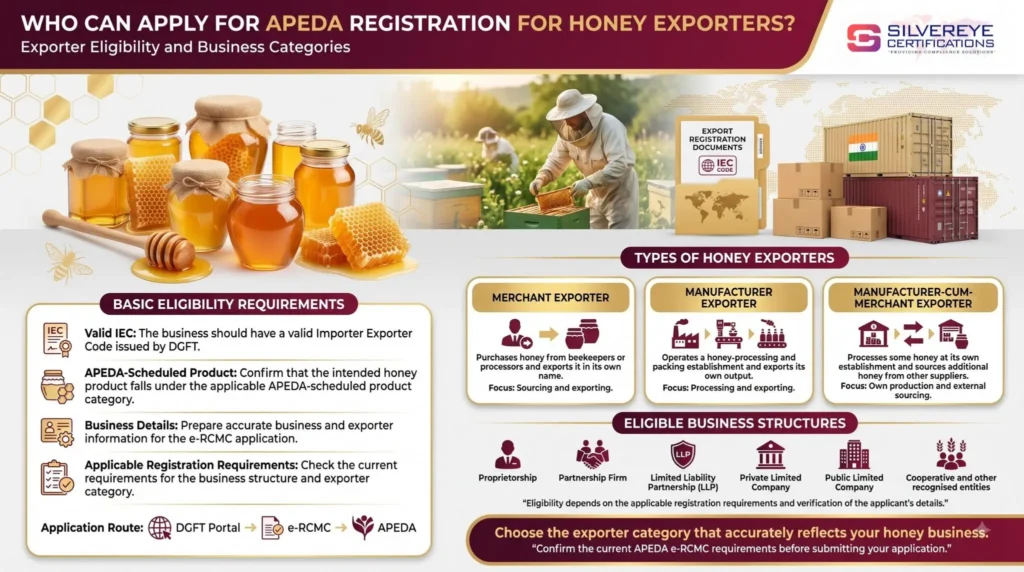
A merchant exporter does not necessarily need to own a processing unit. However, the honey must satisfy applicable EIC requirements. Under the relevant honey-export instructions, honey intended for export must be sourced through the prescribed traceable supply chain, including registered beekeepers where required.
Merchant exporters should confirm the approved establishment arrangements and any required EIC permission before processing, packing or shipping honey.
Documents Required for APEDA Registration for Honey Exporters
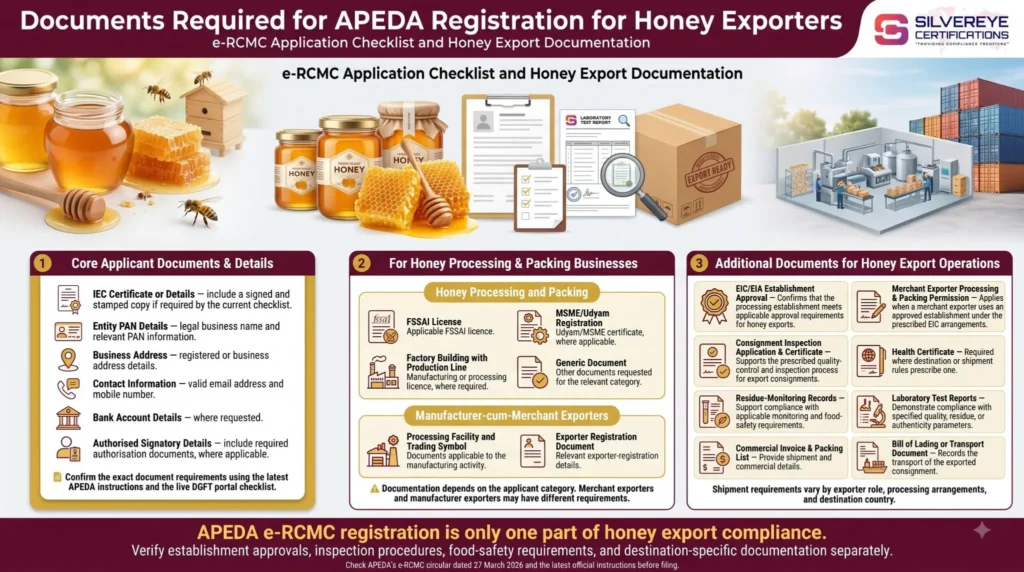
The documents required for an APEDA e-RCMC application depend on the applicant's category. Use the latest APEDA instructions and the live DGFT portal checklist to confirm the exact requirements.
Documents for applicants
Prepare the following information and supporting documents as applicable:
- IEC certificate or details, including the signed and stamped copy if required by the current checklist.
- Entity PAN details and legal business name.
- Registered or business address details.
- Valid email address and mobile number.
- Bank account details, if requested.
- Authorised signatory details and any required authorisation documents.
Additional documents for manufacturer exporters
| Honey business activity | Potential supporting documents |
|---|---|
| Honey processing and packing | Applicable FSSAI licence, Udyam/MSME certificate, manufacturing or processing licence, and other documents requested under the relevant category |
| Manufacturer-cum-merchant exporting | Documents required for the manufacturing activity, along with the applicable exporter-registration details |
Do not assume that every item in this table is mandatory for every applicant. Merchant exporters and manufacturer exporters can have different documentation requirements. APEDA's circular dated 27 March 2026 provides updated guidance on the e-RCMC procedure and should be checked before filing.
Documents for honey export operations (separate from the RCMC)
Obtaining an RCMC is only one part of preparing a honey shipment. Depending on your role, processing arrangements and destination, additional documents may include:
| Document or approval | Purpose |
|---|---|
| EIC/EIA establishment approval | Confirms that the processing establishment meets the applicable approval requirements for honey exports |
| Permission for merchant exporters to process and pack honey | Applies when a merchant exporter uses an approved establishment under the prescribed EIC arrangements |
| Consignment inspection application and inspection certificate | Supports the prescribed quality-control and inspection process for export consignments |
| Health certificate | Required for destinations or shipments where the applicable rules prescribe one |
| Residue-monitoring records | Support compliance with applicable monitoring and food-safety requirements |
| Laboratory test reports | Demonstrate compliance with specified quality, residue or authenticity parameters |
| Commercial invoice and packing list | Provide shipment and commercial details |
| Bill of lading or other transport document | Records the transport of the exported consignment |
The precise documents depend on the destination country, the export route and the applicable EIC instructions. Check the latest requirements before dispatch.
Finally, ensure that the legal name, PAN, address and other identifying details are consistent across your IEC, applicable food licences, business-registration documents and EIC approvals. Correct discrepancies before submitting your application or export documents.
Process of APEDA Registration for Honey Exporters
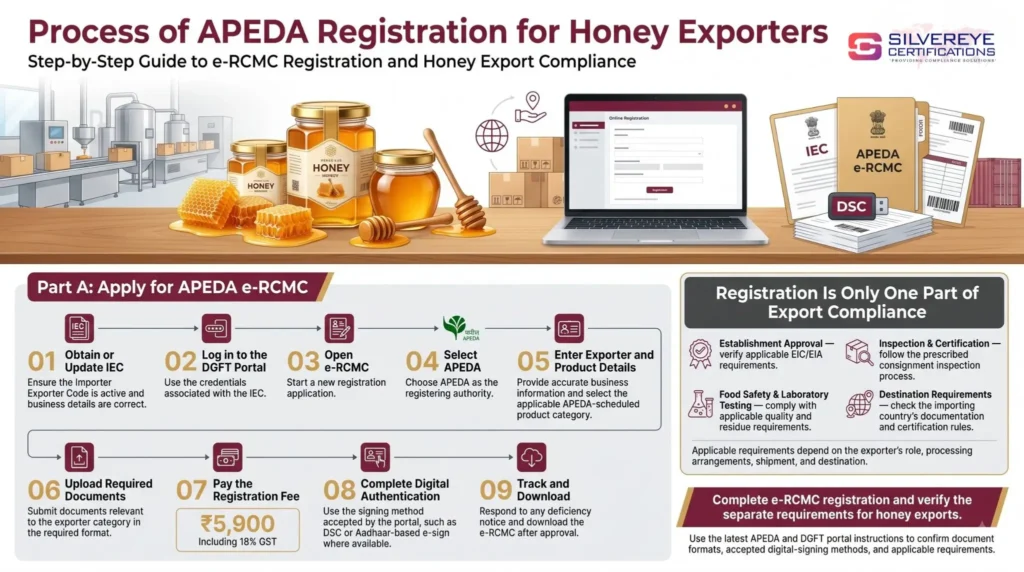
The APEDA registration process for honey exporters has two parts: obtaining your Registration-cum-Membership Certificate (RCMC) and meeting the separate quality-control requirements for honey exports.
Part A: Apply for the APEDA e-RCMC
- Obtain or update your IEC: Ensure your Importer Exporter Code is active and your business details are correct.
- Log in to the DGFT portal: Use the credentials associated with your IEC.
- Open the e-RCMC service: Start a new application for registration.
- Select APEDA: Choose APEDA as the registering authority.
- Enter exporter and product details: Provide accurate business information and select the applicable scheduled product category.
- Upload the required documents: Submit the documents applicable to your exporter category, in the required format.
- Pay the registration fee: The published APEDA fee is ₹5,900, including 18% GST.
- Complete digital authentication: Use the signing method accepted by the portal, such as DSC or Aadhaar-based e-sign, where available.
- Track your application: Respond to any deficiency notice and download your e-RCMC after approval.
Some service providers report processing times of approximately 7–15 working days for straightforward applications. This is an indicative estimate, not a guaranteed statutory timeline.
Part B: Complete the Honey Export Requirements
Obtaining an RCMC does not, by itself, authorise a honey consignment for export. Follow the applicable EIC requirements as well.
- Source traceable honey: Obtain honey through the registered beekeepers, companies, firms or cooperatives specified under the applicable EIC rules.
- Arrange establishment approval: Ensure the processing establishment meets the applicable EIC approval requirements. Merchant exporters should confirm the permitted arrangements for using an approved processor.
- Conduct the required tests: Test the honey for the parameters specified by EIC and the destination market.
- Apply for consignment inspection: Follow the applicable inspection and sampling procedure.
- Obtain the required certification: Secure the Certificate of Inspection or applicable establishment-based certification, along with a health certificate where required.
- Check the Minimum Export Price: Confirm the current MEP for natural honey before finalising the sale contract.
- Complete export documentation: Prepare the commercial invoice, packing list, shipping bill and other applicable documents before dispatch.
The Price Rule: Minimum Export Price on Natural Honey
Natural honey classified under ITC (HS) code 04090000 is subject to export-policy conditions that include a Minimum Export Price (MEP). Although the export policy may classify the product as Free, the applicable MEP must still be followed while the condition remains in force.
The reported policy history is summarised below. Verify the original DGFT notifications before relying on these dates in a commercial contract.
| Date | Reported policy development |
|---|---|
| March 2024 | MEP mechanism for natural honey introduced, according to the reported policy history |
| 22 August 2025 | DGFT Notification No. 27/2025-26 reportedly reduced the MEP from USD 2,000 to USD 1,400 per metric tonne |
| 31 December 2025 | DGFT Notification No. 52/2025-26 reportedly extended the USD 1,400 MEP until 31 March 2026 |
| April 2026 | Notification No. 09/2026-27 is reported to have extended the USD 1,400 MEP until 31 December 2026; confirm the original notification before publication |
If the USD 1,400 MEP remains applicable, natural honey cannot be exported below that minimum FOB price, subject to the exact terms of the operative notification.
Before quoting, check the latest DGFT export-policy notification and consider including a change-in-law clause in your sale contract to address any subsequent change in export conditions.
Testing and Buyer Requirements for Honey Exports
International honey buyers pay close attention to purity, authenticity, residue levels and food safety. Requirements depend on the destination country, the buyer's specifications and the applicable EIC inspection procedure.
- Residue testing: Check for antibiotic, veterinary-drug and pesticide residues against the applicable destination-market limits. Follow the prescribed residue-monitoring requirements where applicable.
- Authenticity testing: Buyers may request testing to detect the addition of exogenous sugars or other forms of adulteration. Some buyers use NMR profiling, but the accepted test method and interpretation should be agreed with the buyer and relevant authorities.
- Labelling and composition: Honey exported to the EU must meet applicable honey composition and labelling rules, including relevant requirements under Directive 2001/110/EC and subsequent amendments. Certain other markets may require local-language labelling, including Arabic for applicable Gulf-market shipments.
- Organic claims: Honey marketed as organic must comply with the applicable organic certification and destination-market rules. For Indian certification under the National Programme for Organic Production (NPOP), verify the current scope and certification requirements.
Always check EIC's current instructions for approved establishments, laboratories, test parameters and consignment inspection. A buyer's preferred test panel does not automatically replace the official export inspection requirements.
APEDA Registration for Honey Exporters: Fees
The following table summarises the published RCMC charges and other potential export-related expenses.
| Item | Indicative cost or fee |
|---|---|
| APEDA e-RCMC registration | ₹5,000 plus ₹900 GST = ₹5,900 |
| RCMC renewal | ₹5,900 under APEDA's published procedure; confirm the current amount before payment |
| RCMC amendment or modification | No additional fee stated under the published procedure |
| EIC establishment approval and consignment inspection | Separate charges; confirm the applicable amount with the relevant EIA |
| Laboratory testing | Varies by laboratory, test panel and destination requirements |
| Consultant or documentation assistance | Varies by scope; request a written quotation |
Important: Fees and procedures can change. Confirm the final amount on the official DGFT e-RCMC payment screen and verify EIC charges directly with the relevant agency.
Validity and Renewal of APEDA Registration for Honey Exporters
APEDA's published procedure specifies a five-year validity period for the RCMC. Keep track of your certificate's actual expiry date and prepare for renewal in advance.
| Topic | What honey exporters should know |
|---|---|
| RCMC validity | Five years; check the validity dates on your certificate |
| RCMC renewal | Apply through the DGFT e-RCMC service and pay the applicable renewal fee |
| Renewal planning | Starting the process 60–90 days before expiry is a prudent planning measure, not a statutory deadline |
| Amendment | Apply to update relevant details, such as business address, constitution, product category or authorised-person information, where permitted |
| Change of legal entity or PAN | Check with APEDA and DGFT whether a fresh IEC and RCMC are required |
| EIC approvals | Follow the validity, surveillance and renewal conditions in the applicable approval |
| MEP | Recheck the operative DGFT notification before each contract |
| Cancellation or suspension | Follow the applicable statutory provisions and APEDA registration conditions; do not rely on an unverified rule reference |
2026 Updates Honey Exporters Should Know
Regulatory changes can affect registration, export pricing and inspection procedures. The following table separates reported updates from matters that need further confirmation.
| Date | Update | What it means for exporters |
|---|---|---|
| 31 December 2025 | DGFT Notification No. 52/2025-26 reportedly extended the USD 1,400 MEP until 31 March 2026 | Check the original notification and subsequent amendments before relying on this date |
| April 2026 | Notification No. 09/2026-27 reportedly extended the USD 1,400 MEP until 31 December 2026 | Verify the notification's exact text and current legal status |
| 27 March 2026 | APEDA issued a circular on the e-RCMC procedure | Review the updated category-wise documents, fees, renewal and amendment procedure |
| 26 June 2026 | A reported effective date for provisions under the Jan Vishwas (Amendment of Provisions) Act, 2026 | Verify the relevant commencement notification and its precise effect on APEDA-related provisions before describing the change as applicable |
| 20 July 2026 | DGFT Trade Notice No. 14/2026-27 was reportedly associated with a draft proposal concerning RCMC exemptions for certain low-value consignments | Confirm the original trade notice and whether the proposal remains a draft or has been implemented; do not treat a consultation proposal as an operative exemption |
Common Mistakes Honey Exporters Make
Avoid these common errors when preparing for APEDA registration and honey exports:
- Treating APEDA registration as the only requirement and overlooking EIC inspection or establishment approval.
- Quoting below the applicable MEP without checking the current DGFT notification.
- Purchasing honey from untraceable sources instead of maintaining the sourcing records required under EIC rules.
- Using an unsuitable laboratory or test panel that does not satisfy the buyer's or regulator's requirements.
- Ignoring destination-specific labelling and composition rules, especially when exporting to regulated markets.
- Selecting the manufacturer-exporter category without the required manufacturing proof.
- Allowing discrepancies in the legal name, PAN or address across the IEC, FSSAI licence, Udyam certificate and EIC records.
- Relying on an outdated export-policy notification instead of checking the latest DGFT requirements.
- Allowing the RCMC to expire and delaying renewal until the last moment.
A well-prepared application, traceable honey supply chain and up-to-date regulatory checks can help reduce avoidable delays and make the export process more predictable.
Why Choose Silvereye Certifications for APEDA Registration for Honey Exporters?
Navigating APEDA registration for honey exporters involves more than obtaining an RCMC. Exporters must also understand the applicable documentation, honey quality-control requirements, inspection procedures and destination-market regulations. Silvereye Certifications helps businesses prepare for these compliance requirements with practical guidance.
- APEDA RCMC Assistance: Guidance on the e-RCMC application process, applicable documents and registration requirements.
- Documentation Support: Help identifying the relevant business, IEC and manufacturer-related documents for your applicant category.
- EIC Compliance Guidance: Assistance in understanding applicable establishment approval, inspection and certification requirements for honey exports.
- Export Requirement Guidance: Support in identifying relevant testing, traceability, labelling and destination-market compliance requirements.
- Regulatory Update Assistance: Guidance on checking current DGFT notifications, Minimum Export Price conditions and applicable APEDA procedures.
- Renewal and Amendment Support: Assistance with understanding RCMC renewal and updating business details when required.
With a structured approach to documentation and regulatory preparation, Silvereye Certifications helps honey exporters understand their compliance obligations and prepare for the export process with greater confidence. Final registration, inspection and certification remain subject to approval by the relevant authorities.
Conclusion
APEDA registration for honey exporters is an important step in establishing the required registration framework for exporting honey from India. However, obtaining an RCMC is only one part of the process. Exporters must also meet the applicable EIC quality-control and inspection requirements, maintain traceable sourcing records, arrange the necessary laboratory testing and comply with destination-country regulations.
Before signing a sales contract, verify the current Minimum Export Price (MEP), export-policy conditions, inspection requirements and applicable fees. Keep your IEC and business documents updated, prepare the correct application documents and plan your RCMC renewal well before expiry.
If you need assistance understanding the applicable requirements, Silvereye Certifications can help you navigate the APEDA registration process and prepare the relevant compliance documentation so your honey export business is better prepared for domestic regulatory procedures and international buyer expectations.
Frequently Asked Questions
Do I need APEDA registration to export honey?
Honey is in APEDA’s scheduled list and Section 12 requires scheduled-product exporters to register. Confirm with APEDA in writing if you rely on any view that says it is optional.
What is the APEDA registration fee in 2026?
₹5,000 plus 18% GST, so ₹5,900. Confirm on the portal when paying.
How long is the RCMC valid?
Five financial years. Check the exact dates on your certificate.
Is there a minimum export price for honey?
Yes. Natural honey carries a Minimum Export Price of USD 1,400 FOB per MT, reported as valid to 31 December 2026. Check the live DGFT policy before quoting.
Does honey need inspection before export?
Yes. Honey is notified for quality control and inspection by the Export Inspection Council before export.
Can a beekeeper export honey directly?
Yes, if the beekeeper or their cooperative holds an IEC, registers with APEDA and meets EIC conditions.
Can a trader export honey without a processing unit?
Yes, as a merchant exporter, but the honey must come from a source that meets EIC conditions, including registered beekeepers.
Is NMR testing compulsory?
Many EU and US buyers expect it. Follow EIC’s current instructions and your buyer’s contract.
Where do I apply for the RCMC?
On the DGFT portal, through the e-RCMC service, selecting APEDA as the registering authority.
Is the IEC the same as the APEDA RCMC?
No. The IEC is the prerequisite from DGFT. The RCMC is the product-specific registration with APEDA.
Does the RCMC allow me to ship immediately?
No. You also need EIC inspection, buyer-specific tests, customs compliance and destination-country compliance.
Is the ₹10,000 RCMC exemption in force?
It was proposed in DGFT Trade Notice 14/2026-27 as a draft. Check DGFT for a final notification before relying on it.