

- Customs Jurisdiction in Karnataka: Karnataka's Customs operations include Bengaluru City, Bengaluru Airport and Air Cargo Complex, and Mangaluru. Confirm the relevant Commissionerate based on your business activities and cargo clearance location before applying.
- Choosing the Right AEO Zone: If your business operates across multiple Customs zones, check the applicable CBIC guidelines to determine the appropriate jurisdiction for your AEO application, including any criteria based on import-export activity.
- Online Application and Government Fees: AEO applications are submitted through the official AEO India portal. There is generally no CBIC application or renewal fee, while consultancy charges vary according to the services required.
- AEO Certificate Validity: AEO-T2 certificates are generally valid for 3 years, while AEO-T3 and Logistics Operator (LO) certificates are generally valid for 5 years. AEO-T1 follows the applicable self-declaration and renewal provisions. Verify the latest CBIC guidelines for current validity and renewal requirements.
How to Apply for AEO Registration in Karnataka?
AEO registration in Karnataka is completed through the official AEO India portal. Applicants need to identify the appropriate AEO category, prepare the relevant application forms and supporting documents, and respond to any Customs queries during processing.
Businesses should confirm the appropriate Customs jurisdiction before submitting their applications. Karnataka's Customs administration includes Bengaluru City, Bengaluru Airport and Air Cargo Complex, and Mangaluru. The relevant office depends on the applicable jurisdiction and the business's import-export operations.

CBIC generally does not charge an AEO application or renewal fee. Consultancy charges, if applicable, are separate. Certificate validity and renewal requirements depend on the AEO category and current CBIC provisions.
Which Customs Office Handles AEO Registration in Karnataka?
AEO requirements are national, but the relevant Customs office depends on the applicant's operations and the applicable jurisdiction. Karnataka's Customs administration includes the following Commissionerates.
| Commissionerate | Coverage or facilities described in the working draft | Businesses that may be concerned |
|---|---|---|
| Bengaluru City Customs | Bengaluru and other areas within its jurisdiction, including ICD Whitefield and relevant container freight stations | Importers and exporters using inland cargo facilities around Bengaluru |
| Airport and Air Cargo Complex, Bengaluru | Kempegowda International Airport, the International Air Cargo Complex at Devanahalli, and the relevant courier terminal | Businesses moving goods through Bengaluru by air |
| Mangaluru Customs | New Mangaluru Port, Mangaluru Airport, Karwar, and the districts covered by its notified jurisdiction | Businesses using coastal and port-linked cargo routes |
The precise jurisdiction of each Commissionerate should be confirmed using current official Customs notifications and contact information.
The working draft also identifies an AEO help desk at the Bengaluru Chief Commissioner's office, an AEO contact for the Airport and Air Cargo Complex, and an AEO Cell at Mangaluru Customs. Check the current official Bengaluru Customs website for updated contact details before contacting an office.
How Do You Choose the Correct Customs Zone for AEO Registration in Karnataka?
Choosing the appropriate jurisdiction is an important step in the AEO registration process. Businesses operating across multiple locations should establish which Customs zone is relevant to their import-export activities before filing.
The guidance described in your draft includes the following considerations:
- Confirm your operations: Identify where your business carries out import-export activities and which Customs locations handle its shipments.
- Review multiple locations: If your business operates across different Customs zones, check the applicable CBIC guidance for selecting the appropriate zone.
- Compare transaction volumes: Your draft cites guidance to select the zone with the higher volume of import-export activity when operations span multiple zones.
- Confirm before filing: Contact the relevant AEO help desk if your business has activities across several jurisdictions.
For example, a Bengaluru-based business that conducts a substantial share of its cargo clearance through Mangaluru should confirm the appropriate jurisdiction rather than automatically selecting Bengaluru.
What Are the Benefits of AEO Registration for Karnataka Businesses?
AEO status may provide eligible businesses with customs facilitation benefits under the applicable CBIC provisions.
Potential benefits include:
- Faster customs clearance: Eligible applicants may receive facilitation that reduces delays or certain examination requirements.
- Duty-payment facilities: Applicable categories may qualify for deferred customs duty payment.
- Bank guarantee benefits: Reduced requirements may apply under the relevant provisions.
- Supply-chain confidence: AEO status can help demonstrate a commitment to customs compliance and security.
- Improved internal controls: The preparation process encourages organised records and documented security procedures.
Benefits vary by category and applicable rules. Before relying on a particular benefit, confirm the relevant official circular or guideline.
Which AEO Registration Tier Should Your Karnataka Business Choose?
The appropriate category depends on your business activities, eligibility, existing AEO status, and ability to meet the relevant requirements.
| AEO category | Suitable applicants, subject to eligibility | Assessment or verification |
|---|---|---|
| AEO-T1 | Importers and exporters seeking entry-level AEO status | As prescribed under the applicable procedure |
| AEO-T2 | Businesses seeking a higher level of facilitation and prepared to meet applicable security requirements | Documentation and verification as required |
| AEO-T3 | Eligible existing AEO-T2 holders meeting the applicable progression criteria | Documentation and verification as required |
| AEO-LO | Qualifying logistics operators | As prescribed for the applicable category |
For a detailed explanation of the categories, direct readers to your AEO Certification guide. Confirm the latest eligibility and verification requirements before publishing category-specific claims.
What Are the Eligibility Requirements for AEO Registration in Karnataka?
Before applying, businesses should review the current eligibility criteria for their intended AEO category. The working draft identifies the following areas for assessment:
- Customs transaction history: Applicable requirements for Bills of Entry or Shipping Bills.
- Business history: The required period of business activity and any permitted exceptions.
- Financial standing: Financial records and solvency evidence required under the programme.
- Compliance history: Conditions concerning serious offences and relevant Customs proceedings.
- AEO-T3 progression: The applicable prior AEO status and other requirements for T3.
The precise thresholds, exceptions, and eligibility conditions must be confirmed against the latest CBIC guidelines. Avoid treating the transaction counts or business-history requirements as universal across all categories.
What Documents Are Required for AEO Registration in Karnataka?
Businesses generally need to prepare their business registration, import-export, tax, financial, and other supporting records. The exact list depends on the AEO category and the applicable application forms.
Common documents may include:
- Business incorporation or registration proof
- Importer Exporter Code (IEC)
- PAN and GST registration details
- Audited financial statements
- Applicable solvency documents
- Relevant application forms and annexures
- SOPs, process maps, site plans, or security documents where required
The following table reflects the annexure structure in your working draft and should be checked against the latest official forms.
| AEO category | Annexures listed in the draft | Additional documents to review |
|---|---|---|
| AEO-T1 | Annexures 1 and 2 | Process map, site plan, and solvency declaration, where applicable |
| AEO-T2 and AEO-LO | Annexures A to E | Security plan, SOPs, and site layout, where applicable |
| AEO-T3 | Annexures A to E and F | Business partner details and applicable certified solvency documents |
| MSME T1 / T2 | MSME Annexures 1 and 2, plus Annexure 3 for T2 as listed in the draft | Valid MSME/Udyam documentation and other applicable records |
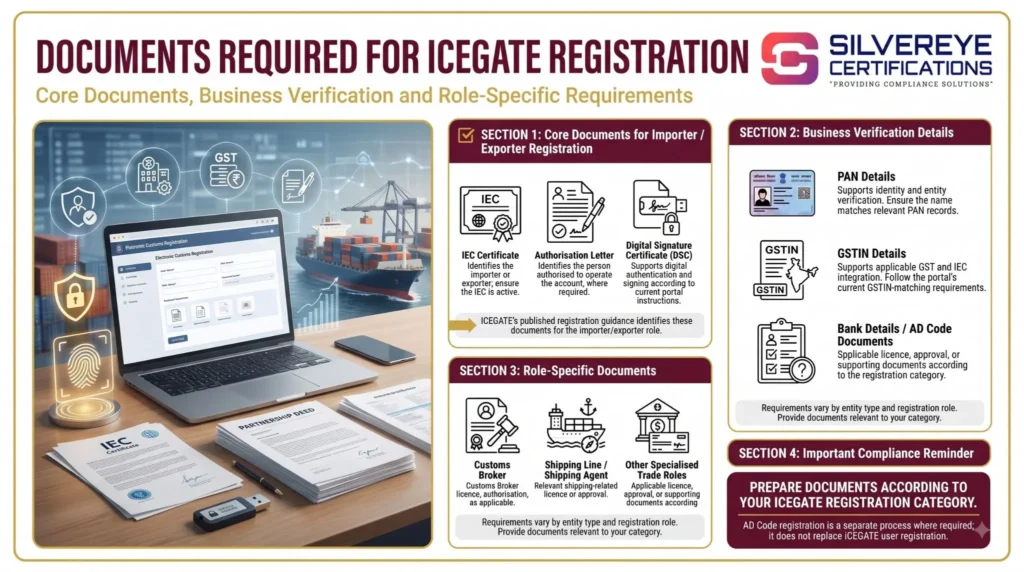
For the complete checklist, direct readers to your AEO Registration Documents page.
Is Physical Document Submission Required for AEO Registration?
Your draft refers to a 2023 Bengaluru Customs notice about digitising the AEO programme and dispensing with physical document submission. It also states that online filing became mandatory for T2 and T3 from August 2021 and for LO from May 2023.
Before publishing these dates or describing the current procedure, verify the relevant official notices and confirm whether any subsequent instructions have changed the process. Applicants should follow the current portal instructions and the requirements communicated by the relevant Customs authority.
How to Complete AEO Registration in Karnataka: Step-by-Step Process
The AEO registration process in Karnataka involves checking eligibility, selecting the appropriate category and Customs jurisdiction, preparing supporting documents, and submitting the application through the official AEO India portal.
Follow these steps to prepare your application:
| Step | What you need to do | Karnataka-specific tip |
|---|---|---|
| 1. Check eligibility | Review the applicable transaction, financial, and compliance requirements | Keep records of Bills of Entry and Shipping Bills organised |
| 2. Select your category | Identify the appropriate AEO-T1, T2, T3, or LO category | Check eligibility before choosing a category |
| 3. Confirm Customs jurisdiction | Identify the appropriate Customs zone for your application | Confirm the relevant jurisdiction if your operations span multiple zones |
| 4. Prepare documents | Gather the required forms, annexures, financial records, and supporting documents | Keep business names and addresses consistent across records |
| 5. Submit online | Complete and submit the application through the official portal | Use the latest applicable forms and instructions |
| 6. Respond to queries | Provide accurate responses and supporting evidence when requested | Monitor application status and respond promptly |
| 7. Complete verification | Cooperate with document checks and any required physical verification | Ensure documented procedures reflect actual business practices |
| 8. Maintain AEO compliance | Follow the applicable conditions after approval | Schedule required declarations and renewal activities |
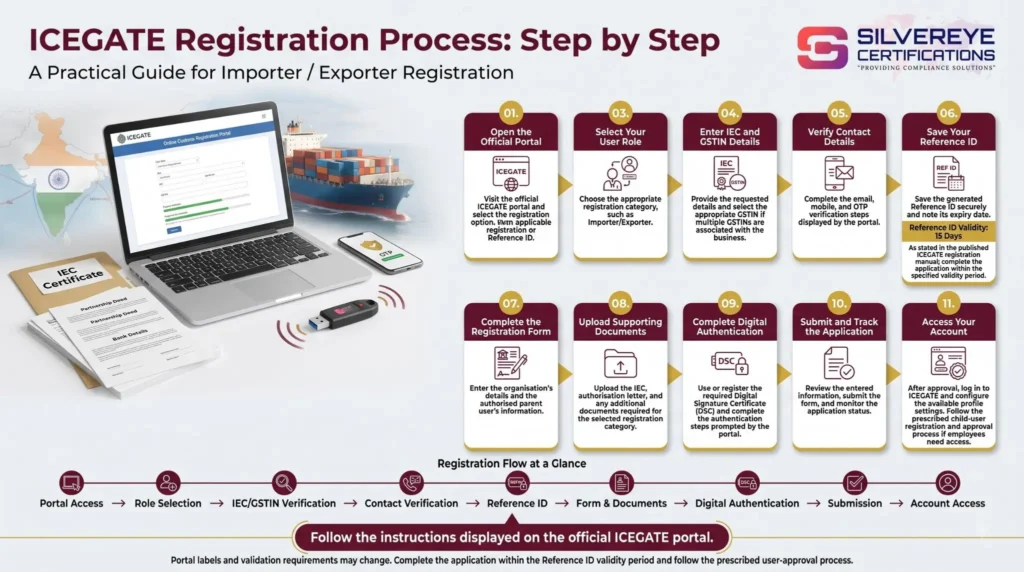
For detailed portal instructions, refer to your AEO Registration Process page.
How Long Does AEO Registration Take in Karnataka?
CBIC's published guidance provides processing targets for different application categories. The Bengaluru Customs AEO guidance describes a target of around 30 days for AEO-T1 after filing, while MSME applications may qualify for shorter processing periods.
| Application category | Processing target stated in the draft |
|---|---|
| AEO-T1 | Around 30 days |
| MSME AEO-T1 | 15 working days |
| AEO-T2 | Up to six months |
| MSME AEO-T2 | Up to three months |
These are processing targets, not guaranteed approval dates. Actual timelines can depend on complete documentation, eligibility checks, clarification requests, and any required verification.
What Are the Fees for AEO Registration in Karnataka?
The cost of AEO registration depends on whether your business applies independently or hires a consultant. Consultancy, professional certification, internal staff time, and any required security improvements should be considered separately.
| Cost component | Amount or basis | What to know |
|---|---|---|
| CBIC application fee | Generally nil | Confirm current official requirements |
| CBIC renewal fee | Generally nil | Verify the applicable renewal procedure |
| Chartered Accountant's solvency certificate | Varies by CA | May be charged separately |
| Internal staff time | Varies by business | Includes document collection and application preparation |
| Security or site improvements | Depends on premises | Additional expenditure may arise if gaps are identified |
| AEO consultant fees | Varies by scope | Compare written quotations and deliverables |
No fixed rupee amount is listed for consultancy because fees vary between providers and businesses. Before hiring a consultant, request an itemised quotation covering document preparation, online filing, Customs query assistance, verification preparation, and renewal support, as applicable.
How Long Is an AEO Certificate Valid in India?
Certificate validity and renewal arrangements depend on the AEO category and applicable CBIC instructions. The table below reflects the periods in your draft, but the AEO-T1 validity wording requires particular care.
| AEO category | Validity stated in the draft | Renewal or compliance note |
|---|---|---|
| AEO-T1 | Continuous, subject to applicable conditions | Verify the annual self-declaration and auto-renewal provisions |
| AEO-T2 | 3 years | Check the prescribed renewal procedure |
| AEO-T3 | 5 years | Check the prescribed renewal procedure |
| AEO-LO | 5 years | Check the prescribed renewal procedure |
CBIC Circular No. 3/2018-Customs specifies three-year validity for AEO-T1 and T2 and five-year validity for T3 and LO. Subsequent instructions may affect how AEO-T1 renewal is handled, so verify the current rules before describing T1 as having continuous validity.
When Should You Renew AEO Registration in Karnataka?
Businesses should track their certificate conditions and renewal obligations well before the relevant deadlines. The following table reflects your proposed planning schedule; confirm the exact requirements against current CBIC instructions and the portal.
| AEO category | Renewal or declaration route stated in the draft | Planning reference |
|---|---|---|
| AEO-T1 | Annual self-declaration, subject to applicable rules | Verify the current declaration window and deadline |
| AEO-T2 | Renewal application with updated documents | Begin preparation well before expiry |
| AEO-T3 | Renewal application with updated documents | Begin preparation well before expiry |
| AEO-LO | Renewal application with updated documents | Begin preparation well before expiry |
For AEO-T1, verify whether the stated 1 October to 31 December declaration window applies to the relevant certificate and year before publishing it as a fixed deadline. For T2, T3, and LO, confirm the prescribed renewal submission period rather than relying solely on general planning intervals.
Your AEO Registration Renewal Process page can provide readers with a detailed explanation of the applicable renewal steps.
What Common Mistakes Should You Avoid During AEO Registration in Karnataka?
Avoidable errors can delay an application or create compliance problems after approval. Review these points before filing:
- Choosing the wrong Customs jurisdiction: Confirm the appropriate zone when your business operates across multiple locations.
- Using outdated forms: Check the portal for the latest applicable application forms and annexures.
- Inconsistent business information: Make sure names and addresses match across IEC, GST, and incorporation records.
- Incomplete financial evidence: Check solvency documents and financial statements for missing information or inconsistencies.
- Security procedures that do not match operations: Ensure applicable security plans and SOPs reflect actual business practices.
- Delayed responses to Customs queries: Monitor the portal and provide accurate supporting evidence within the required timeframe.
- Missing post-approval obligations: Track applicable annual declarations, renewal requirements, and other compliance conditions.
A careful document review before submission can help reduce avoidable errors and make the application process easier to manage.
Why Choose Silvereye Certifications for AEO Registration in Karnataka?
Choosing the right support for AEO registration in Karnataka can help your business understand the applicable requirements, organise documentation, and prepare for the application process. Silvereye Certifications assists businesses with compliance documentation and application preparation.
Here is how Silvereye Certifications can support your business:
- Eligibility Assessment: Understand the applicable AEO category and identify potential gaps before applying.
- Documentation Support: Get assistance organising application forms, annexures, financial records, and supporting documents.
- SOP and Security Documentation: Receive guidance on preparing relevant standard operating procedures and security documents based on your business operations.
- Application Assistance: Get support preparing your application for submission through the official AEO India portal.
- Customs Query Support: Receive assistance preparing responses to clarification requests from the relevant authorities.
- Verification Preparation: Help your team organise records and prepare for applicable verification requirements.
- Renewal and Compliance Guidance: Plan for applicable declarations, renewal deadlines, and ongoing compliance responsibilities.
Whether your business operates in Bengaluru, Mangaluru, or another part of Karnataka, the first step is to confirm your eligibility, identify the appropriate Customs jurisdiction, and prepare the required documents.
Planning to apply for AEO registration in Karnataka? Contact Silvereye Certifications to discuss your business requirements and the assistance you may need.
Conclusion
AEO registration in Karnataka can help eligible importers, exporters, and logistics businesses strengthen customs compliance and access applicable trade facilitation benefits. A well-prepared application begins with selecting the appropriate AEO category, confirming the relevant Customs jurisdiction, and maintaining complete and accurate supporting documents.
An AEO certification consultant in Karnataka can assist with eligibility assessment, document preparation, application filing, Customs queries, and verification readiness. Before hiring a consultant, compare the scope of services, request an itemized quotation, and avoid providers who guarantee approval.
Silvereye Certifications can support businesses with AEO application preparation and compliance documentation guidance. Before filing, review the latest CBIC requirements and plan for ongoing compliance and renewal well ahead of the applicable deadlines.
Frequently Asked Questions
Which customs zone handles AEO registration in Karnataka?
The Bengaluru Customs Zone, with Bengaluru City, Airport and Air Cargo Complex, and Mangaluru commissionerates.
Which zone should I choose for AEO registration if I operate in more than one?
Choose the zone where your import-export activity is higher, as the Bengaluru zone has reminded applicants.
Is there a government fee for AEO registration in Karnataka?
No. CBIC charges nothing for AEO registration, filing or renewal.
Do I file AEO registration in Karnataka online or on paper?
Online, on aeoindia.gov.in. The Bengaluru zone issued a 2023 notice on dispensing with physical submission, so confirm current practice.
Does Mangaluru have its own AEO office?
Mangaluru Customs has an AEO Cell. Check bangalorecustoms.gov.in for current details.
How long does AEO registration in Karnataka take?
CBIC targets about 30 days for T1 and up to six months for T2 after complete documents. MSMEs get shorter targets.
What documents are needed?
Incorporation proof, IEC, PAN, GST, audited financials, solvency certificate, process map, site plan and tier-specific annexures.
Which tier should a first-time AEO registration applicant choose?
Most start with T1. T3 needs at least two years as an AEO-T2 holder.
Can MSMEs in Karnataka go for AEO registration?
Yes. MSMEs use MSME Annexures 1 and 2 (plus 3 for T2) and need a valid MSME certificate.
How long is an AEO certificate valid?
T2 is valid for three years, T3 and LO for five, and eligible T1 holders stay certified through the annual self-declaration.
When is the AEO-T1 annual self-declaration due?
Between 1 October and 31 December each year.
Can logistics operators in Karnataka do AEO registration?
Yes, under the Logistics Operator category. Check the circular for which business types qualify.