
- AEO-T1: Eligible holders must comply with the applicable annual self-declaration requirements under CBIC guidance. This is generally different from filing a fresh certification application. Confirm the current requirements and any applicable exemptions before submission.
- AEO-T2, AEO-T3 and AEO-LO: Submit the required renewal application before expiry, along with updated documents and details of changes, as applicable to the certification category.
- Government Fees: Check CBIC’s current AEO programme guidance for applicable government fees. Any consultancy or advisory charges are separate from government fees.
- Risk of Missing Renewal Requirements: Failure to meet the applicable renewal or self-declaration requirements, or an adverse compliance finding, may result in suspension, withdrawal, or loss of AEO status under the applicable rules.
Introduction
AEO registration renewal depends on your certification tier and the applicable CBIC requirements. AEO-T1 follows an annual self-declaration process for eligible entities, while AEO-T2, AEO-T3, and AEO-LO generally require a renewal application before the existing certificate expires.
Under CBIC Circular No. 33/2016-Customs, as amended, AEO-T1 and AEO-T2 certificates have a validity of three years, while AEO-T3 and AEO-LO certificates have a validity of five years. AEO-T1 also follows the auto-renewal framework introduced by Circular No. 18/2021-Customs.
The AEO programme does not charge a government application fee, according to the official AEO India portal. Consultancy charges, document-preparation expenses, and internal compliance costs are separate.
Last reviewed: 19 October 2026. Requirements should be checked against the latest CBIC circulars and instructions published on the official AEO India portal before filing.
Why AEO Renewal Matters
An Authorised Economic Operator (AEO) certificate is subject to validity conditions and ongoing compliance requirements. Renewal and annual self-declaration procedures help Customs verify that the business continues to meet the applicable programme conditions.
Maintaining AEO status can help eligible businesses retain trade-facilitation benefits, such as reduced routine examinations and priority processing. Depending on the tier and applicable conditions, additional benefits may include deferred payment of Customs duty, bank guarantee relief, and other facilitation measures.
Missing a required filing deadline or failing to meet programme conditions may put AEO status and associated benefits at risk. Businesses should therefore monitor their certificate validity, annual declaration obligations, and any changes that must be reported to Customs.
If you are applying for AEO certification for the first time, refer to our guide to AEO registration documents. This page focuses on maintaining an existing AEO certification.
AEO Renewal Fees, Certificate Validity and Deadlines by Tier
| Requirement | AEO-T1 | AEO-T2 | AEO-T3 | AEO-LO |
|---|---|---|---|---|
| Certificate validity | 3 years, subject to the applicable auto-renewal framework | 3 years | 5 years | 5 years |
| Renewal method | Annual self-declaration for eligible entities | Renewal application | Renewal application | Renewal application |
| Filing deadline | 1 October to 31 December each year, where the annual declaration applies | Generally at least 60 days before expiry | Generally at least 90 days before expiry | Generally at least 90 days before expiry |
| Government application fee | No fee listed on the official portal | No fee listed | No fee listed | No fee listed |
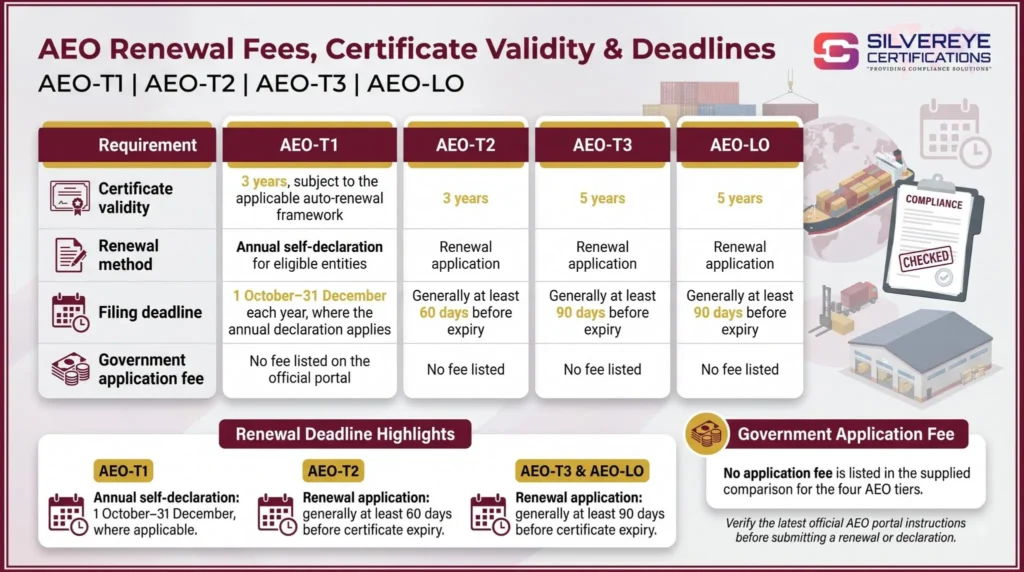
The T2, T3, and LO renewal lead times above are stated in CBIC’s published AEO FAQ. Confirm the applicable deadline for your certificate with the relevant AEO cell, particularly if an amendment or special instruction applies.
For AEO-T1, the annual self-declaration window is specified in Circular No. 18/2021-Customs. The exemption for a newly certified entity applies only to a fresh AEO-T1 certification granted during that calendar year. According to the AEO portal’s update dated 1 October 2026, renewal and auto-renewal do not qualify as fresh certification for this exemption.
AEO-T1 Renewal: How Annual Self-Declaration Works
CBIC introduced an auto-renewal framework for eligible AEO-T1 entities through Circular No. 18/2021-Customs dated 31 July 2021. Instead of treating every eligible T1 renewal as a fresh application, the framework requires an annual self-declaration and continued compliance with the programme conditions.
- Who is covered: AEO-T1 entities covered by the applicable auto-renewal framework, including eligible MSMEs.
- When to file: Submit the annual self-declaration between 1 October and 31 December, using the prescribed process.
- Fresh-certification exemption: An entity receiving fresh AEO-T1 certification during a calendar year is exempt from filing the declaration for that same year.
- Renewed or auto-renewed entities: The AEO portal clarified on 1 October 2026 that these entities do not qualify for the fresh-certification exemption and must submit the declaration for the preceding financial year within the prescribed window.
- What the declaration covers: Relevant compliance matters, financial position, insolvency or liquidation proceedings, additional locations, and the maintenance and availability of commercial and financial records.
- Compliance review: Customs may review the declaration and supporting records and take action where the applicable conditions are not met.
Important: AEO-T1 entities certified before 1 April 2019 should confirm their applicable renewal route with the jurisdictional AEO cell rather than automatically assuming that the same procedure applies to every certificate.
AEO-T2, AEO-T3 and AEO-LO Renewal: Process and Requirements
AEO-T2, AEO-T3, and AEO-LO holders generally need to submit a renewal application before their existing certification expires. The application should use the applicable format and supporting-document checklist for the relevant tier.
Before applying, review the following areas:
- Legal compliance: Check for relevant Customs or GST show-cause notices, adjudication orders, penalties, or other compliance developments that must be disclosed.
- Financial solvency: Prepare current financial information and supporting records required by the applicable checklist.
- Commercial records and internal controls: Confirm that accounting records, document-retention procedures, and compliance systems remain effective and auditable.
- Business and premises changes: Update relevant details concerning the legal entity, business name, address, locations, or operations as required.
- Security arrangements: For tiers requiring security and safety controls, review access management, personnel procedures, conveyance security, seals, and other applicable measures.
- Business partners: For AEO-T3, review the applicable requirements concerning business partners and supporting security or AEO-status information.
AEO-T3 applicants and certificate holders should pay particular attention to the applicable business-partner conditions. Prepare supporting evidence in advance and verify the current requirements in the official T3 checklist.
The documents required for renewal may differ from those submitted in the original application, depending on the tier, changes since certification, and the current CBIC checklist. Use the latest guidance rather than relying solely on an older application file.
AEO Registration Renewal Documents Checklist
The documents required for AEO registration renewal depend on your certification tier and the applicable CBIC requirements. AEO-T1 holders covered by the annual self-declaration framework must submit the prescribed declaration, while AEO-T2, AEO-T3, and AEO-LO holders should prepare the relevant renewal application and supporting documents.
The checklist below is a practical preparation guide, not a substitute for the current official form or tier-specific checklist.
| Document or Record | AEO-T1 Annual Self-Declaration | AEO-T2, T3 and LO Renewal |
|---|---|---|
| Existing AEO certificate number and validity | Required details | Keep available |
| Annual self-declaration | Required where applicable | Not a substitute for renewal application |
| Details of new locations or sites | Declare as required by the form | Update where applicable |
| Proof of notification to Customs about changes | Where applicable | Where applicable |
| Summary of changes since the previous application | If requested or relevant | Recommended; update the application records |
| Legal compliance records, including relevant notices and penalties | Disclose matters covered by the declaration | Update as required by the applicable checklist |
| Latest financial statements and solvency evidence | Keep available if requested | Prepare as required by the applicable checklist |
| Updated site plan and process documentation | If requested | Where applicable |
| Security plan and security procedures | Maintain records as applicable to continuing compliance | Update as required for the relevant tier |
| Staff training and security-awareness records | Maintain relevant evidence | Where applicable |
| Business-partner AEO or security information | Not a routine item in the standard T1 declaration | Prepare where required for T3 |
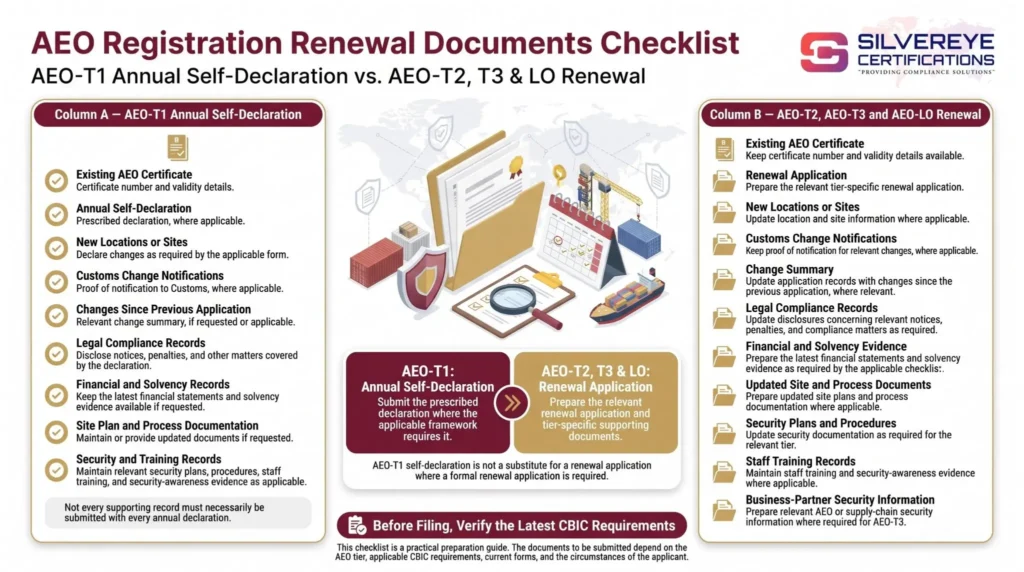
Keep the supporting records needed to demonstrate continued compliance throughout your certification period and for any longer period required by applicable law. Customs may request additional information during a review or verification.
AEO Registration Renewal Process: Step by Step
AEO-T1 Renewal: Annual Self-Declaration
Eligible AEO-T1 entities follow the annual self-declaration framework introduced by CBIC Circular No. 18/2021-Customs.
- Access the official portal: Log in to aeoindia.gov.in and check the current instructions for the annual declaration.
- Review your compliance records: Verify your certificate details, relevant legal or financial developments, and changes to business locations or operations.
- Prepare the declaration: Complete the prescribed form accurately and ensure that the answers agree with your records.
- Submit within the filing window: The annual declaration is due between 1 October and 31 December, where the requirement applies.
- Save the acknowledgement: Retain the submission confirmation and a copy of the declaration.
- Respond to further requests: Provide additional documents if the Zonal AEO Programme Manager or other authorised Customs officials request them.
Important: The AEO India portal clarified on 1 October 2026 that the exemption from filing the declaration applies to entities granted fresh AEO-T1 certification during that calendar year. Renewed and auto-renewed entities do not qualify for this exemption and must follow the applicable annual filing requirements.
AEO-T2, T3 and LO Renewal: Application Process
AEO-T2, AEO-T3 and AEO-LO holders generally need to submit a renewal application before their certificate expires.
- Conduct an internal compliance review: Compare your current business operations with the information submitted in your previous application.
- Update the supporting documents: Refresh the relevant business, financial, premises, security, and compliance records.
- Identify changes: Document changes in legal status, business name, address, operations, accounting systems, responsible personnel, and supply-chain locations, as applicable.
- Submit the renewal application: Use the official AEO portal and the applicable tier-specific checklist.
- Respond to deficiencies: Upload additional documents or clarifications through the portal as instructed.
- Prepare for verification: Keep relevant premises, records, procedures, and personnel available for any required verification visit.
- Check the outcome: Review the renewed certificate and record the new validity dates and subsequent compliance deadlines.
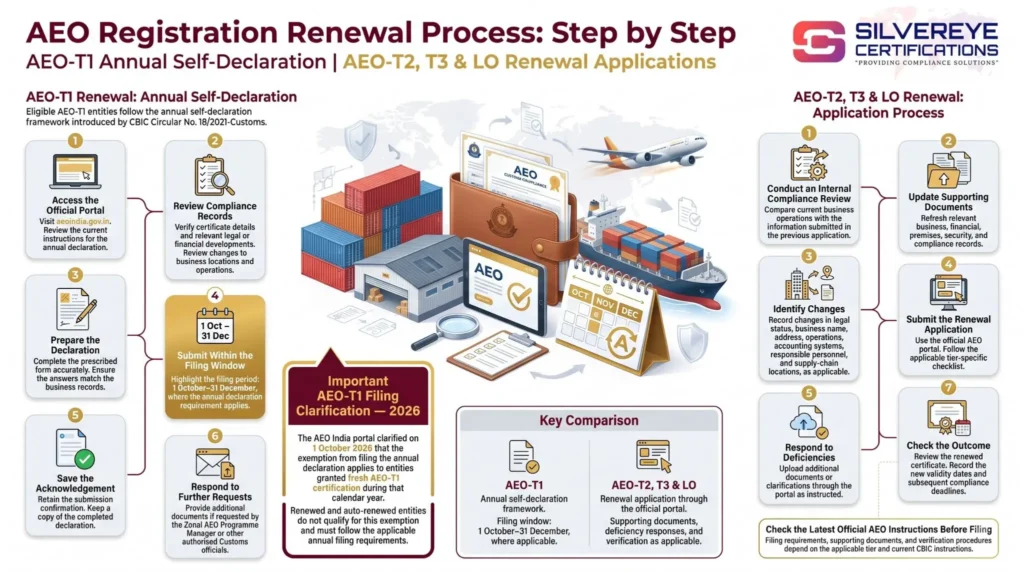
The applicable document requirements and verification steps can differ by tier and by the changes since the previous application. Use the current official checklist rather than relying exclusively on an older application file.
AEO Renewal Timeline: When Should You Start?
| Timing | Recommended Action |
|---|---|
| Six months before T2, T3 or LO expiry | Begin an internal compliance review and identify documentation gaps. |
| At least 90 days before T3 or LO expiry | Plan to submit the renewal application within the applicable lead time. |
| At least 60 days before T2 expiry | Plan to submit the renewal application within the applicable lead time. |
| At least 30 days before expiry for T1 cases following the older renewal route | Confirm the applicable procedure with your AEO cell and submit within the prescribed period. |
| 1 October to 31 December each year for T1 annual declarations | Submit the annual self-declaration where required. |
| Within 14 days of a significant change, where applicable | Notify the relevant Customs/AEO officials in accordance with the programme requirements. |
The 60-day T2, 90-day T3/LO, and 30-day older T1 renewal periods are reflected in the published AEO FAQ. Confirm the route applicable to your certificate and check the current portal instructions before filing. These planning dates do not guarantee approval by the certificate expiry date.
The 14-day notification requirement also covers significant changes beyond new locations. Depending on the circumstances, these can include changes to the legal entity, business name or address, nature of business, accounting or computer systems, and personnel responsible for Customs matters.
What Does AEO Registration Renewal Cost?
CBIC's AEO programme guidance does not list a government application fee for standard AEO certification renewal. However, businesses may incur internal or professional expenses while preparing the renewal.
- Consultancy or advisory fees: If you engage a consultant to review documents or help prepare the application, agree on the scope and charges in advance.
- Security and process improvements: Businesses may need to address gaps in access control, security procedures, record management, or other applicable compliance arrangements.
- Internal staff time: Finance, logistics, HR, security, and compliance teams may need to gather records and respond to questions.
Keep professional service charges separate from government fees and confirm any current portal instructions before making a payment.
Can You Get an Extension If Your AEO Renewal Is Late?
Do not assume that an extension will be available. CBIC issued temporary relief measures during the COVID-19 period, including Circular No. 27/2020-Customs and subsequent extensions for specified certificates. These were time-bound measures, not a permanent entitlement to renew late.
If your certificate is approaching expiry, contact the relevant AEO cell and follow the current renewal procedure. A previous extension granted for a specific period does not establish that the same relief will apply to a later deadline.
What Happens If Your AEO Certificate Expires or Is Revoked?
The consequences depend on the tier, the applicable provisions, and the circumstances of the missed filing or adverse compliance finding.
| Situation | Possible Consequence | Recommended Action |
|---|---|---|
| T2, T3 or LO renewal is not completed before expiry | The existing certificate may expire, putting AEO benefits at risk. | Contact the relevant AEO cell promptly and confirm whether renewal or a fresh application is required. |
| T1 annual self-declaration is missed | Compliance with the continuous-certification framework may be affected. | Contact the AEO helpdesk or Zonal AEO Programme Manager and seek instructions on the applicable procedure. |
| Adverse review or revocation | AEO status may be suspended, downgraded, or revoked under the applicable rules. | Review the official communication, address the identified issues, and confirm the available remedy or reapplication route. |
| The legal identity of the business changes | The existing certificate may no longer match the legal entity operating the business. | Notify Customs and confirm whether a fresh application is required. |
Do not assume that a missed filing automatically results in a particular outcome, or that a late filing will automatically restore status. The applicable circulars, official notices, and instructions from the competent authority determine the next step.
Common AEO Renewal Mistakes and How to Avoid Them
| Common Mistake | How to Avoid It |
|---|---|
| Treating T1 auto-renewal as automatic | Calendar the annual declaration window and submit the required declaration. |
| Failing to report a new warehouse or other significant change | Check the notification requirements and retain evidence of timely communication. |
| Submitting declarations that conflict with Customs records | Reconcile relevant Bills of Entry, Shipping Bills, notices, and internal compliance records before filing. |
| Leaving security or process gaps until verification | Review applicable controls, site records, access procedures, and training evidence in advance. |
| Ignoring show-cause notices or other compliance developments | Assess each matter and disclose it where required by the applicable form or rules. |
| Overlooking T3 business-partner requirements | Check partner information and supporting evidence against the current T3 checklist. |
| Waiting until certificate expiry to start preparing | Begin the internal review well in advance and follow the applicable filing deadline. |
AEO Programme Updates in 2026
AEO holders should distinguish between changes already implemented and proposals that may affect future processing.
- Proposed standardisation of AEO processing: In September 2026, the Ministry of Finance reported that CBIC was considering a uniform Standard Operating Procedure across Customs zones, clearer applicant checklists, a single-deficiency approach, time-bound processing, and clarification of financial-solvency requirements. These were reported as proposed reforms; check the official portal for any subsequent implementation circular. <Cite refs={["turn591511search3"]}/>
- EMI Scheme documentation changes: Circular No. 39/2026-Customs, dated 3 September 2026, reduced the number of documents required for the Eligible Manufacturer Importer (EMI) Scheme from ten to three, effective 15 September 2026. This is an EMI-specific change and should not be presented as a reduction in the documents required for standard AEO renewal. <Cite refs={["turn591511search2","turn591511search3"]}/>
- AEO programme size: A Ministry of Finance update in September 2026 reported 5,967 AEO-certified entities across the T1, T2, T3, and LO categories. This reflects the programme's reported scale, not a change to renewal deadlines. <Cite refs={["turn591511search3"]}/>
The practical takeaway is to use the current AEO portal and applicable CBIC circulars as the source of truth. Keep your records current, report significant changes within the prescribed period, and start renewal preparation early enough to address any deficiencies before your certificate expires.
Why Choose Silvereye Certifications for AEO Registration Renewal?
Renewing your Authorized Economic Operator (AEO) certification requires accurate documentation, timely submissions, and continued compliance with applicable CBIC requirements. Silvereye Certifications supports businesses in preparing their renewal documents and reviewing compliance requirements according to their AEO tier.
- Tier-Specific Guidance: Support for AEO-T1 annual self-declarations and AEO-T2, T3, and LO renewal applications, as applicable.
- Document Checklist Review: Assistance in organising certificate details, updated business records, financial documents, and other supporting information required for your renewal.
- Compliance Gap Assessment: Help identify documentation gaps, changes in business operations, and areas that may need attention before submission.
- Application Preparation Support: Guidance on preparing the relevant forms and supporting documents for submission through the official AEO portal.
- Deadline Planning: Assistance in tracking applicable filing windows, certificate validity, and significant changes that may need to be reported to Customs.
- Clarification Support: Help organise responses and supporting evidence when additional information is requested by the relevant Customs authority.
Silvereye Certifications helps businesses approach AEO renewal with a structured documentation and compliance process. Contact our team to discuss your AEO tier, upcoming deadlines, and renewal documentation requirements.
Conclusion
AEO registration renewal in India depends on your certification tier and the applicable CBIC guidelines. Eligible AEO-T1 entities must follow the annual self-declaration process, while AEO-T2, T3, and LO holders generally need to submit renewal applications before their certificates expire. Keeping business records updated, reporting significant changes within the prescribed period, and preparing the required supporting documents can help reduce avoidable delays.
Before filing, verify the latest instructions, applicable deadlines, and document checklist on the official AEO India portal. Do not assume that a missed deadline will automatically qualify for an extension or that renewal guarantees continued certification.
For assistance with AEO renewal documents, compliance reviews, and application preparation, contact Silvereye Certifications to discuss the requirements relevant to your business and certification tier.
Frequently Asked Questions
How do I renew my AEO certificate?
T1 entities certified on or after 1 April 2019 file an annual self-declaration on aeoindia.gov.in. T2, T3 and LO entities file a renewal application with updated documents before expiry.
Is AEO T1 renewal automatic?
It is continuous, subject to your annual self-declaration and Customs' compliance review. If the review is adverse, the certificate can be revoked.
When is the AEO annual self-declaration due?
Between 1 October and 31 December each year. An entity certified in a calendar year skips the declaration for that year.
How long is an AEO certificate valid?
Three years for T1 and T2, and five years for T3 and LO.
How early should I apply to renew a T2, T3 or LO certificate?
Before expiry. Industry guides cite 60 days for T2 and 90 days for T3 and LO, so confirm with your zonal AEO cell and start earlier.
Is there a fee to renew an AEO certificate?
CBIC's guidance lists no government fee. You may pay advisors and spend on security upgrades.
What documents do I need for AEO renewal?
T1: your certificate details and the self-declaration facts, including new sites. T2, T3 and LO: updated annexures, a list of changes, legal and financial records, and security evidence.
What happens if my AEO certificate expires?
Benefits stop at the validity date. Check with your zonal AEO cell on whether a fresh application is needed.
Do I have to report new warehouses or sites?
Yes. The self-declaration asks whether new locations were added and reported within 14 days of the addition.
Can AEO status be revoked at renewal?
Yes, if a review or a fraud-related show-cause notice shows non-compliance. After revocation a T1 holder must file a fresh application.
My T1 was issued before April 2019. Does auto-renewal apply?
The auto-renewal migration covers T1 certificates issued on or after 1 April 2019. Older certificates followed the renewal-application route, so ask your zonal AEO cell.
Will CBIC extend AEO validity if I miss the deadline?
Not as a rule. Extensions in 2020 and 2021 were one-off pandemic measures.
Can I upgrade my tier when I renew?
Yes, if you qualify. T3 needs two continuous years as T2, so many T2 holders plan the upgrade around their renewal cycle.