
Cardamom is a scheduled spice under the Spices Board's export registration framework. Therefore, businesses exporting cardamom from India must obtain a Certificate of Registration as Exporter of Spices (CRES) from the Spices Board of India.
- Separate dealer license for auction purchases: Businesses purchasing cardamom through Spices Board auctions must obtain the applicable dealer license under the Cardamom (Licensing and Marketing) Rules, 1987. CRES does not replace this license.
- Valid IEC: Exporters must hold an active Importer Exporter Code (IEC) issued by DGFT before applying for CRES.
- Three-year validity: CRES is issued for a three-year period and must be renewed within the prescribed deadline.
- Renewal is not automatic: Exporters must meet the Board's renewal conditions, including applicable export activity and quarterly return filing requirements, and submit their renewal application on time.
Introduction
Spice Board registration for cardamom exporters involves obtaining a valid Certificate of Registration as Exporter of Spices (CRES) from the Spices Board of India, in addition to an Importer Exporter Code (IEC) issued by the Directorate General of Foreign Trade (DGFT). Cardamom is a scheduled spice under the Spices Board's export registration framework, so exporters must obtain CRES to meet the applicable registration requirements before exporting cardamom from India.
Businesses purchasing cardamom through official Spices Board auctions must also obtain the applicable dealer license under the Cardamom (Licensing and Marketing) Rules, 1987. CRES and the auction dealer license serve different purposes, and one does not replace the other.
Exporters can apply for CRES through the DGFT Common Digital Platform (e-RCMC) by providing the required business, identity, tax, bank and constitution documents. The applicant must also pay the prescribed government registration fee.
CRES is generally valid for three years from its date of issue. Renewal is not automatic. Exporters must meet the Spices Board's applicable renewal conditions, maintain their quarterly export returns and submit the renewal application within the prescribed period to continue their registration.
What Is Spice Board Registration for Cardamom Exporters?
Spice Board registration for cardamom exporters refers to obtaining a Certificate of Registration as Exporter of Spices (CRES) from the Spices Board of India, a statutory body under the Ministry of Commerce and Industry, Government of India.
Cardamom is one of India's scheduled spices under the Spices Board Act, 1986. Therefore, businesses exporting cardamom from India must hold a valid CRES in addition to an Importer Exporter Code (IEC) issued by the Directorate General of Foreign Trade (DGFT). An IEC alone does not satisfy the Spices Board's registration requirement.
Exporters can apply for CRES through the DGFT Common Digital Platform (e-RCMC). The application requires business and identity details along with supporting documents, such as the IEC, GST registration, bank report and business constitution documents. Manufacturer exporters may also need additional documents relating to their processing premises and manufacturing activities. Applicants must pay the prescribed government registration fee.
Separate Dealer License for Cardamom Auction Purchases
If your business plans to purchase cardamom through Spices Board auctions, CRES registration alone is not sufficient. You must also obtain the applicable dealer license under the Cardamom (Licensing and Marketing) Rules, 1987.
The two registrations serve different purposes:
- CRES: Required for businesses exporting cardamom and other scheduled spices.
- Cardamom dealer license: Required for businesses undertaking activities covered by the dealer-licensing provisions, including applicable purchases through Spices Board auctions.
A business involved in both auction purchases and exports should check and obtain both applicable registrations.
Validity and Ongoing Compliance
CRES is generally valid for three years from its date of issue. Renewal is not automatic. Exporters must apply within the prescribed period and satisfy the Board's renewal conditions, including applicable export activity and quarterly return requirements.
Registered exporters must also submit the prescribed Quarterly Export Returns (QERs) through the Spices Board's online system, including Nil returns where applicable.
For cardamom businesses, understanding the difference between CRES and the auction dealer license is particularly important. Obtaining the correct registrations helps exporters meet their regulatory obligations and manage their cardamom export activities more effectively.
Why Is Cardamom Export Registration Different from Other Spice Registrations?
Cardamom, often called the Queen of Spices, has a dedicated marketing and auction framework in India. Unlike many other scheduled spices, its domestic trading and auction activities are also regulated under the Cardamom (Licensing and Marketing) Rules, 1987, framed under the Spices Board Act, 1986.
Two separate compliance requirements are particularly important for cardamom businesses.
1. Export registration through CRES
Businesses exporting small or large cardamom from India must obtain a Certificate of Registration as Exporter of Spices (CRES) from the Spices Board, in addition to a valid IEC. CRES is the registration required for spice-export activities.
2. Dealer licensing for regulated cardamom trading
Businesses participating as buyers in cardamom auctions must obtain the applicable Cardamom Dealer Licence (CDL) from the Spices Board. The licence is governed by the Cardamom (Licensing and Marketing) Rules, 1987.
The Board has also clarified that licensed dealers must purchase cardamom only from registered estate owners or growers or licensed auctioneers. Unauthorised cardamom auctions can attract action under the applicable rules.
Where Are Cardamom Auctions Conducted in India?
The auction system differs according to the type of cardamom:
- Small cardamom: The Spices Board operates dedicated e-auction centres at Puttady in Kerala and Bodinayakanur in Tamil Nadu. Manual auction centres for small cardamom may also be established at permitted locations outside Kerala and Tamil Nadu, subject to the Board's licensing requirements.
- Large cardamom: Manual auctions can be conducted at approved centres under the applicable licensing framework.
The Board issues separate licences for cardamom dealers and auctioneers. A dealer licence authorises eligible buyers to participate in regulated cardamom trading, whereas an auctioneer licence is required to conduct auctions.
For a first-time cardamom exporter, this distinction is important. If your business only sources cardamom through ordinary domestic suppliers, your requirements may differ from those of a business purchasing through the Board-regulated auction system.
Small Cardamom vs Large Cardamom: Registration and Auction Requirements
India produces two commercially important types of cardamom: small green cardamom and large cardamom. Both fall under the Spices Board's export registration framework, but their trading and auction arrangements differ.
| Point | Small Cardamom | Large Cardamom |
|---|---|---|
| Common names | Green cardamom, elaichi | Black cardamom, badi elaichi |
| Main growing regions | Kerala, Tamil Nadu and Karnataka | Sikkim and parts of the eastern Himalayan region |
| Auction system | E-auctions at Puttady and Bodinayakanur, along with permitted manual auction centres | Manual auctions at approved centres |
| CRES for export | Required | Required |
| Dealer licence | Required for regulated dealer activities and applicable auction purchases | Required for regulated dealer activities and applicable auction purchases |
| Auctioneer licence | Required to conduct auctions under the applicable rules | Required to conduct auctions under the applicable rules |
Businesses dealing in both varieties should identify the relevant cardamom categories in their business and registration records. They should also check the applicable auction and sourcing requirements separately.
Who Needs CRES Registration to Export Cardamom?
Any eligible business exporting small or large cardamom from India must obtain CRES registration from the Spices Board.
The main applicant categories include:
- Merchant exporters: Businesses that purchase cardamom from registered growers, traders, licensed auctioneers or other permitted suppliers and sell it to overseas buyers.
- Manufacturer exporters: Businesses that clean, sort, grade, process or otherwise prepare cardamom for export at their own processing facilities.
- Business entities: Proprietorships, partnerships, LLPs and companies that meet the applicable registration requirements and hold a valid IEC.
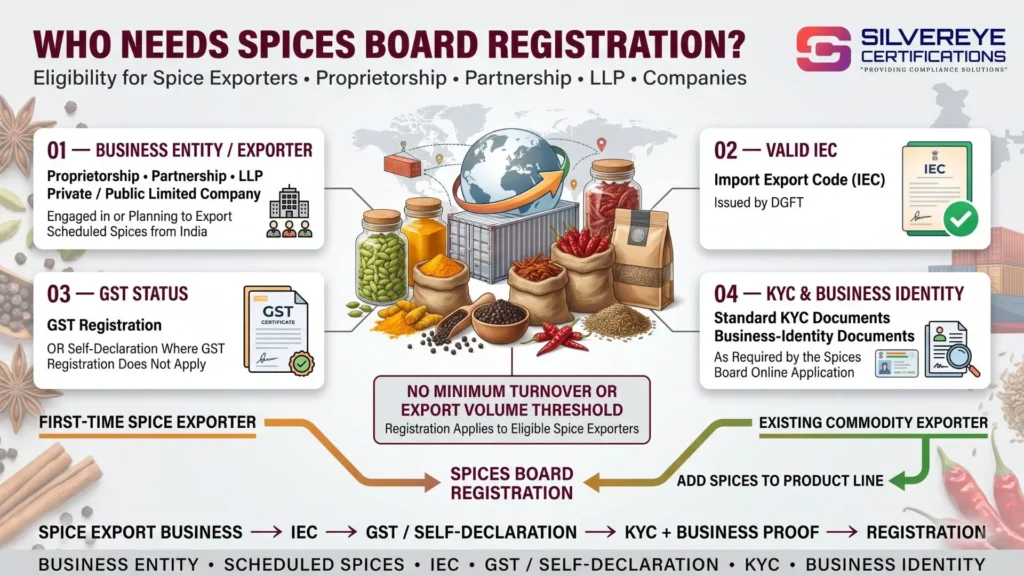
CRES is intended for export activities. Businesses involved only in domestic cardamom trading do not need CRES solely for domestic sales, although dealer licensing, FSSAI and other applicable requirements may still apply to their activities.
Can One Business Have Multiple CRES Certificates?
The Spices Board's FAQ clarifies that only one CRES is issued against a single IEC.
If a business operates additional branches or godowns under the same IEC, it can apply for the necessary address amendment or endorsement through DGFT rather than obtaining a separate CRES for each location.
A change in the legal constitution of the business is different. The existing registration is treated as expired, and fresh CRES registration is required under the new business constitution.
CRES vs Cardamom Dealer License vs RCMC: What Is the Difference?
These three terms are often confused by new cardamom businesses. However, each serves a different regulatory purpose.
| Term | What it means | Who needs it? |
|---|---|---|
| CRES | Certificate of Registration as Exporter of Spices under Section 11 of the Spices Board Act, 1986 | Businesses exporting scheduled spices, including cardamom |
| Cardamom Dealer Licence (CDL) | Licence under the Cardamom (Licensing and Marketing) Rules, 1987 | Businesses undertaking regulated cardamom dealer activities, including applicable auction purchases |
| Cardamom Auctioneer Licence (CAL) | License to conduct cardamom auctions under the applicable rules | Businesses intending to operate as licensed cardamom auctioneers |
| RCMC | Registration-cum-Membership Certificate under the Foreign Trade Policy | Exporters requiring RCMC recognition for applicable policy purposes |
The Spices Board's FAQ confirms that CRES is treated as the RCMC for spice exporters. Therefore, cardamom exporters generally do not need to obtain a separate RCMC solely for exporting spices.
Remember these distinctions:
- CRES covers the export registration requirement.
- CDL covers the applicable dealer activities.
- CAL authorises the conduct of regulated cardamom auctions.
- CRES does not replace a dealer or auctioneer licence.
Benefits of Spices Board Registration for Cardamom Exporters
Obtaining the correct registrations helps cardamom businesses meet regulatory requirements and organise their export and trading activities.
Key benefits include:
- Export compliance: CRES helps meet the Spices Board's registration requirement for exporting scheduled spices such as cardamom.
- Recognition as a registered exporter: The business is registered with the Spices Board for spice-export activities.
- RCMC recognition: CRES is accepted as the RCMC for spice exporters under the applicable Foreign Trade Policy provisions.
- Access to regulated auctions: Businesses holding the applicable dealer licence can participate in eligible cardamom auction activities.
- Access to Board support: Registered exporters can explore applicable quality guidance, testing facilities and export-promotion programmes, subject to the conditions of each scheme.
- Better compliance management: Maintaining valid registrations and submitting prescribed returns helps businesses manage their ongoing regulatory responsibilities.
Obtaining CRES or a dealer licence does not guarantee overseas orders, customs clearance or acceptance by foreign buyers. Exporters must separately meet applicable food-safety, quality and importing-country requirements.
Eligibility Requirements for CRES and Cardamom Dealer License
Cardamom businesses should assess their eligibility separately for export registration and dealer licensing because the two applications have different requirements.
A. Eligibility and Documents for CRES Registration
Before applying for CRES, exporters should check the following requirements:
| Requirement | What it means |
|---|---|
| Valid IEC | An active Importer Exporter Code issued by DGFT is required. |
| Business constitution | Proprietorship, partnership, LLP or company details supported by the relevant constitution documents. |
| GST registration | GST certificate or an applicable declaration, as permitted by the Board's current procedure. |
| PAN | PAN details of the business or proprietor, as applicable. |
| Bank report | Bank report prepared in the prescribed Annexure II format. |
| Central FSSAI licence | The current CRES application checklist specifies a Central FSSAI licence for merchant and manufacturer exporters. |
| MSME/Udyam registration | Required as part of the applicable manufacturer-exporter document checklist. |
| Pollution Control Board consent | Valid Consent to Operate for manufacturer exporters, as applicable. |
| Processing-premises proof | Ownership proof, valid lease or rent agreement, or recent property tax receipt for the processing unit, as applicable. |
B. Additional Requirements for Cardamom Dealers Participating in E-Auctions
A business planning to participate as a buyer in Spices Board cardamom e-auctions must separately check the Cardamom Dealer Licence requirements.
The Spices Board issued a circular on 4 December 2025 concerning the requirement for FSSAI licence or registration for cardamom dealers participating in e-auctions. Therefore, applicants should pay particular attention to the applicable FSSAI documentation.
The current dealer-licence application is available through the National Single Window System (NSWS). Applicants should check the latest document checklist, declarations and licensing conditions on the Board's dealer-licence page before applying.
Important: Do not assume that CRES automatically authorises you to purchase cardamom through official auctions. Check the applicable dealer-licensing requirements separately, even if your business already holds an IEC and CRES.
Documents Required for Spice Board Registration
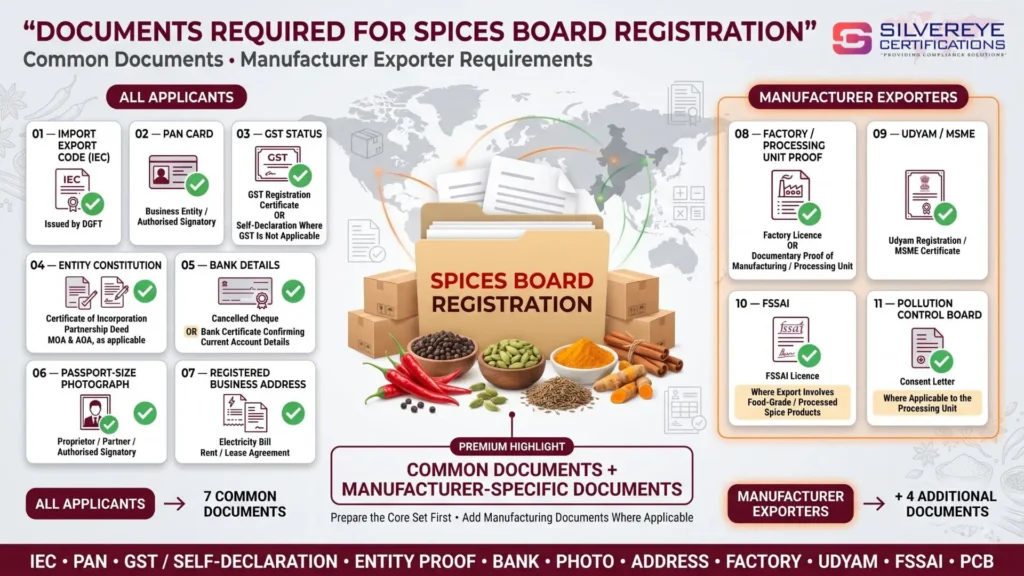
The Spices Board's current online CRES checklist distinguishes between merchant exporters and manufacturer exporters. Prepare your documents according to the category selected in your application.
| Document | Applies to |
|---|---|
| IEC certificate issued by DGFT | All applicants |
| PAN card | All applicants |
| GST registration certificate | All applicants, or the declaration permitted by the Board if GST is unavailable |
| Bank Report in Annex II | All applicants |
| Central FSSAI license | All applicants, as listed in the current CRES checklist |
| Business constitution documents, such as partnership deed, Certificate of Incorporation, MOA and AOA, or LLP agreement | As applicable to the business structure |
| Details of directors or partners | Companies, LLPs and partnership firms, as applicable |
| MSME/Udyam registration certificate | Manufacturer exporters |
| Valid Consent to Operate (CTO) issued by the State Pollution Control Board | Manufacturer exporters |
| Processing-unit premises proof, such as a valid lease or rent agreement, or recent property tax receipt | Manufacturer exporters |
| Authorisation letter | Where an employee is submitting the application on behalf of the IEC holder |
The Board may ask for additional information or supporting documents depending on the application. Follow the checklist displayed on the DGFT portal when filing.
Practical tip: Keep the business name and address consistent across your IEC, PAN, GST certificate, bank report and FSSAI licence. Check these details before uploading documents to reduce the possibility of clarification requests.
Step-by-Step Process for Spice Board CRES Registration
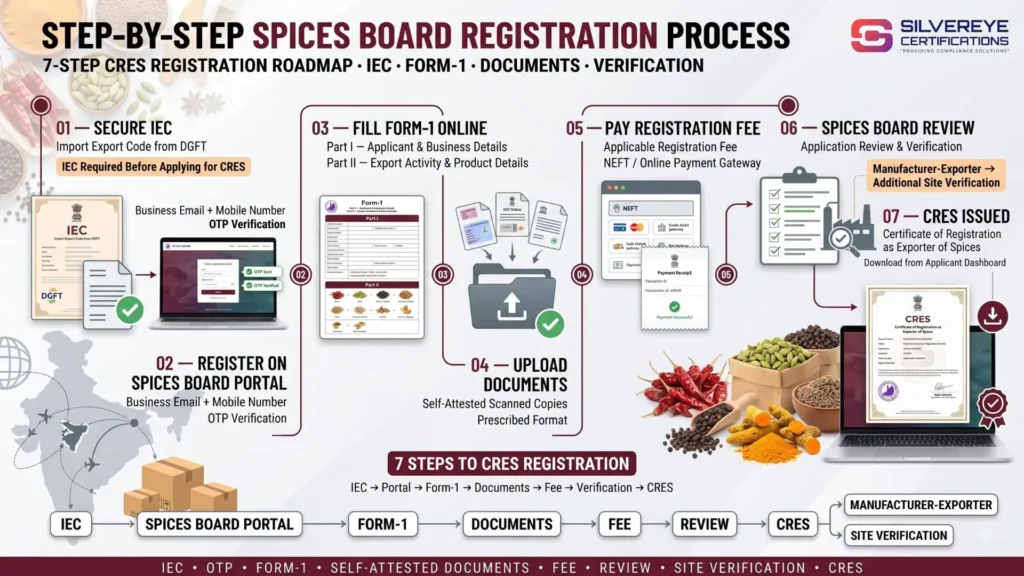
The Spices Board requires CRES applications to be submitted online through the DGFT portal. Follow these steps:
- Obtain an active IEC: Apply for an Importer Exporter Code through DGFT if your business does not already have one.
- Choose your exporter category: Select either merchant exporter or manufacturer exporter, depending on your actual business activity.
- Arrange the required documents: Obtain the bank report in the Board's prescribed Annex II format, GST certificate and Central FSSAI licence. Manufacturer exporters should also arrange their MSME certificate, Consent to Operate and processing-unit premises proof.
- Log in to the DGFT portal: Link your IEC with your DGFT profile and open the e-RCMC application section.
- Select Spices Board: Choose Spices Board (SBCB) as the Export Promotion Council/Commodity Board for the CRES application.
- Complete the application: Enter the business, IEC and exporter-category details. Select the applicable spice products, including cardamom, and check that the information matches your supporting documents.
- Upload the documents: Upload the required documents in the formats and file sizes accepted by the portal.
- Pay the applicable government fee: Complete payment through the portal's payment gateway and submit the application.
- Track the application: Check the application status through your DGFT dashboard or recent activities. Respond to any clarification or document request from the Board.
- Download your CRES: Once the application is approved and processed, the certificate can be downloaded through DGFT.
Important: You do not need to submit a physical copy of the CRES application under the Board's online application procedure. Follow any specific instructions displayed in the current portal or communicated by the concerned authority.
If you also intend to purchase cardamom through regulated auction channels, apply separately for the relevant Cardamom Dealer Licence. CRES does not replace this licence.
Government Fees for Spice Board CRES Registration
The Spices Board's current online fee schedule lists different charges for merchant and manufacturer exporters.
| Application type | Merchant exporter | Manufacturer exporter |
|---|---|---|
| Fresh CRES registration | ₹11,800 | ₹17,700 |
| CRES renewal | ₹8,850 | ₹11,800 |
| Amendment | ₹5,900 | ₹5,900 |
The amounts include 18% GST. The fee schedule shows a merchant amendment fee of ₹5,900 in the Board's FAQ; confirm the applicable category and amount on the portal before making payment.
These are CRES registration fees, not cardamom dealer or auctioneer licence fees. Those licences follow separate procedures and fee requirements.
Always verify the amount displayed on the official portal before paying. If you engage a consultant, ask for the government fee and professional service charges to be shown separately.
How Long Does CRES Registration Take?
The time required depends on document readiness, application accuracy and the Board's processing.
| Stage | Working estimate or guidance |
|---|---|
| Document preparation | Depends on how quickly you obtain the bank report and other certificates |
| Online application | Can be completed in a day if all documents are ready |
| Board processing | The Spices Board FAQ states that CRES can be issued within one week after receiving the application and complete documents |
| Clarifications or verification | May extend the processing time |
| Cardamom Dealer Licence | Follows a separate application process and timeline |
The one-week period is the Board's stated guidance, not a guaranteed approval timeline. Incomplete documents, inconsistent business details or requests for clarification can affect the actual processing time.
CRES Validity and Renewal
The Certificate of Registration as Exporter of Spices (CRES) is valid for three years from its date of issue, according to the Spices Board's FAQ.
Keep these points in mind:
- Renewal is not automatic. You must submit a renewal application through the DGFT portal.
- Apply before expiry. The Board's FAQ states that the renewal application can be filed on or before the certificate's expiry date.
- Check the current renewal instructions. Follow the Board's latest circular and portal requirements rather than relying on older block-period dates.
- Keep export records ready. Maintain shipment details and quarterly return records to support your compliance history.
Practical advice: Start preparing your renewal documents well before the expiry date. This gives you time to obtain updated bank and tax documents and resolve any discrepancies.
Compliance Requirements After CRES Registration
Receiving CRES is not the end of your responsibilities. Cardamom exporters must continue to meet the Spices Board's reporting and applicable export requirements.
- Submit quarterly export returns: Registered exporters must file quarterly returns online through the Spices Board's Export Support System.
- Report business-address changes: If your registered address or branch details change, update your IEC details with DGFT and file the required CRES amendment.
- Apply afresh after a change in constitution: A change in the firm's legal constitution makes the existing CRES certificate expire under the Board's FAQ. A fresh certificate is required in the new name.
- Use authorised cardamom channels: Dealers must follow the applicable Cardamom (Licensing & Marketing) Rules. The Board has issued instructions concerning purchases from registered estate owners or growers and licensed auctioneers.
- Follow sampling and testing requirements: Check the Spices Board's Export Support System for applicable pre-shipment sampling, testing and certification requirements for your consignment and destination market.
- Check buyer and importing-country specifications: Confirm requirements for cardamom size, colour, moisture, pesticide residues and other quality parameters before sourcing and shipping.
- Keep other applicable licences valid: Maintain your FSSAI and other required registrations according to your business activity and the latest regulatory requirements.
Merchant vs Manufacturer Exporter for Cardamom
The Spices Board has separate CRES categories for merchant and manufacturer exporters. Choosing the correct category matters because the document requirements and registration fees differ.
| Factor | Merchant exporter | Manufacturer exporter |
|---|---|---|
| Main activity | Sources cardamom from suppliers and exports it | Processes or manufactures spice products for export |
| Basic documents | GST, Bank Report in Annex II and Central FSSAI, along with the applicable supporting documents | Same basic documents |
| Additional documents | Generally no manufacturing-unit documents under the current checklist | MSME certificate, valid Consent to Operate and processing-unit premises proof |
| Registration fee | ₹11,800 for fresh registration | ₹17,700 for fresh registration |
| Suitable business model | Traders and businesses exporting sourced cardamom | Businesses operating their own eligible processing units |
Choose the category that accurately reflects your business operations. Do not select manufacturer status simply because you purchase, sort or trade cardamom. Check the Board's current definition and document requirements if your activities involve grading, cleaning, processing or packaging.
Common Mistakes Cardamom Exporters Should Avoid
A small documentation or licensing mistake can lead to application queries or compliance problems later. Watch out for these common issues:
- Assuming CRES permits auction purchases: CRES is an exporter registration. It does not replace the separate Cardamom Dealer License required for applicable dealer activities.
- Buying through unauthorised channels: Dealers should follow the applicable licensing rules and source cardamom through permitted channels.
- Applying without an active IEC: CRES applications are linked to the IEC, so check its status and details before starting.
- Submitting inconsistent documents: Differences in business names, addresses or other details across IEC, GST, bank and FSSAI records can lead to clarification requests.
- Selecting the wrong exporter category: Choose merchant or manufacturer status based on the actual business activity and the Board's requirements.
- Uploading an incomplete bank report: Use the prescribed Annex II format and ensure the bank has completed and authenticated the report as required.
- Missing the renewal deadline: Track the certificate's expiry date and apply for renewal within the permitted period.
- Ignoring quarterly returns: Registered exporters must submit the required quarterly export returns even after receiving CRES.
- Overlooking destination-market requirements: Check the buyer's quality specifications and the importing country's food-safety and pesticide-residue requirements before sourcing cardamom.
- Relying on outdated fee information: Check the current Spices Board fee schedule instead of using old figures from third-party websites.
Why Choose Silvereye Certifications for Spice Board Registration?
Applying for Spice Board registration involves more than completing an online form. You need to select the correct exporter category, arrange the prescribed documents and ensure that your application details match your IEC and other business records.
Silvereye Certifications provides guidance and application support to businesses seeking Spice Board CRES registration for cardamom exports.
Here is how our team can assist:
- Exporter category guidance: Help you understand the documentation requirements for merchant and manufacturer exporter registration.
- Document checklist support: Guide you in arranging the IEC, GST certificate, Bank Report in Annex II, FSSAI licence and other applicable documents.
- Application assistance: Support you with the online application process through the DGFT portal and help check the information before submission.
- Fee clarity: Explain the applicable government registration fee separately from professional service charges.
- Query and follow-up support: Assist with responding to document-related queries and tracking the application status.
- Additional compliance guidance: Help you understand related requirements, including quarterly export returns, CRES renewal and the separate Cardamom Dealer Licence where applicable.
Silvereye Certifications works as a compliance consultancy. The Spices Board is the authority responsible for reviewing applications and issuing CRES. Registration is subject to the Board's eligibility criteria, document verification and applicable rules.
Conclusion
Spice Board registration is an important requirement for businesses exporting cardamom from India. Exporters must obtain a valid IEC and the Certificate of Registration as Exporter of Spices (CRES) through the DGFT portal. They should also select the correct exporter category, submit the prescribed documents and pay the applicable government fee.
If your business plans to purchase cardamom through regulated auction channels, remember that CRES and the Cardamom Dealer License serve different purposes. You may need the separate dealer license depending on your activities. After registration, continue filing quarterly returns, updating business details when required and following the applicable export and quality requirements.
Preparing the documents correctly and understanding the licensing requirements before applying can help avoid unnecessary application queries. If you need assistance with the process, Silvereye Certifications can guide you through CRES documentation, application support and related compliance requirements for cardamom exports.
Frequently Asked Questions
Is Spice Board registration compulsory for cardamom export?
Yes. Cardamom is a scheduled spice, and the Board states CRES is mandatory in addition to the IEC.
Can I export elaichi with only an IEC?
No. The IEC allows international trade, but scheduled spices also need CRES.
Do I need a license to buy cardamom at auction?
Yes. Under the Cardamom (Licensing & Marketing) Rules, only licensed dealers and auctioneers can operate in the official auctions.
Is a dealer license the same as CRES?
No. CRES is for exporting. The dealer licence is for buying through the auction system.
Where are small cardamom e-auctions held?
At the Board's e-auction centres in Puttady, Kerala, and Bodinayakanur, Tamil Nadu.
Does large cardamom need registration too?
Yes. CRES applies to scheduled spices, and large cardamom is auctioned manually under the same rules.
How long is CRES valid?
Three years, issued as a block period.
How long does CRES approval take?
The Board's FAQ indicates about a week after complete documents arrive. Manufacturer cases can take longer.
What happens if I miss renewal?
Your application is treated as fresh, with fresh fees and full documents.
What if I made no exports during the block?
Per the Board's FAQ, the application is treated as fresh, not as a renewal.
Do I need FSSAI for cardamom?
The Board issued a circular in December 2025 on FSSAI requirements for dealers in e-auctions. Check the latest circular for your case.