- License requirements: Private-label brands can manufacture cosmetics through an eligible contract manufacturing arrangement without owning their own factory. Depending on the arrangement, the business may need a Cosmetic Loan License (Form COS-6 application, granted as Form COS-9) from the State Licensing Authority. A brand using a licensed contract manufacturer should confirm the applicable licensing requirements before production and sale.
- Legal compliance: Cosmetics manufactured for sale or distribution in India must comply with the Drugs and Cosmetics Act, 1940, and the Cosmetics Rules, 2020. The applicable manufacturing licence arrangements must be in place before manufacturing begins, and products must meet relevant quality, safety and labelling requirements.
- Government fees: License fees are prescribed under the Third Schedule of the Cosmetics Rules, 2020. The applicable amount depends on the license type and relevant application requirements. Confirm the current fee with the concerned State Licensing Authority rather than relying on a general fee estimate.
- Approval timeline: Under Rule 23, the State Licensing Authority is required to grant the license or communicate deficiencies within 45 days of the application, subject to the prescribed requirements. The authority must inspect or verify compliance within 30 days after the license is granted. Actual processing time can vary if documents are incomplete or additional clarification is required.
- Validity and retention: A license granted in Form COS-9 remains valid in perpetuity unless suspended or cancelled, subject to payment of the prescribed retention fee before completion of each five-year period.
Introduction
Private label cosmetic registration in India involves meeting the applicable regulatory requirements when a brand sells cosmetics manufactured by a third-party facility under its own brand name. Depending on the manufacturing arrangement, the brand owner may need a Cosmetic Loan License, applied for in Form COS-6 and granted in Form COS-9, from the relevant State Licensing Authority. However, a separate loan license is not automatically required for every private-label arrangement; the applicable licensing requirements depend on the roles of the brand owner and contract manufacturer.
The process may involve a manufacturing agreement, product formulation details, proposed labels, manufacturer documentation and other prescribed supporting documents. Government fees are determined under the Third Schedule of the Cosmetics Rules, 2020, so applicants should confirm the current applicable fee with the relevant State Licensing Authority rather than rely on a general estimate.
Under Rule 23, the authority must grant the license or communicate deficiencies within 45 days of the application, subject to the prescribed requirements. A post-grant inspection or verification is required within 30 days. A COS-9 loan license remains valid in perpetuity, unless suspended or cancelled, subject to payment of the prescribed retention fee before completion of each five-year period.
For help understanding the applicable license route and preparing the required documentation, Silvereye Certifications can provide cosmetic compliance consultancy support.
What Is Private Label Cosmetic Registration?
Private label cosmetic registration in India refers to the regulatory steps a brand owner must follow when selling cosmetics manufactured by a third-party facility under its own brand name, packaging or trademark. Common examples include skincare creams, shampoos, face washes, makeup and other personal care products.
A brand owner does not necessarily need to own or operate a factory to launch a private-label cosmetic range. Depending on the manufacturing arrangement, the business may need a Cosmetic Loan License from the relevant State Licensing Authority. Under the Cosmetics Rules, 2020, the application is submitted in Form COS-6, and the loan license is granted in Form COS-9.
A loan license allows an eligible applicant to use the manufacturing premises of another licensee for manufacturing cosmetics, subject to the applicable regulatory requirements. However, not every private-label arrangement automatically requires a separate loan license. The appropriate licensing structure depends on the roles of the brand owner and manufacturer, the existing license and the proposed production arrangement.
Legal Framework Governing Private Label Cosmetics in India
Cosmetic regulation in India is governed by the Drugs and Cosmetics Act, 1940, and the Cosmetics Rules, 2020. The regulatory process differs depending on whether a product is manufactured in India or imported as a finished cosmetic.
- Domestic manufacturing: Cosmetic manufacturing and loan licensing are regulated by the relevant State Licensing Authority under the Cosmetics Rules, 2020.
- Import of finished cosmetics: Imported cosmetics generally require registration with the Central Licensing Authority, which operates through CDSCO's applicable registration process.
- Product safety and quality: Cosmetics must comply with the applicable quality and safety standards, ingredient restrictions and labelling requirements.
- New cosmetics: Products that meet the regulatory definition of a new cosmetic may require prior permission from the Central Licensing Authority before the applicable manufacturing or import process proceeds.
Section 3(aaa) of the Drugs and Cosmetics Act, 1940 defines a cosmetic by reference to its intended application to the human body for cleansing, beautifying, promoting attractiveness or altering appearance, including articles intended for use as cosmetic components.
Types of Licenses for Private Label Cosmetic Brands
The appropriate route depends on how the product is manufactured and whether it is imported or produced domestically.
| Licence or Registration Type | When It May Apply | Application Form | Authority |
|---|---|---|---|
| Cosmetic Loan License | An applicant intends to use another licensee's manufacturing premises under a loan-licence arrangement | COS-6; license granted as COS-9 | State Licensing Authority |
| Cosmetic Manufacturing License | A business applies to manufacture cosmetics at its own licensed premises | COS-5; licence granted as COS-8 | State Licensing Authority |
| Cosmetic Import Registration | A business imports finished cosmetics into India | COS-1; registration certificate issued as COS-2 | Central Licensing Authority (CDSCO) |
Important: Forms COS-6 and COS-9 apply to the current loan-license framework under the Cosmetics Rules, 2020. Businesses should refer to the current forms rather than rely on legacy form numbers from earlier regulations.
Who May Need Private Label Cosmetic Registration?
The applicable requirements should be assessed for the proposed manufacturing arrangement. Businesses that may need a loan licence or other regulatory support include:
- Startups and D2C brands launching skincare, haircare, makeup or personal care products through a contract manufacturer.
- Influencers and beauty professionals developing branded cosmetic products for sale.
- E-commerce brands selling own-brand cosmetics through marketplaces or their own websites.
- Established cosmetic companies expanding production through another manufacturing facility.
- Herbal, organic and plant-based cosmetic brands using third-party manufacturing facilities, subject to the applicable product classification and ingredient requirements.
Before production begins, the parties should confirm that the manufacturing facility's licence covers the relevant products and that the proposed arrangement complies with the Cosmetics Rules, 2020.
Business registration, PAN, GST details, trademark documents and manufacturing agreements may be relevant to the application or business setup, depending on the circumstances. They should not all be treated as universally mandatory loan-licence documents without checking the applicable requirements.
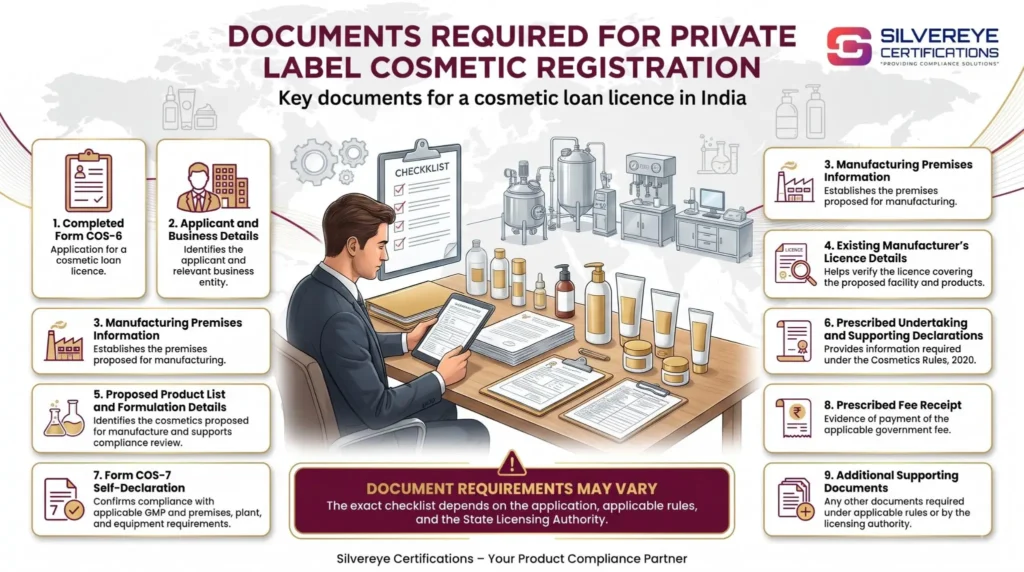
Documents Required for Private Label Cosmetic Registration
The prescribed documentation for a loan licence is governed by Part II of the Second Schedule and the applicable requirements of Rule 23. The exact documents depend on the application and the State Licensing Authority's requirements.
| Document or Information | Purpose |
|---|---|
| Completed Form COS-6 | Application for a cosmetic loan licence |
| Applicant and business details | Identifies the applicant and relevant business entity |
| Manufacturing premises information | Establishes the premises proposed for manufacturing |
| Existing manufacturer's licence details | Helps verify the licence covering the proposed manufacturing facility and products |
| Proposed product list and formulation details | Identifies the cosmetics proposed for manufacture and supports compliance review |
| Prescribed undertaking and supporting declarations | Provides information required under the Cosmetics Rules, 2020 |
| Form COS-7 self-declaration | Confirms compliance with applicable GMP and premises, plant and equipment requirements |
| Prescribed fee receipt | Evidence of payment of the applicable government fee |
| Additional supporting documents | Any other documents required under the applicable rules or by the licensing authority |
The manufacturer and applicant should also review the proposed label against Rule 34 of the Cosmetics Rules, 2020 and other applicable labelling requirements. A trademark application or certificate may help protect the brand, but it should not automatically be described as a mandatory licensing document.
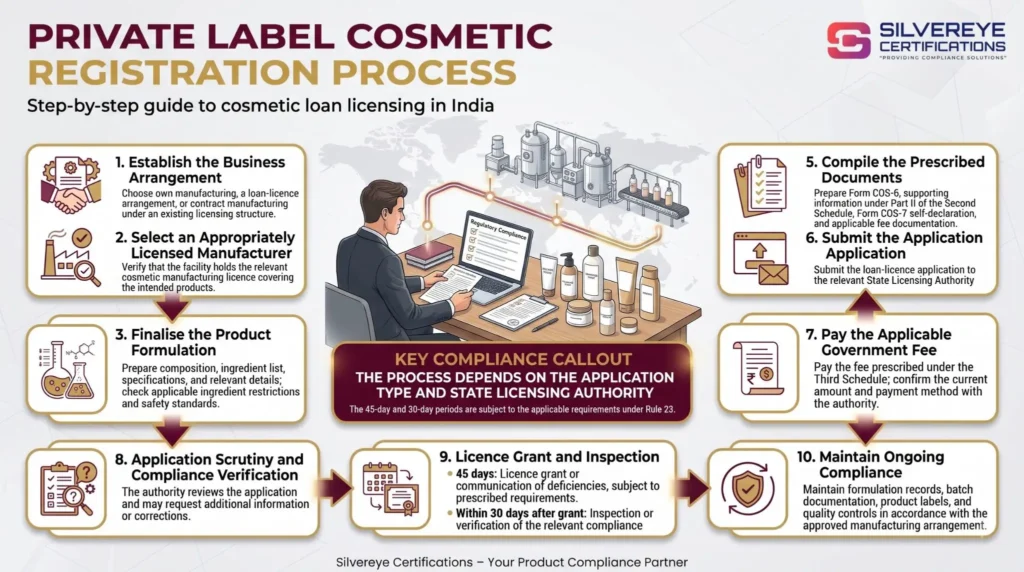
Step-by-Step Private Label Cosmetic Registration Process
Step 1: Establish the business arrangement
Decide whether the business will manufacture through its own facility, use a loan-licence arrangement or work with a contract manufacturer under an existing licensing structure.
Step 2: Select an appropriately licensed manufacturer
Check that the proposed manufacturing facility holds the relevant cosmetic manufacturing licence and that the licence covers the products intended for production.
Step 3: Finalise the product formulation
Prepare the product composition, ingredient list, specifications and other relevant details. Check the formulation against applicable ingredient restrictions and safety standards.
Step 4: Prepare compliant product labels
Review the proposed packaging and labels against Rule 34 of the Cosmetics Rules, 2020 and other applicable legal metrology and labelling requirements.
Step 5: Compile the prescribed documents
Prepare Form COS-6 and the supporting information required under Part II of the Second Schedule. Include the prescribed Form COS-7 self-declaration and applicable fee documentation.
Step 6: Submit the application
Submit the loan-licence application to the relevant State Licensing Authority through the prescribed application process.
Step 7: Pay the applicable government fee
Pay the fee prescribed under the Third Schedule of the Cosmetics Rules, 2020. Confirm the current amount and payment procedure with the concerned authority.
Step 8: Application scrutiny and compliance verification
The State Licensing Authority reviews the application and supporting documents. Additional information or corrections may be required if deficiencies are identified.
Step 9: Licence grant and inspection
Under Rule 23, the authority must grant the licence or communicate deficiencies within 45 days of the application, subject to the prescribed requirements. The authority must inspect or verify the relevant compliance declaration within 30 days after the licence is granted.
Step 10: Maintain ongoing compliance
Once the applicable licence and other requirements are in place, the business can proceed in accordance with the approved manufacturing arrangement. Maintain appropriate formulation records, batch documentation, product labels and quality controls.
These steps describe the general route; the exact process depends on the application type and the requirements of the relevant State Licensing Authority.
Government Fees for Private Label Cosmetic Registration
The government fee for a Cosmetic Loan Licence (Form COS-9) is prescribed under the Third Schedule of the Cosmetics Rules, 2020. The fee depends on the number of items and cosmetic categories covered by the application.
| Fee Component | Prescribed Fee |
|---|---|
| Loan licence application for up to 10 items in each cosmetic category | ₹10,000 |
| Each additional item in a category | ₹500 |
| Loan licence retention fee for up to 10 items in each category | ₹10,000 |
| Retention fee for each additional item | ₹500 |
| Further application after rejection | ₹1,000 |
| Duplicate copy of a licence, if lost, damaged or defaced | ₹500 |
These amounts are based on the Third Schedule of the Cosmetics Rules, 2020. Confirm the applicable fee calculation and payment procedure with the relevant State Licensing Authority before submitting your application.
Businesses should also budget separately for consultancy services, product testing, trademark registration, packaging design and other business expenses. These are not included in the statutory loan-licence fees.
Validity and Retention of a Private Label Cosmetic License
Under Rule 30 of the Cosmetics Rules, 2020, a Cosmetic Loan Licence issued in Form COS-9 remains valid in perpetuity unless suspended or cancelled, provided the prescribed retention fee is paid before completion of each five-year period.
| Milestone | Timeline or Requirement |
|---|---|
| Document preparation and manufacturer agreement | Depends on document readiness |
| Application submission and fee payment | After the prescribed documents are ready |
| Licence grant or communication of deficiencies | Within 45 days of application, subject to the applicable requirements |
| Post-grant inspection or verification | Within 30 days after licence grant |
| Retention fee | Before completion of each five-year period |
The 45-day period is specified in Rule 23. It is not a guarantee that every application will be approved within that period; the authority may communicate deficiencies where requirements have not been met. The post-grant inspection or verification is a separate requirement.
Late payment: Rule 30 provides for a late fee of 2% of the applicable retention fee for every month or part of a month, for up to 180 days. If payment remains outstanding beyond that period, the licence is deemed cancelled under the rule.
Labelling Requirements for Private Label Cosmetics in India
Rule 34 of the Cosmetics Rules, 2020 specifies labelling requirements for cosmetics. Private-label brands should coordinate with their manufacturing partners to ensure that the product packaging complies with the applicable rules and other relevant requirements.
Depending on the product and package, the label requirements include:
- Product name: The name of the cosmetic.
- Manufacturer details: The manufacturer's name and complete address of the premises where the product was manufactured. Special provisions apply to certain small containers.
- Use-before or expiry information: The applicable use-before or expiry declaration.
- Batch identification: A batch or lot number, subject to specified exceptions for certain small packs and soaps.
- Manufacturing licence number: The licence number in the prescribed format.
- Net contents: The applicable declaration of net quantity on the outer label, subject to the rule's exceptions.
- Ingredient list: Ingredients present at more than 1% concentration must be listed in descending order by weight or volume. Ingredients at 1% or less may follow in any order, subject to applicable exceptions.
- Safety information: Where a hazard exists, the label must include appropriate directions for safe use and relevant warnings.
- Retail declarations: MRP and other applicable packaged-commodity declarations must also be checked under the Legal Metrology requirements.
The exact declarations and their placement depend on the product, packaging and applicable exceptions. Review the final artwork before printing or launching the product.
Benefits of Private Label Cosmetic Manufacturing
- Lower initial investment: Launch a cosmetic brand without building and operating your own manufacturing facility.
- Access to manufacturing expertise: Work with an appropriately licensed manufacturing partner that has suitable facilities and technical resources.
- Focus on brand development: Concentrate on product positioning, packaging, marketing and customer relationships while production is handled by the manufacturing partner.
- Potentially faster launch preparation: An established manufacturing facility may help reduce the time needed to establish production infrastructure, although regulatory approval and product development timelines still apply.
- Product range expansion: Introduce additional products or variants subject to the applicable licence scope, documentation and fees.
- Structured compliance: Maintain product, batch, labelling and manufacturing records in coordination with your manufacturing partner.
A licence does not automatically guarantee marketplace acceptance, consumer trust or faster approval. Each business must meet the relevant regulatory and commercial requirements.
Common Mistakes That Can Delay Private Label Cosmetic Applications
- Choosing an unsuitable manufacturer: Check that the facility holds the appropriate licence and can manufacture the intended product categories.
- Submitting incomplete documentation: Ensure the application and supporting documents meet the requirements of the Cosmetics Rules, 2020.
- Using incorrect labels: Verify manufacturer details, batch identification, licence number, ingredient declarations and other applicable label information.
- Overlooking technical requirements: Confirm that the manufacturing facility meets the applicable GMP, technical staffing, testing and equipment requirements.
- Misclassifying the product: Products marketed with medicinal or therapeutic claims may require assessment under a different regulatory framework.
- Assuming every private-label arrangement needs a loan licence: Confirm the appropriate licensing route based on the actual arrangement between the brand owner and manufacturer.
- Ignoring retention-fee deadlines: Track the five-year retention-fee deadline to help keep the licence valid.
Private Label vs Third-Party vs White Label Cosmetics
These terms primarily describe business and manufacturing models. They do not automatically determine which licence is legally required.
| Model | What It Means | Regulatory Consideration |
|---|---|---|
| Private label | A brand sells cosmetics manufactured by another business under its own brand identity; the formulation may be customised or exclusive | Confirm whether a loan licence or another compliant manufacturing arrangement applies |
| Third-party or contract manufacturing | One business manufactures cosmetics on behalf of another business | The factory must hold the appropriate manufacturing licence; the brand's licensing obligations depend on the arrangement |
| White label | A manufacturer offers an existing formulation that can be sold under different brand names | Confirm the licensing structure, product documentation, labelling and responsibilities of each party |
Before launching a private-label cosmetic product, confirm the licensing route, fee calculation, product formulation and label requirements with the relevant State Licensing Authority. Silvereye Certifications can provide consultancy support with understanding the applicable requirements and preparing the documentation for your application.
Why Choose Silvereye Certifications for Private Label Cosmetic Registration?
Choosing the right compliance partner can help you understand the regulatory requirements for launching your private label cosmetics in India. Silvereye Certifications supports businesses in identifying applicable licensing requirements and preparing the documentation needed for their cosmetic manufacturing arrangements.
- Regulatory Guidance: Understand the applicable requirements under the Cosmetics Rules, 2020, based on your business model and manufacturing setup.
- Licence Route Assessment: Get guidance on whether your arrangement requires a manufacturing licence, loan licence, or coordination with an already licensed contract manufacturer.
- Documentation Support: Receive assistance with preparing and organising the relevant application documents and compliance records.
- GMP and Premises Compliance: Understand the applicable requirements for manufacturing facilities, equipment, hygiene, and Good Manufacturing Practices.
- Labelling Compliance: Get guidance on applicable cosmetic labelling requirements, ingredient declarations, batch details, and manufacturing licence information.
- Application Assistance: Get support throughout the application process, including addressing documentation gaps and responding to regulatory queries where applicable.
With a structured approach to compliance, Silvereye Certifications helps businesses better understand their regulatory responsibilities before introducing private label cosmetic products to the Indian market.
Conclusion
Private label cosmetic registration in India requires careful planning, appropriate licensing, compliant manufacturing arrangements, and accurate product labelling. The applicable route depends on who manufactures the cosmetics, the licences held by the manufacturer, and the specific nature of the business arrangement.
Before launching your products, review the requirements under the Cosmetics Rules, 2020, confirm whether a manufacturing licence or loan licence is applicable, and ensure that the required documentation and labelling declarations are in place. Remember that private label, white label, and third-party manufacturing are commercial models; they do not automatically determine which licence your business needs.
Silvereye Certifications can help you understand the relevant compliance requirements and prepare for the registration process. Seeking guidance early can help you identify documentation gaps and plan your cosmetic launch with greater clarity.
Frequently Asked Questions
What is private label cosmetic registration in India?
It is the legal approval — a Cosmetic Loan License — that allows a brand owner to sell cosmetics manufactured by a licensed third-party factory under the brand's own name, without owning a manufacturing unit.
Do I need a factory to sell my own cosmetic brand in India?
No. You can partner with an already-licensed contract manufacturer and apply for a Cosmetic Loan License instead of a full Manufacturing License.
Which form is used for private label cosmetic registration?
The loan license application is filed in Form COS-6 (earlier known as Form 31-A) with the State Licensing Authority, and the license is granted in Form COS-9 (earlier Form 32-A).
Who issues the private label cosmetic license?
The State Licensing Authority of the state where the contract manufacturer's facility is located issues the Cosmetic Loan License, not CDSCO — CDSCO only handles import registrations.
How much does private label cosmetic registration cost?
Government fees typically range from about ₹2,500 to ₹10,000 depending on the state and number of products, plus a separate inspection fee of roughly ₹1,000–₹2,000.
How long does the registration process take?
Most applications are approved within 4 to 8 weeks from submission, provided documents are complete and the facility inspection goes smoothly.
What is the validity of a cosmetic loan license?
Under the Cosmetics Rules, 2020, the license remains in force on an ongoing basis, subject to a retention fee payable every 5 years, unless suspended or cancelled.
Can I sell private label cosmetics on Amazon or Flipkart without registration?
No. Marketplaces increasingly require sellers to furnish a valid cosmetic license, and selling without one is an offense under the Drugs and Cosmetics Act, 1940.
What documents does the contract manufacturer need to provide?
A copy of their valid Cosmetic Manufacturing License, GMP self-declaration, and technical staff qualification proof, along with the signed manufacturing agreement.
Is GST registration mandatory for a private label cosmetic brand?
Yes, GST registration is required for the brand-owning entity as part of standard business compliance and is typically requested during the license application.
Can herbal or Ayurvedic products use the same private label registration route?
Yes, herbal and Ayurvedic cosmetics generally follow the same Cosmetic Loan License route, though certain ingredients may need additional safety documentation.
What happens if I sell cosmetics without a valid license?
It is an offense under the Drugs and Cosmetics Act, 1940, and can lead to product seizure, monetary penalties, and cancellation or suspension of the manufacturer's license.