
- Check ingredients against BIS IS 4707 and the Cosmetics Rules, 2020: Before filing a COS-1 import registration or COS-5 manufacturing license application, verify that the formulation complies with applicable ingredient restrictions, colour requirements and product safety standards.
- Prohibited ingredients: Raw materials listed in Annex A of IS 4707 Part 2 must not be added to cosmetics. Mercury compounds are subject to specific restrictions, while lead and arsenic compounds are prohibited when used for colouring cosmetics. Applicable limits for contaminants in permitted colours must also be followed.
- Screen ingredients before applying: Review the complete ingredient list, concentrations, intended use and product formulation before submitting the relevant application. This helps identify potential compliance issues early.
- New cosmetic requirements: A cosmetic containing a novel ingredient that meets the regulatory definition of a new cosmetic requires prior permission from CDSCO. The application is made in Form COS-12, and permission is granted in Form COS-3, before proceeding with the applicable import registration or manufacturing license process.
Introduction
Restricted ingredients in cosmetics in India are regulated under the Cosmetics Rules, 2020, and applicable BIS standards, including IS 4707. These provisions identify prohibited substances, restrict the use of certain ingredients, and specify conditions or limits where applicable. Mercury compounds and lead- or arsenic-based colourants must be assessed against the relevant restrictions and permitted impurity limits.
Ingredient screening should be completed before submitting a cosmetic registration or licensing application. Importers generally apply through Form COS-1 to obtain registration in Form COS-2, while domestic manufacturers apply through Form COS-5 for a license in Form COS-8. Formulations must comply with the applicable ingredient, quality and safety requirements; non-compliance can result in regulatory objections or refusal of approval.
For a product that qualifies as a new cosmetic under the Cosmetics Rules, 2020, prior permission from CDSCO is required. The application is submitted in Form COS-12, and permission is granted in Form COS-3 before proceeding with the applicable import registration or manufacturing license process. Businesses should verify the current rules and relevant ingredient schedules before finalizing a formulation.
What Are Restricted and Prohibited Ingredients in Cosmetics?
Restricted and prohibited ingredients in cosmetics in India are governed by the Cosmetics Rules, 2020, and applicable Bureau of Indian Standards (BIS) requirements, including IS 4707 Parts 1 and 2. These requirements identify substances that must not be used, ingredients permitted only under specified conditions, and approved colourants and other ingredients subject to applicable limits.
Under Rule 12(1), cosmetics generally cannot be imported into India unless registered under the applicable rules. Rule 39 requires imported and domestically manufactured cosmetics to comply with the applicable quality and safety standards. Therefore, a formulation accepted in another country may still need to be reviewed against India's requirements before import registration or manufacturing approval.
Regulatory Framework at a Glance
| Reference | What It Covers | Relevance |
|---|---|---|
| Rule 12, Cosmetics Rules, 2020 | Registration requirements for imported cosmetics | Import registration |
| Rule 39, Cosmetics Rules, 2020 | Applicable quality and safety standards, including restrictions on animal testing | Import and manufacturing compliance |
| BIS IS 4707, Parts 1 and 2 | Requirements relating to permitted colourants and prohibited or restricted raw materials | Ingredient and formulation review |
| Ninth Schedule, Cosmetics Rules, 2020 | Prescribed standards for specified cosmetic products | Product quality and safety |
| Tenth Schedule, Cosmetics Rules, 2020 | Requirements relating to permitted colours, dyes and pigments | Colourant compliance |
| Rule 32, Cosmetics Rules, 2020 | Prior permission for new cosmetics | New cosmetic applications |
| IS 4011:2018 | Methods of testing for the safety evaluation of cosmetics | Safety evaluation of new cosmetics |
Note: Schedule Q belonged to the earlier regulatory framework and should not be presented as a current schedule under the Cosmetics Rules, 2020. Similarly, the prohibited-substance list in Annex A of IS 4707 Part 2 should not be described as an independent CDSCO Appendix A.
Prohibited vs Restricted Ingredients: What Is the Difference?
| Term | Meaning | Compliance Consideration |
|---|---|---|
| Prohibited ingredient | A substance that cannot be used in a cosmetic under the applicable prohibition | Check the relevant BIS list and regulatory provision |
| Restricted ingredient | A substance whose use is permitted only under specified conditions, concentrations or product categories | Verify the applicable limit and conditions |
| Permitted colourant | A colourant allowed under the applicable BIS requirements and Cosmetics Rules | Confirm that the colourant is permitted and meets purity requirements |
| New cosmetic | A cosmetic containing a novel ingredient that has not been used anywhere in the world or is not recognised for cosmetic use in national or international literature | Obtain prior permission under Rule 32 where applicable |
Key Ingredient-Compliance Checkpoints for Manufacturers and Importers
- Mercury: Do not describe every form of mercury as universally prohibited. The Cosmetics Rules specify limits, including a maximum of 70 ppm for mercury used as a preservative in cosmetics intended only for the eye area, and a maximum of 1 ppm for unintentional mercury in other finished cosmetic products.
- Lead and arsenic: Permitted synthetic organic and natural organic colours must comply with the applicable impurity limits. The rules specify limits of 20 ppm for lead and 2 ppm for arsenic, calculated as arsenic trioxide. These limits should not be confused with a blanket prohibition on every lead or arsenic compound in every context.
- Hexachlorophene: The rules specifically prohibit importing cosmetics containing hexachlorophene. Manufacturing requirements and any applicable soap-related exception must be checked against the exact provisions before making a broader claim.
- Colourants, pigments and dyes: Verify that every colourant complies with the applicable BIS standard and the Tenth Schedule. Do not assume that a colourant permitted overseas is automatically acceptable in India.
- Animal testing: Rule 39(7) prohibits the use of animals for testing cosmetics. The rules also prohibit importing cosmetics tested on animals after 12 November 2014. Import applications require the applicable non-animal-testing undertaking.
- Microplastics: Do not describe an industry phase-out as a CDSCO mandate without an identifiable official notification or direction supporting that claim.
These requirements should be checked against the applicable rules and current BIS standards before a formulation is finalised.
New Cosmetic Ingredients: Prior Approval Before COS-1 or COS-5
Under Rule 32 of the Cosmetics Rules, 2020, a cosmetic containing a novel ingredient that meets the regulatory definition of a new cosmetic requires prior permission from the Central Licensing Authority.
The general process is:
- Step 1 — Submit Form COS-12: Apply to CDSCO with the prescribed fee and supporting data on the cosmetic's safety and effectiveness.
- Step 2 — Provide safety information: Submit the relevant composition, specifications, test methods, safety assessment, available evidence of undesirable effects, supporting efficacy information and product labelling, as applicable.
- Step 3 — Obtain prior permission: If the authority is satisfied that the cosmetic is safe and effective, it may grant permission in Form COS-3.
- Step 4 — Proceed with the applicable application: Submit the COS-3 permission with the relevant import registration or manufacturing licence application.
Safety evaluation must follow the applicable methods specified in IS 4011:2018, as amended from time to time. The definition of a new cosmetic is based on the presence of a novel ingredient that has not been used anywhere in the world or is not recognized for use in cosmetics in national or international literature—not simply the absence of an established Indian safety profile.
Before filing, manufacturers and importers should verify the current Cosmetics Rules, applicable BIS standards and the latest CDSCO guidance for their specific formulation.
How Ingredient Compliance Fits Into COS-1, COS-2, COS-5 and COS-8
Ingredient compliance is an important part of cosmetic registration and licensing in India. Importers must provide product and formulation details for CDSCO review, while domestic manufacturers must meet the applicable ingredient, quality, safety and manufacturing requirements under the Cosmetics Rules, 2020.
The following table explains where ingredient compliance fits into each application route.
| Pathway | Form | Where Ingredient Compliance Applies | Authority |
|---|---|---|---|
| Import registration | COS-1 | The application includes ingredient composition, product details, labels and other prescribed supporting documents. | Central Licensing Authority (CDSCO) |
| Import registration | COS-2 | The registration certificate covers the products, variants, pack sizes and manufacturing premises specified in the approved registration. | Central Licensing Authority (CDSCO) |
| Manufacturing license | COS-5 | The proposed formulation and manufacturing application must comply with applicable ingredient, quality and safety requirements. | State Licensing Authority |
| Manufacturing license | COS-8 | The licence holder must continue to comply with applicable requirements when manufacturing the approved cosmetics. | State Licensing Authority |
Important: COS-1 is the import registration application, and COS-2 is the resulting registration certificate. COS-5 is the manufacturing license application, and COS-8 is the resulting manufacturing license. Ingredient review is part of the broader compliance process; it should not be described as a separate ingredient-clearance certificate.
Documents That Support Cosmetic Ingredient Compliance
The documents required depend on the application type, product and applicable checklist. For import registration, CDSCO's published checklist identifies several important documents and declarations.
- Complete ingredient list: Provide the ingredients and their percentage composition as required. INCI names can help identify ingredients consistently.
- Product labels and specifications: Submit the proposed labels, product specifications and testing methods applicable to the products.
- Non-animal-testing undertaking: Provide the prescribed undertaking confirming compliance with India's cosmetic animal-testing requirements.
- Heavy-metal and hexachlorophene declaration: Submit the applicable manufacturer declaration covering raw materials, pigments, heavy-metal content and hexachlorophene compliance.
- Certificate of Analysis (CoA): Keep relevant test reports and quality documentation available where required by the applicable checklist or regulatory review.
- Safety and efficacy information: For a product qualifying as a new cosmetic, submit the prescribed supporting data with the application for prior permission.
- Free Sale Certificate: For imported products, submit the required Free Sale Certificate or the applicable alternative documentation recognised by CDSCO.
- Manufacturing licence and supporting documents: Provide the relevant manufacturing authorisation or other prescribed evidence from the country of origin, as applicable.
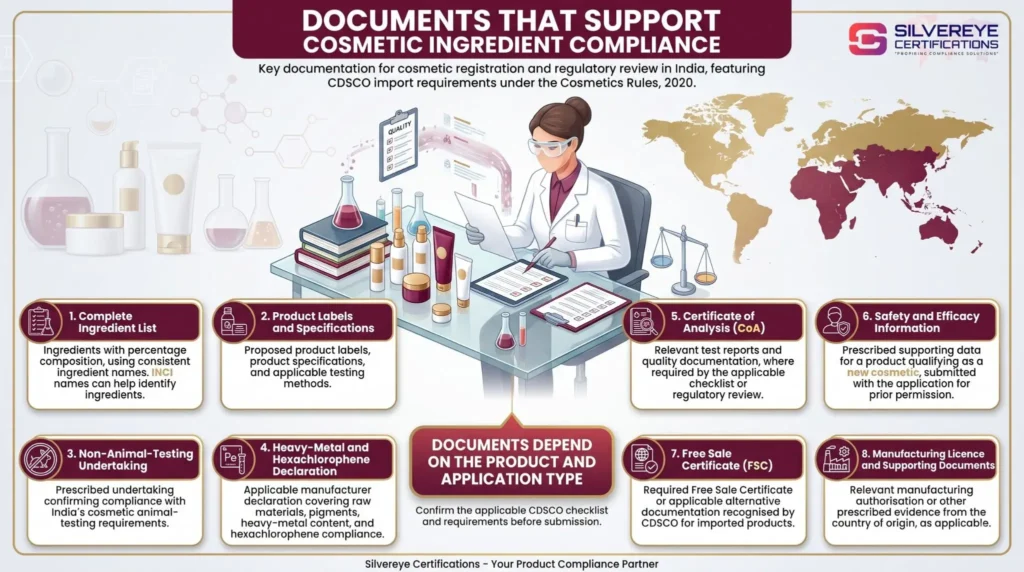
Not every document listed above is a universal requirement for every application. Confirm the current CDSCO checklist for the specific registration or license being sought.
Cosmetic Product Categories and Common Ingredient-Compliance Checks
Ingredient checks depend on the formulation, intended use and applicable product standards. The following table is a practical guide to areas businesses may need to review; it is not an exhaustive list of official category-specific restrictions.
| Category | Representative Products | Common Compliance Checks |
|---|---|---|
| Skin Care and Skin-Brightening Products | Face creams, serums, brightening creams, body lotions | Prohibited substances, ingredient restrictions, preservatives and heavy-metal limits |
| Sun Care | Sunscreens, sunblock lotions, after-sun gels | Permitted UV filters, applicable concentration limits and product safety requirements |
| Hair Colourants | Hair dyes, henna-based colours, highlighting products | Permitted colourants, ingredient restrictions and applicable safety requirements |
| Hair Care | Shampoos, conditioners, hair oils, serums | Preservatives, restricted ingredients and formulation safety |
| Colour Cosmetics and Makeup | Lipsticks, foundations, kajal, eyeliners | Permitted colourants, applicable impurity limits and product-specific requirements |
| Nail Care | Nail polish, nail polish remover, cuticle products | Restricted solvents, permitted ingredients and applicable concentration limits |
| Oral Care | Toothpaste, mouthwash | Applicable product standards, ingredient limits and safety requirements |
| Bath and Shower | Soaps, body washes, shower gels | Preservatives, restricted ingredients and formulation compliance |
| Baby Care | Baby lotions, baby powders, baby shampoos | Ingredient suitability, product safety and raw-material quality |
| Deodorants and Antiperspirants | Roll-ons, sprays, antiperspirant sticks | Ingredient restrictions, preservatives and applicable propellant requirements |
| Talcum and Powders | Talcum powder, dusting powder, foot powder | Raw-material quality, purity and applicable contaminant limits |
Use the applicable BIS standards and current Cosmetics Rules, 2020 to verify each ingredient. Do not rely on an overseas approval or an outdated ingredient list as proof of compliance in India.
Step-by-Step: Checking Ingredient Compliance Before Filing
- Step 1 — Compile the formulation: Prepare the complete ingredient list, including percentage composition and product-specific details.
- Step 2 — Review applicable restrictions: Check ingredients against the relevant prohibited and restricted substance provisions and current BIS standards.
- Step 3 — Verify colourants and UV filters: Confirm that any colourants or UV filters comply with the applicable permitted lists and conditions.
- Step 4 — Identify potential new cosmetics: Assess whether the product meets the regulatory definition of a new cosmetic under the Cosmetics Rules, 2020.
- Step 5 — Obtain prior permission where required: If the product qualifies as a new cosmetic, apply in Form COS-12 and obtain permission in Form COS-3 before proceeding with the applicable import or manufacturing application.
- Step 6 — Prepare supporting documents: Gather ingredient declarations, product specifications, labels, test information and other documents required for the relevant application.
- Step 7 — Submit the appropriate application: Use Form COS-1 for import registration or Form COS-5 for a domestic manufacturing licence, subject to the applicable requirements.
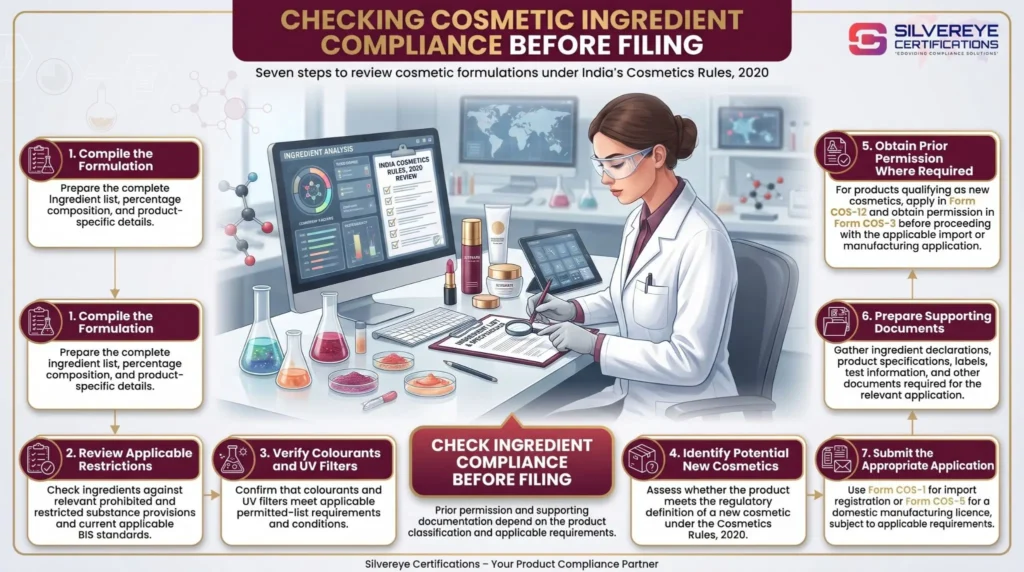
Completing these checks before submission can help identify potential formulation or documentation issues early, although the final decision rests with the relevant licensing authority.
Consequences of Non-Compliant Cosmetic Ingredients
Using prohibited or otherwise non-compliant ingredients can create regulatory and commercial risks, including:
- Application queries or refusal: CDSCO or the relevant State Licensing Authority may raise objections or refuse an application if the applicable requirements are not met.
- Customs delays or import restrictions: Imported cosmetics that do not meet applicable requirements may face delays or regulatory action.
- Suspension or cancellation: An existing registration or licence may be subject to action under the applicable law if non-compliance is established.
- Product withdrawal or recall: Businesses may need to remove affected products from the market, depending on the nature of the violation and the authority's directions.
- Penalties and legal consequences: Violations may attract penalties or other proceedings under applicable legislation.
- Reputational damage: Compliance failures can affect consumer confidence and relationships with distributors and retailers.
The consequences depend on the specific violation, applicable legal provisions and action taken by the competent authority.
Benefits of Reviewing Ingredient Compliance Early
- Earlier identification of formulation issues: Potentially non-compliant ingredients can be identified before the application is submitted.
- Better documentation quality: Complete ingredient lists and supporting declarations help make the application more consistent.
- Lower risk of avoidable queries: Addressing known documentation gaps can reduce preventable back-and-forth during review.
- Ongoing compliance support: Keeping formulation records updated helps businesses assess the impact of product changes.
- Improved readiness for market entry: Regulatory preparation supports a more organised import registration or manufacturing licensing process.
Ingredient screening does not guarantee approval, uninterrupted customs clearance or acceptance by e-commerce platforms. Businesses must satisfy all applicable requirements.
Common Ingredient-Compliance Mistakes Cosmetic Brands Should Avoid
- Assuming foreign approval is sufficient: A formulation accepted in the EU, US or another market must still meet India's applicable requirements.
- Overlooking new cosmetic requirements: Products that meet the definition of a new cosmetic require prior permission under the relevant provisions.
- Using unverified colourants: Check the applicable BIS requirements rather than relying only on the ingredient's status in the country of origin.
- Ignoring formulation changes: Reassess compliance when ingredients, concentrations, variants or product specifications change.
- Submitting incomplete declarations: Ensure the required ingredient, heavy-metal, hexachlorophene and non-animal-testing documents are accurate and consistent with the application.
- Relying on outdated regulatory references: Verify current rules, standards, checklists and notifications before submitting an application.
Why Work With Silvereye Certifications for Cosmetic Registration?
Reviewing cosmetic formulations requires attention to ingredient restrictions, product specifications, supporting declarations and the correct regulatory application route. Silvereye Certifications provides consultancy support to cosmetic importers, manufacturers and brand owners preparing for registration or licensing in India.
Our support can include:
- Ingredient-compliance review: Help identify potential concerns in the formulation against applicable regulatory requirements.
- Documentation assistance: Help organise ingredient lists, product specifications, labels and relevant declarations.
- Application guidance: Assist with preparing the documentation for Form COS-1 or Form COS-5, as applicable.
- New cosmetic guidance: Help businesses understand whether a product may require prior permission through Form COS-12 and Form COS-3.
- Regulatory coordination support: Help clients understand application queries and the information requested by the relevant authority.
Whether you plan to import skincare, haircare, makeup or personal care products, or manufacture cosmetics in India, Silvereye Certifications can help you understand the applicable compliance requirements and prepare your registration or licensing application. Approval remains subject to the decision of the competent authority.
Conclusion
Restricted ingredients in cosmetics in India are an important part of the registration and licensing process. Whether you are importing cosmetics through COS-1/COS-2 or manufacturing them domestically through COS-5/COS-8, your formulation must comply with the applicable ingredient restrictions, quality standards and safety requirements under the Cosmetics Rules, 2020 and relevant BIS standards.
Reviewing ingredients early and identifying products that require prior permission through COS-12/COS-3 can help reduce avoidable application queries and delays.
Frequently Asked Questions
What is the difference between a prohibited and a restricted cosmetic ingredient in India?
A prohibited ingredient cannot be used in any cosmetic at any concentration, such as mercury. A restricted ingredient can be used, but only up to a specified limit or within defined product categories, as set out in Schedule Q.
Which law governs restricted ingredients in cosmetics in India?
The Cosmetics Rules, 2020, framed under the Drugs and Cosmetics Act, 1940, governs ingredient compliance through Rule 12, Appendix A, Schedule Q, and the Ninth Schedule, supported by BIS standard IS 4707.
Is mercury allowed in cosmetics sold in India?
No. Mercury and mercury compounds are prohibited outright in cosmetic formulations sold in India, including in skin-lightening products.
What is a 'new cosmetic' ingredient under Indian rules?
A new cosmetic is one containing an ingredient not previously used in any cosmetic registered in India, or one without an established Indian safety profile. It requires prior permission via Form COS-12 before COS-1 or COS-5 can be filed.
Do imported cosmetics get checked for restricted ingredients before COS-2 is granted?
Yes. CDSCO reviews the formulation and ingredient list submitted with Form COS-1 against Appendix A and Schedule Q before granting the COS-2 Registration Certificate.
Are cosmetics tested on animals allowed to be imported into India?
No. India has prohibited the testing of cosmetics on animals and the import of animal-tested cosmetics since November 2014; a non-animal testing declaration is required for both COS-1 and COS-5 filings.
Can a cosmetic formulation approved in the EU or US automatically be sold in India?
Not necessarily. India maintains its own prohibited and restricted ingredient lists under Appendix A, Schedule Q, and BIS IS 4707, which do not fully mirror any single overseas regulation.
What happens if a cosmetic is found to contain a prohibited ingredient after registration?
The Central or State Licensing Authority can suspend or cancel the existing COS-2 or COS-8 approval, order stock seizure, and, in serious cases, pursue penalties under the Drugs and Cosmetics Act, 1940.
Are all parabens banned in cosmetics in India?
No. Not all parabens are banned; some are permitted preservatives under BIS classification, while certain types are restricted or under review, so each preservative should be checked individually against the current list.
What documents show ingredient compliance in a COS-1 or COS-5 filing?
A complete INCI formulation sheet, a non-animal testing declaration, a no-hexachlorophene declaration, a Certificate of Analysis, and safety data prepared as per IS 4011:2018 for any new ingredient.
Who checks ingredient compliance for domestically manufactured cosmetics?
The State Licensing Authority reviews the manufacturing formula submitted with Form COS-5 against the same prohibited and restricted ingredient lists that apply to imports.
Is there a single official list of all restricted cosmetic ingredients in India?
The reference points are CDSCO's Appendix A (prohibited substances) and Schedule Q (restricted substances with limits) under the Cosmetics Rules, 2020, together with BIS standard IS 4707, which should always be checked in their current, updated form.