

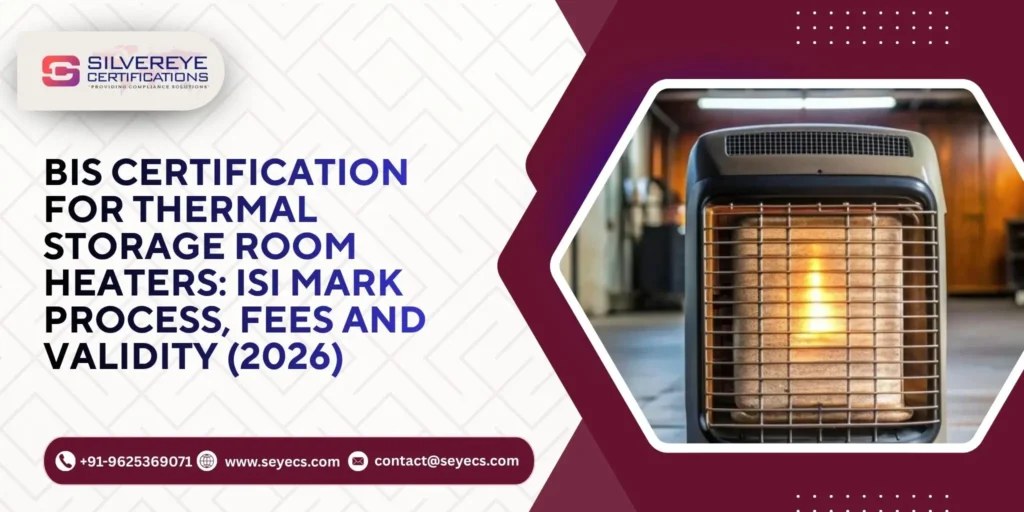
- Covered Under the 2026 Order: Thermal Storage Room Heaters are listed at Serial No. 61 of the Quality Control Order.
- Implementation Deadlines: 1 October 2026 for general manufacturers, 1 January 2027 for small enterprises, and 1 April 2027 for micro enterprises, subject to the applicable provisions.
- Certification Requirements: Manufacturers must follow the applicable BIS Scheme-I certification process, including testing against IS 302 (Part 1):2024 and the relevant product-specific standard, along with factory assessment.
- Product-Specific Compliance: Heater design and construction can affect the applicable testing requirements. Confirm the relevant standards early, particularly if the appliance incorporates direct-acting heating elements or features that may bring additional product-specific requirements into scope.
Introduction
BIS Certification for Thermal Storage Room Heaters is the authorization required for manufacturers to use the ISI Standard Mark under Scheme-I of the BIS (Conformity Assessment) Regulations, 2018. The Safety of Household, Commercial and Similar Electrical Appliances (Quality Control) Order, 2026 (S.O. 1739(E)) lists Thermal Storage Room Heaters at Serial No. 61. Certification involves compliance with IS 302 (Part 1):2024, along with any applicable product-specific requirements, and a factory assessment before the license is granted.

The implementation dates are 1 October 2026 for general manufacturers, 1 January 2027 for small enterprises, and 1 April 2027 for micro enterprises, subject to the Order's applicable provisions. Goods manufactured domestically exclusively for export are exempt under the Order. The BIS license is held by the manufacturer, so importers should verify that the relevant manufacturer has the required certification before sourcing covered products.
What Is BIS Certification for Thermal Storage Room Heaters?
The Bureau of Indian Standards (BIS) is India's national standards body. BIS certification for a thermal storage room heater authorizes the manufacturer to use the ISI Standard Mark after meeting the applicable product safety and factory assessment requirements.

Under the Safety of Household, Commercial and Similar Electrical Appliances (Quality Control) Order, 2026, the prescribed certification route is Scheme-I under Schedule II of the BIS (Conformity Assessment) Regulations, 2018. This is a factory-based certification process and is different from the Compulsory Registration Scheme (CRS) used for specified electronic products.
Three key elements determine the certification requirements:
- General safety standard: IS 302 (Part 1):2024, aligned with IEC 60335-1:2020, covers general safety requirements for household and similar electrical appliances.
- Product-specific standard: Thermal storage room heaters may also require compliance with the relevant product-specific standard. IEC 60335-2-61 addresses thermal storage room heaters; confirm the corresponding Indian Standard and applicable edition with BIS or the recognized testing laboratory.
- BIS license and ISI Mark: The manufacturer must complete the applicable testing and factory assessment requirements and obtain a BIS license before using the ISI Mark on covered products.
Important: Confirm the applicable standard and certification scope for your exact heater model before arranging laboratory testing or submitting the application.
Why Thermal Storage Heater Manufacturers and Sellers Should Not Wait
Thermal storage room heaters work differently from conventional fan heaters. They use electricity to heat a dense storage core, retain the heat, and release it gradually into the room. This design supports steady heating but also makes surface temperatures, electrical insulation, charging controls, and overheating protection important aspects of product safety.
The Safety of Household, Commercial and Similar Electrical Appliances (Quality Control) Order, 2026 explicitly lists Thermal Storage Room Heaters at Serial No. 61 in its Table. The Department for Promotion of Industry and Internal Trade (DPIIT) issued the Order on 6 April 2026, and the general implementation date was 1 October 2026.
This guide is intended for manufacturers, importers, and brand owners dealing with thermal storage room heaters in India. It explains the Order's key provisions, applicable standards, certification process, fees, and license requirements. For other types of heaters, refer to our separate guide on BIS Certification for Room Heaters and our broader guide to BIS Certification for Electrical Appliances.
2026 Regulatory Update: Safety of Household, Commercial and Similar Electrical Appliances (Quality Control) Order, 2026
The following summary outlines the key provisions of the Quality Control Order. Consult the official Gazette notification and any subsequent amendments before making compliance decisions.
Order details
| Item | Details |
|---|---|
| Order name | Safety of Household, Commercial and Similar Electrical Appliances (Quality Control) Order, 2026 |
| Notification | S.O. 1739(E), dated 6 April 2026 |
| Issuing authority | Ministry of Commerce and Industry, Department for Promotion of Industry and Internal Trade |
| Legal basis | Section 16 of the Bureau of Indian Standards Act, 2016 |
| Effect on previous Order | Supersedes the 2025 Order, subject to the stated transitional provision |
| Commencement | 1 October 2026 |
Clause 1: Application and scope
- The Order applies to electrical appliances intended for household, commercial, or similar use.
- The stated voltage limits are up to 250 V for single-phase appliances and 480 V for other appliances, including appliances supplied by direct current or batteries.
- Appliances covered by another Quality Control Order under the BIS Act, or notified for mandatory BIS certification under another Act, are excluded as specified in the Order.
Clause 2: Compulsory use of the Standard Mark
- Covered products listed in column (2) of the Order's Table must conform to the applicable Indian Standard specified in column (3) and bear the Standard Mark (ISI Mark) under a BIS license through Scheme-I of Schedule II of the BIS (Conformity Assessment) Regulations, 2018.
- The Order specifies IS 302 (Part 1):2024, aligned with IEC 60335-1:2020, for general safety requirements.
- The Table includes a note stating that the latest version of the applicable Indian Standards applies for the purposes of the Order.
Implementation deadlines
| Enterprise category | Implementation date |
|---|---|
| General category, excluding micro and small enterprises | 1 October 2026 |
| Small enterprises | 1 January 2027 |
| Micro enterprises | 1 April 2027 |
Exemptions and transitional provisions under Clause 2
- Goods manufactured exclusively for export: The Order does not apply to goods manufactured domestically for export, subject to the wording of the applicable provision.
- Small and micro enterprises: Eligible enterprises, as defined under the MSME Development Act, 2006, follow the implementation dates specified in the Order.
- Research and development imports: The Order provides for the import of up to 200 units per year for research and development by manufacturers of household and similar electrical appliances, subject to conditions. These goods must not be sold commercially; disposal as scrap is permitted, and year-wise records must be maintained and furnished to the Central Government when requested.
- Existing stock: Certain goods manufactured domestically or imported before the applicable implementation date may qualify for a sell-through period of up to six months, provided the relevant manufacturer is BIS-certified or has applied for certification and submits the required declaration to BIS.
Clause 3: Certification and enforcement authority
The Bureau of Indian Standards (BIS) is the certification and enforcement authority for the products covered by the Order.
Clause 4: Penalties
Contraventions of the Order are punishable under the applicable provisions of the BIS Act, 2016.
Product entry applicable to thermal storage room heaters
| Serial number | Product listed in the Order |
|---|---|
| 61 | Thermal Storage Room Heaters |
Is Your Product Classified as a Thermal Storage Room Heater?
Although many manufacturers can identify a thermal storage heater, some product designs may require closer assessment. The heating mechanism, intended use, rated voltage, and additional functions can affect the applicable requirements.
| Product or situation | What to check |
|---|---|
| Electric heater with a storage core that retains heat and releases it into the room | Assess whether the product falls under Serial No. 61 of the Order |
| Storage heater with an additional direct-acting heating element | Confirm the applicable product-specific standards. IEC 60335-2-30 addresses room heaters with direct-acting heating elements and may be relevant alongside the thermal storage heater requirements |
| Sauna heater or infrared cabin | Check the separate product category listed at Serial No. 56 |
| Flexible heating pad, blanket, or mat | Check the relevant separate entries, including those for flexible heating appliances and heating mats |
| Heater integrated into a building structure or central heating system | Review the applicable standard's scope and exclusions before determining the certification route |
| Appliance exceeding the stated voltage limits | Check whether it falls outside the scope of this particular Order |
| Product manufactured domestically exclusively for export | Assess eligibility for the export-related exemption under the Order |
Additional checks before certification
- Other Quality Control Orders: Check whether another applicable Order or mandatory certification requirement affects the product. Although Serial No. 61 specifically lists thermal storage room heaters, confirm the precise classification and applicable requirements with the testing laboratory or BIS.
- Components and additional functions: Controls, charging systems, or radio modules may have separate compliance requirements. Include these features in the initial product assessment.
- Product-specific standards: Confirm the corresponding Indian Standard and current edition applicable to your exact model before arranging testing.
Practical recommendation: Manufacturers should complete product classification and standards mapping early. This helps establish the correct testing scope, prepare the factory for assessment, and reduce the risk of avoidable delays in the BIS certification process.
What Do Labs Check on a Thermal Storage Room Heater?
Thermal storage room heaters must be evaluated against IS 302 (Part 1):2024 and the applicable product-specific requirements. IEC 60335-2-61 is the international reference for thermal storage room heaters. The testing laboratory should confirm the corresponding Indian Standard, applicable edition, and testing scope for your specific model.
Laboratory testing may cover the following areas, depending on the applicable standard and product design:
- Surface temperatures: Checks whether accessible surfaces remain within the prescribed temperature limits during operation. The applicable standard specifies measurement methods and relevant temperature limits.
- Protection against access to live parts: Uses standard test probes to assess whether users can accidentally contact hazardous electrical components.
- Leakage current and electric strength: Evaluates electrical insulation and protection against electric shock under the prescribed test conditions.
- Heating and abnormal operation: Assesses how the heater behaves under specified abnormal conditions, such as restricted airflow or control failures, where applicable.
- Stability and mechanical hazards: Checks the appliance's stability and construction, particularly important for heavy heaters containing dense thermal storage cores.
- Moisture resistance and insulation: Evaluates relevant insulation and moisture-related safety requirements.
- Construction and electrical connections: Examines internal wiring, components, earthing, supply connections, clearances, and creepage distances.
- Resistance to heat and fire: Assesses whether materials and components meet the applicable thermal and fire-safety requirements.
- Marking and instructions: Reviews rating information, safety warnings, product markings, and user instructions.
This is an overview rather than an exhaustive test checklist. The actual test requirements depend on the applicable standard, product configuration, and laboratory assessment. The test report provides evidence of conformity for the BIS certification process.
Benefits of BIS Certification for Thermal Storage Room Heaters
Obtaining the required BIS license offers several important advantages for manufacturers and businesses supplying thermal storage room heaters in India.
- Regulatory compliance: Manufacturers can demonstrate compliance with the applicable Quality Control Order and certification requirements.
- Reduced import and sales disruption: Valid certification and correct product marking help businesses meet applicable regulatory requirements when importing or selling covered products.
- Improved product safety: Testing evaluates relevant risks involving surface temperatures, electrical insulation, stability, and overheating.
- Greater buyer confidence: Commercial customers, distributors, and property developers may prefer products supported by valid certification.
- Earlier identification of defects: Laboratory testing can identify certain design or safety issues before products reach the market.
- Stronger brand credibility: Authorised use of the ISI Mark helps customers identify products covered by a valid BIS licence.
Who Can Apply for BIS Certification? Eligibility Requirements
The appropriate certification route depends on the manufacturer, the product, and the applicable BIS requirements.
| Applicant category | Applicable route or arrangement | Key consideration |
|---|---|---|
| Indian manufacturer | Scheme-I certification | Must meet the applicable factory, testing, and documentation requirements |
| Foreign manufacturer | Foreign Manufacturers Certification Scheme (FMCS), where applicable | An Authorised Indian Representative is generally required, and the overseas manufacturing facility may be assessed by BIS |
| Importer or trader | Sources products from a suitably BIS-licensed manufacturer | Must verify that the licence covers the relevant product and that the required marking is present |
| Brand owner using contract manufacturing | Certification arrangement based on the manufacturing and licensing structure | Confirm the licence holder, model coverage, and brand details before placing orders |
| Eligible small or micro enterprise | Applicable BIS certification route with the relevant implementation timeline | Verify enterprise classification and the applicable deadline under the Order |
Udyam registration may be relevant when establishing small or micro enterprise status. Keep the appropriate supporting documents ready and verify eligibility under the applicable provisions before relying on a later implementation date.
Requirements for BIS Certification of Thermal Storage Room Heaters
Before applying, manufacturers should review their product design, factory arrangements, and quality-control documentation to ensure they can meet the applicable certification requirements.
- Product conformity: The heater must comply with the applicable general safety standard and relevant product-specific requirements.
- Laboratory testing: Arrange testing through a BIS-recognised laboratory with the appropriate testing scope. Confirm whether any alternative testing arrangement is permitted under the applicable BIS procedure.
- Factory readiness: Maintain documented quality controls, calibrated instruments, incoming inspection procedures for critical components, and appropriate routine testing of finished products.
- Critical components: Prepare a list of relevant components, such as heating elements, thermal cut-outs, thermostats, charge controllers, switches, fans where fitted, wiring, supply cords, and plugs. Include relevant makes, ratings, and specifications.
- Thermal storage core and insulation: Document the core material and insulation design, as these can affect heat retention, surface temperatures, and product safety.
- Marking and labelling: Ensure that product markings, rating information, safety warnings, and the ISI Mark comply with the applicable standard and licence conditions.
- Production and marking records: Maintain the records required by BIS, including production and marking information relevant to applicable licence and marking-fee obligations.
Documents Required for BIS Certification
The final document checklist depends on the application route, manufacturing facility, and applicable BIS procedure. The following table provides a preliminary checklist for thermal storage room heater manufacturers.
| Document category | Documents and information |
|---|---|
| Applicant identity | Incorporation or partnership documents, GST registration where applicable, and authorised signatory details |
| Factory information | Manufacturing premises address proof, factory layout, and machinery list |
| Enterprise classification | Udyam registration and supporting records, where relevant to enterprise classification |
| Product details | Model list, rating label artwork, circuit diagrams, critical component list, storage core and insulation details, user manual, and safety instructions |
| Quality management | Manufacturing process flow chart, quality-control plan or test scheme, and test equipment list with calibration records |
| Product testing | Test report from a laboratory recognised by BIS for the applicable testing scope |
| Foreign manufacturer documentation | Authorised Indian Representative appointment and other documents required under the applicable FMCS procedure |
| Existing stock, where applicable | Supporting stock details and declaration to BIS, if relying on an eligible transitional stock provision |
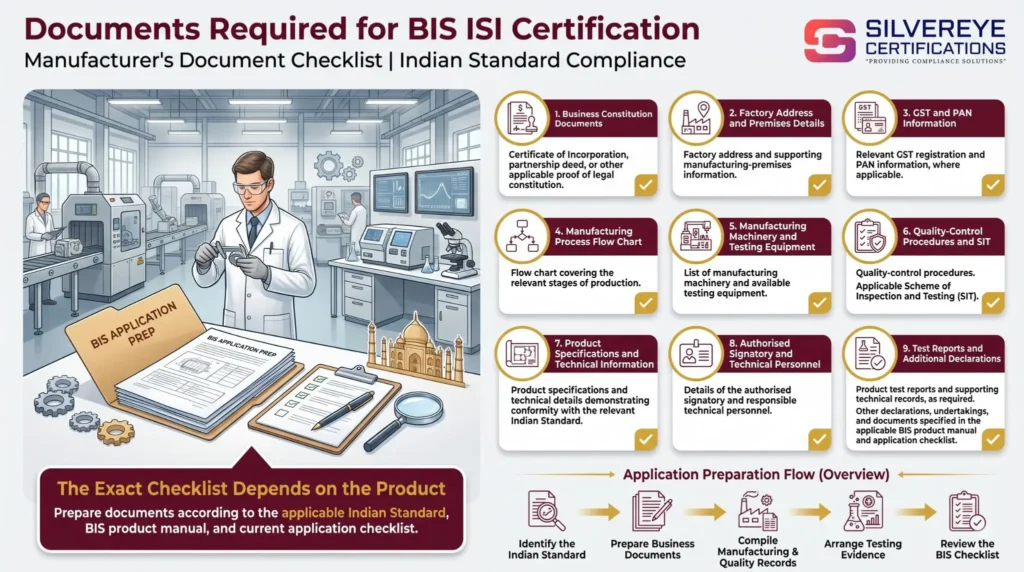
Before submitting your application: Check that the product specifications, model details, circuit diagrams, component information, and test samples are consistent. Confirm the latest documentation requirements through the official BIS portal to avoid preventable delays.
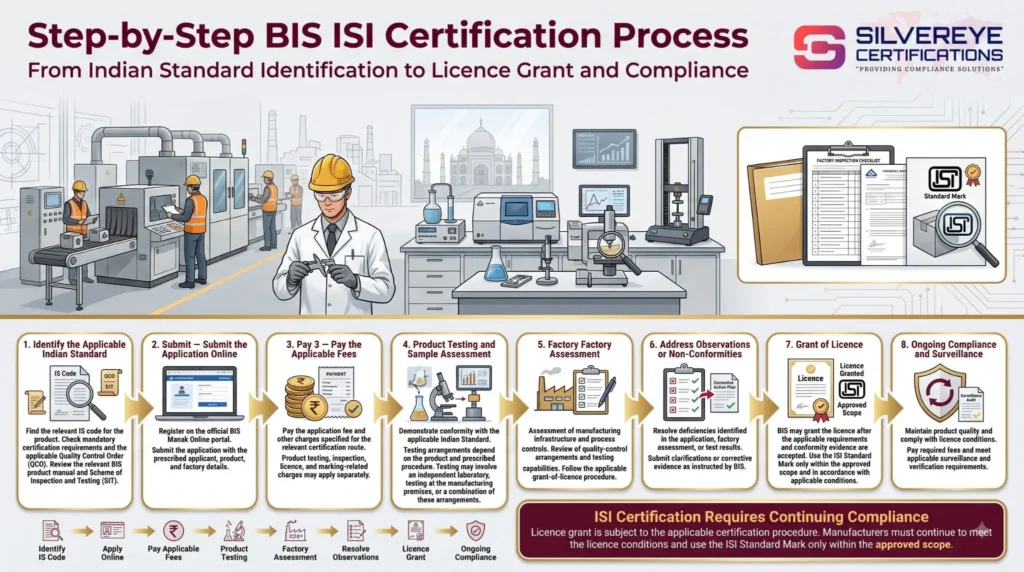
BIS Certification Process for Thermal Storage Room Heaters: Step by Step
Obtaining BIS certification for thermal storage room heaters involves confirming the applicable standards, completing product testing, preparing the manufacturing facility, and satisfying BIS assessment requirements.
Step 1: Confirm the product scope and applicable standards. Verify whether your heater falls under Serial No. 61 of the 2026 Quality Control Order. Identify any additional product-specific requirements, particularly if the heater incorporates a direct-acting heating element.
Step 2: Finalize the model and critical components. Freeze the product design and document the bill of critical components before testing. Changes to heating elements, thermostats, thermal cut-outs, or controllers may require additional evaluation or testing.
Step 3: Arrange laboratory testing. Submit samples to a laboratory recognised by BIS for the applicable testing scope. Testing should cover IS 302 (Part 1):2024 and any additional applicable product-specific requirements. Plan sample transportation carefully because thermal storage heaters can be heavy.
Step 4: Submit the online application. Apply through the official BIS online system, complete the required documentation, and pay the applicable fees. BIS accepts product certification applications online, including payments.
Step 5: Complete the factory assessment. BIS assesses the manufacturing infrastructure, production processes, quality-control arrangements, and testing capabilities. For foreign manufacturers, the assessment may involve the overseas manufacturing facility under the applicable certification procedure.
Step 6: Complete sample verification and testing. BIS may draw samples during the assessment for independent laboratory testing or verification, as required under the applicable procedure.
Step 7: Obtain the licence. Once the application, factory assessment, and test results meet the applicable requirements, BIS may proceed with the licence grant. Pay the prescribed licence fee, advance minimum marking fee, and any other applicable dues.
Step 8: Apply the ISI Mark. Mark the covered heaters according to the licence conditions and applicable BIS marking requirements. Do not use the mark before obtaining the necessary authorisation.
Step 9: Maintain ongoing compliance. Keep production, testing, and marking records updated. Comply with applicable surveillance requirements and obtain approval for changes that affect the licence scope.
How Long Does BIS Certification Take?
The time required depends on laboratory availability, the testing scope, document completeness, factory readiness, inspection scheduling, and how quickly outstanding queries are resolved.
The following table provides an indicative planning estimate, not an official BIS commitment.
| Stage | Indicative planning time |
|---|---|
| Product scoping and document preparation | 1–2 weeks |
| Laboratory testing | 2–4 weeks, depending on the testing scope and laboratory queue |
| Application review and clarification | 1–2 weeks, where applicable |
| Factory inspection scheduling and assessment | 2–4 weeks |
| Final review and licence grant | Depends on outstanding requirements and applicable fees |
| Overall planning estimate | Approximately 2–3 months in a straightforward case |
These stages can overlap, so the individual estimates should not simply be added together. BIS publishes different indicative timelines for different application options, and the actual duration can vary.
Thermal storage heaters may require additional time for sample transportation and testing. Start the process early and obtain a realistic schedule from the laboratory and certification team before committing to a product launch date.
BIS Certification Fees for Thermal Storage Room Heaters
The total cost of BIS certification depends on the applicable government fee schedule, testing requirements, number of models, inspection arrangements, and any optional consultancy support.
The following table separates common fee components. Verify the current amounts through the official BIS portal before preparing your budget.
| Fee component | Indicative amount or basis | Important details |
|---|---|---|
| Application fee | ₹1,000 under the published general fee schedule | Confirm the current applicable fee before submission |
| Inspection fee | Applicable inspection charges; the published general schedule lists ₹7,000 per man-day | Confirm the current rate and number of inspection man-days |
| Annual licence fee | ₹1,000 under the published general fee schedule | Pay as required under the applicable grant or renewal procedure |
| Minimum marking fee | Product-specific | Check the current marking-fee schedule for the applicable standard |
| Laboratory testing | Charged separately by the laboratory | Depends on the test scope, model, and any additional testing |
| Foreign manufacturer certification | Applicable FMCS fees and related requirements | Additional overseas inspection and administrative expenses may apply |
| Consultant fee | Agreed separately | Depends on the scope of documentation and application support |
The application, inspection, and annual license fee figures above are based on BIS's published general fee information; verify their current applicability before payment.
Minimum marking fee and MSME concessions
The minimum marking fee is separate from laboratory testing and consultancy charges. BIS has published concessions on annual minimum marking fees for eligible micro and small enterprises, along with an additional concession for eligible women-owned enterprises. The published extension runs until 31 May 2029, subject to the applicable conditions.
| Enterprise category | Published concession on annual minimum marking fee |
|---|---|
| Micro enterprise | 80% |
| Small enterprise | 50% |
| Eligible women-owned enterprise | Additional 10% concession, subject to applicable conditions |
Confirm the eligibility criteria and calculation method with BIS before including these concessions in your budget. Do not assume that they apply to every certification fee or other project expense.
How to manage certification costs
- Finalise the product design before laboratory testing to reduce the risk of repeat testing.
- Check whether model grouping is permitted under the relevant BIS product guidelines.
- Confirm the current minimum marking fee and applicable payment schedule before submitting the application.
- Include sample transportation, laboratory testing, factory inspection, and any applicable foreign manufacturer expenses in the budget.
- Obtain a written quotation from any consultant before engaging their services.
Products with identical safety-critical designs may be suitable for grouping where BIS guidelines permit it. Models with different storage cores, heating elements, or control systems may require separate evaluation.
Validity and Renewal of a BIS License
A BIS license under Scheme-I has an initial validity period and may be renewed in accordance with the applicable regulations. The initial grant and renewal periods should not be confused: BIS's published guidance states that an initial license may be granted for up to two years, while renewal may be available for up to five years. Always follow the validity date and conditions stated in your actual license.
| Licence aspect | What manufacturers should know |
|---|---|
| Initial validity | Check the period stated in the licence and the applicable regulations |
| Renewal | Apply through the BIS online portal for the permitted renewal period |
| Annual payments | Pay applicable licence and marking fees according to the prescribed schedule |
| Renewal documents | May include production and marking details, applicable fees, and evidence of continued compliance |
| Expired or suspended licence | Do not assume that continued use of the ISI Mark is permitted |
| New models and variants | Obtain approval for inclusion in the licence scope before marking and selling them |
Renewal tip: Begin preparations well before the expiry date. BIS guidance requires renewal applications and applicable payments within the prescribed timeframe; late or incomplete submissions can result in deferment or other license-related consequences.
A longer renewal period does not remove ongoing responsibilities. Manufacturers must continue to meet the applicable requirements for production, marking, fees, and surveillance.
Importing Thermal Storage Room Heaters: What Changes?
Importers and overseas manufacturers should address BIS compliance before confirming shipment schedules or purchase orders.
- Foreign manufacturer certification: The overseas manufacturer must follow the applicable certification route, including FMCS where required. An Authorized Indian Representative is generally required under FMCS, and the license is associated with the manufacturer and manufacturing premises.
- Existing stock: The 2026 Order provides conditional relief for certain goods manufactured domestically or imported before the relevant implementation date. Eligible stock may qualify for a sell-through period of up to six months, subject to the required declaration and other conditions.
- Research and development samples: The Order provides a conditional exemption for up to 200 imported units per year for specified R&D purposes. These units cannot be sold commercially, and the required records must be maintained.
- Purchase planning: Include BIS license requirements, product marking, and documentary responsibilities in supplier agreements and purchase orders. This is especially important for heavy heaters, where repeat shipping can be expensive.
The six-month stock provision is not a general grace period for newly manufactured or imported goods. Confirm eligibility and declaration requirements with BIS before relying on it.
Common Mistakes to Avoid
Manufacturers and importers can reduce delays and compliance risks by avoiding these common errors:
- Assuming that a foreign safety mark automatically replaces mandatory BIS certification in India.
- Overlooking additional product-specific requirements for heaters with direct-acting or boost heating elements.
- Applying under the CRS route when the applicable Order requires Scheme-I certification.
- Testing one model and then selling variants with different heating cores, elements, or controllers without confirming licence coverage.
- Treating the six-month stock provision as permission for new production or imports after the relevant deadline.
- Budgeting only for the application fee and overlooking laboratory testing, sample transportation, inspection, and marking fees.
- Confusing thermal storage room heaters at Serial No. 61 with sauna heaters at Serial No. 56 or heating mats and foot warmers at Serial Nos. 68 and 89.
Before applying, confirm your product classification, applicable standards, current fees, and implementation requirements through the official BIS sources. This helps establish a more reliable certification plan and reduces the risk of costly mistakes.
Why Choose Silvereye Certifications?
BIS certification projects can face delays due to incomplete documentation, unclear testing requirements, or factories that are not ready for inspection. Silvereye Certifications helps businesses navigate regulatory compliance by providing guidance on BIS certification and related requirements.
Here's how we can support your thermal storage room heater certification project:
- Product and standard assessment: We help identify the applicable product category, review relevant standards, and flag design features that may require additional testing.
- Laboratory coordination: We assist with sample submission planning, testing arrangements, and model grouping where permitted under applicable BIS guidelines.
- Application and documentation support: We help prepare and review application documents and guide you through the online filing process.
- Factory inspection preparation: We provide checklists and guidance to help you organise quality-control records, testing equipment, and manufacturing documentation before the assessment.
- Importer and FMCS guidance: We help businesses understand the applicable foreign manufacturer certification procedure, Indian Representative requirements, and relevant stock-related provisions.
- Post-certification assistance: We provide guidance on licence renewals, marking requirements, and the process for adding models to an existing licence.
Looking to understand the certification requirements and estimated project costs for your thermal storage room heaters? Contact Silvereye Certifications with your product model list, manufacturing location, and target launch date to discuss the applicable certification route.
Conclusion
BIS Certification for Thermal Storage Room Heaters is an important compliance requirement under the Safety of Household, Commercial and Similar Electrical Appliances (Quality Control) Order, 2026, which lists these products at Serial No. 61. The general implementation date was 1 October 2026, while the specified dates for eligible small and micro enterprises are 1 January 2027 and 1 April 2027, respectively.
To prepare for certification, confirm your product's classification and applicable standards, finalise critical components, arrange the required laboratory testing, and prepare your factory and documentation for assessment. You should also plan for applicable certification fees, product marking, ongoing compliance, and licence renewal from the beginning.
If you intend to rely on an exemption or the six-month stock provision, verify that your circumstances meet the specific conditions in the Order before proceeding. Silvereye Certifications can help you understand the requirements, prepare documentation, and plan the certification process, helping you approach BIS compliance with greater clarity and confidence.
Frequently Asked Questions
Is BIS certification mandatory for thermal storage room heaters in India?
The 2026 order lists Thermal Storage Room Heaters at serial no. 61, so they must conform to IS 302 (Part 1):2024 and bear the ISI Standard Mark under a BIS licence, subject to the implementation dates and exemptions.
Which standard applies for thermal storage room heaters?
The order specifies IS 302 (Part 1):2024, which corresponds to IEC 60335-1:2020, and says the latest version of the Indian Standards applies. For product-specific requirements, the international reference is IEC 60335-2-61, and your lab confirms the Indian equivalent.
What are the deadlines for thermal storage room heaters?
1 October 2026 for general manufacturers, 1 January 2027 for small enterprises and 1 April 2027 for micro enterprises.
What is the voltage limit for thermal storage room heaters?
Up to 250 V for single-phase appliances and up to 480 V for other appliances, including DC supplied and battery-operated ones.
Does a storage heater with a boost element need extra testing?
The international storage heater standard says IEC 60335-2-30 is also applicable to heaters with direct-acting heating elements. Ask your lab how that applies to your design.
Are sauna heaters and heating mats covered by the same entry?
No. Sauna heating appliances and infrared cabins are at serial no. 56, and foot warmers and heating mats are at serial nos. 68 and 89.
Can I sell my existing stock after the deadline?
Goods made or imported before the implementation date by a BIS-certified manufacturer, or one who has applied, can be sold or offered for sale for up to six months from that date. A declaration to BIS is required.
Can I import sample heaters for R&D?
Up to 200 units per year can be imported for R&D by manufacturers of household and similar electrical appliances. They cannot be sold commercially, and records must be kept.
Are export-only heaters exempt?
Goods manufactured domestically for export are outside the order.
How much does BIS certification for a storage heater cost?
Government fees include a Rs 1,000 application fee, a Rs 1,000 annual license fee and a product-specific minimum marking fee. Testing and inspection are charged at actuals. Verify current figures on the BIS portal.
How long is the license valid for thermal storage room heaters?
Under the 2026 amendment, up to 5 years initially and renewable for up to 5 years. Annual fees still apply.
Can a foreign manufacturer apply?
Yes, through FMCS with an Indian representative. BIS may inspect the overseas factory.
What is the penalty for non-compliance?
The order says contravention is punishable under the BIS Act, 2016.